
Secondary claim guide
Nexus Letter for Back Pain Secondary to a Service-Connected Knee
Medically reviewed by the Patriot Path Medical Team
Licensed MD reviewers • Last updated:
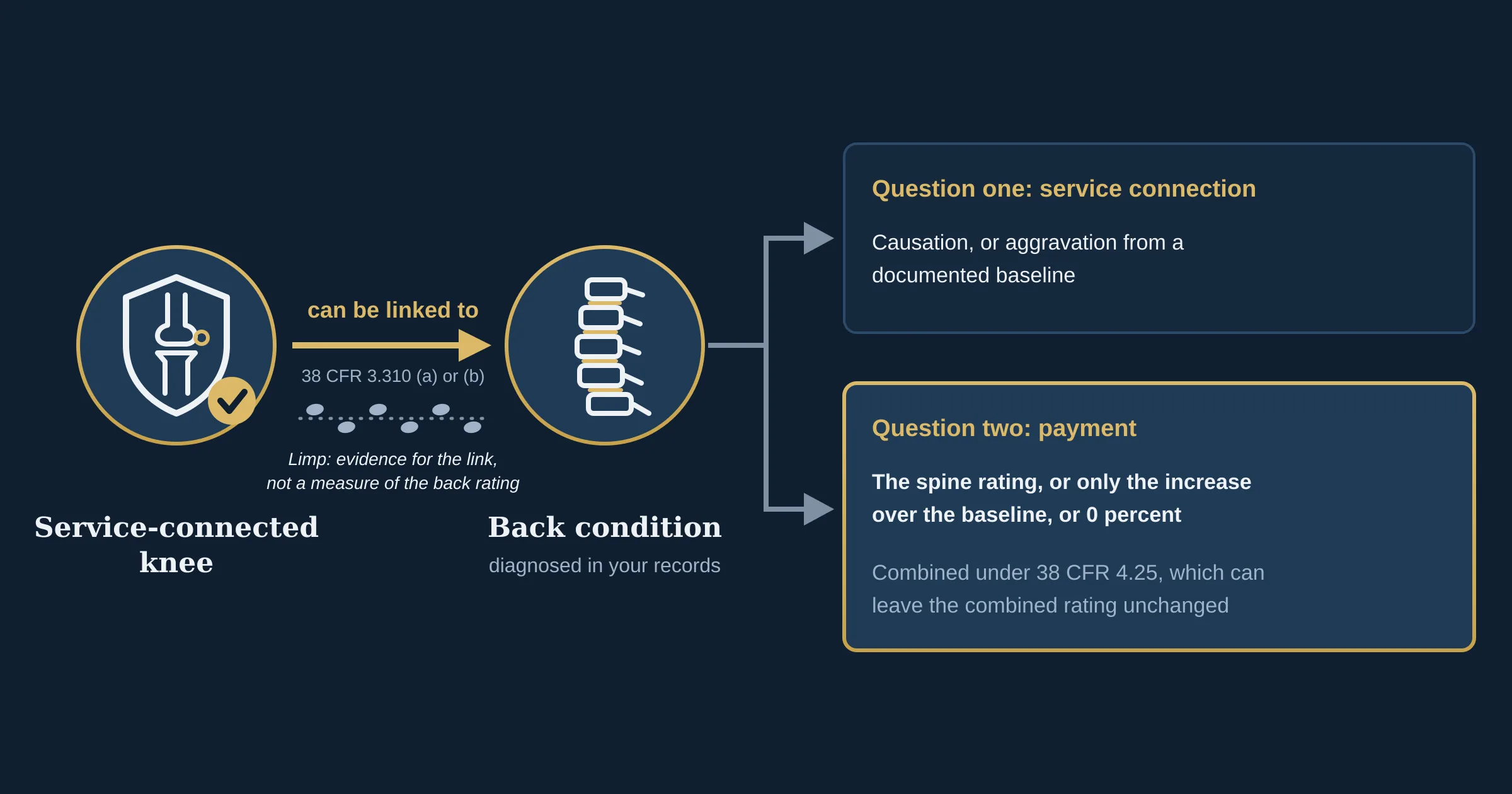
VA can service connect a back condition secondary to a service-connected knee under 38 CFR 3.310 when the evidence links them, by causation or by aggravation. A limp is how the knee is said to reach the back, not a measure of the back rating, and a grant can be rated 0 percent or leave your combined rating unchanged.
Three points belong up front. You may not need to buy a letter: once service-connected arthritis has been medically determined to be degenerative, not post-traumatic, VA's manual says each joint the disease reaches, verified by x-ray, is subject to service connection without a medical opinion, absent an intervening cause, and it applies that principle to the spine (M21-1 V.iii.1.C.2.b). That rule is narrower than it sounds, it is not secondary service connection, and we could not measure whether VA applies it to the spine today. No study we found shows that knee problems cause back problems: the research is limited and runs in both directions, so the case rests on your own records. And the Board grants we read on this pairing granted service connection, not a percentage, each "binding only with regard to the specific case decided" under 38 CFR 20.1303.
An illustrative example
A veteran is service connected for a right knee injured in a fall during training, rated 10 percent for limited motion, his only rating. His treatment notes have recorded a limp for years, an MRI shows degenerative disc disease in his lower back, and his forward flexion measures 50 degrees. A VA examiner wrote that the knee and the back are separate parts of the body. Because the knee is service connected for an injury, not for degenerative arthritis, the manual's arthritis rule does not reach his back, and the link needs medical evidence.
Suppose a physician's opinion addresses his gait history and VA grants the back as secondary to the knee. On causation, 50 degrees of flexion fits the spine formula's 20 percent row, and Table I combines 20 with 10 to 28, which rounds to 30. If instead a 2015 record had put his back at the 10 percent level before the limp worsened it, an aggravation grant would pay the difference, 10 percent, and 10 with 10 is 19, which rounds to 20. Had both records fallen at the 20 percent level, with the evidence showing some worsening, VA would grant service connection at 0 percent. The back's numbers come from its own measurements, not from the limp.
This veteran is invented to show how the rules turn assumed facts into numbers. He is not a client or a case result, and nothing here predicts what VA will decide on a real claim.
Do You Need a Nexus Letter if Your Knee Arthritis Is Service Connected?
Possibly not, and VA's own manual is the reason: M21-1 has a rule for degenerative arthritis that reaches one joint after another, and its Note carries the rule to the spine. It is narrower than it sounds.
When 38 CFR 4.71a, DC 5003 is assigned for an arthritic condition, every joint or group of joints affected by this disease is subject to service connection (SC) in the absence of an intervening cause.M21-1 V.iii.1.C.2.b (topic change date February 8, 2021)
If it has been medically determined that the Veteran has service-connected (SC) degenerative arthritis, and not post-traumatic arthritis, there is no need for a medical opinion to establish SC for each affected joint.M21-1 V.iii.1.C.2.b (topic change date February 8, 2021)
Once degenerative arthritis has been clinically diagnosed and SC has been properly established for one affected joint, establish SC for and evaluate each joint as it becomes affected, with x-rays used to verify involvement of individual joints.M21-1 V.iii.1.C.2.b (topic change date February 8, 2021)
Note: In evaluating arthritis of the spine, the principles for establishing SC for joints affected by the subsequent development of degenerative arthritis (as contemplated under 38 CFR 4.71a, DC 5003) are not dependent on the choice of DC.M21-1 V.iii.1.C.2.b (topic change date February 8, 2021)
What the rule is not
It is not 38 CFR 3.310, and it is not secondary service connection: the block does not mention 3.310, gait or the knee. It is a rule about one disease, degenerative arthritis rated under DC 5003, reaching more joints.
Its worked example runs spine first: degenerative arthritis of the spine service connected under DC 5242, then the right elbow "with no intercurrent cause noted" (the rule's own word is "intervening"), where service connection "may be established". It is not a knee case; a knee-to-spine reading rests on the rule sentence and the Note, with 38 CFR 4.45(f) treating the lumbar vertebrae as a group of minor joints.
Where the rule stops
It applies where it "has been medically determined" that the arthritis is degenerative "and not post-traumatic". Where the type is unclear, VA is to "obtain a medical opinion to determine the etiology" (V.iii.1.C.3.b).
A knee hurt in service goes to DC 5010: "When there is evidence showing a history of in-service trauma to a joint, utilize 38 CFR 4.71a, DC 5010 for rating purposes" (V.iii.1.C.2.c), even where the evidence "diagnoses degenerative or osteoarthritis." Arthritis due to trauma "affects only the joint that received trauma" (V.iii.1.C.3.a).
Before February 7, 2021, "post-traumatic arthritis (previously called arthritis, due to trauma) was evaluated under 38 CFR 4.71a, DC 5003" (V.iii.1.C.2.d), so a DC 5003 code on an older decision does not by itself show degenerative arthritis.
The spine needs arthritis on x-ray: "X-ray evidence of bone changes must be present to substantiate a diagnosis of arthritis" (V.iii.1.C.2.a); disc changes without radiographic arthritic changes are "not indicative of arthritis" (V.iii.1.B.3.a). DC 5242 also covers "degenerative disc disease other than intervertebral disc syndrome" and points to "either DC 5003 or 5010", so a 5242 code is not by itself spinal arthritis, which can itself be post-traumatic.
Read the whole knee code: arthritis rated on motion is hyphenated, as in 5003-5261 (V.iii.1.C.4.a), or 5010 with the joint's code, so a bare 5260 or 5261 settles nothing either way.
What the Board decisions show
In the Board decisions we read, including eight decided after the topic's February 8, 2021 change date, the Board weighed or sought medical opinions on this pairing, apart from one denial because the knees were not service connected (24001968), and did not cite C.2.b or DC 5003. The nearest fact pattern, 21066807, had both knees service connected "with degenerative arthritis" and degenerative lumbar findings on x-ray, and was granted on private opinions; but its knees also carried a meniscectomy and a ligament repair, and it states no diagnostic code. Whether regional offices or the Board apply C.2.b to the spine today, we could not measure. Each decision is binding only with regard to the specific case decided (38 CFR 20.1303).
Where a letter does the work
Everywhere else, the link needs a 38 CFR 3.310 opinion. For a knee injured in service and rated under DC 5010, the opinion has to deal with the injury history, since history alone "may be the only distinguishing element for a medical diagnosis of arthritis due to trauma" (V.iii.1.C.3.a).
The same goes for a knee under a code that is not arthritis (DC 5256 to 5259, 5262, 5263, or by analogy), argued from its own mechanism, such as instability, locking or a prescribed brace; a back that is not arthritis on x-ray, such as a strain (DC 5237), a herniated disc pressing on or irritating a nerve root (DC 5243), spondylolisthesis (DC 5239) or disc disease without arthritic changes; a later injury to place in the timeline; any aggravation theory; and a negative VA opinion.
Which route your file is on
| Your knee is service connected as | Your back shows | Route | What the claim needs |
|---|---|---|---|
| Degenerative arthritis under DC 5003, medically determined not post-traumatic | Arthritis of the spine on x-ray | VA's manual arthritis rule (M21-1 V.iii.1.C.2.b) | Per the manual, no medical opinion, absent an intervening cause; the rating decision's full code and the spine x-ray |
| Post-traumatic arthritis under DC 5010, after an in-service injury | Any acquired back diagnosis | Secondary service connection, 38 CFR 3.310 | A medical opinion on causation or aggravation that deals with the injury history |
| A code that is not arthritis, such as DC 5257, 5258 or 5259 | Any acquired back diagnosis | Secondary service connection, 38 CFR 3.310 | A medical opinion built on the knee's own mechanism |
| Degenerative arthritis under DC 5003 | A diagnosis that is not arthritis on x-ray, such as strain or disc disease | Secondary service connection, 38 CFR 3.310 | A medical opinion; disc wear without arthritic changes does not meet the manual's rule |
| Any knee code | Back trouble documented before the knee affected it | Aggravation, 38 CFR 3.310(b) | A baseline from the earliest records and an opinion on the worsening |
The rows describe routes, not outcomes.
So we promise neither the shortcut nor its absence. If your file fits the rule, you can name it in your claim. If your knee arthritis followed an injury in service, your back diagnosis is not arthritis on x-ray, or VA has already said no, the link needs medical evidence, and that is where a letter does its work.
How Does VA Decide Back Pain Secondary to a Knee?
Outside the arthritis rule, a back claim through the knee runs on 38 CFR 3.310, as VA's manual applies it. Each Board decision this section names is binding only with regard to the specific case decided (38 CFR 20.1303).
Causation: 38 CFR 3.310(a)
38 CFR 3.310(a) reads: "Except as provided in § 3.300(c), disability which is proximately due to or the result of a service-connected disease or injury shall be service connected. When service connection is thus established for a secondary condition, the secondary condition shall be considered a part of the original condition."
VA's manual words the test as but-for: causation means the back is "the result of, or would not have occurred but for, an SC disability" (M21-1 V.ii.2.D.1.b), because in Spicer v. McDonough, 61 F.4th 1360 (Fed. Cir. 2023), the Federal Circuit "held that the language “resulting from” in 38 U.S.C. 1110 requires a standard of “but-for causation” and that a stricter proximate causation standard is inconsistent with the statute" (Block 1.a note). In A25015277 (2025), the Board wrote that the but-for standard in a secondary service-connected case "is not limited to a single cause and effect, but rather contemplates multi-causal links, including action and inaction".
Aggravation: 38 CFR 3.310(b)
Paragraph (b) covers a worsening of a nonservice-connected back that is due to the knee "and not due to the natural progress of the nonservice-connected disease", on one condition: "However, VA will not concede that a nonservice-connected disease or injury was aggravated by a service-connected disease or injury unless the baseline level of severity of the nonservice-connected disease or injury is established by medical evidence created before the onset of aggravation or by the earliest medical evidence created at any time between the onset of aggravation and the receipt of medical evidence establishing the current level of severity of the nonservice-connected disease or injury."
The regulation still prints natural progress twice, but VA's manual has set it aside: "In accordance with the Spicer holding, the Department of Veterans Affairs (VA) will apply the broader but-for standard and will no longer consider natural progress of the NSC disability when deciding a claim based on aggravation of an NSC disability by an SC disability" (M21-1 V.ii.2.D.1.a, topic change date May 1, 2026). That is VA's stated practice, not a change to 3.310(b). The baseline deduction survives (Block 1.g), and "Permanent worsening of an NSC disability by an SC disability is not required to establish SC on the basis of aggravation under 38 CFR 3.310(b)" (Block 1.a).
The general rules for every secondary pairing, not only the knee and the back, are in our guide to nexus letters for secondary conditions.
The standard: 38 CFR 3.102
VA does not ask for proof. Under 38 CFR 3.102, when "a reasonable doubt arises regarding service origin, the degree of disability, or any other point, such doubt will be resolved in favor of the claimant", and "By reasonable doubt is meant one which exists because of an approximate balance of positive and negative evidence which does not satisfactorily prove or disprove the claim."
The phrase "at least as likely as not" is not in 3.102; it is how VA opinions and Board remands word that balance, glossed in A25015277 as "(an approximate balance of positive and negative evidence, i.e., nearly equal)".
The knee must be service connected, though not first
The back claim runs through a service-connected knee. In 24001968 the Board wrote: "Since the Board has denied the Veteran's claims for service connection for left and right knee osteoarthritis, the Veteran's claim for secondary service connection is also denied as a matter of law."
Timing is a different question: "To establish causation, the primary disability need not be SC, or even diagnosed, at the time the secondary disability is incurred" (M21-1 V.ii.2.D.1.b).
The back diagnosis must be a disease or injury
38 CFR 3.303(c) ends: "Congenital or developmental defects, refractive error of the eye, personality disorders and mental deficiency as such are not diseases or injuries within the meaning of applicable legislation." 38 CFR 4.9 is its Part 4 companion. VA's manual names spine defects to note, especially spondylolysis, spina bifida, unstable or exaggerated lumbosacral joints or angle, and incomplete sacralization, and cautions: "Do not automatically classify spondylolisthesis as a congenital condition, although it is commonly associated with a congenital defect" (M21-1 V.iii.1.F.1.h; "commonly" is the manual's word). In 21046103 the Board found service connection for "mild dextroscoliosis/transitional vertebra L5" precluded in that case and granted the acquired lower back disability.
Pain with no named diagnosis is harder. In 18154311, citing Saunders v. Wilkie, 886 F.3d 1356 (Fed. Cir. 2018), the Board asked the examiner: "if there is no diagnosed disability, is it at least as likely as not that any pain reaches the level of a functional impairment of earning capacity?" That is a remand question, not a grant.
A hip, ankle or foot that changed how you walk can support a back claim under the same regulation, 38 CFR 3.310, but the knee-specific rules on this page, such as the knee's arthritis codes, do not carry over directly.
This page runs one way, from a service-connected knee to the back. For a back condition that has affected a knee, or one knee overloading the other, see our knee page.
Does a Limp From Your Knee Raise Your Back Rating?
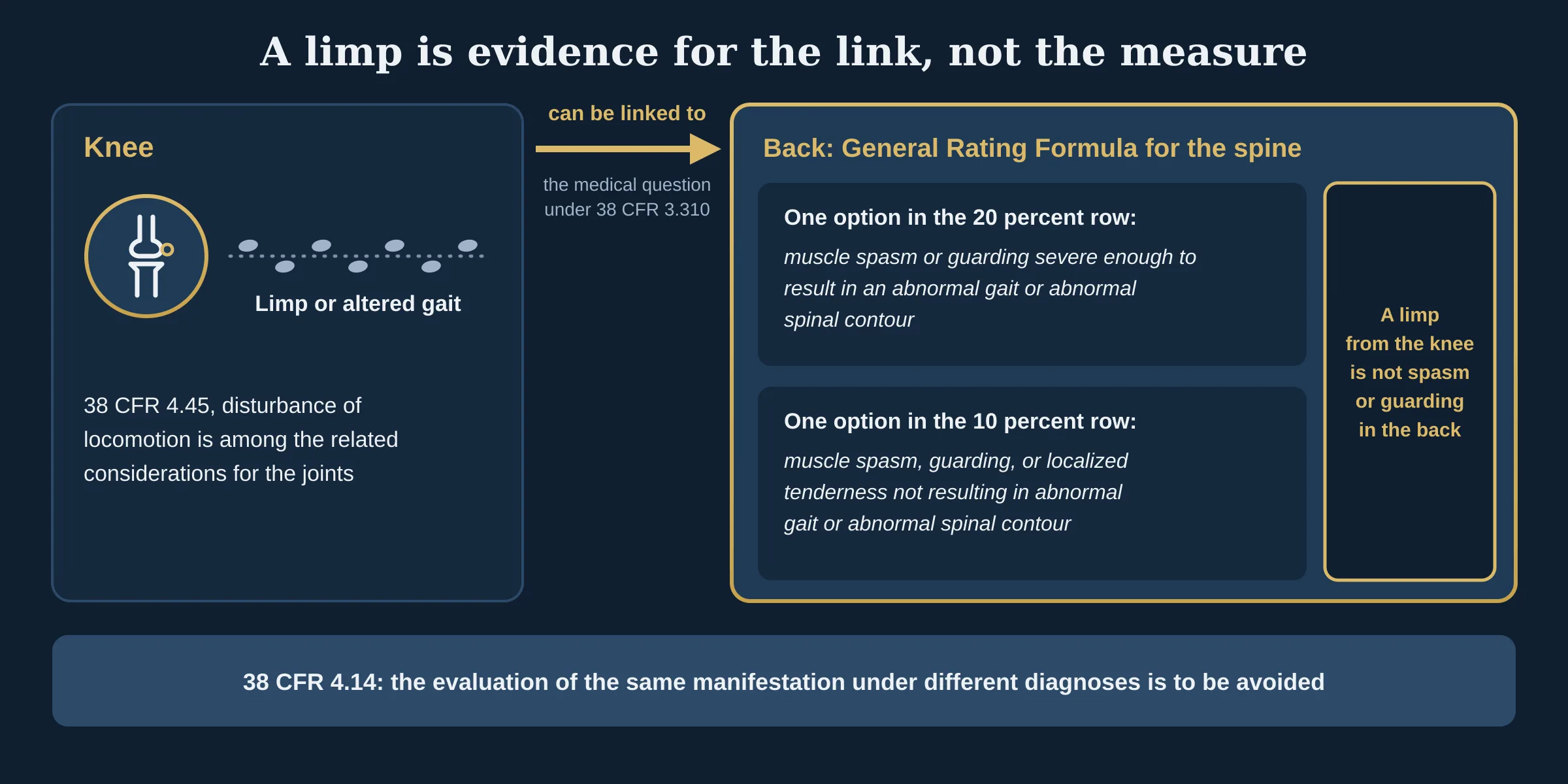
Not by itself. The limp is how the knee is said to reach the back; it is not what the back is rated on.
muscle spasm or guarding severe enough to result in an abnormal gait or abnormal spinal contour such as scoliosis, reversed lordosis, or abnormal kyphosis38 CFR 4.71a, General Rating Formula, one option in the 20 percent row
muscle spasm, guarding, or localized tenderness not resulting in abnormal gait or abnormal spinal contour38 CFR 4.71a, General Rating Formula, one option in the 10 percent row
Each row lists alternatives joined by "or", among them thoracolumbar flexion ranges and combined-motion limits, so the gait wording is one option in each row, not the requirement for either.
Both options tie the gait to spasm or guarding in the spine, "severe enough to result in" it at 20 percent and "not resulting in abnormal gait" at 10, and neither row mentions the knee, a limp or another joint. A limp from the knee is not spasm or guarding in the back, so it does not meet the 20 percent option, however long it has lasted.
The limp sits on the knee's side of the ledger: 38 CFR 4.45(f) says "Instability of station, disturbance of locomotion, interference with sitting, standing and weight-bearing are related considerations", and 38 CFR 4.40 makes functional loss part of examining the rated joint. The six VA manual articles we read have no altered-gait rule (gait, limp, antalgic and altered appear zero times in them); one of them treats another person's account of "a Veteran’s difficulty walking" as lay evidence of painful motion for the minimum rating of the joint itself (M21-1 V.iii.1.A.1.f).
A25039304 shows the two side by side. One file held chiropractic notes recording the veteran's statements about his low back pain in relation to knee pain that had "created an antalgic gait" and an August 2024 VA spine examination documenting "muscle spasms resulting in abnormal gait or abnormal spine contour"; the Board listed both as evidence on the link and decided no rating (binding only with regard to the specific case decided, 38 CFR 20.1303).
Can the knee and the back both be rated?
Yes, where the back is service connected and its findings are not the knee's: knee motion and instability are measured at the knee, and spinal motion, spasm, guarding and ankylosis at the spine. 38 CFR 4.14 does not bar that pairing, and VA's manual says "Separate evaluations are warranted where none of the symptomatology for any one condition duplicates or overlaps another" (M21-1 V.ii.3.D.2.b, citing Esteban v. Brown; its Example 3 separates DC 5257 instability from DC 5003 arthritis motion). The back can still be rated 0 percent, and it is combined with the knee, not added.
Where 38 CFR 4.14 bites
38 CFR 4.14 closes with one sentence that holds two bans: "Both the use of manifestations not resulting from service-connected disease or injury in establishing the service-connected evaluation, and the evaluation of the same manifestation under different diagnoses are to be avoided." The word pyramiding appears only in its heading.
The second ban is the limp's: if the limp is part of how the knee is evaluated, it cannot be evaluated again under a spine code. That bars counting it twice; it is no reason to keep it out of the record.
The first ban is about cause: back symptoms from a cause that is not service connected, such as a separate injury, cannot build the service-connected back evaluation. That is not the aggravation baseline: 4.14 governs what may be counted in evaluating a service-connected disability, 3.310(b) how much of a nonservice-connected back's worsening is service connected.
Symptoms that cannot be separated
VA's manual says: "When evaluating an SC disability for rating purposes, if it is not possible to differentiate the Veteran’s symptoms from an SC and NSC disability, all symptoms should be deemed related to the SC disability and rated accordingly" (M21-1 V.ii.3.D.2.c, topic change date July 29, 2026). The block adds that "the NSC disability is not considered SC" and that the separation question "is a medical determination". We found no text on how it works alongside an aggravation baseline, so we do not treat it as settled here.
Document the limp anyway
Dated records of a limp, an antalgic gait, a cane, a brace or a shorter leg are evidence for the link; 18140986 and 24003862, in the Board section below, relied on them (each binding only with regard to the specific case decided). They are simply not scored on the spine. Describe your walking to every clinician and examiner as it is; a record helps only when it is accurate.
The full spine formula, with the rating estimator, is on our back pain page.
What Can Back Pain Secondary to a Knee Pay?
That depends on the route, and either route can pay nothing. These rules are why this page promises no increase.
Causation rates the whole back
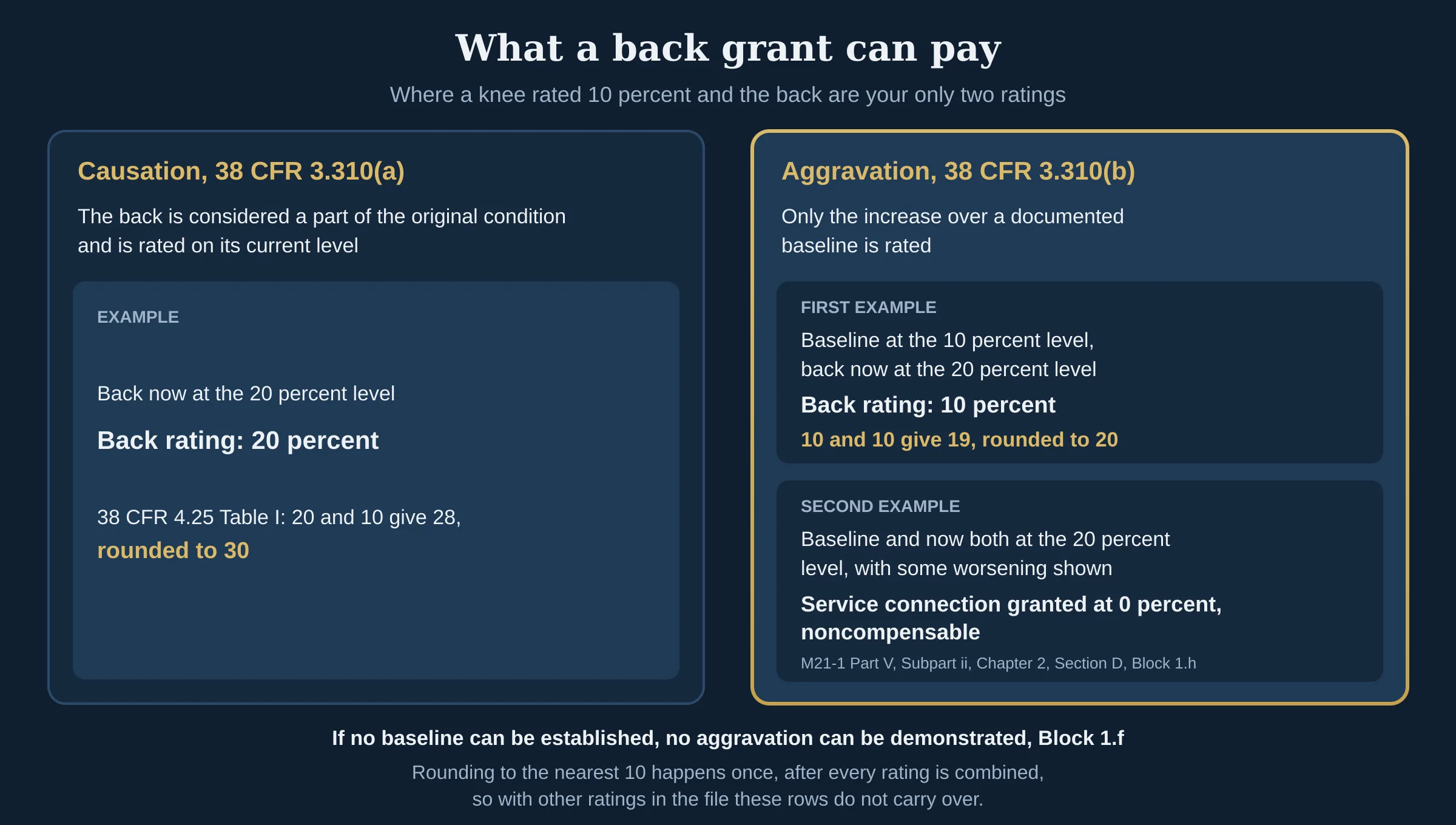
Under 38 CFR 3.310(a) the back "shall be considered a part of the original condition", with no baseline deduction, so it is rated on its full current level. For the thoracolumbar spine the formula's levels are 10, 20, 40 and 50 percent, with 100 percent for unfavorable ankylosis of the entire spine; its 30 percent row is for the neck. It prints no 0 percent row, and 38 CFR 4.31 supplies one: "In every instance where the schedule does not provide a zero percent evaluation for a diagnostic code, a zero percent evaluation shall be assigned when the requirements for a compensable evaluation are not met." A back whose findings fall short of the 10 percent row is rated 0 percent and is still service connected, unless painful motion is shown. Applying 38 CFR 4.59, VA's manual says the minimum compensable evaluation "must be assigned when painful motion is demonstrated" and is the lowest evaluation the code specifies, 10 percent on the spine formula (M21-1 V.iii.1.A.1.g); "Lay evidence or subjective reporting of painful motion is sufficient, if found credible" (V.iii.1.A.1.f).
Aggravation rates only the increase
Only the worsening is service connected. In the words of Block 1.g, "The evaluation assigned will reflect the difference between the current and baseline levels of severity." A back now at the 20 percent level over a baseline at the 10 percent level is rated 10 percent.
Block 1.c accepts three kinds of evidence for the baseline: medical evidence from before the onset of aggravation; the earliest medical evidence between that onset and the evidence of current severity; and "any other credible evidence, including lay evidence, that supports establishment of the baseline", though lay evidence alone may fall short. Setting it "is a legal determination made by the rating activity" (Block 1.d): a letter can supply evidence about the baseline but cannot set it, and a letter written today is not a record from before the worsening.
"In accordance with 38 CFR 3.310(b), if no baseline can be established, no aggravation can be demonstrated" (Block 1.f). Its note, that VA should "not assume a baseline of 0 percent when a baseline cannot be established by the available evidence", works against the veteran: the award is the current level minus the baseline, so VA may not treat a missing baseline as zero and pay the full current level. The protection is that a denial for lack of a baseline comes only "after VA’s duty to assist has been fulfilled". Permanent worsening is not required (Block 1.a).
Same level means 0 percent
Block 1.h: "Whenever there is competent and credible evidence of an increase in severity of the disability from the established baseline, but the current and baseline disability would be assigned the same level of evaluation under the rating schedule, grant SC and assign a noncompensable evaluation." It goes on: "To justify SC, the degree of disability after aggravation does not have to be at least one level of evaluation higher than the baseline." So a back at the 20 percent level before and after, with some worsening shown, is service connected at 0 percent.
Two ratings are combined, not added
38 CFR 4.25 combines ratings through Table I, greatest disability first, then rounds: "This combined value will then be converted to the nearest number divisible by 10, and combined values ending in 5 will be adjusted upward." The conversion "will be done only once per rating decision, will follow the combining of all disabilities, and will be the last procedure in determining the combined degree of disability" (4.25(b)). Its headnote reads "10 combined with 10 is 19".
38 CFR 4.25 Table I, where these are your only two ratings
| Your other rating | Back rating | Table I value | Combined after rounding |
|---|---|---|---|
| 10 percent | 20 percent | 28 | 30 percent |
| 10 percent | 10 percent | 19 | 20 percent |
| 20 percent | 20 percent | 36 | 40 percent |
| 30 percent | 10 percent | 37 | 40 percent |
| 40 percent | 20 percent | 52 | 50 percent |
| 60 percent | 10 percent | 64 | 60 percent (no change) |
| 70 percent | 10 percent | 73 | 70 percent (no change) |
Cells read from Table I in 38 CFR 4.25 (eCFR issue of August 27, 2026). Rounding happens once, after every rating is combined, so with other ratings in the file these rows do not carry over.
How the spine formula measures flexion, combined motion and ankylosis, and the estimator that applies it, are on our back pain page.
What About Sciatica or Nerve Pain From Your Back?
Nerve pain down a leg from the back belongs to the back claim, not to a new link with the knee.
Note (1): Evaluate any associated objective neurologic abnormalities, including, but not limited to, bowel or bladder impairment, separately, under an appropriate diagnostic code.38 CFR 4.71a, General Rating Formula for Diseases and Injuries of the Spine
If an evaluation is assigned based on incapacitating episodes, a separate evaluation may not be assigned for LOM, radiculopathy, or any other associated objective neurological abnormality as doing so would constitute pyramiding under 38 CFR 4.14.M21-1 V.iii.1.B.3.a (topic change date February 27, 2025)
For that reason and because neurological complications of spinal disease are contemplated in the evaluation criteria for spinal conditions under 38 CFR 4.71a, a claim asserting new complications of spinal disease is considered a claim for increase rather than a claim for secondary SC.M21-1 V.iii.1.B.3.d (topic change date February 27, 2025)
Rated with the back, separately
VA's manual evaluates spine conditions "by assigning separate evaluations for the orthopedic and neurological manifestations" (M21-1 V.iii.1.B.3.a), subject to the exception below. Where a service-connected thoracolumbar disability is present and radiculopathy is diagnosed without a specific nerve root identified, the manual rates the leg under the sciatic nerve, 38 CFR 4.124a, DC 8520 (V.iii.1.B.3.d). A separate nerve evaluation is combined with the back rating under 38 CFR 4.25, not added, so it can leave the combined rating unchanged. Where each leg carries a compensable rating, such as the knee on one side and a sciatic nerve rating on the other, 38 CFR 4.26 applies the bilateral factor first: the two legs' ratings are combined and "10 percent of this value will be added (i.e., not combined)" before further combining, and 4.26(a) covers paired legs "regardless of location or specified type of impairment".
The one exception: incapacitating episodes
DC 5243 reads: "Assign this diagnostic code only when there is disc herniation with compression and/or irritation of the adjacent nerve root; assign diagnostic code 5242 for all other disc diagnoses." IVDS is evaluated under the General Rating Formula or the incapacitating-episodes formula, "whichever method results in the higher evaluation when all disabilities are combined under § 4.25." That formula rates the total duration of episodes in the past 12 months at 10, 20, 40 or 60 percent, from at least one week to at least 6 weeks.
An incapacitating episode "requires bed rest prescribed by a physician and treatment by a physician" (IVDS Note (1)); in the manual's words, "By definition, an incapacitating episode of IVDS requires bedrest prescribed by a physician" (V.iii.1.B.3.c). A back rated that way carries no separate nerve evaluation (the B.3.a sentence above, which B.3.d names as the exception); the CFR text itself does not state it.
A new nerve problem is a claim for increase
Neurological complications "represent a medical progression or worsening of the spinal disease" (V.iii.1.B.3.d), so sciatica that appears after the back is service connected is part of the back claim, and when a spinal disability is expressly claimed, VA must consider its neurological complications as within scope of the claim. B.3.d points to the effective-date provisions for increases, and its references list 38 CFR 3.400(o), whose paragraph (o)(2) begins: "Earliest date as of which it is factually ascertainable based on all evidence of record that an increase in disability had occurred if a complete claim or intent to file a claim is received within 1 year from such date, otherwise, date of receipt of claim."
Can a Bad Knee Cause Back Pain? What the Research Shows
No study we found shows that knee problems cause back problems in a population. A plausible mechanism exists for one pathway, the research is limited, and it runs in both directions. Who was studied matters. In the knee-to-back studies here the knee condition was arthritis or a knee replacement, apart from Young's kneecap pain and Murata's 366 patients, whose condition the abstract does not state; the brace and induced-limp experiments used healthy volunteers. Two of the knee replacement series excluded arthritis after an injury (Kechagias 2024; Londhe 2021; both full text), and none of the studies here followed a ligament or meniscus tear to later back outcomes. Figures are from abstracts unless marked full text.
Knee extension loss: lab and model studies
The best-supported pathway, though none of these studies measured back pain. A brace that kept 10 healthy women from straightening one knee by the last 30 degrees changed trunk and pelvic motion; a 15-degree block did not significantly change trunk motion in that study (Harato 2008, PMID 18585042). In 17 healthy young men, braced loss of knee extension raised computer-estimated L4-5 forces in walking, forward by up to 36.5 percent and vertical by up to 23.0 percent, more with more restriction; at 15 degrees the forward force and the forward lean of the trunk rose too, while the vertical force rose significantly only at 30 degrees (full text) (Nakatsuji 2022, PMID 36046010). In 17 adults with knee arthritis examined once (9 with an extension deficit of 10 degrees or more, 8 with less; full text), a walking model estimated higher short peaks of upper-lumbar disc compression in the deficit group, while average compression did not differ; that group also had a different spine and pelvis shape on x-ray (smaller pelvic incidence, larger sagittal vertical axis) (Kotaki 2025, PMID 41228828). In 366 patients examined once, more than 5 degrees of lost knee extension went with less lumbar curve on a standing x-ray; age may confound both, and the abstract reports no symptom measure (Murata 2003, PMID 12585585). No contracture threshold follows from these.
Trunk lean: very low certainty
A 2019 review that included 32 studies (2,037 people), pooling data where possible, found that people with knee arthritis leaned sideways toward the affected (ipsilateral) leg more than healthy adults while walking (pooled standardized mean difference 1.18, 95 percent confidence interval 0.59 to 1.77), at a certainty the authors graded "very low"; forward lean was not significant, and back pain was not measured (Iijima 2019, PMID 30904334).
A limp induced in healthy volunteers: little change in modeled walking loads
In 12 healthy adults made to walk unevenly, modeled low back demands were "similar to, or only moderately different from normal walking for most conditions" (the authors' words; Banks 2022, PMID 36095916). With a walking boot and carried loads, peak forces were "mostly not impacted" (again theirs) except with a 15 percent body-weight load carried alone in the hand opposite the boot (Banks 2026, PMID 42608014). Neither tested a limp from a knee condition, and the authors pointed to daily tasks other than walking, and to factors other than mechanics, as what to study next.
Leg length: mixed
In 148 Finnish food-industry workers, a leg-length difference of 6 mm or more went with more intense low back pain, in standing but not seated workers, a difference the study did not confirm statistically (full text); past leg fractures were excluded (full text), so none of these differences came from a broken leg (Rannisto 2015, PMID 25943907). A 2025 review of observational studies comparing people with and without low back pain found "leg length discrepancy showed no difference between groups" (Sugavanam 2025, PMID 39166267). Neither concerned a shortening caused by a knee condition.
Knee and back trouble together: co-occurrence, not order
Knee and lower-spine arthritis on x-ray occur together more than chance predicts (pooled odds about 1.8), but from unadjusted, cross-sectional data (full text), so neither age-adjusted nor time-ordered (Betzler 2022, PMID 35421911). Of 9,057 US knee replacement patients, 52.6 percent reported back pain at surgery (Ayers 2023, PMID 37001625). In 205 people with knee arthritis, varus thrust, a visible outward lurch of the knee in walking, went with higher odds of moderate or severe back pain at the same visit (Iijima 2020, PMID 31254449).
Which came first: the time-order studies
In a North Carolina community study of 819 adults with paired spine x-rays, followed for an average of five and a half years (full text), x-ray knee arthritis, adjusted for age, weight and other joints, did not significantly predict new low back pain (about 500 people analyzed) or worsening low back pain (about 650) (full text), results that do not rule a link out; it did predict new lumbar facet arthritis (hazard ratio 4.18, 95 percent confidence interval 1.44 to 12.2), an x-ray finding with a wide margin (Goode 2022, PMID 33973412). In a Swedish register of 548,681 people, new knee or hip arthritis went with more later diagnoses of back pain, depression, cardiovascular diseases and osteoporosis (adjusted hazard ratios 1.07 to 1.60 across these outcomes), with no knee-only figure in the abstract (Dell'Isola 2022, PMID 34086422). Of 92,319 Military Health System patients aged 17 to 60 with kneecap (patellofemoral) pain, 21.2 percent were diagnosed with a lumbar injury within two years; there was no comparison group without kneecap pain, and the authors say causation cannot be determined (Young 2023, PMID 36793225).
The reverse order
Studies have also found the reverse order: in 4,638 older community residents followed about five years, back pain came before new knee pain (Ito 2019, PMID 30987680), and a genetic study linked predicted disc degeneration to knee arthritis (Zhu 2026, PMID 42770026), so an association cannot by itself show which caused which.
Shared risk factors an examiner will raise
VA's manual: "In degenerative arthritis, designated for rating purposes under 38 CFR 4.71a, DC 5003, age is the most powerful risk factor" (M21-1 V.iii.1.C.3.a; about DC 5003 arthritis in general, not a lumbar finding; "most" is the manual's word). The VA/DoD low back pain guideline (2022), which says it is "not intended to represent Department of Veterans Affairs or TRICARE policy", puts degenerative lumbar stenosis at "20% in <40 years and 47.2% in >60 years"; its source, a CT study of 191 Framingham participants, gives 47.2 percent for ages 60 to 69, counting acquired narrowing of the spinal canal at a 12 mm cut-point (Kalichman 2009, PMID 19398386). Disc degeneration appears on spine imaging in 37 percent of 20-year-olds and 96 percent of 80-year-olds without symptoms (Brinjikji 2015, PMID 25430861), though it is more prevalent in adults 50 or younger with back pain (odds ratio 2.24, 1.21 to 4.15; Brinjikji 2015, PMID 26359154). Obesity predicted new low back pain (hazard ratio 1.75, 1.19 to 2.56; Goode 2022); a 2023 review of 13 studies reported high pelvic incidence as a risk factor for both spondylolisthesis and knee arthritis, a finding it drew from one included cohort (full text) (Amarasinghe 2023, PMID 36864486); arthritis and spinal stenosis share genetic risk (genetic correlation 0.47 to 0.66), though the same study's genetic analysis read arthritis at any joint, not the knee alone, as a contributor to spinal stenosis (odds ratio 1.6, 1.41 to 1.79) rather than only a shared risk (full text) (Sobczyk 2024, PMID 38160745); and genetic estimates for knee arthritis and back pain are very small and conflict (Gong 2024, PMID 39678046). For scale, the guideline cites a national survey in which 33 percent of Veterans reported significant back pain in the prior three months, and an annual low back pain incidence of 12.0 percent among active duty Service Members from 2010 to 2014.
After knee replacement: uncontrolled series
In 110 patients having knee replacement for knees that could not straighten, 25 of the 73 patients with back pain beforehand (full text) reported less or none a year later, with the lumbar curve not significantly changed (Kitagawa 2021, PMID 32693445). Of 45 patients, 28 had moderate or worse back pain before surgery and about half of them reported less at 12 months, with no comparison group and arthritis caused by trauma excluded (full text) (Kechagias 2024, PMID 38716012). In another series 108 of 120 improved on the Oswestry index, which knee pain may also move, and a letter asked how that was controlled (Londhe 2021, PMID 33355851; letter, PMID 35508940). Pooled data show pelvic tilt changed significantly and lumbar lordosis did not change significantly (Jain 2025, PMID 40698278). Relief after knee surgery does not show what caused the back pain.
What the research supports
- A plausible mechanism for loss of knee extension, from studies without a back pain outcome.
- A sideways trunk lean in knee arthritis, at very low certainty.
- Little change in modeled walking loads when healthy volunteers were made to walk unevenly, and mixed results for leg length.
- Co-occurrence without an order, and shared risk factors an examiner can point to.
What it does not support
- Any population figure for the share of back conditions a knee condition causes; we found none.
- A settled answer either way: the time-order and genetic studies are mixed, so ruling the link out overstates the research as much as ruling it in.
- A contracture threshold, a leg-length size that causes back pain, or relief after surgery as evidence of cause.
So the research makes the question fair to weigh in one veteran's file without settling it, and in the Board decisions we read, the weight fell on that file: the gait history, the time order, the examination, and reasoning that addresses age, weight and other causes (each binding only with regard to the specific case decided, 38 CFR 20.1303).
What Board Decisions on Back Claims Secondary to a Knee Show
We read 80 Board decision files and rely on 16 in which a back claim ran through a knee, alone or with other joints (in one, 24001968, the knees themselves were denied), each read at its ORDER block and the analysis behind it. Five granted service connection for the back and none set a percentage; two denied it; nine sent it back for a new or better opinion. Four of the five grants rested on private opinions, one from a nurse practitioner. No decision in the set applied the 38 CFR 3.310(b) baseline or cited VA's manual arthritis rule. The newest is from April 2025, so every one predates the manual's May 1, 2026 update; the eight from 2018 also predate its arthritis topic's February 8, 2021 change date, and none of the 16 applied a diagnostic code. Seven come from web searches of the Board's archive and nine were carried over from earlier research, so the set is neither complete nor random, and these counts are not grant rates and predict nothing.
The rule is 38 CFR 20.1303: previously issued Board decisions "will be considered binding only with regard to the specific case decided", and "each case presented to the Board will be decided on the basis of the individual facts of the case in light of applicable procedure and substantive law." Every entry below is described for the issue it decided and nothing more.
A grant of service connection is not a grant of a percentage. The rating comes afterward, under the spine formula or, on aggravation, as the increase over a baseline, and none of these decisions shows how the back was then rated. Three grants do not say which route they took: two found the back "caused or aggravated" or "caused and/or aggravated", and 21066807 found it "related to a service-connected disability".
Service connection granted
Citation Nr 24003862 (decided January 25, 2024)
Granted: a back disability secondary to the right knee, after reopening; no percentage. Legacy docket, after Spicer.
An October 2017 private nurse practitioner's letter (NP G.G.U.) cited journal evidence linking low back pain to antalgic gait problems due to knee issues and a January 2017 note of an antalgic gait; the Board found the back (lumbar degenerative disc disease and a herniated disc) "proximately caused and/or aggravated" by the knee. Three VA opinions lost because they "do not consider the Veteran's antalgic gait due to his right knee condition".
Why it matters. The same author's sleep apnea opinion lost because it "does not rest on correct facts".
Binding only with regard to the specific case decided (38 CFR 20.1303).
Citation Nr 21066807 (decided November 2, 2021)
Granted: a low back disorder secondary to both knees; no percentage.
Two private opinions: Dr. C.N.B. (May 2007) wrote, per the Board, that a limp "is known to put abnormal forces on a patient's hip/spine", and Dr. D.B. (March 2012) that the degenerative pattern "makes apparent the initial damage to the knees has caused compensatory gait changes". The April 2015 VA opinion "appears to be based on factual inaccuracy", dating the back to a 2009 work injury "when there is a history of back pain since at least 2002", and ignored gait; the Board gave the benefit of the doubt.
Why it matters. A later injury did not defeat an earlier back history.
Binding only with regard to the specific case decided (38 CFR 20.1303).
Citation Nr 21046103 (decided July 28, 2021)
Granted: a lower back disability, "variously diagnosed"; no percentage.
The finding: "A lower back disability was caused or aggravated by service-connected right knee disabilities, to include due to an altered gait." It rested on a March 2021 private letter whose author's credential is not stated. Three VA opinions "assessed only the Veteran's congenital diagnoses" (one also used a permanent-worsening standard, rejected under Ward v. Wilkie, 31 Vet. App. 233 (2019)), and of three others the Board wrote that "none assess the theory that the Veteran's right knee disabilities cause an altered gait".
Why it matters. The decision describes the service-connected knee as limitation of extension and limitation of flexion and names no knee arthritis or diagnostic code, so it does not test the manual's rule.
Binding only with regard to the specific case decided (38 CFR 20.1303).
Citation Nr 18140986 (decided October 9, 2018)
Granted: low back osteoarthritis caused by the right knee, replaced and rated 30 percent from December 2017; no percentage for the back. A left knee issue is outside this page.
No private letter: the 2017 VA examiner, "while of similar mindset" to a negative 2009 one, allowed that in some situations, such as "major muscle or nerve damage" or the "shortening of the injured lower extremity", where there is "an obvious lurching type gait (a significant limp)" osteoarthritis can result, and 2004 VA and 2008 and 2015 private records documented the limp. The Board said it "will afford the Veteran the benefit of the doubt on this question and will assume that it does".
Why it matters. The Board assumed the medical point on the benefit of the doubt and took the limp from dated records, which is not a positive VA opinion or a medical finding.
Binding only with regard to the specific case decided (38 CFR 20.1303).
Citation Nr 1801870 (decided January 10, 2018)
Granted: a back disability (lumbar degenerative joint disease and spondylosis) secondary to both knees, each service connected as degenerative joint disease at 30 percent; no percentage for the back.
A June 2017 private physician, Dr. L.S., found the back "more likely than not a direct result of" the knees; per the Board, "the leg became shorter, causing an abnormal gait and pelvic shift". The VA opinion reused its direct-service rationale, and the evidence was "at least in equipoise". The grant followed a Court vacatur of a July 2016 denial on a Joint Motion for Remand.
Why it matters. A direct-service rationale does not answer the secondary question; decided before the manual's February 8, 2021 change date.
Binding only with regard to the specific case decided (38 CFR 20.1303).
Service connection denied
Citation Nr 24001968 (decided January 11, 2024)
Denied: a back disability secondary to bilateral knee osteoarthritis, after the Board denied both knees in the same decision. Legacy docket, after Spicer.
Only secondary service connection was before the Board, so with the knees denied the back failed "as a matter of law" (quoted in the section on how VA decides), and the knee-to-back theory was not reached.
Why it matters. The back claim depended on the knee claims.
Binding only with regard to the specific case decided (38 CFR 20.1303).
Citation Nr 1803142 (decided January 17, 2018)
Denied: a lumbar spine disability secondary to both knees, each service connected at 30 percent.
Statements from a VA primary care physician ("reasonable to assume" the knee disease and an unsteady gait "can exacerbate his back issues"), a VA physical therapist and the veteran's spouse, an orthopedic RN, lost to a May 2017 VA examiner, "a VA medical doctor", who found the MRI's asymmetric changes "are not expected to be found due to an antalgic gait". The Board wrote that the examiner reported the weight of the medical literature is against a correlation, found the treating statements speculative and not shown to follow a full record review, weighed a body mass index between 40 and 45 and years of grocery delivery work, and said the spouse "does not possess the higher degree of education and skill that an M.D. possesses".
Why it matters. Its own aggravation wording, "permanently worsened beyond normal progression", is not the standard: permanent worsening is not required (the M21-1 V.ii.2.D.1.a note; Ward v. Wilkie, 31 Vet. App. 233 (2019)).
Binding only with regard to the specific case decided (38 CFR 20.1303).
Sent back for a new or better opinion
Citation Nr A25039304 (decided April 29, 2025)
Remanded: lumbosacral strain with IVDS and spondylolisthesis, secondary to a right knee service connected as patellofemoral pain syndrome with tendinitis, after arthroscopy with chondroplasty. AMA Direct Review, after Spicer.
Both VA opinions used the "proximate cause" standard, "which was invalidated in Spicer v. McDonough", and skipped aggravation; one said the conditions "do not directly cause each other". Directives: "Clearly and separately address the theories of secondary causation and secondary aggravation." And: "The examiner should address the specific facts of the case and not only general medical principles regarding risk factors."
Why it matters. A post-Spicer remand whose directions list what the new opinion had to address.
Binding only with regard to the specific case decided (38 CFR 20.1303).
Citation Nr A25015277 (decided February 20, 2025)
Remanded: lumbosacral strain secondary to the left knee, which the veteran said "caused him to walk uneven". AMA Direct Review on appeal from a Higher-Level Review, after Spicer.
The June 2023 opinion lacked the required but-for analysis and "failed to address the aggravation prong". The Board's questions covered a knee that "resulted in the inability to treat" the back, and it added: "Lay statements of record cannot be disregarded solely due to lack of contemporaneous medical evidence."
Why it matters. Aggravation includes a knee that gets in the way of treating the back.
Binding only with regard to the specific case decided (38 CFR 20.1303).
Citation Nr 23002884 (decided January 17, 2023)
Remanded: a lumbar spine disability as due to a right knee the Board service connected in February 2022. Before Spicer.
A rule that "from a biomechanical perspective" degenerative joint disease of one joint does not cause it in another did not answer the veteran's contention, at his hearing and in correspondence, that decades of "overcompensating for his right knee pain by leaning to one side" left him with "poor posture and an uneven gait"; the Board noted that "according to the Veteran, his limp is substantial, and has occurred for several decades".
Why it matters. The veteran's own account of his gait and posture had to be addressed.
Binding only with regard to the specific case decided (38 CFR 20.1303).
Citation Nr 23006635 (decided February 2, 2023)
Remanded: degenerative disc disease of the lumbar spine, with five claimed primaries, left knee arthritis among them. Before Spicer.
The examiner used "unexpectedly worsening" for the lumbar spine (and "permanently worsened" for the neck), not the correct aggravation standard. Aggravation "must be addressed separately from the question of secondary causation", and the examiner "should quantify the degree of aggravation, if possible".
Why it matters. A mixed-primary case, cited only for the aggravation standard.
Binding only with regard to the specific case decided (38 CFR 20.1303).
Citation Nr 18142566 (decided October 17, 2018)
Remanded: a back disability secondary to the left knee. A right knee issue is outside this page.
A 2013 addendum skipped aggravation and the gait, a 2015 opinion found no antalgic gait, "which is contrary to the evidence of record", and a 2017 VHA opinion rested on the absence of an altered gait. It went to "an orthopedic physician": "If the examiner finds that the Veteran does not have an antalgic gait, he or she must explain why or why not."
Why it matters. Denying or ignoring a documented gait did not hold up.
Binding only with regard to the specific case decided (38 CFR 20.1303).
Citation Nr 18145631 (decided October 30, 2018)
Remanded: a low back disability secondary to both knees.
An abnormal gait recorded in VA examinations from July 1999 to August 2010 went undiscussed by a February 2016 opinion and again by an August 2017 opinion that called the back "a separate entity entirely" from the knee.
Why it matters. Recorded gait findings need an answer.
Binding only with regard to the specific case decided (38 CFR 20.1303).
Citation Nr 18141090 (decided October 9, 2018)
Remanded: a lumbar spine disability secondary to both ankles and the left knee together, not a knee-only case.
The examiner's "[a]rthritis in one joint does not cause arthritis in another joint. Medical literature does not support this." was not adequate; the Board wanted "reasoning specific to the Veteran's case".
Why it matters. A one-line rule about joints is not reasoning about the veteran.
Binding only with regard to the specific case decided (38 CFR 20.1303).
Citation Nr 18146600 (decided October 31, 2018)
Remanded: a lumbar spine disability secondary to a total right knee replacement with instability.
A private treating physician's statement that, in the Board's summary, "it is possible" the abnormal gait and a shortened leg "could have contributed" met the threshold for an examination, "a low one", and decided nothing else.
Why it matters. A "possible" statement was enough to require an examination; the Board did not weigh it on the merits.
Binding only with regard to the specific case decided (38 CFR 20.1303).
Citation Nr 18154311 (decided November 29, 2018)
Remanded: a low back disability secondary to both knees, on a secondary basis only.
An examination found pain on motion but no diagnosis and did not weigh functional impairment of earning capacity (Saunders v. Wilkie). The examiner was to discuss "the relationship, if any, between the Veteran's claimed gait alteration" from the knees and the back.
Why it matters. No diagnosis did not end the inquiry.
Binding only with regard to the specific case decided (38 CFR 20.1303).
What a Strong Nexus Opinion for Back Pain Secondary to a Knee Covers
No form of words wins a claim. These are the parts the Board looked for, or found missing, in the decisions above, each binding only with regard to the specific case decided (38 CFR 20.1303).
- The knee's code and arthritis typeThe full code on the rating decision (5003-5261, or 5010 with the joint's code), whether the arthritis is degenerative or post-traumatic, and when the knee was hurt (M21-1 V.iii.1.C.2.c, 2.d and 4.a).
- An acquired back diagnosisNamed from imaging and examination, with congenital findings kept separate, as 21046103 shows.
- The gait history, with datesEach record of a limp, an antalgic gait, a cane, a brace or a shorter leg, with its date, and your own account of how you walk. Records of the limp, with a VA examiner's caveat and the Board's benefit of the doubt, carried 18140986; recorded gait findings went undiscussed in 18145631; and in 23002884 the veteran's own account of decades of limping had to be addressed.
- The time orderThe knee first, then the change in gait, then the back findings, with any later injury placed in the timeline (21066807).
- Causation and aggravation, answered separatelyFor aggravation, the manual requires the back's current severity, whether any increase "would not have occurred but for" the knee or the back "would have been less severe but for" it, including where the knee "has interfered with or impeded treatment", and "an adequate analysis with medical considerations supporting the opinion" (M21-1 V.ii.2.D.1.e), plus a baseline from the earliest records (38 CFR 3.310(b)) and, as 23006635 asked, the degree of aggravation quantified "if possible"; A25015277, A25039304 and 18142566 went back for skipping aggravation.
- The but-for standardNot proximate cause alone: A25039304 sent back two opinions that applied the "proximate cause" standard, and A25015277 one that did not apply the required but-for analysis.
- The other explanations, weighed on this veteran's factsAge-related change, weight, work and separate injuries (1803142), addressed on "the specific facts of the case and not only general medical principles regarding risk factors" (A25039304).
- The research at its real sizeAnswer "[a]rthritis in one joint does not cause arthritis in another joint" (18141090) and the literature claim the Board paraphrased in 1803142 with reasons specific to the veteran, without overstating the limited, two-way research the other way.
- The record actually reviewedShow that the file was read: the 1801870 opinion "adequately took into consideration the Veteran's medical history", and in 1803142 the Board found no evidence that the supportive statements followed a review of the complete record.
- Who writes itThe Board weighs reasoning. A nurse practitioner's opinion carried 24003862, and the same author lost on another issue for resting on incorrect facts; in 1803142 the Board weighed credentials. Patriot Path letters are written by licensed physicians.
By convention an opinion ends "at least as likely as not", the way VA examiners and Board remand orders word the approximate balance of 38 CFR 3.102; the Board decides on the reasoning above that line.
What we cannot do
We cannot put a back diagnosis into records that lack one, create a baseline record that was never made, or turn a limp into points on the spine formula. A physician on our team signs only an opinion the file supports, and no one can promise what VA will decide. We write medical evidence; we do not file claims or represent veterans.
The parts VA weighs in any medical opinion are in our guide to what a nexus letter must include.
Is There a Knee-to-Back Claim in Your File, and Does It Need a Letter?
Check your file
Tick each statement your records support today. The first one settles whether there is a link left to argue; the next two decide whether a knee-to-back claim exists at all. The rest carry no points. Each names something a rater or a physician will look for.
Tick only what your records show today. Nothing here is scored.
When You May Not Need a Letter, and When a Letter Cannot Help
We write nexus letters. Here is where buying one may not make sense, or cannot work. The Board decisions named here are each binding only with regard to the specific case decided (38 CFR 20.1303).
- Your file may fit VA's arthritis ruleIf your knee arthritis has been medically determined to be degenerative, not post-traumatic, and an x-ray shows arthritis in your spine, VA's manual says each joint it reaches is subject to service connection without a medical opinion, absent an intervening cause (M21-1 V.iii.1.C.2.b). We could not measure whether VA applies that to the spine today.
- Your records may already carry the linkIn 18140986 a VA examiner's caveat, records of the limp and the Board's benefit of the doubt carried the claim with no private letter. A treating clinician's note that your knee or your limp may have contributed is evidence VA weighs.
- The knee is not service connected and no knee claim is pendingA back claim through the knee needs the knee service connected; in 24001968 the back failed as a matter of law when the knees were denied.
- There is no back diagnosis yetA letter cannot supply one; the clinician treating your back comes first. Where an examination found only pain on motion, the question the Board asked in 18154311, whether the pain impairs earning capacity, is one for an examiner.
- The back is already service connectedThen the link is settled, the rating comes from examinations and treatment records, and a new nerve problem is a claim for increase, not a new secondary claim (M21-1 V.iii.1.B.3.d).
- The back finding is a congenital or developmental defect, with no acquired diagnosis38 CFR 3.303(c) excludes congenital or developmental defects "as such"; a claim needs an acquired diagnosis, which can sit beside a congenital finding, as in 21046103.
- An aggravation claim with no baseline recordIf no baseline can be established, no aggravation can be demonstrated (M21-1 V.ii.2.D.1.f), and a letter written today is not a record from before the worsening. Lay evidence can support a baseline (Block 1.c), and VA has to try to develop one before it denies the claim for lack of one (Block 1.f).
- The combined rating may not moveWhere 60 and 10 are your only two ratings, 64 rounds to 60; where 70 and 10 are, 73 rounds to 70; a same-level aggravation grant is rated 0 percent. A 10 percent back rating that leaves the combined rating unchanged is still combined with any rating granted later, and because 38 CFR 4.25(b) rounds once per rating decision, after all ratings are combined, it can change that later result. Whether that is worth paying for now is your call, and the consultation will say so plainly.
Frequently Asked Questions
Can VA service connect a back condition caused or worsened by my service-connected knee?
Yes, it can: under 38 CFR 3.310(a) for a back the knee caused, or 3.310(b) for a back it made worse, which needs a documented baseline. VA decides on an approximate balance of the evidence (38 CFR 3.102), not on proof, and the knee must itself be service connected. Board decisions on this pairing include grants of service connection, denials and remands, each "binding only with regard to the specific case decided" (38 CFR 20.1303).
Do I need a nexus letter if my knee arthritis is already service connected?
Not necessarily. VA's manual says that once service-connected arthritis has been medically determined to be degenerative, not post-traumatic, each joint the disease reaches, verified by x-ray, is subject to service connection without a medical opinion, absent an intervening cause (M21-1 V.iii.1.C.2.b). That excludes post-traumatic arthritis (DC 5010, which the manual uses where there is a history of in-service trauma to the joint; where the type of arthritis is unclear, VA gets a medical opinion) and disc disease without arthritis on x-ray, and we could not measure whether VA applies the rule to the spine today. In all but one of the Board decisions we read, the Board weighed or sought medical opinions on the knee-to-back link, and none cited the rule (each binding only with regard to the specific case decided, 38 CFR 20.1303).
Does a limp from my knee count toward my back rating?
Not by itself. One option in the spine formula's 20 percent row is "muscle spasm or guarding severe enough to result in an abnormal gait or abnormal spinal contour", so the gait there has to come from spasm or guarding in the back. The limp is how the knee is said to affect the back, and records of it are evidence for the link; for the knee, 38 CFR 4.45 lists disturbance of locomotion among the "related considerations", and 38 CFR 4.14 bars evaluating the same manifestation under different diagnoses.
What is the difference between causation and aggravation for a back claim?
Causation makes the back "a part of the original condition", rated on its full current level. Aggravation rates only the increase over a baseline shown by medical evidence from before the worsening or the earliest after it (the manual also accepts other credible evidence, including lay evidence); with no baseline there is no aggravation, and the same level before and after with some worsening means service connection at 0 percent (M21-1 V.ii.2.D.1.f and 1.h). VA's manual, in a topic dated May 1, 2026, no longer considers natural progress, applying Spicer v. McDonough, and the baseline deduction remains (Blocks 1.a and 1.g).
Will a back rating raise my combined rating?
It may not. 38 CFR 4.25 combines ratings through a table and rounds once, at the end. Where a knee at 10 and a back at 20 are your only two ratings, 28 rounds to 30, and a back at 10 gives 19, rounded to 20; where 70 and 10 are, 73 rounds back to 70, and where 60 and 10 are, 64 rounds to 60. A back grant can also be rated 0 percent (38 CFR 4.31).
Is sciatica from my back a separate claim?
It is part of the back claim. Nerve problems from the spine are evaluated separately under Note (1) of the spine formula, but VA treats a claim for new complications of spinal disease as a claim for increase, not secondary service connection (M21-1 V.iii.1.B.3.d). The exception: while intervertebral disc syndrome is rated on incapacitating episodes, no separate nerve evaluation is allowed (V.iii.1.B.3.a). A separate nerve rating is combined with the back rating under 38 CFR 4.25, not added.
What if my back problem is something I was born with?
38 CFR 3.303(c) says congenital or developmental defects "as such are not diseases or injuries within the meaning of applicable legislation", so a defect by itself does not qualify. An acquired diagnosis beside it can: in 21046103 the Board excluded mild dextroscoliosis and a transitional L5 vertebra and granted the lower back on a private opinion (binding only with regard to the specific case decided, 38 CFR 20.1303). VA's manual also says not to classify spondylolisthesis as congenital automatically (M21-1 V.iii.1.F.1.h).
Does the research prove that knee problems cause back problems?
No. Lab and model studies show that a knee that cannot straighten can change trunk posture and raise estimated lumbar loads, and people with knee arthritis lean sideways more while walking (very low certainty). Studies that follow people over time point both ways: a Swedish register found more later back pain diagnoses after new knee or hip arthritis than in people without it, with no knee-only figure in its abstract; a US community study found that x-ray knee arthritis did not significantly predict new or worsening low back pain, a result that does not rule a link out; and a community study of older adults found back pain coming before new knee pain. The research makes the question fair to weigh in one veteran's file and does not settle it.
Does my knee have to be service connected before my back problems started?
No. VA's manual says that to establish causation, "the primary disability need not be SC, or even diagnosed, at the time the secondary disability is incurred" (M21-1 V.ii.2.D.1.b). What matters is that the knee is service connected when VA decides the back claim. If the knee claim is still pending, the back depends on it; in 24001968 the back failed when the knees were denied (binding only with regard to the specific case decided, 38 CFR 20.1303).
How much does a nexus letter for back pain secondary to a knee cost?
The fee for a physician-authored nexus letter is on our pricing page; the first consultation costs nothing. If you go ahead, you pay the fee before a licensed clinician reviews your records, and if an honest opinion cannot be supported, it is refunded before any drafting. If your knee is service connected for degenerative arthritis and an x-ray shows arthritis in your spine, read the section on VA's arthritis rule first.
Related guides
- Back pain and VA disabilityThe full spine formula, the rating estimator and direct service connection for the back.
- Knee conditions and VA disabilityHow VA rates the knee itself under the knee and leg codes.
- Depression secondary to chronic painThe mental-health claim that can follow a painful knee or back, under the same baseline rules.
- Nexus letters for secondary conditionsThe general rules for any secondary claim under 38 CFR 3.310.
- What a nexus letter must includeThe parts of a medical opinion VA weighs, in any claim.
- Who can write a nexus letterWhich clinicians can write one, and what the Board looks at in their reasoning.
- What is a nexus letterStart here if the document is new to you.
What Records Should You Gather Before a Consultation?
Before a free consultation, have these at hand so you can tell us what they say: the knee rating decision with its full diagnostic code, any x-ray or MRI reports of your back, dated treatment notes that mention a limp, a cane, a brace or an uneven gait, your oldest records of any back trouble, and any VA back examination. You will get a straight answer on whether a physician's opinion can add anything, including when VA's arthritis rule or your existing records may be enough. If you go ahead, you pay the fee first, a licensed clinician then reviews the full file, and if an honest opinion cannot be supported, the fee is refunded before drafting begins.
Citations & References
- 38 CFR 3.102, Reasonable doubt (eCFR, issue date 2026-08-27) https://www.ecfr.gov/current/title-38/section-3.102
- 38 CFR 3.303, paragraph (c), congenital or developmental defects (eCFR, issue date 2026-08-27) https://www.ecfr.gov/current/title-38/section-3.303
- 38 CFR 3.310, secondary service connection and aggravation, paragraphs (a) and (b) (eCFR, issue date 2026-08-27) https://www.ecfr.gov/current/title-38/section-3.310
- 38 CFR 3.400, paragraph (o)(2), increases in disability compensation (eCFR, issue date 2026-08-27) https://www.ecfr.gov/current/title-38/section-3.400
- 38 CFR 4.9, Congenital or developmental defects (eCFR, issue date 2026-08-27) https://www.ecfr.gov/current/title-38/section-4.9
- 38 CFR 4.14, Avoidance of pyramiding (eCFR, issue date 2026-08-27) https://www.ecfr.gov/current/title-38/section-4.14
- 38 CFR 4.25, Combined ratings table, including Table I and paragraphs (a) and (b) (eCFR, issue date 2026-08-27) https://www.ecfr.gov/current/title-38/section-4.25
- 38 CFR 4.26, Bilateral factor (eCFR, issue date 2026-08-27) https://www.ecfr.gov/current/title-38/section-4.26
- 38 CFR 4.31, Zero percent evaluations (eCFR, issue date 2026-08-27) https://www.ecfr.gov/current/title-38/section-4.31
- 38 CFR 4.40, Functional loss (eCFR, issue date 2026-08-27) https://www.ecfr.gov/current/title-38/section-4.40
- 38 CFR 4.45, The joints, paragraph (f) (eCFR, issue date 2026-08-27) https://www.ecfr.gov/current/title-38/section-4.45
- 38 CFR 4.59, Painful motion (eCFR, issue date 2026-08-27) https://www.ecfr.gov/current/title-38/section-4.59
- 38 CFR 4.71a, Schedule of ratings, musculoskeletal system, including DC 5003, DC 5010, the General Rating Formula for Diseases and Injuries of the Spine with its Notes, DCs 5237 to 5243, the incapacitating-episodes formula and DCs 5256 to 5263 (eCFR, issue date 2026-08-27) https://www.ecfr.gov/current/title-38/section-4.71a
- 38 CFR 4.124a, Schedule of ratings, neurological conditions and convulsive disorders, DC 8520, sciatic nerve (eCFR, issue date 2026-08-27) https://www.ecfr.gov/current/title-38/section-4.124a
- 38 CFR 20.1303, Nonprecedential nature of Board decisions (eCFR, issue date 2026-08-27) https://www.ecfr.gov/current/title-38/section-20.1303
- M21-1, Part V, Subpart iii, Chapter 1, Section C, Arthritis, Blocks 2.a to 2.d, 3.a to 3.c and 4.a (VA KnowVA, article 554400000014413) https://www.knowva.ebenefits.va.gov/system/templates/selfservice/va_ssnew/help/customer/locale/en-US/portal/554400000001018/content/554400000014413/M21-1-Part-V-Subpart-iii-Chapter-1-Section-C-Arthritis
- M21-1, Part V, Subpart iii, Chapter 1, Section B, Musculoskeletal Disabilities of the Extremities and Spine, Blocks 3.a, 3.c, 3.d and 4.a (VA KnowVA, article 554400000014410) https://www.knowva.ebenefits.va.gov/system/templates/selfservice/va_ssnew/help/customer/locale/en-US/portal/554400000001018/content/554400000014410/M21-1-Part-V-Subpart-iii-Chapter-1-Section-B-Musculoskeletal-Disabilities-of-the-Extremities-and-Spine
- M21-1, Part V, Subpart iii, Chapter 1, Section A, Painful Motion and Functional Loss, Blocks 1.f and 1.g (VA KnowVA, article 554400000014407) https://www.knowva.ebenefits.va.gov/system/templates/selfservice/va_ssnew/help/customer/locale/en-US/portal/554400000001018/content/554400000014407/M21-1-Part-V-Subpart-iii-Chapter-1-Section-A-Painful-Motion-and-Functional-Loss
- M21-1, Part V, Subpart iii, Chapter 1, Section F, Other Musculoskeletal Considerations, Block 1.h, congenital or developmental defects (VA KnowVA, article 554400000014425) https://www.knowva.ebenefits.va.gov/system/templates/selfservice/va_ssnew/help/customer/locale/en-US/portal/554400000001018/content/554400000014425/M21-1-Part-V-Subpart-iii-Chapter-1-Section-F-Other-Musculoskeletal-Considerations
- M21-1, Part V, Subpart ii, Chapter 2, Section D, secondary service connection and aggravation of non-service-connected disabilities, Topic 1, Blocks 1.a to 1.h (VA KnowVA, article 554400000180484) https://www.knowva.ebenefits.va.gov/system/templates/selfservice/va_ssnew/help/customer/locale/en-US/portal/554400000001018/content/554400000180484/M21-1-Part-V-Subpart-ii-Chapter-2-Section-D-Secondary-Service-Connection-SC-and-Aggravation-of-Non-Service-Connected-NSC-Disabilities
- M21-1, Part V, Subpart ii, Chapter 3, Section D, Evaluating Disabilities, Block 2.b (the Esteban note and Example 3) and Block 2.c (VA KnowVA, article 554400000180489) https://www.knowva.ebenefits.va.gov/system/templates/selfservice/va_ssnew/help/customer/locale/en-US/portal/554400000001018/content/554400000180489/M21-1-Part-V-Subpart-ii-Chapter-3-Section-D-Evaluating-Disabilities
- VA/DoD Clinical Practice Guideline for the Diagnosis and Treatment of Low Back Pain, Version 3.0 (2022), first page and page 7 (VA, healthquality.va.gov) https://www.healthquality.va.gov/guidelines/Pain/lbp/VADODLBPCPGFinal508.pdf
- Harato, et al. A gait analysis of simulated knee flexion contracture to elucidate knee-spine syndrome. Gait Posture. 2008 (PubMed) https://pubmed.ncbi.nlm.nih.gov/18585042/
- Nakatsuji, et al. Effect of Unilateral Knee Extension Restriction on the Lumbar Region during Gait. J Healthc Eng. 2022 (PubMed) https://pubmed.ncbi.nlm.nih.gov/36046010/
- Kotaki, et al. The Effect of Knee Extension Limitation on Lumbar Intervertebral Disc Compression Force During Walking: A 3D Musculoskeletal Analysis. Sensors (Basel). 2025 (PubMed) https://pubmed.ncbi.nlm.nih.gov/41228828/
- Murata, et al. The knee-spine syndrome. Association between lumbar lordosis and extension of the knee. J Bone Joint Surg Br. 2003 (PubMed) https://pubmed.ncbi.nlm.nih.gov/12585585/
- Iijima, et al. Proximal gait adaptations in individuals with knee osteoarthritis: A systematic review and meta-analysis. J Biomech. 2019 (PubMed) https://pubmed.ncbi.nlm.nih.gov/30904334/
- Banks, et al. Lower back kinetic demands during induced lower limb gait asymmetries. Gait Posture. 2022 (PubMed) https://pubmed.ncbi.nlm.nih.gov/36095916/
- Banks, et al. Low Back Forces During Load Carriage in Asymmetrical Gait. J Appl Biomech. 2026 (PubMed) https://pubmed.ncbi.nlm.nih.gov/42608014/
- Rannisto, et al. Leg-length discrepancy is associated with low back pain among those who must stand while working. BMC Musculoskelet Disord. 2015 (PubMed) https://pubmed.ncbi.nlm.nih.gov/25943907/
- Sugavanam, et al. Postural asymmetry in low back pain - a systematic review and meta-analysis of observational studies. Disabil Rehabil. 2025 (PubMed) https://pubmed.ncbi.nlm.nih.gov/39166267/
- Betzler, et al. The Prevalence of Coexisting Lumbar Spondylosis and Knee Osteoarthritis: A Systematic Review and Meta-Analysis. Asian Spine J. 2022 (PubMed) https://pubmed.ncbi.nlm.nih.gov/35421911/
- Ayers, et al. How Back Pain Affects Patient Satisfaction After Primary Total Knee Arthroplasty. J Arthroplasty. 2023 (PubMed) https://pubmed.ncbi.nlm.nih.gov/37001625/
- Iijima, et al. Relationship Between Varus Thrust During Gait and Low Back Pain in Individuals With Knee Osteoarthritis. Arthritis Care Res (Hoboken). 2020 (PubMed) https://pubmed.ncbi.nlm.nih.gov/31254449/
- Goode, et al. Predictors of Lumbar Spine Degeneration and Low Back Pain in the Community: The Johnston County Osteoarthritis Project. Arthritis Care Res (Hoboken). 2022 (PubMed) https://pubmed.ncbi.nlm.nih.gov/33973412/
- Dell'Isola, et al. Risk of Comorbidities Following Physician-Diagnosed Knee or Hip Osteoarthritis: A Register-Based Cohort Study. Arthritis Care Res (Hoboken). 2022 (PubMed) https://pubmed.ncbi.nlm.nih.gov/34086422/
- Young, et al. What is the incidence of subsequent adjacent joint injury after patellofemoral pain? Clin Rehabil. 2023 (PubMed) https://pubmed.ncbi.nlm.nih.gov/36793225/
- Ito, et al. Low back pain precedes the development of new knee pain in the elderly population; a novel predictive score from a longitudinal cohort study. Arthritis Res Ther. 2019 (PubMed) https://pubmed.ncbi.nlm.nih.gov/30987680/
- Zhu, et al. Genetically Predicted Intervertebral Disc Degeneration and Risk of Osteoarthritis: A Two-Sample Mendelian Randomization Study with Mediation Analysis of Obesity and Sarcopenia. J Pain Res. 2026 (PubMed) https://pubmed.ncbi.nlm.nih.gov/42770026/
- Amarasinghe, et al. Biomechanical and clinical relationships between lower back pain and knee osteoarthritis: a systematic review. Syst Rev. 2023 (PubMed) https://pubmed.ncbi.nlm.nih.gov/36864486/
- Sobczyk, et al. Causal relationships between anthropometric traits, bone mineral density, osteoarthritis and spinal stenosis: A Mendelian randomisation investigation. Osteoarthritis Cartilage. 2024 (PubMed) https://pubmed.ncbi.nlm.nih.gov/38160745/
- Gong, et al. The genetic causal association between arthritis and low back pain. JOR Spine. 2024 (PubMed) https://pubmed.ncbi.nlm.nih.gov/39678046/
- Brinjikji, et al. Systematic literature review of imaging features of spinal degeneration in asymptomatic populations. AJNR Am J Neuroradiol. 2015 (PubMed) https://pubmed.ncbi.nlm.nih.gov/25430861/
- Brinjikji, et al. MRI Findings of Disc Degeneration are More Prevalent in Adults with Low Back Pain than in Asymptomatic Controls: A Systematic Review and Meta-Analysis. AJNR Am J Neuroradiol. 2015 (PubMed) https://pubmed.ncbi.nlm.nih.gov/26359154/
- Kalichman, et al. Spinal stenosis prevalence and association with symptoms: the Framingham Study. Spine J. 2009 (PubMed) https://pubmed.ncbi.nlm.nih.gov/19398386/
- Kitagawa, et al. Spinopelvic Alignment and Low Back Pain before and after Total Knee Arthroplasty. Asian Spine J. 2021 (PubMed) https://pubmed.ncbi.nlm.nih.gov/32693445/
- Kechagias, et al. Hip-Spine and Knee-Spine Syndrome: Is Low Back Pain Improved After Total Hip and Knee Arthroplasty? Cureus. 2024 (PubMed) https://pubmed.ncbi.nlm.nih.gov/38716012/
- Londhe, et al. Study of Patients with Bilateral Knee Osteoarthritis Undergoing Total Knee Replacement Procedure with Coexisting Lumbar Spondylosis Symptoms. Asian Spine J. 2021 (PubMed) https://pubmed.ncbi.nlm.nih.gov/33355851/
- Kataria, et al. Letter to the Editor: [title of the Londhe 2021 study]. Asian Spine J. 2022 (PubMed) https://pubmed.ncbi.nlm.nih.gov/35508940/
- Jain, et al. Effect of total knee arthroplasty on the spinopelvic parameters: A systemic review and metanalysis. World J Orthop. 2025 (PubMed) https://pubmed.ncbi.nlm.nih.gov/40698278/
- Board of Veterans' Appeals, Citation Nr A25039304 (2025) https://www.va.gov/vetapp25/Files4/A25039304.txt
- Board of Veterans' Appeals, Citation Nr A25015277 (2025) https://www.va.gov/vetapp25/Files2/A25015277.txt
- Board of Veterans' Appeals, Citation Nr 24003862 (2024) https://www.va.gov/vetapp24/Files1/24003862.txt
- Board of Veterans' Appeals, Citation Nr 24001968 (2024) https://www.va.gov/vetapp24/Files1/24001968.txt
- Board of Veterans' Appeals, Citation Nr 23006635 (2023) https://www.va.gov/vetapp23/Files2/23006635.txt
- Board of Veterans' Appeals, Citation Nr 23002884 (2023) https://www.va.gov/vetapp23/Files1/23002884.txt
- Board of Veterans' Appeals, Citation Nr 21066807 (2021) https://www.va.gov/vetapp21/Files11/21066807.txt
- Board of Veterans' Appeals, Citation Nr 21046103 (2021) https://www.va.gov/vetapp21/Files7/21046103.txt
- Board of Veterans' Appeals, Citation Nr 1801870 (2018) https://www.va.gov/vetapp18/Files1/1801870.txt
- Board of Veterans' Appeals, Citation Nr 18140986 (2018) https://www.va.gov/vetapp18/Files10/18140986.txt
- Board of Veterans' Appeals, Citation Nr 1803142 (2018) https://www.va.gov/vetapp18/Files1/1803142.txt
- Board of Veterans' Appeals, Citation Nr 18142566 (2018) https://www.va.gov/vetapp18/Files10/18142566.txt
- Board of Veterans' Appeals, Citation Nr 18145631 (2018) https://www.va.gov/vetapp18/Files10/18145631.txt
- Board of Veterans' Appeals, Citation Nr 18141090 (2018) https://www.va.gov/vetapp18/Files10/18141090.txt
- Board of Veterans' Appeals, Citation Nr 18146600 (2018) https://www.va.gov/vetapp18/Files10/18146600.txt
- Board of Veterans' Appeals, Citation Nr 18154311 (2018) https://www.va.gov/vetapp18/Files11/18154311.txt
M21-1 citations name the part, subpart, chapter, section and block, with the topic's change date; in the short form used on this page, V.iii.1.C.2.b means Part V, Subpart iii, Chapter 1, Section C, Topic 2, Block b. KnowVA builds each manual page with JavaScript, so a linked page may sit blank for a moment while its text loads. We read the manual text quoted here on October 20, 2026, and the CFR text comes from the eCFR issue dated August 27, 2026. Study figures come from each PubMed abstract unless marked as coming from the full text in PubMed Central.