
VA Secondary Claims
Nexus Letter for a Secondary Condition
Medically reviewed by the Patriot Path Medical Team
Licensed MD reviewers • Last updated: July 2026
A nexus letter for a secondary condition is a physician's written opinion that your new condition is at least as likely as not caused or aggravated by a disability the VA has already service-connected. The VA does not presume that link, so a secondary claim usually turns on this one document. Get it right and a claim the VA would otherwise deny can be approved. This guide walks through what the letter has to prove, the exact language the VA looks for, and how to get one.
An illustrative example
James was service-connected for a knee he blew out on a training jump, rated at 10 percent. Years of favoring that knee changed how he walked, and the other knee and his lower back started to go.
He filed for the back, and the VA denied it. The back condition was in his records and the knee was service-connected, but nothing in the file explained why one had led to the other.
A clinician then wrote a nexus letter describing the altered gait, the extra load it put on his back over years, and the medical basis for the connection. On the supplemental claim, the VA connected the back to his service-connected knee and paid it.
A composite example for illustration, not a real client. Outcomes depend on your own facts and evidence.
What a Secondary Condition Is
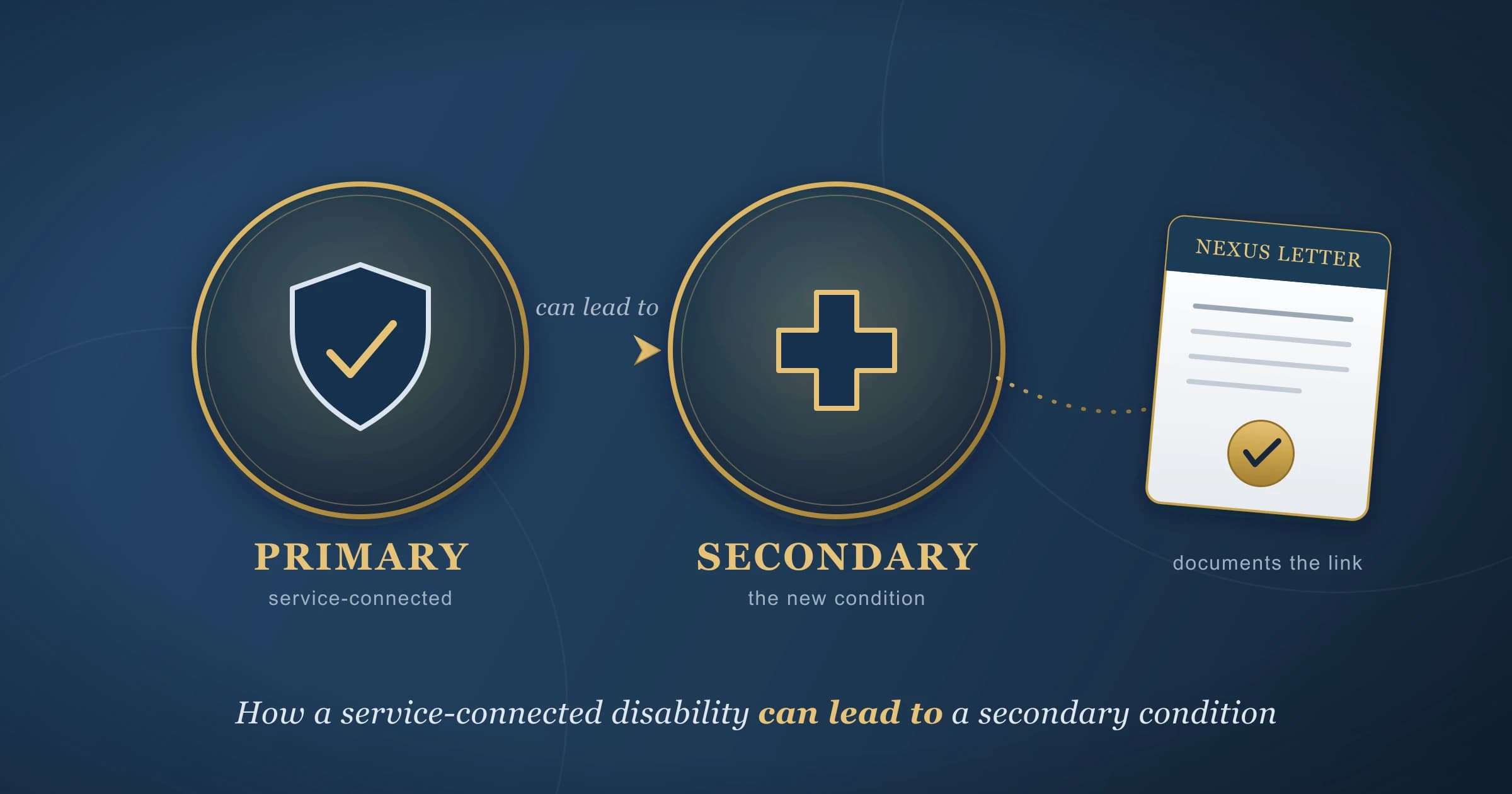
Most veterans picture service connection as a straight line: something happened in service, and it caused a condition. A secondary claim works differently. It connects a new condition to a disability the VA has already service-connected, rather than to your service directly. The rule that allows it is 38 C.F.R. 3.310.
That difference matters, because it opens a door. You do not have to trace the new condition back to an event in service. You only have to tie it to a disability the VA already accepts as service-connected. The primary condition has already cleared the hardest bar; the secondary claim builds on it.
Secondary versus direct service connection
Direct service connection, under 38 C.F.R. 3.303, links a condition to something that happened during service. Secondary service connection links a condition to another service-connected disability. Many veterans pursue both theories over the life of a claim, and a single condition can sometimes be claimed either way.
The practical upshot: if a condition appeared long after you separated, a direct claim can be hard to prove. But if it flows from a disability you are already rated for, the secondary path is often the stronger route.
Caused or aggravated: two paths, both count
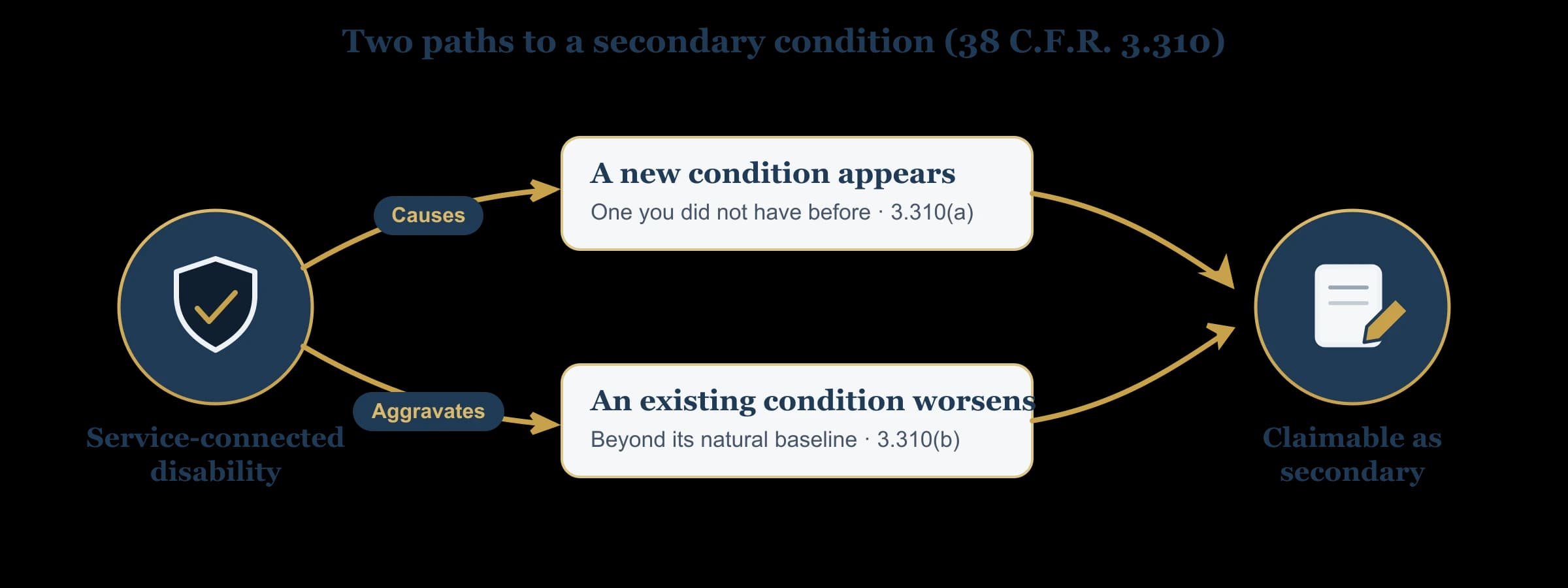
38 C.F.R. 3.310 recognizes two ways a service-connected disability can produce a secondary condition. The first is causation: the primary disability brought on a condition you did not have before. The second is aggravation, covered in 3.310(b): the primary disability made a condition you already had worse than it would have been on its own.
Aggravation is the path veterans most often overlook. If you had a mild, manageable condition that a service-connected disability pushed into something disabling, the VA can compensate the degree of worsening beyond its natural baseline. A nexus letter should say directly which path it is arguing, and describe the baseline if the argument is aggravation.
Why the Nexus Letter Decides a Secondary Claim
Here is the catch with secondary claims: the VA does not assume the connection for you. Unlike a presumptive condition, where the link is accepted as a matter of policy, a secondary claim puts the burden on the evidence in your file. If nothing in that file explains why your primary disability led to the new condition, the claim reads as two unrelated problems, and it gets denied.
The nexus letter is the piece of evidence that supplies the missing link. It is a medical opinion, from a qualified provider, that connects the two conditions and explains the medicine behind the connection. A rating official is not a doctor and will not infer the link on their own. The letter gives them the medical reasoning they are not allowed to supply themselves.
This is also why a strong letter is weighed more heavily than a weak one. The VA gives the most probative value to opinions that review your records, name a plausible mechanism, and cite support for it. A bare assertion that two conditions are related, with no reasoning, carries little weight even when it reaches the right conclusion.
New to these documents? Start with our primer on what a nexus letter is, then come back here for the secondary-claim specifics.
What a Secondary Claim Needs
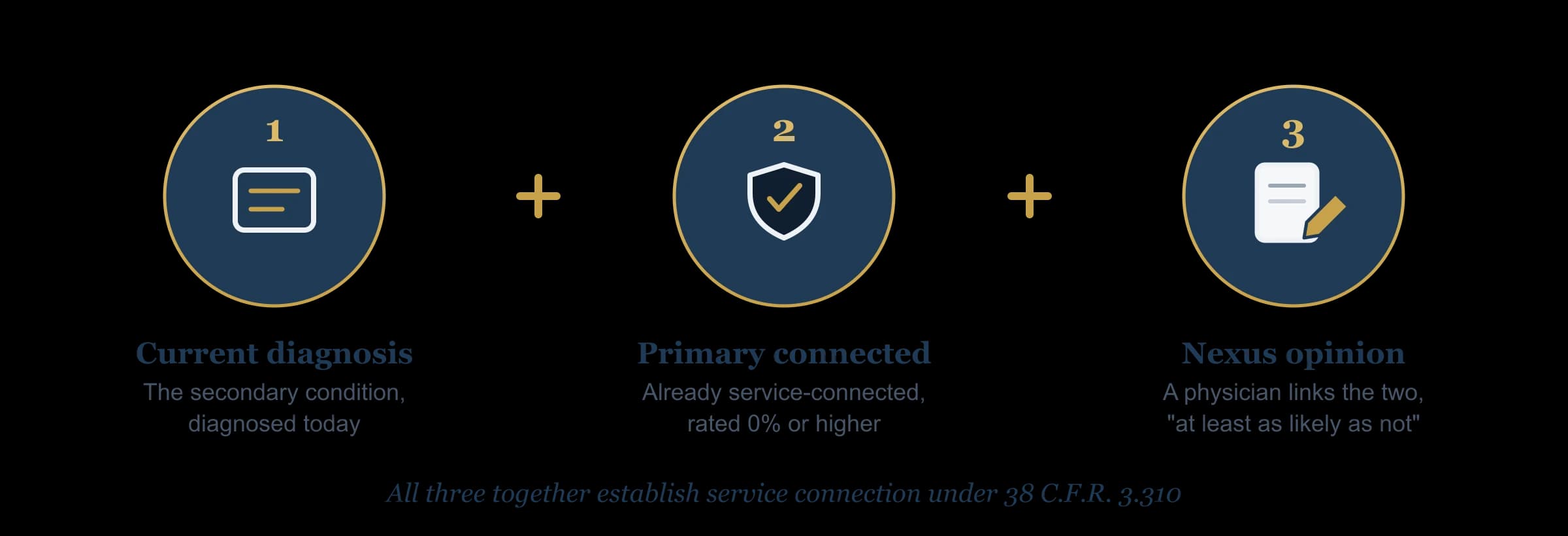
To win a secondary claim, three things have to be in place. The nexus letter supplies the third and ties the first two together. Missing any one of them is the usual reason these claims fail.
- 1
A current diagnosis
A present-day diagnosis of the secondary condition from a qualified provider. A condition you no longer have, or have never had formally diagnosed, cannot be rated.
- 2
A service-connected primary
A primary disability the VA has already service-connected. It can be rated at 0 percent and still support a secondary claim; what matters is that the service connection exists.
- 3
A medical nexus
A qualified opinion that the secondary condition is at least as likely as not caused or aggravated by the primary. This is the nexus letter.
Notice what is not on the list: you do not need the secondary condition to trace back to service on its own. That is the whole point of a secondary claim. The service connection you already hold does that work for you.
The Language the VA Requires
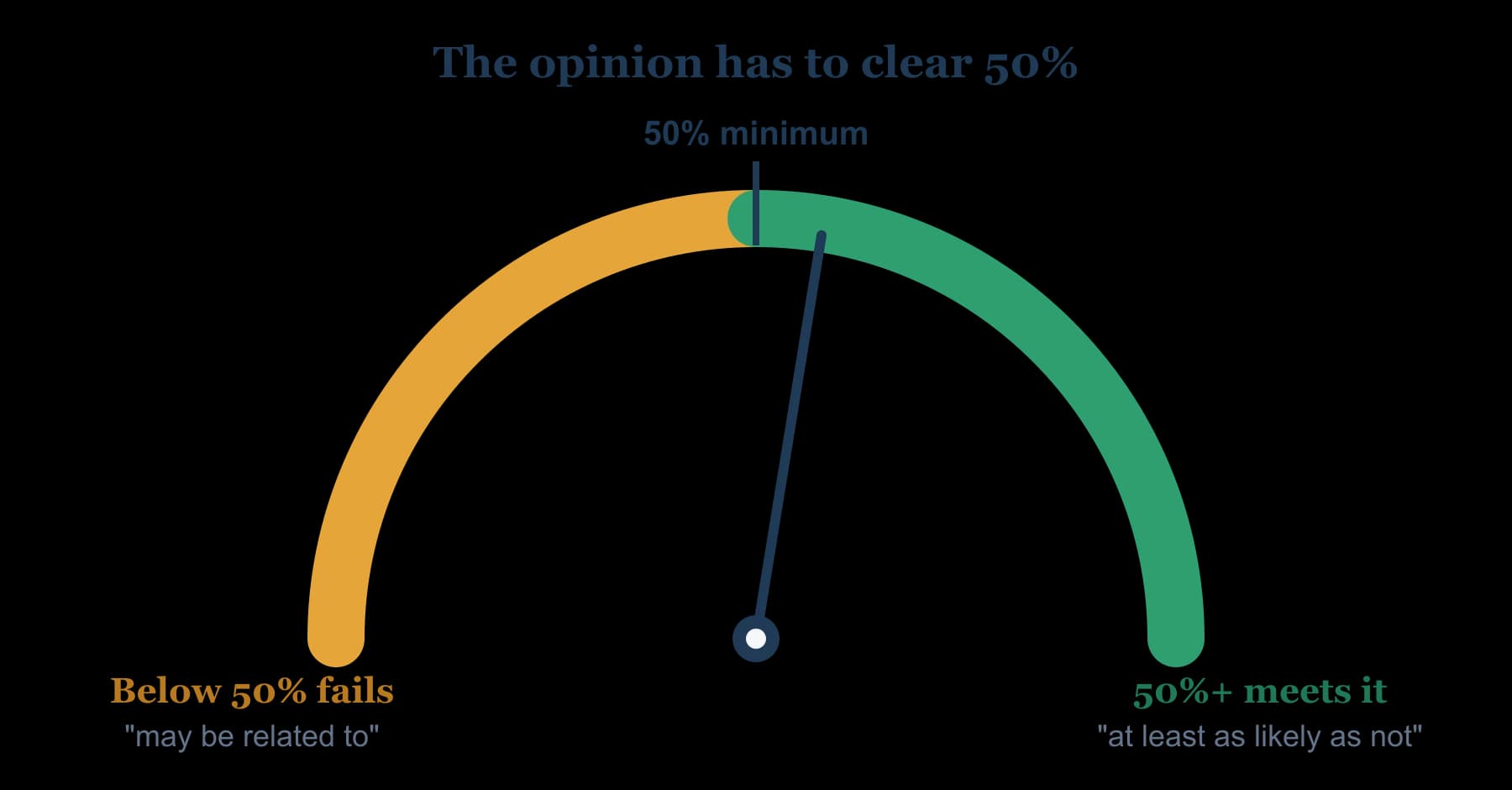
The VA reads a nexus letter closely, and small differences in wording change how much weight it carries. The standard the letter has to meet is 'at least as likely as not,' which means a 50 percent or greater probability that the primary disability caused or aggravated the secondary condition. That threshold comes from the benefit-of-the-doubt rule in 38 U.S.C. 5107(b): when the evidence for and against is roughly balanced, the tie goes to the veteran.
Language that meets the bar
- “At least as likely as not caused or aggravated by the veteran's service-connected [primary condition]” Meets the 50 percent threshold and names the secondary path. The standard to aim for.
- “More likely than not a result of the veteran's service-connected [primary condition]” Exceeds 50 percent; stronger than the minimum.
Language that fails
- “May be related to the veteran's [primary condition]” A possibility, not a probability. Below the standard.
- “Could possibly be connected to the service-connected condition” "Could possibly" does not meet the 50 percent bar, and vague wording invites a denial.
Do not overlook aggravation
If the argument is aggravation rather than outright causation, the letter should say so directly and describe your baseline before the primary disability made things worse. Under 38 C.F.R. 3.310(b), a letter that documents the worsening can win service connection even when the primary did not cause the condition from scratch.
What a Strong Secondary Nexus Letter Includes
A strong secondary nexus letter is not long, but it is complete. Rather than a fill-in-the-blank template, think of it as a short medical argument that a rating official can follow from start to finish. The elements below are what separate a letter the VA relies on from one it sets aside.
- The records the provider reviewedNaming your service-connection decision, diagnosis, and treatment records shows the opinion rests on your actual history, not a generic form.
- Both conditions, named clearlyThe service-connected primary and the secondary condition being claimed, so the examiner never has to guess what is being linked.
- The mechanism, explainedHow the primary disability plausibly caused or aggravated the secondary. This is the heart of the letter and the part weak letters skip.
- Support for the connectionA reference to medical literature or accepted clinical reasoning, which turns an assertion into a supported opinion.
- The opinion, in the required languageThe 'at least as likely as not' conclusion, stated plainly, naming causation or aggravation.
- The provider's qualificationsCredentials and, where relevant, why the provider is competent to offer the opinion, which speaks to how much weight it carries.
For the full element-by-element breakdown, see our guide to what a nexus letter must include.
You will find full sample letters on other sites. We deliberately do not publish one to copy. The VA gives the least weight to letters that read as boilerplate, and a borrowed template that does not fit your records can do more harm than good. The anatomy above is what a clinician builds around your specific facts.
Common Secondary Conditions That Need a Nexus Letter
Almost any condition can be secondary to another if the medicine supports it, but a handful of pairings come up again and again. Each one below is a claim the VA grants regularly when a nexus letter connects the two. Where we have a full guide to a pairing, follow the link for the details.
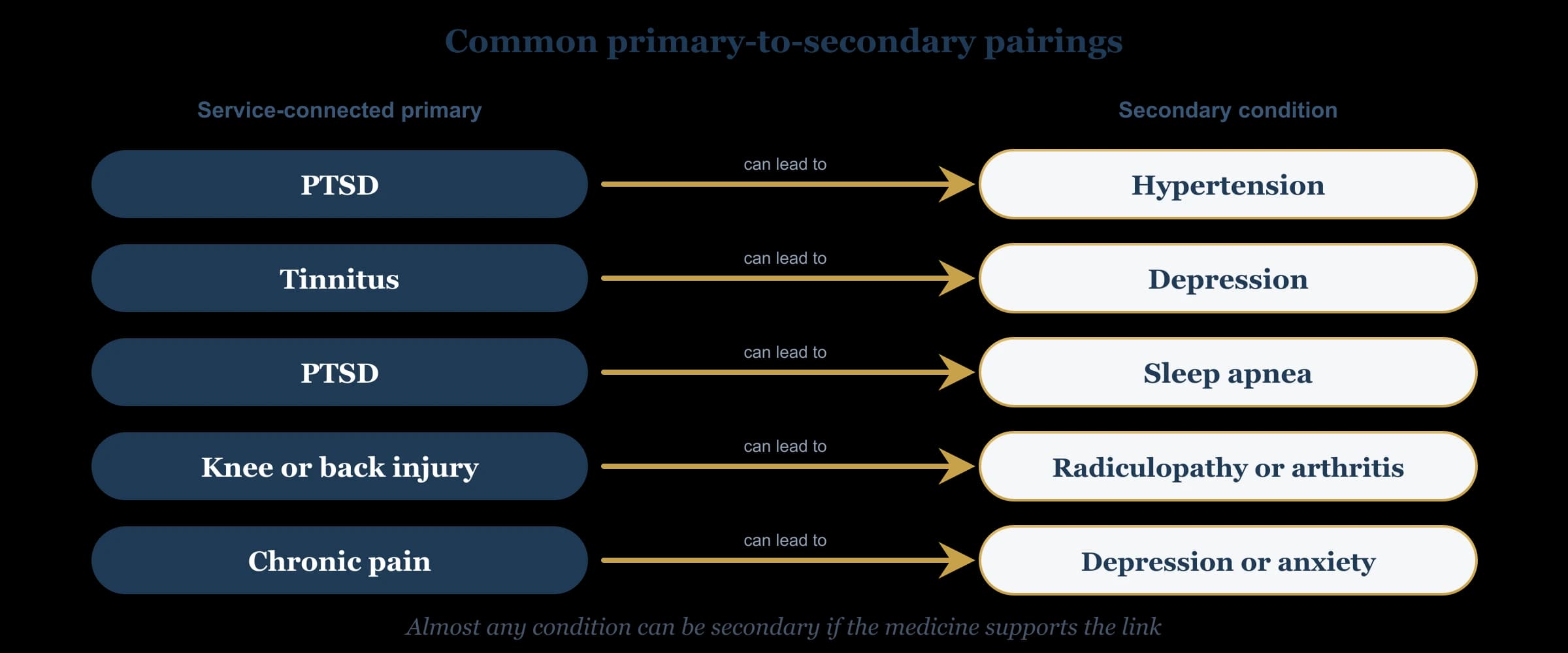
Hypertension secondary to PTSD
The physiological strain of chronic PTSD is linked in the research to a higher risk of developing high blood pressure. It is one of the most common secondary claims veterans file.
Read the hypertension secondary to PTSD guideDepression secondary to tinnitus
Constant ringing that disrupts sleep, focus, and mood is a recognized contributor to depression, and the odds rise with tinnitus severity. A nexus letter applies that evidence to your case.
Read the depression secondary to tinnitus guideSleep apnea secondary to PTSD
PTSD and its treatments are associated with disrupted, fragmented sleep, and veterans claim obstructive sleep apnea as secondary on that basis. A nexus letter has to carry the causal link itself, because the medical literature reports association rather than proven causation.
Read the sleep apnea secondary to PTSD guideSleep apnea secondary to GERD
Chronic nighttime acid reflux can inflame and narrow the upper airway and fragment sleep, which can cause or worsen obstructive sleep apnea. A nexus letter documents that reflux-to-airway link.
Read the sleep apnea secondary to GERD guideHypertension secondary to sleep apnea
Repeated overnight oxygen drops are one contributing pathway to raised blood pressure, and VA's manual expressly contemplates a hypertension diagnosis made secondary to a service-connected disability. What surprises veterans is the evaluation: Diagnostic Code 7101 prints no 0 percent tier, so 38 CFR 4.31 supplies one, and service connection can be awarded at 0 percent.
Read the hypertension secondary to sleep apnea guideRadiculopathy or arthritis from a joint injury
A service-connected knee, hip, or back injury changes how you move and load your joints, which over years can drive nerve pain or arthritis in nearby areas.
See musculoskeletal VA claimsDepression or anxiety from chronic pain
Living with a painful service-connected condition takes a mental toll, and depression secondary to chronic pain is a well-recognized and claimable connection. The rating turns on occupational and social impairment rather than on how severe the pain is.
Nexus letter for depression secondary to chronic painDo not stop at this list. If a service-connected disability plausibly led to another condition you now have, it is worth exploring, even if you have never seen it named as a common pairing. What decides the claim is not whether it is on a list; it is whether the medicine supports the link and a nexus letter makes the case.
How to Get a Nexus Letter for a Secondary Condition
A nexus letter is only as strong as the records behind it. The steps below get a clinician what they need to write from evidence rather than assumption.
- 1Gather your recordsYour primary condition's service-connection decision, a current diagnosis of the secondary condition, and the treatment records for both. These are the raw material of the opinion.
- 2Write a personal statementIn your own words, how the primary disability has affected you and when the secondary condition started. A rough timeline linking the two is especially useful.
- 3Choose the right providerA licensed clinician competent to opine on the secondary condition. For a mental health secondary, that weighs toward a psychologist or psychiatrist; for a physical one, a relevant specialist.
- 4Have the letter reviewed and finalizedThe provider reviews your records, explains the mechanism, and states the opinion in the language the VA requires. Read it to confirm both conditions and the standard are named.
A Veterans Service Officer through your state or a veterans organization can help you file at no cost. Their help is a good complement to a strong nexus letter, not a substitute for it.
Who Can Write It, and What It Costs
Any licensed clinician can write a nexus letter, but the VA gives the most weight to an opinion from a provider competent to speak on the condition at issue. For a mental health secondary that points toward a psychiatrist or psychologist; for a physical one, toward a relevant specialist. What sets a strong letter apart is not only the credential; it is a clinician who reviews your records, explains the mechanism, and states the opinion in the language the VA expects.
Patriot Path's physicians write letters built for exactly this kind of claim: records reviewed, the primary-to-secondary connection explained, support cited, and the opinion in the language the VA looks for. One flat fee of $1,500, and the first consultation is free.
Not sure who qualifies? See our breakdown of who can write a nexus letter, and see our flat, upfront nexus letter pricing and what is included.
How a Secondary Rating Affects Your Combined Rating
A secondary condition is rated on its own merits, under the same rating schedule the VA would use if the condition were direct. Once it is service-connected, the VA does not simply add its percentage to your existing rating. It combines them using the combined ratings table in 38 C.F.R. 4.25, which is why two disabilities rated 30 and 20 percent do not add up to 50.
The practical point is that a secondary condition raises your combined rating rather than replacing what you already have, and even a moderate secondary rating can push you into a higher bracket or across a threshold that changes your monthly compensation. It is worth pursuing a well-supported secondary claim even when your primary rating already feels settled.
Is Your Secondary Claim Ready?
Score your claim
0 of 6 in hand
Check each item you already have in hand. Your score updates as you go.
A few core pieces are missing. Start by confirming your primary service connection and getting the secondary condition diagnosed.
Have a clinician build the missing pieces →If Your Claim Is Denied
Secondary claims are often denied the first time, usually because the medical evidence did not clearly connect the two conditions, or a VA examiner disagreed with the link. A denial is not the end of the claim.
Read the decision and any exam report to see exactly why it was denied. If the problem was a weak or missing link, a stronger nexus letter that answers the examiner's reasoning is often what turns it around. You can then file a Supplemental Claim on VA Form 20-0995 with that new and relevant evidence.
We break down the most common reasons these claims fail, and how to fix each one, in our guide to why the VA denies nexus letters.
Give Your Secondary Claim Its Strongest Evidence
Your primary disability is already service-connected. Let our physicians write the nexus letter that explains to the VA how it led to your secondary condition.
Frequently Asked Questions
Does the VA automatically connect a secondary condition to my service-connected disability?
No. Outside of a small set of presumptive conditions, the VA does not assume the connection for you. A secondary claim puts the burden on the evidence in your file, and the nexus letter is the piece of evidence that supplies the medical link. Without it, the VA usually reads the two conditions as unrelated and denies the claim.
Do I need my primary condition to be service-connected first?
Yes. A secondary claim builds on a disability the VA has already service-connected, so that service connection needs to exist before you can tie a new condition to it. If your primary condition is not yet service-connected, that claim comes first, and you can pursue the secondary once it is settled.
Is a nexus letter required for a secondary claim?
It is not legally required, but it is usually what decides the claim. Because the VA will not infer the medical connection on its own, a secondary claim without a nexus opinion typically fails. In practice, these claims are frequently denied when no nexus evidence is submitted or the evidence is inadequate, so a strong letter is the single most important thing you can add.
Can a condition be secondary if it appeared years after service?
Yes, and that is often exactly when a secondary claim is the right route. Secondary service connection does not require the condition to trace back to service directly. It only has to be linked to a disability the VA already service-connected, so a condition that developed long after you separated can still be claimed as secondary.
What if my primary condition is only rated at 0 percent?
A 0 percent rating still counts as service-connected, and it can support a secondary claim. What matters for a secondary claim is that the service connection exists, not the size of the rating. The secondary condition is then rated on its own merits.
What is the difference between a condition being caused versus aggravated?
Caused means your service-connected disability brought on a condition you did not have before. Aggravated, under 38 C.F.R. 3.310(b), means it made a condition you already had worse than it would have been on its own. Both are valid paths to service connection, and a nexus letter should say clearly which one it is arguing.
Who can write the nexus letter, and what does it cost?
Any licensed clinician can, but the VA gives the most weight to a provider competent to opine on the condition at issue, and to a letter that reviews your records and uses the required language. Patriot Path charges $1,500 flat for a nexus letter, and the first consultation is free. Book a consultation and a clinician will tell you honestly whether a letter can help your secondary claim.
Related guides
- What a nexus letter must includeThe seven elements the VA looks for in any nexus letter.
- What is a nexus letterStart here if the document itself is new to you.
- Who can write a nexus letterWhich providers the VA takes seriously, and why.
- Nexus letters, explainedThe full overview of how these documents work.
- Hypertension secondary to PTSDA worked example of a common secondary claim.
- Hypertension secondary to sleep apneaA secondary claim where the surprise is the evaluation rather than the entitlement: it can be granted at 0 percent.
- Depression secondary to tinnitusAnother secondary claim, start to finish.
- Sleep apnea secondary to GERDHow reflux can drive sleep apnea, and the nexus letter that proves it.
- Nexus letters for diabetesWhy the complications, not the diabetes, are where the letter earns its keep.
- Peripheral neuropathy secondary to diabetesA secondary claim where service connection is the easy half and the nerve code decides whether it pays.
- How to get a nexus letterThe full process, from records to finished letter.
- When the VA denies a nexus letterThe common reasons, and how to fix each one.
- Nexus letter exampleSee the framework on a finished letter.
- Military toxic exposure claimsWhen exposure conditions cascade into secondary ones.
- Nexus letter pricingOne flat fee, and what is included.
Citations & References
- 38 CFR 3.310, Secondary service connection and aggravation (eCFR) https://www.ecfr.gov/current/title-38/section-3.310
- 38 CFR 3.303, Principles relating to direct service connection (eCFR) https://www.ecfr.gov/current/title-38/section-3.303
- 38 CFR 4.25, Combined ratings table (eCFR) https://www.ecfr.gov/current/title-38/section-4.25
- 38 CFR 4.130, Schedule of ratings, mental disorders (eCFR) https://www.ecfr.gov/current/title-38/section-4.130
- 38 U.S.C. 5107, Claimant responsibility and benefit of the doubt (uscode.house.gov) https://uscode.house.gov/view.xhtml?req=granuleid:USC-1999-title38-section5107&num=0&edition=2024
- VA disability compensation, how to file (VA.gov) https://www.va.gov/disability/
- Evidence needed to support your VA disability claim (VA.gov) https://www.va.gov/disability/how-to-file-claim/evidence-needed/
- VA Form 21-526EZ, Application for Disability Compensation (VA.gov) https://www.va.gov/find-forms/about-form-21-526ez/
- M21-1 Adjudication Procedures Manual, sufficiency of medical examinations and opinions (VA KnowVA) https://knowva.ebenefits.va.gov/system/templates/selfservice/va_ssnew/help/customer/locale/en-US/portal/554400000001018/content/554400000180517/M21-1-Part-IV-Subpart-i-Chapter-3-Section-C-Insufficient-Examinations#1a
- Burg MM, et al. Risk for Incident Hypertension Associated with PTSD in Military Veterans. Psychosom Med. 2017 (PMC) https://pmc.ncbi.nlm.nih.gov/articles/PMC5285494/
- Prewitt A, et al. Mental Health Symptoms Among Veteran VA Users by Tinnitus Severity. Mil Med. 2021 (PMC) https://pmc.ncbi.nlm.nih.gov/articles/PMC7980480/