
VA Disability Claims
Nexus Letters for VA Disability Claims
Medically reviewed by the Patriot Path Medical Team
Licensed MD reviewers • Last updated: July 2026
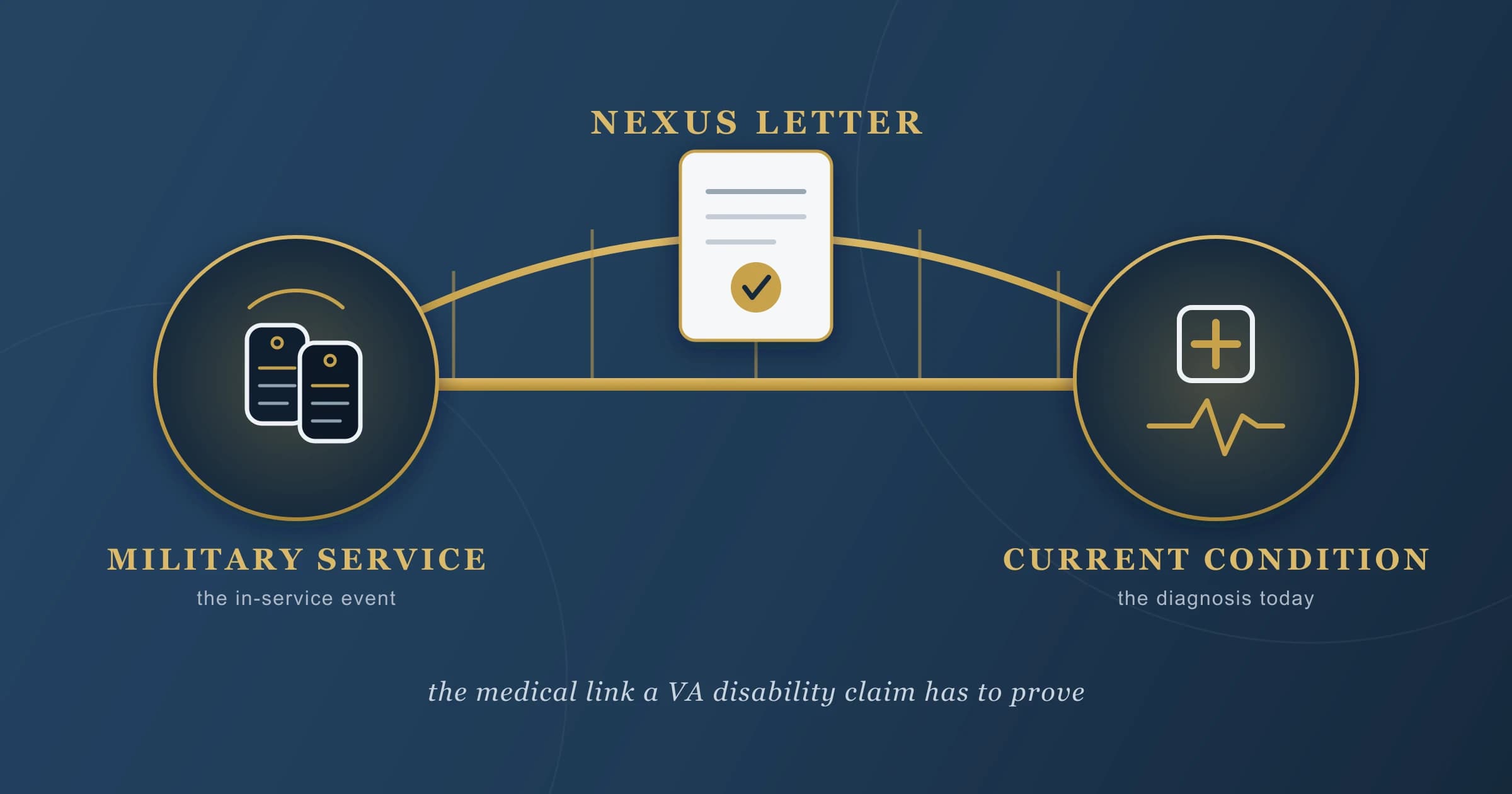
A nexus letter is a signed medical opinion from a qualified provider stating that your diagnosed condition is at least as likely as not connected to your military service. For claims the VA cannot presume, it supplies the missing link between service and diagnosis, and it is often the single piece of evidence that decides the claim.
A common story
A veteran files for a knee condition that started with a fall in service. The diagnosis is solid and the service records show the fall, but fifteen years passed with little treatment in between. The claim comes back denied for no nexus.
Nothing was wrong with the knee or the service history. What was missing was a doctor connecting the two. That connection is the job of a nexus letter, and this page is your starting point, with a link to the right guide for each step.
Your nexus letter guide, step by step
This page is the overview. Use it to get your bearings, then jump to the guide that answers your next question.
- What is a nexus letterThe plain-language definition and how it works in a claim.
- How to write a nexus letterThe seven elements, the structure, and the wording the VA looks for.
- Who can write a nexus letterWhich providers qualify, and whose opinion carries weight.
- See a nexus letter exampleThe framework on a finished, annotated letter.
- Secondary condition nexus lettersWhen one service-connected condition causes another.
- How Patriot Path builds lettersOur physician-authored process, pricing, and turnaround.
What a nexus letter is
A nexus letter is a signed medical opinion tying a current, diagnosed condition to something that happened in military service. It is not a diagnosis or a treatment record; it supplies the one thing the VA cannot presume on its own, the medical link between your service and your condition, using the standard the VA is required to apply.
For a plain-language primer on the basics, see what a nexus letter is.
Why the nexus is the piece most claims miss
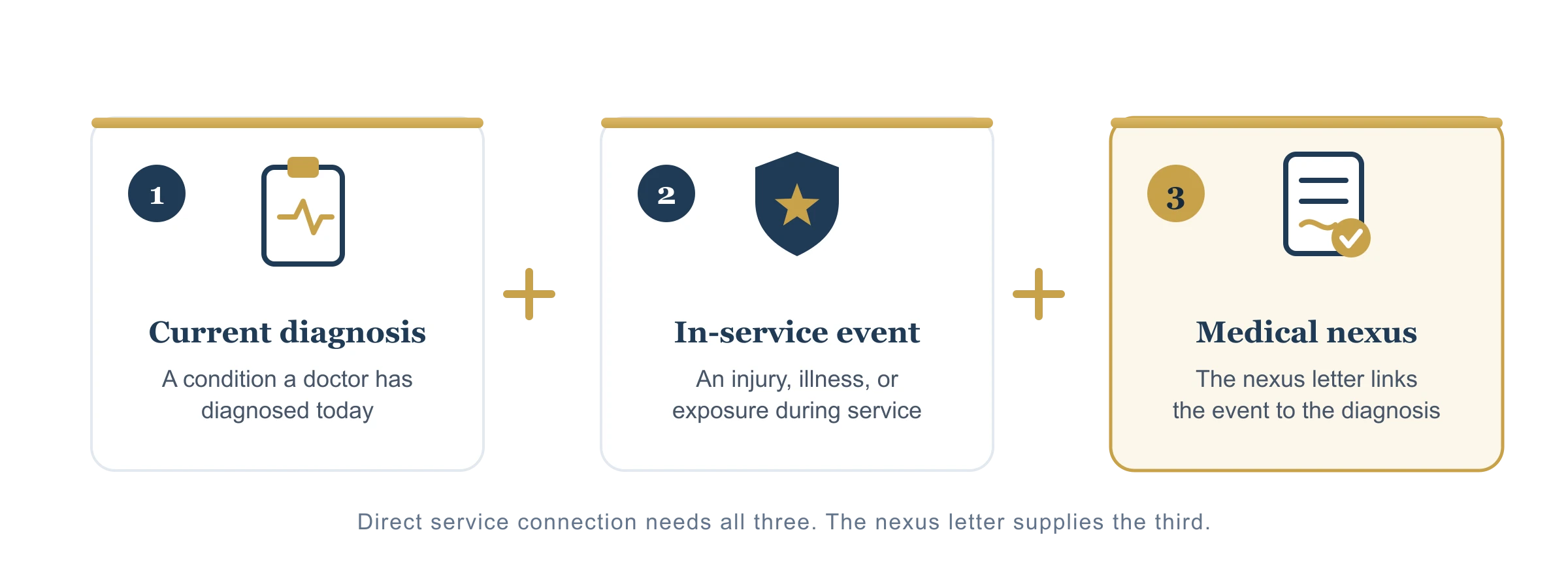
Direct service connection has three parts, and a claim needs all three. Most veterans already have the first two. The nexus is the one the VA cannot see on its own, so it is where otherwise strong claims fall apart.
- 1
A current diagnosis
A condition a doctor has diagnosed now. Your treatment records usually establish this.
- 2
An in-service event
An injury, illness, or exposure during service. Your service records and statements support this.
- 3
A medical nexus
A provider's opinion linking the event to the diagnosis. This is what the nexus letter supplies.
When a claim is denied for lack of a nexus, the diagnosis and the service history are often fine. The rater simply had no medical opinion connecting them. A nexus letter closes that gap, which is why it carries so much weight in a direct claim.
What a strong nexus letter must say
The VA does not need a provider to be certain. It applies a 50 percent standard called 'at least as likely as not.' If the evidence for and against a connection is in balance, the benefit of the doubt goes to the veteran, so the exact language a provider uses is what moves an opinion above or below that line.
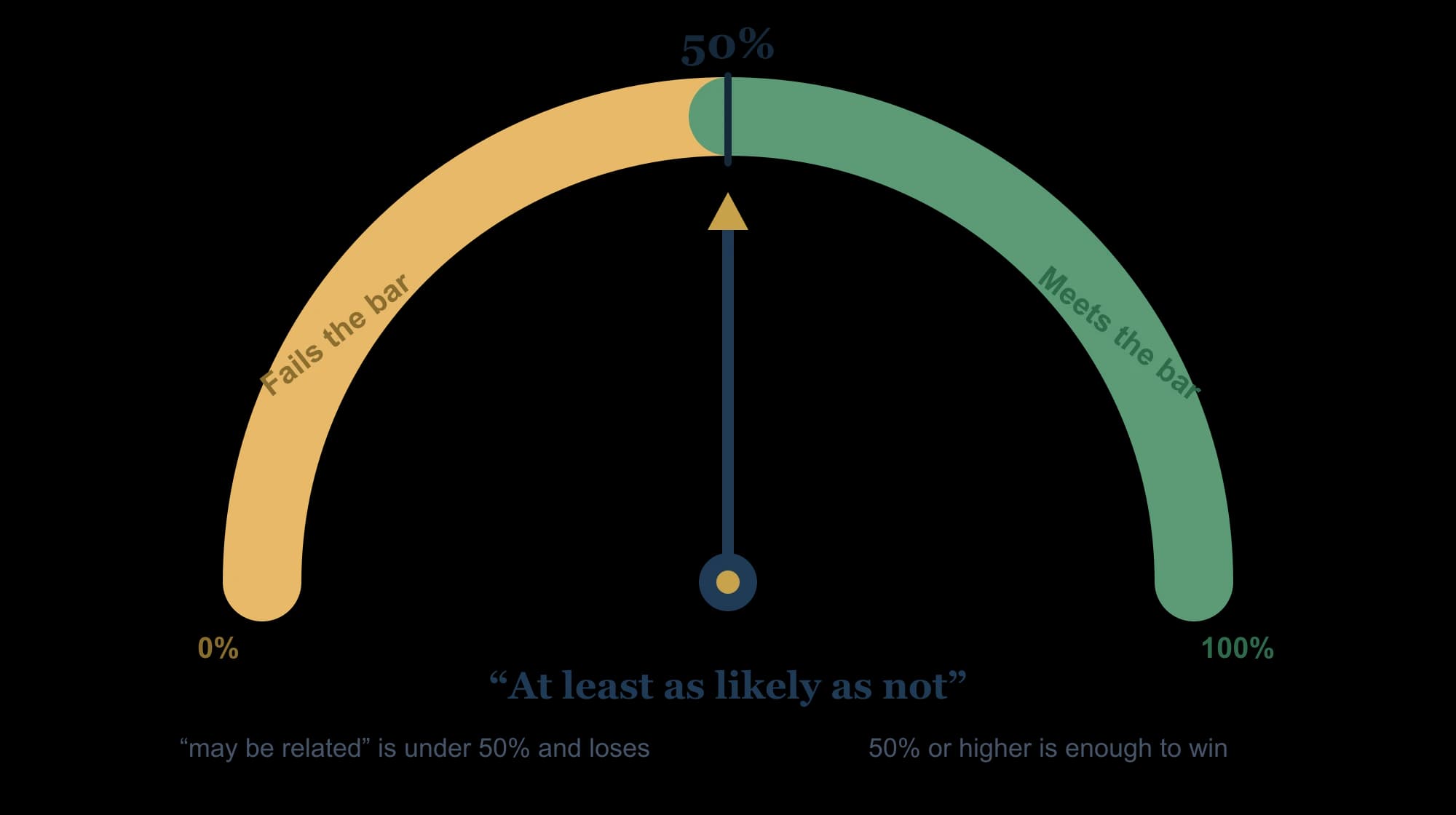
Phrases like 'at least as likely as not' clear the bar; hedged wording like 'may be related' invites a denial. Beyond the language, the letter has to show the provider reviewed the records and give the medical rationale for the opinion.
The qualifying language in full, and the seven elements a defensible letter includes, are their own guide. See the seven elements every nexus letter should include.
Who can write a nexus letter
Any licensed provider competent to diagnose and treat the condition can write a nexus letter, including MDs and DOs and, in many cases, nurse practitioners, physician assistants, and psychologists acting within their scope. A relevant specialist who reviews your records and states a clear opinion carries the most weight, and the provider does not have to be your treating doctor or work for the VA.
More on who can write a nexus letter, and the common question of whether a chiropractor can write one.
How to get a nexus letter
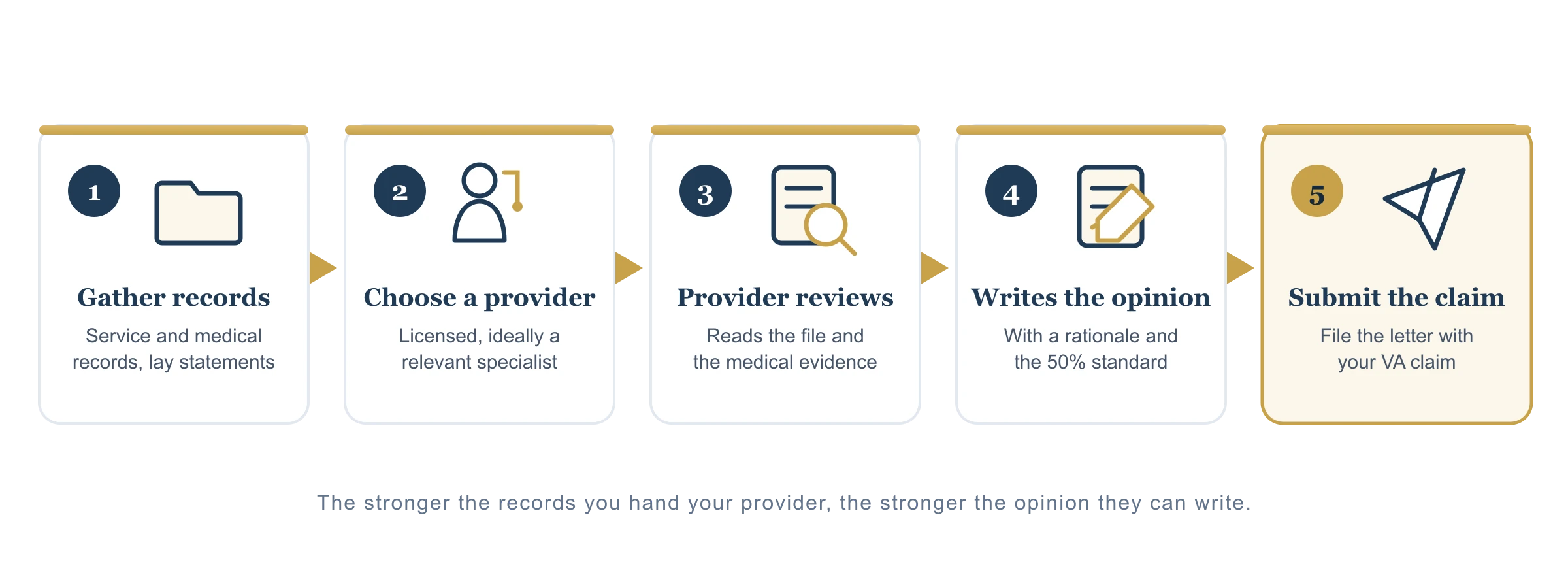
Getting a nexus letter is a short process: gather your records, choose a qualified provider, have them review the evidence, write the opinion using the 'at least as likely as not' standard, then submit it with your claim. The quality of the records you hand your provider shapes the opinion they can write.
When you may not need a nexus letter
A nexus letter is powerful, but it is not always required. In two situations the VA may already accept the connection, so paying for a letter can be unnecessary.
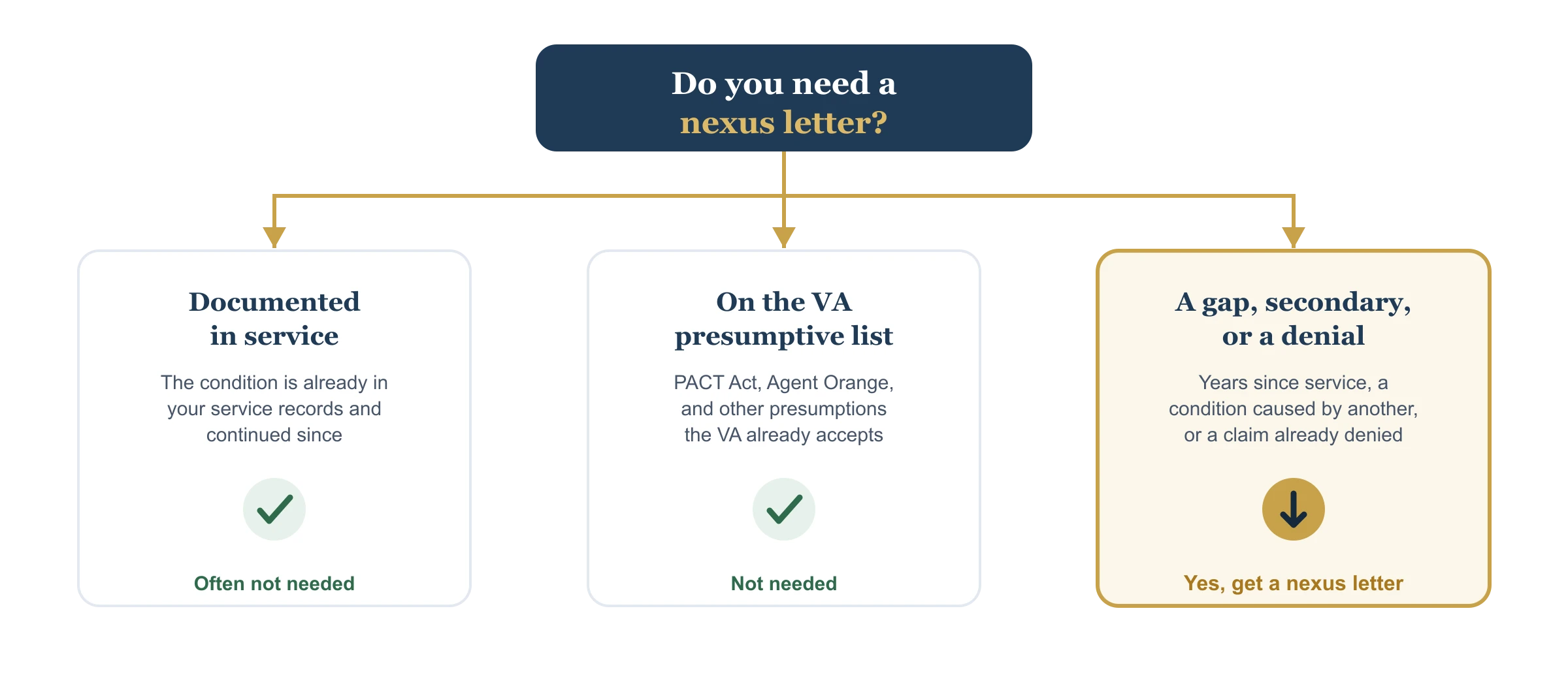
If your condition is clearly documented in your service records and has continued since, the record itself can establish the connection. And if your condition is on a VA presumptive list, through the PACT Act, Agent Orange, Gulf War rules, or another presumption, the VA presumes the link and does not ask you to prove it.
Outside of those situations, a nexus letter usually helps. That includes conditions that surfaced years after service, conditions caused or worsened by another service-connected disability, and claims that were already denied for a weak or missing nexus.
If you were exposed to burn pits, Agent Orange, or other hazards, start with our toxic exposure and presumptive conditions guide.
Nexus letters for secondary conditions
A secondary condition is one caused or aggravated by a disability the VA has already service-connected, such as sleep apnea worsened by service-connected PTSD. These claims lean even harder on the nexus letter, because the connection is medical rather than a documented event in service, and the provider has to explain how one condition led to or worsened the other.
For a worked example, see our guide to a nexus letter for hypertension secondary to PTSD, or browse the conditions we write letters for.
What a nexus letter costs
Independent nexus letters are usually paid out of pocket because they come from a private provider, and a rock-bottom price often buys a template with no real record review, the kind of letter the VA discounts. Patriot Path uses a single flat fee for a physician-authored letter, with a free consultation first.
See our nexus letter pricing.
Is your claim ready for a nexus letter?
Score your claim
0 of 5 in hand
Check what you already have. The more of these you can answer yes to, the stronger the opinion a provider can write.
A few core pieces are missing. Start by confirming your diagnosis and gathering your service and medical records.
Talk to a physician about the missing pieces →Not sure if a nexus letter is your next step?
A short conversation is usually enough to tell whether a nexus letter would strengthen your claim, or whether your evidence already covers the connection. Start with a free consultation and get a straight answer before you spend anything.
Frequently Asked Questions
Where should I start with nexus letters for a VA claim?
Start here. This page is the overview of how nexus letters support a VA disability claim, and it links to the right guide for each step: what a nexus letter is, what it must include, who can write one, and a full example. If you are filing a secondary claim or were exposed to a hazard, follow those links for the specifics.
Do I need a nexus letter for every VA claim?
No. If your condition is clearly documented in your service records and has continued since, or if it is on a VA presumptive list such as the PACT Act or Agent Orange conditions, the VA may already accept the connection. A nexus letter helps most for conditions that appeared years after service, secondary conditions, and claims denied for a weak or missing nexus.
Who can write a nexus letter?
Any licensed medical professional competent to diagnose and treat the condition, including MDs, DOs, and often nurse practitioners, physician assistants, and psychologists acting within their scope. A specialist who treats the condition generally gives an opinion more weight. The provider does not have to be your treating doctor or work for the VA.
What does 'at least as likely as not' mean?
It is the VA's evidentiary standard, met when the probability of a connection is 50 percent or higher. If the evidence for and against is in balance, the benefit of the doubt goes to the veteran. A provider who writes 'at least as likely as not' is stating that the connection clears that 50 percent bar.
How much does a nexus letter cost?
Independent letters are usually paid out of pocket because they come from a private provider, and market prices vary widely. A very low price often means a template with no real record review, which the VA tends to discount. Patriot Path charges a single flat fee for a physician-authored letter, with a free consultation first.
Will a nexus letter guarantee my claim is approved?
No. A nexus letter removes the most common reason claims are denied, but the VA still weighs all of the evidence, including your records and any exam. A well-reasoned letter from a qualified provider that reviews your records and states a clear opinion gives your claim its best chance, but no one can promise a rating.
Can I use a nexus letter to appeal a denial?
Yes. If your claim was denied for a weak or missing nexus, a strong medical opinion is often the new and relevant evidence a supplemental claim needs. Filing a nexus letter that addresses the reason for the denial is one of the most direct ways to reopen a claim.
What is the difference between a nexus letter and a C&P exam?
A C&P exam is conducted by a VA or contracted examiner and produces the VA's own opinion on your claim. A nexus letter is independent evidence you submit from your own qualified provider. They can agree or disagree; a strong nexus letter can support your claim alongside, or against, a C&P opinion.
Related guides
- What is a nexus letterA plain-language primer on the basics.
- How to write a nexus letterThe seven elements, the structure, and the wording.
- Who can write a nexus letterWhich providers qualify, and who carries weight.
- Can a chiropractor write oneScope of practice, and when it holds up.
- Nexus letter exampleSee the framework on a finished letter.
- Hypertension secondary to PTSDA worked secondary-condition example.
- Depression secondary to tinnitusA worked mental-health secondary example.
- Nexus letter for a secondary conditionThe umbrella guide to secondary claims.
- Toxic exposures and presumptivesWhen the VA presumes the connection for you.
- Our nexus letter servicesHow Patriot Path physicians build letters.
Citations & References
- 38 CFR 3.303, Principles relating to service connection https://www.ecfr.gov/current/title-38/chapter-I/part-3/subpart-A/section-3.303
- 38 CFR 3.304, Direct service connection and wartime and peacetime https://www.ecfr.gov/current/title-38/chapter-I/part-3/subpart-A/section-3.304
- 38 CFR 3.310, Disabilities that are proximately due to, or aggravated by, service-connected disease or injury https://www.ecfr.gov/current/title-38/chapter-I/part-3/subpart-A/section-3.310
- 38 CFR 3.102, Reasonable doubt (the benefit-of-the-doubt rule) https://www.ecfr.gov/current/title-38/chapter-I/part-3/subpart-A/section-3.102
- 38 U.S.C. 5107, Claimant responsibility; benefit of the doubt https://www.govinfo.gov/link/uscode/38/5107
- VA, How to file a VA disability claim https://www.va.gov/disability/how-to-file-claim/
- VA, Evidence to support your claim (including DBQs) https://www.va.gov/disability/how-to-file-claim/evidence-needed/
- VA, Eligibility for VA disability compensation (including presumptive conditions) https://www.va.gov/disability/eligibility/