
VA Disability Claims
What Is a Nexus Letter?
Medically reviewed by the Patriot Path Medical Team
Licensed MD reviewers • Last updated: July 2026
A nexus letter is a signed medical opinion from a licensed physician stating that your diagnosed condition is at least as likely as not connected to your military service. It gives the VA the independent medical basis it needs to grant service connection, and for many claims it can be the decisive piece of evidence.
For the full picture, start with our overview of nexus letters for VA disability claims.
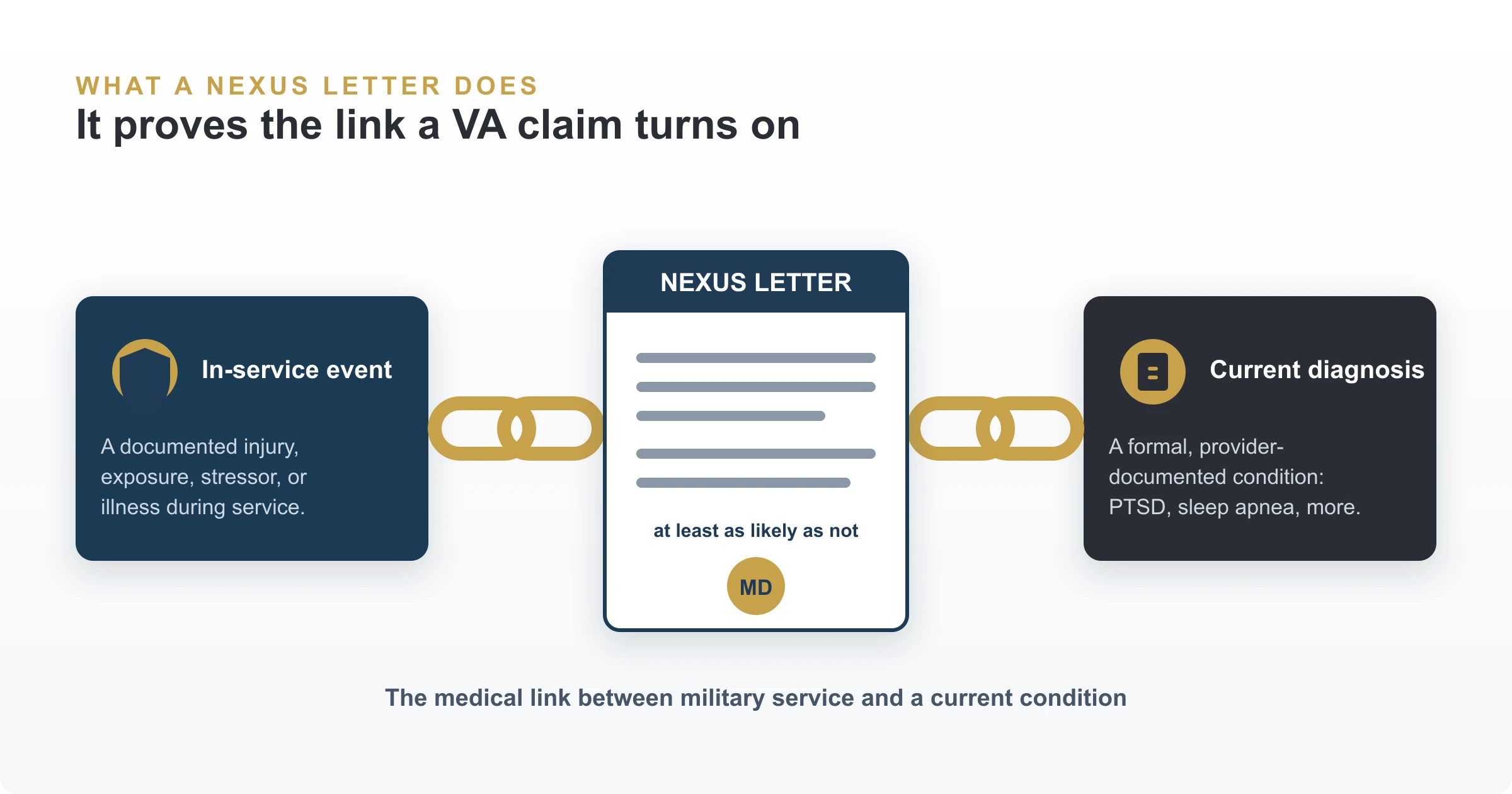
How a Nexus Letter Works in a VA Claim
To receive VA disability compensation, you must prove three things to the Department of Veterans Affairs. A nexus letter exists to satisfy the third.
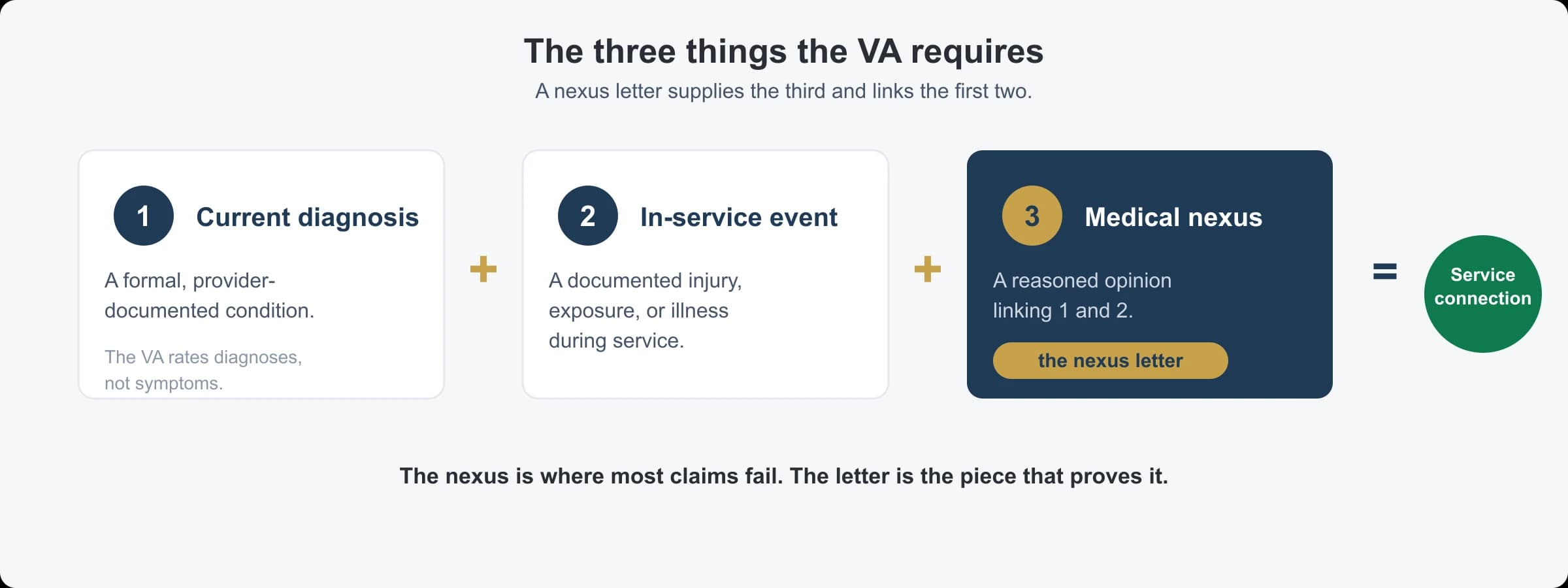
- 1
A current, diagnosed condition
A formal, provider-documented diagnosis such as PTSD, sleep apnea, tinnitus, or depression. The VA rates diagnoses, not symptoms.
- 2
An in-service event
A documented injury, exposure, stressor, or illness during service that may have caused or aggravated the condition.
- 3
A medical nexus
A reasoned medical opinion linking items 1 and 2. This is where most claims fail, and the element a nexus letter supplies.
The third element, the medical nexus, is where most VA claims fall apart. The VA's own Compensation and Pension (C&P) examiners are often overworked, may not review your complete service record, and are not advocates for your claim.
A nexus letter from an independent, board-certified physician provides exactly the opinion the VA rater needs, in writing, in the form the claim requires. It does not prove your diagnosis; the VA already has that. It proves the connection.
Under 38 CFR 3.303, the VA's regulation on service connection, that link has to be shown by medical evidence, which is exactly what a nexus letter provides. The probability standard the evidence is judged against is covered next.
The "At Least as Likely as Not" Standard
The VA weighs evidence on a probability scale. A nexus opinion only helps your claim when it clears one specific bar: the condition must be at least as likely as not, a 50 percent or greater probability, caused or aggravated by service.
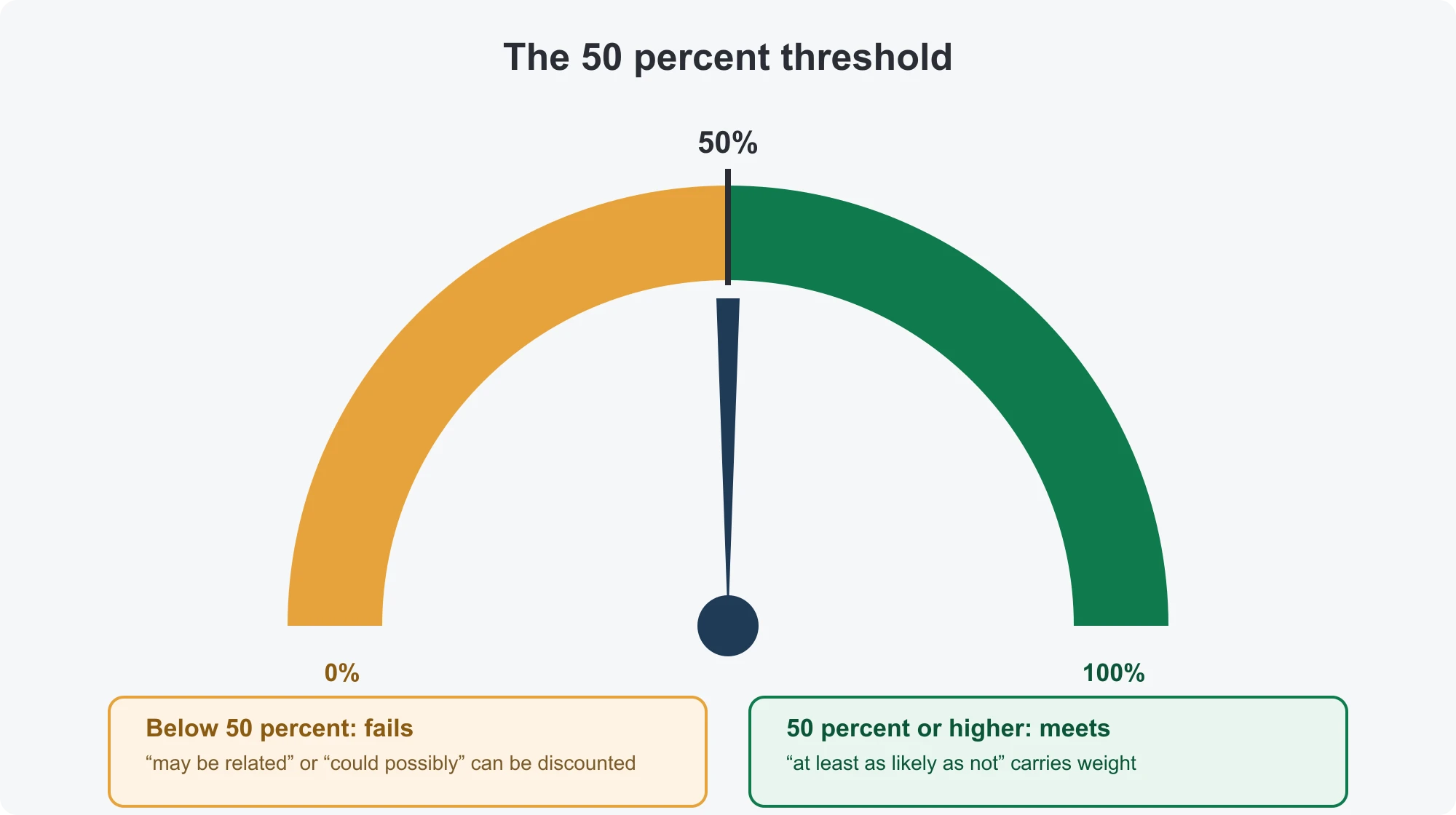
Phrases that meet the bar
- “is at least as likely as not” the VA's required threshold language (50 percent or greater).
- “more likely than not” exceeds the bar and reads as a confident opinion.
Phrases that fail
- “may be related to” reads below 50 percent; the VA can discount it.
- “could possibly be connected” speculative language carries little probative weight.
This threshold comes from the benefit-of-the-doubt rule in 38 U.S.C. 5107(b), which resolves an even balance of evidence in the veteran's favor.
The exact wording, records review, and rationale a letter needs are covered in full in our guide to what a nexus letter must say to meet the VA's standard.
Three Types of Service Connection
Your nexus letter should be tailored to the type of service connection you are claiming. There are three recognized pathways.
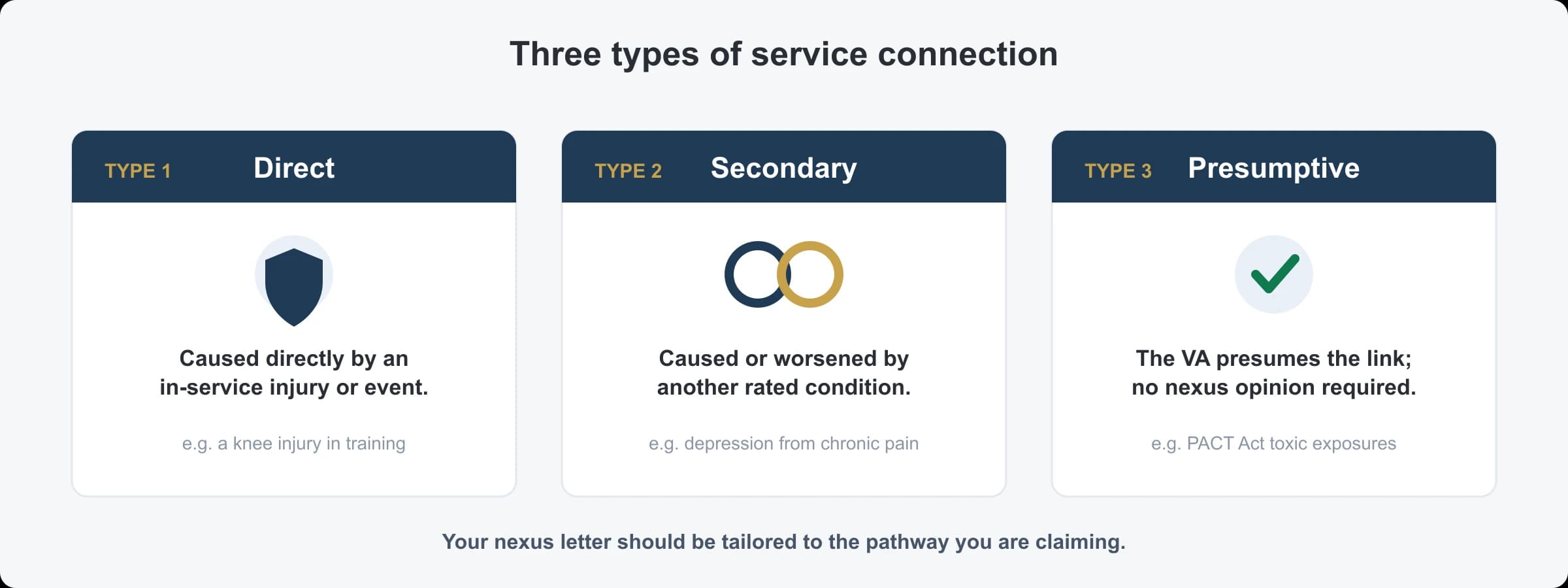
- Type 1
Direct service connection
The condition was caused directly by an in-service event, injury, or illness. The letter links the specific incident to your diagnosis.
Example: Chronic knee pain from a training injury that developed into documented joint disease.
- Type 2
Secondary service connection
The condition was caused or worsened by an already service-connected disability, even if it did not arise during service.
Example: Depression developing as a result of chronic pain from a service-connected back injury.
- Type 3
Presumptive connection
For certain conditions the VA presumes service connection without requiring a nexus opinion. A letter may still strengthen a presumptive claim for rating purposes.
Example: Bladder cancer in a veteran with documented Agent Orange exposure.
Secondary claims are governed by 38 CFR 3.310. For a full breakdown with condition-specific examples such as hypertension secondary to PTSD, see our secondary-condition guides.
For a real-world example of a properly structured letter, see our nexus letter example guide.
Why a Nexus Letter Matters, and When You Need One
For most claims the nexus is the hardest element to prove and a common reason a claim is denied. A well-reasoned letter is one of the most valuable documents a veteran can submit, because it speaks in the medical and legal terms a VA rater is required to weigh.
Because the nexus is the element the VA most often finds missing, a clear letter directly addresses the gap that stalls or sinks many claims. It gives the rater independent medical evidence to weigh alongside the C&P exam, rather than leaving the connection to be inferred from the records alone.
A strong letter also does work beyond the initial grant. It can support a higher disability rating by documenting severity and mechanism, it can serve as new and relevant evidence when a denied or stalled claim is appealed, and it can clarify a complex or multi-condition claim where the connection is not obvious from the records.
The VA's own how-to-file guidance stresses that the evidence you submit is what the decision turns on, which is why the quality of a nexus opinion matters so much.
What a strong nexus letter can change
- Secure the initial grant of service connection when the record does not connect your condition to service on its own.
- Support a higher disability rating by documenting how severe the condition is and the mechanism behind it.
- Revive a denied or stalled claim as new and relevant evidence on a Supplemental Claim, without a full Board hearing.
- Carry a secondary condition, such as a mental-health condition arising from chronic pain, back to a service-connected cause.
- Clarify a complex or multi-condition claim where the link is not obvious from the records alone.
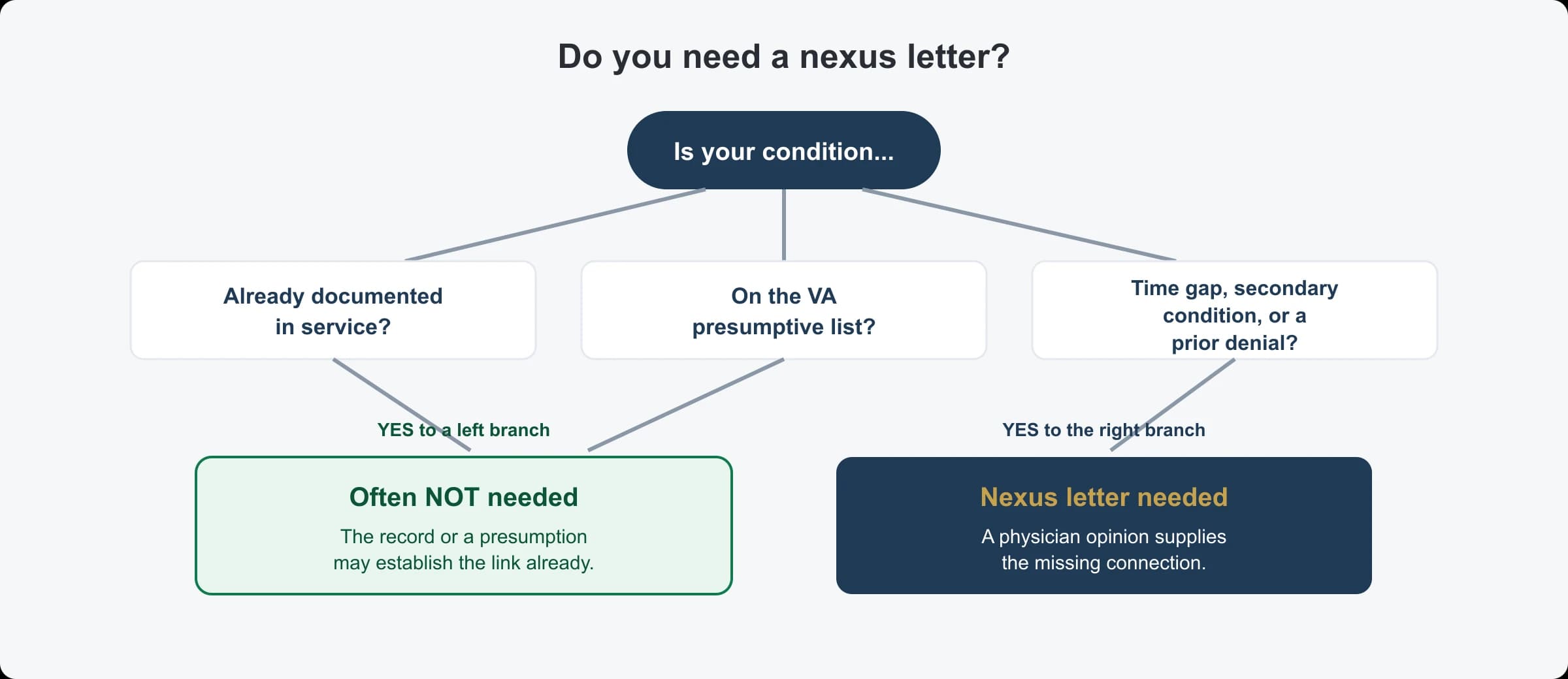
Do you need a nexus letter?
0 of 3 answered
Answer three quick questions to see whether a nexus letter is likely what your claim needs.
1.Have you been diagnosed with a medical condition linked to your service, such as PTSD, sleep apnea, tinnitus, or another disability?
2.Can you identify a specific in-service event, exposure, or injury that may have caused or contributed to this condition?
3.Has the VA denied your claim for this condition, or have you not yet filed a claim?
When You May Not Need a Nexus Letter
A nexus letter is not always required. If your condition was clearly diagnosed and documented during service, the records may already establish the connection on their own. And if your condition qualifies for presumptive service connection, the VA presumes the link without a nexus opinion.
Presumptive conditions include many tied to Agent Orange, Gulf War service, and the toxic exposures covered by the PACT Act. In those cases a nexus letter is optional, though one can still help establish severity for your rating.
You can check the current presumptive lists on the VA's PACT Act page and its hazardous-materials exposure eligibility page.
For exposure-based claims, see our overview of toxic exposures and presumptive conditions.
What a Nexus Letter Must Include
Not every letter is accepted. A letter that is vague, lacks a medical rationale, or omits a required element is given little to no probative value by a rater, meaning it will not help your claim. A complete letter carries all of these:
- Physician credentials: full name, license number, specialty, and state of licensure.
- A current, ICD-coded diagnosis of the condition being claimed.
- A records review statement confirming the provider read the Service Treatment Records and relevant history.
- The nexus opinion in the VA's required "at least as likely as not" language.
- A medical rationale: the clinical reasoning, citing literature or documented findings. This is where most letters fall short.
- A signature and date. Unsigned letters are dismissed.
For the complete breakdown of all seven components, including the correlative and causative reasoning VA adjudicators look for, see what a nexus letter must say to meet the VA's standard.
Who Can Write a Nexus Letter?
The VA accepts nexus letters from licensed healthcare providers, including MDs, DOs, PhDs in relevant clinical fields, nurse practitioners, and physician assistants. Any qualified provider can write one, but the weight the VA gives the letter depends heavily on the writer's qualifications and specialty.
A board-certified physician who specializes in the claimed condition, a psychiatrist for a PTSD letter or a pulmonologist for sleep apnea, carries significantly more authority than a general practitioner. An independent medical opinion from a specialist outside the VA system, reviewed and signed by a qualified MD or PhD, is typically more persuasive and better structured for adjudication.
For the full answer, including whether a VA doctor or a chiropractor can write one, see our guide on who can write a nexus letter.
How a Nexus Letter Differs From a DBQ
Veterans often confuse nexus letters with Disability Benefits Questionnaires (DBQs). Both are medical documents used in VA claims, but they serve different purposes.
| Nexus letter | DBQ | |
|---|---|---|
| Purpose | Establishes service connection (the why) | Documents current severity (the rating) |
| Format | Free-form opinion with clinical rationale | Standardized VA form with checkboxes |
| Best for | Initial claims and denied claims | Disability ratings and increases |
| Proves | The condition is related to service | How disabling the condition is |
Many claims need both. For a full deep-dive, see our nexus letter vs. DBQ comparison guide.
Common Reasons the VA Rejects a Nexus Letter
The VA can give a letter little to no probative value if it lacks a sufficient medical rationale, does not review the veteran's service records, or is written by a provider without relevant expertise. This is one of the most common reasons claims are denied even when a veteran submits a letter.
The quality of the rationale matters as much as the conclusion, which is why the strongest letters are written by specialists who cite medical literature and document their reasoning in detail.
For a full breakdown of why letters get rejected and how to respond, see overcoming nexus letter denials.
How Patriot Path Helps Veterans Get Stronger Nexus Letters
Patriot Path is a VA nexus letter service staffed exclusively by licensed MDs and PhDs. Rather than route cases through non-specialist clinicians or produce templated letters, we assign each case to a board-certified physician with specialty experience relevant to the claimed condition.
- A full review of your Service Treatment Records, medical history, and relevant documentation
- Case assignment to a specialist MD or PhD whose credentials align with your condition
- A fully reasoned nexus letter with cited medical literature, not a template
- Coverage for up to five conditions per engagement
- Turnaround designed around your VA claim timeline
See our full nexus letter process and our services and pricing for details.
Related guides
- OverviewNexus letters for VA disability claims
- RequirementsWhat a nexus letter must include
- Who writes itWho can write a nexus letter
- ExampleA nexus letter example
- ComparisonNexus letter vs. DBQ
- DenialsOvercoming nexus letter denials
- How to get oneHow to get a nexus letter
- Sleep apneaSleep apnea nexus letters: the complete guide
- Our processThe Patriot Path nexus letter process
Ready to Strengthen Your VA Claim?
Patriot Path's licensed MDs and PhDs write nexus letters built to meet the VA's evidentiary standards: fully reasoned independent medical opinions, not templates. Up to five conditions per engagement.
Frequently Asked Questions
Do I need a nexus letter for every condition on my VA claim?
Not necessarily. If you are claiming a condition that qualifies for presumptive service connection under VA regulations, such as certain Agent Orange conditions, Gulf War illnesses, or conditions covered by the PACT Act, the VA presumes the connection without requiring a nexus opinion. For most other conditions, including PTSD, sleep apnea, depression, and tinnitus, a well-documented nexus letter from a qualified physician is one of the most important pieces of evidence you can submit.
How long does it take to get a nexus letter?
Turnaround time varies depending on the provider and the complexity of your case. At Patriot Path, we work with veterans to align our delivery timeline with their claim deadlines. Contact us for a specific estimate based on your situation.
How much does a nexus letter cost?
Patriot Path charges a flat fee per engagement, which covers up to five conditions. While that is a real cost, consider the context: a successful VA disability rating can mean thousands of dollars per year in tax-free benefits, and a single service connection approval or rating increase represents a substantial lifetime outcome. See our services and pricing page for current details.
Can the VA reject a nexus letter?
Yes. The VA can give a nexus letter little to no probative value if it lacks sufficient medical rationale, does not review the veteran's service records, or is written by a provider without relevant expertise. This is one of the most common reasons for claim denials even when veterans submit a letter. The quality of the rationale matters as much as the conclusion, which is why Patriot Path letters are written by specialists who cite medical literature and document their reasoning in detail.
What is the difference between a nexus letter and a buddy statement?
A buddy statement (VA Form 21-10210) is a lay statement from a fellow service member, family member, or friend that describes observable effects of your condition. It is not a medical opinion. It can support your claim but cannot substitute for a physician's medical nexus opinion. In a strong claim, both may be used.
Can I use a nexus letter for a supplemental claim after a denial?
Yes, and in many cases this is exactly the right move. If your initial claim was denied because the VA found insufficient evidence of service connection, a well-reasoned nexus letter from an independent MD or PhD constitutes new and relevant evidence under the Appeals Modernization Act framework. Supplemental claims with strong independent medical opinions have a meaningful chance of reversing prior denials without requiring a full Board of Veterans' Appeals hearing.
Does Patriot Path work with veterans attorneys?
Yes. Patriot Path works with veterans' attorneys and accredited claims agents who need independent medical opinions for their clients' cases. If you represent veterans and need a reliable nexus letter provider, contact us to discuss how we support legal teams.
What happens if I submit a nexus letter and the VA still denies my claim?
A denial after submitting a nexus letter usually means the VA gave the letter little to no probative value, typically because the medical rationale was insufficient, the reviewing physician lacked specialty credentials, or the letter did not explicitly address your service records. Under the Appeals Modernization Act, you have three options: a Supplemental Claim with new and relevant evidence, a Higher-Level Review, or an appeal to the Board of Veterans' Appeals. Strengthening the letter with a more detailed specialist opinion is often the most effective path forward.
Is a nexus letter the same as an independent medical opinion (IMO)?
The terms are used interchangeably in VA claims practice. An independent medical opinion is the broader term for any medical opinion obtained outside the VA system; a nexus letter is specifically the document that establishes the medical connection between your condition and your military service. All nexus letters are IMOs, but not all IMOs are nexus letters, since some address disability severity for rating purposes rather than service connection.
How is a Patriot Path nexus letter different from one my own doctor writes?
Your treating physician knows your medical history, but most general practitioners are not experienced with VA evidentiary standards, the at least as likely as not legal threshold, or the specific clinical rationale VA adjudicators require. A Patriot Path nexus letter is written by a board-certified specialist whose credentials match your claimed condition, who has reviewed your service treatment records, and who cites peer-reviewed medical literature to support the opinion. The difference is not just who signs it; it is the depth of reasoning that determines whether the VA gives the letter persuasive weight.
Citations & References
- 38 CFR 3.303, Principles relating to service connection (eCFR). https://www.ecfr.gov/current/title-38/chapter-I/part-3/subject-group-ECFR5961eb0bd0af23e/section-3.303
- 38 CFR 3.310, Disabilities that are proximately due to, or aggravated by, service-connected disease or injury (eCFR). https://www.ecfr.gov/current/title-38/chapter-I/part-3/subpart-A/section-3.310
- 38 U.S.C. 5107, Claimant responsibility; benefit of the doubt (U.S. Code). https://uscode.house.gov/view.xhtml?req=granuleid:USC-prelim-title38-section5107&num=0&edition=prelim
- VA.gov, Eligibility for VA disability benefits. https://www.va.gov/disability/eligibility/
- VA.gov, How to file a VA disability claim. https://www.va.gov/disability/how-to-file-claim/
- VA.gov, Evidence needed to support your claim. https://www.va.gov/disability/how-to-file-claim/evidence-needed/
- VA.gov, The PACT Act and your VA benefits. https://www.va.gov/resources/the-pact-act-and-your-va-benefits/
- VA.gov, Hazardous materials exposure eligibility. https://www.va.gov/disability/eligibility/hazardous-materials-exposure/