
VA Claims Guides
Sleep Apnea Nexus Letter: A Veteran's Complete Guide
Medically reviewed by the Patriot Path Medical Team
Licensed MD reviewers • Last updated: July 2026
A sleep apnea nexus letter is a medical opinion from a licensed clinician stating that your sleep apnea is at least as likely as not connected to your military service. The VA rarely presumes that link, so most sleep apnea claims are won or lost on this one document. This guide explains what the letter must say, who should write it, how to get one step by step, what it costs, and the mistakes that quietly sink claims.
A veteran's story
Marcus spent eight years in the Marine Corps, including a deployment where he slept four hours a night in a burn-pit haze. Years later his wife told him he stopped breathing in his sleep. A sleep study confirmed obstructive sleep apnea, and the VA prescribed a CPAP machine through his health care. So he filed a disability claim and assumed the diagnosis would carry it.
The VA denied the claim. Not because the apnea was not real, but because nothing in his file explained why it was connected to his service. His service treatment records never mentioned a sleep disorder, and no clinician had put the connection on paper.
A physician then reviewed his records and wrote a nexus letter: it laid out his in-service sleep deprivation and exposures, his documented weight history, the research on sleep apnea in veterans, and the opinion in the exact language the VA requires. On the supplemental claim, the VA granted service connection at 50 percent.
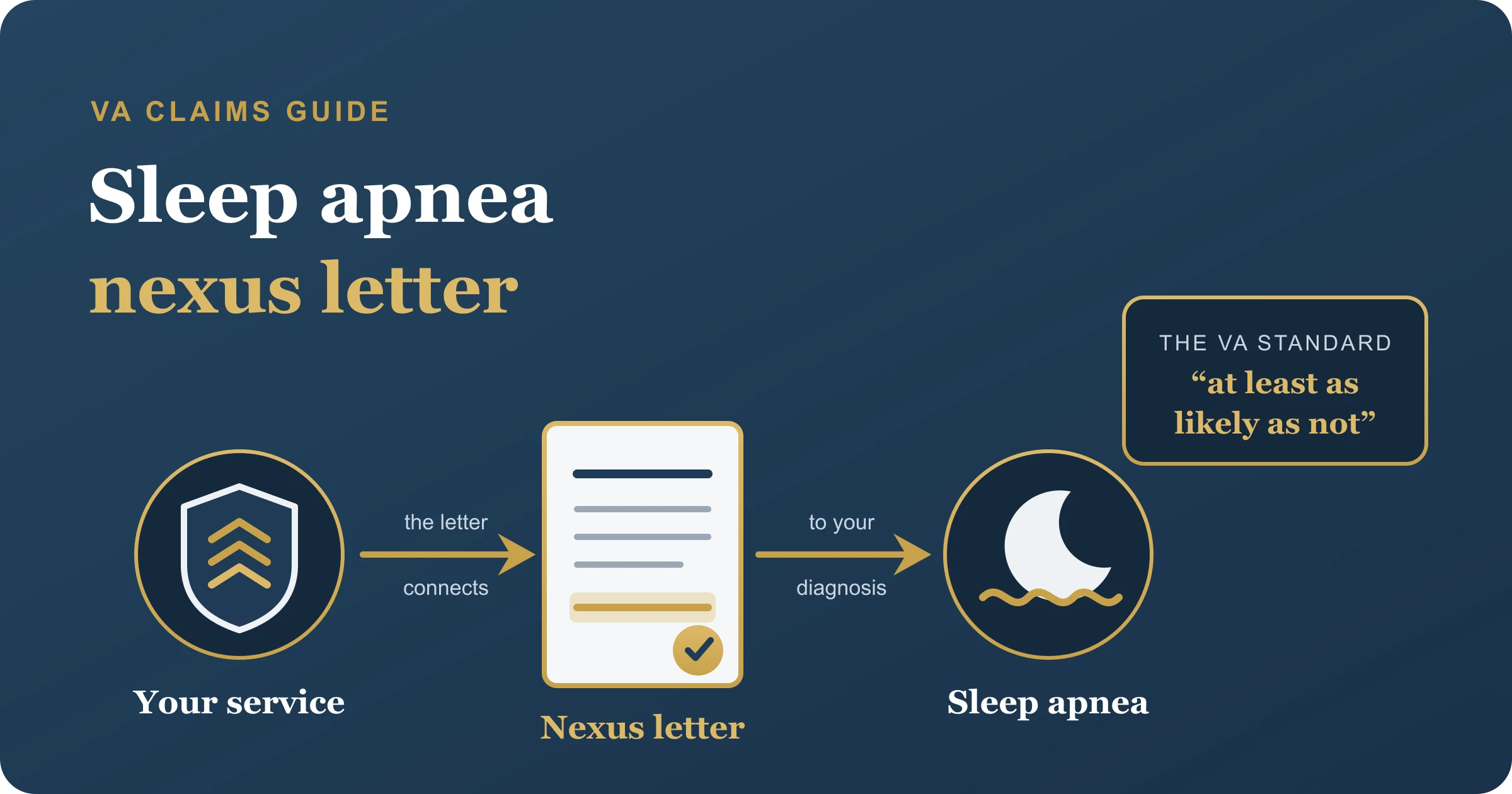
What a Sleep Apnea Nexus Letter Is (and When You Need One)
Nexus is the Latin word for connection, and that is the letter's whole job. It is a written medical opinion from a licensed clinician that connects your diagnosed sleep apnea to your military service, either directly or through another condition the VA has already service-connected. The legal foundation sits in 38 C.F.R. 3.303 for direct service connection and 38 C.F.R. 3.310 for secondary service connection.
You need one whenever the connection is not obvious from your records, which for sleep apnea is nearly always. Most veterans were never diagnosed during service. Sleep apnea develops gradually, service members push through fatigue as a matter of culture, and a snoring complaint rarely makes it into a service treatment record. So the typical file shows a diagnosis years after discharge and nothing tying it back. Without a medical opinion bridging that gap, the VA has little choice but to deny.
A nexus letter is not required by any regulation, and that trips veterans up. The VA will decide your claim without one. But deciding is not granting: when the file contains no medical link, the C&P examiner's opinion is usually the only one in the record, and if it is negative, the claim fails. The letter exists to put a well-reasoned, favorable medical opinion in the file before that happens.
If you are brand new to these documents, start with our primer on what a nexus letter is, or see how one differs from the VA's own exam forms in our guide to nexus letters vs DBQs.
What a Strong Sleep Apnea Nexus Letter Must Include
The VA does not weigh every medical opinion equally. Under the agency's own evidence rules, laid out in the M21-1 adjudication manual, an opinion earns weight from its reasoning, the records it reviewed, and the qualifications behind it. A strong sleep apnea nexus letter has five elements, and missing any one of them costs the letter most of its value.
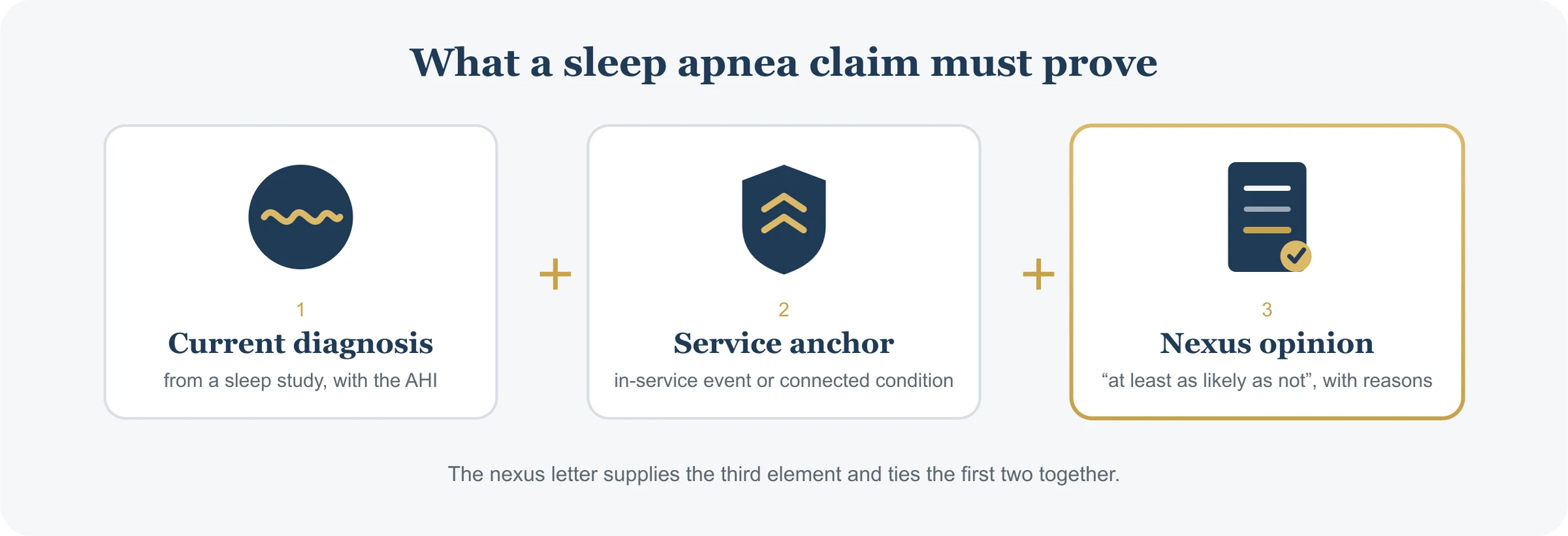
The provider's credentials
Who is writing, their license and specialty, and why they are qualified to opine on a sleep disorder. A pulmonologist, sleep medicine physician, or internist who manages sleep apnea carries natural weight here.
A records review, stated explicitly
The letter should list what was reviewed: service treatment records, the sleep study, VA decisions, and treatment history. An opinion that never says what it looked at reads as a guess.
The diagnosis, anchored to a sleep study
Obstructive sleep apnea confirmed by polysomnography or a home sleep apnea test, with the severity (the AHI). The VA needs the study itself on record; a CPAP prescription alone does not establish the diagnosis.
A reasoned medical rationale
The why. The letter walks from your service history or service-connected condition to the sleep apnea, citing peer-reviewed research where it helps. This is the element examiners can least afford to ignore.
The opinion, in the VA's own standard
A clear statement that the sleep apnea is at least as likely as not related to service or to a service-connected condition. This exact probability threshold is what the VA adjudicates against.
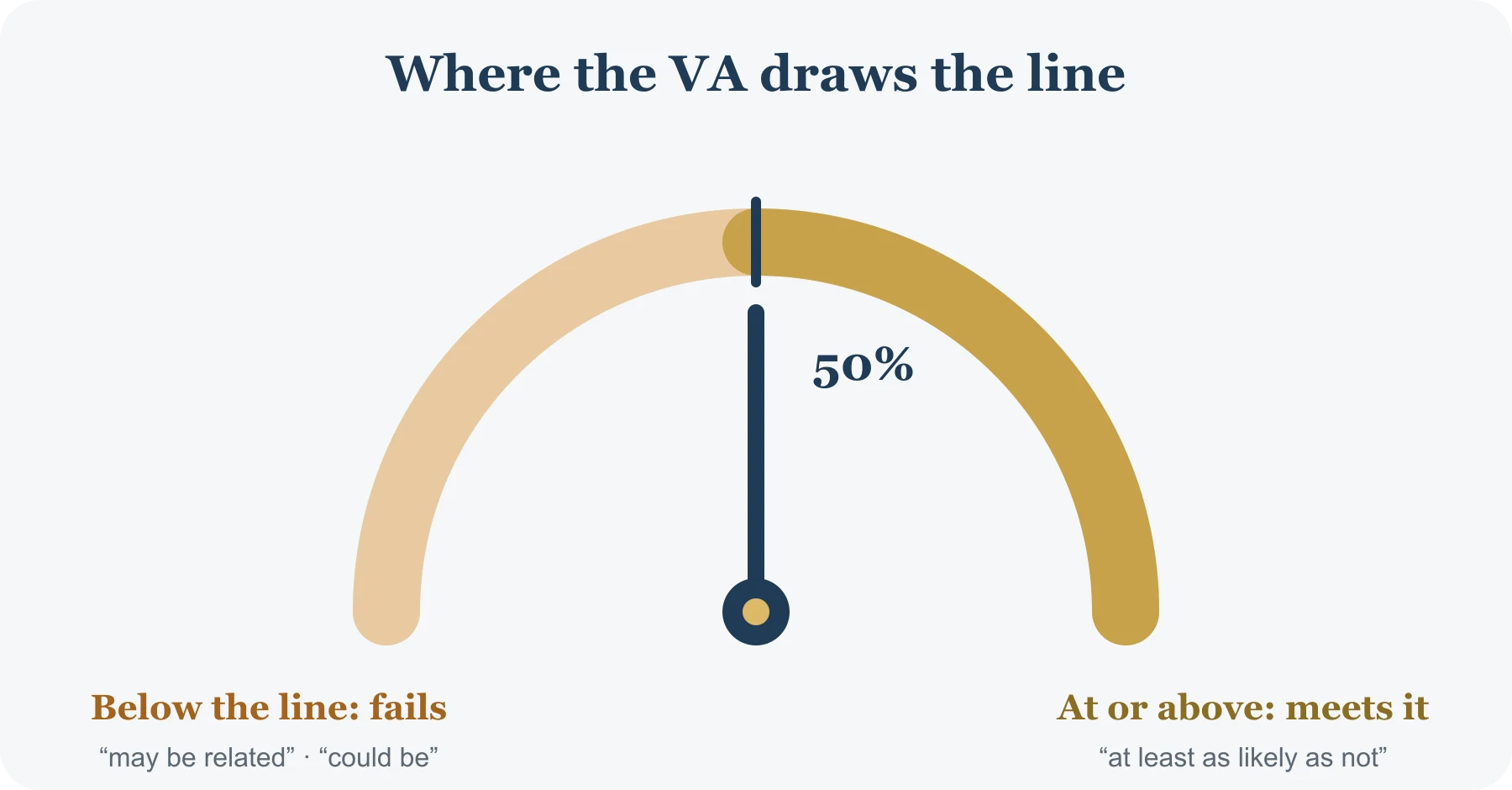
That last element deserves its own spotlight, because wording is where otherwise solid letters fail. The VA's threshold is a 50 percent or greater probability, the benefit-of-the-doubt standard set by 38 U.S.C. 5107(b) and carried out in 38 C.F.R. 3.102. Language that hedges below that line gets a letter set aside.
Language that meets the bar
- “At least as likely as not related to the veteran's military service” Meets the 50 percent threshold. The standard to aim for.
- “More likely than not caused by the veteran's service-connected PTSD” Exceeds 50 percent and names the secondary path. Stronger than the minimum.
Language that fails
- “May be related to the veteran's time in service” A possibility, not a probability. Below the standard.
- “Could possibly be connected to service” The words could and possibly do not meet the 50 percent bar, no matter how strong the reasoning around them.
Any licensed physician can write one, but the VA weighs relevant expertise. See our full breakdown of who can write a nexus letter and the complete list of nexus letter requirements.
How to Get a Sleep Apnea Nexus Letter, Step by Step
Unlike a C&P exam, the VA will not arrange a nexus letter for you. It is private medical evidence you obtain yourself, and the process rewards preparation. Here is the path our physicians see work.
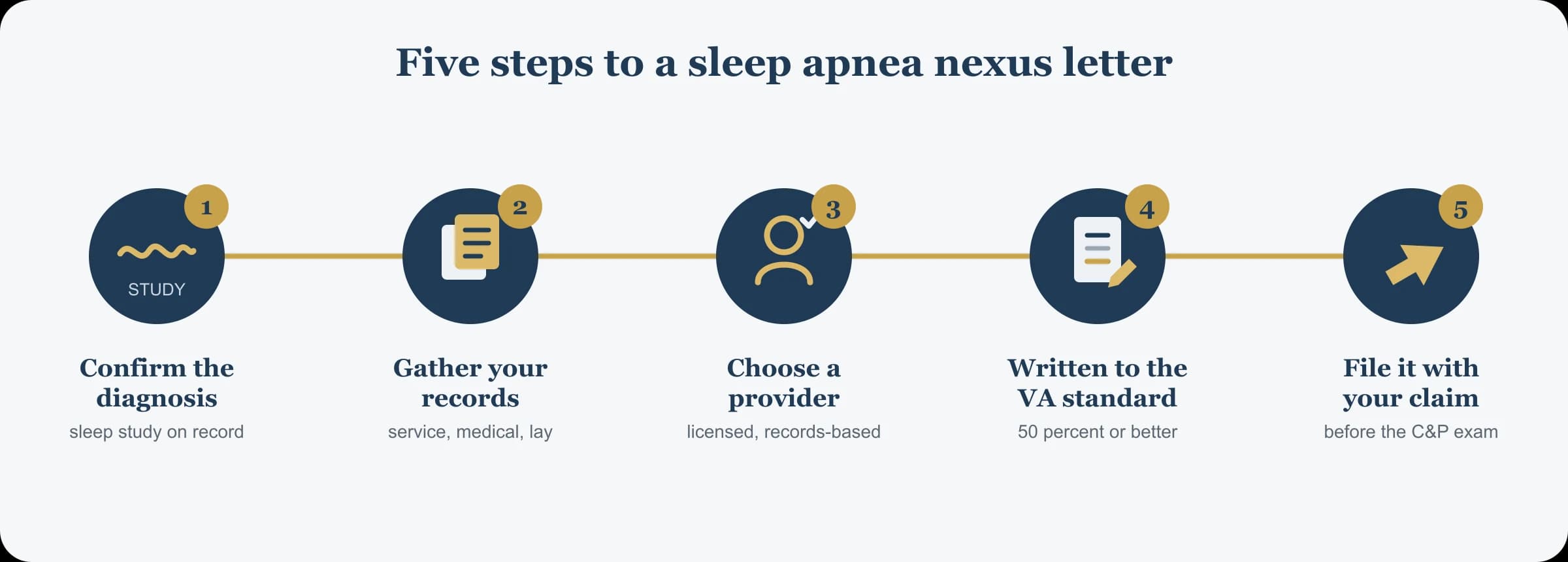
Step 1: Confirm the diagnosis with a sleep study
Everything starts with polysomnography or a VA-accepted home sleep apnea test. If you have never had one, ask your doctor or VA provider for a referral before pursuing a letter; a nexus opinion without a confirmed diagnosis has nothing to connect. If you were tested years ago, get the report itself, not just the CPAP prescription that followed it.
Step 2: Gather your records
Collect your DD-214, service treatment records, the sleep study report, CPAP compliance data, any prior VA decisions, and treatment notes for related conditions such as PTSD, GERD, or weight changes that began in service. Lay statements help too: a spouse who watched you stop breathing at night, or a bunkmate who remembers the snoring, supplies observations no record captures.
Step 3: Choose a qualified provider
Look for a licensed physician who reviews records before opining, explains their reasoning, and knows the VA's probability language. Your VA provider must assist when you ask, under VHA Directive 1134, and may give a causality opinion. That policy also notes VHA providers often lack access to military records and may not be familiar with service-specific health issues, which is one reason veterans often seek an independent opinion as well.
Step 4: Have the letter written to the VA standard
A credible physician will review everything first and give you an honest answer about whether the evidence supports a connection. If it does, the letter states the credentials, the records reviewed, the diagnosis, the rationale, and the opinion at the at-least-as-likely-as-not threshold. If it does not, a good provider tells you that too, before you spend money filing a claim the evidence cannot carry.
Step 5: File it with your claim
Submit the letter with your initial application, a supplemental claim after a denial, or an appeal. Uploading it before any scheduled C&P exam matters: the examiner is required to review the claims file, and a strong opinion already in the file frames the whole exam.
Direct vs Secondary Service Connection for Sleep Apnea
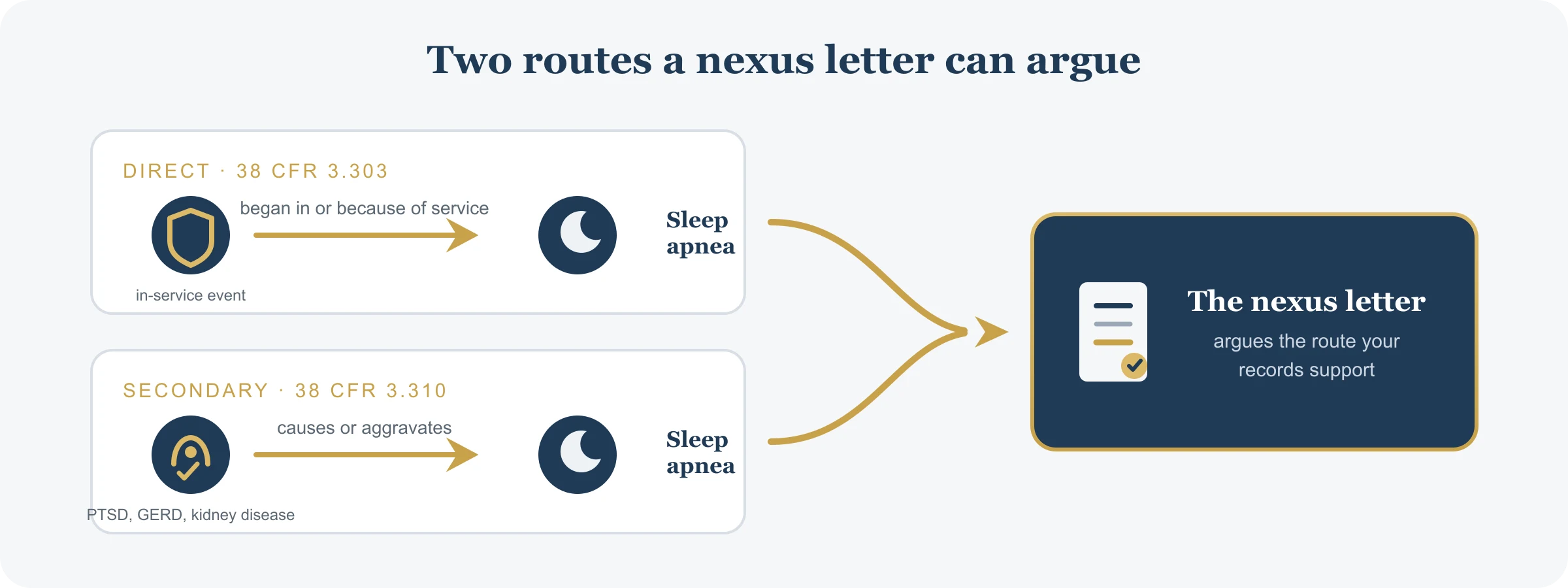
A nexus letter argues one of two routes, and choosing the right one is half the strategy. The letter's reasoning, and the evidence it needs, differ sharply between them.
The direct path
Direct service connection under 38 C.F.R. 3.303 says your sleep apnea began in service or was caused by something that happened there: documented in-service snoring or witnessed apneas, significant in-service weight gain, airborne hazards, or a nose or jaw injury that narrowed the airway. The letter reconstructs the timeline and explains why the condition at least as likely as not had its onset in or because of service.
The direct path is evidence-hungry. Because sleep apnea was rarely diagnosed in service, the letter leans on circumstantial anchors: buddy statements about snoring in the barracks, weight records, deployment exposures, and the medicine of how the condition develops slowly before anyone names it.
The secondary path
Secondary service connection under 38 C.F.R. 3.310 connects your sleep apnea to a condition the VA has already service-connected, either because that condition caused the apnea or because it aggravated it, meaning made it measurably worse. For most veterans this is the stronger route, because the hard part, a service-connected anchor condition, is already established.
PTSD is the most studied anchor, and the research there is more mixed than most sites admit. Our dedicated guide to sleep apnea secondary to PTSD walks through what the studies actually found, including the ones that found no difference. An association is not proof of causation in any single case, which is exactly why the letter matters: it applies the evidence to your records, your timeline, and your body, and states the probability for you specifically.
We keep dedicated guides for the most common secondary claims: sleep apnea secondary to PTSD, secondary to GERD, secondary to kidney disease, and secondary to diabetes. Each one goes deep on that specific mechanism and its evidence.
What One Looks Like: An Annotated Excerpt
Here is what the working parts of a sleep apnea nexus letter look like in practice. This is an illustration of the structure, not a template to copy; a real letter is written from your records by the physician who reviewed them.
Credentials
I am a licensed physician, board-certified in internal medicine, and I regularly diagnose and manage obstructive sleep apnea in my practice.
Records reviewed
I have reviewed the veteran's DD-214, service treatment records, the polysomnography report dated [date] confirming obstructive sleep apnea with an apnea-hypopnea index of [value], and CPAP prescription and compliance records.
The rationale
The service treatment records document witnessed snoring, observed breathing pauses, and daytime somnolence beginning during active duty, alongside a documented weight gain of [value] over the period of service. Those in-service findings are the recognized early presentation of obstructive sleep apnea, and the record shows a continuous symptom course from separation to the confirming sleep study.
The opinion
It is my opinion that the veteran's obstructive sleep apnea is at least as likely as not incurred in or caused by his active military service.
Two things to notice. The opinion sentence uses the VA's exact probability standard, and the rationale walks from evidence to conclusion instead of asserting one. Those two features are what separate a letter the VA weighs from a letter the VA sets aside.
Want the complete version? Our annotated nexus letter example walks through a full letter section by section.
Using Your Nexus Letter at the C&P Exam
After you file, the VA will usually schedule a compensation and pension exam. The examiner reviews your claims file, examines you, and renders their own opinion on the connection. This is where a nexus letter quietly does its most important work: an examiner who opens the file and finds a reasoned, record-based opinion from a qualified physician must engage with it, and the VA's own manual directs adjudicators to weigh competing opinions on their reasoning, not on who wrote them.
Practical points: upload the letter before the exam rather than after, bring your own copy in case the examiner has not seen it, answer questions plainly without minimizing symptoms, and never exaggerate. If the exam goes badly and the claim is denied anyway, the letter remains in your file as the foundation for a supplemental claim or appeal, where a decision reviewer will weigh it fresh.
If the VA denies the claim despite a strong letter, that is not the end. Our guide to whether the VA can reject a nexus letter explains the common reasons and the appeal paths that follow.
Read more in can the VA reject a nexus letter, and see how nexus letters and DBQs interact under VA Directive 1134.
What a Sleep Apnea Nexus Letter Costs
Market prices for a physician-written nexus letter generally run from several hundred dollars to two thousand or more, and the spread reflects real differences: whether the provider actually reviews your records, whether the letter cites research, the writer's credentials, and whether revisions are included if the VA asks for clarification.
Be wary at both ends. A bargain letter produced from a template without a records review can be worse than no letter, because a weak opinion in your file gives the VA something concrete to discount. And a high price does not by itself buy weight; the VA weighs reasoning, not invoices.
Patriot Path charges a flat $1,500 for a physician-written nexus letter, with a free initial consultation, records review included, and an honest answer up front if the evidence will not support an opinion. Details are on our pricing page, and the full scope of what our physicians write is on our services page.
See our flat-rate pricing and our nexus letter services.
Common Mistakes That Sink Sleep Apnea Nexus Letters
Most failed letters fail the same few ways. Every one of these is avoidable, and every one comes from a real denial pattern our physicians see in the files veterans bring us.
No sleep study behind the diagnosis
The VA needs polysomnography or a home sleep test on record. A letter opining on a diagnosis the file cannot document connects nothing to nothing.
Hedged probability language
May be related, could be connected, is possibly due to. Anything below the 50 percent standard fails, and examiners are quick to flag it.
A template letter with no records review
Adjudicators read hundreds of letters and recognize boilerplate instantly. An opinion that never mentions your specific records, dates, or history carries almost no weight.
No rationale, just a conclusion
The doctor believes the conditions are related is a conclusion. Why the doctor believes it, from your records and the medicine, is a rationale. The VA weighs the second and discounts the first.
Arguing the wrong path
Forcing a direct-connection argument when the evidence supports a secondary claim through PTSD or GERD, or vice versa, wastes the letter's strongest material. The route should follow the records, not a formula.
Filing it too late to matter
A letter uploaded after the C&P exam and the decision misses its chance to frame both. It still helps on appeal, but the cheapest win is putting it in the file first.
After Service Connection: How the VA Rates Sleep Apnea
Once service connection is granted, the VA rates sleep apnea under 38 C.F.R. 4.97, Diagnostic Code 6847. As of July 2026 the schedule runs from 0 percent for documented sleep disorder breathing without symptoms, through 30 percent for persistent day-time hypersomnolence, to 50 percent when a breathing assistance device such as a CPAP machine is required, and 100 percent for chronic respiratory failure with carbon dioxide retention or cor pulmonale, or a required tracheostomy. The 50 percent level turns on whether the device is medically necessary, which VA treats as a medical question, rather than on whether you own or consistently use one.
The nexus letter's job ends at service connection; the rating then follows your treatment records. For the full rating breakdown, sleep study details, and how our physicians handle these claims end to end, see the flagship guide below.
Full detail: sleep apnea and VA disability claims, our complete condition page.
Is Your Sleep Apnea Claim Ready for a Nexus Letter?
Score your claim
0 of 6 in hand
Check each item you already have in hand. Your score updates as you go.
A few core pieces are missing. Start with the sleep study; without it there is no diagnosis for a letter to connect.
Have a physician build the missing pieces →Put the Connection on Paper
Your diagnosis is real and your service happened. What the VA needs is the document that connects them. Our physicians review your records for free and tell you honestly whether a nexus letter can carry your claim.
Frequently Asked Questions
What is a nexus letter for sleep apnea?
It is a written medical opinion from a licensed clinician stating that your diagnosed sleep apnea is at least as likely as not connected to your military service, either directly or through a condition the VA has already service-connected. It supplies the medical link the VA needs and your records usually lack.
Do I need a nexus letter to win a sleep apnea claim?
No regulation requires one, but in practice most sleep apnea claims need one. Sleep apnea is rarely diagnosed during service, so the typical file shows a post-service diagnosis with no documented link. Unless a C&P examiner supplies a favorable opinion, a nexus letter is usually the only medical evidence connecting the condition to service.
Who can write a sleep apnea nexus letter?
Any licensed physician or qualified clinician can, but the VA weighs relevant expertise and reasoning. A physician who manages sleep apnea, reviews your actual records, and writes to the VA's probability standard carries the most weight. Under VHA Directive 1134 your VA provider must assist when you ask and may give a causality opinion, though that policy notes its providers often lack access to military records, which is one reason veterans often seek an independent opinion as well.
How much does a sleep apnea nexus letter cost?
Market prices generally run from several hundred dollars to two thousand or more depending on the records review, the credentials, and whether revisions are included. Patriot Path charges a flat $1,500 with a free initial consultation, and our physicians tell you honestly up front if the evidence will not support an opinion.
What should a sleep apnea nexus letter say?
Five things: the provider's credentials, the records reviewed, the diagnosis anchored to a sleep study, a reasoned medical rationale connecting the apnea to service or a service-connected condition, and the opinion stated at the at-least-as-likely-as-not threshold, which is the VA's 50 percent standard.
Can sleep apnea be claimed secondary to PTSD?
Yes, and it is the most common secondary route veterans ask us about. We cover the evidence, the two theories, and what the letter has to prove in our dedicated guide to sleep apnea secondary to PTSD.
Do I need a sleep study for a VA sleep apnea claim?
Yes. The VA requires the diagnosis to be confirmed by a sleep study, meaning polysomnography or an accepted home sleep apnea test. A CPAP prescription alone is not enough, and a nexus letter cannot substitute for the study; it connects a documented diagnosis to service, it does not create the diagnosis.
What VA rating will I get for sleep apnea?
Sleep apnea is rated under Diagnostic Code 6847 at 0, 30, 50, or 100 percent. As of July 2026, the 50 percent level applies when a breathing device such as a CPAP machine is required, which is why it is the most common rating for treated apnea. The rating follows your treatment records once service connection is granted.
Related guides
- Sleep apnea and VA disabilityRatings, sleep studies, DC 6847, and our physician letter service.
- What is a nexus letter?The definitional primer, if you are starting from zero.
- Nexus letter requirementsThe elements the VA looks for in any nexus letter.
- Nexus letter exampleA full annotated sample letter, section by section.
- Who can write a nexus letterWhich providers the VA takes seriously.
- Sleep apnea secondary to PTSDThe most common secondary path for veterans.
- Sleep apnea secondary to GERDWhen reflux drives nighttime airway trouble.
- Sleep apnea secondary to kidney diseaseThe fluid-overload path to a secondary claim.
- Hypertension secondary to sleep apneaThe reverse direction: claiming high blood pressure as a consequence of the apnea.
- Sleep apnea secondary to rhinitisWhen service-connected nasal inflammation restricts nighttime airflow.
- Nexus letters vs DBQsWhat each document does, and when you need both.
Citations & References
- 38 CFR 3.303, Principles relating to service connection (eCFR) https://www.ecfr.gov/current/title-38/part-3/section-3.303
- 38 CFR 3.310, Disabilities that are proximately due to, or aggravated by, service-connected disease or injury (eCFR) https://www.ecfr.gov/current/title-38/part-3/section-3.310
- 38 CFR 3.102, Reasonable doubt (eCFR) https://www.ecfr.gov/current/title-38/part-3/section-3.102
- 38 CFR 4.97, Schedule of ratings, respiratory system, including DC 6847 sleep apnea (eCFR) https://www.ecfr.gov/current/title-38/part-4/section-4.97
- 38 U.S.C. 5107, Claimant responsibility and benefit of the doubt (Cornell LII) https://www.law.cornell.edu/uscode/text/38/5107
- VA disability, evidence needed to support your claim (VA.gov) https://www.va.gov/disability/how-to-file-claim/evidence-needed/
- About VA disability ratings (VA.gov) https://www.va.gov/disability/about-disability-ratings/
- M21-1, Part V, Subpart ii, Chapter 1, Section A: Principles of Reviewing and Weighing Evidence (VA adjudication manual) https://www.knowva.ebenefits.va.gov/system/templates/selfservice/va_ssnew/help/customer/locale/en-US/portal/554400000001018/content/554400000014383/M21-1-Part-V-Subpart-ii-Chapter-1-Section-A-Principles-of-Reviewing-and-Weighing-Evidence
- Sleep apnea overview (NHLBI, NIH) https://www.nhlbi.nih.gov/health/sleep-apnea
- Colvonen PJ, et al. Obstructive Sleep Apnea and Posttraumatic Stress Disorder among OEF/OIF/OND Veterans. J Clin Sleep Med. 2015 (PMC) https://pmc.ncbi.nlm.nih.gov/articles/PMC4410924/
- Peppard PE, et al. Prospective Study of the Association between Sleep-Disordered Breathing and Hypertension. NEJM, 2000 (PMC) https://pmc.ncbi.nlm.nih.gov/articles/PMC12072724/