
VA Secondary Claims
Nexus Letter for Hypertension Secondary to Sleep Apnea
Medically reviewed by the Patriot Path Medical Team
Licensed MD reviewers • Last updated:
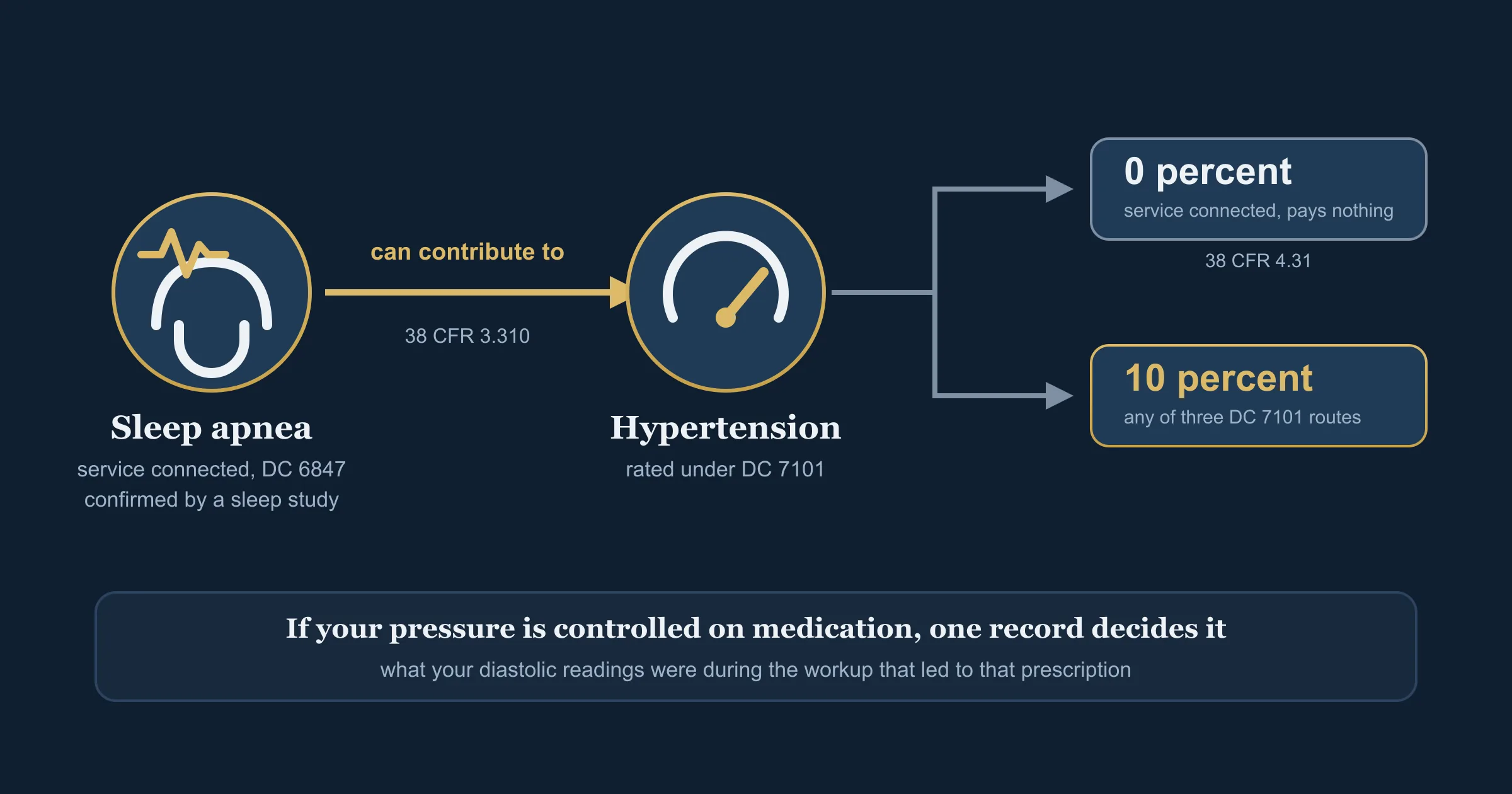
If the VA already service-connects your obstructive sleep apnea, you can claim high blood pressure as secondary to it under 38 CFR 3.310. VA's own adjudication manual expressly contemplates this route, and the two conditions are rated in different body systems, so one does not absorb the other. Here is the part no other page on this topic will tell you, and you should know it before you spend a dollar with anyone. You can win this claim and be paid nothing for it. If your pressure still runs predominantly 100 or more diastolic, or 160 or more systolic, the schedule pays at least 10 percent on those current readings and none of this arises. But once medication has brought your readings into the non-compensable range, whether the claim pays at all turns on what your diastolic pressure was doing during the workup that led to that prescription, and that is a question about your old records rather than about the strength of any letter.
An illustrative example
A veteran has been service-connected for obstructive sleep apnea at 50 percent since 2019, confirmed by a sleep study and treated with CPAP. His primary care physician started him on lisinopril in 2021 after a run of readings in the 150s over 90s. He takes it every day and his pressure now sits around 128 over 78.
He has a real claim. His hypertension was diagnosed after the apnea, it is controlled on continuous medication, and the manual's own exception lets him establish service connection without current qualifying readings because the diagnosis arose secondary to a service-connected disability. What decides the money is whether his pre-medication records show diastolic predominantly 100 or greater. His were in the 90s. On those facts the likely outcome is service connection at 0 percent.
That is not a wasted claim. A 0 percent rating establishes service connection, which protects him if the condition worsens, opens the door to VA care for it, and makes a later worsening an increased-rating claim on an established condition rather than a fresh service-connection fight. It does not backdate that increase to this claim: under 38 CFR 3.400(o)(2) an increase runs from the earliest date the worsening is factually ascertainable if he files within a year of it, and otherwise from the date VA receives the increase claim. But he should hear it before he files, not after.
A composite drawn from common fact patterns, not a real client. It illustrates how the criteria interact, not a predicted outcome.
What this claim has to establish
Secondary service connection is short in the regulation and demanding in practice. 38 CFR 3.310(a) says a disability which is proximately due to or the result of a service-connected disease or injury shall be service connected. Applied here that is three things: sleep apnea the VA already rates, a current diagnosis of hypertension that meets the regulatory definition, and medical evidence connecting the two.
VA states the causation standard in terms most competing pages have not caught up with. M21-1 V.ii.2.D.1.a directs raters to award service connection for disabilities that are the result of, or would not have occurred but for, a service-connected disability. That but-for language comes from M21-1 V.ii.2.D.1.a, which records that in Spicer v. McDonough, 61 F.4th 1360 (Fed. Cir. 2023), the Federal Circuit read the phrase resulting from in 38 USC 1110 as requiring but-for causation. In Spicer itself the parties agreed on that much. What the court decided was that the but-for standard is not confined to onset or etiological causes and reaches a service-connected disability that impedes treatment of another condition, and that 38 CFR 3.310(b), as applied to reject that theory, was inconsistent with the statute.
The same block carries something useful that almost nobody publishes. To establish causation, the primary disability need not be service-connected, or even diagnosed, at the time the secondary disability was incurred, citing Frost v. Shulkin, 29 Vet.App. 131 (2017). So a veteran whose blood pressure started climbing years before the VA finally granted the apnea claim is not barred by the sequence.
There is a second theory alongside causation, and on this pairing it is worth pleading. 38 CFR 3.310(b) covers aggravation: where a non-service-connected condition is made worse by a service-connected one. Hypertension is common and can predate the apnea diagnosis, so the aggravation facts fit some of these cases better than the causation facts do. It has its own evidence requirement, and its own arithmetic, and both are covered further down this page.
For the rating ladder, the other routes to a hypertension claim and the PACT Act presumptive path, see our page on hypertension and VA disability.
For how sleep apnea itself is rated and what a sleep study has to show, see the VA sleep apnea nexus letter guide.
What this claim pays, and why it can pay nothing
This is the most useful thing on this page and the reason it sits above the rest. Most pages on this topic explain how sleep apnea raises blood pressure, or the reverse pairing, and then show you the DC 7101 rating table, and stop there. What they leave out is that this claim can be granted and still evaluated at 0 percent, and what decides which way it goes. VA's own manual names both results in one sentence: where service connection rests on a hypertension diagnosis controlled by medication, the evaluation will be either 0 percent or 10 percent.
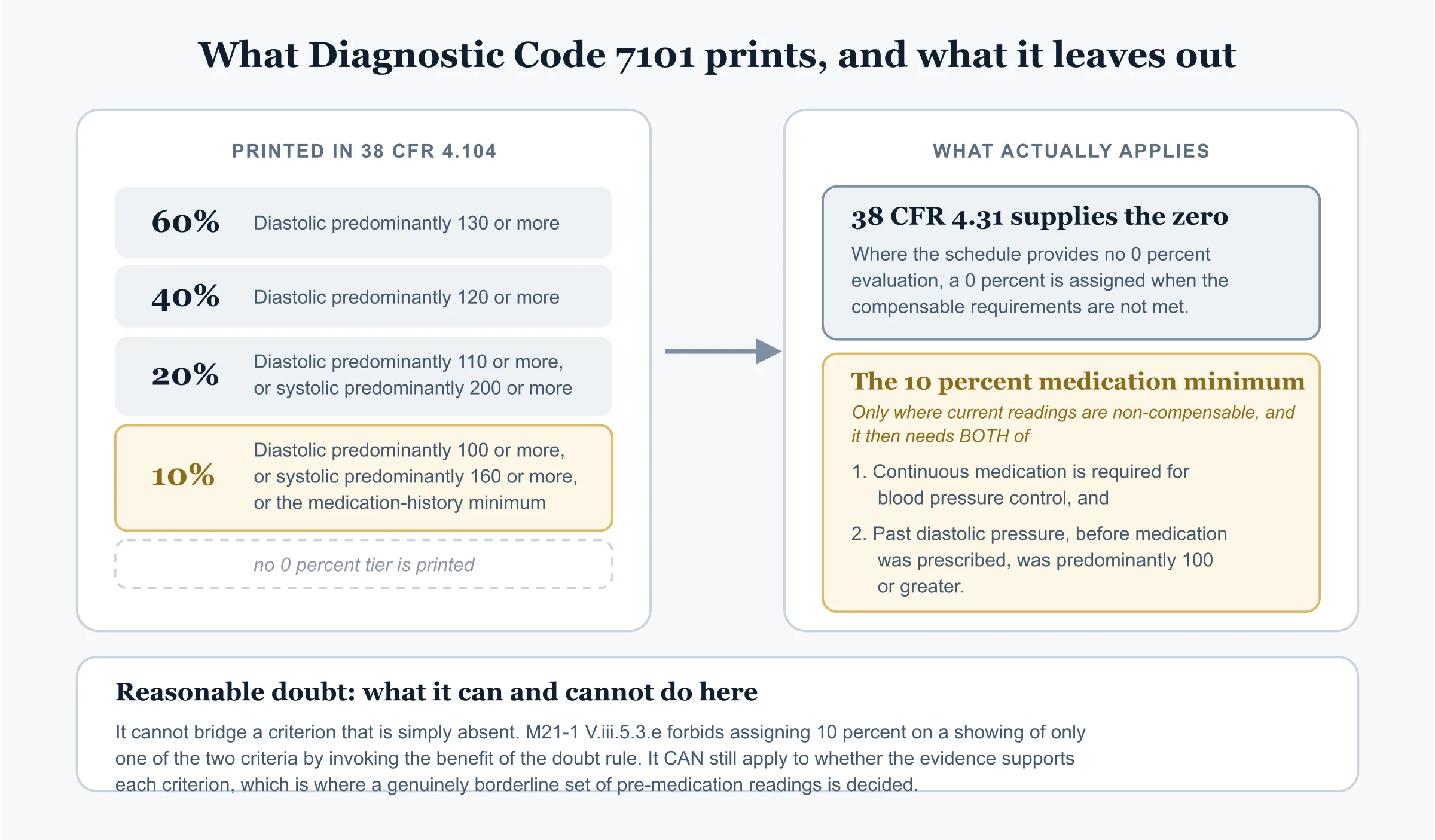
Diagnostic Code 7101 prints no 0 percent tier
The schedule at 38 CFR 4.104 lists four evaluations for hypertensive vascular disease and the lowest printed one is 10 percent: diastolic pressure predominantly 100 or more, or systolic pressure predominantly 160 or more, or a minimum evaluation for an individual with a history of diastolic pressure predominantly 100 or more who requires continuous medication for control. Above that sit 20, 40 and 60 percent. Read the table alone and you would think 10 percent is the floor.
38 CFR 4.31 supplies the missing zero, silently
It is a general provision sitting in a different part of the schedule, and it reads in full: in every instance where the schedule does not provide a zero percent evaluation for a diagnostic code, a zero percent evaluation shall be assigned when the requirements for a compensable evaluation are not met. Nothing in the DC 7101 block points at it. That is why a page that reads only the printed tiers implies a floor that does not exist.
The 10 percent minimum has two conditions and you need both
M21-1 V.iii.5.3.e is the operative text. Where current readings are non-compensable, 10 percent may be assigned if continuous medication is required for blood pressure control, AND past diastolic pressure, before medication was prescribed, was predominantly 100 or greater. Being on medication is not enough on its own. The manual's own worked example is a claimant using prescribed anti-hypertensive medication whose diastolic has never been predominantly 100 or greater.
Reasonable doubt cannot supply a criterion that is simply absent
The manual is unusually blunt here. Do not assign a 10-percent evaluation based upon a showing of one of the two conjunctive criteria above by invoking the benefit of the doubt rule, citing 38 CFR 3.102 and 38 CFR 4.3 or 38 CFR 4.7. Where one criterion is simply not shown, the manual says the evidence is not in relative equipoise and the disability picture does not more nearly approximate the 10 percent criteria.
But reasonable doubt still applies to whether each criterion is met
This is the qualifier that gets dropped, and dropping it makes the rule sound harsher than it is. The same paragraph continues that 38 CFR 3.102, 38 CFR 4.3 and 38 CFR 4.7 may be applicable to whether the evidence supports each criterion, namely whether diastolic readings before were predominantly 100 or higher, or whether continuous medication is required for control. So if your old readings are a genuinely close call between predominantly 100 and predominantly just under it, reasonable doubt is available on that question. What it cannot do is invent a criterion that is not there at all.
The controlling records are narrower than most people expect
Both criteria look backwards, and the manual is specific about which backward-looking readings count. M21-1 V.iii.5.3.e tells the rater to start with the more current of two sets: the readings taken as part of the diagnostic workup leading to the hypertension diagnosis, where medication was prescribed at that time, or the readings from a later workup leading to the prescription. On the 10 percent history question it goes further and says to consider only readings obtained while the veteran was undergoing a diagnostic evaluation for hypertension, and not other clinical records documenting treatment before that evaluation. So a stray high reading from an employment physical will not carry the criterion. The rule cuts both ways, and the second half is the part people miss: normal readings taken long before the diagnosis, and minimally hypertensive readings from before the surveillance that led to the prescription, are excluded too, because the manual says they would impermissibly skew the analysis. Whether you are on medication now is easy to prove. A medical opinion can explain why the apnea contributed to the hypertension, but it cannot change what that workup recorded, and no one selling you a letter can either.
There is a second route to zero, and it comes from the aggravation theory
If you claim on aggravation rather than causation, M21-1 V.ii.2.D.1.h governs the outcome, and it is explicit. Aggravation is established by any increase in severity shown to be the result of a service-connected disability, regardless of whether it would result in a schedular increased evaluation. Where there is credible evidence of an increase but the current and baseline levels would be assigned the same evaluation, the instruction is to grant service connection and assign a noncompensable evaluation. So the aggravation route reaches the same place from a different direction: the entitlement is real and the payment can still be zero.
Why a 0 percent grant is still worth having
Service connection at 0 percent is a real award and not a denial. It establishes the causal link permanently, so if your readings worsen later you are filing for an increase on an established condition rather than starting over. It gives you VA care for that condition. It preserves an effective date. And a 0 percent secondary can matter to other claims down the line, because a service-connected hypertension is itself a lawful primary for a further secondary theory. That is exactly what happened in one of the Board decisions cited below, where the Board granted hypertension secondary to apnea and then remanded a coronary artery disease claim built on top of it.
Two gates come first, and a letter cannot open either one
Before any of the above matters, two things have to be true in your records. Both are stated as prohibitions in VA's manual, which means a rater has no discretion to work around them, and neither is something a nexus letter can supply.
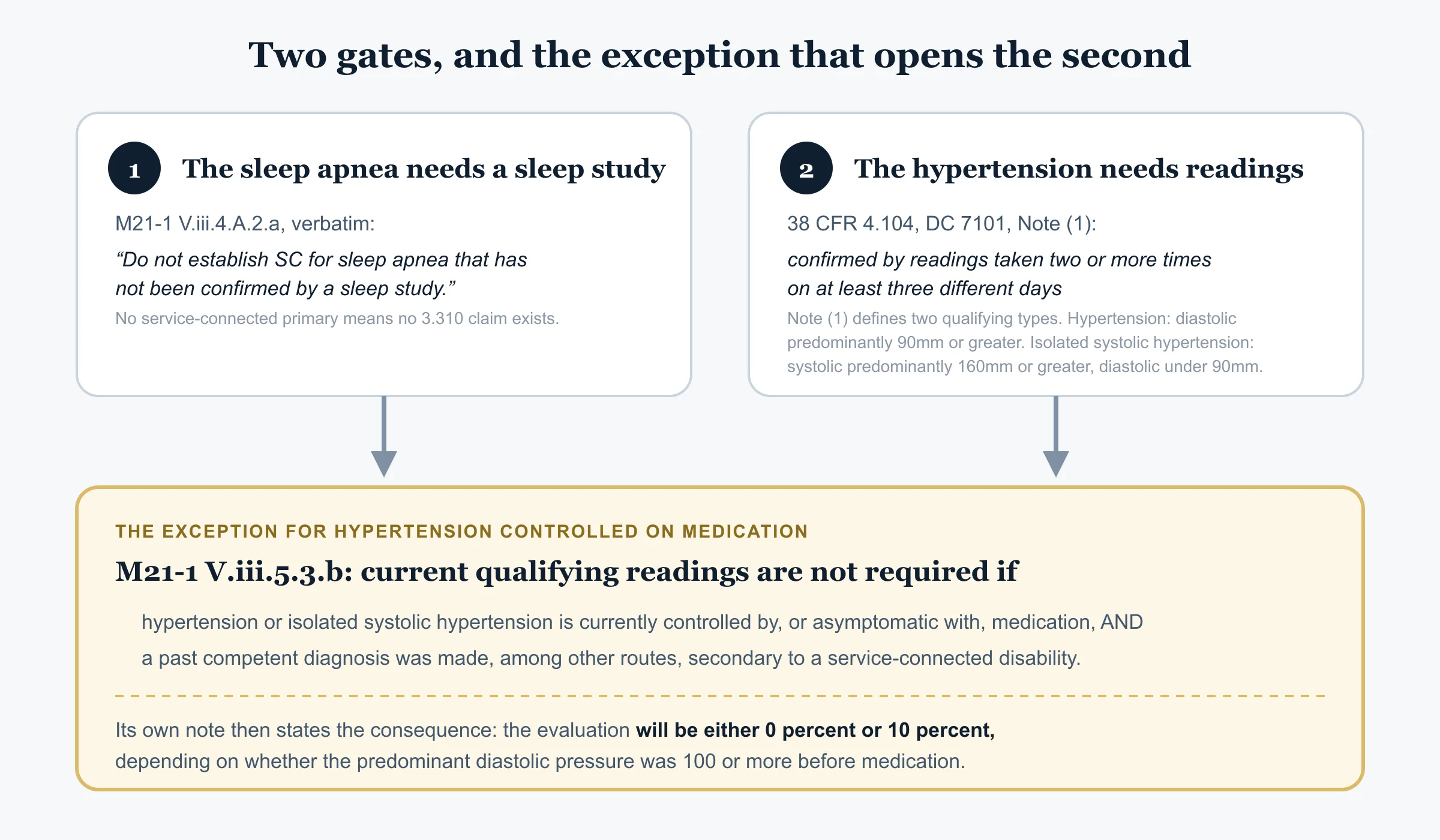
Gate 1: the sleep apnea must be confirmed by a sleep study
M21-1 V.iii.4.A.2.a says it plainly: do not establish service connection for sleep apnea that has not been confirmed by a sleep study. Medical evidence disclosing a diagnosis without a study is enough to trigger VA's duty to schedule an examination, but it is not enough to award service connection. If the apnea is not service-connected, there is no primary disability, and a 3.310 secondary claim built on it does not exist. The manual accepts a home sleep study, but only where it has been clinically determined that you can appropriately be evaluated by one and a competent medical provider has evaluated the results.
Gate 2: the hypertension needs qualifying readings
38 CFR 4.104, DC 7101, Note (1) requires that hypertension be confirmed by readings taken two or more times on at least three different days, and it defines hypertension as diastolic pressure predominantly 90mm or greater. M21-1 V.iii.5.3.c quotes the rulemaking's reason: to assure that the existence of hypertension is not conceded based solely on readings taken on a single, perhaps unrepresentative, day. M21-1 V.iii.5.3.i turns that into an instruction, which is not to establish service connection for hypertension if the evidence does not contain blood pressure readings as specified in Note (1).
The exception that matters most on a secondary claim
There is a route around Gate 2 where the hypertension is already diagnosed and now controlled on medication, and it is the good news on this page. M21-1 V.iii.5.3.b says current qualifying readings are NOT required where the competent evidence shows a diagnosis of hypertension currently controlled by, or asymptomatic with, medication, and a past competent diagnosis was made, among other routes, secondary to a service-connected disability. Its note then states the consequence directly: the percentage will be either 0 percent or 10 percent, depending on whether or not the predominant diastolic pressure was 100 or more before symptoms were controlled with medication. The manual also relaxes the multiple-readings requirement in that situation. Read together with the rest of this page, that means entitlement is not really the open question here. The percentage is.
No, this does not pyramid with your sleep apnea rating
This question is rarely answered on the pages that cover this pairing. The answer is that the two ratings coexist, and it is worth showing how that was checked rather than just asserting it, because the same check is what rules out the traps that do exist elsewhere in the schedule.
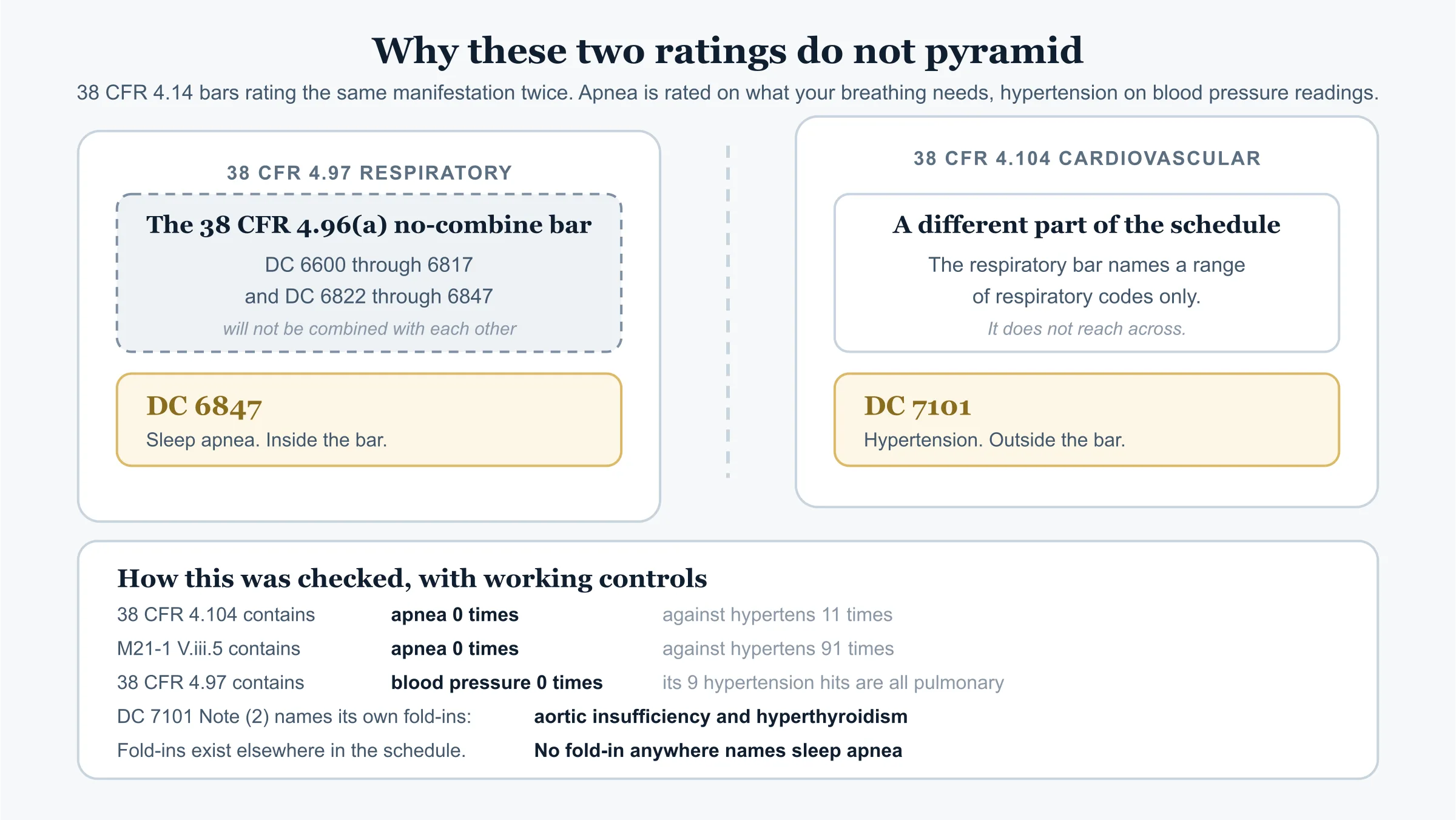
The respiratory no-combine rule does not reach DC 7101
38 CFR 4.96(a) is the provision that stops respiratory conditions stacking, and it is precise about its scope: ratings under diagnostic codes 6600 through 6817 and 6822 through 6847 will not be combined with each other. Sleep apnea is DC 6847 and sits inside that range. Hypertension is DC 7101 and sits in the cardiovascular schedule at 38 CFR 4.104, outside it. The bar simply does not extend there.
38 CFR 4.14 is about manifestations, and these are different ones
The pyramiding rule prohibits the evaluation of the same manifestation under different diagnoses. Sleep apnea is rated on what your breathing needs: a documented sleep disorder breathing at 0 percent, persistent day-time hypersomnolence at 30, a required breathing assistance device such as a CPAP machine at 50, and chronic respiratory failure with carbon dioxide retention or cor pulmonale, or a required tracheostomy, at 100. Hypertension is rated on blood pressure numbers. Those are different manifestations measured by different instruments.
The schedule names its own fold-ins, and apnea is not one
DC 7101 Note (2) says to evaluate hypertension due to aortic insufficiency or hyperthyroidism, which is usually the isolated systolic type, as part of the condition causing it rather than by a separate evaluation. That is the regulation identifying the fold-ins it governs. Note (3) then says to evaluate hypertension separately from hypertensive heart disease and other types of heart disease. Fold-ins do exist elsewhere in the schedule: 38 CFR 4.115 says separate ratings are not to be assigned for disability from disease of the heart and any form of nephritis, subject to two exceptions of its own. Sleep apnea appears in none of them.
The manual's only prohibition on separate evaluation is a different one entirely
M21-1 V.iii.5.3.j is the topic titled Prohibition on Separate Evaluation of Hypertension, and it is about 38 CFR 4.115 renal dysfunction from nephritis, with two exceptions of its own. That is the whole of it. There is no sleep apnea provision.
How that was verified, so you can check it yourself
Rather than searching for a rule and not finding one, we counted. The complete text of 38 CFR 4.104 contains the word apnea zero times and the word sleep zero times, against eleven occurrences of hypertens as a working control. M21-1's cardiovascular chapter contains apnea zero times against ninety-one occurrences of hypertens. The respiratory chapter contains apnea thirty-six times and hypertension only twice, and both of those are pulmonary hypertension in a pulmonary function test context rather than DC 7101. Three independent zero counts with live controls are a stronger statement than one search that came back empty.
What the medical evidence actually shows, stated honestly
The literature linking obstructive sleep apnea to high blood pressure is real, large and consistent. It is also weaker than the way most claim-help pages describe it, and the gap between the two matters, because an opinion that overstates its own sources is the kind an examiner discounts.
The strongest prospective data comes from the Wisconsin Sleep Cohort, published in the New England Journal of Medicine in 2000. In 709 participants followed for four years, with adjustment for baseline hypertension, body-mass index, neck and waist circumference, age, sex, alcohol and cigarettes, the odds of hypertension at follow-up rose with the apnea-hypopnea index in a dose-response pattern: 1.42 (95 percent CI 1.13 to 1.78) at an index of 0.1 to 4.9 events per hour, 2.03 (1.29 to 3.17) at 5.0 to 14.9, and 2.89 (1.46 to 5.64) at 15 or more. The authors' own conclusion is that sleep-disordered breathing is likely to be a risk factor for hypertension. That is deliberately short of a causal claim, and quoting it as one misrepresents the paper.
The Sleep Heart Health Study in JAMA the same year, which described itself on publication as the largest cross-sectional study to date, examined 6,132 people and found an adjusted odds ratio of 1.37 (1.03 to 1.83) comparing the highest apnea-hypopnea index category with the lowest. Its own abstract records the caveat that most pages omit: some of this association was explained by body mass index. Obesity raises the risk of both conditions independently, which is the single hardest confounder on this topic, and an opinion that does not engage with it has left the obvious counter-argument on the table.
On treatment, the evidence is more modest still. The HIPARCO randomized trial in JAMA in 2013 studied 194 patients with resistant hypertension and an apnea-hypopnea index of 15 or higher. After twelve weeks, CPAP produced a 3.1 mm Hg greater fall in 24-hour mean blood pressure (0.6 to 5.6, P=.02) and 3.2 mm Hg in 24-hour diastolic (1.0 to 5.4, P=.005). The change in 24-hour systolic pressure was 3.1 mm Hg but not statistically significant (-0.6 to 6.7, P=.10). A 2014 Chest meta-analysis of 29 randomized trials against passive comparators, covering 1,820 patients, found net reductions of 2.6 mm Hg systolic and 2.0 mm Hg diastolic, which its authors describe as a low effect size.
The American Heart Association's 2021 scientific statement in Circulation recommends screening for obstructive sleep apnea specifically in patients with resistant or poorly controlled hypertension. It is a synthesis of existing guidance rather than new primary evidence, and it is worth citing for what it is.
Set against all of it is a sentence from VA's own manual that no competitor quotes. M21-1 V.iii.5.3.i carries the note that the cause of hypertension is unknown in the vast majority of cases. That is not a reason to abandon the claim. It is the reason a persuasive opinion argues your particular chronology, your particular apnea severity and your particular records, rather than reciting population statistics that describe everybody and nobody.
What this evidence does not support
It does not support the claim that treating your apnea will fix your blood pressure, and you should be wary of any page or letter that says so. The measured treatment effect is a few millimetres of mercury on average, the systolic result in the best resistant-hypertension trial did not reach significance, and the observational association is partly explained by body weight. Never change, stop or start any medication because of something you read here or because you think it will help a claim. That is a decision for you and your prescriber on medical grounds alone.
Aggravation, and why it matters more on this claim than most
Hypertension is common and frequently predates the apnea diagnosis. That makes 38 CFR 3.310(b) aggravation the theory that fits a lot of these cases better than pure causation, and it comes with an evidence requirement that decides claims on its own.
One of the regulation's two deductions is no longer applied, and the other still is
38 CFR 3.310(b) recites two deductions in a single sentence: the rating activity determines the extent of aggravation by deducting the baseline level of severity, as well as any increase in severity due to the natural progress of the disease, from the current level. VA has stopped applying one of them and kept the other. M21-1 V.ii.2.D.1.a records that following Spicer v. McDonough, VA will apply the broader but-for standard and will no longer consider natural progress of the non-service-connected disability when deciding a claim based on aggravation, and adds that permanent worsening is not required. The baseline deduction is untouched. Cite each source for what it says: the regulation's text is one thing and VA's current instruction is another.
The baseline is the whole claim
38 CFR 3.310(b) says VA will not concede aggravation unless the baseline level of severity of the non-service-connected condition is established by medical evidence created before the onset of aggravation, or by the earliest medical evidence created between the onset of aggravation and the evidence establishing the current level. M21-1 V.ii.2.D.1.c adds a third route that is easy to miss: any other credible evidence, including lay evidence, that supports establishment of the baseline. Lay evidence alone may not be sufficient, but it can support the baseline and can trigger further development.
No baseline means no claim, and VA is told not to assume one
M21-1 V.ii.2.D.1.f is direct about the consequence: if no baseline can be established, no aggravation can be demonstrated, and the claim based on aggravation must be denied. It also instructs raters not to assume a baseline of 0 percent when one cannot be established, and it is worth being precise about which way that runs. Because the evaluation is calculated by deducting the baseline from the current level, a baseline of 0 percent would produce the largest award available, so the instruction operates against the claimant rather than for him. The protection is in the sentence before it: a claim alleging aggravation should only be denied for lack of baseline evidence after VA's duty to assist has been fulfilled, and that duty requires development for baseline evidence, which may include requesting an examination or medical opinion. The same paragraph also requires the rating decision narrative to explain why the degree of aggravation cannot be determined. A denial where VA never developed for a baseline, or never explained the gap, is a ground to raise rather than a closed door.
What an aggravation grant actually pays, and why it can be nothing
M21-1 V.ii.2.D.1.g is the topic that sets the percentage, and it is the arithmetic behind the second route to zero described further up this page. The rating activity determines the percentage evaluations that would be warranted for both the baseline and the current levels of severity under the rating schedule, and deducts the baseline from the current level to calculate the evaluation to assign. On DC 7101, whose tiers are 10, 20, 40 and 60, two blood pressure pictures frequently land on the same rung. When they do, the difference is zero, which is exactly why M21-1 V.ii.2.D.1.h then directs that VA grant service connection and assign a noncompensable evaluation. Aggravation is established by any increase in severity shown to be the result of a service-connected disability, regardless of whether it would produce a schedular increase, and the degree of disability after aggravation does not have to be one level higher than the baseline.
The manual lists what an opinion has to address
M21-1 V.ii.2.D.1.e sets out what an examiner's report must separately address to be adequate on an aggravation claim: the current level of severity of the non-service-connected disability; an opinion on whether there has been any increase in severity that would not have occurred but for the service-connected disability, or whether the condition would have been less severe but for it, including where the service-connected disability has interfered with or impeded treatment; and an adequate analysis with medical considerations supporting the opinion. That is a checklist written by the adjudicator, and a private opinion that answers all three is answering the questions the rater has been told to look for.
Plead both theories
Causation under 3.310(a) and aggravation under 3.310(b) are alternatives, not a choice you have to make in advance. Plead both, give each its own rationale, and let the adjudicator take whichever the record supports. One of the two Board decisions below made its finding of fact in exactly that form, that the hypertension was caused by or is aggravated by the sleep apnea.
Two Board decisions, and what they actually decided
Both of these are grants of service connection. Neither is a grant of a percentage, and the difference is the whole point of this page. They are included because of what they show about the opinions themselves.
Citation Nr 1520878 (2015)
Entitlement to service connection for hypertension, secondary to sleep apnea, is granted.
This is the more instructive of the two, because the record contained two private letters and the Board reasoned from only one of them. Their scope was not the same. A June 2008 letter from one physician addressed the sleep apnea alone, opining that it was secondary to the veteran's service-connected postoperative deviated septum, and the Board noted simply that he did not provide a detailed rationale for that opinion. It did not reject that letter, weigh it against anything, or find it inadequate, and the sleep apnea claim it supported was granted.
A July 2009 letter from a second physician was credited. The Board found it adequate because he thoroughly reviewed the veteran's medical records, discussed the relevant evidence, and provided a thorough supporting rationale for the conclusions reached. What that looked like in practice: he read the 2001 and 2008 sleep studies, traced a history of inflamed nasal turbinate membranes from jet fume exposure, explained how that combined with the deviated septum, and only then reached the hypertension, explaining that epidemiologic data indicated sleep apnea increased blood pressure and that over time this could cause functional and structural cardiovascular changes predisposing to hypertension.
The VA examination in the file was set aside, and it is worth being precise about what it addressed. The November 2008 examiner opined that the sleep apnea and hypertension were not related to the veteran's active service, which is the direct theory rather than the secondary one this page is about. The Board found the report incomplete because no rationale was offered, and specifically because on the sleep apnea question the examiner simply listed risk factors rather than addressing why, in this case, the apnea was not related to the deviated septum. Having found it inadequate, the Board held it could not be used for rating purposes and in any event found it less persuasive than the more detailed private opinion.
Two things are worth taking from it. The letter the Board reasoned from was the one that reached the whole chain and supplied a rationale for it, and an opinion that never reaches the hypertension link cannot carry a hypertension claim however well argued the rest of it is. And the primary condition here was itself secondary to something else, so a chain of secondaries is a recognised structure rather than an exotic argument.
Citation Nr 22057353 (2022)
Service connection for hypertension, as secondary to service-connected obstructive sleep apnea, is granted.
The more recent decision, and a more qualified illustration. The veteran submitted a July 2022 private etiological opinion. The Board found it based on a claims-file review with a reasonable medical basis and said that, absent probative evidence to the contrary, it was not in a position to further question the opinion, citing Colvin v. Derwinski. It concluded there was probative evidence that the hypertension was secondary to the service-connected obstructive sleep apnea.
Read carefully, though, because it is not quite the opinion it appears to be. The physiology the Board recites is expressly tinnitus physiology. The examiner described patients with tinnitus suffering sleep fragmentation, and fragmentation due to tinnitus producing increased sympathetic hormone release and baroreflex changes that raise systolic and diastolic pressure, before concluding that the hypertension was a direct result, in pertinent part, of the service-connected obstructive sleep apnea. Nothing in that recited mechanism attaches the fragmentation to the apnea, which reads as material carried over from the same author's tinnitus opinion in the same case. What is left connecting the apnea itself to blood pressure is the point the Board records as additional reasoning: a long-established association in the literature between a rising apnea-hypopnea index and rising blood pressure.
The honest lesson is narrower than it first looks. The examiner stated the hypertension link above equipoise, as much more likely, and nothing in the record contradicted it, so the Board said it was not in a position to question the opinion further. The at-least-as-likely-as-not formulation appears in this decision on the sibling issue, apnea secondary to tinnitus, not on the hypertension one. Against a VA examiner who had written a reasoned negative opinion, the same letter would have had considerably more work to do.
One further detail is useful for planning. Having granted hypertension secondary to the apnea, the Board remanded a coronary artery disease claim pleaded as secondary to that newly service-connected hypertension. A 0 percent hypertension grant can still be the foundation of a later claim.
Board of Veterans' Appeals decisions are not precedent. 38 CFR 20.1303 provides that prior Board decisions are considered binding only with regard to the specific case decided, and that each case is decided on the basis of the individual facts in light of applicable law. These are illustrations of reasoning, not authority you can rely on.
What a strong letter contains for this claim specifically
The general elements of a nexus letter are covered on our primer. What follows is narrower: the seven things that decide a hypertension-secondary-to-apnea claim in particular, most of which turn on records rather than on argument, and none of which a generic template would prompt an author to address.
- The pre-medication blood pressure history, in numbersThis matters only where the current readings are non-compensable, and in that situation it is the single most important record on the claim and the one most often missing. The opinion should recite the actual readings from the diagnostic workup that led to the hypertension diagnosis, or from the later workup that led to the first antihypertensive prescription, with dates and sources, because M21-1 V.iii.5.3.e makes the 10 percent minimum turn on whether past diastolic pressure was predominantly 100 or greater before medication and tells the rater to weigh only readings from that workup window. If the readings are borderline, say so and set out the range, because reasonable doubt is available on whether a criterion is met even though it cannot supply a criterion that is absent.
- Engagement with body weight, not silence about itThe Sleep Heart Health Study says on its face that some of the association was explained by body mass index. An examiner who knows the literature knows that, and an opinion that never mentions weight looks like it is avoiding the obvious objection. The stronger move is to address it directly: the veteran's weight history, whether his blood pressure tracked his apnea severity independently of it, and what the Wisconsin cohort's adjustment for body-mass index, neck and waist circumference actually controlled for.
- This veteran's chronology, not the population dataVA's own manual records that the cause of hypertension is unknown in the vast majority of cases, so an opinion built entirely on general literature is arguing something the manual has already conceded is usually unknowable. What makes an individual case persuasive is sequence and severity: when the apnea began, how severe the sleep study showed it to be, when the pressures started to climb, and whether they tracked periods of untreated or poorly controlled apnea.
- Both theories, argued separatelyCausation under 3.310(a) and aggravation under 3.310(b), each with its own rationale. For the aggravation branch, answer the three questions M21-1 V.ii.2.D.1.e tells the adjudicator to look for: the current severity, whether the increase would not have occurred but for the service-connected condition or whether the condition would have been less severe but for it, and an analysis with medical considerations supporting the opinion.
- A stated baseline, or an honest account of why one cannot be fixedBecause M21-1 V.ii.2.D.1.f requires an aggravation claim to be denied where no baseline can be established, the opinion should identify the baseline evidence explicitly rather than leaving the rater to hunt for it. Where the pre-apnea records are genuinely thin, the manual permits any other credible evidence, including lay evidence, to support the baseline, so a spouse's or coworker's account of the period is worth gathering rather than dismissing.
- A rationale, not a conclusionIn Citation Nr 1520878 the Board rested its grant on the private opinion that reviewed the records, worked through the chronology and supplied a thorough rationale. Of the earlier private letter it said only that the physician did not provide a detailed rationale, and it went no further than that; both claims were granted, so the thinner letter did not sink the case, it simply was not the one the Board reasoned from. The VA examination in the same file fared worse and was set aside as inadequate, because the examiner listed generic risk factors instead of addressing why, in this veteran, the conditions were unrelated. A letter that says at least as likely as not and stops has done the easy half.
- Honesty about the percentageAn opinion is about causation, not about what the claim will pay, and it should not promise a rating. But you should go in knowing which outcome your records point to, because that is what tells you whether this claim is worth pursuing now or whether the better first step is gathering the older readings.
Is this claim ready to file
The first three items are absolute prerequisites rather than points, stated as the manual states them and including the controlled-on-medication exception set out above, and none of them is something a nexus letter can supply. The fourth decides what the claim is likely to pay, but only where medication has already brought your readings into the non-compensable range. The rest is the evidence that makes the claim stronger.
0 of 8 in hand, but a requirement is not met yet
Start with the sleep apnea. A secondary claim under 38 CFR 3.310 attaches to a disability the VA has already service-connected, and VA's manual instructs raters not to establish service connection for sleep apnea that has not been confirmed by a sleep study. If you have never had a study, that is a conversation with your provider rather than a purchase. If you have had one but the apnea is not yet service-connected, that claim comes first and no nexus letter can substitute for it.
Nothing to buy at this stage. When that piece is in place, our page on hypertension and VA disability covers the rating ladder and the other routes to a claim.
Start with a free consultation
We will look at your sleep study, your service-connected rating and your blood pressure history, and tell you what the claim needs before anyone writes anything. On this claim that includes telling you what it is likely to pay. If the answer is that your records point to 0 percent, or that you need a sleep study before any of this is possible, that is what we will say.
Frequently Asked Questions
Can I really win this claim and be paid nothing?
Yes, and it is the outcome most pages on this topic leave out. Diagnostic Code 7101 prints no 0 percent tier, so 38 CFR 4.31 supplies one whenever the requirements for a compensable evaluation are not met. This only arises once your readings are controlled: if your current pressure still runs predominantly 100 or more diastolic or 160 or more systolic, those readings set the evaluation on their own. Where they are non-compensable, reaching the 10 percent minimum needs two things together: continuous medication for control, and past diastolic pressure predominantly 100 or greater before that medication was prescribed. If your pre-medication readings were in the 90s, service connection at 0 percent is the likely result. That is still a real award. It establishes the connection permanently, preserves an effective date, gives you VA care for the condition, and can serve as the primary for a further secondary claim later.
Will a separate hypertension rating pyramid with my sleep apnea rating?
No. 38 CFR 4.96(a), the rule that stops respiratory conditions stacking, applies only to diagnostic codes 6600 through 6817 and 6822 through 6847. Sleep apnea is DC 6847 and sits inside that range; hypertension is DC 7101 and sits in the cardiovascular schedule at 38 CFR 4.104, outside it. 38 CFR 4.14 bars evaluating the same manifestation under different diagnoses, and these are different manifestations: apnea is rated on what your breathing needs, hypertension on blood pressure readings. DC 7101 Note (2) names its own fold-ins, hypertension due to aortic insufficiency or hyperthyroidism, and sleep apnea is not one of them. Fold-ins do exist elsewhere in the schedule, such as the 38 CFR 4.115 bar on separately rating heart disease and any form of nephritis, subject to its own two exceptions, but none of them names sleep apnea. Where the hypertension is compensable, the two evaluations then combine under 38 CFR 4.25, which is combining rather than adding.
My sleep apnea was diagnosed by my doctor but I never had a sleep study. Can I still do this?
Not yet, and this is worth sorting out before anything else. M21-1 V.iii.4.A.2.a instructs raters not to establish service connection for sleep apnea that has not been confirmed by a sleep study. Without service connection for the apnea there is no primary disability, and a secondary claim under 38 CFR 3.310 has nothing to attach to. A diagnosis without a study is enough to trigger VA's duty to schedule an examination, but not enough to award the claim. The manual does accept a home sleep study, provided it has been clinically determined that you can appropriately be evaluated by one and a competent medical provider has evaluated the results. Ask your provider about a study first; that is the step that unlocks everything else.
My blood pressure is well controlled now. Does that disqualify me?
No, and there is a specific provision for your situation. M21-1 V.iii.5.3.b says current readings meeting the regulatory definition are not required where the evidence shows a diagnosis of hypertension currently controlled by, or asymptomatic with, medication, and a past competent diagnosis was made secondary to a service-connected disability. The manual also relaxes the multiple-readings requirement in that case. Its own note states what follows: the percentage will be either 0 percent or 10 percent, depending on whether the predominant diastolic pressure was 100 or more before symptoms were controlled with medication. So being controlled does not cost you the entitlement. It moves the question to your older records.
How strong is the evidence that sleep apnea causes high blood pressure?
Strong enough to support an opinion and not strong enough to call it settled causation, and the difference matters when an examiner reads your letter. The Wisconsin Sleep Cohort followed 709 people for four years and found a dose-response relationship, with adjusted odds of hypertension rising from 1.42 at a low apnea-hypopnea index to 2.89 at an index of 15 or more. The authors' own conclusion was that sleep-disordered breathing is likely to be a risk factor. The Sleep Heart Health Study of 6,132 people found an adjusted odds ratio of 1.37 and stated in its abstract that some of the association was explained by body mass index. On treatment, a randomized trial in resistant hypertension found CPAP lowered 24-hour mean and diastolic pressure by about 3 mm Hg while the systolic change was not statistically significant, and a meta-analysis of 29 trials found reductions its authors call a low effect size. VA's manual adds that the cause of hypertension is unknown in the vast majority of cases. A good letter argues your chronology rather than overstating the population data.
My high blood pressure came before my sleep apnea was diagnosed. Am I out of luck?
No, and there are two separate answers. First, on causation, M21-1 V.ii.2.D.1.b records that the primary disability need not be service-connected, or even diagnosed, at the time the secondary disability was incurred, citing Frost v. Shulkin. Apnea often goes undiagnosed for years while it is already doing its work. Second, if the hypertension genuinely predates the apnea, aggravation under 38 CFR 3.310(b) is the theory that fits those facts. It needs a documented baseline of how severe the hypertension was beforehand, because M21-1 V.ii.2.D.1.f instructs raters to deny an aggravation claim where no baseline can be established, and tells them not to assume a baseline of 0 percent. Plead both theories and let the adjudicator choose.
Does the natural progression of my hypertension get deducted?
Not any more, and this is a place where the regulation's text and VA's current practice have come apart. 38 CFR 3.310(b) still recites a deduction for the natural progress of the disease. M21-1 V.ii.2.D.1.a records that following Spicer v. McDonough, 61 F.4th 1360 (Fed. Cir. 2023), VA will apply the broader but-for standard and will no longer consider natural progress when deciding a claim based on aggravation. The same note adds that permanent worsening is not required. Be careful not to read that too widely, though, because 3.310(b) recites two deductions and VA dropped only one. The baseline deduction stays: M21-1 V.ii.2.D.1.g tells the rater to work out the evaluation your hypertension would warrant at its baseline level and at its current level and to assign the difference. That is the arithmetic that produces a 0 percent aggravation grant whenever both levels land on the same rung of DC 7101.
Should I go on CPAP or change my medication to help the claim?
No. Never start, stop or change any treatment because of a disability claim. Whether you use CPAP and what medication you take are medical decisions for you and your prescriber on medical grounds alone, and the evidence would not support doing it for claim reasons anyway: the measured blood pressure effect of CPAP in randomized trials is a few millimetres of mercury on average. Your claim is decided on what your records show, not on what you do after reading a web page.
Can I claim this if my sleep apnea is itself secondary to something else?
Yes. A chain of secondaries is a recognised structure. In Citation Nr 1520878 the Board granted sleep apnea as secondary to a service-connected postoperative deviated septum and, in the same decision, granted hypertension as secondary to that sleep apnea. In Citation Nr 22057353 the apnea was itself granted as secondary to service-connected tinnitus before the hypertension was granted on top of it. Board decisions are not precedent under 38 CFR 20.1303, so treat these as illustrations of reasoning rather than authority, but the structure is ordinary.
What rating does hypertension secondary to sleep apnea usually get?
There is no usual figure and anyone quoting one is guessing. The evaluation turns on blood pressure numbers under DC 7101, and 10 percent has three independent routes: diastolic predominantly 100 or more, or systolic predominantly 160 or more, or, as a minimum evaluation, a history of diastolic predominantly 100 or more in a veteran who requires continuous medication for control. Above that sit 20 percent at diastolic predominantly 110 or systolic predominantly 200, 40 percent at diastolic predominantly 120, and 60 percent at diastolic predominantly 130. If your current readings still reach one of the first two routes, they decide it. For a veteran whose pressure is controlled on medication, the realistic range is 0 or 10 percent, and which one depends on the workup readings from before that medication rather than on anything in a letter.
What does a nexus letter from Patriot Path cost?
One flat fee of $1,500, and the first consultation is free. On this particular claim we would rather use that consultation to look at your pre-medication readings first. If they show the claim is heading for 0 percent, we will tell you that before you decide whether to proceed, and if your apnea has never been confirmed by a sleep study we will tell you to start there instead, because no opinion can substitute for it.
Related guides
- Nexus letter for hypertension secondary to PTSDThe same rating mechanics with a different primary. Worth reading if PTSD is also service-connected, because the two theories can be pleaded together.
- VA sleep apnea nexus letter guideThe hub for sleep-apnea claims, including how DC 6847 is rated and what a sleep study has to show.
- Nexus letter for sleep apnea secondary to kidney diseaseA sibling spoke in the same cluster, running in the opposite direction.
- Why you need a nexus letter for a secondary conditionThe umbrella page on how secondary claims work under 38 CFR 3.310.
Citations & References
- 38 CFR 4.104, Schedule of ratings, Cardiovascular system (Diagnostic Code 7101) (eCFR) https://www.ecfr.gov/current/title-38/section-4.104
- 38 CFR 4.97, Schedule of ratings, Respiratory system (Diagnostic Code 6847) (eCFR) https://www.ecfr.gov/current/title-38/section-4.97
- 38 CFR 4.31, Zero percent evaluations (eCFR) https://www.ecfr.gov/current/title-38/section-4.31
- 38 CFR 3.400, Effective dates, including increases (eCFR) https://www.ecfr.gov/current/title-38/section-3.400
- 38 CFR 4.96, Special provisions regarding evaluation of respiratory conditions (eCFR) https://www.ecfr.gov/current/title-38/section-4.96
- 38 CFR 4.14, Avoidance of pyramiding (eCFR) https://www.ecfr.gov/current/title-38/section-4.14
- 38 CFR 4.25, Combined ratings table (eCFR) https://www.ecfr.gov/current/title-38/section-4.25
- 38 CFR 4.3, Resolution of reasonable doubt (eCFR) https://www.ecfr.gov/current/title-38/section-4.3
- 38 CFR 4.7, Higher of two evaluations (eCFR) https://www.ecfr.gov/current/title-38/section-4.7
- 38 CFR 3.310, Disabilities that are proximately due to, or aggravated by, service-connected disease or injury (eCFR) https://www.ecfr.gov/current/title-38/section-3.310
- 38 CFR 3.102, Reasonable doubt (eCFR) https://www.ecfr.gov/current/title-38/section-3.102
- 38 CFR 20.1303, Nonprecedential nature of Board decisions (eCFR) https://www.ecfr.gov/current/title-38/section-20.1303
- 38 USC 1110, Basic entitlement for wartime disability compensation https://uscode.house.gov/view.xhtml?req=granuleid:USC-prelim-title38-section1110&num=0&edition=prelim
- BVA Citation Nr 1520878 (2015) https://www.va.gov/vetapp15/Files3/1520878.txt
- BVA Citation Nr 22057353 (2022) https://www.va.gov/vetapp22/Files10/22057353.txt
- Peppard PE et al. Prospective study of the association between sleep-disordered breathing and hypertension. N Engl J Med. 2000 (PMID 10805822) https://pubmed.ncbi.nlm.nih.gov/10805822/
- Nieto FJ et al. Association of sleep-disordered breathing, sleep apnea, and hypertension in a large community-based study. Sleep Heart Health Study. JAMA. 2000 (PMID 10770144) https://pubmed.ncbi.nlm.nih.gov/10770144/
- Yeghiazarians Y et al. Obstructive Sleep Apnea and Cardiovascular Disease: A Scientific Statement From the American Heart Association. Circulation. 2021 (PMID 34148375) https://pubmed.ncbi.nlm.nih.gov/34148375/
- Martinez-Garcia MA et al. Effect of CPAP on blood pressure in patients with obstructive sleep apnea and resistant hypertension: the HIPARCO randomized clinical trial. JAMA. 2013 (PMID 24327037) https://pubmed.ncbi.nlm.nih.gov/24327037/
- Fava C et al. Effect of CPAP on blood pressure in patients with OSA/hypopnea: a systematic review and meta-analysis. Chest. 2014 (PMID 24077181) https://pubmed.ncbi.nlm.nih.gov/24077181/
M21-1 is VA's adjudication procedures manual. It is published through VA's KnowVA portal, which serves its pages through JavaScript, so the sections cited on this page are named rather than linked. Every one was read in full on August 29, 2026.