
Welcome to Patriot Path
Nexus Letters for High Blood Pressure
Licensed Physician, MD | Patriot Path Medical Team
Specializing in VA cardiovascular evaluations and independent medical opinions • Last updated: June 2026
Board-certified physicians specializing in VA disability documentation. Meet our clinicians → • Our review process →
High blood pressure is one of the most common conditions veterans live with, and one of the most overlooked on a claim. It rarely gets written up in service, and plenty of veterans never connect it to the PTSD, sleep apnea, or Agent Orange exposure that drove it. So it sits unclaimed, or it gets denied for a missing link.
A nexus letter supplies that link. Our physicians connect your high blood pressure to your service, or to another service-connected condition, in the language the VA expects. One flat fee of $1,500, and the first consultation is free.
How VA Rates High Blood Pressure
The VA rates high blood pressure (hypertension) under 38 C.F.R. § 4.104, Diagnostic Code 7101. One thing drives it: your blood-pressure readings, mostly the diastolic (bottom) number. Here is the rule, word for word, then what each level looks like.
"Diastolic pressure predominantly 130 or more ... 60. Diastolic pressure predominantly 120 or more ... 40. Diastolic pressure predominantly 110 or more, or; systolic pressure predominantly 200 or more ... 20. Diastolic pressure predominantly 100 or more, or; systolic pressure predominantly 160 or more, or; minimum evaluation for an individual with a history of diastolic pressure predominantly 100 or more who requires continuous medication for control ... 10."
| Rating | What it generally takes | Monthly pay (approx) |
|---|---|---|
| 60% | Diastolic pressure predominantly 130 or higher. This is the highest rating for hypertension. | ~$1,435/mo |
| 40% | Diastolic pressure predominantly 120 or higher. | ~$796/mo |
| 20% | Diastolic pressure predominantly 110 or higher, or systolic pressure predominantly 200 or higher. | ~$357/mo |
| 10% | Diastolic pressure predominantly 100 or higher, or systolic 160 or higher, or a history of diastolic around 100 that now needs continuous medication to control. | ~$180/mo |
| 0% | Readings that do not yet meet the 10% mark. It pays nothing, but it keeps the condition service-connected, which protects you if it gets worse. | $0/mo |
Two things decide a hypertension rating, and both come straight from the rule. First, the VA goes by your readings, mostly the diastolic (bottom) number, and they must be confirmed by readings taken two or more times on at least three different days (Note 1). 'Predominantly' means most of your readings, not a single high one. Second, medication does not lower your rating, but it shapes it. The 10% level includes a veteran whose diastolic was predominantly 100 or higher in the past and who now needs continuous medication to control it. That medication route needs both halves, though: a history of diastolic predominantly 100 or higher AND continuous medication now. Current diastolic predominantly 100 or higher, and current systolic predominantly 160 or higher, each reach 10% on their own. It is only where your current predominant readings are non-compensable that the medication route decides it, and where one of its halves is simply absent 38 C.F.R. 4.31 assigns 0%. Getting above 10% takes readings that stay high (diastolic 110, 120, or 130 and up) even with treatment. One more point that helps a lot of veterans: the VA rates hypertension separately from heart disease (Note 3), so high blood pressure and a heart condition can each carry their own rating. A 0% rating applies when your readings do not yet meet the 10% mark; it pays nothing, but it keeps the condition service-connected (38 C.F.R. § 4.31).
Pay figures are approximate 2026 rates (effective December 1, 2025) for a single veteran with no dependents. Check VA.gov for current amounts.
Estimate your likely high blood pressure rating
This estimates your likely rating from your blood-pressure readings. It is a rough guide, not a rating. The VA decides your claim on your records and its own exam, using readings confirmed over at least three different days.
Making a VA Disability Claim for High Blood Pressure
A VA disability claim for high blood pressure needs three things to line up:
A current diagnosis
A hypertension diagnosis backed by blood-pressure readings in your records. The VA wants readings taken two or more times on at least three different days.
A service connection
Either high blood pressure that showed up in service, a presumptive path like Agent Orange, or a link to another service-connected condition such as PTSD, sleep apnea, or kidney disease.
A medical nexus
A qualified opinion that your high blood pressure is 'at least as likely as not' connected to your service, or to a service-connected condition.
The nexus is where most hypertension claims turn. High blood pressure usually is not written up in service, and a doctor rarely tied it to a service-connected cause at the time. A nexus letter supplies that opinion. The 'at least as likely as not' standard (a 50% or better chance) comes from the benefit-of-the-doubt rule in 38 U.S.C. § 5107(b), carried out in 38 C.F.R. § 3.102. One exception: if your claim runs on a presumptive path like Agent Orange, the VA already accepts the link, so you may not need a nexus letter at all.
Read our guide to a nexus letter for hypertension secondary to PTSD →
How to Connect High Blood Pressure to Service
There are a few ways to tie high blood pressure to your service. For many veterans the presumptive and secondary paths are the strongest, because so many service-connected conditions and exposures drive blood pressure up.
Direct connection
High blood pressure began in service, or was first measured high while you served.
- Readings in your records. Elevated blood-pressure readings on your entrance, periodic, or separation exams, or at sick call.
- A diagnosis in service. Being told you had high blood pressure, or being started on medication, while on active duty.
Presumptive (Agent Orange)
The PACT Act of 2022 added high blood pressure to the Agent Orange presumptive list. If you had qualifying herbicide exposure, the VA accepts the link to your service.
- Qualifying service. Vietnam, the Korean DMZ, Thailand, and several other locations and time periods can qualify you for presumed Agent Orange exposure.
- No nexus needed. On a presumptive claim you do not have to prove the cause. You still need a current diagnosis and proof of qualifying service.
Secondary connection
Another service-connected condition caused or worsened your high blood pressure (38 C.F.R. § 3.310). This is a well-travelled path, and 38 C.F.R. 3.310 is the provision that governs it.
- Sleep apnea. Untreated apnea drops your oxygen over and over at night, and that repeated oxygen drop is one studied contributing pathway to higher blood pressure.
- PTSD, anxiety, or depression. Chronic stress keeps the body's fight-or-flight response switched on, and that raises blood pressure over time.
- Kidney disease. The kidneys help control blood pressure, so kidney damage can drive it up.
- Medication side effects. Some drugs used for other service-connected conditions can raise blood pressure.
Aggravation
You had high blood pressure before service, and service made it permanently worse.
- Worse during service. Your readings climbed, or you were started on stronger medication, on active duty, beyond normal change over time.
Secondary Conditions
High blood pressure rarely travels alone. It can be the result of another service-connected condition, or the cause of one. Each link is worth documenting, because establishing service connection protects you even where the evaluation itself starts at 0 percent.
High blood pressure may be secondary to
- Sleep apnea. Untreated apnea drops your oxygen over and over at night, and the research links that to higher blood pressure as one contributing risk factor rather than a proven single cause. Our dedicated guide covers the claim and what it is likely to pay.
- PTSD, anxiety, or depression. Long-term stress keeps the body's fight-or-flight system switched on, which pushes blood pressure up over time.
- Kidney disease. The kidneys help regulate blood pressure, so kidney damage can cause or worsen hypertension.
- Type 2 diabetes. Diabetes often runs alongside high blood pressure and damages the blood vessels, and both are Agent Orange presumptive.
Conditions that may be secondary to high blood pressure
- Hypertensive heart disease. Years of high pressure thicken and strain the heart muscle (DC 7007). It is rated separately from the hypertension itself, because 38 C.F.R. 4.104, DC 7101, Note (3) directs the rater to evaluate hypertension separately from hypertensive heart disease. One limit is worth knowing before you file alongside a kidney claim: under 38 C.F.R. 4.115, separate ratings are not to be assigned for disability from disease of the heart and any form of nephritis, and that rule has two exceptions of its own. See the kidney disease entry below.
- Stroke and its after-effects. Uncontrolled high pressure is a leading cause of stroke, and the lasting effects can be rated on their own.
- Kidney disease. High pressure damages the kidneys over time, and the damage feeds back into more high pressure. Be aware of one rating rule that catches veterans out. 38 C.F.R. 4.115 says separate ratings are not to be assigned for disability from disease of the heart and any form of nephritis, on account of the close interrelationships of cardiovascular disabilities. So a heart claim and a nephritis claim may not both add a percentage, even when both are service connected. The rule is narrower than it sounds and it has two express exceptions. It reaches nephritis specifically, and the same section says albuminuria alone is not nephritis. It does not apply where the absence of a kidney is the sole renal disability, in which case the absent kidney and any hypertension or heart disease are separately rated. It also does not apply once chronic renal disease has progressed to the point where regular dialysis is required, in which case any coexisting hypertension or heart disease is separately rated. Claim what you have and let the VA characterize it; this is about what the rating can pay, not about whether the condition is service connected.
- Erectile dysfunction. High blood pressure and the medicines that treat it are common causes, and ED is often claimed as a secondary condition.
What to Gather - Evidence Checklist
Gather these before you file or ask for a letter. For high blood pressure, the readings do the heavy lifting, because the rating turns on the numbers, confirmed over at least three different days.
Frequently Asked Questions
How does the VA rate high blood pressure?
Under 38 C.F.R. 4.104, Diagnostic Code 7101. The rating turns on your blood-pressure readings, mostly the diastolic (bottom) number: 10% (diastolic predominantly 100 or higher, or systolic 160 or higher, or a history of diastolic around 100 now controlled by medication), 20% (diastolic 110+ or systolic 200+), 40% (diastolic 120+), and 60% (diastolic 130+). The readings have to be confirmed two or more times on at least three different days. DC 7101 prints no 0% tier, so 38 C.F.R. 4.31 supplies one when the compensable requirements are not met.
Is high blood pressure presumptive for Agent Orange?
Yes. The PACT Act of 2022 added hypertension to the list of Agent Orange presumptive conditions. If you had qualifying herbicide exposure, the VA accepts that your high blood pressure is connected to your service, so you do not have to prove the cause. You still need a current diagnosis and proof of qualifying service.
Can I get VA disability for hypertension secondary to PTSD or sleep apnea?
Yes. Sleep apnea drops your oxygen over and over at night, and PTSD keeps the body under chronic stress, and both have been studied as contributing pathways to raised blood pressure. If either is already service-connected, you need a hypertension diagnosis in your records and a nexus opinion linking the two. Be clear-eyed about the payment, though: under DC 7101 read with 38 CFR 4.31 a secondary hypertension claim can be granted at 0 percent, which still establishes service connection but pays nothing at that level.
Why is my high blood pressure only rated 10%?
Because medication usually keeps the numbers down. The 10% level is built for exactly that: a veteran with a history of diastolic predominantly 100 or higher who now needs continuous medication to control it. To rate higher, your readings have to stay high (diastolic 110, 120, or 130 and up) even with treatment. Worth knowing in the other direction too: 10% is not the floor. DC 7101 prints no 0 percent tier, so 38 CFR 4.31 assigns one when the compensable requirements are not met, and a veteran on medication whose pre-medication diastolic was never predominantly 100 or higher can be service-connected at 0 percent. That is why the old readings from before your first prescription matter as much as the current log.
Does taking blood pressure medication hurt my claim?
No. The rule builds medication into the 10% level, so treating your high blood pressure does not lower your rating. It does not guarantee 10% either. Where your current readings are still predominantly 100 or higher diastolic, or 160 or higher systolic, they set the evaluation on their own. Where medication has brought them into the non-compensable range, the 10% minimum also needs a history of diastolic predominantly 100 or higher before that medication started; without it, 38 C.F.R. 4.31 assigns 0%. What matters is your history of readings. Keep filling your prescriptions and tracking your numbers; both help your claim rather than hurt it.
Do I need a nexus letter for a hypertension claim?
Often, yes, especially for a direct or secondary claim, since high blood pressure usually is not documented in service and a doctor rarely tied it to a service-connected cause at the time. A nexus letter supplies that opinion. The exception is a presumptive claim, such as Agent Orange, where the VA already accepts the link.
Guides for this condition
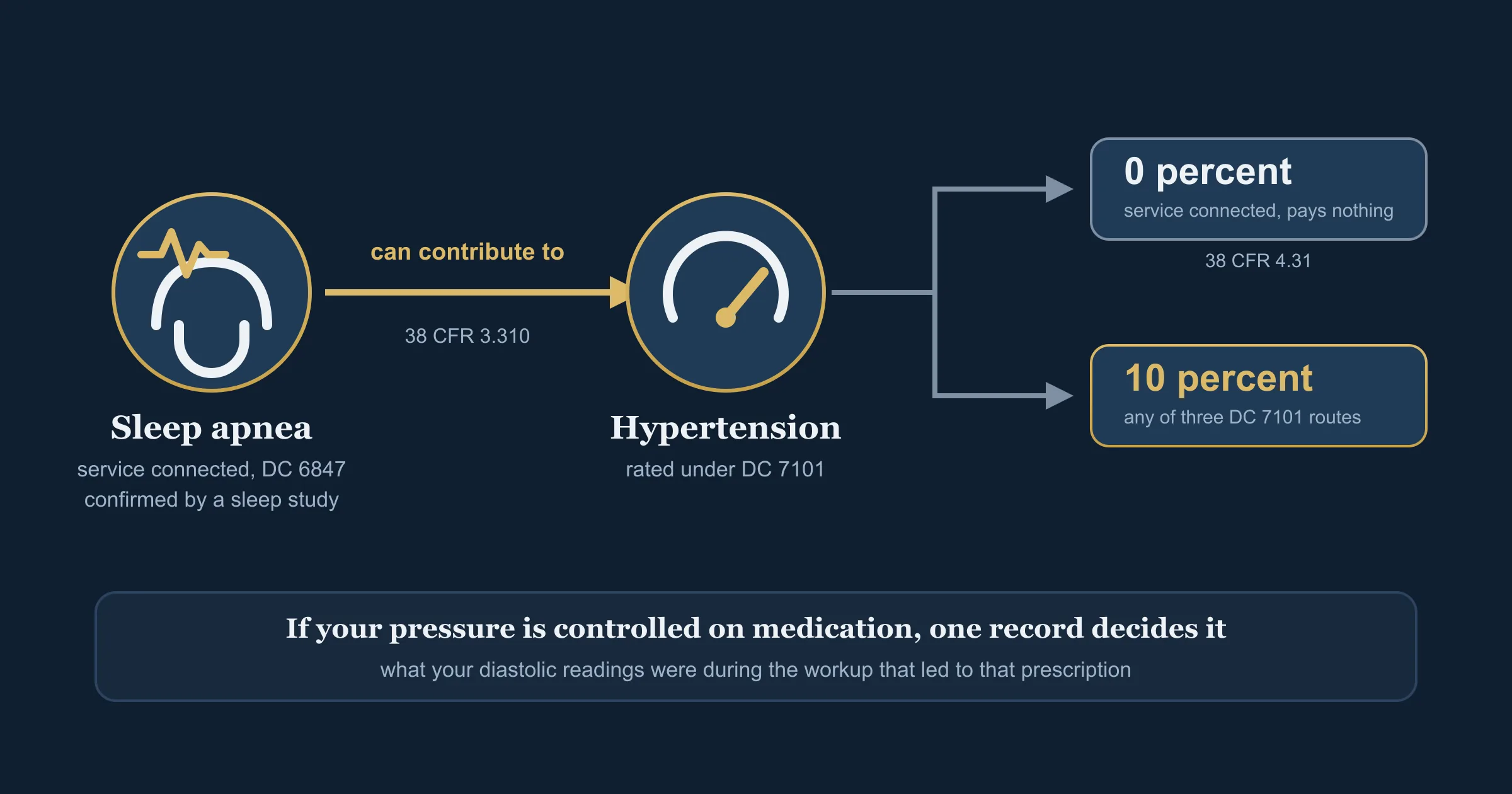 Nexus Letter for Hypertension Secondary to Sleep ApneaHow to prove hypertension is secondary to service-connected sleep apnea, why the claim can be granted at 0 percent, and the one record a nexus letter cannot fix.Read the guide
 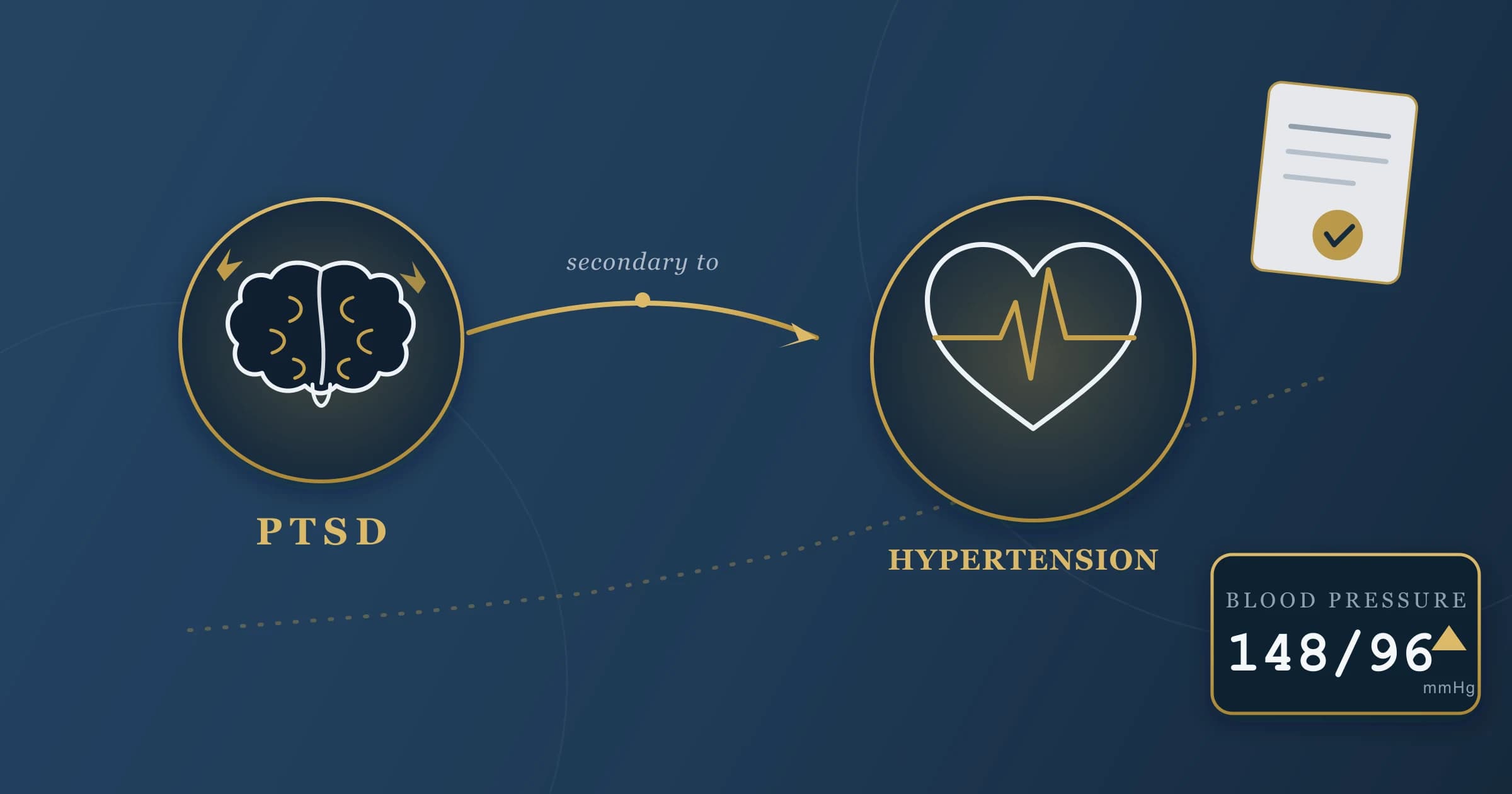 Nexus Letter for Hypertension Secondary to PTSDA nexus letter links your hypertension to service-connected PTSD. What the VA requires, the medical evidence, and the exact language, from our physicians.Read the guide
Your blood pressure is on the record. Make the claim show why.
Let our physicians prepare a high blood pressure nexus letter that meets the VA's evidence standards and supports the benefits you earned.
Sources & Regulatory References
- VA disability compensation (VA.gov) https://www.va.gov/disability/
- 2026 VA disability compensation rates (VA.gov) https://www.va.gov/disability/compensation-rates/veteran-rates/
- 38 CFR 4.104, Schedule of ratings, cardiovascular system, including DC 7101 (eCFR) https://www.ecfr.gov/current/title-38/section-4.104
- 38 CFR 4.31, Zero percent evaluations (eCFR) https://www.ecfr.gov/current/title-38/section-4.31
- Agent Orange exposure and disability compensation (VA.gov) https://www.va.gov/disability/eligibility/hazardous-materials-exposure/agent-orange/
- 38 CFR 3.310, Secondary service connection (eCFR) https://www.ecfr.gov/current/title-38/section-3.310
- 38 U.S.C. 5107, Benefit of the doubt (Cornell LII) https://www.law.cornell.edu/uscode/text/38/5107