
Welcome to Patriot Path
Nexus Letters for PTSD
Licensed Psychologist, PhD, Counseling Psychology, PSYPACT Certified | Patriot Path Medical Team
Specializing in VA mental health evaluations and independent psychological assessments • Last updated: June 2026
Board-certified physicians and licensed psychologists specializing in VA disability documentation. Meet our clinicians → • Our review process →
PTSD affects a lot of veterans. But even with a clear diagnosis, the VA often denies the claim. The reason is usually the same: the link between the PTSD and your service was never proven on paper.
A nexus letter fixes that. It is the expert medical opinion that ties your PTSD to what happened in service. At Patriot Path, our licensed psychologists and physicians write that opinion, and connect your PTSD to your service history or to another condition you already have, in the language the VA is required to weigh.

How VA Rates PTSD (DC 9411)
VA rates PTSD under 38 C.F.R. § 4.130, Diagnostic Code 9411. The level depends on how much PTSD affects your work and your relationships, not on matching every symptom. Use the estimator below to see roughly where your situation may fall.
| Rating | What it generally takes | Monthly pay (approx) |
|---|---|---|
| 0% | Diagnosed, but symptoms are mild enough that they do not affect work or social life and need no regular medication. | $0 |
| 10% | Mild symptoms that lower work efficiency only during stress, or symptoms controlled by continuous medication. | ~$180/mo |
| 30% | Occasional dips in work efficiency; generally functioning well, with normal routine, self-care, and conversation. | ~$552/mo |
| 50% | Reduced reliability and productivity: panic attacks more than once a week, memory or concentration trouble, flattened mood. | ~$1,133/mo |
| 70% | Deficiencies in most areas (work, family, mood, judgment): near-continuous panic or depression, suicidal thoughts.Most Common | ~$1,808/mo |
| 100% | Total occupational and social impairment: symptoms so severe you cannot work or keep relationships. | ~$3,939/mo |
Pay figures are approximate 2026 rates (effective December 1, 2025) for a single veteran with no dependents. Check VA.gov for current amounts.
Estimate your likely rating
Answer a few quick questions. This gives a rough idea of where your PTSD may fall on the VA's scale. It is not a rating decision or medical advice.
Making a VA Disability Claim for PTSD
When you apply for VA disability for PTSD, the claim needs three things to line up:
A current PTSD diagnosis
A diagnosis that meets DSM-5 criteria, from a qualified clinician (38 C.F.R. § 4.125).
An in-service stressor
An event in service that could cause PTSD: combat, fear of hostile activity, military sexual trauma, an accident, or loss.
A medical nexus
A qualified opinion that the PTSD is 'at least as likely as not' connected to that stressor.
That third piece, the nexus, is where most claims fall apart. A nexus letter supplies it: a written medical opinion that connects your diagnosis to your stressor in the language the VA must weigh. The 'at least as likely as not' standard (a 50% or better chance) comes from the benefit-of-the-doubt rule in 38 U.S.C. § 5107(b), carried out in 38 C.F.R. § 3.102.
How to Connect Your PTSD to Service
How you prove the stressor depends on what happened. PTSD has special rules under 38 C.F.R. § 3.304(f). Here are the pathways we see most.
PTSD diagnosed during service
If PTSD was diagnosed while you were still in service and your stressor is tied to that service, the bar for proof is lower.
- Your word can be enough. If the diagnosis was made in service and the stressor fits the circumstances of your service, your own statement may establish it, absent clear and convincing evidence to the contrary (3.304(f)(1)).
- Service records carry it. A PTSD diagnosis already in your service treatment records is strong support on its own.
Combat-related stressor
If you engaged in combat and your stressor is related to it, the bar for proof is lower.
- Your word can be enough. If the stressor fits the circumstances of your service, your own statement may establish it, absent clear and convincing evidence to the contrary (3.304(f)(2)).
- Awards help. A Combat Infantryman Badge, Combat Action Ribbon, Purple Heart, or similar on your DD-214 supports combat service.
Fear of hostile military or terrorist activity
You served where hostile or terrorist activity was a real threat, even without a documented firefight.
- A VA clinician confirms it. A VA or VA-contracted psychologist or psychiatrist confirms the stressor is enough to support a PTSD diagnosis (3.304(f)(3)).
- Lay testimony counts. Your statement can establish the stressor if it fits the places and circumstances of your service.
Former prisoner of war
If you were a prisoner of war and your stressor is tied to that experience, the bar for proof is lower.
- Your word can be enough. If you were a POW and the stressor relates to that experience, your own statement may establish it, absent clear and convincing evidence to the contrary (3.304(f)(4)).
- POW status opens it. Confirmed prisoner-of-war status, defined in 38 C.F.R. 3.1(y), is what opens this pathway.
Military sexual trauma (personal assault)
For PTSD from in-service personal assault, the VA accepts a wider range of evidence.
- Alternate evidence works. Records from police, medical providers, or counselors, and statements from family, roommates, or fellow service members can corroborate the assault (3.304(f)(5)).
- Behavior changes count. A sudden transfer request, a drop in performance, or substance use can serve as markers, even if nothing is in your file.
Secondary to another condition
PTSD can be tied to another service-connected condition, and it can cause others (38 C.F.R. § 3.310).
- PTSD tied to another condition. A service-connected TBI, or the trauma of a serious physical injury, can support or worsen PTSD.
- Other conditions from PTSD. Sleep apnea, high blood pressure, or other physical conditions can be claimed as secondary to PTSD.
Secondary Conditions
PTSD rarely travels alone. These links point to conditions in other body systems, since VA normally evaluates the psychiatric disability as a whole under one rating formula. Spotting them often turns a partial claim into a complete one.
PTSD may be secondary to
- Traumatic brain injury (TBI). Neurological trauma can drive hypervigilance and trouble controlling emotions.
- Chronic pain. Constant pain can wear down mood and trigger or worsen PTSD symptoms.
- Physical injuries. The event that injured you can leave both physical and emotional scars.
Conditions that may be secondary to PTSD
- Sleep apnea. Stress, hyperarousal, and medication can disrupt normal sleep. nexus letter for sleep apnea secondary to PTSD.
- High blood pressure. Long-term stress can raise blood pressure over time. nexus letter for hypertension secondary to PTSD.
- Erectile dysfunction. PTSD and the medications prescribed for it are both recognized routes to a secondary claim, and it pays through Special Monthly Compensation rather than a percentage. nexus letter for erectile dysfunction secondary to PTSD.
- Irritable bowel syndrome. In a cohort of 603,221 Iraq and Afghanistan veterans, IBS was the gastrointestinal condition most strongly associated with mental health diagnoses. It is rated on its own digestive code rather than folded into the PTSD evaluation. nexus letter for IBS secondary to PTSD.
- GERD and other digestive issues. Chronic stress can aggravate the gut.
- Cardiovascular issues. Long-term stress can affect heart health.
What to Gather - Evidence Checklist
Gather these before you file or ask for a letter. Tick each off as you go.
Frequently Asked Questions
What is a PTSD nexus letter?
A written medical opinion from a licensed clinician that links your PTSD to your service, at the 'at least as likely as not' standard. It is usually the piece the VA is missing when a claim is denied.
Do I have to prove my stressor?
It depends on the type. Combat and fear-of-hostile-activity stressors can be established by your own statement if it fits your service. Military sexual trauma has special rules that allow a wider range of evidence (38 C.F.R. 3.304(f)).
What rating will I get for PTSD?
PTSD is rated 0, 10, 30, 50, 70, or 100 percent under 38 C.F.R. 4.130, based on how much it affects your work and relationships. The estimator above gives a rough idea. 70% is one of the most common ratings.
Can PTSD be connected to other conditions?
Yes. PTSD can be secondary to a TBI or chronic pain, and it can cause secondary conditions like sleep apnea, high blood pressure, or GERD. Those can be claimed too and can raise your combined rating. Where PTSD is diagnosed alongside another service-connected mental disorder, VA normally evaluates the psychiatric disability as a whole under the single General Rating Formula at 38 C.F.R. 4.130, because 38 C.F.R. 4.14 bars evaluating the same manifestation under two diagnoses. That is about the evaluation, not about whether you can claim it: PTSD can still be service connected as secondary to another service-connected mental disorder under 38 C.F.R. 3.310.
What does it cost, and how do we start?
Patriot Path charges $1,500 flat for a nexus letter, and the first consultation is free. Book a consultation and a clinician will review your situation and tell you straight whether a letter can help.
Guides for this condition
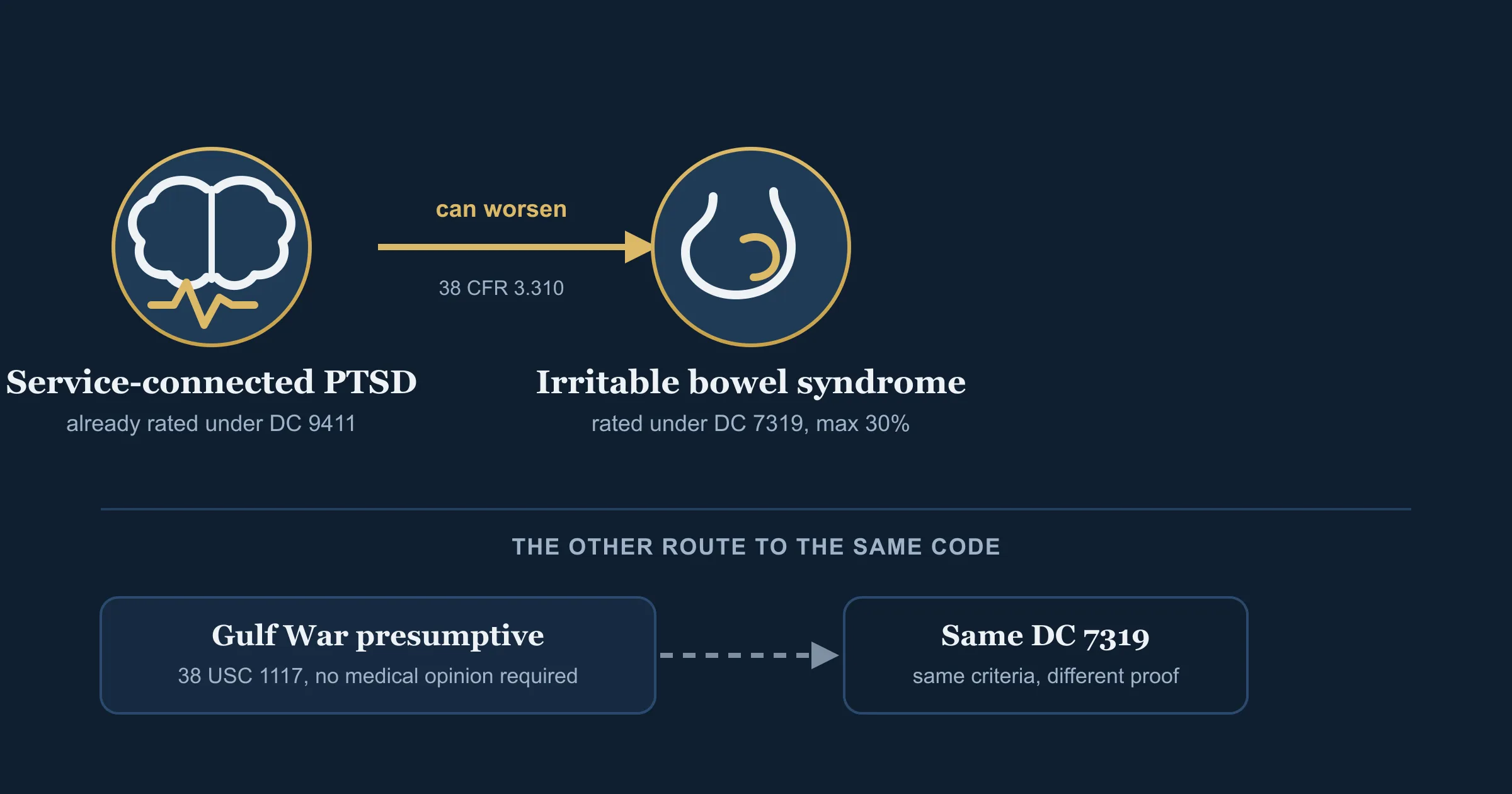 Nexus Letter for IBS Secondary to PTSDHow to prove IBS is secondary to service-connected PTSD, what DC 7319 pays, and the Gulf War route that can make a nexus letter unnecessary.Read the guide
 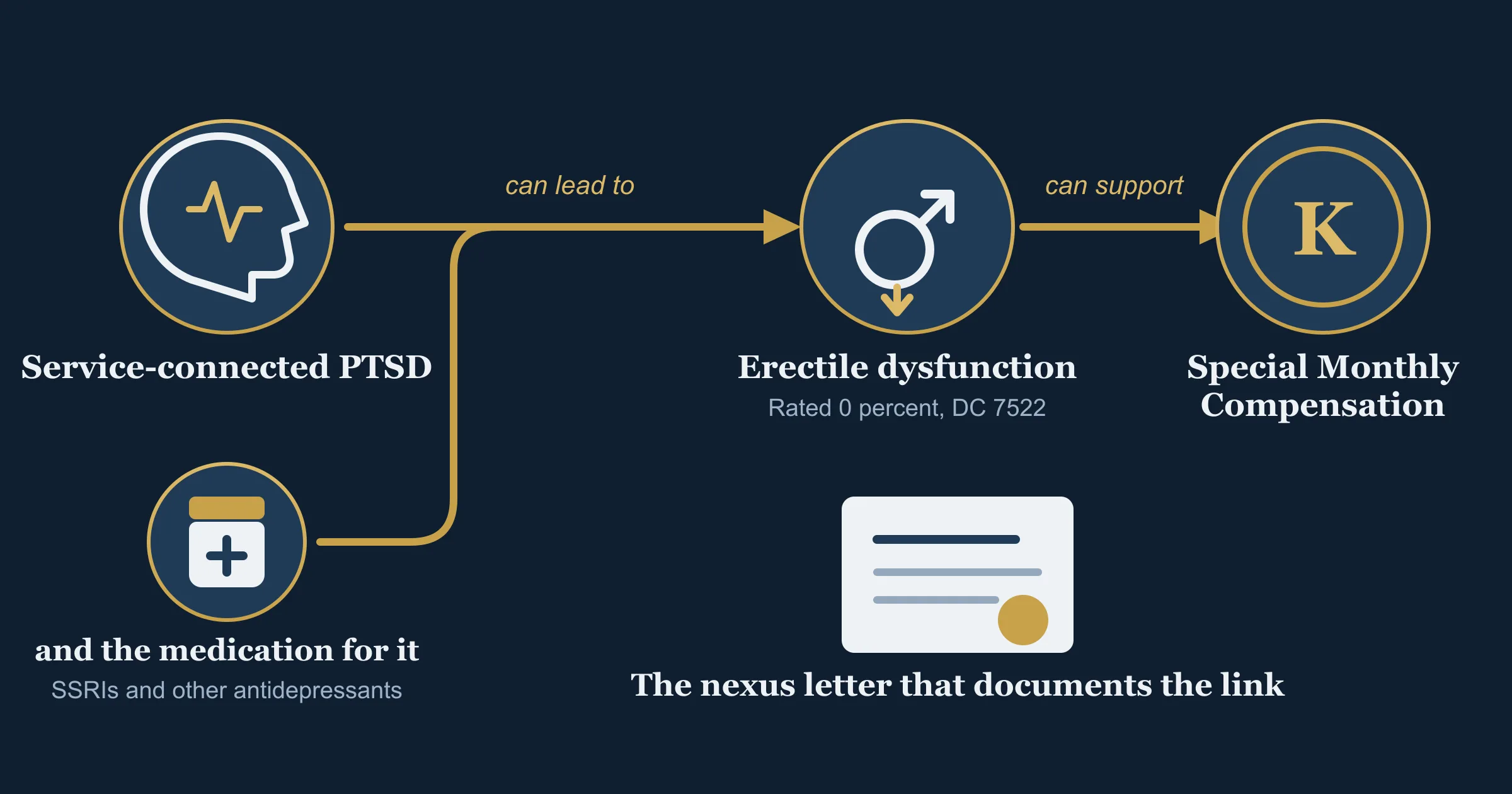 Nexus Letter for Erectile Dysfunction Secondary to PTSDErectile dysfunction secondary to PTSD or the medication that treats it. What the nexus letter must prove, and why a 0 percent rating is the whole point.Read the guide
 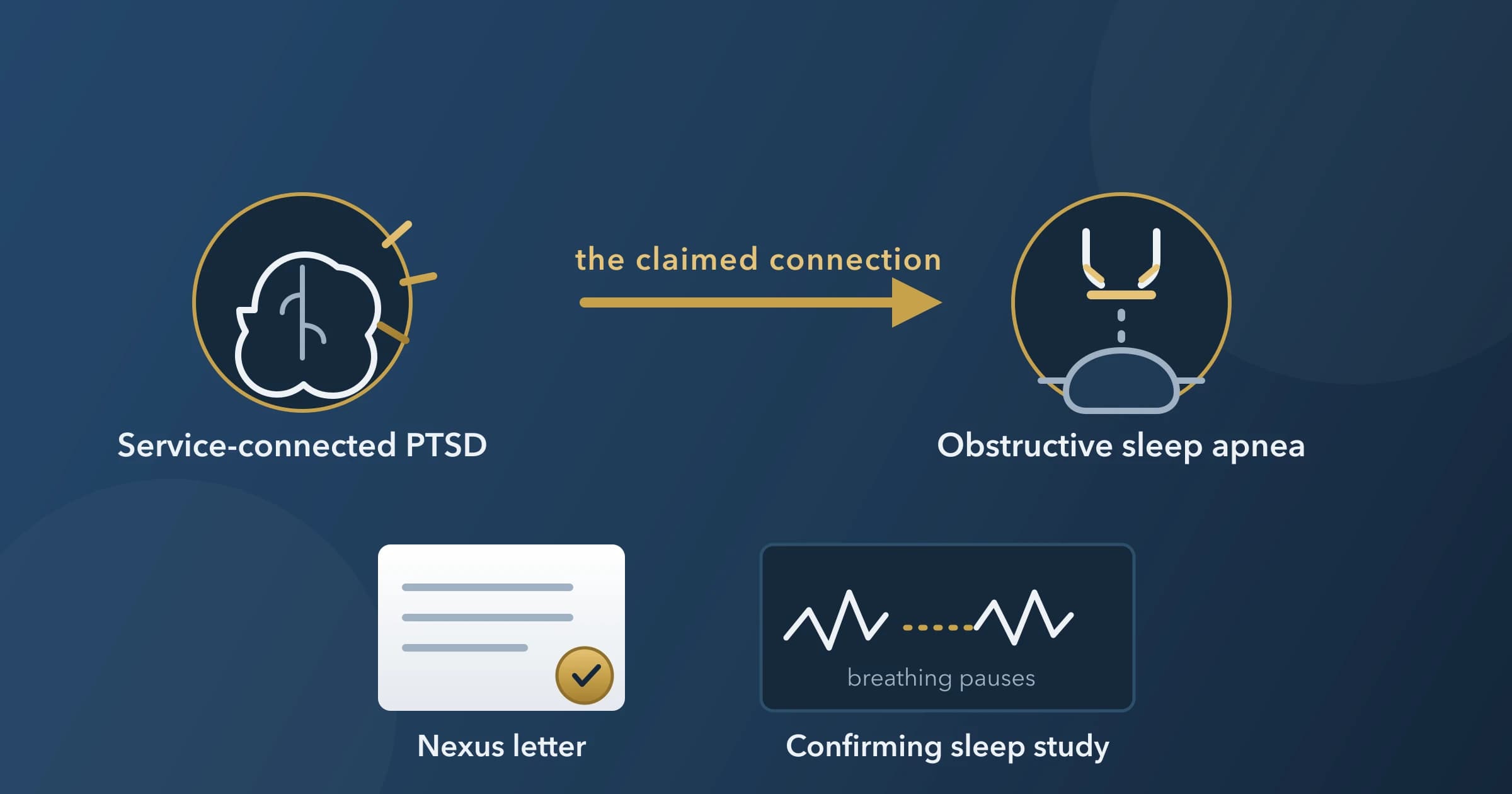 Nexus Letter for Sleep Apnea Secondary to PTSDSleep apnea claimed as secondary to service-connected PTSD: what the nexus letter must prove, the sleep study the VA requires, and what the research shows.Read the guide
 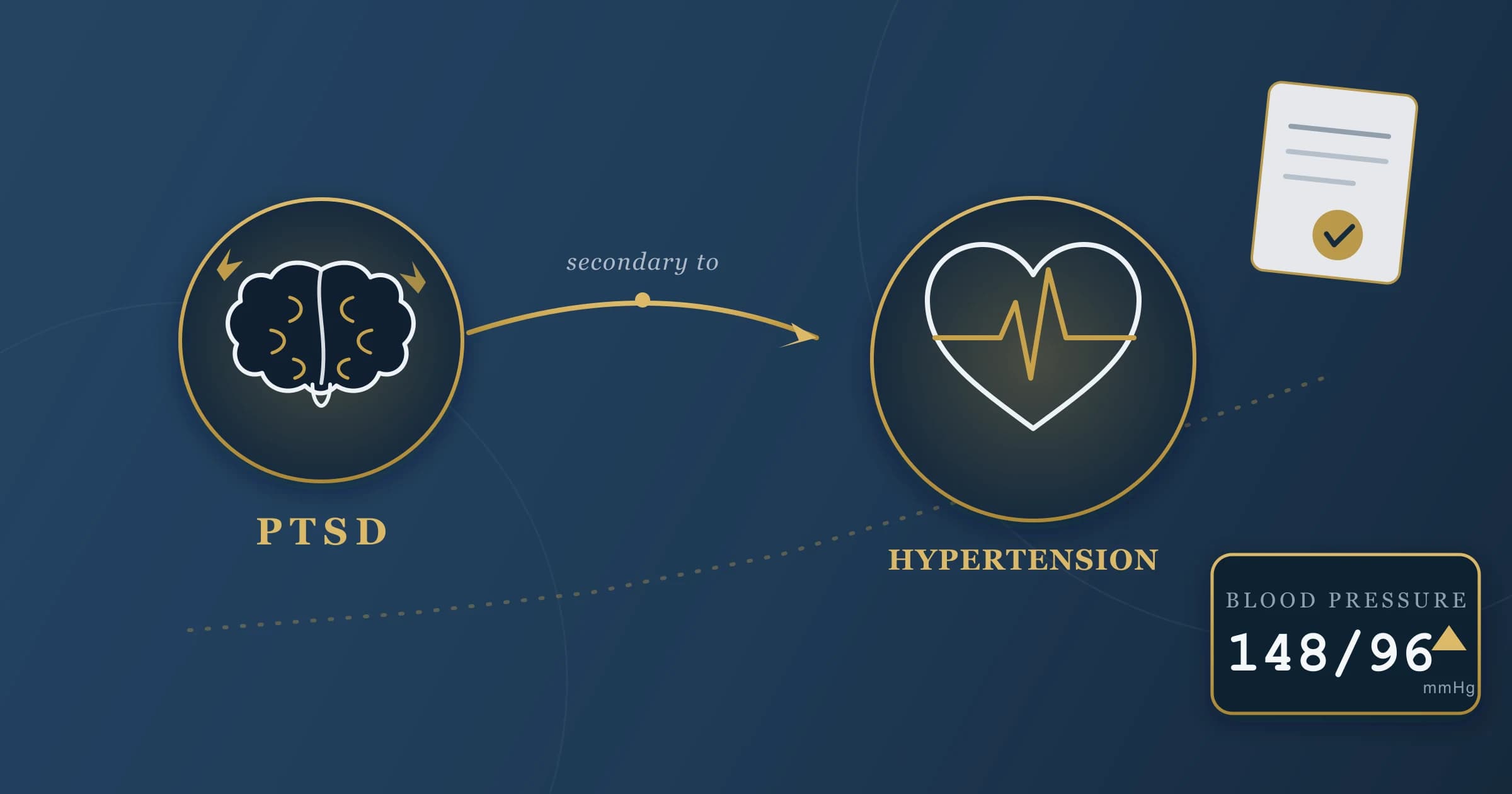 Nexus Letter for Hypertension Secondary to PTSDA nexus letter links your hypertension to service-connected PTSD. What the VA requires, the medical evidence, and the exact language, from our physicians.Read the guide
Your service matters, and your records should show it
Let our clinicians prepare a PTSD nexus letter that meets the VA's evidence standards and supports the benefits you earned.
Sources & Regulatory References
- VA disability compensation (VA.gov) https://www.va.gov/disability/
- 38 CFR 4.130, Schedule of ratings, mental disorders (eCFR) https://www.ecfr.gov/current/title-38/section-4.130
- 38 CFR 3.304, Direct service connection (PTSD stressor rules) (eCFR) https://www.ecfr.gov/current/title-38/section-3.304
- 38 CFR 3.310, Secondary service connection (eCFR) https://www.ecfr.gov/current/title-38/section-3.310
- 38 U.S.C. 5107, Benefit of the doubt (Cornell LII) https://www.law.cornell.edu/uscode/text/38/5107