
How to Get a Nexus Letter for Your VA Disability Claim
A step-by-step guide to getting a VA nexus letter that works. Learn what the VA requires, who should write it, and how board-certified MDs can strengthen your claim.

Daniel served 12 years as a combat engineer in the Army, including two tours in Iraq. When he filed for VA disability for his knee condition in 2021, the claim was denied. The examiner said there wasn't enough medical evidence connecting his knee to his service. Daniel had the diagnosis. He had the service record. What he was missing was a nexus letter. He got one. His claim was approved at 60%.
The nexus letter, also called an independent medical opinion (IMO), is one of the most powerful documents in a VA disability claim. It's also one of the most misunderstood. This guide walks you through how to get one, what the VA requires, and why the doctor who writes it matters as much as the letter itself.
First, check whether a nexus letter applies to your situation.
Do You Need a Nexus Letter? A Quick Self-Assessment
Check each item that applies to you. If two or more apply, a nexus letter is likely what your claim is missing.
Select all that apply to your situation.
What the VA Actually Needs to See in a Nexus Letter
The VA evaluates every nexus letter against a three-part standard. Know this standard before you get a letter written. It's the difference between a letter that holds up and one that gets dismissed.
Check which parts you can already satisfy.
The VA needs a confirmed medical diagnosis from a licensed provider. Without it, there's nothing to connect to your service.
Do you have a formal diagnosis on file?
Your service record must show something that could have caused your condition: an injury, a stressor, a physical demand, or a hazardous exposure.
Does your service record document something relevant?
A licensed physician must review your records and state, in writing, that it is "at least as likely as not" that your condition was caused or worsened by your service. Vague language like "possibly related" does not meet the standard.
Do you have a written medical opinion making this connection?
"The nexus letter doesn't prove your condition. The VA already has your diagnosis. It proves the connection between your condition and your service. That's the piece the VA examiner cannot supply."
— Board-Certified Physician, Patriot Path Medical TeamHow to Get a Nexus Letter: 6 Steps
Follow these steps in order. Each one builds on the last. Skipping any of them — especially Step 4 — is the most common reason a nexus letter fails to move a claim forward.
Gather Your Available Medical Records
Your doctor builds a case from whatever records you provide. The stronger the foundation, the stronger the opinion. That said, you don't need perfect records. Your physician will work with what you have and address any gaps directly in the letter.
Gather what you can before your first consultation. In particular, prioritize recent medical records showing your current diagnosis and any prior VA paperwork.
Don't wait until you have everything. Bring what you have now. Your doctor will tell you if anything else is needed.
Documents to collect
Get what you can. You don't need all of these.
Choose a Physician Whose Specialty Matches Your Condition
Why specialty matters to VA examiners
Not all nexus letters carry the same weight. The VA doesn't require VA-specific experience. But claims examiners do weigh the letter's credibility against the physician's credentials and specialty.
In contrast to a general practitioner, a board-certified specialist writing within their area of expertise carries far more authority. Picture two nexus letters for PTSD: one from a licensed psychiatrist with combat trauma experience, one from a family doctor who reviewed the file once. Both may say "at least as likely as not." The examiner's confidence in those words is not the same.
Look for a physician whose training matches your condition. Patriot Path's medical team includes board-certified physicians and PhD-level clinicians matched to the conditions veterans most commonly claim.

Come Prepared to Your Consultation
Next, schedule a focused consultation with your chosen physician. The quality of the consultation directly affects the quality of the letter. Come prepared to do three things.
Don't just hand over records. Explain the specific incidents or exposures you believe connect to your condition. A physician reviewing records cold will miss context you can provide in person.
How does the condition affect your daily life? Your sleep? Your ability to work? The more specific you are, the more your physician has to work with when building their opinion.
A strong nexus letter references peer-reviewed research or VA/DoD clinical guidelines. Ask your physician directly whether they plan to include citations and why those citations are relevant to your condition.
Review the Draft Before It Goes to the VA
The five elements every letter must have
A nexus letter is not a form. It's a professional medical opinion. Review it the way you'd review any legal document before it goes to the VA.
As a result, missing any one of the five elements below gives the VA a reason to discount the letter entirely. Check each one before signing off.
- A confirmed, current diagnosis
- A reference to the specific in-service event or condition
- The exact phrase "at least as likely as not"
- Medical reasoning explaining why the connection is sound
- The physician's full name, credentials, license number, and contact information
See our detailed breakdown of what a nexus letter needs to include for the complete element-by-element checklist.
If you're having a nexus letter written elsewhere, use this list before you submit. One missing element is all it takes for the VA to assign the letter little or no weight.
Submit Your Letter With a Complete Claim Package
Your nexus letter is one part of a full VA disability claim. Submitting it without supporting documents limits what it can do. Together, these items give the VA everything it needs to evaluate your case.
- VA Form 21-526EZ (Application for Disability Compensation)
- Service treatment records and your DD-214
- Current medical records confirming your diagnosis
- The nexus letter from your physician
- Any buddy statements supporting your claim
Submit via VA.gov, eBenefits, or in person at your regional VA office. Keep a full copy of everything you submit, including the date of submission.
Know What Happens After You Submit
What if the VA schedules a C&P exam?
After submission, the VA assigns your claim to a ratings specialist. They may also schedule a Compensation and Pension (C&P) exam. Even so, a C&P exam is not a substitute for a nexus letter.
The C&P examiner is a VA employee doing a routine evaluation. They are not an advocate for your claim. If the C&P exam produces an opinion that goes against you, a nexus letter from a board-certified specialist can directly counter it.
A prior denial doesn't close the door. Read our guide to nexus letters after a VA denial to understand your options for a supplemental claim or higher-level review.
A board-certified physician's independent medical opinion is new evidence the VA must consider. A denial is not the end of the road.
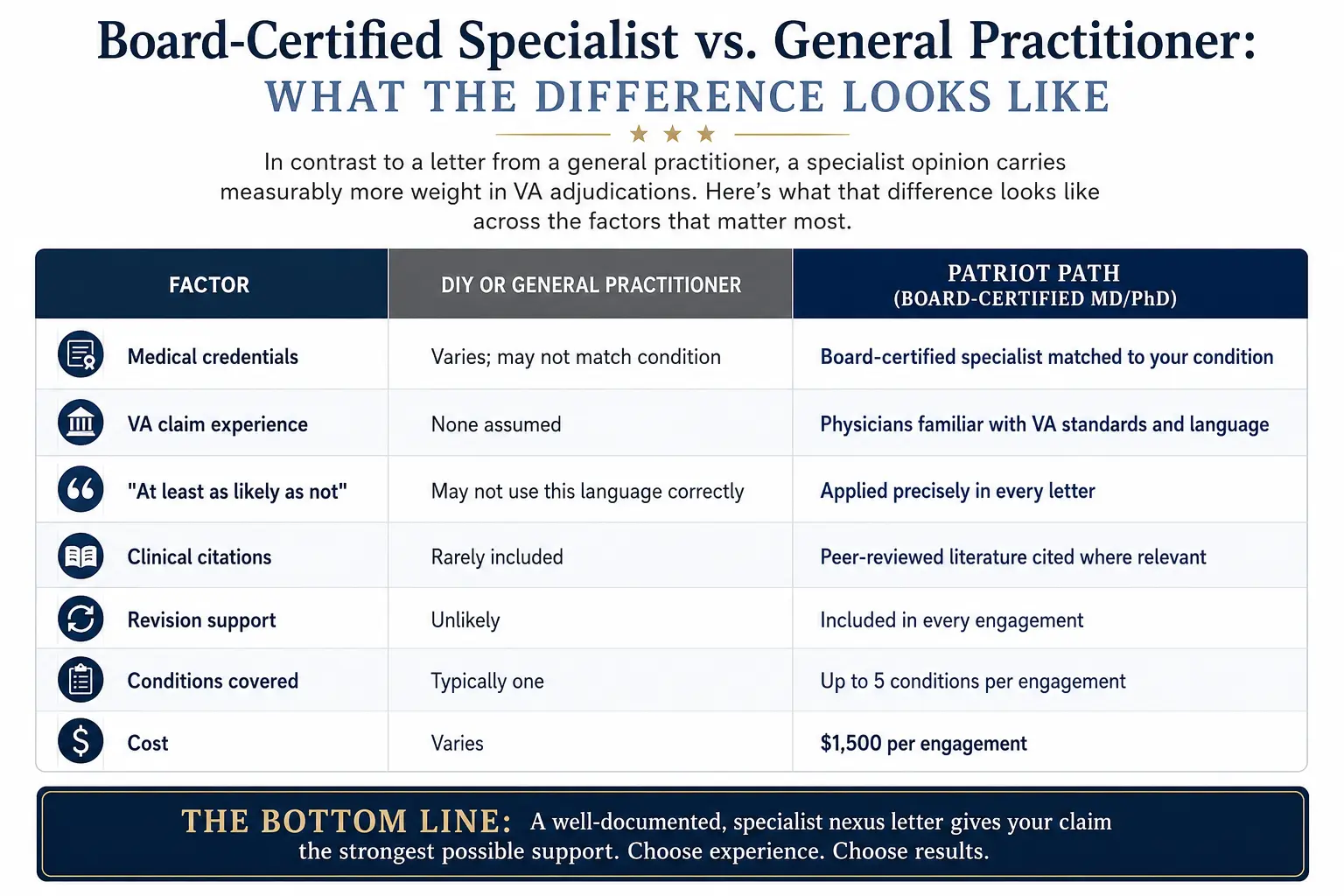
Board-Certified Specialist vs. General Practitioner: What the Difference Looks Like
In contrast to a letter from a general practitioner, a specialist opinion carries measurably more weight in VA adjudications. Here's what that difference looks like across the factors that matter most.
| Factor | DIY or General Practitioner | Patriot Path (Board-Certified MD/PhD) |
|---|---|---|
| Medical credentials | Varies; may not match condition | Board-certified specialist matched to your condition |
| VA claim experience | None assumed | Physicians familiar with VA standards and language |
| "At least as likely as not" | May not use this language correctly | Applied precisely in every letter |
| Clinical citations | Rarely included | Peer-reviewed literature cited where relevant |
| Revision support | Unlikely | Included in every engagement |
| Conditions covered | Typically one | Up to 5 conditions per engagement |
| Cost | Varies | $1,500 per engagement |
For a deeper look at the documents themselves, see our guide: Nexus letter vs. DBQ: what's the difference?
Bottom Line for Veterans
Frequently Asked Questions
What does a nexus letter for the VA need to include?
A VA nexus letter must have five things: a confirmed diagnosis; a reference to the in-service event; the phrase "at least as likely as not"; medical reasoning explaining why the connection is sound; and the physician's full credentials and contact information. Missing any of these gives the VA grounds to discount the letter. See our complete guide to writing a nexus letter for the full breakdown.
Who is qualified to write a nexus letter for a VA claim?
Any licensed medical professional can write a nexus letter, including MDs, DOs, psychologists, and nurse practitioners. A board-certified specialist matched to your condition carries the most weight with VA examiners. This matters most on complex claims or claims that have been denied before.
Can I get a nexus letter after my VA claim has been denied?
Yes. A nexus letter written after a denial is one of the most effective tools for a supplemental claim or higher-level review. If the denial cited weak medical evidence, a board-certified physician's independent opinion fills that gap directly. It gives the VA new and material evidence it must consider. Read our guide to nexus letters after a VA denial for next steps.
How long does it take to get a nexus letter?
Turnaround time depends on the provider and your case. At Patriot Path, our physicians review your full record before writing the opinion. Contact us for current turnaround estimates; timelines vary based on your condition and how much documentation you provide.
Is a nexus letter worth the cost?
A 30% VA disability rating pays roughly $524 per month, tax-free. A 70% rating pays over $1,700 per month, for life. At $1,500 for up to five conditions, a nexus letter often pays for itself within three months of a successful rating change.
What is the difference between a nexus letter and a buddy statement?
A buddy statement is a lay statement from someone who served with you, describing what they observed. A nexus letter is a medical opinion from a licensed physician. The VA treats these very differently; a buddy statement adds context, while a nexus letter is clinical evidence that can establish service connection on its own.
Can a VA doctor write my nexus letter?
A VA-employed physician can technically write a nexus letter. In practice, VA doctors rarely do because it creates a conflict of interest with their employer. Most veterans use private physicians or nexus letter services staffed by board-certified doctors who have no ties to the VA.
What happens if my nexus letter is rejected or discounted by the VA?
If the VA discounts your letter, the denial notice must explain why. Common reasons include weak clinical rationale, missing the "at least as likely as not" language, or a mismatch between the physician's specialty and your condition. Patriot Path physicians can review the VA's stated reasons and provide a supplemental opinion that addresses them directly.
Putting It All Together
Getting a nexus letter right requires three things working together: complete records, a qualified physician, and a letter that meets VA evidentiary standards. All three matter. Miss one, and the letter may not move your claim forward.
The good news is that a denied claim is not the end. As long as you have a current diagnosis and something in your service history to connect it to, a board-certified physician's independent medical opinion gives the VA new evidence it must consider. That's the point of this process.
If you're not sure whether a nexus letter applies to your situation, start with a free consultation. Our physicians will review your case and tell you plainly what they can and can't support.
Key Takeaways
References
- U.S. Department of Veterans Affairs. How to File a VA Disability Claim. VA.gov.
- U.S. Department of Veterans Affairs. VA Disability Compensation Eligibility. VA.gov.
- 38 C.F.R. § 3.303 — Principles Relating to Service Connection. GovInfo.gov.
- 38 C.F.R. § 3.102 — Benefit of the Doubt. (The "at least as likely as not" standard.) GovInfo.gov.
Ready to Strengthen Your VA Claim?
If your claim was denied for lack of medical evidence, our board-certified physicians can help. We review your full record and build the strongest possible medical opinion. Patriot Path serves veterans nationwide from Franklin, Tennessee.
Start your free consultation