
Welcome to Patriot Path
Nexus Letter for Sleep Apnea VA Claims
Licensed Internist, MD, Internal Medicine, Licensed in Georgia | Patriot Path Medical Team
Medically reviewed by a licensed MD • Last updated: June 2026
Board-certified physicians and licensed psychologists specializing in VA disability documentation. Meet our clinicians → • Our review process →
James served 11 years in the Army, with two deployments to Iraq. He filed for VA disability for sleep apnea in 2021. The VA denied his claim. The examiner’s reasoning: no sleep study on record during active duty. No doctor formally linking the diagnosis to his service. James already owned a CPAP machine. He had used it for three years. The diagnosis was real. The link just was not on paper.
Eighteen months later, a Patriot Path sleep medicine doctor reviewed his records and wrote a nexus letter. It cited his deployment history, his PTSD diagnosis, and peer-reviewed research on OSA onset in combat veterans. James was rated at 50%. That is $1,133 per month, tax-free, for life.
The same condition. The same records. A different outcome, all because one document changed what the VA could see.
Maybe your sleep apnea claim was denied. Maybe it was rated at 0%. Or maybe you have not filed yet because you are not sure how to tie it to your service. This page explains how a nexus letter works for sleep apnea. It also covers what Patriot Path’s licensed doctors do that a family doctor usually cannot.
Learn the full step-by-step process on how to get a nexus letter for your sleep apnea claim.

What Is a Sleep Apnea Nexus Letter?
A nexus letter is a written medical opinion from a licensed clinician. It establishes a legally recognized link between two things: your obstructive sleep apnea (OSA) diagnosis, and an event, exposure, or condition from your military service. Under 38 C.F.R. § 3.303, VA disability compensation requires three things to line up:
Current Diagnosis
A confirmed sleep apnea diagnosis. It is usually obstructive (OSA), central (CSA), or mixed. A sleep study (polysomnogram) or a CPAP prescription must document it.
In-Service Event or Exposure
A documented in-service event tied to your condition. Examples: burn pit exposure, breathing in airborne toxins, a head injury, or significant weight gain during service.
Medical Nexus Opinion
A qualified clinician’s opinion, stated at the legal threshold of “at least as likely as not” (a 50% or better chance), that the diagnosis is related to your service. That standard is the benefit-of-the-doubt rule in 38 U.S.C. § 5107(b), carried out in 38 C.F.R. § 3.102.
Not every veteran needs a nexus letter. Some qualify through presumptive service connection. Then you do not have to prove the cause. But most sleep apnea claims are different, especially those diagnosed after discharge. For those claims, an independent nexus letter is the key piece that decides whether the claim succeeds.
See how our nexus letter process works →
VA raters routinely reject vague or boilerplate medical opinions. A strong nexus letter cites peer-reviewed medical research. It reviews your own service and medical history. It uses VA-compliant language. Patriot Path’s MDs and PhDs specialize in writing opinions that meet this standard.
How VA Rates Sleep Apnea (DC 6847)
VA rates sleep apnea under 38 C.F.R. § 4.97, Diagnostic Code 6847. Use the estimator below to see where your situation may fall.
Proposed Rating Change (As of June 2026): A proposed VA rule would eliminate the automatic 50% rating for CPAP use. No final rule has been published; current criteria remain in effect. Filing now may be strategically important.
| Rating | Criteria | Monthly Pay (2026) |
|---|---|---|
| 0% | Asymptomatic but with documented sleep disorder breathing | $0 |
| 30% | Persistent day-time hypersomnolence | ~$552/mo |
| 50% | Requires a medically necessary breathing assistance device, such as CPAP, APAP, or BiPAPMost Common | ~$1,133/mo |
| 100% | Chronic respiratory failure with carbon dioxide retention or cor pulmonale, or requires a tracheostomy | ~$3,939/mo |
Pay figures are approximate 2026 rates (effective December 1, 2025) for a single veteran with no dependents. Check VA.gov for current amounts.
Estimate Your Likely Rating
Answer 3 quick questions for a preliminary estimate. Your actual rating depends on your full medical record.
Making a VA Disability Claim for Sleep Disorders
Sleep disorders like obstructive sleep apnea (OSA) are common among veterans. Even so, these claims are often denied because they lack a clear medical link. That’s where a nexus letter becomes vital.
A nexus letter is a professional medical opinion from a qualified provider. It connects your diagnosed condition to your time in service. It lays out the medical reasoning and cites supporting evidence. It uses the language the VA needs to consider a condition “service-connected.” Board-certified physicians and doctoral-level experts stand behind each letter we write. They know the medical side and the process side of the VA disability system.

Why the VA May Deny a Claim
Even when veterans have a valid diagnosis, the VA may deny a claim if:
- The connection between service and the condition isn’t clearly documented
- A sleep study wasn’t completed while on active duty
- There is no independent medical opinion explaining causation
- Statements from other doctors are too vague or unsupported
A well-prepared nexus letter for sleep apnea closes these gaps. It gives the VA the detailed reasoning it needs. It draws on your service records, your diagnosis, and the relevant medical research. The goal is a clear service connection.
How to Connect Your Sleep Apnea to Military Service
VA recognizes three legal pathways to establish service connection. Select the one that best describes your situation:
Direct Service Connection
Your sleep apnea was caused directly by an in-service event, injury, or exposure:
- Sinus/airway injury trauma to the nose, throat, or airway during service
- Airborne hazard exposure breathing in smoke, dust, or chemicals over time, damaging the upper airway
- Service-related weight gain documented significant weight gain during service or from service-connected medications
- Traumatic Brain Injury (TBI) neurological damage affecting breathing regulation during sleep
Secondary Service Connection
Your sleep apnea is caused or worsened by another already service-connected condition. This is the most commonly successful pathway in 2026.
- PTSD → OSA: Hypervigilance, cortisol dysregulation, and disrupted sleep architecture cause airway muscle dysfunction
- Depression/Anxiety → OSA: Medications and disrupted sleep cycles alter respiratory patterns
- Chronic Pain → OSA: Opioid medications suppress respiratory drive; poor posture affects airway patency
- TBI → Central Sleep Apnea: Brainstem damage disrupts automatic breathing signals during sleep
PACT Act: Burn Pit & Toxic Exposure
The Honoring our PACT Act of 2022 expanded presumptive service connection for toxic-exposed veterans.
- Served in post-9/11 Southwest Asia theaters (Iraq, Afghanistan, Syria, Djibouti, etc.)
- Exposed to open-air burn pit smoke damaging your upper airway or sinuses
- Served in other qualifying locations with documented airborne hazard exposure
Under PACT Act, many veterans qualify for presumptive status; VA presumes the connection without a full nexus opinion.
Aggravation of a Pre-Existing Condition
Did you have sleep apnea before service? If military service significantly worsened it beyond natural progression, you may qualify under 38 C.F.R. § 3.306.
- VA presumes every veteran entered service in sound condition (the “presumption of soundness”)
- VA must prove the condition was not aggravated by service to deny the claim
- A nexus letter documents the degree of worsening attributable to service
Secondary Conditions & Sleep Apnea
Sleep apnea can cause secondary conditions. Other service-connected diagnoses can also cause it. Filing for related conditions can raise your combined disability rating, though how much depends entirely on the diagnostic code each one is rated under, and some carry a 0 percent evaluation.
Conditions that may cause or worsen sleep apnea:
| Condition | How It Contributes to Sleep Apnea | Key Note |
|---|---|---|
| PTSD → OSA | Hypervigilance, cortisol dysregulation, and disrupted sleep architecture cause airway muscle dysfunction | Most litigated secondary pathway; strong medical literature support |
| Depression → OSA | Antidepressant medications and disrupted sleep cycles alter respiratory patterns | Medication side effects are a documented contributing mechanism |
| TBI → CSA | Brainstem/neurological damage disrupts automatic breathing signals during sleep | Often causes central sleep apnea; both types are ratable |
| Chronic Pain → OSA | Opioid medications suppress respiratory drive; poor posture from injuries affects airway patency | Document medication names and dosages in your records |
| Anxiety → OSA | Anxiety medications and autonomic dysregulation contribute to sleep-disordered breathing | Bidirectional; anxiety can also worsen from OSA |
Conditions that may be caused by sleep apnea:
| Condition | How Sleep Apnea Causes It | VA Code |
|---|---|---|
| Hypertension OSA → | Repeated overnight oxygen drops activate the sympathetic nervous system, which is one contributing pathway to raised blood pressure | DC 7101; see our dedicated guide, because the rating can be 0 percent |
| Atrial Fibrillation / Heart Disease OSA → | Repeated hypoxia stresses the cardiovascular system, triggering arrhythmias and coronary disease | Needs secondary nexus letter linking OSA to cardiac events |
| Depression / Anxiety OSA → | Chronic sleep deprivation and hypoxia cause mood dysregulation | Can be rated separately; requires secondary nexus opinion |
| Erectile Dysfunction OSA → | Hypoxia impairs vascular function and testosterone production | Rated under genitourinary codes; often overlooked |
| Cognitive Impairment / Memory Loss OSA → | Chronic sleep fragmentation and oxygen desaturation impair memory consolidation | Document with neuropsychological testing if possible |
| GERD / Acid Reflux OSA → | Negative intrathoracic pressure during apnea events draws stomach acid into the esophagus | Common and separately ratable; often missed in claims |
A nexus letter for sleep apnea makes these medical links clear. It helps the VA see how your conditions connect to each other.
Guides for this condition
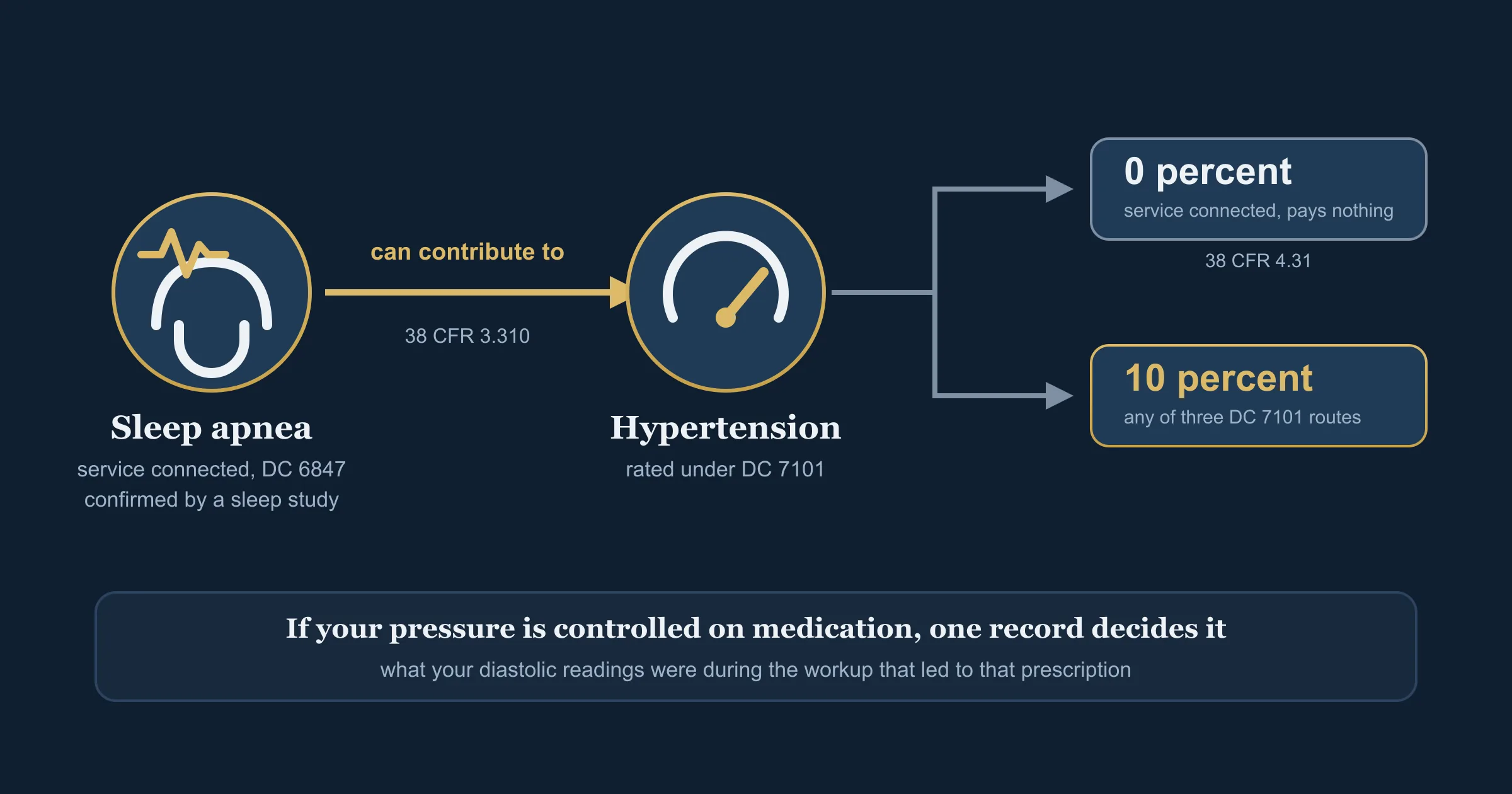 Nexus Letter for Hypertension Secondary to Sleep ApneaHow to prove hypertension is secondary to service-connected sleep apnea, why the claim can be granted at 0 percent, and the one record a nexus letter cannot fix.Read the guide
 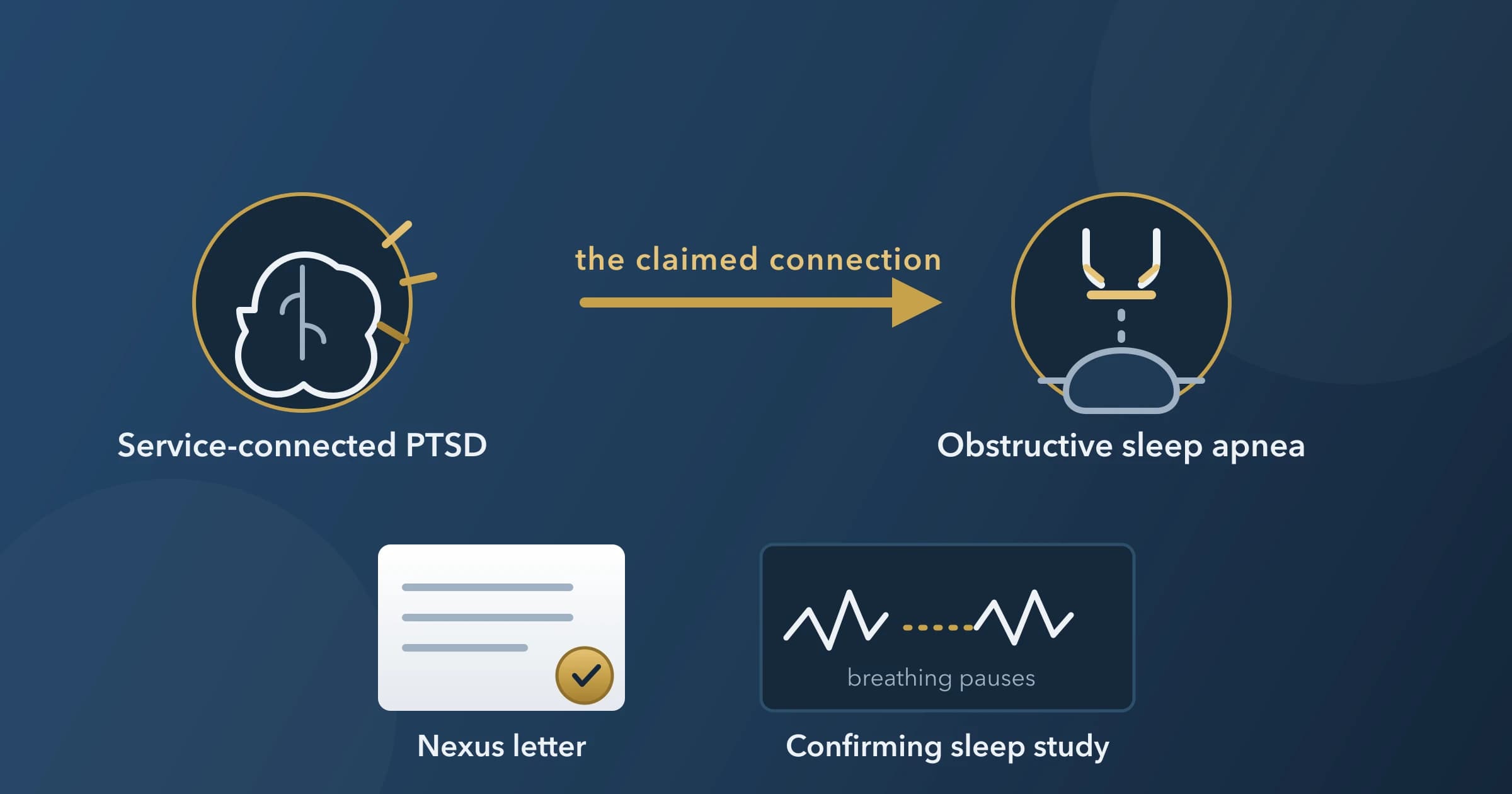 Nexus Letter for Sleep Apnea Secondary to PTSDSleep apnea claimed as secondary to service-connected PTSD: what the nexus letter must prove, the sleep study the VA requires, and what the research shows.Read the guide
 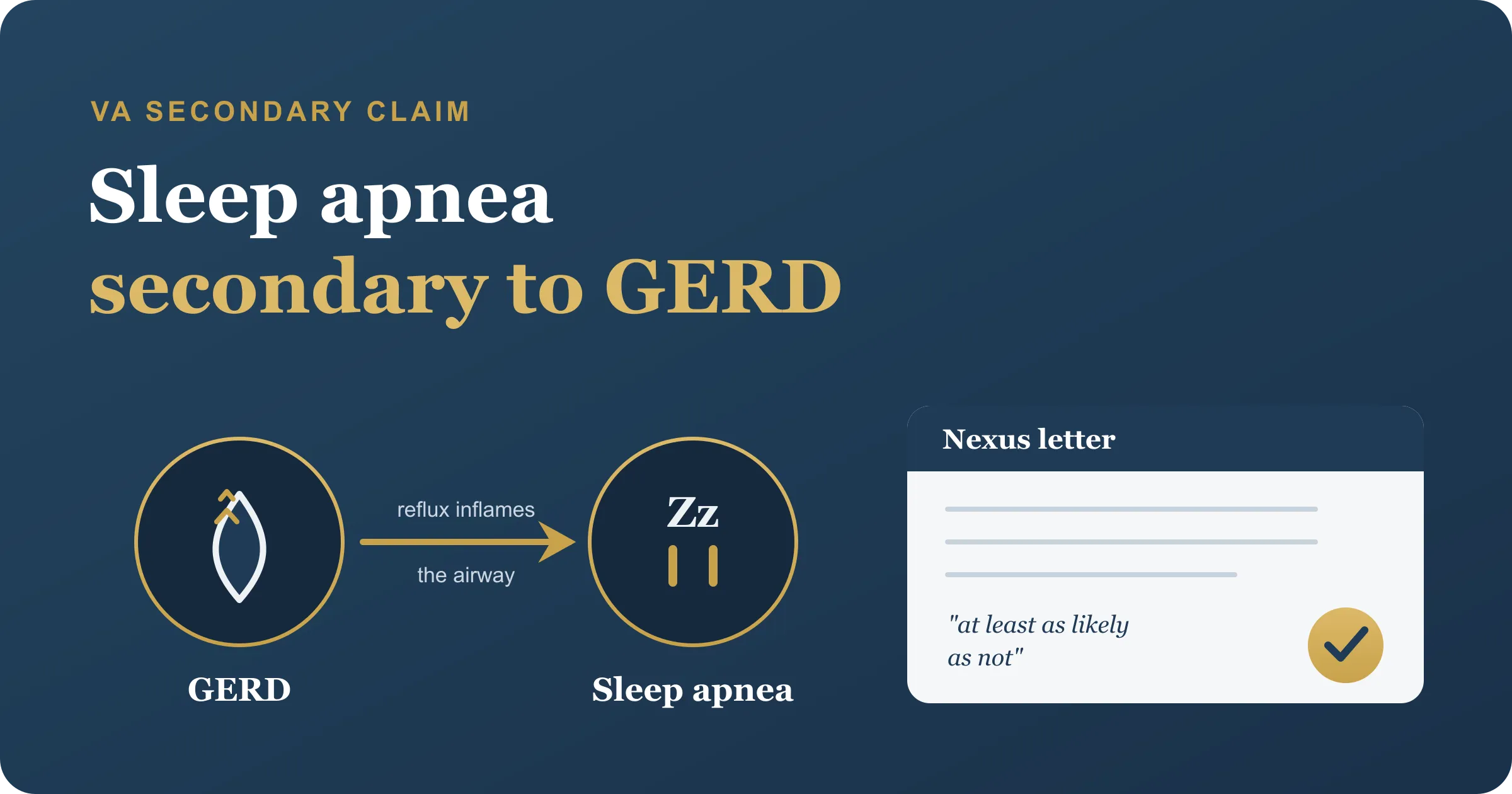 Nexus Letter for Sleep Apnea Secondary to GERDHow to connect sleep apnea to service-connected GERD for a VA claim: the medical link, the evidence needed, ratings, and a physician-written nexus letter.Read the guide
 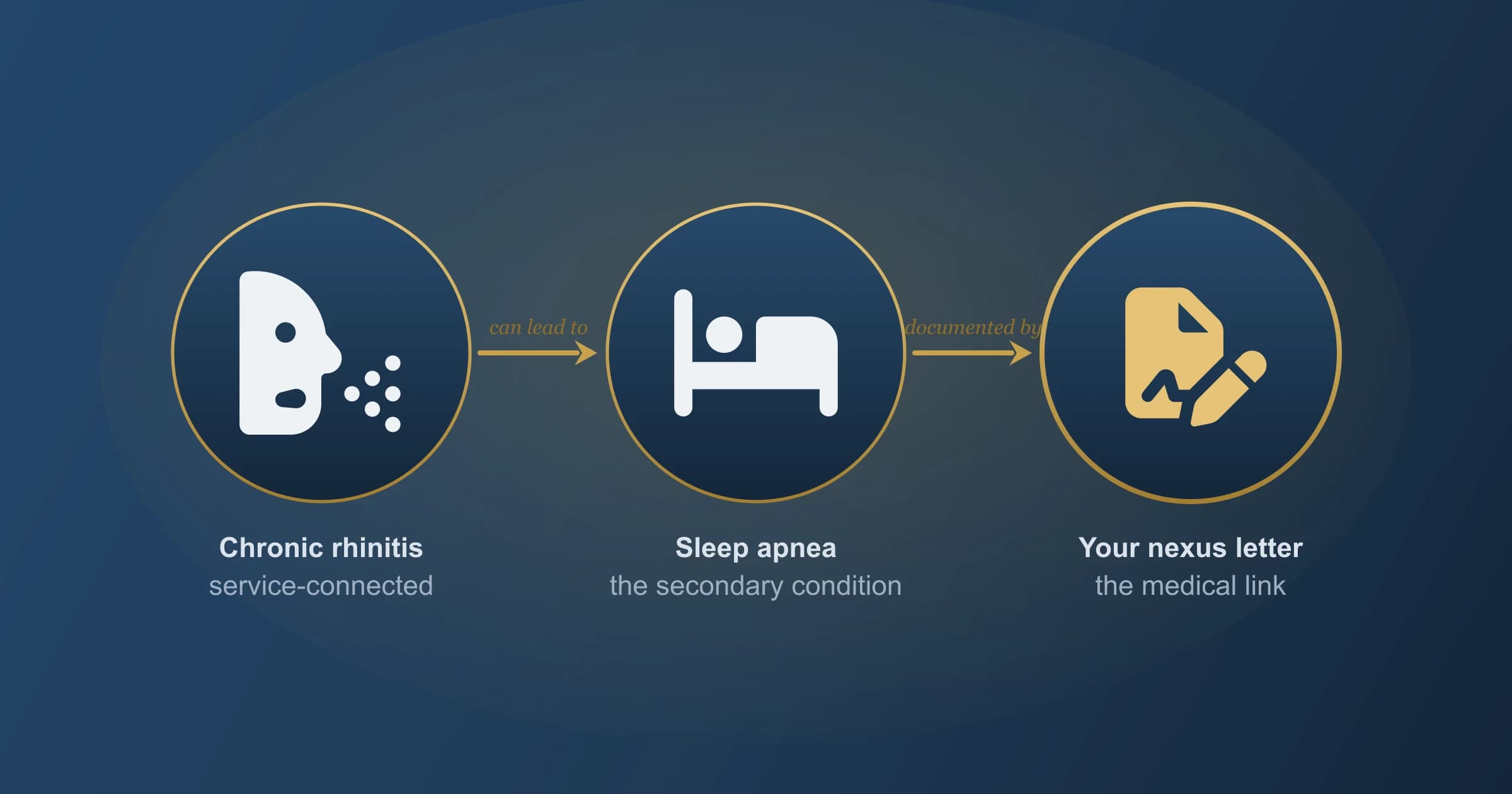 Nexus Letter for Sleep Apnea Secondary to RhinitisHow to obtain a nexus letter for sleep apnea secondary to rhinitis, linking service-connected nasal problems to obstructive sleep apnea in your VA claim.Read the guide
 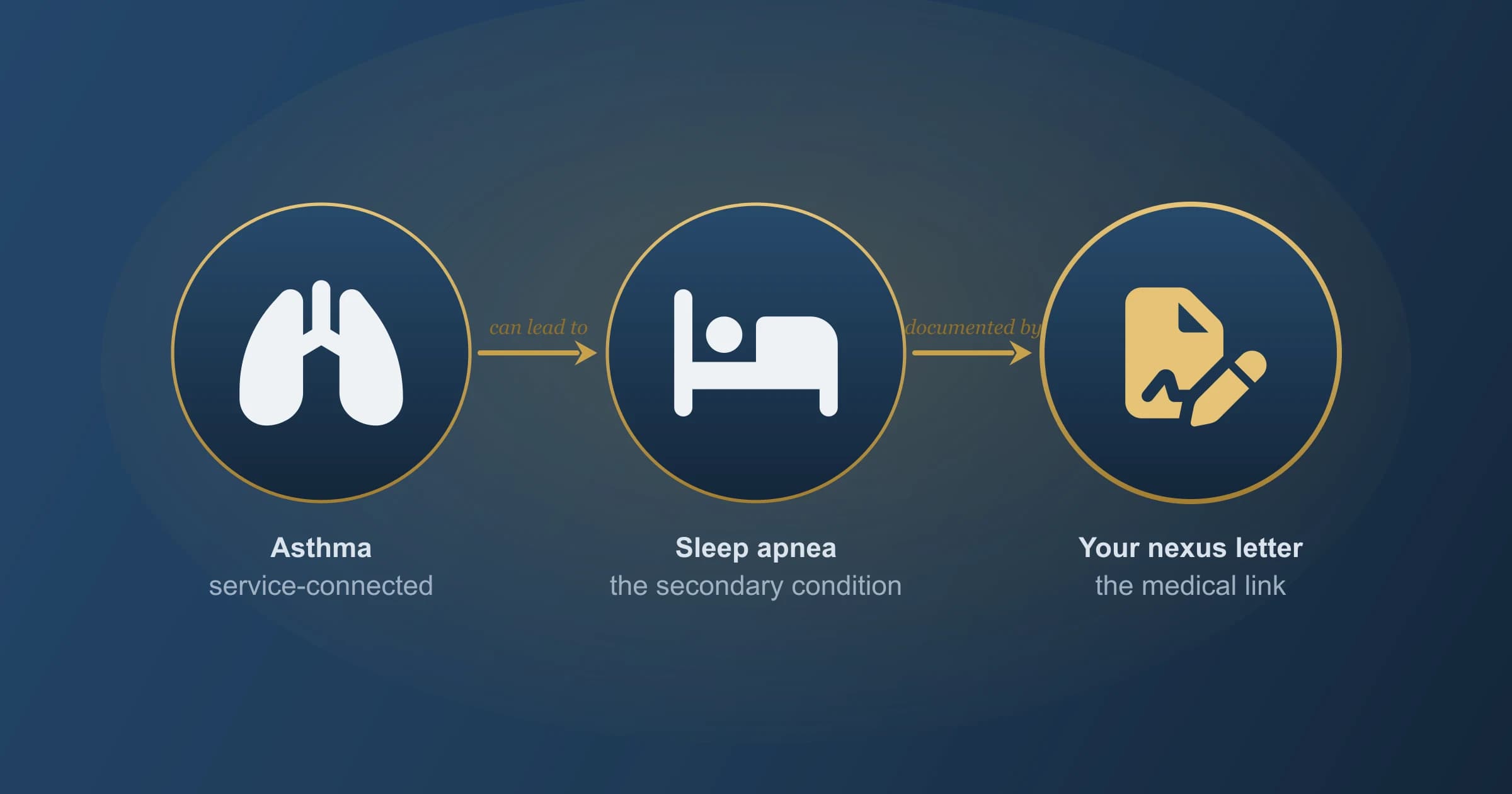 How to Get a Nexus Letter for Sleep Apnea Secondary to AsthmaHow to get a nexus letter for sleep apnea secondary to asthma: how the two conditions are medically linked and the evidence a VA secondary claim needs.Read the guide
 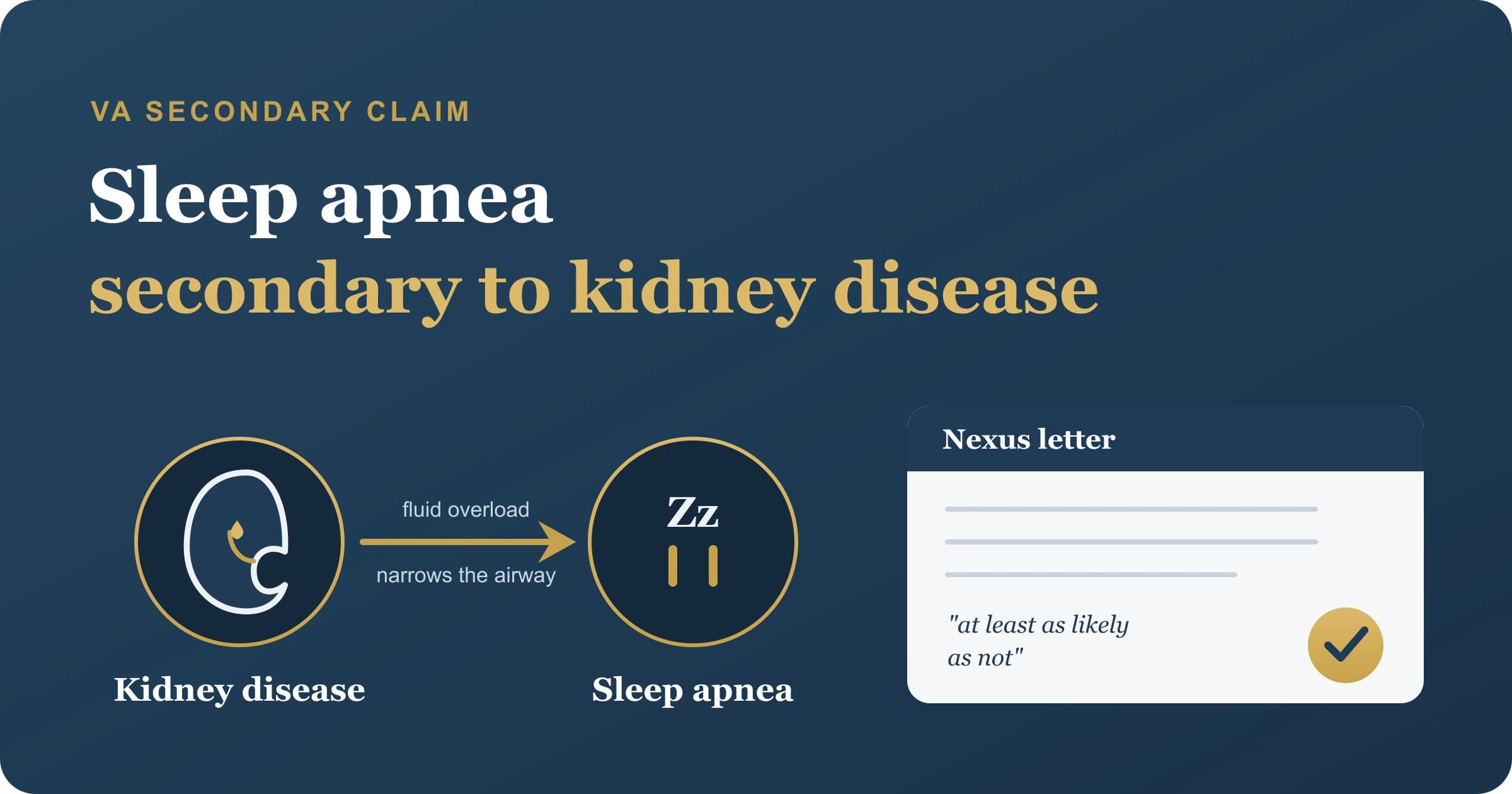 Nexus Letter for Sleep Apnea Secondary to Kidney DiseaseHow to connect obstructive sleep apnea to service-connected kidney disease for a VA claim: the fluid-overload mechanism, the evidence, and a nexus letter.Read the guide
 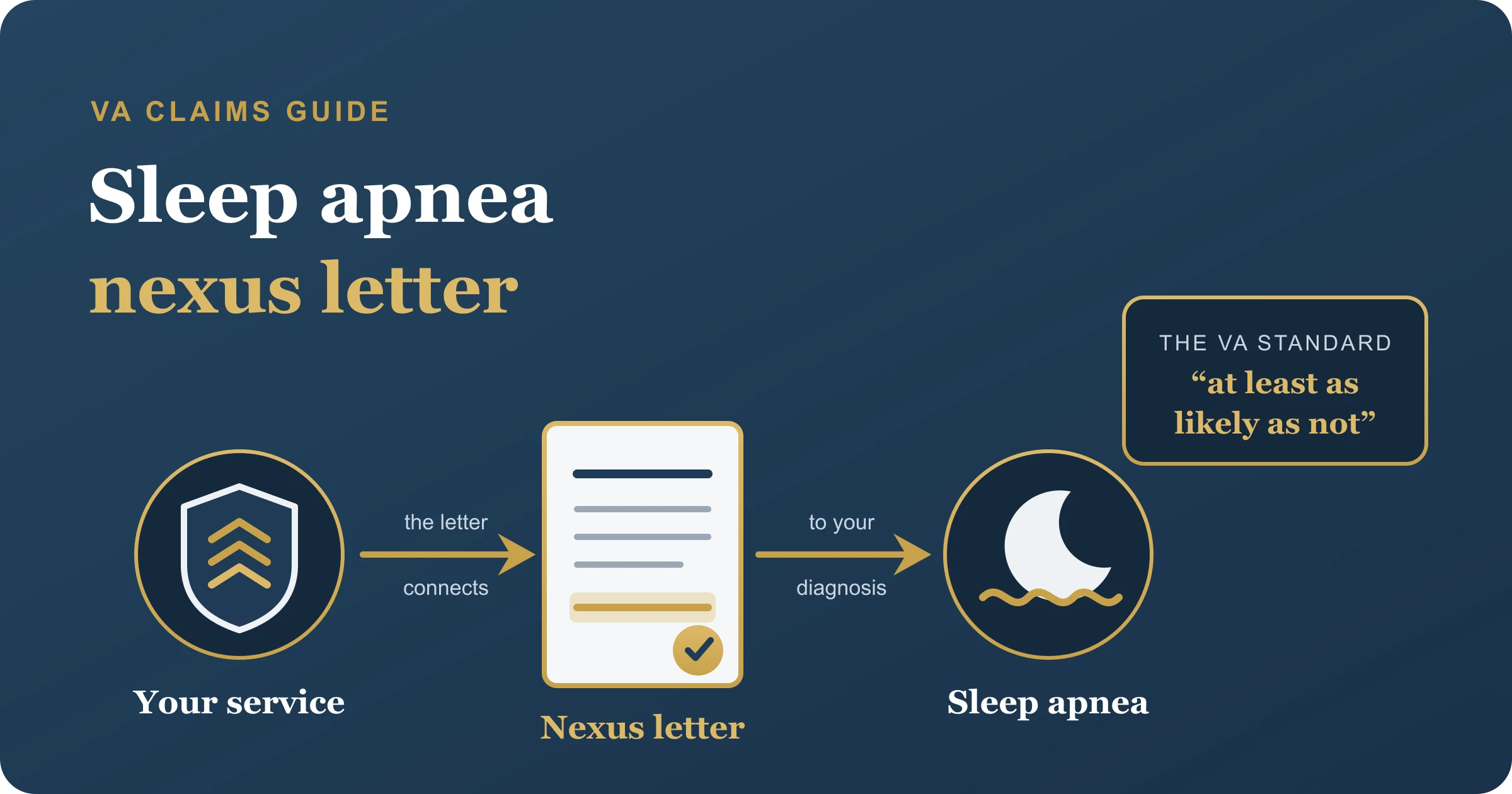 Sleep Apnea Nexus Letter: A Veteran's Complete GuideHow to get a nexus letter for sleep apnea: what it must say, who should write it, what it costs, and the mistakes that sink VA claims, explained by physicians.Read the guide
How Patriot Path Helps with Sleep Apnea Claims
Our licensed MDs and PhDs work where medical science meets VA claim decisions. Here is what that means for your sleep apnea claim:
Full Record Review
We review your DD-214, service medical records, deployment history, sleep study results, and CPAP compliance data. Only then do we write the first line of your nexus letter.
Evidence-Based Opinions
Every letter cites peer-reviewed medical research. Our clinicians explain the biology that connects your service to your diagnosis. No generic template.
Secondary Condition ID
We check for related conditions like hypertension, atrial fibrillation, and erectile dysfunction. Some may call for their own secondary nexus letters. Where the condition is compensable in its own right, such as hypertension, that can raise your combined rating; where it is not, such as erectile dysfunction at 0 percent under DC 7522, the benefit is service connection and, for erectile dysfunction, special monthly compensation.
PACT Act Expertise
We screen every veteran for PACT Act eligibility. Veterans exposed to burn pits may qualify for presumptive coverage. We spot this before we suggest a nexus letter plan.
C&P Exam Rebuttals
If your C&P examiner issued an unfavorable opinion, we write a rebuttal nexus letter. VA adjudicators must weigh competing opinions. Ours are built to prevail.
VA-Compliant Language
Our opinions use the precise legal phrasing required, “at least as likely as not”. They are drafted to meet the standards of both VA raters and the Board of Veterans’ Appeals.
What You’ll Need - Document Checklist
Gather these records before your consultation. Check off each item as you find it.
Frequently Asked Questions
Do I need a CPAP prescription to get VA disability for sleep apnea?
A CPAP prescription is the key to the 50% rating under DC 6847. Without one, you may still qualify for a 30% rating if you have persistent daytime hypersomnolence. A nexus letter can help explain why your condition needs treatment. It can also document your service connection even without an active prescription.
Regulatory basis: 38 C.F.R. § 4.97, Diagnostic Code 6847
Can I get a nexus letter without a sleep study done on active duty?
Yes. VA does not require a sleep study during active duty. What matters is two things. You have a current diagnosis, and a qualified clinician can establish a medical nexus between that diagnosis and your military service. Many veterans are diagnosed long after they separate. That alone does not disqualify a claim.
Can sleep apnea be secondary to PTSD?
Yes. VA can service-connect sleep apnea as secondary to PTSD when the medical evidence shows either that the PTSD caused the apnea or that it made an existing apnea worse.
If your PTSD is already service-connected, you do not have to re-prove your military service. Your secondary claim only needs the medical link between PTSD and OSA, and a sleep study confirming the diagnosis. Our guide to a nexus letter for sleep apnea secondary to PTSD covers what that evidence has to show.
Does the PACT Act cover sleep apnea for burn pit-exposed veterans?
Potentially yes. The PACT Act of 2022 expanded presumptive service connection for veterans exposed to burn pits and airborne hazards. That covers post-9/11 deployments. Sleep apnea caused by chronic airway inflammation from burn pit smoke may qualify. Patriot Path clinicians screen every veteran for PACT Act eligibility. We do that before we suggest a nexus letter plan.
Reference: Honoring our PACT Act of 2022 (Pub. L. 117-168)
What if my C&P exam gave an unfavorable nexus opinion?
An unfavorable C&P exam is not the end of your claim. VA adjudicators must weigh all competent medical opinions of record. When the evidence for and against is in relative balance, the benefit of the doubt goes to the veteran (38 U.S.C. § 5107(b); 38 C.F.R. § 3.102). A rebuttal from a Patriot Path clinician can directly counter an inadequate or unsupported C&P conclusion. Many appeals succeed on the strength of an independent medical opinion filed after an unfavorable exam.
Can I claim sleep apnea and hypertension at the same time?
Yes. If your sleep apnea is service-connected, a secondary nexus opinion can link your hypertension (DC 7101) to it, and the two do not pyramid, because the respiratory no-combine rule at 38 CFR 4.96(a) covers only diagnostic codes 6600 through 6817 and 6822 through 6847, while DC 7101 sits in the cardiovascular schedule. What it pays is a separate question, and the honest answer is that it can be nothing. DC 7101 prints no 0 percent tier, so 38 CFR 4.31 supplies one when the compensable requirements are not met, and for a veteran whose blood pressure is controlled on medication the 10 percent minimum needs past diastolic pressure predominantly 100 or greater before that medication started. Our guide on hypertension secondary to sleep apnea works through both outcomes.
What are the proposed VA sleep apnea rating changes?
In September 2024, the VA proposed ending the automatic 50% rating for CPAP use. It would be replaced with a functional-impairment model. As of June 2026, no final rule has been published, and current criteria remain in effect. Veterans who file before a final rule takes effect will be protected under current criteria. Ask your Patriot Path clinician what this means for your filing strategy.
What’s the difference between obstructive (OSA) and central sleep apnea (CSA)?
Obstructive (OSA): throat muscles collapse, blocking the airway. Most common; frequently linked to PTSD, depression, and weight changes.
Central (CSA): the brain fails to send proper signals to breathing muscles. Particularly common in veterans with TBI. Both types are rated under DC 6847 and may be service-connected.
Can I file a secondary claim for depression or anxiety caused by my sleep apnea?
Yes. Say your sleep apnea is service-connected. Mental health conditions can then be service-connected on a secondary basis. That includes major depressive disorder and generalized anxiety disorder. They must arise from, or be worsened by, your sleep apnea. A secondary nexus letter documents that causal link.
How long does a sleep apnea VA disability claim take?
Processing times vary with claim complexity and the VA backlog. Well-documented claims may resolve within a few months. Complex claims or appeals can take much longer. Filing a complete evidence package, including an independent nexus letter, cuts delays. Patriot Path can help you build a complete evidence package before you file.
Call Patriot Path Today to Get Started
Don’t let an incomplete medical record stand between you and the benefits you’ve earned. Patriot Path’s expert clinicians are ready to help you establish the service connection your claim deserves.
Related sleep apnea nexus letter guides
Sources & Regulatory References
- VA. How to File a VA Disability Claim. https://www.va.gov/disability/how-to-file-claim/
- VA. Evidence Needed for Your VA Disability Claim. https://www.va.gov/disability/how-to-file-claim/evidence-needed/
- 38 C.F.R. § 4.97, Diagnostic Code 6847: Sleep Apnea Syndromes https://www.ecfr.gov/current/title-38/section-4.97
- 38 C.F.R. § 3.303: Principles Relating to Service Connection https://www.ecfr.gov/current/title-38/section-3.303
- 38 C.F.R. § 3.306: Aggravation of Preservice Disability https://www.ecfr.gov/current/title-38/section-3.306
- VA. The PACT Act and Your VA Benefits. https://www.va.gov/resources/the-pact-act-and-your-va-benefits/
- 38 U.S.C. § 5107, Claimant responsibility; benefit of the doubt (Cornell LII) https://www.law.cornell.edu/uscode/text/38/5107
- 38 C.F.R. § 3.102, Reasonable doubt (eCFR) https://www.ecfr.gov/current/title-38/section-3.102
- Peppard et al. “Sleep-Disordered Breathing and Hypertension.” NEJM, 2000. https://pmc.ncbi.nlm.nih.gov/articles/PMC12072724/