
Welcome to Patriot Path
Nexus Letters for Type 2 Diabetes
Licensed Physician, MD | Patriot Path Medical Team
Specializing in VA endocrine evaluations and independent medical opinions • Last updated: October 2026
Board-certified physicians specializing in VA disability documentation. Meet our clinicians → • Our review process →
Type 2 diabetes is on the Agent Orange presumptive list for Vietnam-era veterans. But the diabetes rating is only half the story. A nerve, eye, kidney, or heart problem it causes is rated separately when it is compensable in its own right, unless it was used to reach a 100% diabetes rating; one that is not compensable is treated as part of the diabetes rating (38 C.F.R. 4.119, DC 7913 Note 1).
A nexus letter ties it together. Our physicians connect your diabetes to your service, or document the complications that flow from it, in the language the VA expects. One flat fee of $1,500, and the first consultation is free.
How VA Rates Type 2 Diabetes
The VA rates diabetes under 38 C.F.R. § 4.119, Diagnostic Code 7913. The rating climbs with how much treatment your diabetes takes, from diet alone up to insulin with serious episodes and complications. Here is the rule, word for word, then what each level looks like.
"Requiring more than one daily injection of insulin, restricted diet, and regulation of activities ... with episodes of ketoacidosis or hypoglycemic reactions requiring at least three hospitalizations per year or weekly visits to a diabetic care provider, plus either progressive loss of weight and strength or complications ... 100. Requiring one or more daily injection of insulin, restricted diet, and regulation of activities with episodes ... requiring one or two hospitalizations per year or twice a month visits ... plus complications that would not be compensable if separately evaluated ... 60. Requiring one or more daily injection of insulin, restricted diet, and regulation of activities ... 40. Requiring one or more daily injection of insulin and restricted diet, or; oral hypoglycemic agent and restricted diet ... 20. Manageable by restricted diet only ... 10."
| Rating | What it generally takes | Monthly pay (approx) |
|---|---|---|
| 100% | More than one daily insulin injection, restricted diet, and regulation of activities, with episodes of ketoacidosis or low blood sugar needing 3 or more hospital stays a year or weekly provider visits, plus weight and strength loss or complications serious enough to rate on their own. | ~$3,939/mo |
| 60% | Insulin, restricted diet, and regulation of activities, with episodes needing 1 or 2 hospital stays a year or twice-monthly provider visits, plus complications too minor to rate on their own. | ~$1,435/mo |
| 40% | Insulin, restricted diet, and regulation of activities (a doctor's order to avoid strenuous activity). | ~$796/mo |
| 20% | Insulin and restricted diet, or an oral medication and restricted diet.Most Common | ~$357/mo |
| 10% | Managed by a restricted diet alone, with no medication. | ~$180/mo |
Pay figures are approximate 2026 rates (effective December 1, 2025) for a single veteran with no dependents. Check VA.gov for current amounts.
How the VA builds a diabetes rating
Diabetes ratings climb with how much treatment your diabetes takes. Each level includes everything below it and adds one more piece. Here is the ladder.
- 1
Diet alone (10%)
Diabetes you keep in check with a restricted diet and no medication.
- 2
Add medication (20%)
An oral medication, or insulin, along with the restricted diet. Most veterans on treatment for type 2 diabetes land here.
- 3
Add regulation of activities (40%)
Insulin and diet, plus a doctor's order to avoid strenuous activity. 'Regulation of activities' is a legal term that needs medical evidence. Your provider has to prescribe limiting your activity; it is not enough that you slow down on your own.
- 4
Add serious episodes and complications (60%)
The 40% picture, plus episodes of ketoacidosis or low blood sugar that need one or two hospital stays a year (or twice-a-month provider visits), plus complications too minor to rate on their own.
- 5
The most severe (100%)
More than one insulin injection a day, diet, and regulation of activities, with episodes needing three or more hospital stays a year (or weekly visits), plus either ongoing weight and strength loss or complications serious enough to rate on their own.
One rule changes the math. Some complications are serious enough to carry their own rating. Those are rated separately and added on top, unless they were used to reach 100% (Note 1). Nerve damage can fall on either side of that line: at the mild level, some nerve codes pay 10% and others pay 0%, and a 0% complication is folded into the diabetes rating (Note 1). That is where a diabetes claim can grow.
Estimate your diabetes rating (DC 7913)
Diabetes is rated on how much treatment it takes. Answer about your current treatment. This is a rough orientation, not a rating decision, and it does not count the complications, which are rated separately when they are compensable in their own right (DC 7913 Note 1).
Making a VA Disability Claim for Type 2 Diabetes
A VA disability claim for type 2 diabetes needs three things to line up:
A current diagnosis
A diabetes diagnosis backed by lab work (such as your A1c or glucose readings) and your treatment record.
A service connection
Either diabetes that showed up in service, the Agent Orange presumptive path, or a link to another service-connected condition or its treatment.
A medical nexus
A qualified opinion that your diabetes is 'at least as likely as not' connected to your service, or to a service-connected cause.
For a veteran with qualifying herbicide exposure, the presumptive path does the heavy lifting. Type 2 diabetes is on the Agent Orange list. So if you had qualifying exposure, the VA already accepts the link, and you may not need a nexus letter for the diabetes itself. A nexus letter can earn its keep on a complication a VA examiner attributed to another cause, tying your nerve, eye, kidney, or heart disease back to the diabetes; if the VA examination never addressed a complication, raise that with VA first. It also helps on any diabetes claim that is not presumptive. The 'at least as likely as not' standard (a 50% or better chance) comes from the benefit-of-the-doubt rule in 38 U.S.C. § 5107(b), carried out in 38 C.F.R. § 3.102.
How to Connect Type 2 Diabetes to Service
There are a few ways to tie type 2 diabetes to your service. For many veterans the presumptive path is the strongest, because type 2 diabetes is on the Agent Orange list.
Presumptive (Agent Orange)
Type 2 diabetes is an Agent Orange presumptive condition (38 C.F.R. § 3.309(e)). If you had qualifying herbicide exposure, the VA accepts the link to your service.
- Qualifying service. Vietnam, the Korean DMZ, Thailand, and several other locations and time periods can qualify you for presumed Agent Orange exposure.
- No nexus needed. On a presumptive claim you do not have to prove the cause. You still need a current diagnosis and proof of qualifying service.
Direct connection
Diabetes began in service, or was first diagnosed while you served.
- A diagnosis in service. Being diagnosed with diabetes, or showing high blood sugar on labs, while on active duty.
- Onset soon after service. A diagnosis in the years right after service can still support a direct claim with the right medical opinion.
Secondary connection
Another service-connected condition, or its treatment, brought on your diabetes (38 C.F.R. § 3.310).
- Steroid medication. Long-term corticosteroid (steroid) treatment for a service-connected condition can raise blood sugar and bring on diabetes.
- Other service-connected conditions. Some service-connected conditions and the medications that treat them affect how your body handles blood sugar.
Aggravation
You had diabetes before service, and service made it permanently worse.
- Worse during service. Your diabetes progressed, or your treatment had to be stepped up, on active duty, beyond normal change over time.
Secondary Conditions
Diabetes can affect several body systems, and each complication that is compensable in its own right is rated separately and added to your combined rating, unless it was used to reach a 100% diabetes rating. Under DC 7913 Note (1), a complication that is noncompensable is instead treated as part of the diabetic process, so it is service connected without changing the percentage. Either way it is worth putting in the record.
Diabetes may be secondary to
- Steroid medication. Long-term corticosteroids prescribed for another service-connected condition can raise blood sugar and bring on diabetes.
- Other service-connected conditions. Some service-connected conditions and their treatments change how your body handles blood sugar, which can support a secondary claim.
Conditions that may be secondary to diabetes
- Peripheral neuropathy. VA's adjudication manual calls peripheral neuropathy a common complication of diabetes and one of the most common of its neurological complications. It is rated nerve by nerve under 38 CFR 4.124a: a neuropathy compensable under its own nerve code is rated separately, unless it was used to reach 100%, and one rated 0% is folded into the diabetes rating under DC 7913 Note (1). Nexus letter for peripheral neuropathy secondary to diabetes →
- Eye disease (diabetic retinopathy). High blood sugar damages the small vessels in the eyes and can harm vision. It is rated under DC 6040 on vision or on documented treatment visits: a compensable retinopathy is rated separately, unless it was used to reach 100%, and one rated 0% is folded into the diabetes rating under DC 7913 Note (1). Nexus letter for diabetic retinopathy secondary to diabetes →
- Kidney disease (diabetic nephropathy). Diabetes can damage the kidneys. Kidney disease is rated under the genitourinary rules, and under DC 7913 Note (1) it is rated separately only when it is compensable in its own right and was not used to reach 100%.
- Heart disease and high blood pressure. Heart disease and hypertension have their own diagnostic codes; under DC 7913 Note (1) one that is compensable is rated separately unless it was used to reach 100%, and one rated 0% is part of the diabetic process.
- Erectile dysfunction. A common diabetic complication. It is rated 0 percent under DC 7522, so under DC 7913 Note (1) it is evaluated as part of the diabetic process rather than separately, and the benefit that follows a grant is special monthly compensation rather than a higher rating. Nexus letter for erectile dysfunction secondary to diabetes →
What to Gather - Evidence Checklist
Gather these before you file or ask for a letter. For diabetes, your treatment record and your complication records do the heavy lifting, because the rating turns on how much treatment it takes and what it has caused.
Frequently Asked Questions
How does the VA rate type 2 diabetes?
Under 38 C.F.R. 4.119, Diagnostic Code 7913. The rating climbs with how much treatment it takes. A restricted diet alone is 10%. An oral medication or insulin plus diet is 20%. Insulin plus a doctor's order to limit your activities is 40%. Serious episodes and complications push it to 60% or 100%. Each level builds on the one before it.
Is type 2 diabetes presumptive for Agent Orange?
Yes. Type 2 diabetes is on the Agent Orange presumptive list (38 C.F.R. 3.309(e)). If you had qualifying herbicide exposure, the VA accepts that your diabetes is connected to your service, so you do not have to prove the cause. You still need a current diagnosis and proof of qualifying service.
What does 'regulation of activities' mean?
It is the legal term for a doctor's order to avoid strenuous occupational and recreational activity because of your diabetes. It is the line between a 20% and a 40% rating, and it needs medical evidence. It is not enough that you have slowed down on your own; your provider has to have prescribed limiting your activity, and it should be in your records.
Can I get separate ratings for my diabetes complications?
Yes, and this is where a diabetes claim grows. The VA rates compensable complications separately and combines them (Note 1 to DC 7913). Peripheral neuropathy in the hands and feet, eye disease, kidney disease, and heart disease are diabetic complications that carry their own rating when they are compensable in their own right, unless they were used to reach a 100% diabetes rating. A noncompensable complication, such as a neuropathy rated 0% under its nerve code, is treated as part of the diabetic process instead.
Why is my diabetes only rated 20%?
Because 20% covers diabetes controlled by an oral medication or insulin plus diet, which fits most veterans with type 2 diabetes. To reach 40%, you need insulin, diet, and a doctor's order to limit your activities (regulation of activities), backed by medical evidence. The bigger gains usually come from rating the complications separately, not from a higher diabetes number.
Do I need a nexus letter for diabetes?
If your type 2 diabetes is presumptive through Agent Orange, you may not need one for the diabetes itself. Where a nexus letter can earn its keep is a complication a VA examiner attributed to another cause, and any diabetes claim that is not presumptive. If the VA examination never addressed a complication, raise that with VA first. That medical opinion is what we write.
Guides for this condition
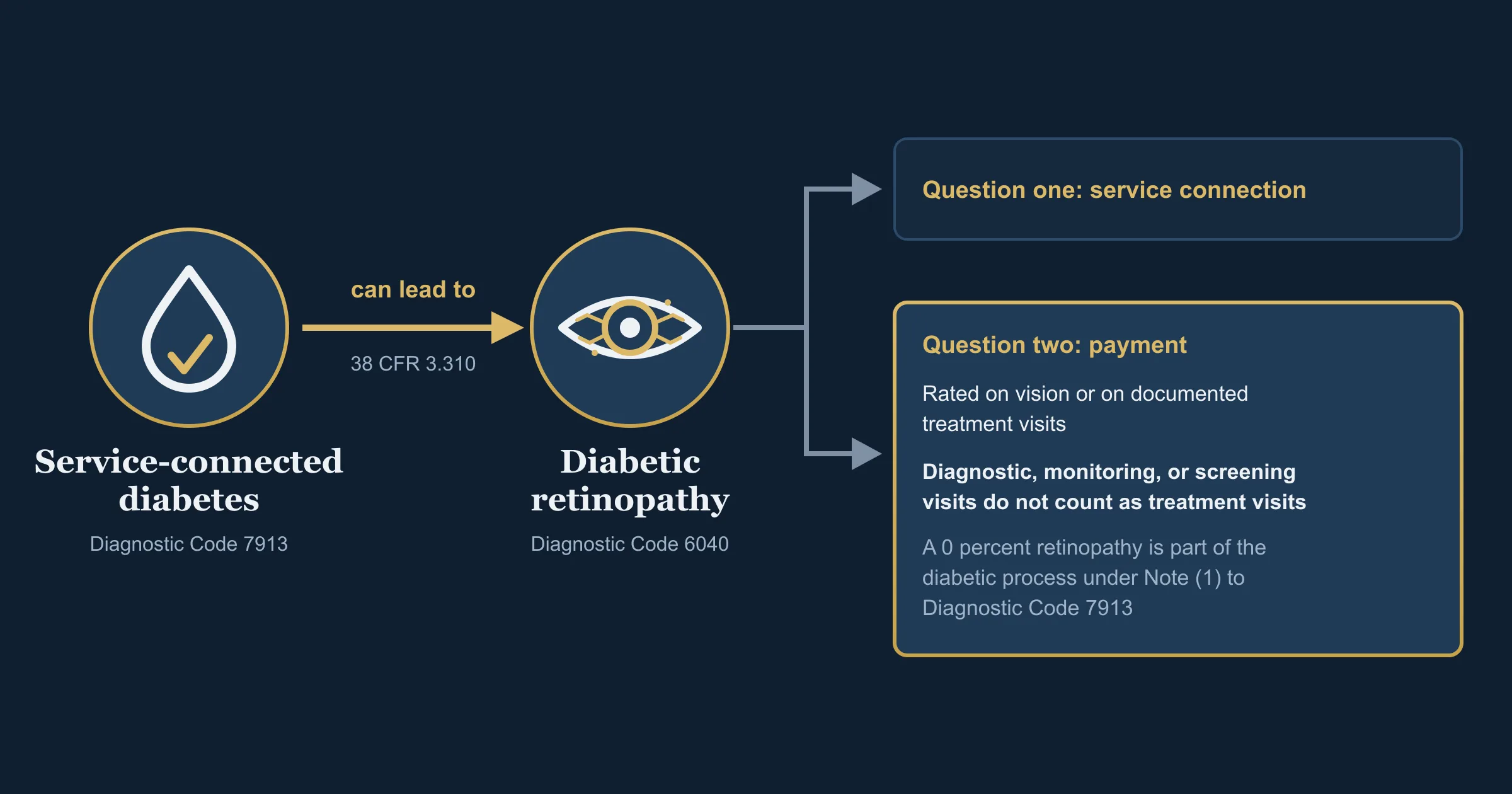 Diabetic Retinopathy Secondary to Type 2 Diabetes: How VA Rates Vision and Treatment VisitsRetinopathy from service-connected diabetes is rated on vision or treatment visits. Screenings are not treatment visits; a 0 percent rating folds into DC 7913.Read the guide
 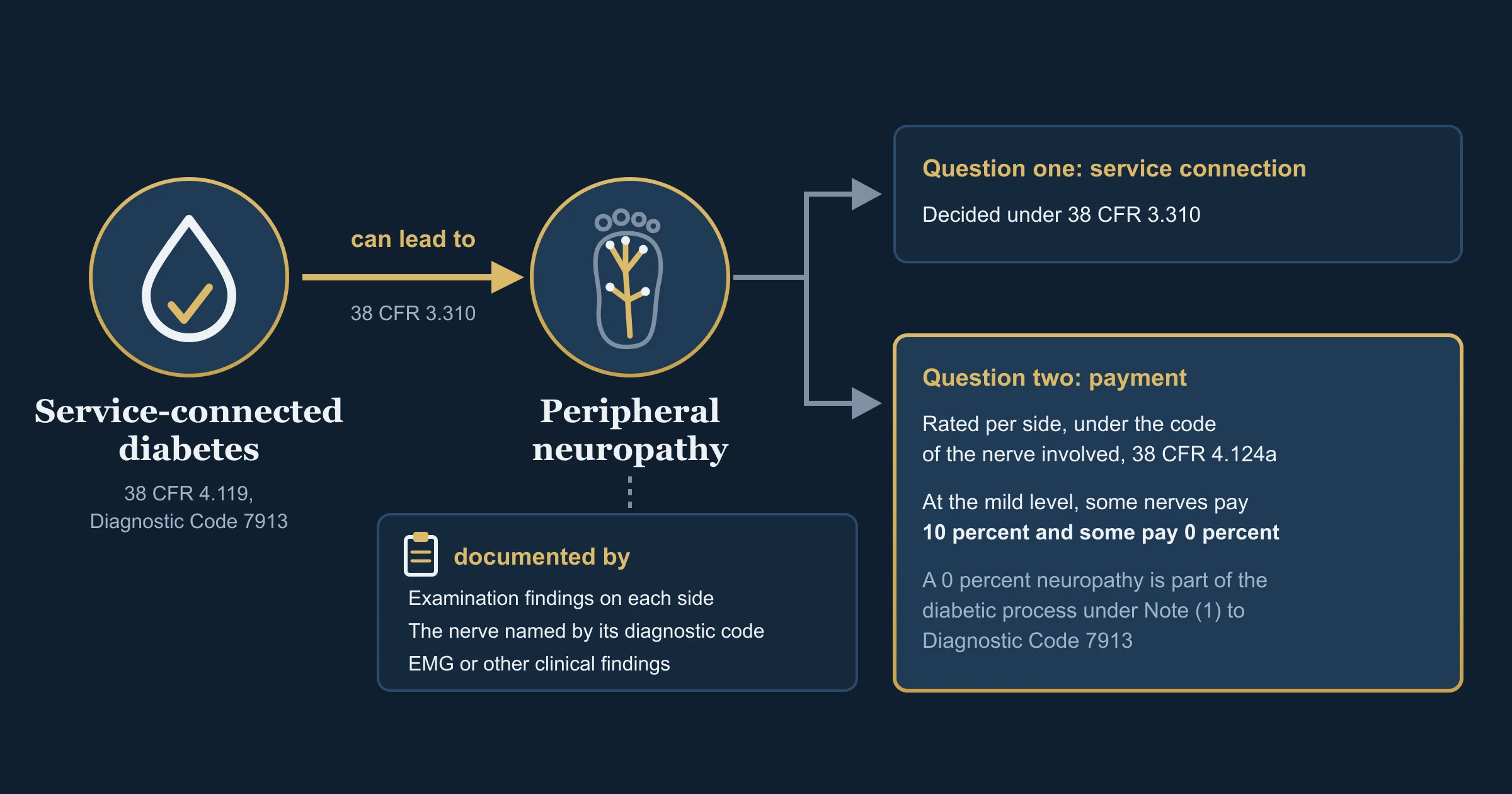 Peripheral Neuropathy Secondary to Diabetes: The Nerve Decides the RatingMild diabetic neuropathy pays 10 percent under some leg nerve codes and 0 under others. How VA rates it, and why a new complication is a claim for increase.Read the guide
 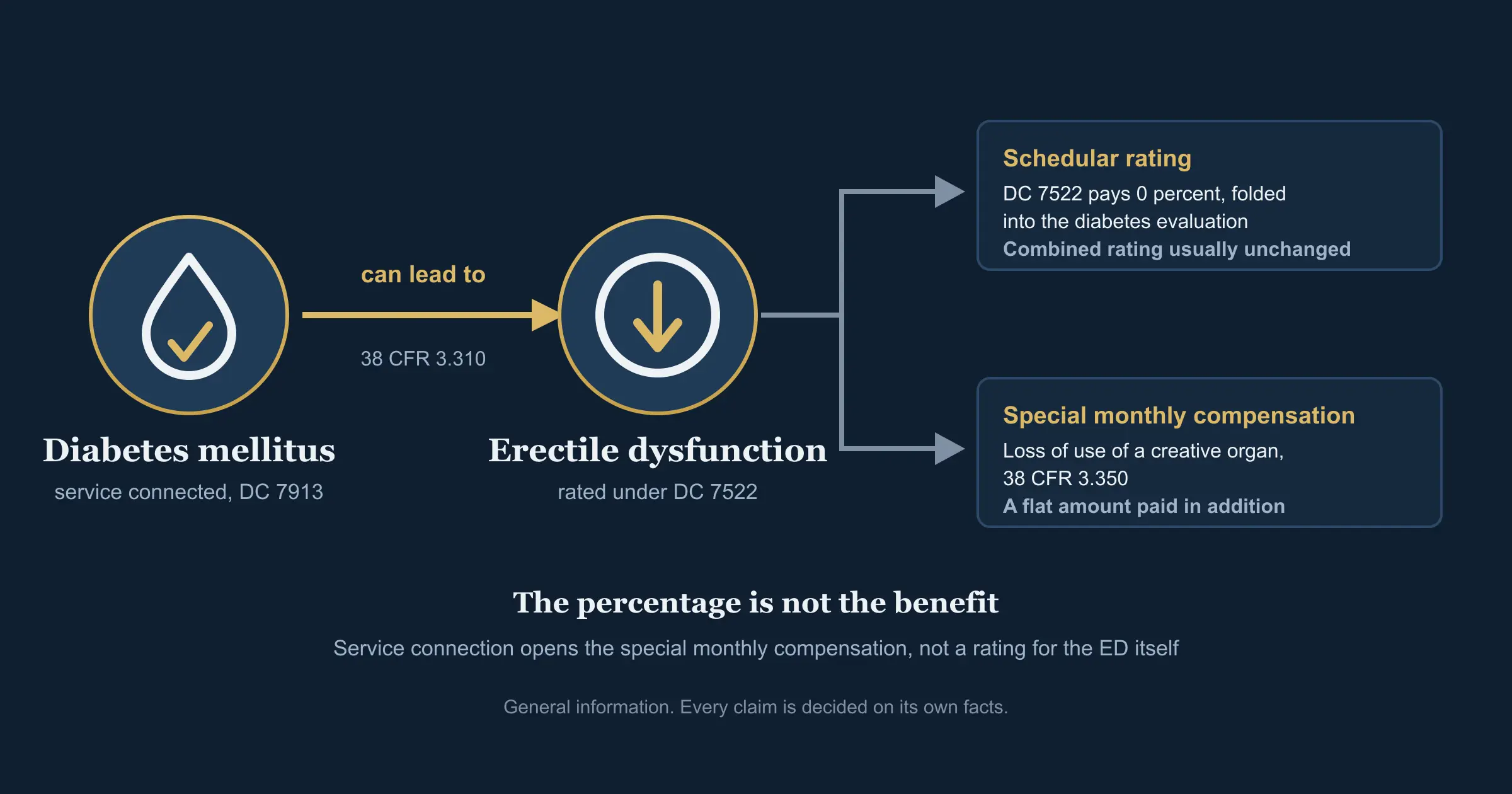 Nexus Letter for Erectile Dysfunction Secondary to DiabetesED secondary to service-connected diabetes never gets its own rating percentage. What the nexus letter must prove, and where the money actually comes from.Read the guide
  Nexus Letter for Diabetes: When You Need One (and When You Don't)Type 2 diabetes is Agent Orange presumptive, so many veterans do not need a nexus letter. Here is when you do, what it must say, and how secondary claims work.Read the guide
Diabetes can cause other conditions. Claim what it caused.
Let our physicians prepare a diabetes nexus letter, and document the complications, to meet the VA's evidence standards and support the benefits you earned.
Sources & Regulatory References
- VA disability compensation (VA.gov) https://www.va.gov/disability/
- 2026 VA disability compensation rates (VA.gov) https://www.va.gov/disability/compensation-rates/veteran-rates/
- 38 CFR 4.119, Schedule of ratings, endocrine system, including DC 7913 (eCFR) https://www.ecfr.gov/current/title-38/section-4.119
- Agent Orange exposure and disability compensation (VA.gov) https://www.va.gov/disability/eligibility/hazardous-materials-exposure/agent-orange/
- 38 CFR 3.309, Disease subject to presumptive service connection (eCFR) https://www.ecfr.gov/current/title-38/section-3.309
- 38 CFR 3.310, Secondary service connection (eCFR) https://www.ecfr.gov/current/title-38/section-3.310
- 38 U.S.C. 5107, Benefit of the doubt (Cornell LII) https://www.law.cornell.edu/uscode/text/38/5107