
Welcome to Patriot Path
Nexus Letters for Peripheral Neuropathy
Licensed Physician, MD | Patriot Path Medical Team
Specializing in VA neurological evaluations and independent medical opinions • Last updated: September 2026
Board-certified physicians specializing in VA disability documentation. Meet our clinicians → • Our review process →
Numbness, tingling, burning, the pins and needles that start in the feet and creep up. Peripheral neuropathy is nerve damage, and for a lot of veterans it traces back to service: to diabetes, to Agent Orange or burn-pit exposure, or to an injury. The VA rates it nerve by nerve, so which nerve is affected matters.
A nexus letter draws the line. Our physicians connect your nerve damage to your service, or to a service-connected cause like diabetes, in the language the VA expects. One flat fee of $1,500, and the first consultation is free.
How VA Rates Peripheral Neuropathy
The VA rates nerve damage under 38 C.F.R. § 4.124a, by how badly the nerve works and which nerve is affected. The table below uses the sciatic nerve (DC 8520), which runs down the leg. Other nerves have their own ladders and percentages, and several leg nerves pay 0% at the mild level.
| Rating | What it generally takes | Monthly pay (approx) |
|---|---|---|
| 80% | Complete paralysis of the nerve. The foot dangles and drops, and there is no real movement below the knee. | ~$2,102/mo |
| 60% | Severe incomplete paralysis, with marked muscle wasting. | ~$1,435/mo |
| 40% | Moderately severe incomplete paralysis. | ~$796/mo |
| 20% | Moderate incomplete paralysis. | ~$357/mo |
| 10% | Mild incomplete paralysis. Numbness, tingling, or mild weakness in the limb. | ~$180/mo |
Two things to know. First, each affected limb is rated on its own, so two legs and two arms can each carry a rating, and they combine. Second, if your symptoms are all sensory (numbness and tingling, but no real weakness or muscle loss), 38 C.F.R. 4.124a says the rating should be for the mild, or at most, the moderate degree. The exact percentage depends on which nerve is involved and on the findings in the record. The VA rater, not the examiner, decides the level. VA's adjudication manual (M21-1) requires EMG results unless an earlier EMG is on file or the clinical findings are enough to show how badly the nerve is affected.
Pay figures are approximate 2026 rates (effective December 1, 2025) for a single veteran with no dependents. Check VA.gov for current amounts.
Making a VA Disability Claim for Peripheral Neuropathy
A VA disability claim for peripheral neuropathy needs three things to line up:
A current diagnosis
A diagnosis of peripheral neuropathy, documented by examination findings on each side and, where you have them, EMG results.
A service connection
Either a cause in service (an injury or a toxic exposure), or a link to a service-connected condition such as diabetes.
A medical nexus
A qualified opinion that the nerve damage is 'at least as likely as not' connected to your service or to a service-connected cause.
For neuropathy, the nexus turns on the cause. Diabetic neuropathy, for example, is connected by tying it to service-connected diabetes. A nexus letter supplies that opinion in writing. The 'at least as likely as not' standard (a 50% or better chance) comes from the benefit-of-the-doubt rule in 38 U.S.C. § 5107(b), carried out in 38 C.F.R. § 3.102.
How to Connect Peripheral Neuropathy to Service
There are a few ways to tie nerve damage to your service, including the secondary path through a service-connected condition such as diabetes.
Secondary connection
Another service-connected condition caused the nerve damage (38 C.F.R. § 3.310).
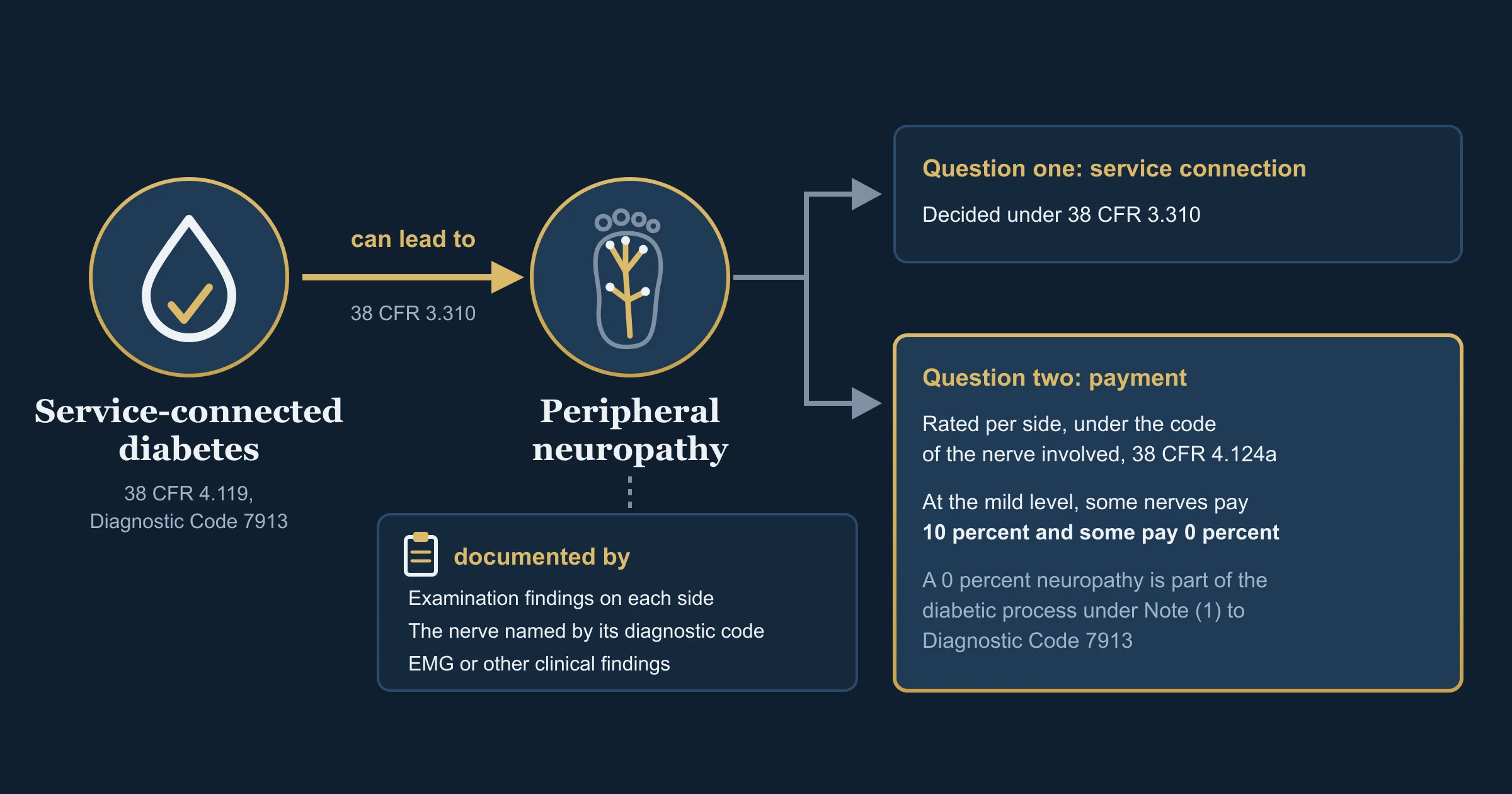
- Diabetes. VA's adjudication manual (M21-1) calls peripheral neuropathy a common complication of diabetes, and, describing its neurological complications, says: "One of the most common disabilities is peripheral neuropathy." If your diabetes is service-connected, the neuropathy can be too, but whether it pays depends on the nerve: at the mild level some nerve codes pay 10% and others pay 0%. Peripheral neuropathy secondary to diabetes →
- Medications. Some drugs for a service-connected condition, such as certain chemotherapy, can damage nerves.
Direct connection
The nerve damage started in service.
- Toxic exposure. Agent Orange, burn pits, and other toxic exposures can be linked to nerve damage. Your exposure history can be the key to the claim.
- An injury. A wound or crush injury that damaged a nerve directly.
Aggravation
You had nerve problems before service, and service made them permanently worse.
- Worsened by service. Symptoms got worse during active duty, beyond normal change over time.
Secondary Conditions
Neuropathy has a cause behind it, and it can cause problems of its own. Documenting both directions helps your combined rating.
Peripheral neuropathy may be secondary to
- Diabetes. Neuropathy caused by service-connected diabetes can be service-connected under 38 C.F.R. 3.310. One that is compensable under its own nerve code is rated separately, unless it was used to reach a 100% diabetes rating; one rated 0% is treated as part of the diabetes rating under DC 7913 Note (1). Peripheral neuropathy secondary to diabetes →
- Toxic exposure. Agent Orange, burn pits, and other exposures can be linked to nerve damage.
- Medications. Some treatments for a service-connected condition can damage nerves.
Conditions that may follow neuropathy
- Falls and injuries. Numb feet and weak legs make falls more likely.
- Foot ulcers and wounds. Lost feeling in the feet can lead to sores that are slow to heal, especially with diabetes.
- Depression or anxiety. Chronic pain and lost function wear on mood and can be claimed as secondary. Depression secondary to chronic pain →
What to Gather - Evidence Checklist
Gather these before you file or ask for a letter. For neuropathy, the examination findings on each side and the proof of the cause are the core of the claim.
Frequently Asked Questions
How does the VA rate peripheral neuropathy?
By how badly the nerve works and which nerve is affected, under 38 C.F.R. 4.124a. For the sciatic nerve in the leg (DC 8520), it runs from 10% for mild incomplete paralysis up to 80% for complete paralysis. Each affected limb is rated on its own and combined.
Is neuropathy from diabetes covered?
It can be. If your diabetes is service-connected, the neuropathy it causes can be service-connected too, under 38 C.F.R. 3.310. Whether it adds a percentage depends on the nerve. A neuropathy compensable under its own nerve code is rated separately, unless it was used to reach a 100% diabetes rating; one rated 0%, as several leg nerve codes are at the mild level, is treated as part of the diabetes rating under DC 7913 Note (1).
Can I get a rating for each limb?
Yes. Each side is evaluated on its own under 38 C.F.R. 4.124a, and the evaluations combine; where both sides are compensable, the bilateral factor in 38 C.F.R. 4.26 applies. Within one limb the rule is narrower. In a leg, VA assigns separate evaluations only when the symptoms are separate and distinct and come from nerves in different branches (sciatic, femoral, obturator, external cutaneous nerve of the thigh, ilio-inguinal); nerves within the same branch, such as the peroneal and tibial nerves, get one evaluation (M21-1 V.iii.12.A.2.f). In an arm, several nerves are rated by reference to the major involvement, or, if extensive enough, as a radicular group, not separately (note to DC 8719; M21-1 V.iii.12.A.2.c).
What if my symptoms are only numbness?
Under 38 C.F.R. 4.124a, numbness and tingling with no real weakness or muscle loss should be rated mild, or at most moderate. Weakness, muscle wasting, and lost function can support a higher level. Detailed examination findings, and EMG results where you have them, document the difference.
Do I need a nexus letter?
Sometimes, above all when the cause is in dispute, such as a VA examiner pointing to another cause, or when the link to service or to a condition like diabetes has not been accepted. If a VA exam has already tied your neuropathy to a service-connected condition, you may not need one. A nexus letter supplies the medical opinion, and the VA weighs it with the rest of the record.
What does it cost, and how do we start?
Patriot Path charges $1,500 flat for a nexus letter, and the first consultation is free. Book a consultation and a clinician will tell you straight whether a letter can help your claim.
Numb feet are not just getting older.
Let our physicians prepare a neuropathy nexus letter that meets the VA's evidence standards and supports the benefits you earned.
Sources & Regulatory References
- VA disability compensation (VA.gov) https://www.va.gov/disability/
- 2026 VA disability compensation rates (VA.gov) https://www.va.gov/disability/compensation-rates/veteran-rates/
- 38 CFR 4.124a, Schedule of ratings, neurological conditions, including the peripheral nerve codes (eCFR) https://www.ecfr.gov/current/title-38/section-4.124a
- 38 CFR 4.123, Neuritis (eCFR) https://www.ecfr.gov/current/title-38/section-4.123
- 38 CFR 3.310, Secondary service connection (eCFR) https://www.ecfr.gov/current/title-38/section-3.310
- 38 U.S.C. 5107, Benefit of the doubt (Cornell LII) https://www.law.cornell.edu/uscode/text/38/5107