
Welcome to Patriot Path
Nexus Letters for Migraines
Licensed Physician, MD | Patriot Path Medical Team
Specializing in VA neurological evaluations and independent medical opinions • Last updated: June 2026
Board-certified physicians specializing in VA disability documentation. Meet our clinicians → • Our review process →
Migraines are one of the most common conditions veterans claim, and one of the most under-rated. Plenty of veterans get stuck at 0%, or denied outright. The headaches were never written up in service, or no one tied them to the tinnitus or PTSD that set them off.
A nexus letter fixes the link. Our physicians connect your migraines to your service, or to another service-connected condition, in the language the VA expects. One flat fee of $1,500, and the first consultation is free.
How VA Rates Migraines
The VA rates migraines under 38 C.F.R. § 4.124a, Diagnostic Code 8100. One thing drives the rating: how often you get 'prostrating' attacks, the kind that stop you cold and force you to lie down. Here is the rule, word for word, then what each level looks like.
"With very frequent completely prostrating and prolonged attacks productive of severe economic inadaptability ... 50. With characteristic prostrating attacks occurring on an average once a month over last several months ... 30. With characteristic prostrating attacks averaging one in 2 months over last several months ... 10. With less frequent attacks ... 0."
| Rating | What it generally takes | Monthly pay (approx) |
|---|---|---|
| 50% | Very frequent, completely prostrating, prolonged attacks that badly affect your ability to work (severe economic inadaptability). This is the highest rating for migraines. | ~$1,133/mo |
| 30% | Characteristic prostrating attacks averaging about once a month over the last several months.Most Common | ~$552/mo |
| 10% | Characteristic prostrating attacks averaging about one every two months over the last several months. | ~$180/mo |
| 0% | Less frequent attacks. Still service-connected, which protects you if it gets worse. | $0/mo |
Fifty percent is the highest rating the migraine code gives. There is no 70% or 100% for migraines by themselves. If they are so frequent and disabling that you cannot hold steady work, the way past 50% is not a higher migraine number. It is a TDIU claim (total disability based on individual unemployability), which can pay at the 100% rate, or an extraschedular rating under 38 C.F.R. § 3.321(b). The word 'prostrating' is the heart of this code, and the regulation does not define it. In plain terms it means an attack that stops you cold, so you have to lie down in a dark, quiet room until it passes. The VA and the courts read 'severe economic inadaptability' to mean the attacks badly affect your ability to work, not that you must be completely unable to work. Tension and cervicogenic headaches that are not classic migraines are often rated by analogy to this same code.
Pay figures are approximate 2026 rates (effective December 1, 2025) for a single veteran with no dependents. Check VA.gov for current amounts.
Estimate your likely migraine rating
This estimates your likely migraine rating from how often you get prostrating attacks. It is a rough guide, not a rating. The VA decides your claim on your records and its own exam.
Making a VA Disability Claim for Migraines
A VA disability claim for migraines needs three things to line up:
A current diagnosis
A migraine diagnosis from a provider, ideally backed by neurology notes. The record should show the pattern: how often the attacks hit and how bad they are.
A service connection
Either migraines that started in service, or a link to another service-connected condition that causes them, such as tinnitus, PTSD, a head injury, or a neck condition.
A medical nexus
A qualified opinion that your migraines are 'at least as likely as not' connected to your service.
The nexus is where migraine claims fall apart. That is true above all when the headaches were never written up in service, or a doctor never tied them to a service-connected cause. A nexus letter supplies it: a written medical opinion connecting your migraines to your service. The 'at least as likely as not' standard (a 50% or better chance) comes from the benefit-of-the-doubt rule in 38 U.S.C. § 5107(b), carried out in 38 C.F.R. § 3.102.
How to Connect Migraines to Service
There are a few ways to tie migraines to your service. For migraines, the secondary path is often the strongest, because so many service-connected conditions trigger them.
Direct connection
Migraines began in service, or an in-service event caused them.
- Headaches in your records. Sick-call visits or complaints of bad headaches during service.
- A head injury or blast. A concussion, an IED blast, or another head injury can start migraines.
Secondary connection
Another service-connected condition causes or worsens your migraines (38 C.F.R. § 3.310). This is the most common path for migraines.
- Tinnitus. Constant ringing in the ears is a well-known migraine trigger.
- PTSD, anxiety, or depression. Stress, lost sleep, and the medications that treat them can drive headaches.
- Head injury (TBI). Post-traumatic headaches are common after a concussion or blast injury.
- Neck conditions. A service-connected cervical spine problem can refer pain into the head as cervicogenic headaches.
Aggravation
You had migraines before service, and service made them permanently worse.
- Worse during service. The attacks got more frequent or more severe on active duty, beyond normal change over time.
Secondary Conditions
Migraines rarely travel alone. They sit at the center of a web of service-connected conditions. They can be the result of one, or the cause of another. Each link can add to your combined rating, so they are worth documenting.
Migraines may be secondary to
- Tinnitus. Constant ringing in the ears is a common migraine trigger, and one of the most claimed migraine secondaries.
- PTSD, anxiety, or depression. Stress, poor sleep, and some psychiatric medications can set off or worsen migraines.
- Head injury (TBI). Post-traumatic headaches often follow a concussion or blast injury. A separate rating depends on having a distinct diagnosed headache disorder, not just subjective complaints. Nexus letter for headaches secondary to TBI →
- Neck (cervical) conditions. A service-connected neck problem can refer pain into the head as cervicogenic headaches.
Conditions that may be secondary to migraines
- Depression or anxiety. Frequent, disabling migraines wear on mood and can be claimed as secondary.
- Sleep problems. Migraines disrupt sleep, and the lost sleep feeds back into more headaches.
- Unemployability (TDIU). If migraines keep you from steady work, TDIU can pay at the 100% rate even when the schedular rating is 50%.
What to Gather - Evidence Checklist
Gather these before you file or ask for a letter. For migraines, the headache log does the heavy lifting, because the rating turns on how often the attacks hit.
Frequently Asked Questions
How does the VA rate migraines?
Under 38 C.F.R. 4.124a, Diagnostic Code 8100. The rating turns on how often you get 'prostrating' attacks, the kind that force you to stop and lie down. The levels are 0%, 10% (about one every two months), 30% (about one a month), and 50% (very frequent, prolonged attacks that badly affect your ability to work). 50% is the highest rating this code gives.
What does 'prostrating' mean?
The regulation does not define it, which is a big reason migraine claims get denied. In plain terms, a prostrating attack stops you cold. You cannot keep working or functioning, and you have to lie down in a dark, quiet room until it passes. A headache you can push through usually is not prostrating.
Can I get more than 50% for migraines?
Not from the migraine code itself. 50% is its ceiling. If migraines keep you from holding steady work, the path to more is TDIU, total disability based on individual unemployability, which can pay at the 100% rate, or an extraschedular rating. Those are separate claims.
Can tinnitus or PTSD cause migraines?
Yes, and it is common. Constant ringing from tinnitus is a known migraine trigger, and the stress, lost sleep, and medications that come with PTSD can drive headaches too. If either is already service-connected, migraines secondary to it is one of the most overlooked claims. A head injury or a neck condition can do the same.
Do I need a nexus letter for migraines?
Often, yes, especially for a secondary claim. Migraines usually are not documented in service, and the VA needs a medical opinion linking them to your service or to a service-connected condition. A nexus letter, backed by a headache log, is usually what decides the claim.
What does it cost, and how do we start?
Patriot Path charges $1,500 flat for a nexus letter, and the first consultation is free. Book a consultation and a clinician will tell you straight whether a letter can help your migraine claim.
Guides for this condition
 Nexus Letter for Migraines and Headaches Secondary to TBIHeadaches and migraines after a service-connected TBI can be a secondary VA claim. What the nexus letter must prove, and when VA rates them separately.Read the guide
 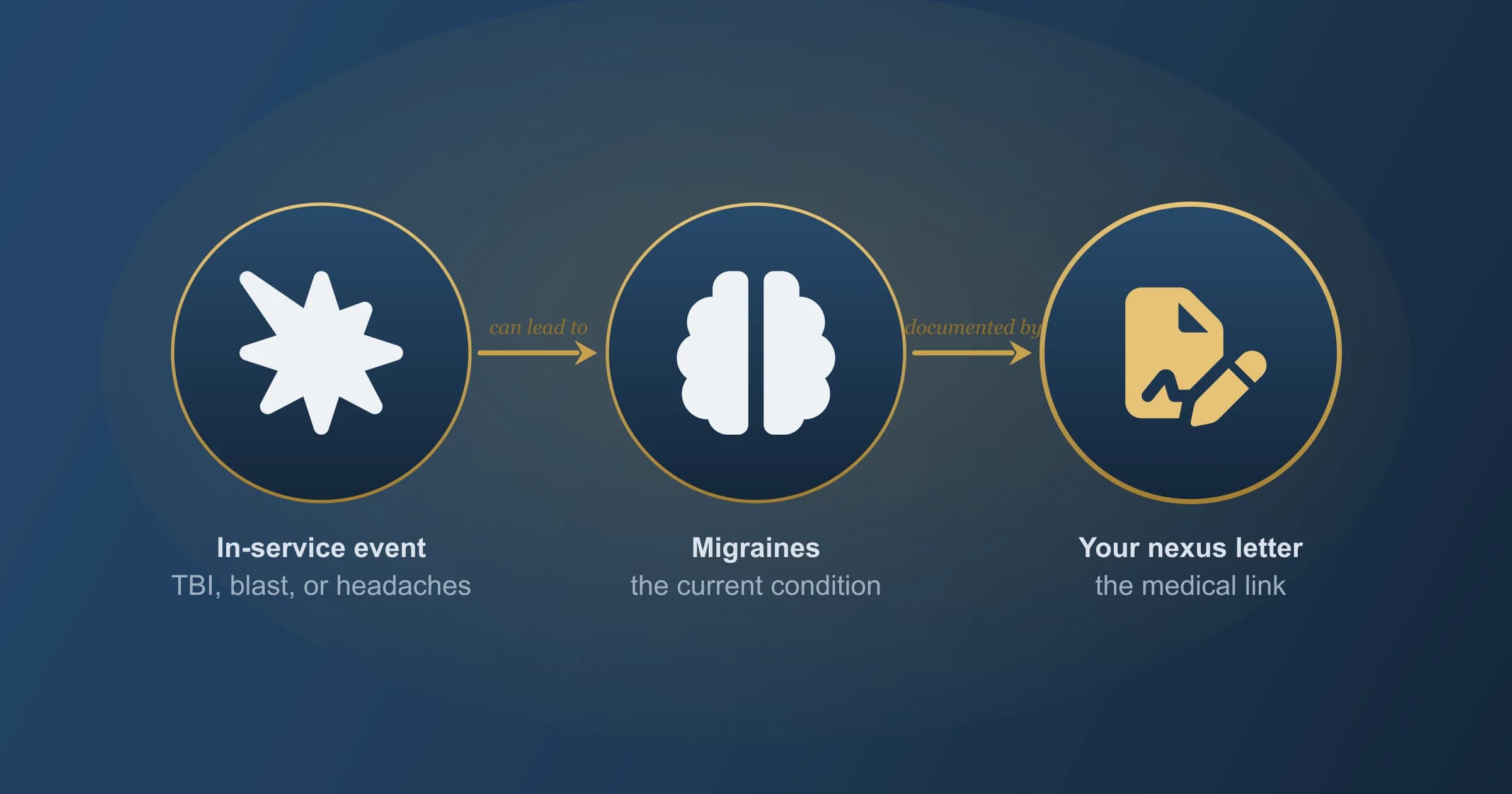 How to Obtain a Nexus Letter for Migraines to Support Your VA Disability ClaimHow to obtain a nexus letter for migraines: what the letter must include, why it matters for service connection, and steps to support your VA claim.Read the guide
 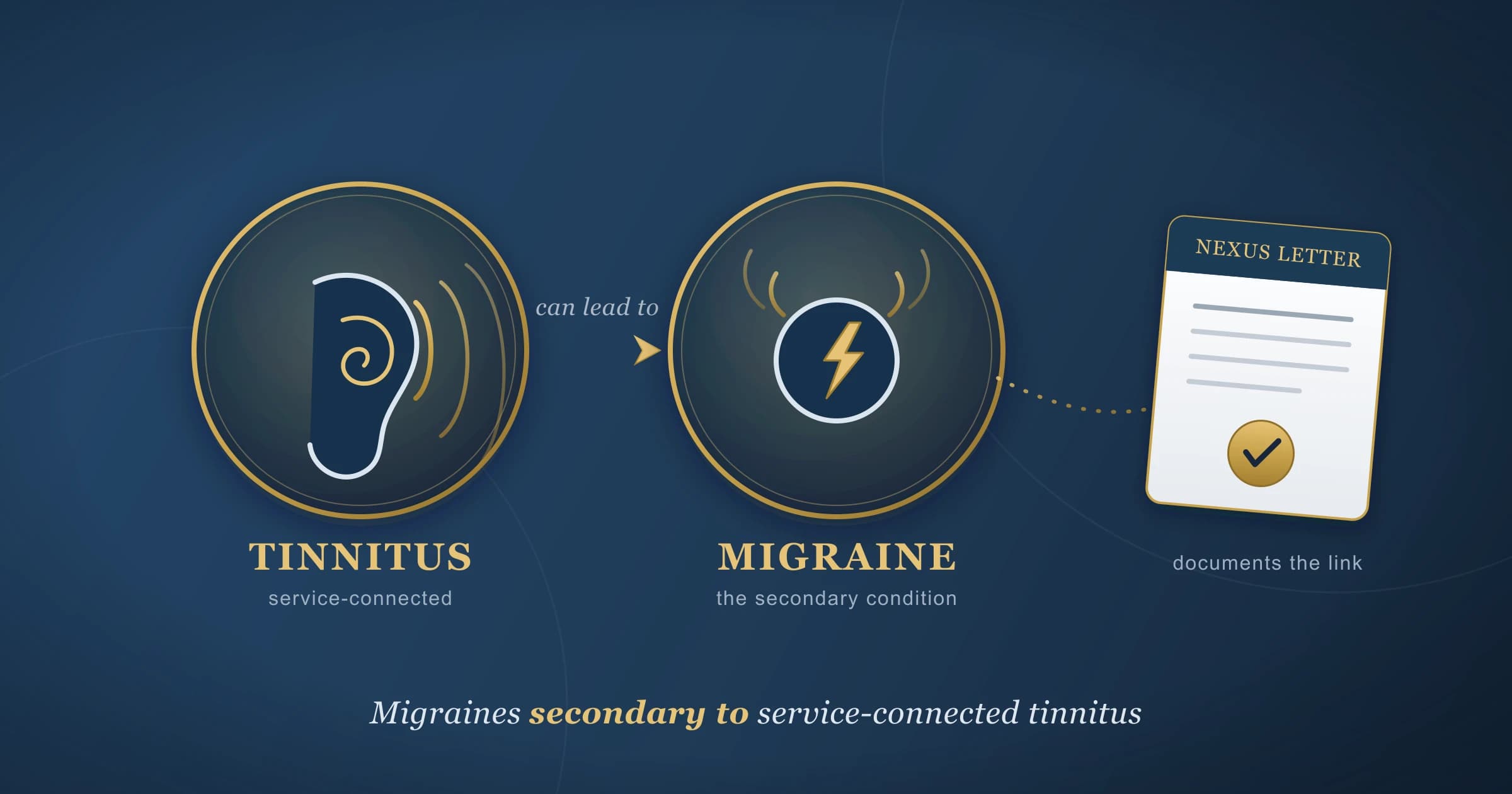 Nexus Letter for Migraines Secondary to TinnitusMigraines from service-connected tinnitus can be a secondary VA claim. What the nexus letter must prove, the DC 8100 rating, and the exact language.Read the guide
The headaches are real. Make your record show it.
Let our physicians prepare a migraine nexus letter that meets the VA's evidence standards and supports the benefits you earned.
Sources & Regulatory References
- VA disability compensation (VA.gov) https://www.va.gov/disability/
- 2026 VA disability compensation rates (VA.gov) https://www.va.gov/disability/compensation-rates/veteran-rates/
- 38 CFR 4.124a, Schedule of ratings, neurological conditions, including DC 8100 migraine (eCFR) https://www.ecfr.gov/current/title-38/section-4.124a
- 38 CFR 3.303, Principles relating to service connection (eCFR) https://www.ecfr.gov/current/title-38/section-3.303
- 38 CFR 3.310, Secondary service connection (eCFR) https://www.ecfr.gov/current/title-38/section-3.310
- 38 U.S.C. 5107, Benefit of the doubt (Cornell LII) https://www.law.cornell.edu/uscode/text/38/5107