
VA Secondary Claims
Nexus Letter for Migraines and Headaches Secondary to TBI
Medically reviewed by the Patriot Path Medical Team
Licensed MD reviewers • Last updated: October 2026
A nexus letter is the medical opinion that ties your headaches to your service-connected traumatic brain injury. Headaches are among the most common things veterans report after a head injury, and that is exactly why they are easy to lose. The VA already treats headaches as part of a TBI, so unless your record shows a distinct diagnosed headache disorder, they get folded into the TBI rating and earn you nothing extra. That diagnosis has to come from a provider who works you up. Medical evidence then has to tie it to the injury and separate your headaches from the symptoms already being counted, whether from a VA examination, treating records or a private medical opinion such as a nexus letter.
An illustrative example
Marcus was close enough to an IED blast in Helmand to be knocked down and evaluated at the aid station. He came home with a service-connected TBI and a 10 percent rating. The headaches started that same year and never really stopped.
He filed for migraines and got nothing. The decision said the headaches were already contemplated by his TBI evaluation. Reading it again, he found the reason buried in the exam: his record said 'subjective headaches'. No diagnosis, no frequency, nothing that made them a condition of their own.
A neurologist then diagnosed post-traumatic migraine, and a clinician wrote a nexus letter that did two separate jobs. It tied the headaches to the blast, and it spelled out which symptoms belonged to the headaches and which belonged to the cognitive side of his TBI. That second part is what let the rater treat them as separable.
A composite example for illustration, not a real client. Outcomes depend on your own facts and evidence.
What Headaches Secondary to TBI Means
A secondary claim connects a new condition to a disability the VA has already service-connected, rather than to your service directly. The rule that allows it is 38 CFR 3.310. Under 3.310(a), a disability that is 'proximately due to or the result of a service-connected disease or injury shall be service connected'.
Headaches after a TBI fit that shape. Your head injury is already service-connected. The headaches followed. You are asking the VA to accept that the injury caused them, or made a headache problem you already had meaningfully worse.
One point is worth knowing up front, because it explains why this claim needs real evidence rather than a form. Under 38 CFR 3.310(d), and only within that rule's own severity and timing limits, the VA holds five conditions to be the proximate result of a service-connected TBI absent clear evidence to the contrary: parkinsonism and unprovoked seizures following a moderate or severe TBI, certain dementias manifesting within 15 years of one, depression manifesting within 3 years of a moderate or severe TBI or within 12 months of a mild one, and diseases of hormone deficiency from hypothalamo-pituitary changes within 12 months of a moderate or severe TBI. Headache and migraine are not on that list at all. There is no shortcut here, which is precisely why the medical opinion carries the claim.
The claim rests on your service-connected TBI, so that rating needs to be settled first.
New to these documents? Start with our primer on what a nexus letter is.
When the VA Rates Your Headaches Separately, and When It Does Not
This part decides whether your claim is worth anything. A separate headache rating on top of your TBI rating is possible, but it is not automatic. It depends on two things, and you have to clear both.
The regulation opens the door. 38 CFR 4.124a, under Diagnostic Code 8045, first routes TBI symptoms into a facet table, then carves out an exception in the very next sentence:
“However, separately evaluate any residual with a distinct diagnosis that may be evaluated under another diagnostic code, such as migraine headache or Meniere's disease, even if that diagnosis is based on subjective symptoms, rather than under the "Evaluation of Cognitive Impairment and Other Residuals of TBI Not Otherwise Classified" table”38 CFR 4.124a, Diagnostic Code 8045
Migraine headache is the regulation's own first example, and the clause 'even if that diagnosis is based on subjective symptoms' forecloses the common objection that a headache disorder cannot count because it rests on your own reporting. Subjectivity is expressly not a disqualifier. The absence of a distinct diagnosis is.
The VA's own adjudication manual then turns that into a two-branch test. M21-1 Part V, Subpart iii, Chapter 12, Section B, Topic 2, block d puts headaches in the first row of its table of TBI comorbidities:
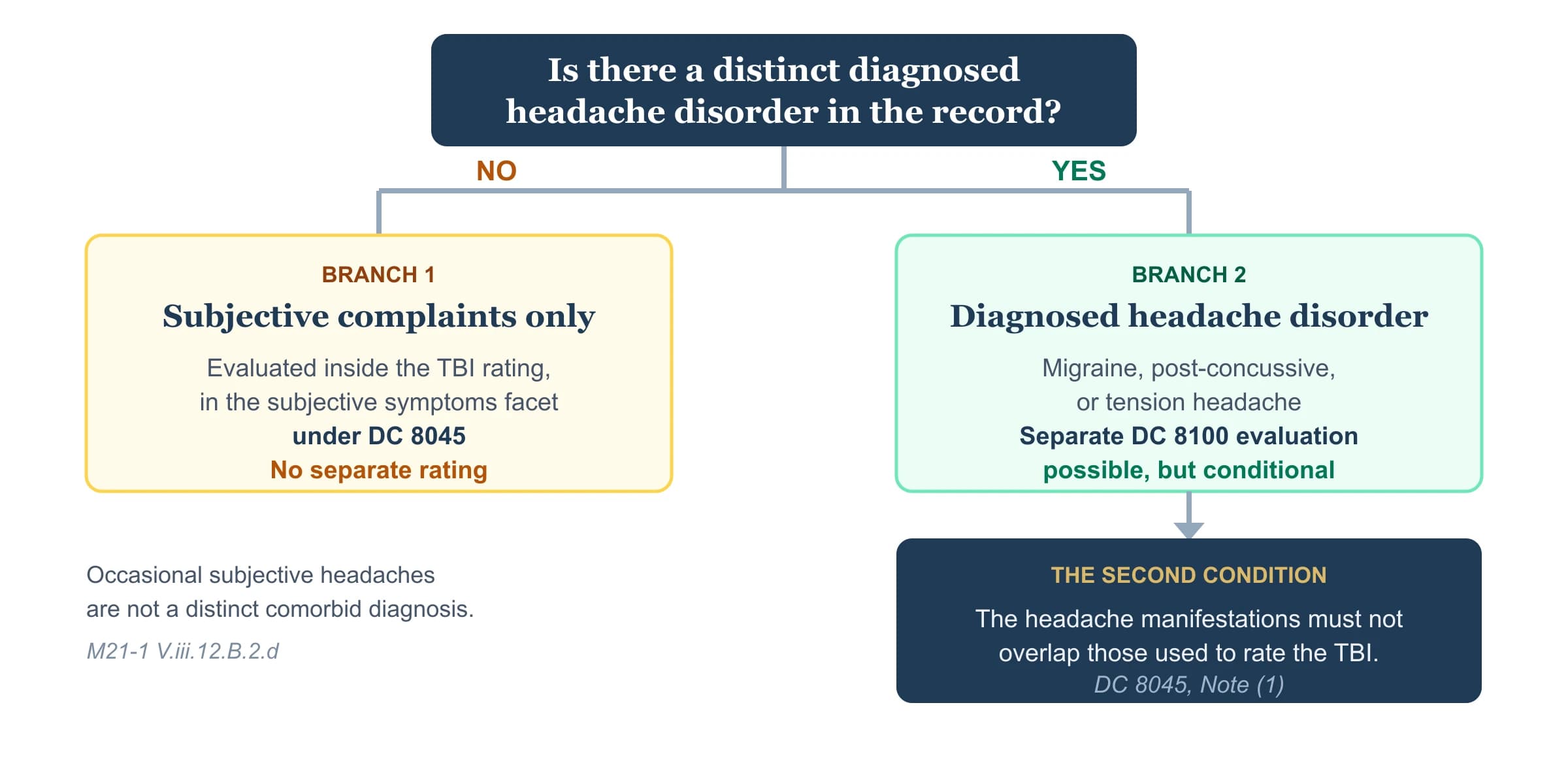
Branch 1: subjective complaints of headaches
Evaluate the complaints as part of the TBI evaluation under Diagnostic Code 8045, rather than under a separate diagnostic code. The manual adds a note in plain terms: occasional subjective headaches are not a distinct comorbid diagnosis. This branch produces no separate rating at all.
Branch 2: a distinct comorbid diagnosis of a headache disorder
The manual's own examples are migraine headaches, post-concussive headaches, and tension headaches. Here a separate evaluation under Diagnostic Code 8100 is assigned, but only so long as the manifestations do not overlap with those used to assign the TBI evaluation under Diagnostic Code 8045.
That overlap condition is not a technicality. It comes from Note (1) under DC 8045, which is the pyramiding guard for this exact situation:
“In such cases, do not assign more than one evaluation based on the same manifestations. If the manifestations of two or more conditions cannot be clearly separated, assign a single evaluation under whichever set of diagnostic criteria allows the better assessment of overall impaired functioning due to both conditions. However, if the manifestations are clearly separable, assign a separate evaluation for each condition.”38 CFR 4.124a, Diagnostic Code 8045, Note (1)
Read the nouns carefully, because they shift. The first gate turns on your DIAGNOSIS. Note (1) turns on your MANIFESTATIONS. You can clear the diagnosis gate and still be collapsed back to one rating at the manifestation gate. This is the general rule against pyramiding in 38 CFR 4.14, which says 'the evaluation of the same manifestation under different diagnoses are to be avoided', applied to TBI.
One thing Note (1) does not say is that the TBI table wins by default. It says the better-assessing criteria win. If frequent prostrating headaches are your dominant impairment and your cognitive facets are low, DC 8100 can be the single surviving evaluation.
Why the Diagnosis Is Worth Fighting For
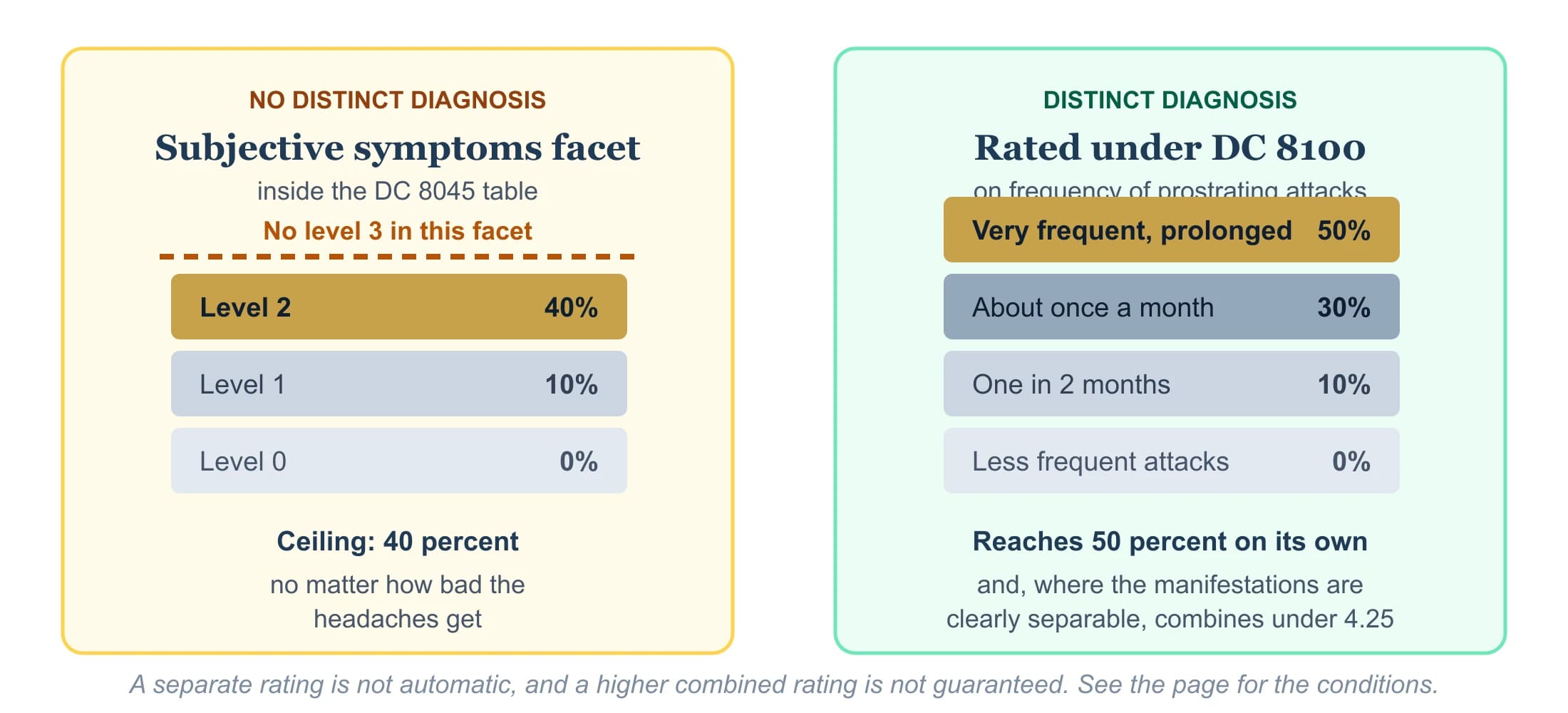
If your headaches stay undiagnosed, they are evaluated in what the DC 8045 table calls the subjective symptoms facet. Headaches appear as express examples at each of its levels: 'mild or occasional headaches' at level 0, 'daily mild to moderate headaches' at level 1, and 'headaches requiring rest periods during most days' at level 2.
Here is the part almost nobody points out. That facet has no level 3 and no total level. The next row of the table is neurobehavioral effects. Since 38 CFR 4.124a maps facet levels to percentages as '0 = 0 percent; 1 = 10 percent; 2 = 40 percent; and 3 = 70 percent', headaches standing alone inside that facet can carry your TBI evaluation no higher than 40 percent, no matter how bad they get.
A distinct diagnosed headache disorder is rated instead under Diagnostic Code 8100, which reaches 50 percent on its own, and where the manifestations are clearly separable the two evaluations are combined under 38 CFR 4.25 rather than added. That gap is the concrete reason the diagnosis matters, and it is the single most useful thing a nexus letter can secure for you.
The part most guides leave out
An honest caveat that pages selling these letters tend to leave out: a separate headache rating does not guarantee a higher combined rating. M21-1 permits the VA to remove a facet from your TBI evaluation when the same symptoms are what support the newly separated condition, so long as the overall evaluation of the two together is not reduced. If your headaches were the only thing holding up a facet level, moving them to DC 8100 can lower the TBI number while the combined figure stays flat. Ask your provider to be candid with you about which symptoms are carrying which rating before you file.
It Does Not Have to Be a Migraine
It is easy to assume this claim is only for migraines, because that is the word every guide uses. The schedule is narrower than the claim is. In 38 CFR 4.124a the code reads '8100 Migraine:', it sits under the subheading Miscellaneous Diseases, and the word headache does not appear in it at all. Its four levels are written entirely in terms of prostrating attacks.
Non-migraine post-traumatic headache still gets there, by a different route. 38 CFR 4.20 permits rating an unlisted condition 'under a closely related disease or injury in which not only the functions affected, but the anatomical localization and symptomatology are closely analogous', with the diagnostic code number built up under 38 CFR 4.27. That is how post-concussive and tension-type headaches are rated by analogy to DC 8100, and it is why M21-1 lists all three as examples in the TBI context.
One warning that follows directly from the same regulation. 38 CFR 4.20 expressly cautions against 'the use of analogous ratings for conditions of doubtful diagnosis, or for those not fully supported by clinical and laboratory findings'. For the headaches family, the diagnosis is not a formality. It is the load-bearing element of the whole argument.
How a Head Injury Leads to Lasting Headaches
The link is well documented in military populations specifically, which matters because a nexus letter that cites the literature carries far more weight than one that asserts a connection.
It is common after a deployment concussion
In a study of 5,270 US soldiers screened on return from Iraq or Afghanistan, 1,033 (19.6 percent) met criteria for a deployment-related concussion, and 37 percent of that concussed group had headache beginning within a week of the injury.
The headaches usually look like migraines
In that same cohort, 58 percent of the post-traumatic headaches were classified as migraine. Two further military studies found the same pattern independently, at 66 percent among soldiers with chronic daily headache and 78 percent in a military neurology clinic sample. This is the clinical bridge that connects a blast injury to the migraine code.
They tend to persist
A prospective civilian study of 212 patients followed after mild TBI reported new or worse headache in 62 percent at three months and 58 percent at one year. In a military cohort with a control group, 47 percent of mild TBI cases reported clinically relevant post-concussive symptoms at three months against 25 percent of controls, with headache specifically reported by 15 percent of cases against 5 percent of controls.
Blast is the usual mechanism, but not a stronger argument
Blast was the cause of 67 percent of head and neck injuries in one military clinic sample. It is worth documenting as the in-service event, but be careful how you use it: the studies that looked found no significant difference in blast exposure between soldiers whose headaches became chronic and those whose did not. Blast explains how you were hurt, not why the headaches lasted.
The classification side is separate and worth knowing. ICHD-3 recognizes persistent headache attributed to traumatic injury to the head, defines traumatic injury to include forces generated from blasts or explosions, and ordinarily expects the headache to develop within seven days. If yours started later, that is not fatal. ICHD-3 itself calls the seven-day window somewhat arbitrary and supplies appendix criteria for delayed onset, and in any case it is a classification convention rather than a VA rule.
If a blast is the event behind your injury, see our guides to proving blast exposure in combat and addressing blast injuries in your nexus letter.
Can You Get VA Disability for Headaches Secondary to TBI?
Yes, where the headaches are a distinct diagnosis rather than subjective complaints already folded into the TBI evaluation. Three things have to be in place. A nexus letter supplies the third and ties the first two together.
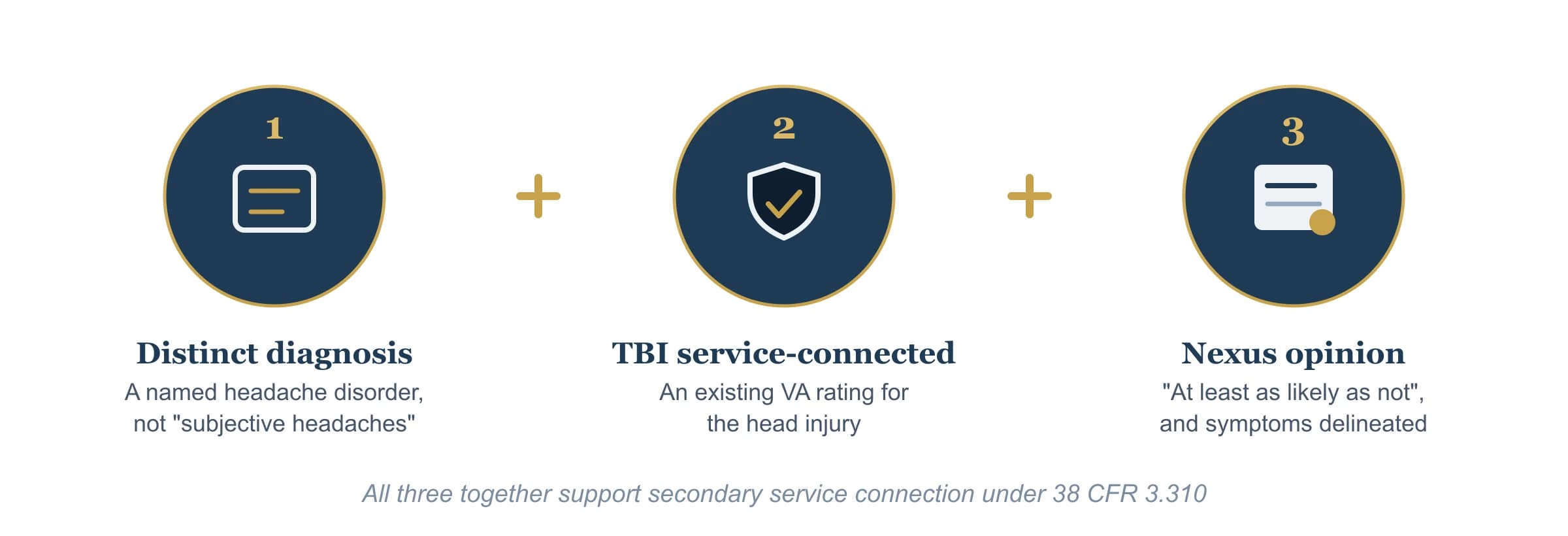
- 1
A distinct headache diagnosis
Not 'subjective headaches' in an exam note. A named diagnosis from a provider: migraine, post-traumatic or post-concussive headache, or tension-type headache, with the pattern of attacks recorded.
- 2
TBI already service-connected
Your head injury needs an existing service connection and rating. The secondary claim builds on it, so this has to be settled first.
- 3
A medical nexus opinion
A qualified opinion that your headaches are at least as likely as not caused or aggravated by your service-connected TBI, and that separates the headache symptoms from those already rating the TBI.
The Language the VA Requires
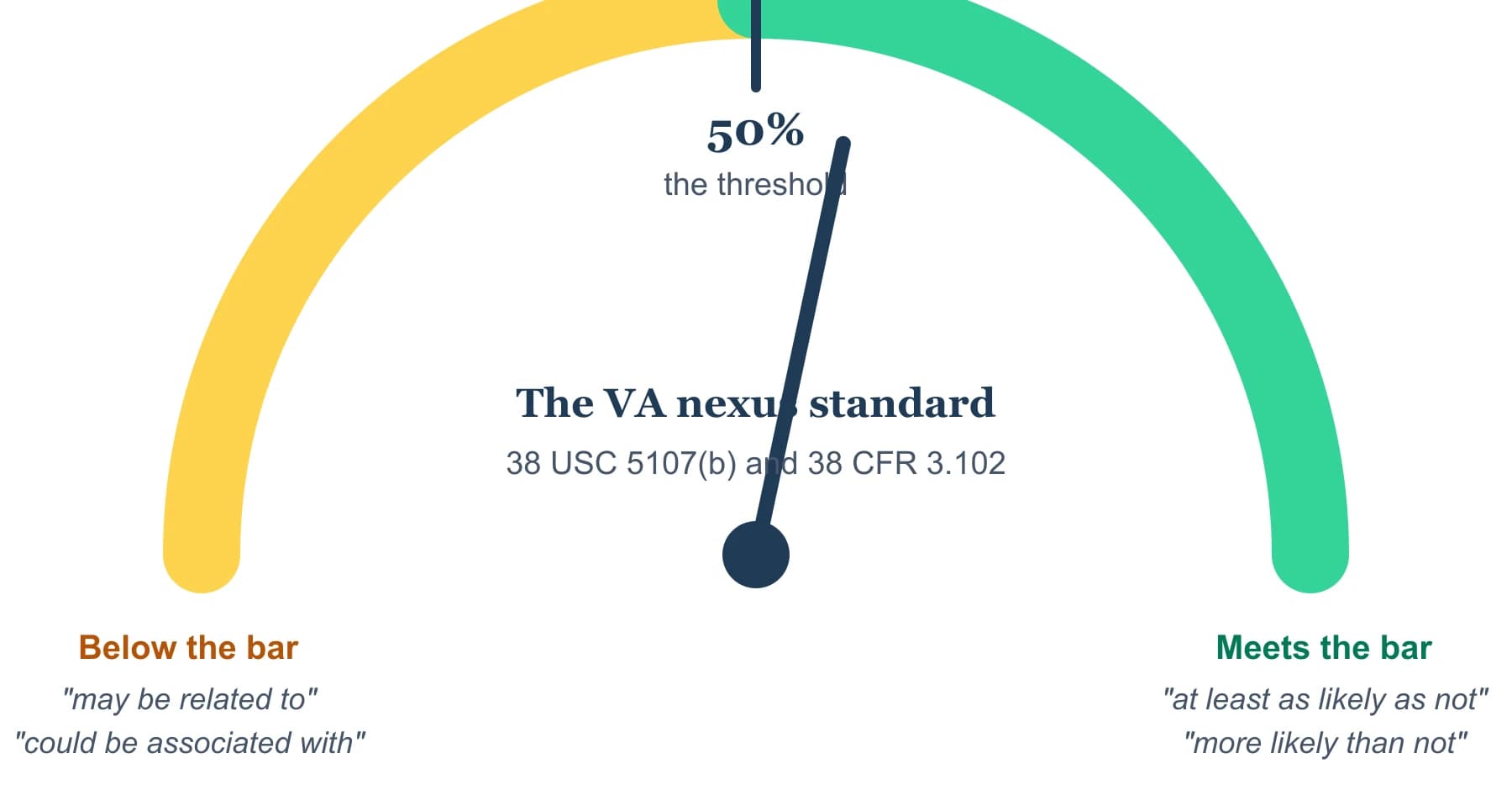
The VA reads a nexus letter closely, and small differences in wording change how much weight it carries. The threshold comes from the benefit-of-the-doubt rule in 38 USC 5107(b), carried out in 38 CFR 3.102: when the evidence is roughly balanced, the tie goes to the veteran. That standard turns on the balance of the evidence as a whole, not on any one document's phrasing.
Language that meets the bar
- “At least as likely as not caused or aggravated by the veteran's service-connected traumatic brain injury” Meets the 50 percent threshold and names the secondary path. The standard to aim for.
- “More likely than not a residual of the veteran's in-service head injury” Exceeds 50 percent; stronger than the minimum.
Language that fails
- “May be related to the veteran's head injury” A possibility, not a probability. Below the standard.
- “Could be associated with the reported blast exposure” "Could" does not meet the 50 percent bar, and vague wording invites a denial.
Do not overlook aggravation
If you had headaches before the injury and it made them worse, that is claimable under 38 CFR 3.310(b), but it carries a documentary requirement. The regulation's text says VA will not concede aggravation unless the baseline level of severity is established by medical evidence created before the onset of aggravation, or by the earliest medical evidence created between that onset and the evidence showing your current severity. VA's adjudication manual, M21-1 Part V, Subpart ii, 2.D.1 (updated May 1, 2026), also lets the baseline rest on 'any other credible evidence, including lay evidence', though lay evidence on its own may not be sufficient. The rating then reflects the increase over that baseline. The regulation still recites a deduction for natural progress, but the manual, following Spicer v. McDonough, 61 F.4th 1360 (Fed. Cir. 2023), says VA 'will no longer consider natural progress' of the condition. Find that baseline record before you file; under the manual, if no baseline can be established, no aggravation can be demonstrated.
What the Nexus Letter Must Include
For this claim the letter has to do two jobs, and a letter can do the first without the second. It has to link the headaches to the injury, and it has to separate them from the symptoms already rating your TBI.
- 1A clear statement of the opinionThe conclusion in the VA's own words, that your headaches are at least as likely as not caused or aggravated by your service-connected TBI. This sentence is what the rater looks for first.
- 2The distinct headache diagnosis, namedMigraine, post-traumatic or post-concussive headache, or tension-type headache. This is the element that decides whether a separate evaluation is even available to you.
- 3A delineation of symptomsThe part that wins this specific claim. Which manifestations belong to the headache disorder, and which belong to the cognitive, emotional, or other facets already rating the TBI. Note (1) turns on exactly this separation, and a rater is not the right person to make that clinical call.
- 4A review of your recordsConfirmation that the clinician read your TBI rating decision, your service treatment records, the injury documentation, and your headache treatment history, not just your account.
- 5The medical rationale and literatureThe mechanism spelled out, from the head injury to the headache disorder, supported by the research on post-traumatic headache in service members.
- 6The provider's credentialsWho the clinician is and why they are qualified to give the opinion. For this claim, neurology or headache experience carries real weight.
For the full checklist the VA applies to any nexus letter, see our guide to what a nexus letter must include.
What to Give Your Provider
A nexus letter is only as strong as the records behind it. For headaches the log does the heavy lifting. Because DC 8100 is written entirely around how often prostrating attacks occur, a contemporaneous record of dates, duration, and whether you had to stop and lie down is the evidence most directly on point.
The core file
- Your TBI service-connection decisionThe VA letter or rating showing the TBI is service-connected, with the effective date and the facet levels assigned.
- Documentation of the injuryThe incident report, line-of-duty determination, aid station or medical record, buddy statements, or anything else placing you at the blast or impact.
- A named headache diagnosisProvider notes naming the disorder, ideally from neurology. If your record only says 'subjective headaches', getting this is your first priority.
What strengthens it
- A headache log or journalEvidence a rater can read. Track each attack: the date, how long it lasted, how bad it was, whether you had to stop and lie down, and what you missed.
- Treatment records and prescriptionsTriptans, preventives, Botox, or ER and urgent-care visits all show how serious and frequent the attacks are.
- Your most recent TBI examSo the clinician can see which facets are carrying your current evaluation and write the delineation against them.
- A personal statementIn your own words, when the headaches started relative to the injury, and what they cost you at work and at home.
What VA Rating Can You Get for Headaches Secondary to TBI?
Where a separate evaluation is warranted, the VA rates the headache disorder under 38 CFR 4.124a, Diagnostic Code 8100, at 0, 10, 30, or 50 percent. The criteria are written entirely around prostrating attacks: 'with very frequent completely prostrating and prolonged attacks productive of severe economic inadaptability' at 50 percent, 'with characteristic prostrating attacks occurring on an average once a month over last several months' at 30 percent, 'with characteristic prostrating attacks averaging one in 2 months over last several months' at 10 percent, and 'with less frequent attacks' at 0 percent.
The regulation never defines prostrating, and because every level of DC 8100 turns on that one word, the record has to do the work. In plain clinical terms it describes an attack that stops you cold and forces you to lie down until it passes. A headache you can push through usually is not prostrating, and a log that records when you had to stop is the best way to show the difference.
Two structural points. Fifty percent is the ceiling this code gives; there is no 70 or 100 percent for headaches by themselves, and the path beyond it is TDIU or an extraschedular rating under 38 CFR 3.321(b), not a higher headache number. And where a separate evaluation is assigned, the two are combined under 38 CFR 4.25 rather than added, with the conversion to the nearest degree divisible by 10 done once, at the end, after all disabilities are combined.
For the full rating breakdown, the pay figures, and a migraine rating estimator, see our guide to migraines and VA disability.
How to File the Secondary Claim
You file headaches secondary to TBI like any disability claim, but you present it as a secondary condition and lead with the nexus letter.
- 1File VA Form 21-526EZThe Application for Disability Compensation. Name your headache disorder by its diagnosis as secondary to your service-connected TBI, so the VA reviews it on that theory.
- 2Attach the nexus letterThe physician opinion tying the headaches to the injury and separating their manifestations from those rating the TBI.
- 3Include your supporting evidenceYour diagnosis, your headache log, your treatment records, your personal statement, and your most recent TBI exam.
- 4Submit and track itYou can file at VA.gov, by mail, or through a Veterans Service Officer. Keep a dated copy of the nexus letter in particular, because if the claim goes to a Supplemental Claim later you will need to show what the rater already had in front of them.
A Veterans Service Officer can file this with you at no charge, and for a two-condition claim like this one their help is worth taking: they can make sure the headaches are presented as secondary to the TBI, so the VA develops the claim on that theory from the start.
What to Expect at the C&P Exam
The VA will usually schedule a Compensation and Pension exam. Expect questions about how often the attacks hit, how long they last, whether they force you to stop what you are doing, and how the headaches differ from the other residuals of your injury. That last line of questioning is where the separable-manifestations issue gets decided, so it is worth being ready for it.
Describe your symptoms accurately, including your worst attacks rather than only an average day, and answer about your condition as it actually is. A clear, consistent account that matches your records and your letter is what carries the exam. If a question is about which symptoms belong to your headaches and which to your TBI, you can say that a clinician addressed that separation in the nexus letter in your file, and then answer from your own experience.
If Your Claim Is Denied
Two grounds for denial follow directly from the rules above, and the decision should show which one was applied. The first is that the record showed headaches but no distinct diagnosis, so they were treated as already contemplated by the TBI evaluation. The second is that a diagnosis existed but nothing separated the headache symptoms from the ones already rating the injury, so Note (1) collapsed them into one evaluation.
Both are fixable, and they need different fixes. The first needs a diagnosis and a workup. The second needs a clinician's account, in treating records or a medical opinion, that does the delineation explicitly. Read the decision and the exam report to see which one you are facing, then file a Supplemental Claim on VA Form 20-0995 with the evidence that answers it.
We break down the reasons these claims fail, and how to fix each one, in our guide to why the VA denies nexus letters.
Who Should Write the Letter, and What It Costs
Any licensed clinician can write a nexus letter, but for this claim the opinion is best written by a clinician who diagnoses and treats headache disorders, such as a neurologist. The reason is specific rather than general: the delineation of headache manifestations from TBI residuals is a clinical judgement, and it needs to come from someone qualified to make it.
Patriot Path's physicians write letters built for this exact claim: records reviewed, the injury-to-headache mechanism, the separation of symptoms that Note (1) turns on, and the opinion in the language the VA expects. One flat fee of $1,500, and the first consultation is free.
Not sure who qualifies? See our breakdown of who can write a nexus letter, and how the whole process works in our guide to getting a nexus letter.
See our flat, upfront nexus letter pricing and what is included.
Is Your Secondary Claim Ready?
Score your claim
0 of 7 in hand
Check each item you already have in hand. Your score updates as you go.
Start with the TBI itself. A secondary claim under 38 CFR 3.310 attaches to a disability the VA has already service-connected, so until the head injury carries its own rating there is nothing for the headaches to attach to. That claim comes first.
Have a clinician build the missing pieces →Give Your Secondary Claim Its Strongest Evidence
Your head injury is already on the record. Let our physicians write the nexus letter that names the headache disorder, ties it to the injury, and separates it from the symptoms already rating your TBI.
Frequently Asked Questions
Will I get a separate rating for headaches on top of my TBI rating?
Sometimes, but it is not automatic. The VA's manual sets a two-branch test. If your record shows only subjective complaints of headaches, they are evaluated inside the TBI rating under Diagnostic Code 8045 and there is no separate rating. If you have a distinct diagnosed headache disorder, such as migraine, post-concussive, or tension headache, a separate evaluation under Diagnostic Code 8100 can be assigned, but only so long as the headache manifestations do not overlap with those already used to rate the TBI. You have to clear both conditions.
Does the VA automatically connect headaches to a TBI?
No. Under 38 CFR 3.310(d) the VA holds five conditions to be the proximate result of a service-connected TBI absent clear evidence to the contrary: parkinsonism, unprovoked seizures, certain dementias, depression, and diseases of hormone deficiency resulting from hypothalamo-pituitary changes. Four of them apply only after a moderate or severe TBI, depression also reaches a mild one, and only the dementia, depression and hormone entries carry time limits. Headache and migraine are not among them at all, under any severity. So the connection has to be proven on the evidence, which can come from a VA examination, treating records or a private medical opinion such as a nexus letter.
My exam just says 'subjective headaches'. Does that hurt my claim?
That wording on its own cannot support a separate rating. The VA's manual states plainly that occasional subjective headaches are not a distinct comorbid diagnosis, which means they stay inside the TBI evaluation and earn nothing separately. The fix is a proper workup and a named diagnosis from a provider. Until that exists, there is no separate evaluation available to claim.
Does it have to be a migraine?
No. Diagnostic Code 8100 is titled Migraine in the rating schedule, but non-migraine post-traumatic headache reaches it by analogous rating under 38 CFR 4.20, with the code number built up under 38 CFR 4.27. The VA's own manual names migraine headaches, post-concussive headaches, and tension headaches as examples in the TBI context. What matters is that the disorder is actually diagnosed, because 38 CFR 4.20 warns against analogous ratings for conditions of doubtful diagnosis.
What VA rating can I get for headaches secondary to TBI?
Where a separate evaluation is warranted, the VA rates the headache disorder under 38 CFR 4.124a, Diagnostic Code 8100, at 0, 10, 30, or 50 percent, based on how often prostrating attacks occur. Roughly, one every two months supports 10 percent, about one a month supports 30 percent, and very frequent completely prostrating and prolonged attacks productive of severe economic inadaptability support 50 percent. Fifty percent is the highest this code gives, and the evaluations are combined under 38 CFR 4.25 rather than added.
Could claiming headaches separately lower my TBI rating?
It can change how the ratings are distributed. The VA's manual permits removing a facet from the TBI evaluation when the same symptoms are what support the newly separated condition, as long as the overall evaluation of both together is not reduced. In practice that means a separate headache rating does not guarantee a higher combined rating, particularly if the headaches were the only thing holding up a facet level. It is worth asking your provider which symptoms are carrying which rating before you file.
What does 'prostrating' mean?
The regulation uses the word three times and never defines it, which leaves the standard to the rating decision. In plain clinical terms a prostrating attack stops you cold: you cannot keep working or functioning, and you have to lie down until it passes. A headache you can push through usually is not prostrating. A log recording when you had to stop and lie down is the most direct way to show it.
What if my headaches started more than a week after the injury?
It does not disqualify you. The ICHD-3 classification ordinarily expects headache attributed to head trauma to develop within seven days, but ICHD-3 itself describes that window as somewhat arbitrary and provides appendix criteria for delayed onset. More importantly, ICHD-3 is a classification system used by clinicians, not a VA rule. The VA question is whether your headaches are at least as likely as not caused or aggravated by the service-connected injury, and a nexus letter can address a later onset directly.
What if I had headaches before the injury?
You can still claim it as aggravation under 38 CFR 3.310(b), but there is a documentary requirement: a baseline showing how severe the headaches were before the aggravation began. The regulation points to medical evidence created before the aggravation began, or the earliest medical evidence created between then and the evidence showing your current severity, and VA's manual (M21-1 Part V, Subpart ii, 2.D.1.c) also accepts other credible evidence, including lay evidence, though lay evidence alone may not be enough. The rating reflects the increase over that baseline. The regulation's text still mentions deducting natural progress, but since Spicer v. McDonough VA's manual says it no longer considers natural progress in these claims. Locating that baseline record is the first thing to do.
My claim was denied. Is it over?
No. Read the decision to find which of the two grounds applies. If the headaches were treated as already contemplated by the TBI rating, you need a distinct diagnosis. If a diagnosis existed but the symptoms were found inseparable from the TBI residuals, you need a clinician's account, in treating records or a medical opinion, that delineates them explicitly. Then file a Supplemental Claim on VA Form 20-0995 with that new evidence.
What does it cost, and how do we start?
Patriot Path charges $1,500 flat for a nexus letter, and the first consultation is free. Book a consultation and we will give you a straight answer on whether a letter can help your headaches secondary to TBI claim.
Related guides
- Nexus letter for migrainesThe direct-service-connection version of the claim.
- Migraines and VA disabilityThe full DC 8100 rating breakdown and evidence.
- TBI and VA disabilityHow the VA rates traumatic brain injury residuals.
- Depression secondary to TBIThe mental-health route from the same service-connected head injury, and the one mental-health condition 38 CFR 3.310(d) names.
- Seizures secondary to TBIUnprovoked seizures, one of the five conditions 38 CFR 3.310(d) does reach, after a moderate or severe injury with no time limit, and what happens outside that rule.
- Migraines secondary to tinnitusAnother secondary path to a migraine claim.
- What a nexus letter must includeThe seven elements the VA looks for.
- Nexus letter for a secondary conditionHow secondary claims work, in general.
- Who can write a nexus letterWhich providers the VA takes seriously.
- Proving blast exposure in combatDocumenting the in-service event behind the injury.
- Addressing blast injuries in your letterHow a letter handles a blast-related injury.
- When the VA denies a nexus letterThe common reasons, and how to fix them.
- How to get a nexus letterThe full process, start to finish.
- Nexus letter exampleSee the framework on a finished letter.
Citations & References
- 38 CFR 4.124a, Schedule of ratings, neurological conditions, including DC 8045 and DC 8100 (eCFR) https://www.ecfr.gov/current/title-38/section-4.124a
- 38 CFR 4.14, Avoidance of pyramiding (eCFR) https://www.ecfr.gov/current/title-38/section-4.14
- 38 CFR 4.20, Analogous ratings (eCFR) https://www.ecfr.gov/current/title-38/section-4.20
- 38 CFR 4.25, Combined ratings table (eCFR) https://www.ecfr.gov/current/title-38/section-4.25
- 38 CFR 3.310, Secondary service connection, aggravation, and TBI-related presumptions (eCFR) https://www.ecfr.gov/current/title-38/section-3.310
- 38 CFR 3.102, Reasonable doubt and benefit of the doubt (eCFR) https://www.ecfr.gov/current/title-38/section-3.102
- 38 USC 5107, Claimant responsibility and benefit of the doubt (Cornell LII) https://www.law.cornell.edu/uscode/text/38/5107
- 38 CFR 3.321, Rating schedule and extraschedular ratings (eCFR) https://www.ecfr.gov/current/title-38/section-3.321
- M21-1 Part V, Subpart iii, Chapter 12, Section B, Traumatic Brain Injury (VA KnowVA) https://www.knowva.ebenefits.va.gov/system/templates/selfservice/va_ssnew/help/customer/locale/en-US/portal/554400000001018/content/554400000180832/M21-1-Part-V-Subpart-iii-Chapter-12-Section-B-Traumatic-Brain-Injury-TBI
- M21-1, Part V, Subpart ii, Chapter 2, Section D, secondary service connection and aggravation, Blocks 1.a, 1.c and 1.f (VA KnowVA, article 554400000180484) https://www.knowva.ebenefits.va.gov/system/templates/selfservice/va_ssnew/help/customer/locale/en-US/portal/554400000001018/content/554400000180484/M21-1-Part-V-Subpart-ii-Chapter-2-Section-D-Secondary-Service-Connection-SC-and-Aggravation-of-Non-Service-Connected-NSC-Disabilities
- ICHD-3 5.2, Persistent headache attributed to traumatic injury to the head https://ichd-3.org/5-headache-attributed-to-trauma-or-injury-to-the-head-andor-neck/5-2-persistent-headache-attributed-to-traumatic-injury-to-the-head/
- VA disability compensation, how to file (VA.gov) https://www.va.gov/disability/
- VA Form 21-526EZ, Application for Disability Compensation (VA.gov) https://www.va.gov/find-forms/about-form-21-526ez/
- VA Form 20-0995, Supplemental Claim (VA.gov) https://www.va.gov/find-forms/about-form-20-0995/
- Theeler BJ, et al. Headaches after concussion in US soldiers returning from Iraq or Afghanistan. Headache. 2010 (PubMed) https://pubmed.ncbi.nlm.nih.gov/20553333/
- Theeler BJ, et al. Chronic daily headache in U.S. soldiers after concussion. Headache. 2012 (PubMed) https://pubmed.ncbi.nlm.nih.gov/22404747/
- Lucas S, et al. A prospective study of prevalence and characterization of headache following mild traumatic brain injury. Cephalalgia. 2014 (PubMed) https://pubmed.ncbi.nlm.nih.gov/23921798/
- Mac Donald CL, et al. Epidemiology and prognosis of mild traumatic brain injury in returning soldiers: A cohort study. Neurology. 2017 (PubMed) https://pubmed.ncbi.nlm.nih.gov/28314862/
- Theeler BJ, Erickson JC. Mild head trauma and chronic headaches in returning US soldiers. Headache. 2009 (PubMed) https://pubmed.ncbi.nlm.nih.gov/19220499/