
Nexus Letter Guide
Can the VA Reject a Nexus Letter?
Medically reviewed by the Patriot Path Medical Team
Licensed MD reviewers • Last updated: July 2026
Yes. The VA can reject a nexus letter, or give it so little weight that it does not help. The VA rarely throws a letter out on sight. What usually happens is quieter: a rater reads the letter, decides it is speculative, unsupported, or from the wrong kind of provider, and assigns it little or no probative weight. The claim is then denied as if the letter were not there. The good news is that almost every reason this happens is preventable, and a denial is not the end of the road.
New to these documents? Start with what a nexus letter is, then come back for what makes the VA set one aside.
Can the VA Actually Reject a Nexus Letter?
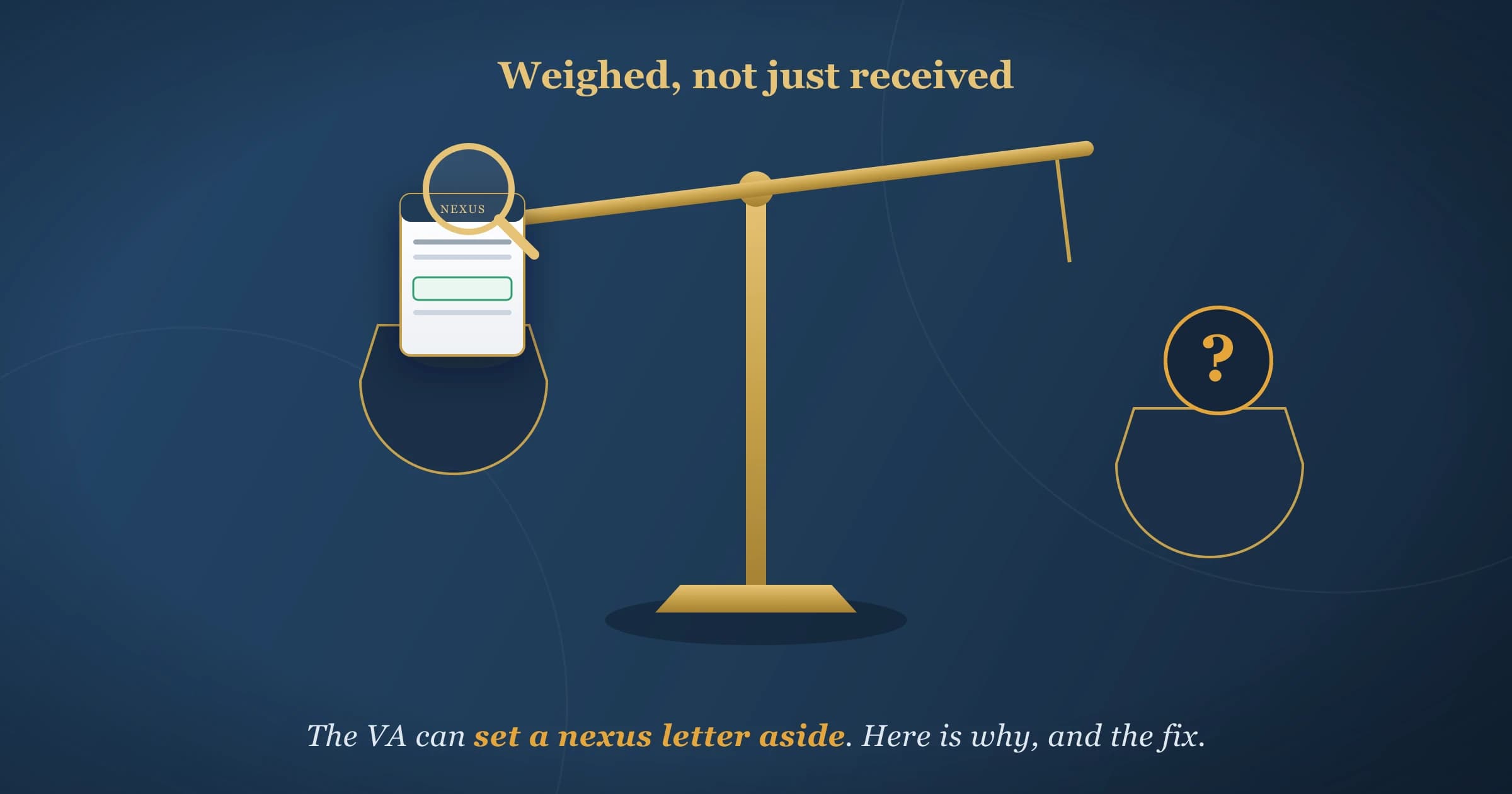
It helps to be precise about what "reject" means here. The VA does not stamp a nexus letter "denied" and mail it back. Instead, a rating specialist weighs it against the rest of the evidence and decides how much it proves. A letter can be accepted in full, given partial weight, or set aside as not probative. When a letter is set aside, the practical result is the same as a rejection: it does nothing to move the claim, and the decision reads as though no medical opinion was submitted at all.
That weighing is not arbitrary. Under 38 CFR 4.6, the rater must consider the whole record and judge the credibility and probative value of each piece of evidence. A nexus letter earns weight when it is credible, well-reasoned, and comes from a qualified source, and loses weight when it is vague, unsupported, or outside the author's expertise. Understanding that standard is the key to writing a letter that survives it.
So the honest answer is yes, the VA can effectively reject a nexus letter, but it almost always does so for reasons you can see coming and prevent. The rest of this guide walks through those reasons, the language that keeps a letter from being set aside, and what to do if your claim is denied anyway.
For the full picture of how nexus letters fit into a claim, see our overview of nexus letters and VA disability claims.
Why the VA Denies a Claim That Includes a Nexus Letter
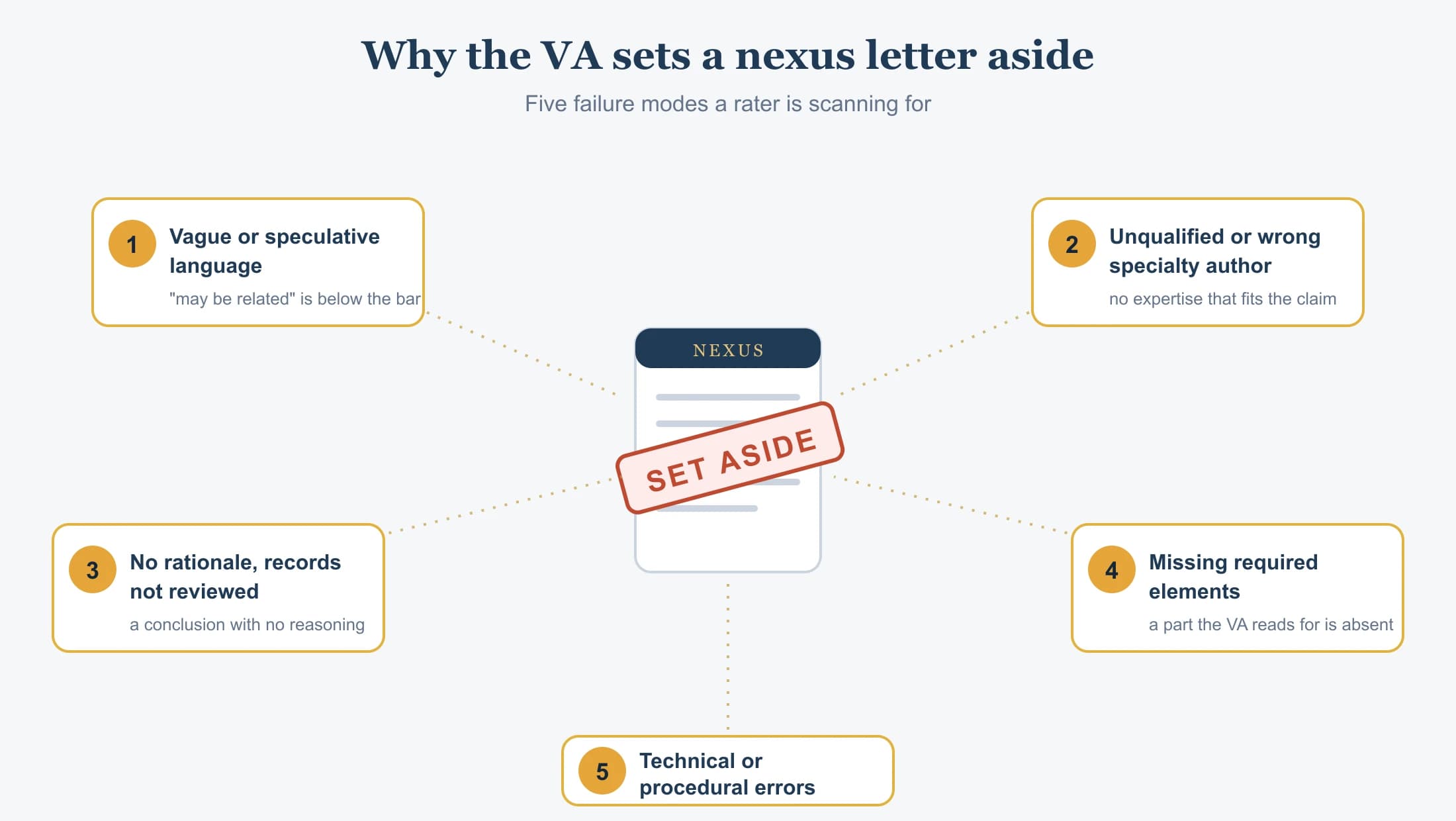
Veterans are often shocked to see a denial after paying for a nexus letter. The letter was supposed to be the missing piece. When a claim with a letter still fails, it is almost always for one of five reasons, and a rater who reads dozens of these a week spots each one fast. Here is what sinks a letter, and where each problem is fixed.
- 1
Vague or speculative language
This is the single most common reason. A letter that says the condition "may be," "could be," or is "possibly" related to service states a possibility, not a probability. The VA needs the opinion to reach at least a 50 percent likelihood, phrased as "at least as likely as not." A caring provider may mean 50 percent or better, but the rater reads the words on the page, not the intent behind them.
- 2
An unqualified or wrong-specialty author
Any licensed clinician can write a nexus letter, but the VA weighs the opinion partly on whether the author's expertise fits the condition. A general provider opining on a complex psychiatric or orthopedic claim carries less weight than a specialist in that field. A letter from a provider with no relevant background is easy for the VA to discount. The fix is choosing the right author; see who can write a nexus letter.
- 3
No medical rationale, or records not reviewed
A conclusion with no reasoning behind it reads as a guess. The VA gives the most weight to a letter that shows the clinician actually read the file, service treatment records, VA records, test results, and lay statements, and then explains the medical reasoning that connects the condition to service. A letter that states an opinion without a rationale is routinely set aside, no matter how confident it sounds.
- 4
Missing required elements
A nexus letter is short, but each part does a job: provider credentials, records reviewed, the rationale, the opinion in the right language, the supporting basis, and a signature. Leave one out and the letter reads as incomplete. Raters are scanning for all of them, and an absent part is a reason to give the letter less weight. For the full checklist, see our guide to what a nexus letter must include.
- 5
Technical or procedural errors
Sometimes the letter is fine and the claim still fails on process: it was submitted to the wrong lane, key records never made it into the file, the diagnosis on record does not match the claim, or a deadline slipped. These are not medical problems, but they end the same way, so it is worth confirming the paperwork and the evidence are complete before you file.
What "At Least as Likely as Not" Means
The most important line in any nexus letter is the opinion itself, and the wording is not a formality. The VA decides a service-connection claim on whether the evidence reaches a specific probability, and "at least as likely as not" is the phrase that meets it. It means a 50 percent or greater likelihood that the condition is connected to service. Anything that reads as less than that, "may be," "could be," "possibly," falls below the bar and invites a denial.
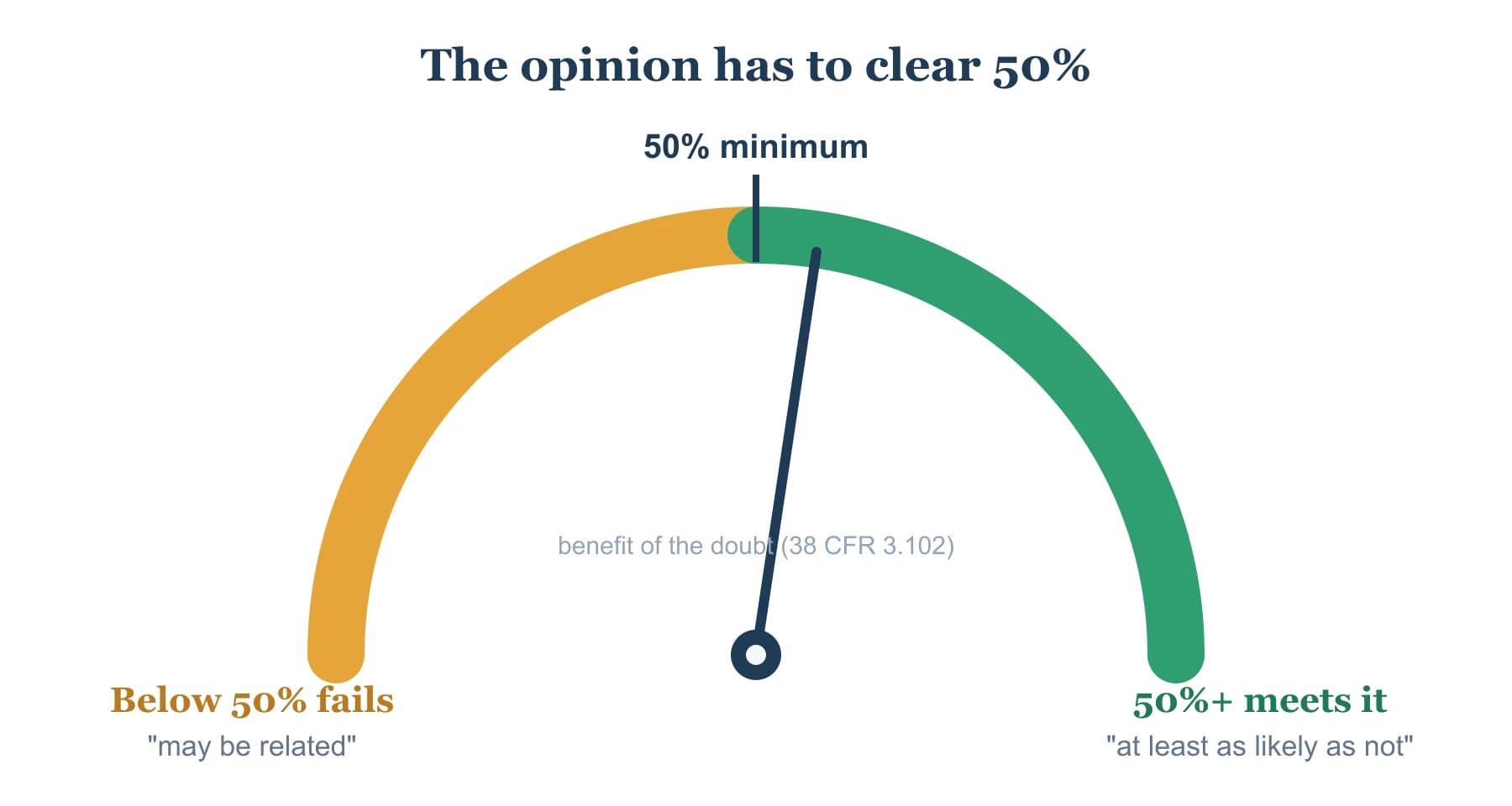
That 50 percent line is not the VA being generous; it is the law. It comes from the benefit-of-the-doubt rule in 38 U.S.C. 5107(b), carried out in 38 CFR 3.102. When the evidence for and against a claim is roughly balanced, the VA must resolve the doubt in the veteran's favor. A letter that lands the opinion squarely at or above 50 percent is what tips a close claim your way, which is exactly why vague wording is so costly.
How to Strengthen a Nexus Letter the VA Will Accept
Comparing a strong letter to a weak one is the fastest way to see what to insist on. A strong letter does the same handful of things every time, and a weak one fails in the same predictable ways.
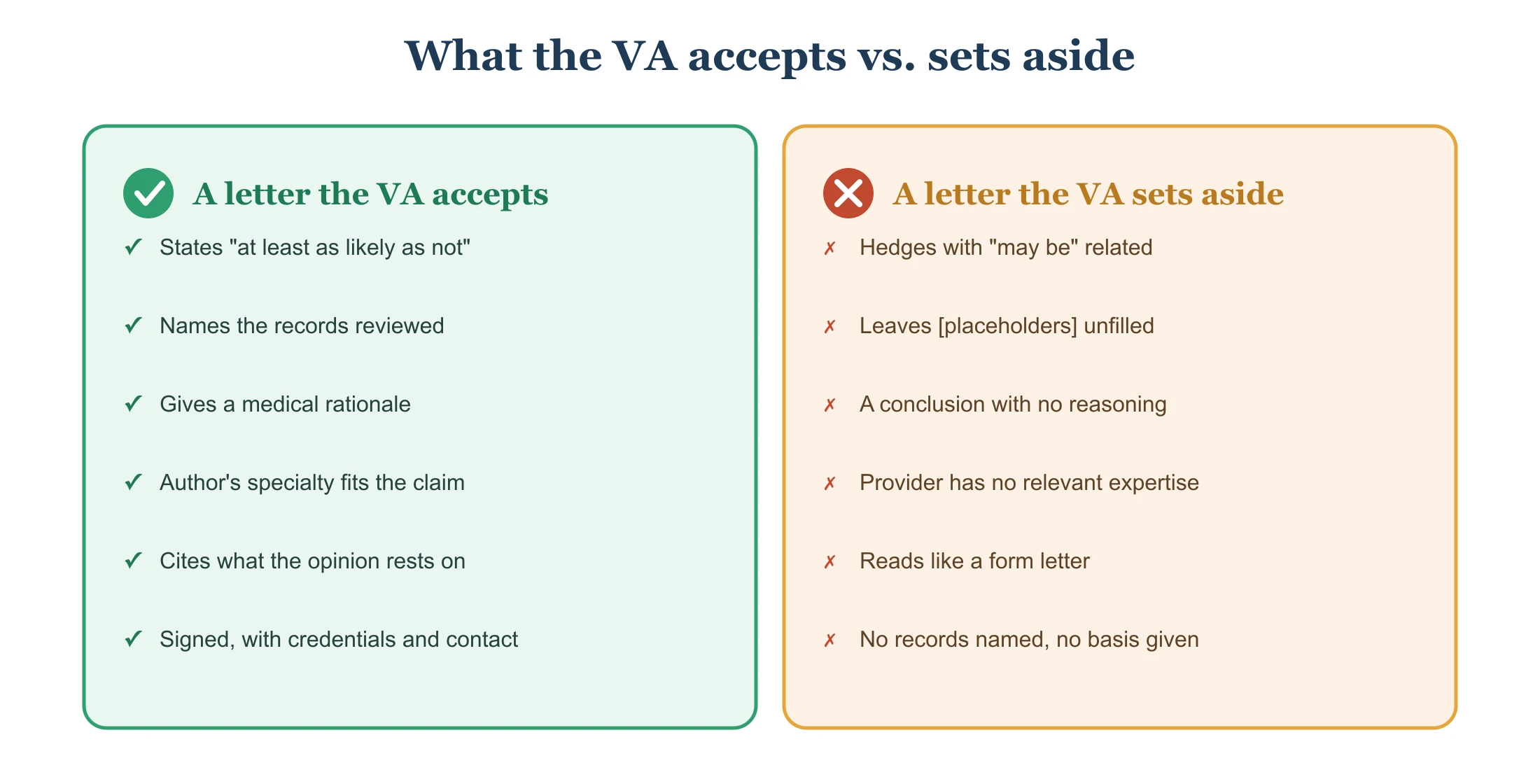
A letter the VA accepts
- States the opinion as "at least as likely as not".
- Names the specific records the clinician reviewed.
- Gives a medical rationale, not just a conclusion.
- Comes from a clinician whose specialty fits the condition.
- Cites the evidence or literature the opinion rests on.
- Is signed, with credentials and contact information.
A letter the VA sets aside
- Hedges with "may be" or "could be" related.
- Leaves bracketed placeholders unfilled in the final version.
- States a conclusion with no reasoning behind it.
- Comes from a provider with no relevant expertise.
- Reads like a form letter that could apply to anyone.
- Names no records and gives no basis for the opinion.
To see all of this on the page, read our annotated nexus letter example, which walks through a full sample part by part.
Fixing a Mistake on a Letter You Already Have
If your letter is already written and you spot a problem, you usually do not need to start over. Take it back to the provider and ask for a corrected version. The most common fixes are the cheapest: change "may be related" to "at least as likely as not," add the rationale that explains why, and name the records the opinion is based on. A short addendum from the same clinician, dated and signed, can carry the correction.
If the provider will not revise it, or was never the right author for the claim, a second opinion from a clinician whose specialty fits the condition is often the stronger move. Either way, fix the letter before it goes into the file. It is far easier to strengthen an opinion before you submit than to overcome a denial after the VA has already set a weak letter aside.
When the VA Ignores Your Nexus Letter
Sometimes a letter is strong and the decision still reads as if the VA never considered it. That is a different problem from a weak letter, and it has its own remedy. The VA is required to consider all the evidence in the file and to explain the weight it gave each piece. When a decision does not mention your nexus letter at all, or dismisses it in a single line with no reasoning, that can be an error in how the claim was decided, not a verdict on the medicine.
Under 38 CFR 4.6, the rater must evaluate the whole record, and the duty to assist obligates the VA to help develop the evidence and to weigh what you submit. If a favorable opinion was overlooked, the record was incomplete, or a Compensation and Pension examiner's opinion was given weight while yours was not addressed, those are grounds to challenge the decision. The next section covers how.
First, make sure the letter itself is airtight against the five failure modes above; a strong letter is what makes an overlooked-evidence argument work on appeal.
How to Appeal a VA Denial
A denial is a decision you can challenge, not a final word. Since the Appeals Modernization Act, you have three review lanes, and the right one depends on why the claim was denied and what you can add. You generally have one year from the date on the decision to act, so the first step is to read the decision closely and identify the reason for the denial.
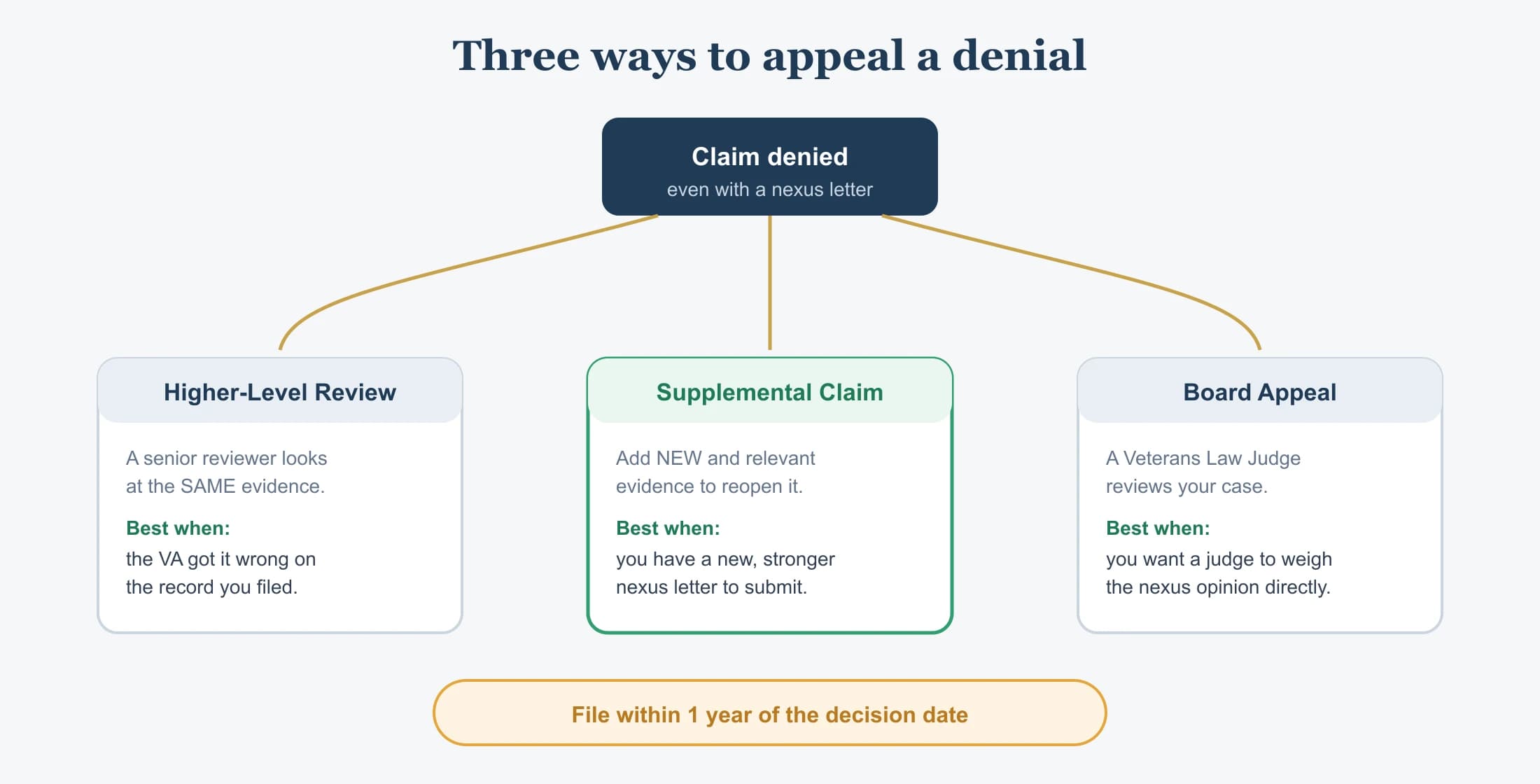
Higher-Level Review
A more senior reviewer takes a fresh look at the exact same evidence you already submitted. You cannot add new records, so this lane fits when you believe the VA made an error on the file as it stands, for example overlooking your nexus letter or misreading the record. You can request an informal conference to point the reviewer to the error.
Supplemental Claim
You reopen the claim by adding new and relevant evidence, and this is the lane most denials with a weak letter should use. A new, stronger nexus letter, one that fixes the language, adds the rationale, or comes from a better-fitting specialist, is exactly the kind of evidence that reopens a Supplemental Claim and gives the VA a reason to decide differently.
Board Appeal
You appeal to a Veterans Law Judge at the Board of Veterans' Appeals. You can choose a direct review, submit additional evidence, or request a hearing. This lane fits when you want a judge to weigh the nexus opinion directly, and it is often where a well-supported letter that a rater set aside gets a full hearing.
All three lanes generally must be filed within one year of the decision date. Miss it and you can still file a Supplemental Claim later, but you may lose the earlier effective date and the back pay tied to it. The official rules for each lane are on VA.gov decision reviews.
Can You Win an Appeal Without a Nexus Letter?
Sometimes, but it is the harder road. Service connection requires a link between a current condition and service, and for most claims a competent medical opinion is what proves that link. Without one, you are relying on the VA's own Compensation and Pension examiner to reach a favorable conclusion, and if the C&P opinion is unfavorable, you have nothing to weigh against it.
There are exceptions. Some conditions are presumptively connected to service, such as certain illnesses tied to toxic exposures under the PACT Act, where the law supplies the link and a nexus letter may not be required. Lay evidence, buddy statements and your own account of symptoms, can establish facts a layperson can observe, like when symptoms began. But when the question is medical causation, a strong nexus letter is usually what turns a denial into an approval, which is why fixing the letter is the center of most successful appeals.
This is especially true for secondary conditions, where the connection runs through another service-connected disability and has to be spelled out.
Is Your Nexus Letter Denial-Proof?
Score your letter
0 of 6 parts
Check your letter against the six things the VA weighs. The parts you cannot tick are the ones most likely to get it set aside. Your score updates as you go.
Several core parts are missing. A letter this thin is easy for the VA to set aside. A clinician can rebuild it to the standard the VA applies.
Have a clinician fix the missing parts →Get a Letter That the VA Cannot Set Aside
If your claim was denied with a weak letter, the strongest move is usually a new opinion built to the standard the VA applies: records reviewed, the connection explained, supporting evidence, and the opinion in the exact language the VA expects. Submitted as a Supplemental Claim, that is what gives the VA a reason to decide differently.
Patriot Path's physicians write letters to this standard for the exact claim you are filing, and review a denied claim honestly to tell you whether a stronger letter can help. One flat fee of $1,500, and the first consultation is free.
Not sure who should write it? See who can write a nexus letter, or walk through how to get a nexus letter from first consultation to filing.
Denied With a Nexus Letter? Let a Physician Look
A denial is not the end. Have our physicians review your claim and write an opinion built to the standard the VA applies, in the language it expects.
Frequently Asked Questions
Can the VA reject a nexus letter?
Yes. The VA does not formally stamp a letter "rejected," but a rater can assign it little or no weight, which has the same effect. It happens when the letter is speculative, gives no rationale, comes from a provider without relevant expertise, or leaves out a required part. When a letter is set aside, the claim is decided as if no opinion was submitted.
Why was my VA claim denied even with a nexus letter?
Almost always for one of five reasons: vague language that falls short of "at least as likely as not," an author whose specialty does not fit the condition, a conclusion with no medical rationale, a missing required element, or a technical problem like records that never reached the file. A letter can be present and still carry no weight if it has any of these flaws.
What does "at least as likely as not" mean?
It means a 50 percent or greater probability that the condition is connected to service. That is the threshold the VA uses, and it comes from the benefit-of-the-doubt rule (38 U.S.C. 5107(b) and 38 CFR 3.102). Wording like "may be" or "could be" related reads as less than 50 percent and usually fails, so the exact phrase matters.
What should I do if the VA ignored my nexus letter?
If the decision does not address a strong letter, that can be an error in how the claim was decided rather than a judgment on the medicine. The VA must consider the whole record (38 CFR 4.6). A Higher-Level Review is designed for exactly this: a senior reviewer looks again at the same evidence and can correct an overlooked opinion. First confirm the letter itself is airtight.
Can I fix a nexus letter after it has been written?
Usually yes, and it is far better than starting over. Ask the original provider for a corrected version or a signed addendum: change hedged wording to "at least as likely as not," add the rationale, and name the records reviewed. If that provider was never the right author, a fresh opinion from a fitting specialist is the stronger fix. Correct it before it goes into the file.
How do I appeal a denial that involved a nexus letter?
You have three lanes, generally within one year of the decision. A Supplemental Claim lets you add a new, stronger nexus letter and is the right lane for most weak-letter denials. A Higher-Level Review asks a senior reviewer to re-examine the same evidence, which fits when the VA erred on the record. A Board appeal puts the case before a Veterans Law Judge.
Can I win a VA claim without a nexus letter?
Sometimes. Presumptive conditions, such as certain illnesses tied to toxic exposures, and cases where the VA's own examiner reaches a favorable opinion can succeed without one. But when the issue is medical causation, a strong nexus letter is usually what proves the connection. Lay statements can establish facts you can observe, but not the medical link itself.
Does a stronger nexus letter really change the outcome?
It removes the most common reason claims are denied. On-page, a letter that states the opinion correctly, names the records, and gives a rationale from a fitting specialist is hard for the VA to set aside. It does not guarantee an approval, because the VA weighs the whole record, but it gives a close claim the evidence it needs to be decided in your favor.
Related guides
- What a nexus letter must includeThe elements the VA reads for in every letter.
- Who can write a nexus letterWhich providers the VA takes seriously.
- VA Directive 1134: make your VA doctor helpThe policy that obligates your VA provider to assist.
- Nexus letter example, annotatedA full sample, part by part, in the right language.
- What is a nexus letterThe definition and how it fits your claim.
- How to get a nexus letterThe full process, start to finish.
- Nexus letters, explainedThe complete overview of nexus letters and claims.
- Why you need one for a secondary conditionWhen the link runs through another disability.
- The nexus letter processWhat working with us looks like, step by step.
Citations & References
- 38 U.S.C. 5107, Claimant responsibility and benefit of the doubt (Cornell LII) https://www.law.cornell.edu/uscode/text/38/5107
- 38 CFR 3.102, Reasonable doubt and benefit of the doubt (eCFR) https://www.ecfr.gov/current/title-38/chapter-I/part-3/subpart-A/section-3.102
- 38 CFR 3.303, Principles relating to service connection (eCFR) https://www.ecfr.gov/current/title-38/chapter-I/part-3/subpart-A/section-3.303
- 38 CFR 3.310, Secondary service connection and aggravation (eCFR) https://www.ecfr.gov/current/title-38/chapter-I/part-3/subpart-A/section-3.310
- 38 CFR 4.6, Evaluation of evidence (eCFR) https://www.ecfr.gov/current/title-38/chapter-I/part-4/subpart-A/section-4.6
- VA decision reviews and appeals, the three lanes (VA.gov) https://www.va.gov/decision-reviews/
- VA Higher-Level Review (VA.gov) https://www.va.gov/decision-reviews/higher-level-review/
- VA Supplemental Claim (VA.gov) https://www.va.gov/decision-reviews/supplemental-claim/
- VA disability compensation, evidence and how to file (VA.gov) https://www.va.gov/disability/how-to-file-claim/evidence-needed/