
Know Your Rights
VA Directive 1134: Make Your VA Doctor Help With Your Nexus Letter
Medically reviewed by the Patriot Path Medical Team
Licensed MD reviewers • Last updated: August 2026
The short answer
Yes. VA Directive 1134 requires your VA provider, when you ask, to help complete your medical forms and provide a medical statement about your condition. That is the same kind of medical opinion that supports a nexus letter. A provider can decline only if they are genuinely uncomfortable doing so or it would be a conflict of interest, not because they are busy or doubt your claim. If they refuse, the facility must offer a reconsideration process.
- Cites VHA Directive 1134(3) & VA.gov
- Physician-Reviewed
- Veteran Friendly
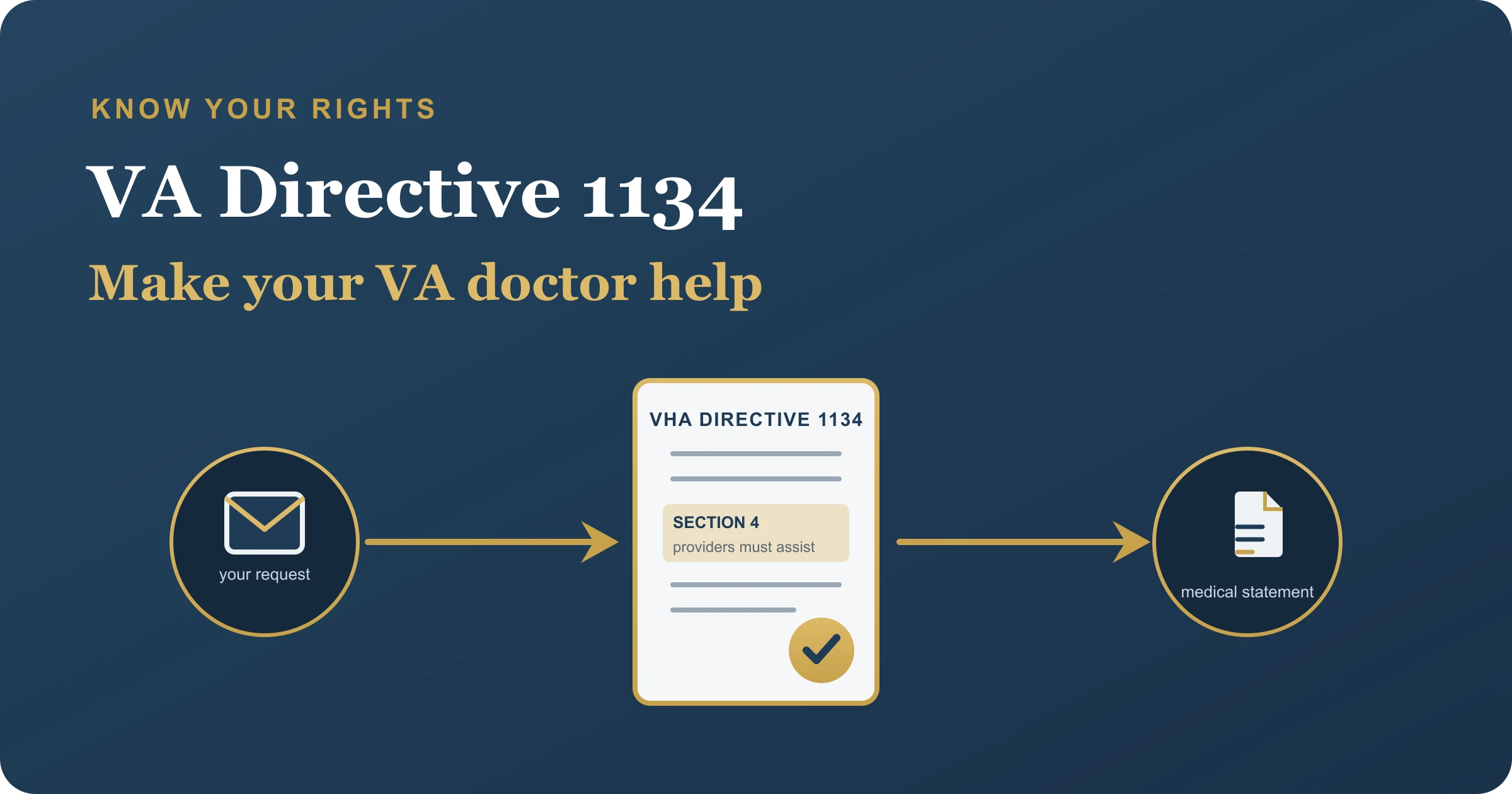
What VA Directive 1134 Actually Says
Most veterans are told their VA doctor “doesn’t do” nexus letters. That is not what the policy says. The document is formally VHA Directive 1134(3), Provision of Medical Statements and Completion of Forms by VA Health Care Providers. It dates to 2016 and was last amended on July 8, 2025. Most people search for it as “VA Directive 1134,” and Section 4 puts the obligation on the provider, not the veteran.
“Except when specifically prohibited, it is VHA policy that providers, when requested, must assist patients in completion of VA and non-VA medical forms and provide medical statements with respect to the patient’s medical condition and functionality.”
Get the document
Download VHA Directive 1134(3)
This is the official policy PDF, straight from VA.gov. Save it, send it to your provider through Secure Messaging with Section 4 highlighted, and bring a copy to your appointment.
Free and official. About 300 KB, 13 pages.
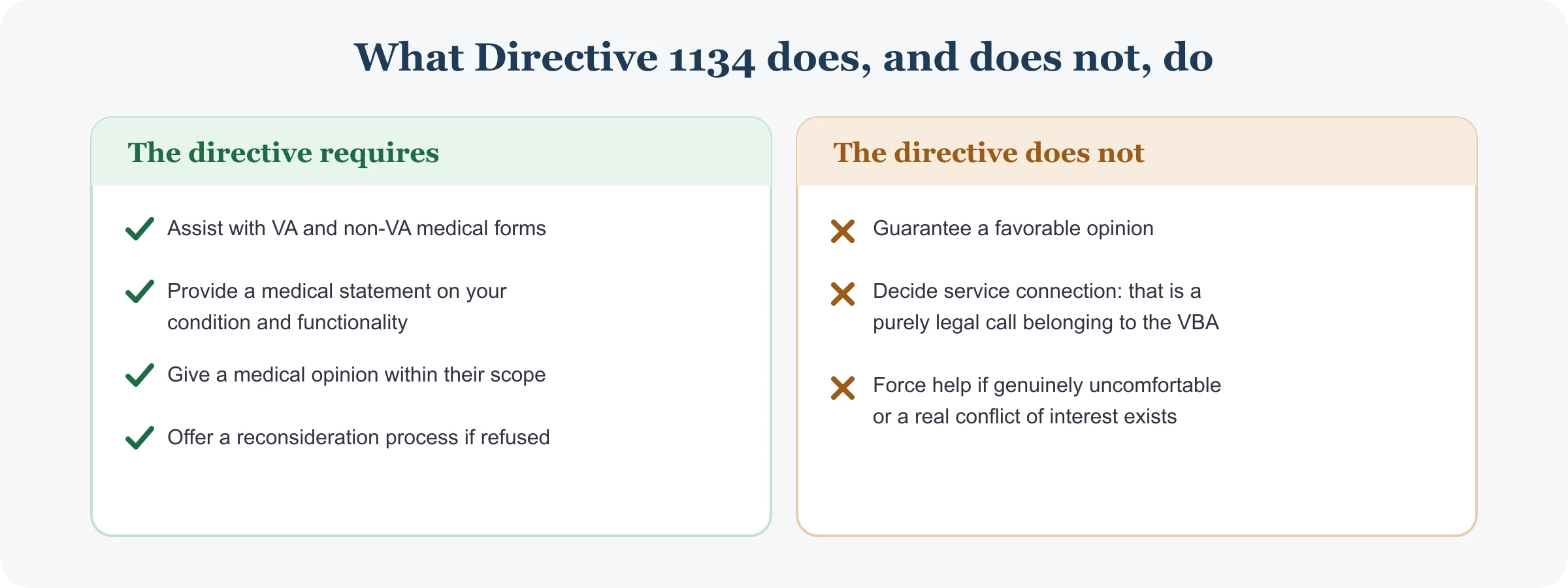
The directive uses the term “medical opinion” rather than “nexus letter,” and it notes that medical opinions “are often concerned with establishing causality” between a condition and military service. That is exactly what a nexus letter does. There are only two grounds to decline: the provider is genuinely uncomfortable doing so, or it would be a conflict of interest. “I’m too busy” and “I don’t think it will help your claim” are not on that list.
Two limits are worth understanding up front, because they set realistic expectations. First, the directive obligates your provider to assist and to give a medical statement or opinion within their scope; it does not guarantee a favorable opinion. Second, the provider does not decide your claim. Service connection and disability ratings are, in the directive’s own words, “purely legal determinations belonging exclusively” to the Veterans Benefits Administration. Your provider supplies the medicine; the VBA makes the legal call. The opinion itself should meet the “at least as likely as not” standard in 38 CFR 3.102, a 50 percent or greater probability that your condition is connected to service.
The directive also sets a timeline. A facility must notify you if your request cannot be completed within a 20 work day window, and every facility must have a process for reconsideration when a provider refuses.
One line in the directive is widely misread, and the misreading costs veterans. Providers must complete forms “to the best of their ability based on their scope and clinical expertise.” That is often repeated secondhand as permission to refuse anything outside a provider’s specialty. The directive says the opposite in the very next clause: when completion of the form extends beyond the scope of the provider, the provider “should assist by consulting with a specialty care expert as appropriate” and by reviewing the evidence already in your VA electronic medical record. Out of their depth is an instruction to go get help, not a reason to hand the form back.
Which Forms Directive 1134 Actually Covers
Veterans usually arrive at this policy asking about one document, a nexus letter or a DBQ. The directive is broader than that, and knowing the full list matters, because a provider who says “we don’t do that form here” is often wrong.
VA forms the directive names as examples
- Application for clothing allowance
- Aid and Attendance (A&A) pension forms
- Housebound pension forms
- Survivors pension forms
- Vocational rehabilitation forms
- Disability Benefits Questionnaires (DBQ)
- Veterans Benefits Administration life insurance forms
Non-VA forms the directive names as examples
- Family Medical Leave Act (FMLA) forms
- Life insurance application forms
- Non-VA disability retirement forms
- Return to work and work status forms
- Medical clearance forms
- State and federal workers’ compensation forms
- Permits, such as a state driver’s license or handicap parking
Both lists are the directive’s own wording, and both are explicitly “not limited to” those examples. Note that DBQs appear by name on the VA list. A provider who completes Aid and Attendance paperwork without argument is working from the same policy that covers your DBQ.
How to Request a Nexus Letter or DBQ From Your VA Doctor
The directive gives you the leverage. This is how to use it without putting your provider on the defensive.
Steps 2 and 4 ask you to attach the directive itself. If you have not saved it yet, download VHA Directive 1134(3) from VA.gov first.
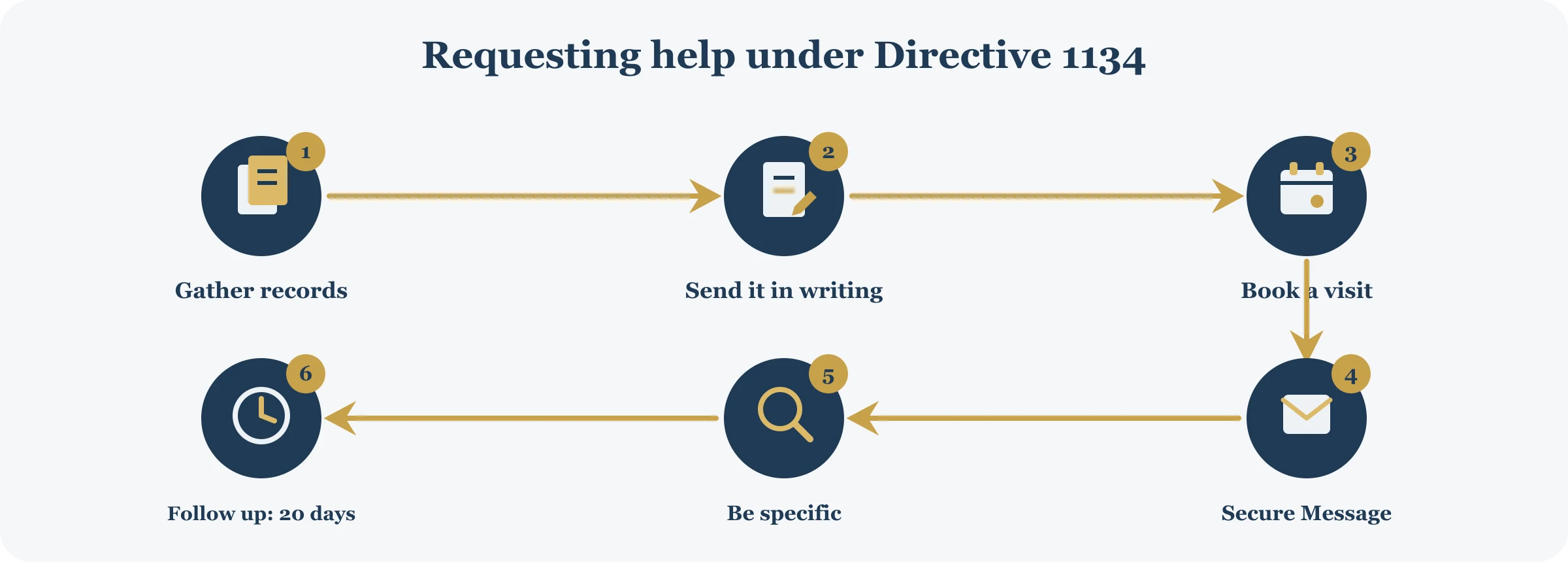
- 1
Gather your records
Pull together the records that show your condition and tie it to service: service treatment records, private notes, and any prior denials.
What this means for you: The more complete your file, the stronger the statement your provider can write.
- 2
Send the directive first, in writing
Email or secure-message your provider a copy of VHA Directive 1134(3) with Section 4 highlighted, before the appointment.
What this means for you: Most VA providers do not know the mandatory language exists. Seeing it first changes the conversation.
- 3
Book a dedicated appointment
Schedule a visit specifically to discuss the nexus letter or DBQ, not tacked onto a routine check-up.
What this means for you: A rushed 15-minute visit is how these requests get brushed off.
- 4
Make the request through Secure Messaging
Log in at myhealth.va.gov, compose a message to your provider, state the request plainly, and attach the directive.
What this means for you: A written request creates a record and starts the 20 work day clock.
- 5
Be specific about the connection
Spell out the in-service event or exposure and how it links to your current condition.
What this means for you: You are handing your provider the reasoning, not asking them to guess.
- 6
Follow up at 20 work days
No response in 20 work days? Follow up in writing and cite the timeframe. If it is a flat refusal, ask for the facility’s reconsideration process.
What this means for you: This is where most veterans give up. Do not. The directive is on your side here.
If Your VA Doctor Says No, or Writes a Letter That Does Not Hold Up
Directive 1134 says your provider has to help. But “has to help” and “does it well” are two different things. A provider can follow the rule and still hand you a letter that will not move your claim. Three things go wrong, and the third has a fix most veterans never hear about.
They refuse anyway
The directive allows only two grounds to decline: the provider is genuinely uncomfortable doing so, or it would be a conflict of interest. “I’m too busy” and “I don’t think it will help” are not on that list. Put your request in writing, cite Section 4, and ask for the facility’s reconsideration process.
They say yes, but the letter is thin
This is the bigger problem. Most VA primary care providers were never trained in service connection. They will write that your condition is “consistent with” service and stop there. The VA wants a clear medical opinion, stated as “at least as likely as not,” backed by your records and the medical literature. A letter without that rationale carries little weight, and you have waited months to find out.
Escalate to the facility’s Medical Statements and Forms POC
Most veterans do not know this person exists. The directive requires every VA medical facility, and every large community-based outpatient clinic serving more than 10,000 enrolled veterans, to have at least one designated Medical Statements and Forms Point of Contact. That POC is responsible for answering questions from patients about form completion, serving as a resource to providers handling those requests, and escalating anything that cannot be resolved locally. Ask your facility by name for the MS&F POC when a provider refuses or stalls.
That is the gap an independent medical opinion fills. The physicians at Patriot Path write nexus letters for one purpose: VA claims. They state the opinion in the language the VA actually uses, ground it in your history, and cite the peer-reviewed research that supports the connection. If your VA provider will not write one, or already wrote one that came back weak, a private opinion may be the faster, stronger path.
Nexus Letters and DBQs Under Directive 1134
The directive covers both kinds of document, and strong claims often include both. They do different jobs: a nexus letter is a medical opinion explaining why your condition is connected to your service, while a DBQ is a standardized VA form documenting how severe that condition is. One decides whether the claim is granted; the other drives the rating percentage.
Because they answer different questions, neither substitutes for the other. Requesting the wrong one for your situation is a common and expensive mistake.
See the full side-by-side comparison, including where the C&P exam fits
Your VA Provider vs a Private Specialist
If your VA provider cannot or will not write a strong one, here is the honest comparison.
| Your VA provider | Private specialist | |
|---|---|---|
| Cost | Free | $1,500 flat, quoted up front |
| Trained in VA service connection | Often not | Yes, it is all they do |
| Uses the at-least-as-likely-as-not rationale | Sometimes | Yes |
| Cites your records and the medical literature | Varies | Yes |
| Turnaround | Up to 20 work days, often longer | Defined turnaround |
| Conflict of interest on mental health | Possible | None |
Mental Health DBQs and the Conflict-of-Interest Question
Mental health is the one place the directive softens. For a mental health DBQ, Directive 1134 recommends, but does not require, that your treating provider decline, to protect the integrity of the patient-provider relationship. If your therapist or psychiatrist says no for that reason, that is their professional judgment, not a policy prohibition. A private mental health professional can complete the DBQ without that conflict.
One thing worth knowing: “I don’t have enough to support your claim” is not a conflict of interest. A conflict of interest is when a provider’s objectivity could be genuinely compromised, personal or financial interests interfering with impartiality. Thin evidence is a different issue. If a provider points to that, ask them to document what they do know about your condition and its history. That documentation has value on its own.
Should You Wait on Your VA Doctor, or Go Private?
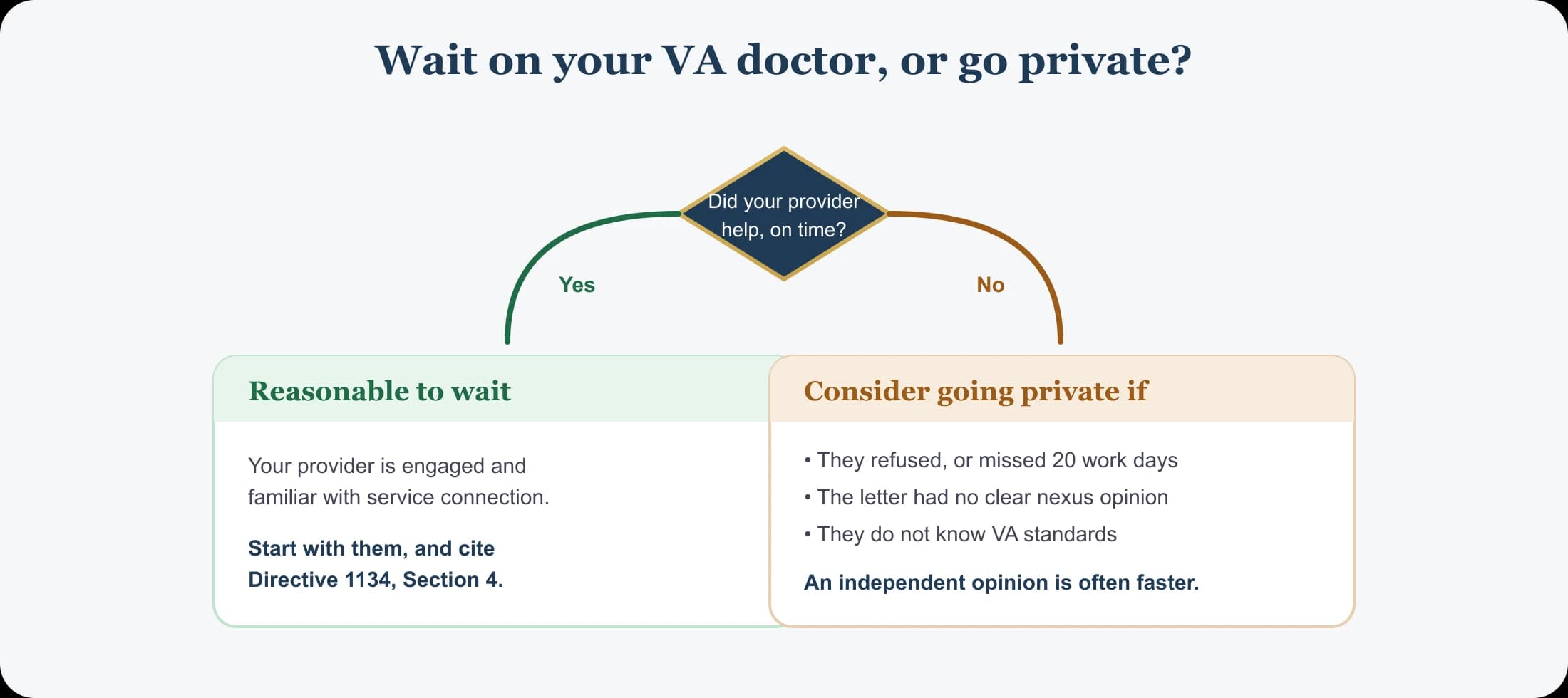
Score your situation
0 of 5 apply
Check each one that is true for you. Your result updates as you go.
None of these apply yet. If your VA provider is engaged and familiar with service connection, it is reasonable to start with them and cite Directive 1134.
Get a free case review →This is general information, not medical or legal advice. The VA makes the rating decision.
The Bottom Line for Veterans
- Directive 1134 means your VA doctor has to help when you ask. Put the request in writing and cite Section 4.
- A “yes” is not always enough. A thin letter with no clear opinion will not move your claim.
- The VA accepts nexus letters from any licensed physician, not just VA providers.
- The directive gets you a medical opinion; the VBA still makes the legal service-connection decision.
- If your provider refuses or writes a weak letter, a private specialist opinion may be the faster path.
Stuck Waiting on Your VA Doctor?
Start with a free consultation. A licensed clinician reviews your situation and gives you a straight answer on whether a nexus letter can help, and if it cannot, we will say so. No one honest guarantees VA approval; the VA makes the rating decision. What we control is the quality of the medical opinion.
Frequently Asked Questions
Does VA Directive 1134 actually require my VA doctor to help me?
Yes. Section 4 of VHA Directive 1134(3) states that, except when specifically prohibited, providers, when requested, must assist patients in completing VA and non-VA medical forms and provide medical statements about the patient's condition and functionality. It is a binding policy obligation, not a courtesy your doctor can opt out of based on preference or workload.
Can my VA doctor refuse to write a nexus letter?
Only in limited circumstances. The directive allows a provider to decline when they are genuinely uncomfortable doing so, or when it would be a conflict of interest. Insufficient evidence and it is not my job are not recognized exceptions. If your doctor refuses, the facility is required to have a reconsideration process in place.
Does Directive 1134 mean the VA has to grant my claim?
No. The directive obligates your provider to assist and to give a medical statement or opinion within their scope. It does not guarantee a favorable opinion, and the provider does not decide your claim. Service connection and disability ratings are purely legal determinations that belong exclusively to the Veterans Benefits Administration; the medical opinion is evidence the VBA weighs.
What counts as a conflict of interest under VA Directive 1134?
A conflict of interest is when a provider's objectivity could be genuinely compromised, such as personal or financial interests interfering with impartiality. It is not simply thin evidence. A VA doctor cannot cite I don't think you'll win as a conflict of interest; that is a judgment about the evidence, not a conflict.
What should I do if my VA doctor refuses to write a nexus letter?
First, reference Section 4 of VHA Directive 1134(3) in writing; VA Secure Messaging works well for this. If the refusal stands, request the facility's formal reconsideration process, which the directive requires every facility to have. You can also obtain a nexus letter from a private, board-certified physician outside the VA system.
Can my VA mental health provider complete a DBQ for me?
The directive recommends, but does not require, that a treating mental health provider decline to complete a mental health DBQ, to protect the patient-provider relationship. If yours declines for that reason, it is their professional judgment, not a policy prohibition. A private mental health professional can complete the DBQ without that concern.
What is the difference between a nexus letter and a DBQ?
A nexus letter is a medical opinion establishing the connection between your current condition and your military service. A DBQ (Disability Benefits Questionnaire) is a standardized VA form documenting the current severity of your condition. Both are covered under Directive 1134, and many strong claims include both documents.
How long does my VA doctor have to respond to my request?
Directive 1134 references a 20 work day timeframe. If your request cannot be completed within that window, the facility is required to notify you. If you receive no response after 20 work days, follow up in writing through VA Secure Messaging and cite the timeframe.
Should I bring a copy of VA Directive 1134 to my appointment?
Yes, and it works better to send it before the appointment. Email or secure-message your provider a copy of VHA Directive 1134(3) with Section 4 highlighted. Most VA providers are unaware of the mandatory language, and having it in writing before you sit down changes the dynamic of the conversation.
Can I get a nexus letter from a private doctor instead of my VA doctor?
Yes. The VA accepts nexus letters from any licensed physician, not just VA providers. A private, board-certified specialist who focuses on VA claims can often provide a stronger, more detailed nexus opinion than a VA primary care provider who is unfamiliar with service-connection standards.
Keep reading: related guides
- Who can write a nexus letterVA doctors, private specialists, and who the VA takes seriously.
- How to get a nexus letterThe full process, start to finish.
- Nexus letter vs DBQWhat each document does, and when you need both.
- Can the VA reject a nexus letterThe common reasons a letter gets little weight, and how to fix them.
- Why you need a nexus letter for a secondary conditionThe general guide to secondary VA claims.
- Nexus letter exampleA full annotated sample letter, section by section.
- Sleep apnea nexus letters: the complete guideThe directive in action for the most common claim.
Citations & References
- VHA Directive 1134(3), Provision of Medical Statements and Completion of Forms by VA Health Care Providers (VA.gov) https://www.va.gov/vhapublications/ViewPublication.asp?pub_ID=4300
- 38 CFR 3.102, Reasonable doubt (eCFR) https://www.ecfr.gov/current/title-38/section-3.102
- VA disability, evidence needed to support your claim (VA.gov) https://www.va.gov/disability/how-to-file-claim/evidence-needed/
- My HealtheVet Secure Messaging (VA.gov) https://www.myhealth.va.gov/