
Nexus Letter Guide
Nexus Letter Example: A Physician's Sample
Medically reviewed by the Patriot Path Medical Team
Licensed MD reviewers • Last updated: July 2026
A nexus letter example shows you what a winning medical opinion actually looks like on the page. Below is a full sample letter, annotated part by part, with the exact language the VA looks for. Use it to understand the format and to check the letter your own provider writes. It is an illustrative composite, not a letter to copy word for word.
New to these documents? Start with what a nexus letter is, then come back to see one in full.
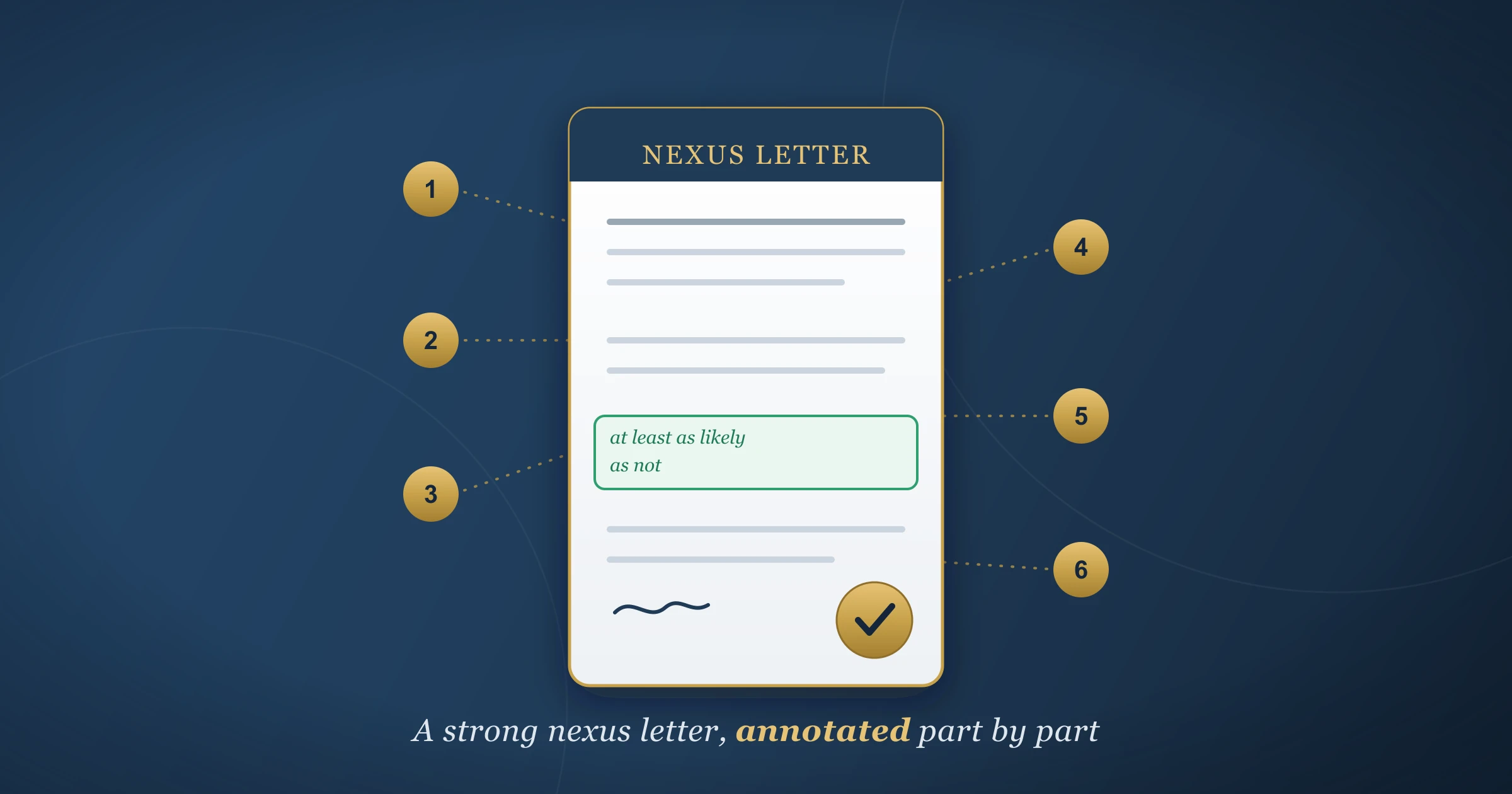
The Anatomy of a Nexus Letter
Every strong nexus letter is built from the same parts. Whatever length it runs, each part does a specific job, and a rater who reads dozens of these a week is scanning for all of them. Leave one out and the letter reads as incomplete, no matter how confident it sounds. Here is what the VA is reading for, in the order it usually appears.
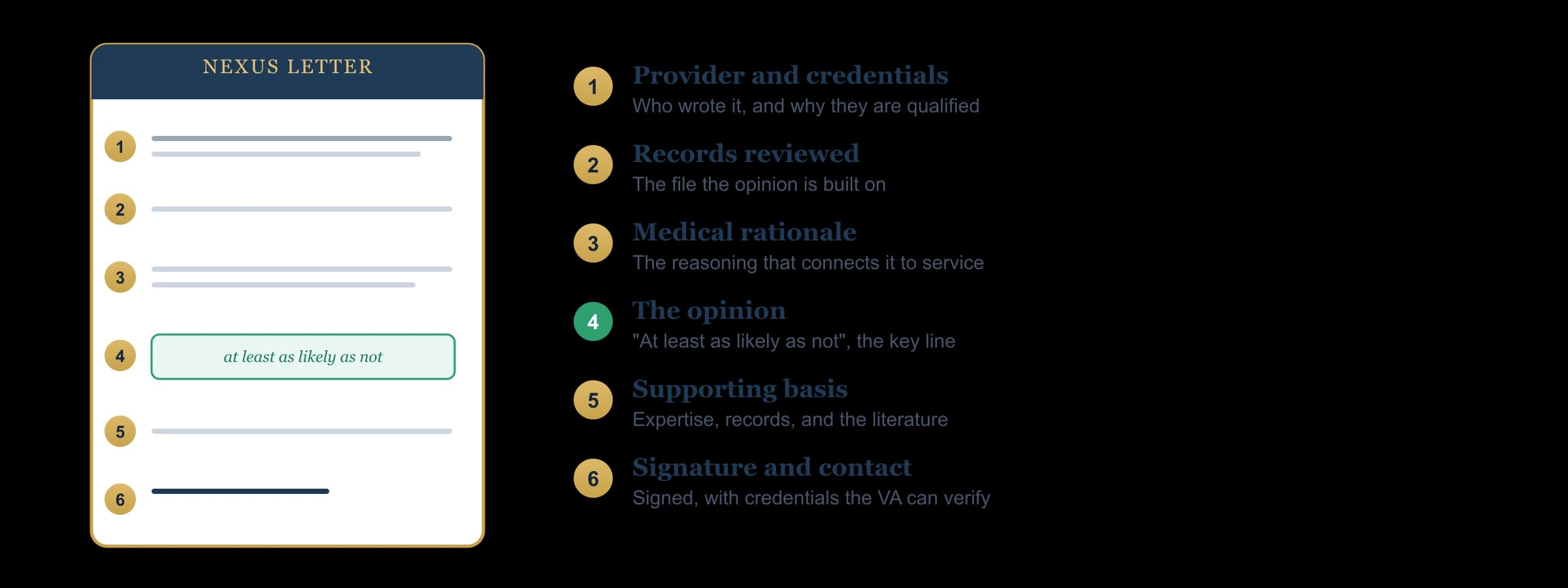
- 1
Provider identification and credentials
Who the clinician is, their license and specialty, and why they are qualified to give this opinion. Specialty that matches the condition adds weight.
- 2
Records reviewed
A statement that the clinician actually read the file: service treatment records, VA records, test results, and any lay statements. An opinion built on the record beats one built on the veteran's say-so.
- 3
The medical rationale
The reasoning that connects the condition to service, spelled out. This is the part examiners weigh most, and the part weak letters skip.
- 4
The opinion, in the VA's language
The conclusion stated as 'at least as likely as not' (a 50 percent or greater probability). This one sentence is what the rater looks for first.
- 5
Supporting basis
What the opinion rests on: the clinician's expertise, the records, and the medical literature. A rationale without a basis reads as a guess.
- 6
Signature and contact
A signature, printed name, credentials, license number, and contact information, so the VA can verify the author.
For the full checklist the VA applies to each of these, see our guide to nexus letter requirements.
A Sample Nexus Letter, Annotated
Here is a complete example for obstructive sleep apnea (OSA), the kind of claim a nexus letter often decides. Each numbered marker points to one of the six parts above. Read the letter first, then the notes.
Illustrative composite for education only. It is not a real letter, and it is not legal or medical advice. Identifying details are shown as [bracketed placeholders], and the signature is a role, not a real person. Do not copy it word for word; a strong letter is written to your own facts and records.
[Physician or Clinic Letterhead]
[Street Address] | [City, State ZIP] | [Phone] | [State License No.]
[Date]
RE: Independent Medical Nexus Opinion for [Veteran's Full Name], VA File No. [XX-XXX-XXX]
To Whom It May Concern at the Department of Veterans Affairs:
1Provider identification and credentials
I am a physician licensed to practice medicine in [State] and board-certified in [specialty, for example sleep medicine or internal medicine]. I have been asked to provide an independent medical opinion on whether [Veteran's Full Name]'s obstructive sleep apnea is related to active-duty service. I have no financial interest in the outcome of this claim.
2Records reviewed
In forming this opinion, I reviewed [Veteran's] service treatment records, VA medical records, a sleep study dated [date] confirming a diagnosis of obstructive sleep apnea, and lay statements from [Veteran] and [his or her] spouse describing loud snoring and witnessed breathing pauses that began during active duty.
3The medical rationale
During service, the records document [significant weight gain and chronic nasal congestion], both recognized risk factors for obstructive sleep apnea, alongside [loud snoring and daytime sleepiness], which are early signs of the condition itself. The lay statements place the onset of witnessed apneas in the service period, before any formal diagnosis. The natural history of OSA, which often goes years between symptom onset and a sleep study, is consistent with symptoms that began in service and were formally diagnosed afterward.
4The opinion, in the VA's language
It is therefore my professional opinion that [Veteran's] obstructive sleep apnea is at least as likely as not (a 50 percent or greater probability) incurred in or caused by [his or her] active-duty service.
5Supporting basis
This opinion is based on my clinical training and experience in [specialty], my review of the records identified above, and the peer-reviewed medical literature on the risk factors and natural history of obstructive sleep apnea. I am available to provide further information on request.
Respectfully,
6Signature and contact
[Physician signature]
Licensed Physician, MD
Board-Certified in [specialty]
[State medical license number] | [Contact information]
What this example gets right
Notice what this letter does not do. It never says the OSA 'may be' or 'could be' related. It names the records, gives a reason, and states the opinion in the exact probability language the VA requires. That is the difference between a letter that helps and one the VA sets aside.
The Language That Makes It Work
The single most important line in the example is the opinion itself. The VA weighs a nexus letter on whether it reaches a specific probability, and the wording is how it shows that. This is where most letters are won or lost. A caring provider who writes that a condition is 'likely related' or 'probably connected' may mean 50 percent or better, but the rater cannot read intent; they read the words on the page. The standard comes from the benefit-of-the-doubt rule: when the evidence for and against is roughly balanced, the tie goes to the veteran, so a letter that lands the opinion squarely at or above 50 percent tips a close claim in your favor.
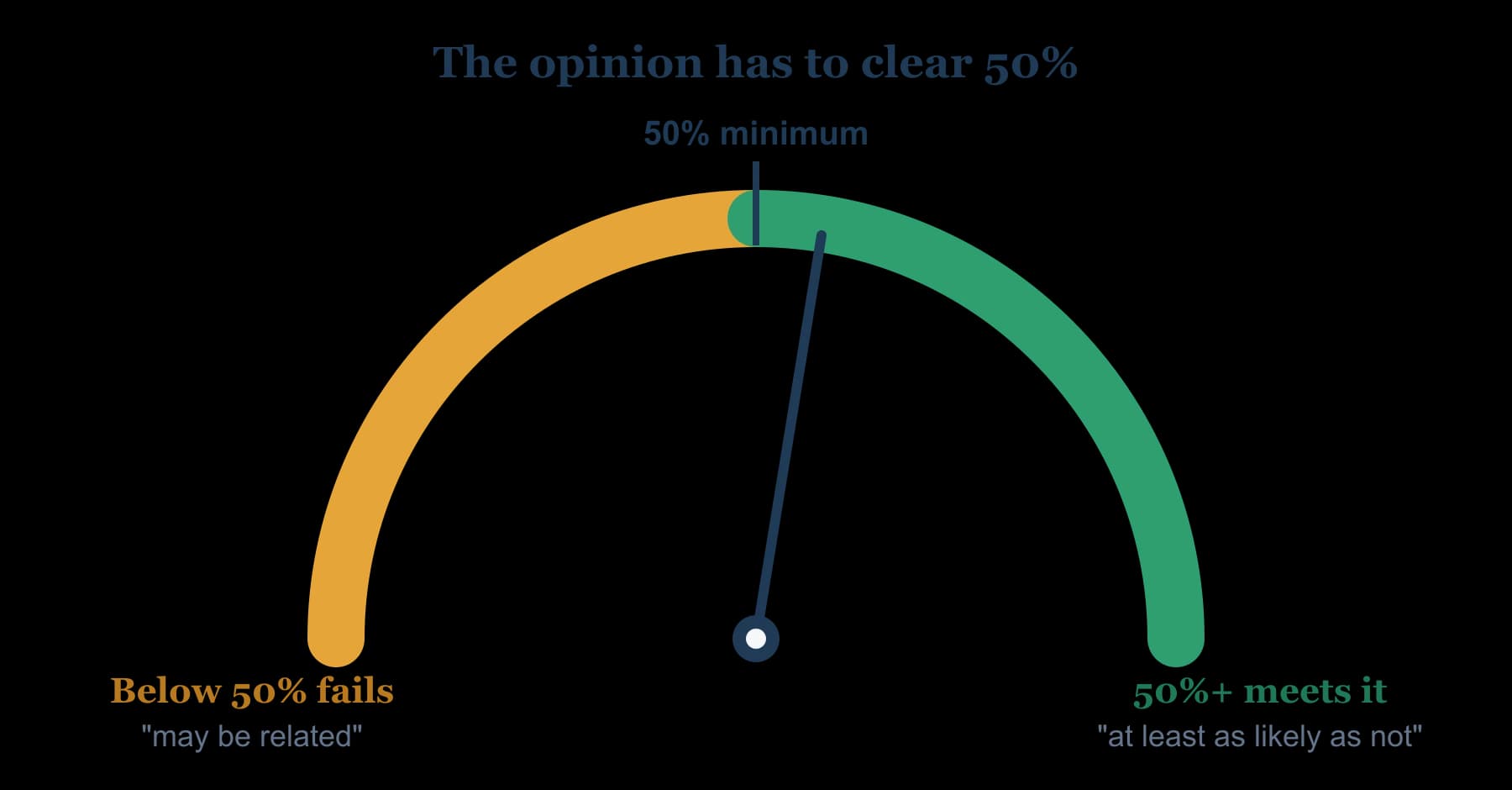
Phrases that meet the bar
- “At least as likely as not” Meets the 50 percent threshold exactly. This is the standard phrase to aim for.
- “More likely than not” Exceeds 50 percent; stronger than the minimum.
Phrases that fail
- “May be related to service” A possibility, not a probability. Below the standard.
- “Could possibly be connected” "Could" does not meet the 50 percent bar, and vague wording invites a denial.
That 50 percent standard is not a courtesy; it is the law. It comes from the benefit-of-the-doubt rule in 38 U.S.C. 5107(b), carried out in 38 C.F.R. 3.102. When the evidence for and against is in equipoise, the VA must resolve it in the veteran's favor.
Causal vs. Correlative Language
Probability is only half of the opinion line. The other half is the verb: whether the letter speaks in causal language or merely correlative language. Causal language states that service produced the condition: 'caused by', 'due to', 'a result of', 'incurred in', or, in an aggravation claim, 'aggravated by'. Correlative language only observes that two things appear together: 'associated with', 'linked to', 'consistent with', 'related to'. An association is not a cause, and the VA cannot grant service connection on a correlation alone.
The distinction matters because the medical literature mostly speaks in correlations. A study reports that a condition is associated with a risk factor; it cannot say what caused one veteran's illness. A strong letter uses that literature as support and then does what a study cannot: it states a causal opinion about this specific veteran. The example above does both. The rationale cites recognized risk factors and the natural history of the condition, and the opinion line converts that evidence into causal language, 'at least as likely as not incurred in or caused by' active-duty service. A letter that stops at 'associated with service' leaves the causal question unanswered, and the rater will not answer it for you.
Strong vs. Weak: What Sinks a Nexus Letter
Most of the example nexus letters you find online fail in the same few ways. Comparing a strong letter to a weak one is the fastest way to see what to insist on.
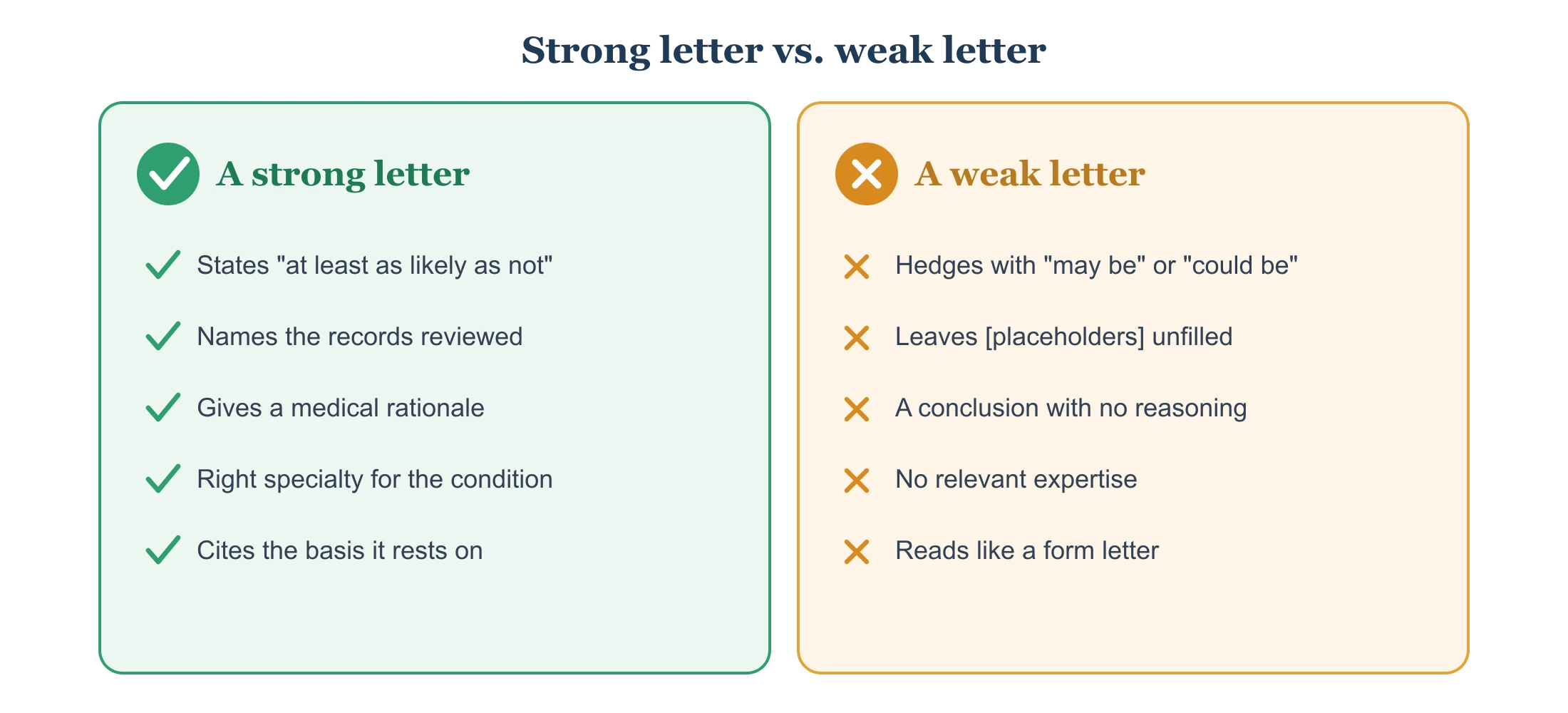
A strong letter
- States the opinion as 'at least as likely as not'.
- Names the specific records the clinician reviewed.
- Gives a medical rationale, not just a conclusion.
- Is signed by a clinician whose specialty fits the condition.
- Cites the evidence or literature the opinion rests on.
A weak letter
- Hedges with 'may be' or 'could be' related.
- Leaves [bracketed placeholders] unfilled in the final version.
- States a conclusion with no reasoning behind it.
- Comes from a provider with no relevant expertise.
- Reads as a form letter that could apply to anyone.
When a letter fails on these points, the VA often sets it aside. We break down the most common reasons, and how to fix each, in our guide to why the VA denies nexus letters.
How to Use This Example
The example is a model to learn from, not a document to submit. Here is how to put it to work on your own claim.
- 1
Do not copy it word for word
A letter that matches a template found online carries little weight, and identical letters can hurt more than help. Use it to understand the shape, then have a clinician write to your facts. - 2
Bring it to your provider
Show it to the physician who knows your condition. It tells them exactly what the VA is reading for, which many providers have never been told. - 3
Check your letter against the six parts
When you get a draft back, confirm each of the six parts is present, above all the opinion line and the rationale. A missing part is a fixable weakness before you submit. - 4
Submit it as evidence with your claim
File it with your VA Form 21-526EZ (or 20-0995 for a Supplemental Claim), along with the records the letter relies on, so the rater sees the opinion and the basis together. - 5
Keep a copy and track the claim
Save a signed copy for your records, and follow the claim on VA.gov or through a Veterans Service Officer. If the VA schedules a C&P exam, bring the letter so the examiner sees the opinion you have already submitted.
For the full process, from finding a provider to filing, see our guide on how to get a nexus letter.
Does Your Nexus Letter Measure Up?
Score your letter
0 of 6 parts
Check your own letter against the six parts of the example. Your score updates as you go.
Several core parts are missing. A letter this thin is easy for the VA to set aside. A clinician can rebuild it to the standard in the example.
Have a clinician build the missing parts →Who Writes a Strong Letter, and What It Costs
Any licensed clinician can write a nexus letter, but the VA gives the most weight to a provider whose specialty fits the condition, and to a letter that does everything the example above does: reviews the records, gives a rationale, and states the opinion in the right language. Many treating providers have simply never been shown what the VA needs, which is why so many letters fall short on the rationale or the opinion line.
You have two broad options: your own treating provider, or an independent physician who writes these opinions regularly. A treating provider already knows your history, which helps, but many have never seen what the VA requires and write in clinical language that misses the mark. An independent physician who reviews the records fresh can be just as persuasive, sometimes more so, because the opinion reads as neutral rather than advocacy. Either can work; what matters is that the letter does everything the example does.
Patriot Path's physicians write letters built to this standard for the exact claim you are filing: records reviewed, the connection explained, supporting evidence, and the opinion in the language the VA expects. One flat fee of $1,500, and the first consultation is free.
Not sure who qualifies? See our breakdown of who can write a nexus letter, and see our flat, upfront nexus letter pricing and what is included.
Get a Nexus Letter Built to This Standard
You have seen what a strong letter looks like. Let our physicians write one to your own records, in the language the VA expects.
Frequently Asked Questions
Can I just copy a nexus letter example for my claim?
No. A letter copied from an online example carries little weight, and the VA can give identical, templated letters less credibility, not more. Use the example to understand the format and the language, then have a clinician who knows your condition write an original letter to your own records and facts.
What is the single most important line in a nexus letter?
The opinion itself, stated as 'at least as likely as not' (a 50 percent or greater probability) that the condition is connected to service. That phrase maps to the benefit-of-the-doubt standard the VA uses, and a letter that hedges with 'may be' or 'could be' related usually falls short of it.
What is the difference between causal and correlative language in a nexus letter?
Causal language states that service produced the condition: 'caused by', 'due to', 'a result of', 'incurred in'. Correlative language only notes an association: 'associated with', 'linked to', 'consistent with'. Medical studies usually report associations, but the VA needs a causal opinion about your specific case, stated to the 'at least as likely as not' standard. A letter that only observes an association leaves the actual question unanswered.
How long should a nexus letter be?
There is no required length. The VA weighs what a letter contains, not how many pages it fills: who the provider is, which records they reviewed, the rationale connecting the condition to service, the opinion in the required language, and a signature. A straightforward claim can be argued briefly, while a complex or secondary claim may need considerably more room for the rationale. Length is not the goal; a clear rationale and the right opinion line are.
Does a nexus letter have to be from a specialist?
Not strictly, but specialty helps. Any licensed clinician can write one, and the VA weighs the opinion partly on whether the author's expertise fits the condition. A sleep specialist for sleep apnea, or a psychiatrist for a mental health claim, generally carries more weight than a provider with no related background.
Can a nexus letter be used for a secondary or toxic-exposure claim?
Yes. The same structure works when the condition is claimed as secondary to a service-connected disability (under 38 C.F.R. 3.310) or tied to a toxic exposure. The opinion language is the same 'at least as likely as not', and the rationale explains the specific connection, whether to service, to another condition, or to an exposure.
Where do I submit the nexus letter?
You submit it as evidence with your claim, not as a separate filing. Upload it with your VA Form 21-526EZ on VA.gov, mail it with your claim, or hand it to a Veterans Service Officer to file for you. Include the records the opinion relies on so the rater sees the opinion and its basis together. If a Compensation and Pension exam is scheduled, bring a copy so the examiner has it in front of them.
Is a nexus letter the same as a DBQ?
No. A Disability Benefits Questionnaire (DBQ) is a standardized VA form that documents how severe a condition is, which drives the rating percentage. A nexus letter is a narrative medical opinion about whether the condition is connected to service. They answer different questions, and a strong claim often uses both: the DBQ for severity and the nexus letter for the connection.
What does a nexus letter cost, and how do we start?
Patriot Path charges $1,500 flat for a nexus letter, and the first consultation is free. Book a consultation and a clinician will review your situation and tell you honestly whether a letter can help your claim.
Related guides
- What a nexus letter must includeThe seven elements the VA looks for.
- What is a nexus letterThe definition and how it fits your claim.
- Who can write a nexus letterWhich providers the VA takes seriously.
- How to get a nexus letterThe full process, start to finish.
- The nexus letter processWhat working with us looks like, step by step.
- When the VA denies a nexus letterThe common reasons, and how to fix them.
- Nexus letters, explainedThe full overview of nexus letters and claims.
- Sleep apnea and the VAThe condition in our worked example.
- Sleep apnea nexus letters: the complete guideThe deep dive on the letter behind our worked example.
- Depression secondary to tinnitusA condition-specific secondary example.
- Migraines secondary to tinnitusAnother worked secondary example.
Citations & References
- 38 U.S.C. 5107, Claimant responsibility and benefit of the doubt (Cornell LII) https://www.law.cornell.edu/uscode/text/38/5107
- 38 CFR 3.102, Reasonable doubt and benefit of the doubt (eCFR) https://www.ecfr.gov/current/title-38/section-3.102
- 38 CFR 3.303, Principles relating to service connection (eCFR) https://www.ecfr.gov/current/title-38/section-3.303
- 38 CFR 3.310, Secondary service connection and aggravation (eCFR) https://www.ecfr.gov/current/title-38/section-3.310
- 38 CFR 3.159, VA assistance and definition of competent medical evidence (eCFR) https://www.ecfr.gov/current/title-38/section-3.159
- VA disability compensation, evidence and how to file (VA.gov) https://www.va.gov/disability/how-to-file-claim/evidence-needed/
- VA Form 21-526EZ, Application for Disability Compensation (VA.gov) https://www.va.gov/find-forms/about-form-21-526ez/
- M21-1 Adjudication Procedures Manual, sufficiency of medical opinions (VA KnowVA) https://www.knowva.ebenefits.va.gov/system/templates/selfservice/va_ssnew/help/customer/locale/en-US/portal/554400000001018/content/554400000180517/M21-1-Part-IV-Subpart-i-Chapter-3-Section-C-Insufficient-Examinations