
VA Secondary Claims
Nexus Letter for Migraines Secondary to Tinnitus
Medically reviewed by the Patriot Path Medical Team
Licensed MD reviewers • Last updated: July 2026
A nexus letter is the medical opinion that ties your migraines to your service-connected tinnitus. The VA does not presume the link, so a secondary claim usually turns on this one document. It states that your migraines are at least as likely as not caused or aggravated by your tinnitus, and it explains the medicine behind that conclusion. Get it right and a claim the VA would otherwise deny can be approved.
An illustrative example
Ray left service with a 10 percent rating for tinnitus and figured that was the whole story. The ringing never let up. It cost him sleep first, and before long the headaches started, the kind that sent him into a dark room until they passed.
By the time a neurologist wrote down the word migraine, he was missing work days he could not get back. He filed a claim, and the VA denied it. His tinnitus was service-connected and his migraines were in the record, but nothing explained why one led to the other.
A clinician then wrote a nexus letter that laid out the connection, the broken sleep and constant strain of tinnitus setting off the attacks, and cited the research behind it. On the supplemental claim, the VA connected the migraines to his tinnitus and paid it.
A composite example for illustration, not a real client. Outcomes depend on your own facts and evidence.
What Migraines Secondary to Tinnitus Means
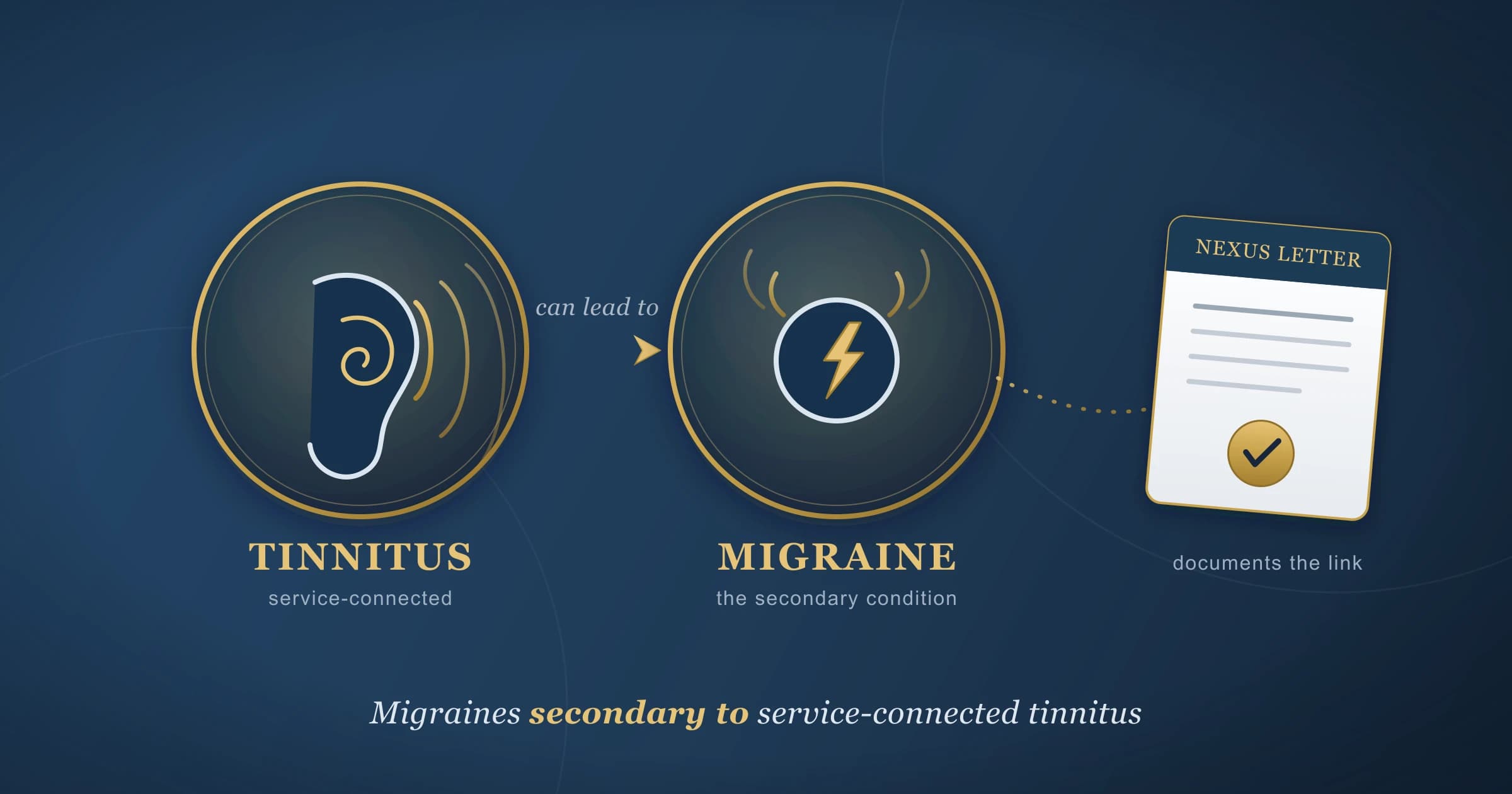
Most veterans picture service connection as a straight line: something happened in service, and it caused a condition. A secondary claim works differently. It connects a new condition to a disability the VA already service-connected, rather than to your service directly. The rule that allows it is 38 C.F.R. 3.310.
Migraines secondary to tinnitus fit this exactly. Your tinnitus is already service-connected. Your migraines came later. You are asking the VA to accept that the tinnitus caused the migraines, or made them worse than they would have been on their own. Aggravation counts too: if the constant ringing turned occasional headaches into frequent, disabling migraines, that worsening is claimable.
The catch is that the VA does not assume any of this. Unlike a presumptive claim, where the link is accepted for you, a secondary claim puts the burden on the evidence. That evidence is the nexus letter.
The claim rests on your service-connected tinnitus, so that rating needs to be settled first.
New to these documents? Start with our primer on what a nexus letter is.
How Tinnitus Can Lead to Migraines
The connection is not a courtesy the VA extends. It is well documented, and it is easy to understand once you have lived with the ringing. Tinnitus is a sound that never turns off, and a brain that never gets quiet is primed for headaches.
Shared nerve pathways
Hearing and head pain run through overlapping wiring. The auditory system and the trigeminal nerve, the main pain pathway of the head, are closely linked, and a system already sensitized by tinnitus is easier to tip into a migraine. Many veterans notice that loud sound and their own ringing both trigger attacks, which is the same sound sensitivity, phonophobia, at work in each condition.
Sleep that never fully comes
Tinnitus is loudest when everything else is silent, which is exactly when you are trying to sleep. Broken, shallow sleep night after night is one of the most reliable migraine triggers there is, and it is one of the first things a strong nexus letter describes.
Constant strain and stress
A sound you cannot escape takes a share of your attention all day. The effort of tuning it out is exhausting, and the tension and poor sleep that come with it are classic setups for a migraine. Over months and years, that steady strain shows up as more frequent, more severe attacks.
A documented pattern
This is not one veteran's theory. In a large national survey, about a third of people with tinnitus also had migraine, and in a separate population study the rate of headaches climbed as tinnitus grew more severe, reaching roughly four in ten among those with severe tinnitus. The VA can grant these claims when the evidence connects the two conditions.
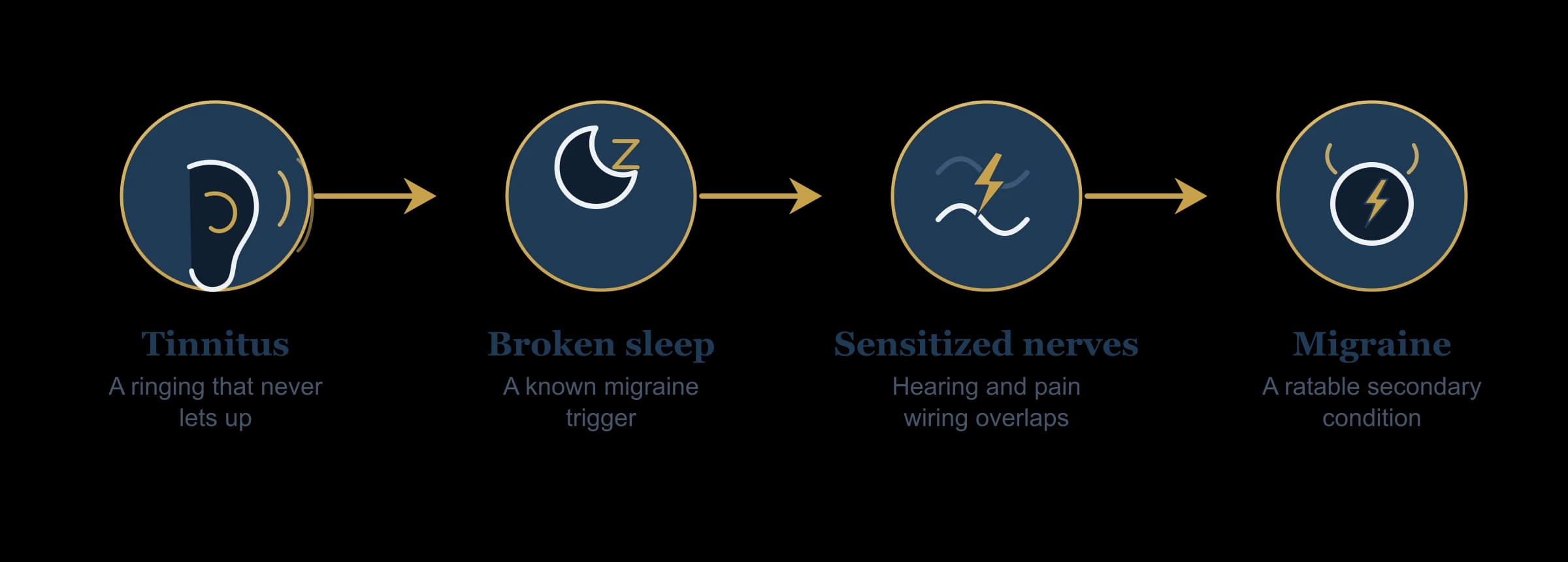
For a nexus letter, this matters because the VA weighs opinions that explain the mechanism far more heavily than a bare assertion. A clinician who can name the pathway, from ringing to lost sleep to a sensitized nervous system to migraine attacks, and cite the literature writes a letter an examiner cannot easily wave away.
The same ringing drives other claims. See our guides to insomnia secondary to tinnitus and depression secondary to tinnitus.
Can You Get VA Disability for Migraines Secondary to Tinnitus?
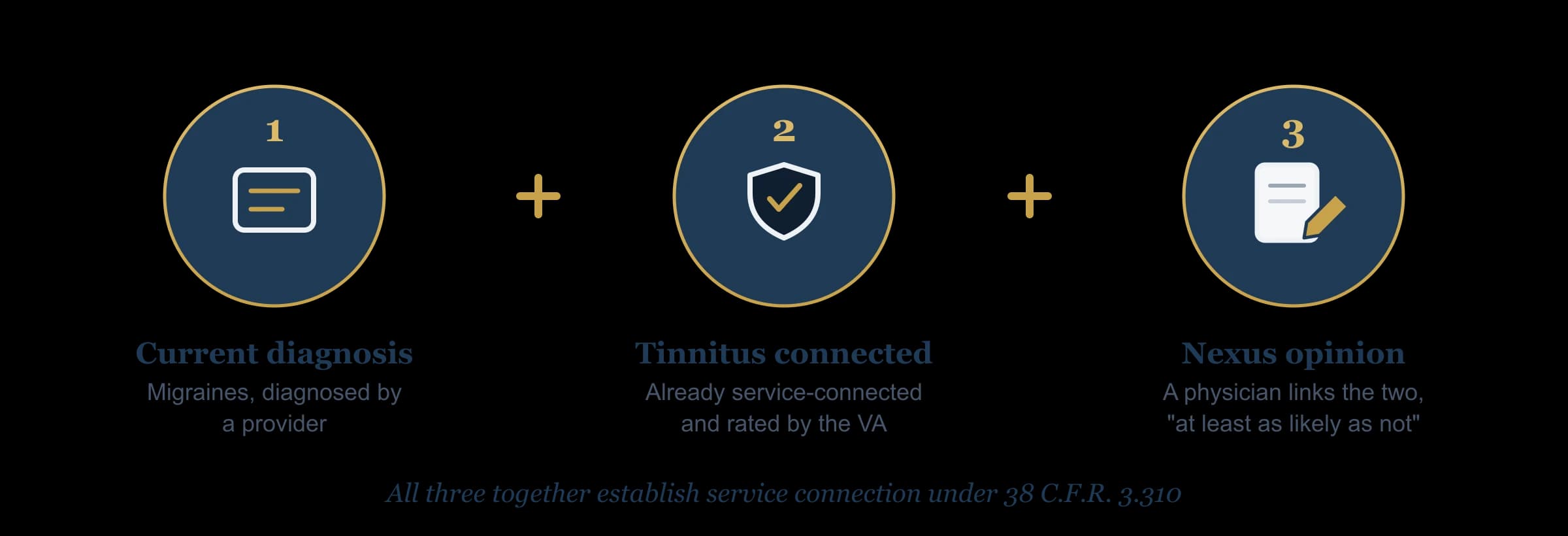
Yes, and it is one of the more overlooked secondary claims tinnitus supports. To win it, three things have to be in place. A nexus letter supplies the third and ties the first two together.
- 1
A current migraine diagnosis
A migraine diagnosis from a provider, ideally backed by neurology notes. The record should show the pattern: how often the attacks hit and how bad they are.
- 2
Tinnitus already service-connected
Your tinnitus needs an existing service connection and rating. The secondary claim builds on it, so this has to be settled first.
- 3
A medical nexus opinion
A qualified opinion that your migraines are at least as likely as not caused or aggravated by your tinnitus. This is the nexus letter.
The Language the VA Requires
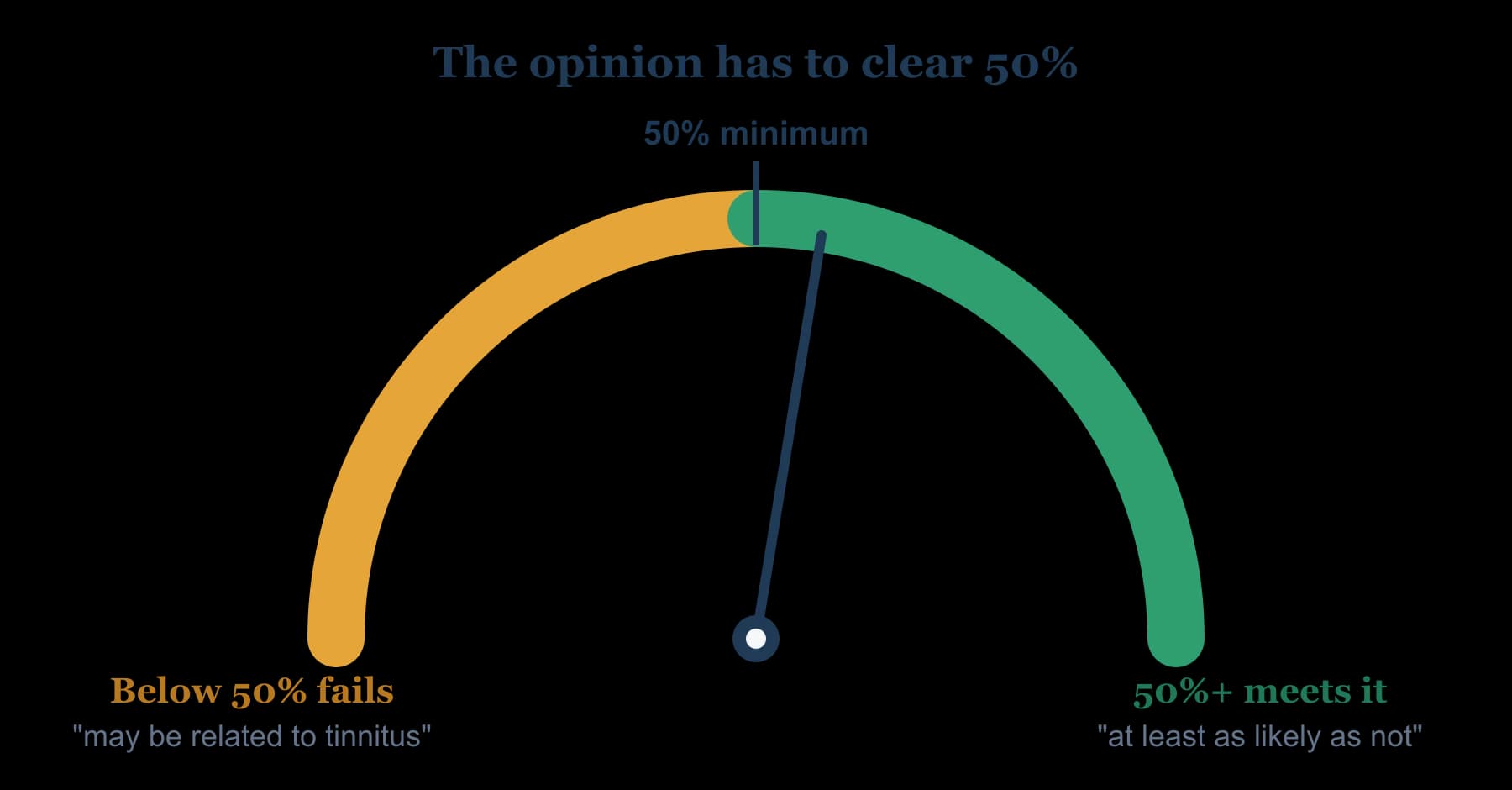
The VA reads a nexus letter closely, and small differences in wording change how much weight it carries. A strong letter names the records reviewed, states your current migraine diagnosis, confirms your service-connected tinnitus, explains how the ringing drove the migraines, cites supporting research, and closes with the opinion in the exact probability language the VA requires. That standard comes from the benefit-of-the-doubt rule in 38 U.S.C. 5107(b), carried out in 38 C.F.R. 3.102: when the evidence is roughly balanced, the tie goes to the veteran.
Language that meets the bar
- “At least as likely as not caused or aggravated by the veteran's service-connected tinnitus” Meets the 50 percent threshold and names the secondary path. The standard to aim for.
- “More likely than not a result of the veteran's tinnitus” Exceeds 50 percent; stronger than the minimum.
Language that fails
- “May be related to the veteran's tinnitus” A possibility, not a probability. Below the standard.
- “Could be associated with the ringing in the ears” "Could" does not meet the 50 percent bar, and vague wording invites a denial.
Do not overlook aggravation
If you had occasional headaches before but the tinnitus made them worse, the letter should say so directly and describe the baseline. Aggravation is its own path to service connection under 38 C.F.R. 3.310(b), and a letter that documents the worsening can win even when the migraines were not caused by tinnitus outright.
What the Nexus Letter Must Include
A migraine secondary letter is not a form. It is a reasoned medical opinion, and the strongest ones share the same parts. Here is what a clinician should put in yours.
- 1A clear statement of the opinionThe conclusion in the VA's own words, that your migraines are at least as likely as not caused or aggravated by your service-connected tinnitus. This sentence is what the rater looks for first.
- 2A review of your recordsConfirmation that the clinician read your tinnitus rating, your migraine diagnosis, and your treatment history, not just your say-so. An opinion built on the file carries far more weight.
- 3The timeline and how the attacks progressedWhen the tinnitus was service-connected, when the migraines started or worsened, and how the two track together over time.
- 4The medical rationale and literatureThe mechanism spelled out, ringing to lost sleep and a sensitized nervous system to migraine, supported by the research on tinnitus and headache. This is what separates a persuasive letter from a bare assertion.
- 5The provider's credentialsWho the clinician is and why they are qualified to give the opinion, so the VA can weigh it. For migraines, neurology or headache experience helps.
For the full checklist the VA applies to any nexus letter, see our guide to what a nexus letter must include.
What to Give Your Provider
A nexus letter is only as strong as the records behind it. For migraines, the headache log does the heavy lifting, because the rating turns on how often the attacks hit. Bring these so the clinician can write from evidence rather than assumption.
The core file
- Your tinnitus service-connection decisionThe VA letter or rating showing tinnitus is service-connected, with the effective date.
- A current migraine diagnosisProvider notes naming the diagnosis, ideally from neurology, with the pattern of attacks.
- A headache log or journalThe single most useful piece of evidence. Track each attack: the date, how long it lasted, how bad it was, whether you had to lie down, and what you missed.
What strengthens it
- Treatment records and prescriptionsTriptans, preventives, Botox, or ER and urgent-care visits for migraines all show how serious and frequent they are.
- A personal statementIn your own words, how the ringing sets off or worsens the headaches, and what the attacks cost you at work and at home.
- A timelineRoughly when your tinnitus and your migraines each began, so the clinician can line them up.
- Lay statementsShort notes from family or coworkers about the attacks and the days you miss.
What VA Rating Can You Get for Migraines Secondary to Tinnitus?
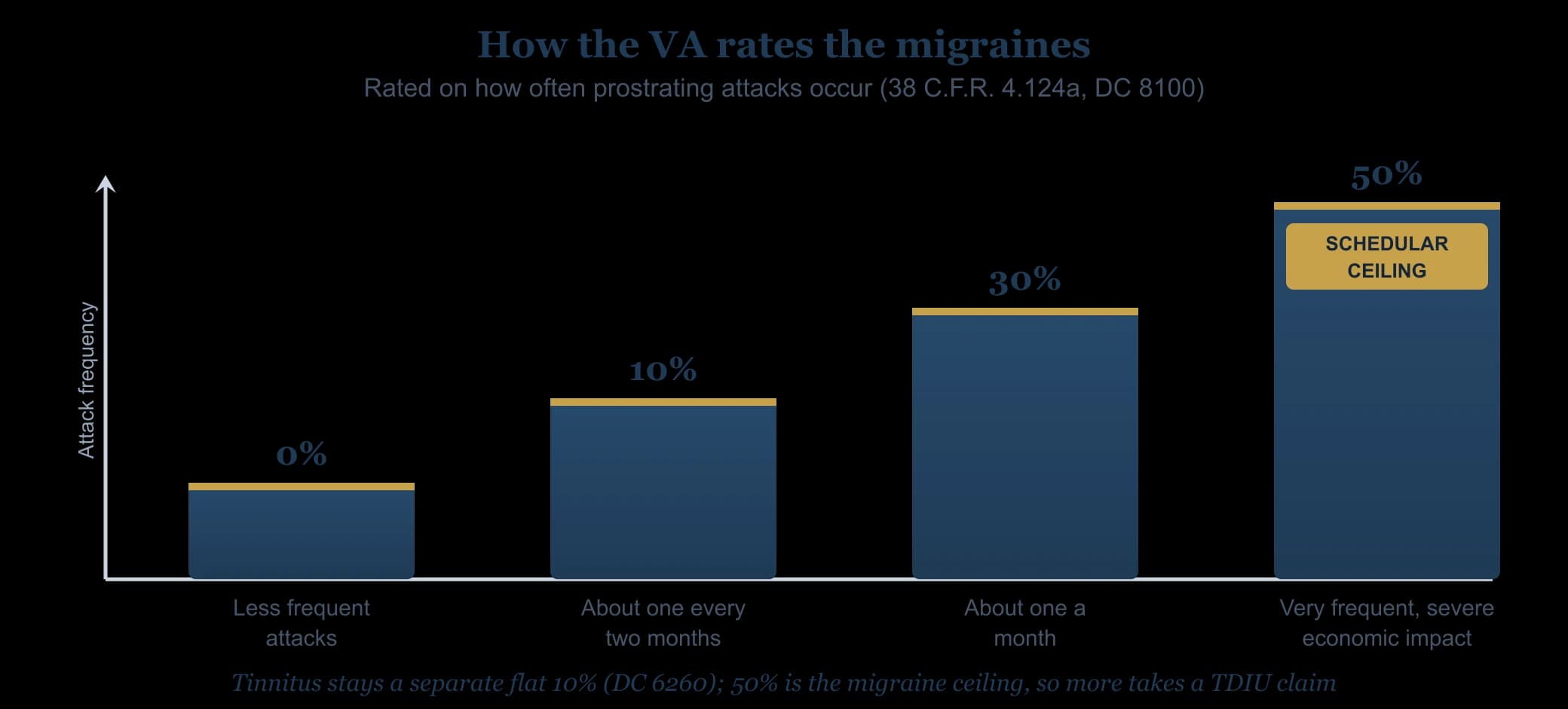
Once the migraines are service-connected, the VA rates them under 38 C.F.R. 4.124a, Diagnostic Code 8100, at 0, 10, 30, or 50 percent. One thing drives the level: how often you get prostrating attacks, the kind that stop you cold and force you to lie down. Roughly, one every two months supports 10 percent, about one a month supports 30 percent, and very frequent, prolonged attacks that badly affect your ability to work support 50 percent. The regulation does not define prostrating, which is a big reason these claims get denied, so a headache log that shows the frequency is essential.
How it adds to your combined rating
Two points matter for your combined rating. First, tinnitus stays a separate flat 10 percent under 38 C.F.R. 4.87, Diagnostic Code 6260, and the migraine rating is combined with it under the VA combined-ratings table rather than replacing it (the VA combines percentages with that table, not simple addition). Second, 50 percent is the highest rating the migraine code gives. There is no 70 or 100 percent for migraines by themselves. If the attacks keep you from holding steady work, the path past 50 percent is not a higher migraine number; it is a TDIU claim, total disability based on individual unemployability, which can pay at the 100 percent rate, or an extraschedular rating under 38 C.F.R. 3.321(b).
For the full rating breakdown, the pay figures, and a migraine rating estimator, see our guide to migraines and VA disability.
How to File the Secondary Claim
You file migraines secondary to tinnitus like any disability claim, but you present it as a secondary condition and lead with the nexus letter.
- 1File VA Form 21-526EZThe Application for Disability Compensation. Name migraines as secondary to your service-connected tinnitus so the VA reviews it on that theory.
- 2Attach the nexus letterThe physician opinion tying the migraines to the tinnitus in the language above. This is the centerpiece of the claim.
- 3Include your supporting evidenceYour migraine diagnosis, your headache log, your treatment records, your personal statement, and any lay statements from people who know you.
- 4Submit and track itFile online at VA.gov, by mail, or with a Veterans Service Officer, who can help at no cost. Keep copies of everything you send.
A Veterans Service Officer through your state or a veterans organization can file the claim with you for free. Their help is a good complement to a strong nexus letter, not a substitute for it.
What to Expect at the C&P Exam
The VA will usually schedule a Compensation and Pension exam to evaluate the migraines. A VA examiner or contractor asks about your attacks, your history, and how the condition affects your work and daily life, and then offers an opinion on severity and cause. For migraines, expect questions about how often the attacks hit, how long they last, and whether they force you to stop and lie down.
Bring a copy of your nexus letter and your headache log, and be honest and specific. Describe your worst attacks, not just an average day, and how the ringing sets them off. A clear, consistent account that matches your records and your letter is what carries the exam.
If Your Claim Is Denied
Secondary migraine claims are often denied the first time, usually because the medical evidence did not clearly connect the two conditions, or because the record did not prove the attacks were prostrating and frequent. A denial is not the end of the claim.
Read the decision and the exam report to see exactly why it was denied. If the problem was a weak or missing link, a stronger nexus letter that answers the examiner's reasoning is often what turns it around. If the problem was frequency, a fuller headache log helps. You can then file a Supplemental Claim on VA Form 20-0995 with that new evidence.
We break down the most common reasons these claims fail, and how to fix each one, in our guide to why the VA denies nexus letters.
Who Should Write the Letter, and What It Costs
Any licensed clinician can write a nexus letter, but for migraines the VA gives added weight to opinions from neurologists and other providers who diagnose and treat headache for a living. What sets a strong letter apart is not just the credential; it is a clinician who reviews your records, explains the mechanism, and states the opinion in the language the VA requires.
Patriot Path's physicians write letters built for this exact claim: records reviewed, the tinnitus-to-migraine connection, supporting research, and the opinion in the language the VA expects. One flat fee of $1,500, and the first consultation is free.
Not sure who qualifies? See our breakdown of who can write a nexus letter, and how the whole process works in our guide to getting a nexus letter.
See our flat, upfront nexus letter pricing and what is included.
Is Your Secondary Claim Ready?
Score your claim
0 of 6 in hand
Check each item you already have in hand. Your score updates as you go.
A few core pieces are missing. Start by confirming your tinnitus service connection and getting your migraines diagnosed.
Have a clinician build the missing pieces →Give Your Secondary Claim Its Strongest Evidence
Your tinnitus and your migraines are both on the record. Let our physicians write the nexus letter that explains to the VA how one led to the other.
Frequently Asked Questions
Does the VA automatically connect migraines to tinnitus?
No. There is no presumption that links migraines to tinnitus, so the VA will not make the connection for you. You have to prove it, and the nexus letter is the piece of evidence that does. It states that your migraines are at least as likely as not caused or aggravated by your service-connected tinnitus, and explains the medicine behind that conclusion.
Do I need my tinnitus to be service-connected first?
For a secondary claim, yes. The claim builds on an already service-connected condition, so your tinnitus needs an existing rating before migraines can be tied to it. If your tinnitus is not yet service-connected, that claim comes first, and you can pursue the migraines once it is settled.
Can tinnitus really cause migraines?
The connection is well documented. Hearing and head pain share overlapping nerve pathways, and the broken sleep, sound sensitivity, and constant strain of tinnitus are all known migraine triggers. In a large national survey about a third of people with tinnitus also had migraine, and in a separate study the rate of headaches rose as tinnitus grew more severe. A nexus letter applies that evidence to your specific case.
What VA rating can I get for migraines secondary to tinnitus?
The VA rates the migraines under 38 C.F.R. 4.124a, Diagnostic Code 8100, at 0, 10, 30, or 50 percent, based on how often you get prostrating attacks. Roughly, one every two months is 10 percent, about one a month is 30 percent, and very frequent, prolonged attacks that badly affect your ability to work are 50 percent. Your tinnitus stays a separate flat 10 percent, so the migraine rating adds to your combined rating. Fifty percent is the highest rating this code gives.
What does 'prostrating' mean?
The regulation does not define it, which is a big reason migraine claims get denied. In plain terms, a prostrating attack stops you cold. You cannot keep working or functioning, and you have to lie down in a dark, quiet room until it passes. A headache you can push through usually is not prostrating. A headache log that records when you had to stop and lie down is the best way to show it.
Who can write the nexus letter?
Any licensed clinician can, but for migraines the VA gives added weight to neurologists and other providers who treat headache. What matters most is that the provider reviews your records, explains how the tinnitus led to the migraines, and uses the exact 'at least as likely as not' language the VA requires.
What if I had headaches before the tinnitus?
You can still claim it. Under 38 C.F.R. 3.310(b), the VA can service-connect the amount your tinnitus worsened a condition you already had. The nexus letter should describe your baseline, occasional headaches, and how they became more frequent or disabling as the ringing continued, so the VA can see the aggravation rather than treating the migraines as pre-existing and unrelated.
My claim was denied. Is it over?
No. Many secondary migraine claims are denied the first time, often for a weak medical link or thin proof of how often the attacks hit. Read the decision and the C&P exam report, then file a Supplemental Claim (VA Form 20-0995) with a stronger nexus letter and a fuller headache log that answer the reason for the denial. New, relevant evidence is what reopens the claim.
What does it cost, and how do we start?
Patriot Path charges $1,500 flat for a nexus letter, and the first consultation is free. Book a consultation and a clinician will review your situation and tell you honestly whether a letter can help your migraines secondary to tinnitus claim.
Related guides
- Tinnitus and the VAThe flat 10% rating and the claims it anchors.
- Migraines and VA disabilityThe full DC 8100 rating breakdown and evidence.
- What a nexus letter must includeThe seven elements the VA looks for.
- Nexus letter for a secondary conditionHow secondary claims work, in general.
- Who can write a nexus letterWhich providers the VA takes seriously.
- Depression secondary to tinnitusAnother secondary claim the same ringing drives.
- Insomnia secondary to tinnitusThe lost sleep that feeds the headaches, as its own claim.
- Anxiety secondary to tinnitusThe fourth secondary claim the same ringing drives.
- Migraines secondary to PTSDThe other common secondary path for migraines.
- Headaches secondary to TBIPost-traumatic headache after a concussion or blast, as its own secondary claim.
- Nexus letter for migrainesThe direct-service-connection version of the claim.
- When the VA denies a nexus letterThe common reasons, and how to fix them.
- How to get a nexus letterThe full process, start to finish.
- Nexus letter exampleSee the framework on a finished letter.
Citations & References
- 38 CFR 3.310, Secondary service connection and aggravation (eCFR) https://www.ecfr.gov/current/title-38/section-3.310
- 38 CFR 4.124a, Schedule of ratings, neurological conditions, including DC 8100 migraine (eCFR) https://www.ecfr.gov/current/title-38/section-4.124a
- 38 CFR 4.87, Schedule of ratings, ear, including DC 6260 tinnitus (eCFR) https://www.ecfr.gov/current/title-38/section-4.87
- 38 CFR 3.102, Reasonable doubt and benefit of the doubt (eCFR) https://www.ecfr.gov/current/title-38/section-3.102
- 38 U.S.C. 5107, Claimant responsibility and benefit of the doubt (Cornell LII) https://www.law.cornell.edu/uscode/text/38/5107
- 38 CFR 3.321, Rating schedule and extraschedular ratings (eCFR) https://www.ecfr.gov/current/title-38/section-3.321
- VA disability compensation, how to file (VA.gov) https://www.va.gov/disability/
- VA Form 21-526EZ, Application for Disability Compensation (VA.gov) https://www.va.gov/find-forms/about-form-21-526ez/
- VA Form 20-0995, Supplemental Claim (VA.gov) https://www.va.gov/find-forms/about-form-20-0995/
- Goshtasbi K, et al. Tinnitus and Subjective Hearing Loss are More Common in Migraine: A Cross-Sectional NHANES Analysis. Otol Neurotol. 2021 (PMC) https://pmc.ncbi.nlm.nih.gov/articles/PMC8590584/
- Lugo A, et al. Relationship between headaches and tinnitus in a Swedish study. Sci Rep. 2020 (PMC) https://pmc.ncbi.nlm.nih.gov/articles/PMC7244494/
- Hwang JH, et al. Association of Tinnitus and Other Cochlear Disorders With a History of Migraines. JAMA Otolaryngol Head Neck Surg. 2018 (PubMed) https://pubmed.ncbi.nlm.nih.gov/30003226/