
Secondary VA Claims
Insomnia Secondary to Tinnitus: The Nexus Letter Guide
Medically reviewed by the Patriot Path Medical Team
Licensed MD reviewers • Last updated: July 2026
Insomnia caused by service-connected tinnitus can be claimed as a secondary condition. The VA will not make that link for you. A nexus letter has to say the insomnia is at least as likely as not caused or aggravated by the tinnitus, and explain the mechanism behind it. Insomnia has no diagnostic code of its own, so how it is rated surprises most veterans.
An illustrative example
Marcus spent eleven years as a helicopter crew chief. His tinnitus was service-connected at 10 percent in 2019, which is the most the VA pays for ringing ears no matter how loud it is.
What the rating did not capture was the rest of it. The ringing was worst in a quiet bedroom, which is exactly where he needed quiet. He was taking two hours to fall asleep and waking three or four times a night.
His first secondary claim was denied. The letter from his primary care provider said his sleep problems "may be related to" his tinnitus, which sits below the VA's evidentiary threshold, and it never explained how one produced the other.
A composite example for illustration, not a real client. Outcomes depend on your own facts and evidence.
What Insomnia Secondary to Tinnitus Means
A secondary condition is one caused or aggravated by a disability the VA has already service-connected. Under 38 CFR 3.310, if your tinnitus is service-connected and it caused your insomnia, the insomnia can be service-connected too.
Here is where almost every guide on this topic misleads you, and it is worth understanding before you spend money on a letter. Service connection and a separate payment are not the same thing. The VA can grant service connection for insomnia secondary to tinnitus and still pay you nothing extra for it.
You do not have to prove the tinnitus caused the insomnia outright. Aggravation counts too. But 38 CFR 3.310(b) attaches a condition most guides skip: the VA "will not concede" aggravation unless the baseline level of severity before the aggravation began is established by medical evidence. The rating then reflects the increase over that baseline, not the whole condition.
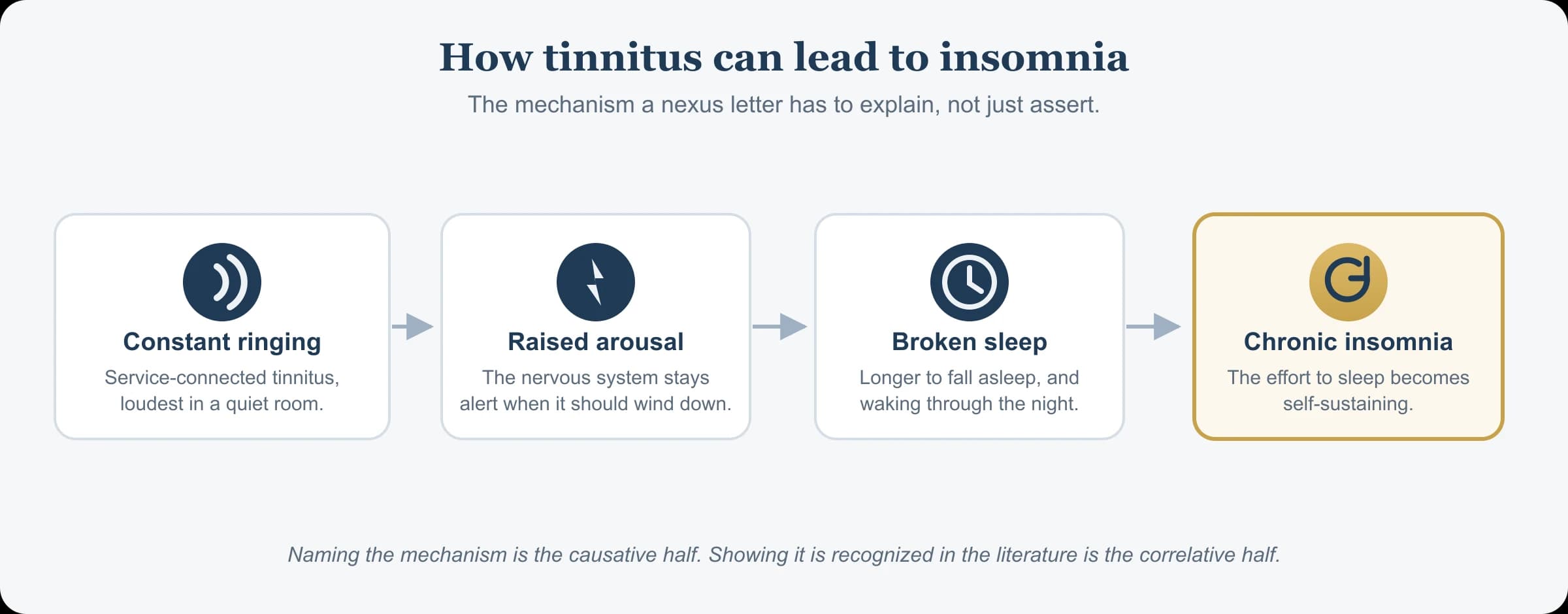
How Tinnitus Can Lead to Insomnia
The association between tinnitus and disturbed sleep is well documented in the medical literature, and that is the correlative half of a nexus opinion. The causative half is the mechanism: how the ringing actually produces the sleeplessness in this particular veteran.
Silence makes it louder
Tinnitus is a phantom perception with no external source, so it does not compete with ambient noise. A quiet, dark bedroom removes the masking sound that made it tolerable during the day, which is why so many veterans describe the ringing as worst at bedtime.
Arousal, not just annoyance
A body of sleep research treats hyperarousal as the common thread between tinnitus and insomnia: the nervous system stays alert when it should be winding down. That framing matters in a letter, because it explains a physiological mechanism rather than describing an irritation.
Sleep onset and maintenance both suffer
The pattern is usually longer time to fall asleep plus repeated waking, rather than one or the other. Documenting both is useful, because the severity criteria the VA applies turn on how much function is lost, not on how loud the ringing is.
The effort becomes the problem
Once sleep is unreliable, anticipating a bad night can sustain the insomnia on its own. That is why a letter written years after onset can still connect the two: the tinnitus set the process going, and the reasoning should say so.
Can You Get VA Disability for Insomnia Secondary to Tinnitus?
Yes, and the Board grants these claims. Three things have to be in place:
- 1
Tinnitus already service-connected
With an existing rating and effective date. If tinnitus is not service-connected yet, that claim comes first.
- 2
A current insomnia diagnosis
Named by a licensed clinician. Trouble sleeping described only in your own words is not a diagnosis.
- 3
A medical opinion linking the two
Stated to the VA's probability standard, with the reasoning behind it. This is the piece most claims are missing.
What Insomnia Secondary to Tinnitus Is Actually Worth
This is the part almost every guide on this topic gets wrong, including the pages currently outranking this one. Winning service connection for insomnia secondary to tinnitus does not usually mean a separate payment, and the reason is written down in the manual VA raters actually use.
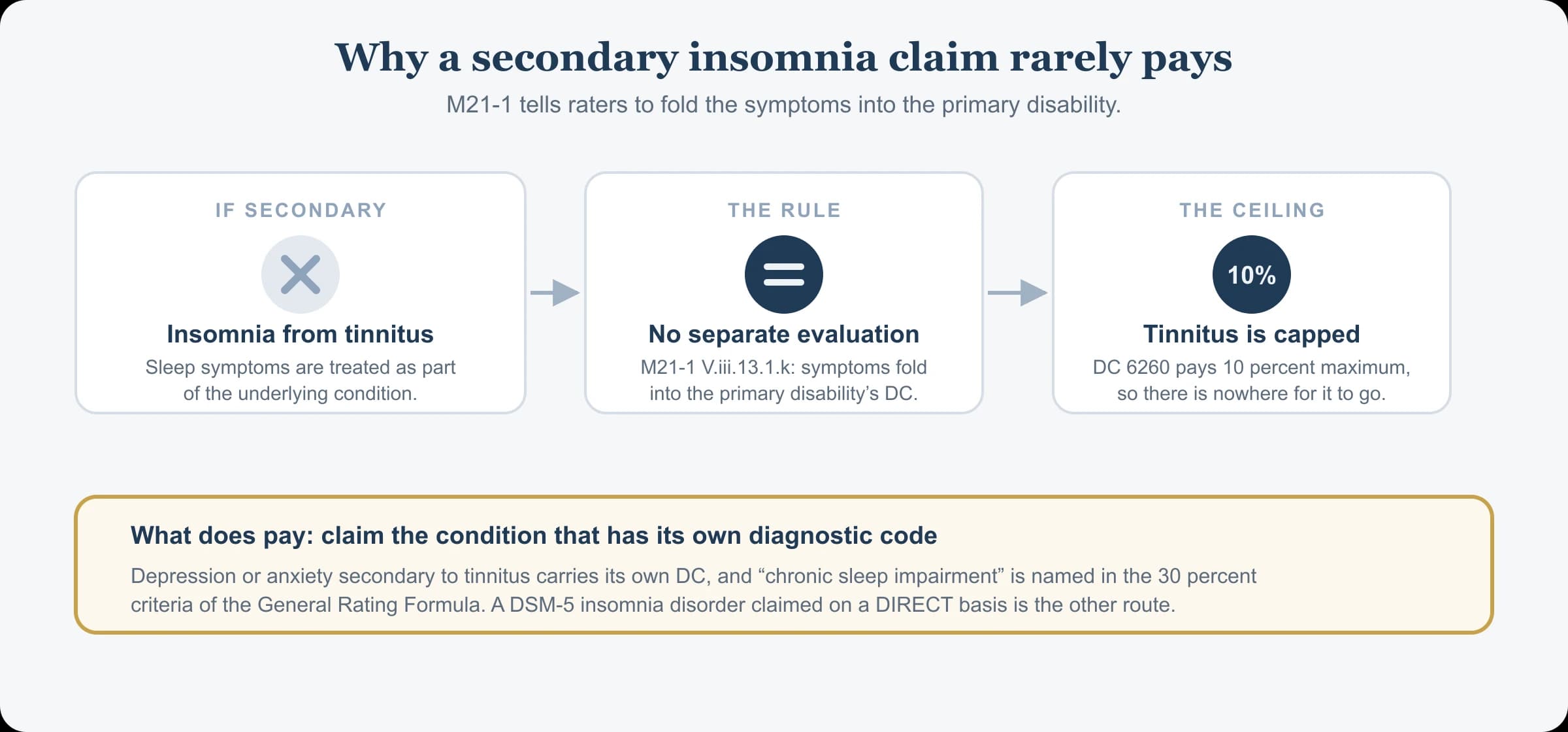
“Insomnia that is shown to be secondary to, or a symptom of, another underlying SC disability: a separate SC evaluation on a secondary basis is not warranted for insomnia. SC should be established for the underlying primary disability, if not already established, and the insomnia symptoms should be included in the evaluation assigned under the DC for the primary SC disability.”
Read that against your own claim. If the insomnia is secondary to tinnitus, the rater is instructed to fold the sleep symptoms into the evaluation for tinnitus. Tinnitus is rated under Diagnostic Code 6260 at a flat 10 percent, and 10 percent is the maximum. There is nowhere for the insomnia to go.
The manual states one exception, and it does not help here: an evaluation under a 38 CFR 4.130 diagnostic code "is not warranted when insomnia is shown to be secondary to another disability, unless the primary SC disability causing the insomnia is another mental disorder with a DSM-5 diagnosis." Tinnitus is a hearing condition, not a mental disorder, so that door stays shut.
This is why the honest answer to "what rating will I get for insomnia secondary to tinnitus" is usually: on its own, none. That is not a reason to give up. It is a reason to claim the thing that actually pays.
One important distinction before you read further. None of this stops the VA from granting service connection. It governs whether a separate percentage is assigned. Those are two different decisions, and conflating them is how veterans end up disappointed by a claim they technically won.
What to Claim Instead
M21-1 closes one door and leaves two open. Both are more likely to change your combined rating than an insomnia-secondary-to-tinnitus claim on its own.
Claim the mental health condition the tinnitus is driving
Depression and anxiety have their own diagnostic codes in 38 CFR 4.130, and either can be service-connected as secondary to tinnitus. Once one of them is rated, sleep impairment counts toward that evaluation: "chronic sleep impairment" is named directly in the 30 percent criteria of the General Rating Formula for Mental Disorders. This is usually the strongest route for a veteran whose tinnitus is wrecking their sleep and their mood together.
Claim insomnia disorder on a direct basis
M21-1 allows a separate evaluation for insomnia where there is a current DSM-5 diagnosis of insomnia disorder, an in-service event such as a diagnosis of insomnia during service, and a nexus connecting the two. In that case it is rated analogously under an appropriate 38 CFR 4.130 code. Note the catch built into the diagnosis itself: DSM-5 insomnia disorder requires ruling out other causes, so by definition it is not secondary to your tinnitus. It is a different claim with a different theory.
A DSM-5 diagnosis is required either way. 38 CFR 4.125(a) conditions a mental disorder rating on a diagnosis that conforms to DSM-5. If your records only say "trouble sleeping," the first job is a proper diagnostic evaluation, not a nexus letter.
Insomnia Is Not Sleep Apnea
These get conflated constantly, and claiming the wrong one costs months. They are different conditions on different rating schedules with different evidence requirements.
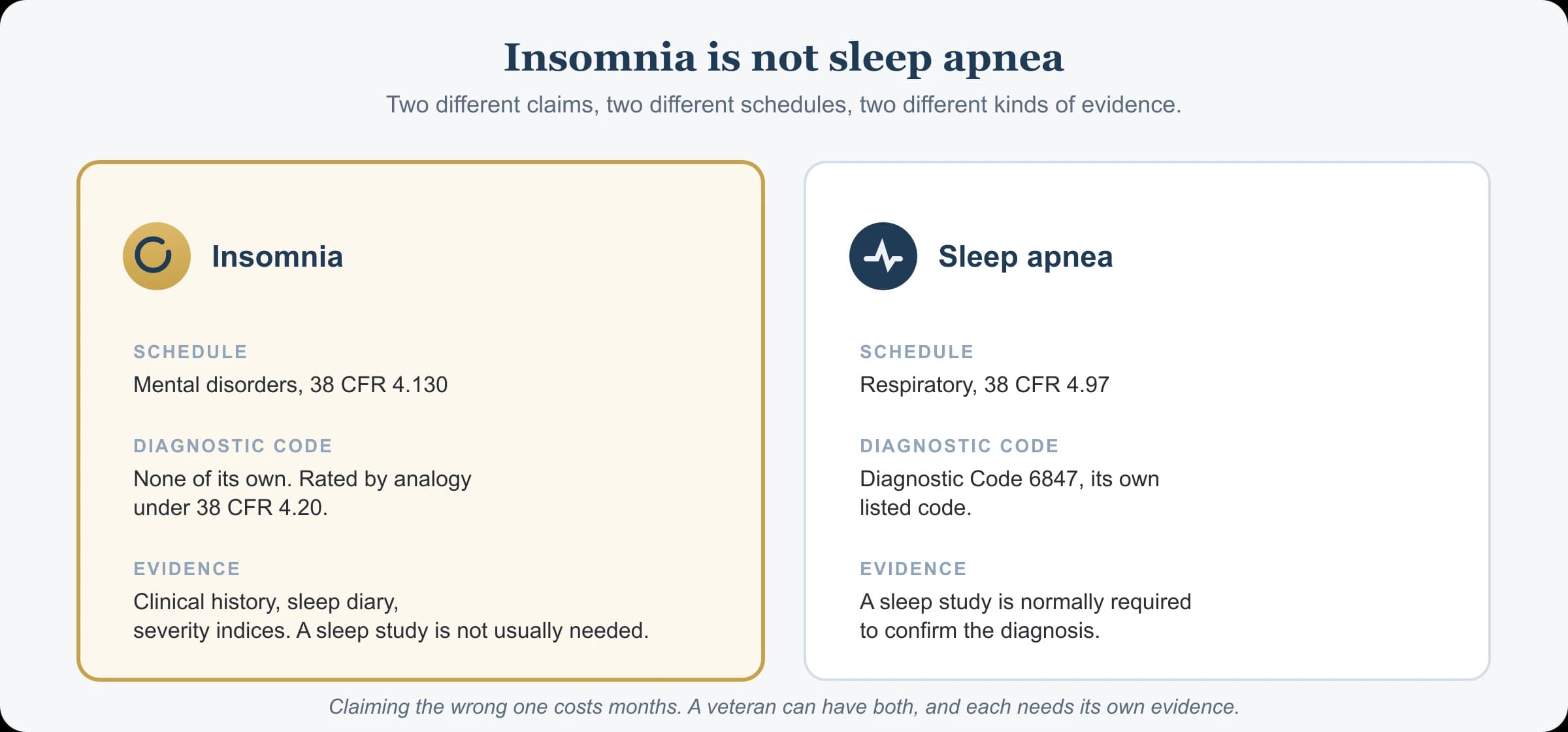
Insomnia is difficulty falling or staying asleep. It is evaluated on the mental disorders schedule, and a sleep study is not normally needed to diagnose it. Sleep apnea is a breathing disorder during sleep, rated on the respiratory schedule at 38 CFR 4.97 under Diagnostic Code 6847, and it normally does require a sleep study to confirm.
A veteran can have both, and each needs its own evidence and its own nexus reasoning. If a sleep study came back negative for apnea, that does not weaken an insomnia claim. It is simply a different question, and a good letter says so rather than leaving the rater to wonder.
The Language the VA Requires
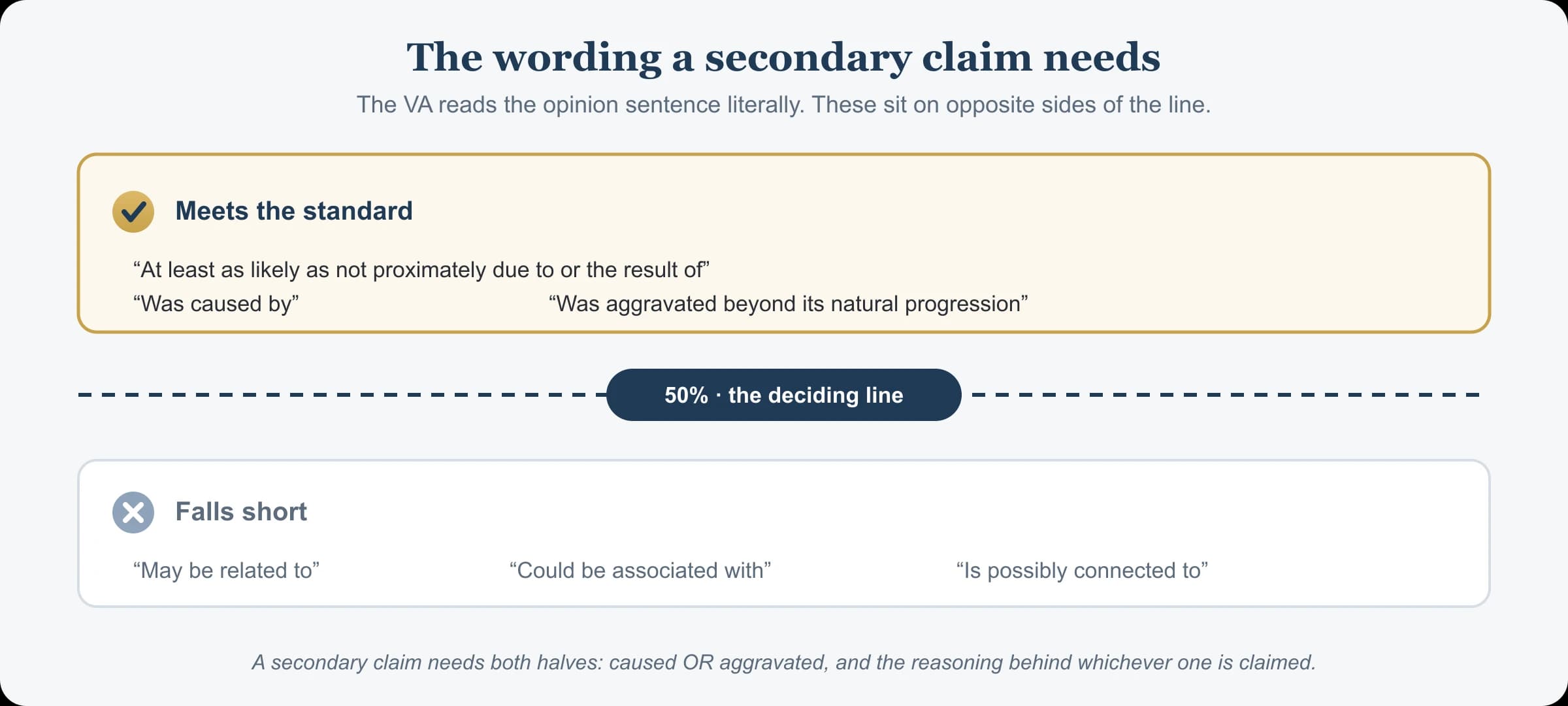
The VA reads the opinion sentence literally. "At least as likely as not" means a 50 percent or greater probability, and 50 percent is enough. Below that threshold the opinion carries little weight no matter how sympathetic the rest of the letter is.
Phrases that meet the bar
- “At least as likely as not proximately due to or the result of” The full formulation, and the safest one. It tracks the causation language in 38 CFR 3.310.
- “Was caused by” Direct causation, unambiguous.
- “Was aggravated beyond its natural progression by” The aggravation route, for insomnia that predated the tinnitus or existed independently.
Phrases that fail
- “May be related to” Speculative. This is what sank the first claim in the story above.
- “Could be associated with” States a possibility, not a probability.
- “Is possibly connected to” Reads as a guess and invites the rater to discount it.
When a Private Nexus Letter Beat the VA's Own Opinion
Board of Veterans' Appeals decisions are public, and one from March 2025 shows exactly what a well-built private opinion can do. The VA's own examiner said no. The veteran won anyway.
Citation Nr: A25022441, decided March 11, 2025
- The order
- "Entitlement to service connection for insomnia as secondary to tinnitus is granted." The finding of fact reads: "Resolving all reasonable doubt in favor of the Veteran, the Veteran's insomnia is proximately due to his service-connected tinnitus."
- The VA examiner said no
- A January 2023 VA medical opinion concluded it was "less likely than not" that the insomnia was proximately due to the tinnitus, reasoning that the treatment records and self-reports did not support a link.
- Why the Board rejected that opinion
- On three grounds. The rationale was inadequate. It "impermissibly relies on the absence of evidence as substantive negative evidence." And it "did not address the aggravation prong of secondary service connection." The Board concluded it "cannot be assigned probative weight."
- What the private opinion did differently
- It established when the sleep trouble began relative to the tinnitus, described the symptoms, and "cites and discusses supporting medical studies linking tinnitus and sleep disturbances." The Board found the application of those studies to the veteran's own account "adequate," and assigned it probative weight.
- It won without a full records review
- The Board noted the opinion "does not indicate to what extent the private medical provider reviewed the Veteran's treatment records," but held that relying on the veteran's competent lay statements about symptoms and onset was permissible. Reasoning carried it.
Three caveats, and the first is the one that matters most. The Board granted SERVICE CONNECTION. It did not assign a percentage, and this decision says nothing about whether a separate evaluation followed. Read alongside the M21-1 rule above, a grant like this can still result in the sleep symptoms being folded into the tinnitus evaluation. Second, M21-1 is VA's internal manual for the regional offices that decide claims; it does not bind the Board on appeal, which is part of why grants like this exist at all. Third, Board decisions are not precedential: each "is binding only with respect to the instant matter decided" under 38 CFR 20.1303. And note the Board did not quote the private physician using the phrase "at least as likely as not," so do not read this as the exact wording that won. What carried it was the structure: onset, symptoms, the literature, and the literature applied to this veteran.
What to Give Your Provider
A letter is only as good as the record behind it. Bring these:
Your tinnitus rating decision
Proof it is service-connected, with the effective date.
Sleep-related treatment records
Any clinician notes about sleep, sleep aids or medications tried, and referrals.
A validated severity measure if you have one
An Insomnia Severity Index or similar. It documents how bad the insomnia is, which is what the percentage turns on once service connection is granted.
A sleep diary
Two to four weeks of time to sleep, number of awakenings, and total hours. Simple, and unusually persuasive.
A personal statement
How the ringing affects your nights, and how the lost sleep affects your work and your family. Severity is rated on function.
A rough timeline
When the tinnitus started, when the sleep problems started, and how the two moved together.
Baseline records, if you are claiming aggravation
Medical evidence showing how bad the insomnia was BEFORE the tinnitus made it worse. Under 38 CFR 3.310(b) the VA will not concede aggravation without it.
How to File the Secondary Claim
- 1
File as secondary, not new
On VA Form 21-526EZ, identify the condition as insomnia secondary to service-connected tinnitus. Naming the primary condition is what routes it correctly.
- 2
Submit the nexus letter with the claim
Filing first and adding evidence later invites a decision made without it.
- 3
Include the severity evidence
The diary, the severity index, the personal statement. The link gets you service-connected; the severity sets the percentage.
- 4
Expect a C&P exam
Most secondary mental health claims get one. Nothing has gone wrong if you are scheduled.
What to Expect at the C&P Exam
The examiner will ask how long it takes you to fall asleep, how often you wake, what you have tried, and how the tiredness affects your work and relationships. Answer for your worst weeks as well as your typical ones. Veterans routinely understate this, and the rating follows what is written down.
Bring the sleep diary. An examiner with a fortnight of your actual sleep times in front of them can describe severity far more precisely than one working from a single conversation.
If the examiner's opinion comes back unfavorable or does not address the tinnitus link at all, that is not the end of the claim. A private opinion that engages the same question directly can outweigh a thin examination report.
If Your Claim Is Denied
Read the decision for the actual reason. Most denials of this claim fall into three groups: no current diagnosis, no medical opinion linking insomnia to tinnitus, or an opinion written in speculative language that fell below the threshold.
All three are fixable. A supplemental claim on VA Form 20-0995 with new and relevant evidence, usually a properly worded nexus letter, is normally the fastest route, and it preserves your effective date if it is filed within a year of the decision.
Who Should Write the Letter, and What It Costs
Any licensed provider qualified to diagnose and treat insomnia can write the opinion. What matters to the VA is whether the author reviewed the records and gave a reasoned explanation, not their job title. A clinician who treats sleep disorders and knows the VA's standard will produce a stronger letter than a busy primary care provider writing one as a favor.
Patriot Path writes physician-authored nexus letters at a flat $1,500, with a free consultation first to tell you honestly whether a letter is likely to help your claim. If your record will not support the opinion, we will say so rather than take the work.
Is Your Secondary Claim Ready?
Score your claim
0 of 7 in hand
Check each item you already have in hand. Your score updates as you go.
A few core pieces are missing. Start by confirming your tinnitus service connection and getting the insomnia formally diagnosed.
Have a clinician build the missing pieces →Frequently Asked Questions
Does the VA automatically connect insomnia to tinnitus?
No. There is no presumption linking insomnia to tinnitus, so the VA will not make the connection on your behalf. You have to prove it, and the nexus letter is the evidence that does. It states that your insomnia is at least as likely as not caused or aggravated by your service-connected tinnitus, and explains the mechanism behind that conclusion.
What VA rating can insomnia secondary to tinnitus get?
Usually none on its own, which surprises most veterans. M21-1 Part V, Subpart iii, Chapter 13, Section 1.k instructs raters that where insomnia is secondary to another service-connected disability, a separate evaluation on a secondary basis is not warranted, and the sleep symptoms are folded into the evaluation for the primary disability. Tinnitus is capped at 10 percent under Diagnostic Code 6260, so there is nowhere for the insomnia to add value. The exception is when the primary condition is itself a mental disorder with a DSM-5 diagnosis, which tinnitus is not.
Is there a diagnostic code for insomnia?
No. Insomnia does not appear in 38 CFR 4.130, the mental disorders schedule. Where a separate evaluation IS warranted, which per M21-1 means insomnia disorder established on a direct basis rather than as a secondary condition, it is rated analogously under 38 CFR 4.20 using a built-up code per 38 CFR 4.27. In practice VA uses 9499 for unlisted mental health conditions, hyphenated with the code it is rated by analogy to, though the 9499 itself is adjudication convention rather than a number the regulation spells out.
Do I need a sleep study for an insomnia claim?
Normally no. A sleep study is used to diagnose sleep apnea, which is a breathing disorder rated on the respiratory schedule under Diagnostic Code 6847. Insomnia is diagnosed from clinical history, and a negative sleep study does not weaken an insomnia claim. The two are separate conditions and a veteran can have both.
Can I claim insomnia if I already had trouble sleeping before service?
Yes, through aggravation, but with an evidentiary condition attached. Under 38 CFR 3.310(b) the VA will not concede aggravation unless the baseline severity before the aggravation began is established by medical evidence, and the rating reflects only the increase over that baseline. So the letter should say plainly that the tinnitus aggravated the insomnia beyond its natural progression and explain what changed, and you should submit the older records that show where you started.
How long does a secondary insomnia claim take?
It varies with the regional office workload and whether a C&P examination is scheduled. Submitting the nexus letter and your severity evidence with the initial claim, rather than adding them after a decision, is the single most reliable way to avoid a denial that then has to be appealed.
Who can write the nexus letter for insomnia?
Any licensed provider qualified to diagnose and treat insomnia. The VA weighs the opinion on whether the author reviewed the relevant records and gave a reasoned explanation, not on their title. A clinician familiar with the VA's evidentiary standard will generally produce a more useful letter than one writing outside their usual scope.
So is a nexus letter for insomnia secondary to tinnitus a waste of money?
Not necessarily, but you should go in with clear eyes. If your only goal is a higher combined rating, an insomnia-secondary-to-tinnitus claim on its own is unlikely to deliver it, because the sleep symptoms get folded into a tinnitus evaluation that is already at its 10 percent ceiling. If the sleep problem is part of a broader mental health picture, the better use of a nexus letter is the depression or anxiety claim, where the sleep impairment then counts toward a ratable condition. Any provider who takes your money for an insomnia-secondary claim without explaining this is not serving you well.
Does M21-1 bind the Board of Veterans' Appeals?
No. M21-1 is VA's internal adjudication manual, written for the regional offices that decide claims in the first instance. It does not bind the Board on appeal, which is why you can find Board decisions granting service connection for insomnia secondary to tinnitus. What those decisions generally do not do is assign a separate percentage, so a grant is not the same as a payment.
Will a nexus letter guarantee my claim is granted?
No, and any provider who promises that is not being straight with you. A nexus letter supplies the medical link, which is the element most secondary claims are missing, but the VA still weighs the whole record. A well-reasoned letter removes the most common reason these claims fail; it does not decide the outcome.
Give Your Secondary Claim Its Strongest Evidence
If your tinnitus is service-connected and the ringing is costing you sleep, the insomnia is very likely claimable. What decides it is whether a clinician has written the link down properly, in the VA's own language, with the reasoning attached.
Related guides
Citations & References
- 38 CFR 3.310, Secondary service connection and aggravation (eCFR)
- M21-1, Part V, Subpart iii, Chapter 13, Section 1.k, Considering SC for Insomnia (VA KnowVA)
- 38 CFR 4.125(a), Diagnosis of mental disorders, DSM-5 requirement (eCFR)
- 38 CFR 4.14, Avoidance of pyramiding (eCFR)
- 38 CFR 4.20, Analogous ratings (eCFR)
- 38 CFR 4.27, Use of diagnostic code numbers (eCFR)
- 38 CFR 4.130, Schedule of ratings, mental disorders (eCFR)
- 38 CFR 4.87, Schedule of ratings, ear, including DC 6260 tinnitus (eCFR)
- 38 CFR 4.97, Schedule of ratings, respiratory, including DC 6847 sleep apnea (eCFR)
- 38 U.S.C. 5107, Claimant responsibility and benefit of the doubt (uscode.house.gov)
- Board of Veterans' Appeals, Citation Nr: A25022441, March 11 2025 (VA.gov)
- Tinnitus and insomnia: is hyperarousal the common denominator? Sleep Medicine Reviews (PubMed)
- Effect of tinnitus on sleep quality and insomnia, International Archives of Otorhinolaryngology (PubMed)
- Insomnia associated with tinnitus and gender differences (PubMed)
- Tinnitus: at a crossroad between phantom perception and sleep, Brain Communications (PubMed)
- Relationship between chronicity and severity of tinnitus and sleep-related issues (PubMed)
- VA disability compensation, how to file (VA.gov)
- VA Form 21-526EZ, application for disability compensation (VA.gov)
- VA Form 20-0995, supplemental claim (VA.gov)
This guide is general information about VA disability claims, not medical advice or a promise of any claim outcome. Every claim is decided on its own record. Speak with a licensed clinician about your own condition.