
VA Secondary Claims
Nexus Letter for Anxiety Secondary to Tinnitus
Medically reviewed by the Patriot Path Medical Team
Licensed MD reviewers • Last updated: July 2026
A nexus letter is the medical opinion that ties your anxiety disorder to your service-connected tinnitus. The VA does not presume the link, so the claim usually turns on this one document. It states that your anxiety is at least as likely as not caused or aggravated by your tinnitus, and it explains the medicine behind that conclusion. The Board of Veterans' Appeals has granted exactly this claim on the strength of a private clinician's opinion, and this guide walks through what that opinion has to say.
An illustrative example
Dale left the artillery with a 10 percent rating for tinnitus and told himself the ringing was just part of the job. But a sound that never stops is hard to ignore. He caught himself on edge all day, dreading quiet rooms where the ringing owned everything, and leaving restaurants because he could not follow a conversation through the noise.
For years he called it stress. When a psychologist finally named it, generalized anxiety disorder, Dale filed a VA claim and was denied. His tinnitus was service-connected and his diagnosis was in the record, but nothing in the file explained why one led to the other.
A clinician then wrote a nexus letter that walked through the connection, a brain kept on constant alert by a sound it cannot switch off, and cited the research behind it. On the supplemental claim, the VA connected the anxiety to his tinnitus and rated it on its own diagnostic code.
A composite example for illustration, not a real client. Outcomes depend on your own facts and evidence.
What Anxiety Secondary to Tinnitus Means
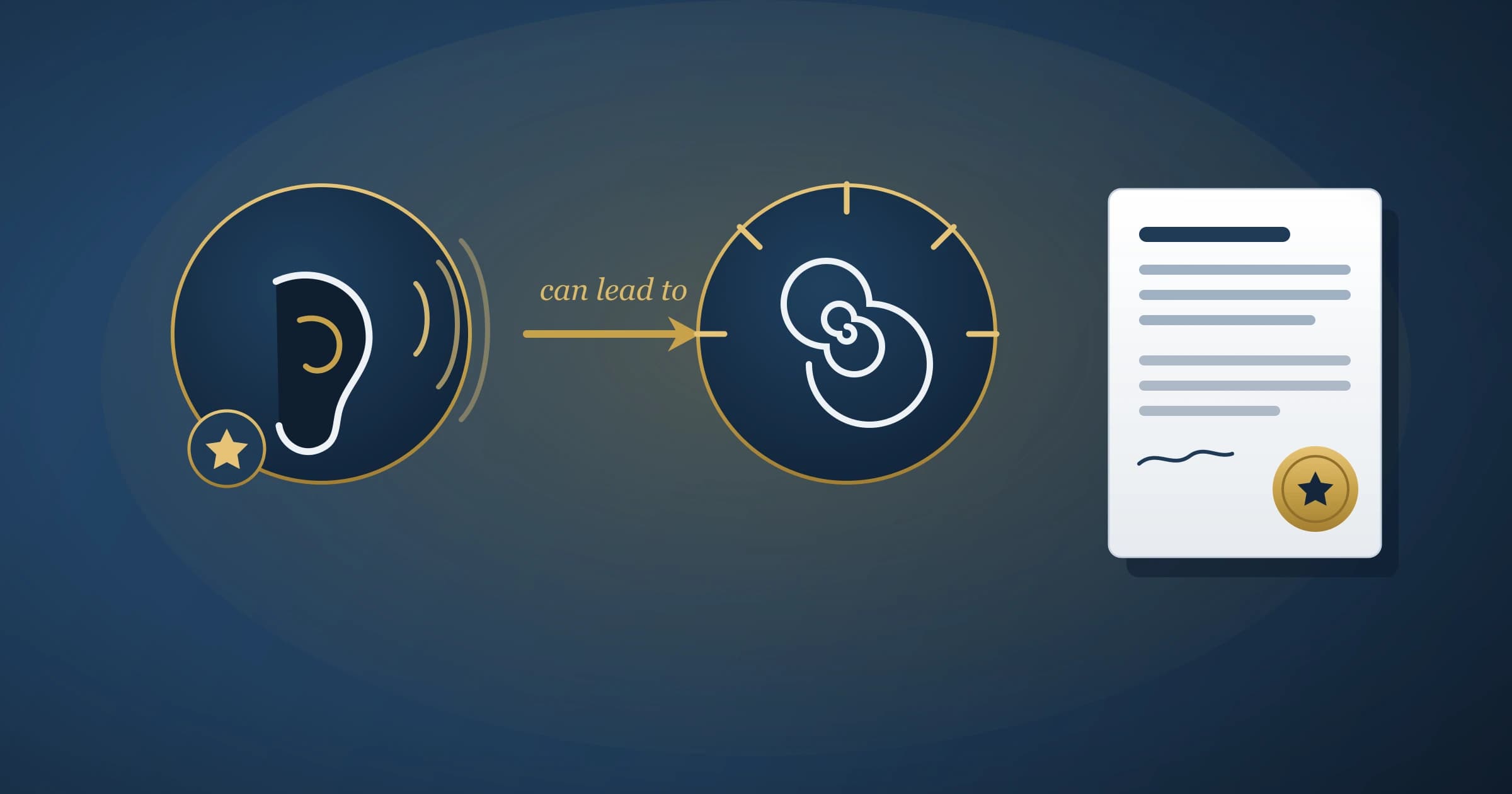
Nothing about anxiety looks like a combat injury, which is why so many veterans never think to claim it. Service connection does not have to run in a straight line from an in-service event, though. Under 38 C.F.R. 3.310, a disability the VA has already service-connected can itself become the cause of a new one, and the new condition is then service-connected in its own right. Your tinnitus is the qualifying injury; the anxiety is what it did to you afterward.
Anxiety secondary to tinnitus fits this exactly. Your tinnitus is already service-connected. The anxiety came later. You are asking the VA to accept that the tinnitus caused the anxiety disorder, or made one you already had worse. Aggravation counts too, under 3.310(b), though it comes with its own evidence rules this guide covers below.
What the VA will not do is join those dots for you. There is no presumption that a veteran with service-connected tinnitus who later develops anxiety got one from the other, and a rater looking at a file that simply contains both diagnoses has no basis to connect them. Somebody qualified has to say, on the record, that the tinnitus is what drove the anxiety, and explain why. That document is the nexus letter.
The claim rests on your service-connected tinnitus, so that rating needs to be settled first.
New to these documents? Start with our primer on what a nexus letter is.
How Tinnitus Can Lead to Anxiety
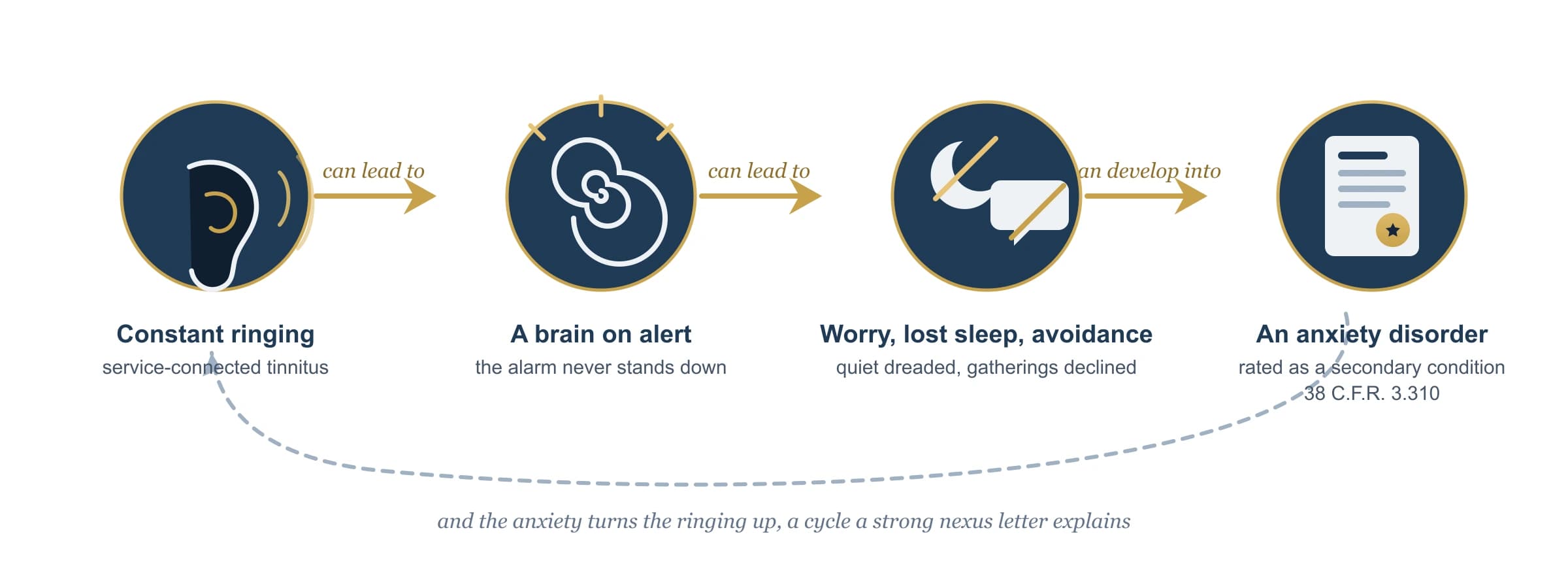
Tinnitus does not just annoy. It is a signal the brain reads as a problem it can never resolve, and a nervous system that never stands down wears into a disorder. The pathway is well documented, and a strong nexus letter names each step of it.
A brain stuck on alert
Your auditory system flags the ringing as something to monitor, the way it would any persistent sound that might matter. But this sound never resolves and never stops, so the alarm never fully shuts off. Clinicians call the result hyperarousal: a baseline of vigilance, muscle tension, and unease that veterans describe as being on edge for no visible reason.
The cycle that feeds itself
Anxiety and tinnitus form a loop. Stress and worry turn attention toward the ringing and make it register louder, and the louder it registers, the more anxious you become. Veterans often notice the sound is at its worst during exactly the periods when everything else is hardest. A careful nexus letter describes this cycle honestly, and anchors the direction of the claim in the timeline: the tinnitus came first, and the anxiety followed it.
Social strain and withdrawal
Following a conversation through constant ringing takes real effort, and many veterans start declining the situations that demand it: restaurants, gatherings, phone calls. Others startle easily or dread quiet rooms where the sound has no competition. The shrinking of ordinary life that follows is fertile ground for an anxiety disorder, and it is usually what family members notice first.
A documented pattern, with numbers
In a national survey of US adults, 26.1 percent of people with tinnitus reported an anxiety problem in the prior year, against 9.2 percent of people without it, and those whose tinnitus was a big or very big problem had almost six times the odds of anxiety symptoms. The veteran data tracks severity closely: in a VA population-based survey of veterans diagnosed with tinnitus, those with severe tinnitus were more than twice as likely to screen positive for anxiety as veterans with none or mild tinnitus, and those with very severe tinnitus were over thirteen times as likely. A separate population-based cohort study of more than 8,500 adults found the same association between tinnitus and anxiety. Note what this evidence is and is not: these are association studies, not proof of causation in any one veteran. That is exactly the gap a nexus letter fills, by applying the pattern to your specific history.
For a nexus letter, this matters because the VA weighs opinions that explain the mechanism far more heavily than a bare assertion. A clinician who can name the pathway, from a sound that never stops to a nervous system that never stands down, and cite the literature writes a letter an examiner cannot easily wave away.
The same ringing drives other claims. See our guides to depression secondary to tinnitus and migraines secondary to tinnitus.
What Winning Looks Like: A Real Board Decision
In January 2022, the Board of Veterans' Appeals granted service connection for generalized anxiety disorder secondary to tinnitus for a Navy veteran who had served on a destroyer in the late 1960s, assigned to the forward gun mount and exposed to repeated blasts from a 5-inch gun. The decision, citation number 22001709, is worth reading because the evidence that won it is exactly what this page describes.
A private opinion carried the claim
The decisive evidence was a private examination and opinion from a PhD licensed clinical psychologist, submitted after the hearing. No VA examination filled that role. The Board walked through the private opinion's reasoning and granted on it.
The letter explained the mechanism
The psychologist did not just assert a link. The opinion described how decades of constant, loud ringing left the veteran unable to communicate at work and in social settings, overwhelmed by noise, startling easily, unable to sleep or concentrate or find relief in quiet, and how anxiety developed out of that.
It cited the medical literature
The Board specifically noted that the psychologist pointed to research associating tinnitus with sleep disorders, slowed processing, reduced speech discrimination, and a higher incidence of anxiety and depression. Literature support is part of what makes an opinion hard to dismiss.
The veteran had first blamed the wrong condition
The veteran originally testified that his anxiety came from his back disability. It took a careful private evaluation to identify the tinnitus as the actual driver. If a clinician has not looked at your whole picture, the true cause of your anxiety may not be the condition you assume.
One honest caution: Board decisions are not precedent. Under 38 C.F.R. 20.1303, each case binds only itself, so this grant does not guarantee yours. What it shows is the kind of evidence the Board found persuasive on the same claim, from a similar starting point: a service-connected tinnitus rating and a well-reasoned private opinion.
Can You Get VA Disability for Anxiety Secondary to Tinnitus?
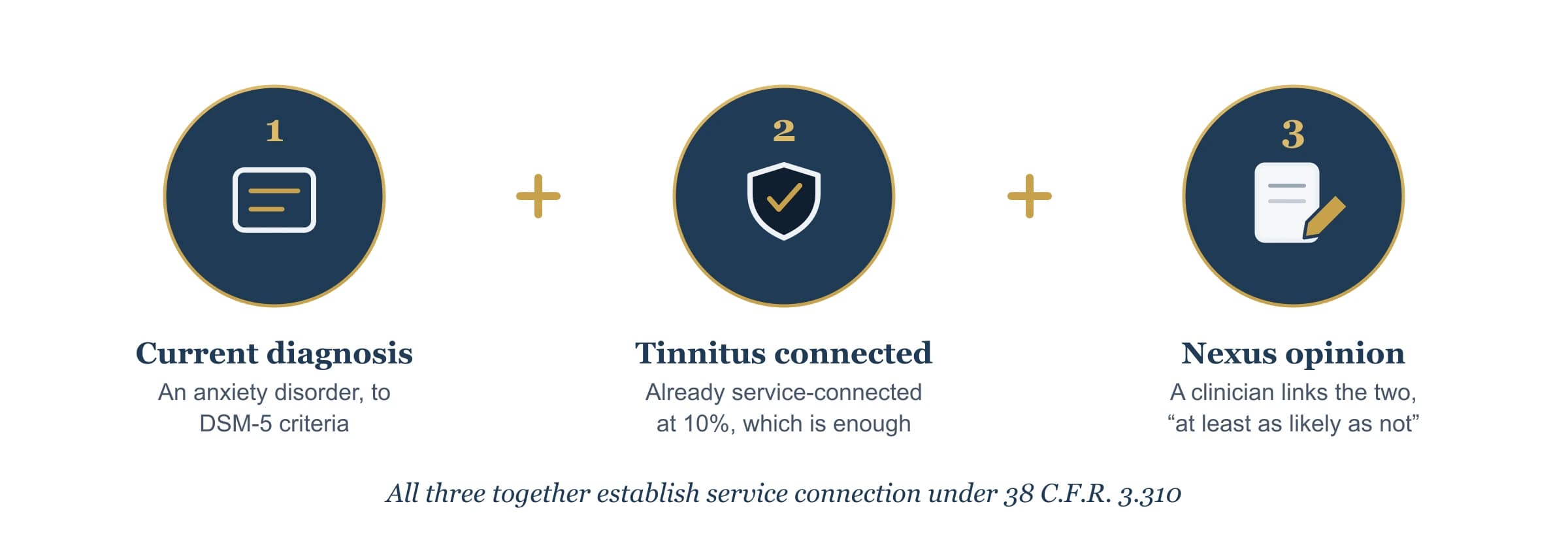
Yes. Anxiety has its own diagnostic codes in the VA rating schedule, and if anxiety would be your first rated mental health condition, a secondary grant rates it as its own condition. If you are already rated for PTSD, depression, or another mental disorder, the grant usually folds into that single mental health evaluation instead, which the section below covers honestly. Either way, three things have to be in place. A nexus letter supplies the third and ties the first two together.
- 1
A current anxiety disorder diagnosis
A diagnosis from a qualified clinician made to DSM-5 criteria, which 38 C.F.R. 4.125 requires for VA rating purposes. Generalized anxiety disorder is the most common, but the schedule also covers panic disorder, social anxiety disorder, and unspecified anxiety disorder.
- 2
Tinnitus already service-connected
Your tinnitus needs an existing service connection and rating. The secondary claim builds on it, so this has to be settled first. The 10 percent tinnitus rating is enough; the anchor does not need to be rated higher.
- 3
A medical nexus opinion
A qualified opinion that your anxiety disorder is at least as likely as not caused or aggravated by your tinnitus. This is the nexus letter.
The Language the VA Requires
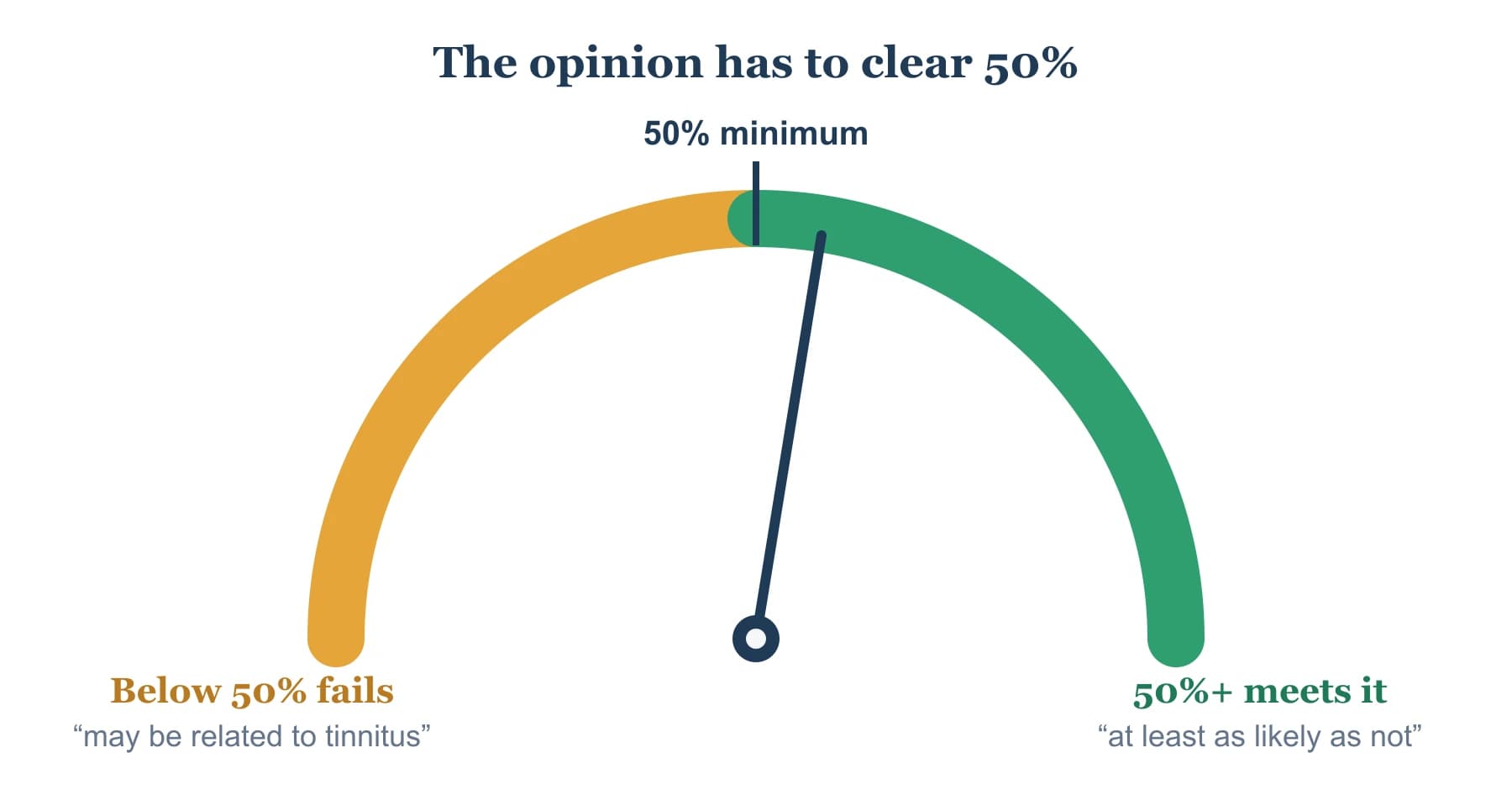
The VA reads a nexus letter closely, and small differences in wording change how much weight it carries. A strong letter names the records reviewed, states your current anxiety diagnosis to DSM-5 criteria, confirms your service-connected tinnitus, explains how the ringing drove the anxiety, cites supporting research, and closes with the opinion in the exact probability language the VA requires. That standard comes from the benefit-of-the-doubt rule in 38 U.S.C. 5107(b): when the evidence is roughly balanced, the tie goes to the veteran.
Language that meets the bar
- “At least as likely as not caused or aggravated by the veteran's service-connected tinnitus” Meets the 50 percent threshold and names the secondary path. The standard to aim for.
- “More likely than not a result of the veteran's tinnitus” Exceeds 50 percent; stronger than the minimum.
Language that fails
- “May be related to the veteran's tinnitus” A possibility, not a probability. Below the standard.
- “The veteran's anxiety could be stress-related” Vague on both probability and cause, and it hands the examiner an alternative explanation.
One more thing a careful letter handles: direction. Because anxiety can also amplify how loud tinnitus feels, a C&P examiner may suggest the arrow points the other way. A strong opinion closes that door with the timeline, tinnitus first, anxiety after, and with the mechanism evidence above.
Do not overlook aggravation
If you had some anxiety before but the tinnitus made it worse, the letter should say so directly and document your baseline. 38 C.F.R. 3.310(b) sets three conditions. The increase has to be proximately due to the tinnitus and not due to the natural progress of the anxiety disorder. The VA will not concede aggravation at all unless your baseline level of severity is established by medical evidence created before the aggravation began, or by the earliest evidence available after it. And the rating reflects only the increase: the VA deducts both your baseline and any worsening attributable to natural progression. A letter that pins down the baseline, and says plainly why the change exceeds natural progression, can win a claim that would otherwise fail at exactly this step.
Who This Claim Pays, and Who It Does Not
We would rather tell you this before you spend money than after. An anxiety secondary to tinnitus claim is one of the strongest ways a 10 percent tinnitus rating grows, but the VA's mental health rating rules decide who actually sees a new percentage.
It pays when anxiety would be your first rated mental health condition
A granted claim gives your anxiety disorder its own diagnostic code under 38 C.F.R. 4.130, rated 0 to 100 percent on the General Rating Formula for Mental Disorders. That rating is combined with your separate 10 percent tinnitus rating. This is where the claim genuinely moves a combined rating.
It usually does not stack on another mental health rating
In practice the VA usually rates all of your mental health as one evaluation. If you are already service-connected for PTSD, depression, or another mental disorder, a new anxiety diagnosis is normally folded into that single rating rather than added on top, because 38 C.F.R. 4.14 bars evaluating the same manifestation under different diagnoses. There is a narrow exception: under Amberman v. Shinseki, two diagnosed mental conditions that produce genuinely distinct symptoms should not be automatically merged into one rating. That turns on the specific symptomatology in your records, not on the number of diagnoses, so treat a second percentage as the exception rather than the expectation. Documented worsening can still support a higher single evaluation.
There is one more rule worth knowing, because it works in your favor here. Sleep loss on its own, claimed as insomnia secondary to tinnitus, rarely adds a percentage: VA's adjudication manual folds those symptoms into the tinnitus rating, which is already capped at 10 percent. Inside an anxiety rating the same symptoms finally count, because chronic sleep impairment is named in the 30 percent criteria of the General Rating Formula. If the ringing has taken your sleep and put you on edge, the anxiety claim is usually where that evidence pays.
If your symptoms lean toward low mood rather than worry, the parallel claim is depression secondary to tinnitus. If sleep is the only symptom, read our honest guide to insomnia secondary to tinnitus before you file. Claim the condition a clinician actually diagnoses, not the label you think rates best.
What VA Rating Can You Get for Anxiety Secondary to Tinnitus?
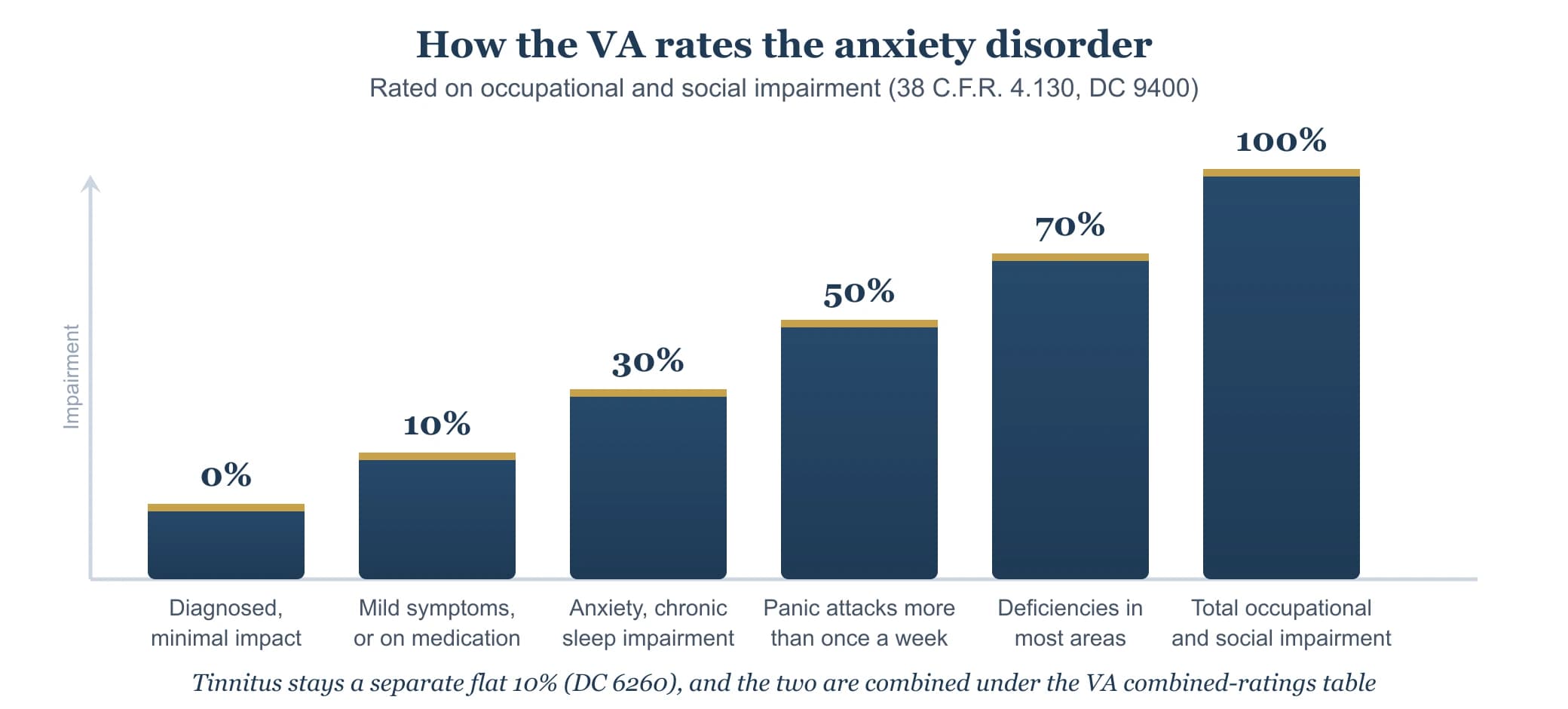
Once the anxiety disorder is service-connected, the VA rates it under 38 C.F.R. 4.130, the General Rating Formula for Mental Disorders, at 0, 10, 30, 50, 70, or 100 percent. Generalized anxiety disorder is Diagnostic Code 9400; unspecified anxiety disorder is 9413. The level turns on how far the condition impairs your work and social life. The 30 percent criteria name the symptoms tinnitus most often drives, including anxiety itself and chronic sleep impairment; the 50 percent level includes panic attacks more than once a week. Because the anxiety is evaluated on its own severity rather than on the size of the tinnitus rating, it can be assigned anywhere on that scale, including 0 or 10 percent where the diagnosis is documented but symptoms are mild or controlled by medication. What the level turns on is your documented occupational and social impairment, not the fact of the grant.
How it adds to your combined rating
Two points matter for your combined rating. First, tinnitus stays a separate flat 10 percent under 38 C.F.R. 4.87, Diagnostic Code 6260, and the anxiety rating is combined with it under the VA combined-ratings table rather than replacing it (the VA combines percentages with that table, not simple addition). Second, being in treatment does not disqualify you from service connection, and you should never skip care to protect a claim. Be precise at the exam, though. Unlike most diagnostic codes, the General Rating Formula names medication in its own criteria: the 10 percent level is "symptoms controlled by continuous medication." That means the VA evaluates your actual, treated presentation rather than estimating how you would be without treatment. Describe your symptoms as they really are, including your worst days, and let your treatment records show what the medication is holding back. A veteran who is medicated and still impaired is rated on that remaining impairment, wherever it falls on the scale.
For the full rating breakdown and the evidence behind each level, see our guide to anxiety and VA disability.
What to Give Your Provider
The Board decision above turned on a clinician who had enough of the veteran's history to describe the mechanism in detail. That is the standard to aim for, and it starts with what you hand over. Bring these so your provider can write from evidence rather than assumption.
The core file
- Your tinnitus service-connection decisionThe VA letter or rating showing tinnitus is service-connected, with the effective date.
- A current anxiety diagnosisProvider notes or a mental health evaluation naming the diagnosis to DSM-5 criteria.
- Mental health treatment recordsTherapy notes, medications, and any screenings, which show the history and severity.
What strengthens it
- A personal statementIn your own words: the vigilance, the dread of quiet, the situations you now avoid, and how the ringing runs through all of it.
- A timelineRoughly when your tinnitus began and when the anxiety symptoms followed, so the clinician can anchor the direction of the claim.
- Lay statementsShort notes from family or coworkers about the changes they have seen in you.
How to File the Secondary Claim
You file anxiety secondary to tinnitus like any disability claim, but you present it as a secondary condition and lead with the nexus letter.
- 1File VA Form 21-526EZThe Application for Disability Compensation. Name the anxiety disorder as secondary to your service-connected tinnitus so the VA reviews it on that theory.
- 2Attach the nexus letterThe physician or psychologist opinion tying the anxiety to the tinnitus in the language above. This is the centerpiece of the claim.
- 3Include your supporting evidenceYour diagnosis and treatment records, your personal statement, and any lay statements from people who know you.
- 4Submit and track itFile at VA.gov, by mail, or through a VSO. Keep a copy of the nexus letter itself: if the claim is denied and you go to a Supplemental Claim, you will need to show what the examiner had in front of them.
A Veterans Service Officer can file this with you at no cost, and on a secondary mental health claim their real value is procedural: naming the theory correctly on the form so the VA adjudicates anxiety as secondary to tinnitus rather than opening a fresh direct-service-connection claim that your evidence was never built to support. What a VSO cannot do is supply the medical opinion. That still has to come from a clinician.
What to Expect at the C&P Exam
The VA will usually schedule a Compensation and Pension exam to evaluate the anxiety. A VA examiner or contractor works through the Mental Disorders Disability Benefits Questionnaire (VA Form 21-0960P-2), asking about your symptoms, your history, and how the condition affects your work and relationships, and then offers an opinion on severity and cause.
Two things carry this exam. First, be honest and specific, and describe your worst days, not just your average ones: the constant edge, the panic in noisy rooms, the sleep the ringing takes. Anxiety pushes many veterans to minimize, and a polished front on exam day reads as mild symptoms in the report. Second, expect the examiner to probe other explanations, including whether the anxiety came first. A consistent account that matches your records and your nexus letter is what closes those doors.
If Your Claim Is Denied
Secondary mental health claims are often denied the first time, usually because the medical evidence did not clearly connect the two conditions or the C&P examiner disagreed. A denial is not the end of the claim. The Board decision above was itself won on evidence added after the initial record fell short.
Start with the exam report rather than the decision letter, because the examiner's rationale is usually where the claim actually died. Two reasons show up again and again on this particular claim: the examiner treated the anxiety as unrelated life stress, or argued the causation runs backward, from anxiety to perceived tinnitus. Both are answerable. A second opinion that names the mechanism, fixes the timeline with tinnitus first, and cites the literature addresses the examiner's reasoning directly instead of simply repeating the original assertion. That is what you attach to a Supplemental Claim on VA Form 20-0995.
We break down the most common reasons these claims fail, and how to fix each one, in our guide to why the VA denies nexus letters.
Who Should Write the Letter, and What It Costs
Any licensed clinician can write a nexus letter, but for a mental health condition the VA gives the most weight to opinions from psychiatrists and psychologists, providers who diagnose and treat anxiety disorders for a living. The Board decision above turned on exactly that: a licensed clinical psychologist who examined the veteran, explained the mechanism, and cited the literature. What sets a strong letter apart is not just the credential; it is a clinician who reviews your records and states the opinion in the language the VA requires.
Patriot Path's physicians and psychologists write letters built for this exact claim: records reviewed, the tinnitus-to-anxiety connection, supporting research, and the opinion in the language the VA expects. One flat fee of $1,500, and the first consultation is free.
Not sure who qualifies? See our breakdown of who can write a nexus letter, and how the whole process works in our nexus letter process.
See our flat, upfront nexus letter pricing and what is included.
Is Your Secondary Claim Ready?
Score your claim
0 of 6 in hand
Check each item you already have in hand. Your score updates as you go.
A few core pieces are missing. Start by confirming your tinnitus service connection and getting the anxiety diagnosed.
Have a clinician build the missing pieces →Give Your Secondary Claim Its Strongest Evidence
Your tinnitus and your anxiety are both on the record. Let our clinicians write the nexus letter that explains to the VA how one led to the other.
Frequently Asked Questions
Does the VA automatically connect anxiety to tinnitus?
No. There is no presumption that links anxiety to tinnitus, so the VA will not make the connection for you. You have to prove it, and the nexus letter is the piece of evidence that does. It states that your anxiety disorder is at least as likely as not caused or aggravated by your service-connected tinnitus, and explains the medicine behind that conclusion.
Can tinnitus really cause anxiety?
The connection is well documented. A sound that never stops keeps the nervous system on alert, disrupts sleep, and pushes many veterans out of social situations, and each of those feeds an anxiety disorder. In a national survey, 26.1 percent of adults with tinnitus reported an anxiety problem in the prior year versus 9.2 percent without it, and a VA survey found veterans with very severe tinnitus were over thirteen times as likely to screen positive for anxiety as veterans with none or mild tinnitus. That research shows an association across populations, not proof about any one veteran, which is why a nexus letter has to apply the evidence to your specific history.
What VA rating can I get for anxiety secondary to tinnitus?
The VA rates a granted anxiety disorder under the General Rating Formula for Mental Disorders (38 C.F.R. 4.130) at 0, 10, 30, 50, 70, or 100 percent, based on occupational and social impairment. Generalized anxiety disorder is Diagnostic Code 9400. Your tinnitus stays a separate flat 10 percent, and the two are combined under the VA combined-ratings table.
Can I get separate ratings for anxiety and depression secondary to tinnitus?
Generally no. The VA rates all of your mental health as a single evaluation, so if you are service-connected for more than one mental health condition, the symptoms are rated together under one diagnostic code rather than stacked; rating the same symptoms twice is barred as pyramiding under 38 C.F.R. 4.14. Claim the condition your clinician actually diagnoses. If both are present, the combined picture can still support a higher single rating.
Does my tinnitus rating need to be higher than 10 percent first?
No, and it cannot be: 10 percent is the maximum schedular rating for tinnitus under Diagnostic Code 6260. That cap is exactly why secondary claims matter. The anchor condition only needs to be service-connected; the anxiety rating is then built on its own severity, not on the size of the tinnitus rating.
Who can write the nexus letter?
Any licensed clinician can, but for a mental health condition the VA gives the most weight to psychiatrists and psychologists. In the January 2022 Board decision granting anxiety secondary to tinnitus, the winning opinion came from a PhD licensed clinical psychologist who examined the veteran, explained the mechanism, and cited supporting research. That is the model a strong letter follows.
What if I already had anxiety before the tinnitus?
You can still claim it, on an aggravation theory. Under 38 C.F.R. 3.310(b), the VA can service-connect the amount your tinnitus worsened a pre-existing condition, as long as the increase is not due to the natural progress of the anxiety disorder itself. Two conditions matter. The VA will not concede aggravation unless your baseline severity is established by medical evidence created before the aggravation began, or by the earliest evidence available after it. And the award covers only the increase, because the VA deducts your baseline and any natural progression from your current level. The nexus letter should document the baseline and explain why the worsening exceeds natural progression.
What does it cost, and how do we start?
Patriot Path charges $1,500 flat for a nexus letter, and the first consultation is free. Book a consultation and a clinician will review your situation and tell you honestly whether a letter can help your anxiety secondary to tinnitus claim, and if it cannot, we will say so.
Related guides
- Tinnitus and the VAThe flat 10% rating and the claims it anchors.
- Anxiety and VA disabilityRatings, evidence, and every connection path.
- Depression secondary to tinnitusThe sibling claim, when the ringing drives mood rather than worry.
- Insomnia secondary to tinnitusWhy sleep alone rarely pays, and where those symptoms count instead.
- Migraines secondary to tinnitusAnother secondary claim the same ringing drives.
- What a nexus letter must includeThe seven elements the VA looks for.
- Nexus letter for a secondary conditionHow secondary claims work, in general.
- Who can write a nexus letterWhich providers the VA takes seriously.
- Nexus letter exampleSee the framework on a finished letter.
- How to get a nexus letterThe full process, start to finish.
- When the VA denies a nexus letterThe common reasons, and how to fix them.
- Nexus letter vs. DBQHow the two documents differ, and when you need each.
Citations & References
- 38 CFR 3.310, Secondary service connection and aggravation (eCFR) https://www.ecfr.gov/current/title-38/section-3.310
- 38 CFR 4.130, Schedule of ratings, mental disorders, including DC 9400 and DC 9413 (eCFR) https://www.ecfr.gov/current/title-38/section-4.130
- 38 CFR 4.125, Diagnosis of mental disorders, DSM-5 requirement (eCFR) https://www.ecfr.gov/current/title-38/section-4.125
- 38 CFR 4.14, Avoidance of pyramiding (eCFR) https://www.ecfr.gov/current/title-38/section-4.14
- 38 CFR 4.87, Schedule of ratings, ear, including DC 6260 tinnitus (eCFR) https://www.ecfr.gov/current/title-38/section-4.87
- 38 U.S.C. 5107, Claimant responsibility and benefit of the doubt (uscode.house.gov) https://uscode.house.gov/view.xhtml?req=granuleid:USC-1999-title38-section5107&num=0&edition=2024
- Board of Veterans' Appeals, Citation Nr: 22001709, January 12 2022, GAD secondary to tinnitus granted (VA.gov) https://www.va.gov/vetapp22/Files1/22001709.txt
- M21-1 Adjudication Procedures Manual, Part V, Subpart iii, Chapter 13, Mental Disorders (VA KnowVA) https://www.knowva.ebenefits.va.gov/system/templates/selfservice/va_ssnew/help/customer/locale/en-US/portal/554400000001018/content/554400000180520/M21-1-Part-V-Subpart-iii-Chapter-13-Mental-Disorders
- Bhatt JM, Bhattacharyya N, Lin HW. Relationships between tinnitus and the prevalence of anxiety and depression. Laryngoscope. 2017 (PMC) https://pmc.ncbi.nlm.nih.gov/articles/PMC5812676/
- Prewitt A, et al. Mental Health Symptoms Among Veteran VA Users by Tinnitus Severity: A Population-based Survey. Mil Med. 2021 (PMC) https://pmc.ncbi.nlm.nih.gov/articles/PMC7980480/
- Hackenberg B, et al. Tinnitus and Its Relation to Depression, Anxiety, and Stress: A Population-Based Cohort Study. J Clin Med. 2023 (PMC) https://pmc.ncbi.nlm.nih.gov/articles/PMC9917824/
- VA disability compensation, how to file (VA.gov) https://www.va.gov/disability/
- VA Form 21-526EZ, application for disability compensation (VA.gov) https://www.va.gov/find-forms/about-form-21-526ez/
- VA Form 20-0995, supplemental claim (VA.gov) https://www.va.gov/find-forms/about-form-20-0995/
- VA Form 21-0960P-2, Mental Disorders Disability Benefits Questionnaire (VA.gov) https://www.va.gov/find-forms/about-form-21-0960p-2/