
VA Claims Guides
Nexus Letter vs DBQ: What Each Document Proves (and When You Need Both)
Medically reviewed by the Patriot Path Medical Team
Licensed MD reviewers • Last updated: July 2026
The short answer
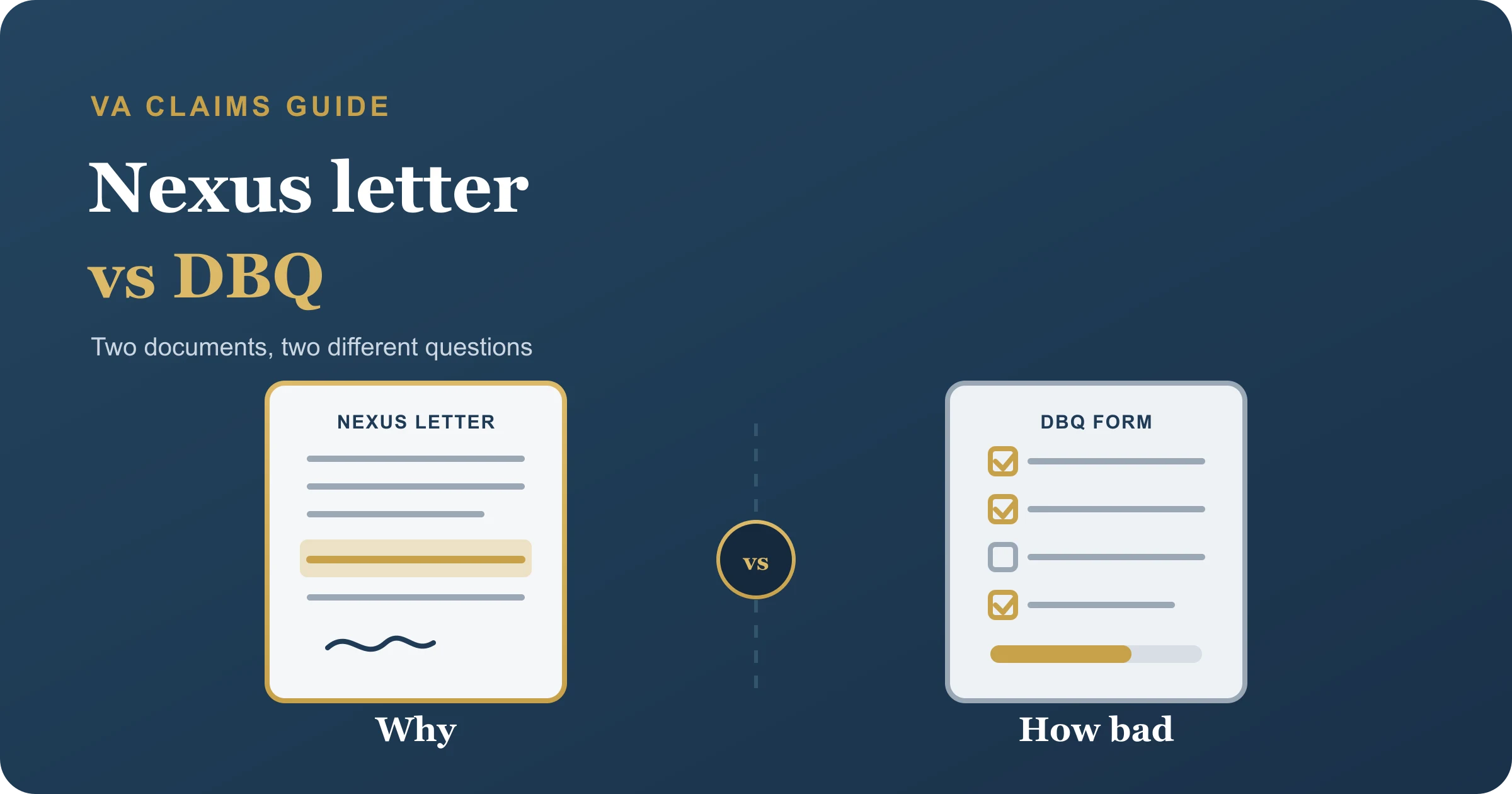
A nexus letter proves why your condition is connected to your service. A DBQ proves how severe that condition is. They answer different questions, so they are not interchangeable, and one cannot do the other's job. A DBQ full of severe findings will not service-connect a claim the VA has denied for lack of a medical link, and a flawless nexus letter will not raise a rating on its own. Many strong claims need both.
What a Nexus Letter Is
A nexus letter is a written medical opinion from a licensed clinician connecting a diagnosed condition to your military service, or to a condition the VA has already service-connected. Nexus is simply the Latin word for connection, and that connection is the letter's entire job.
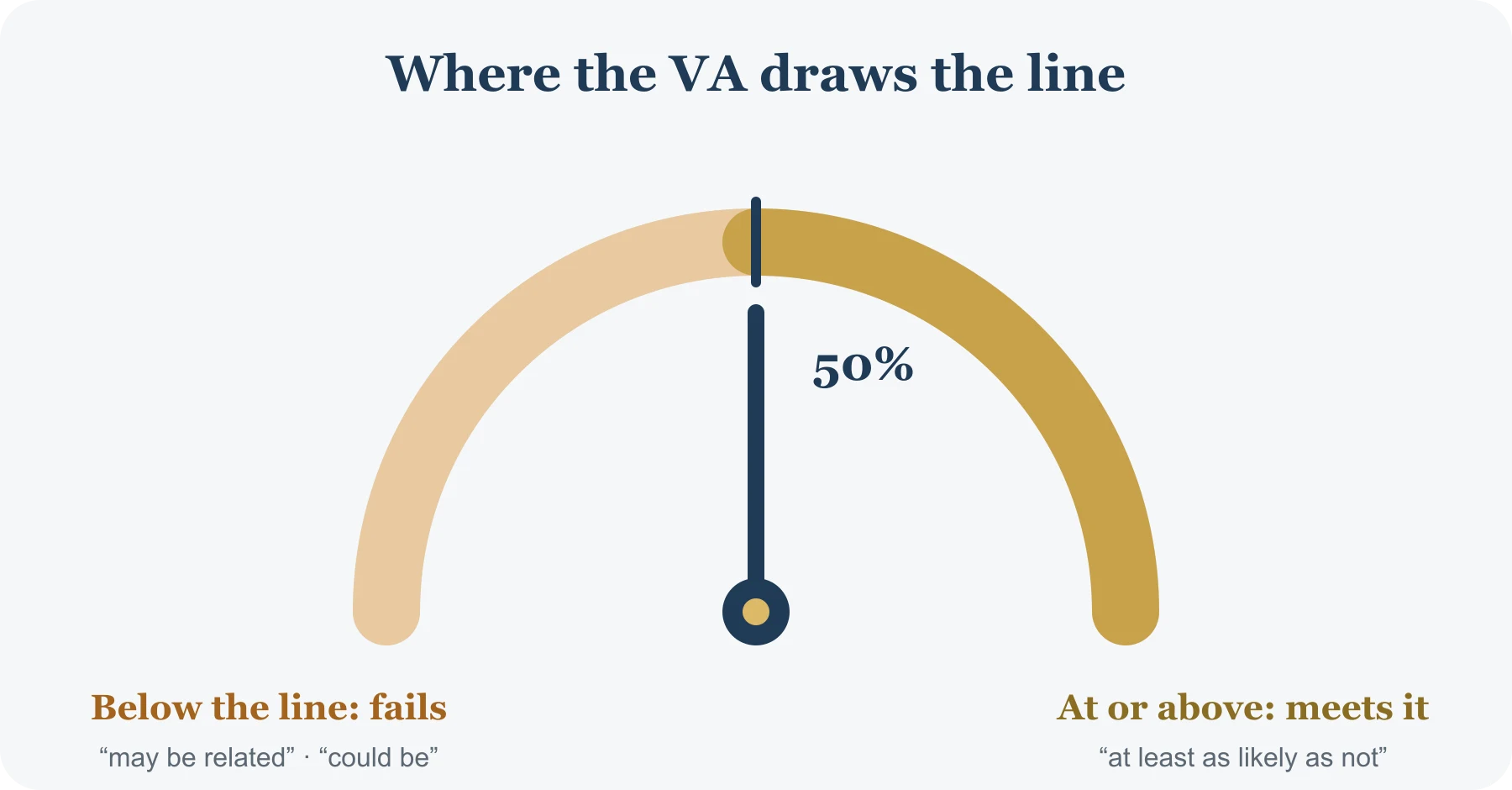
It is private evidence you obtain, not a VA form. There is no template the VA publishes and no box to tick. What gives a nexus letter weight is its reasoning: the records the physician reviewed, the medical explanation of how service produced the condition, and an opinion stated at the VA's probability threshold, that the condition is at least as likely as not related to service. That standard, a 50 percent or better probability, comes from the benefit-of-the-doubt rule in 38 U.S.C. 5107(b), carried out in 38 C.F.R. 3.102.
Service connection itself is governed by 38 C.F.R. 3.303, which the VA applies through a three-element test: a current diagnosis, an in-service event or exposure, and a medical link between them. The nexus letter supplies that third element, which is the one veterans' records almost never contain on their own.
New to the document? Start with our primer on what a nexus letter is, and see the full element list in our guide to nexus letter requirements.
What a DBQ Is
A DBQ, or Disability Benefits Questionnaire, is a standardized VA form. Each one covers a specific body system or condition, and it walks a clinician through the exact findings the rating schedule needs: measurements, test results, symptom frequency, and functional limits. The VA publishes them publicly, so you can see in advance precisely what your condition's form asks.
The purpose is rating, not causation. A DBQ translates your condition into the vocabulary the rating criteria use, so an adjudicator can match your findings to a percentage. It is a severity instrument.
DBQs reach the VA two ways. A VA or contract examiner completes one during a compensation and pension examination, or a private clinician completes one and you submit it as evidence. A privately completed DBQ is legitimate evidence the VA must consider, but it carries the same limit as the VA's own: it documents how bad the condition is, not why it exists.
The VA publishes the current forms by condition on its public DBQ page, which is the authoritative place to confirm which form applies to you. See the VA’s public DBQ list.
Nexus Letter vs DBQ, Side by Side
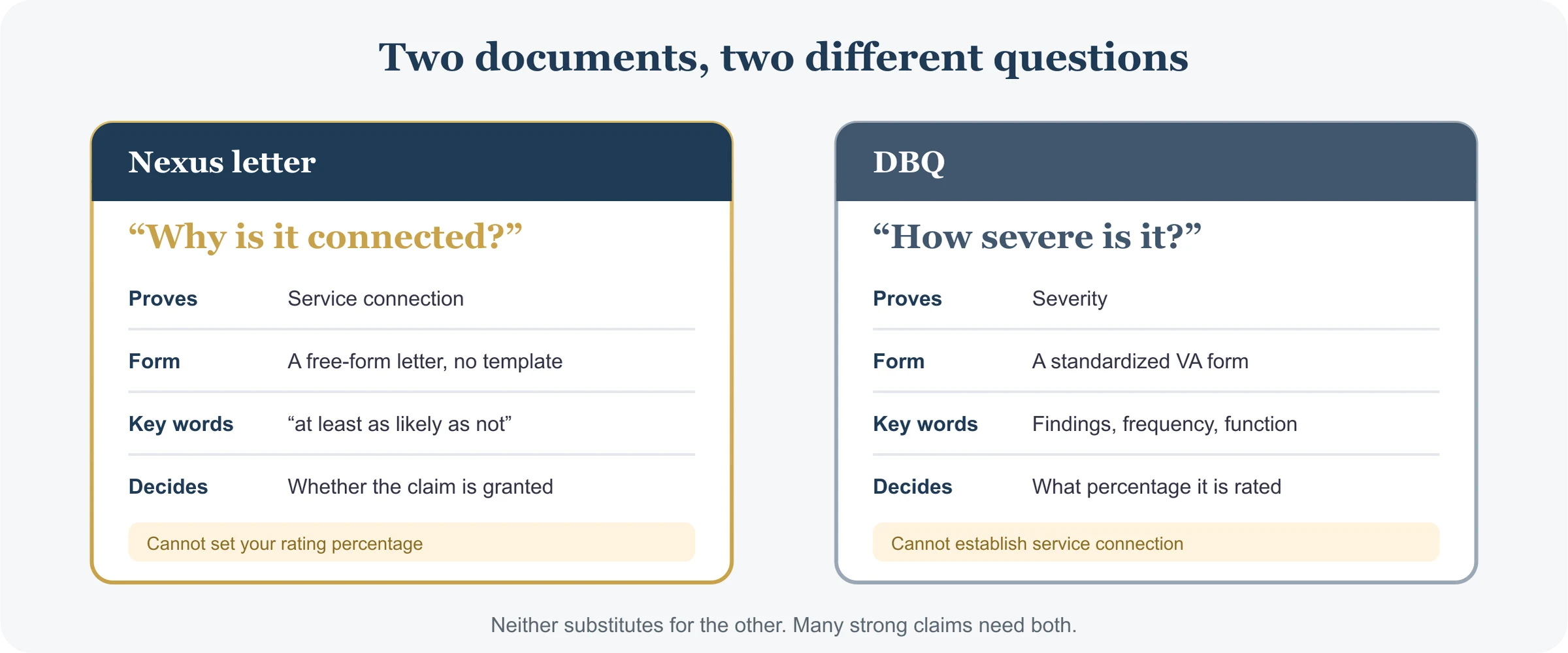
The cleanest way to hold the difference is to ask what question each document answers. Everything else follows from that.
| Nexus letter | DBQ | |
|---|---|---|
| Question it answers | Why is this condition connected to service? | How severe is this condition right now? |
| What it proves | Service connection, through a causation opinion | Severity, through standardized clinical findings |
| Form | A free-form letter, no VA template | A standardized VA form, one per condition |
| Who produces it | Any licensed clinician qualified for the condition | A VA or contract examiner, or a private clinician |
| Key language | At least as likely as not, a 50 percent or better probability | Measurements, findings, frequency, and functional limits |
| What it decides | Whether the claim is granted at all | What percentage the granted claim is rated |
| When it helps | The VA disputes or has denied the link to service | Service connection is settled and the rating is the issue |
| What it cannot do | It does not set your rating percentage | It does not establish service connection |
Read the last row twice, because it is where most claims go wrong. Neither document is a substitute for the other, and submitting the wrong one for your actual problem is a common and expensive mistake.
Where the C&P Exam Fits
Most comparisons stop at two documents, which leaves out the piece of evidence that is often decisive. The compensation and pension examination, the C&P exam, is the VA's own examination of you, and it can produce both kinds of information at once.
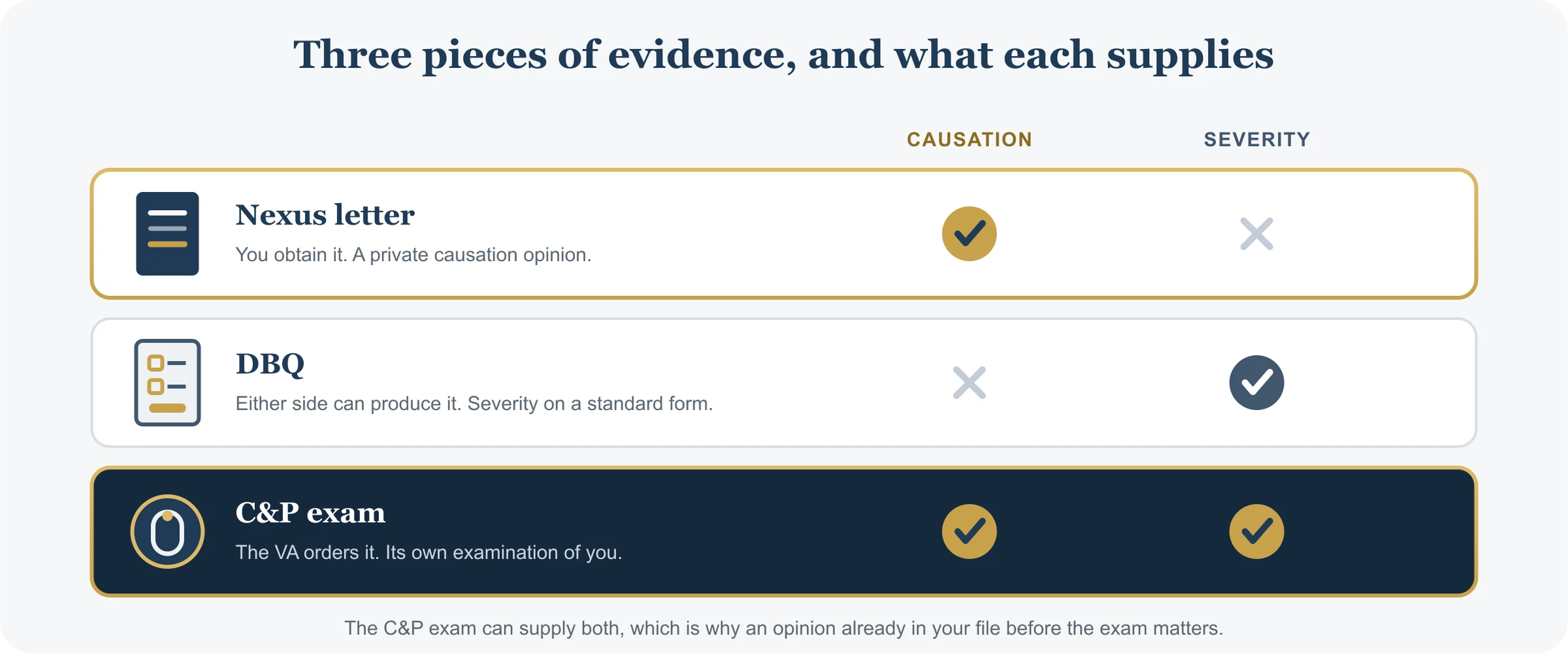
The VA orders a C&P exam when it decides an examination is necessary to decide your claim, a standard set out in 38 C.F.R. 3.159(c)(4), while 38 C.F.R. 3.326 governs those examinations. The exam is conducted by a VA clinician or a contracted examiner. The examiner frequently completes a DBQ during the exam, and when the VA has asked for one, the examiner also renders a medical opinion on causation.
That is why the C&P exam matters so much: it can generate the severity findings AND the nexus opinion, and it is the VA's own evidence. If that examiner's opinion is negative, it typically becomes the opinion of record unless something in your file rebuts it. A nexus letter obtained before the exam sits in the claims file the examiner ordinarily reviews, which is the practical reason timing matters.
The VA weighs competing medical opinions on their reasoning rather than their source, and 38 C.F.R. 4.2 directs adjudicators to interpret examination reports in light of the whole recorded history. A well-reasoned private opinion is not automatically outranked by a VA examiner's.
Held together, the three pieces of evidence divide like this:
Nexus letter
Private causation opinion
You obtain it. It argues why the condition is connected to service.
DBQ
Severity on a standard form
Either side can produce it. It documents how bad the condition is, for rating.
C&P exam
The VA's own examination
The VA orders it. It can yield both severity findings and a causation opinion.
Can a DBQ Prove Service Connection?
No, and this is the single most costly misconception about these two documents. A DBQ records what your condition looks like now. It does not explain how it came to exist, and most DBQ forms do not even ask.
The confusion is understandable. Some DBQs include a remarks field, and a clinician may write a sentence there about cause. That is better than nothing, but it is not a substitute for a reasoned opinion: it usually lacks the records review, the medical rationale, and the probability language the VA adjudicates against. An adjudicator reading a stray remark has little to weigh.
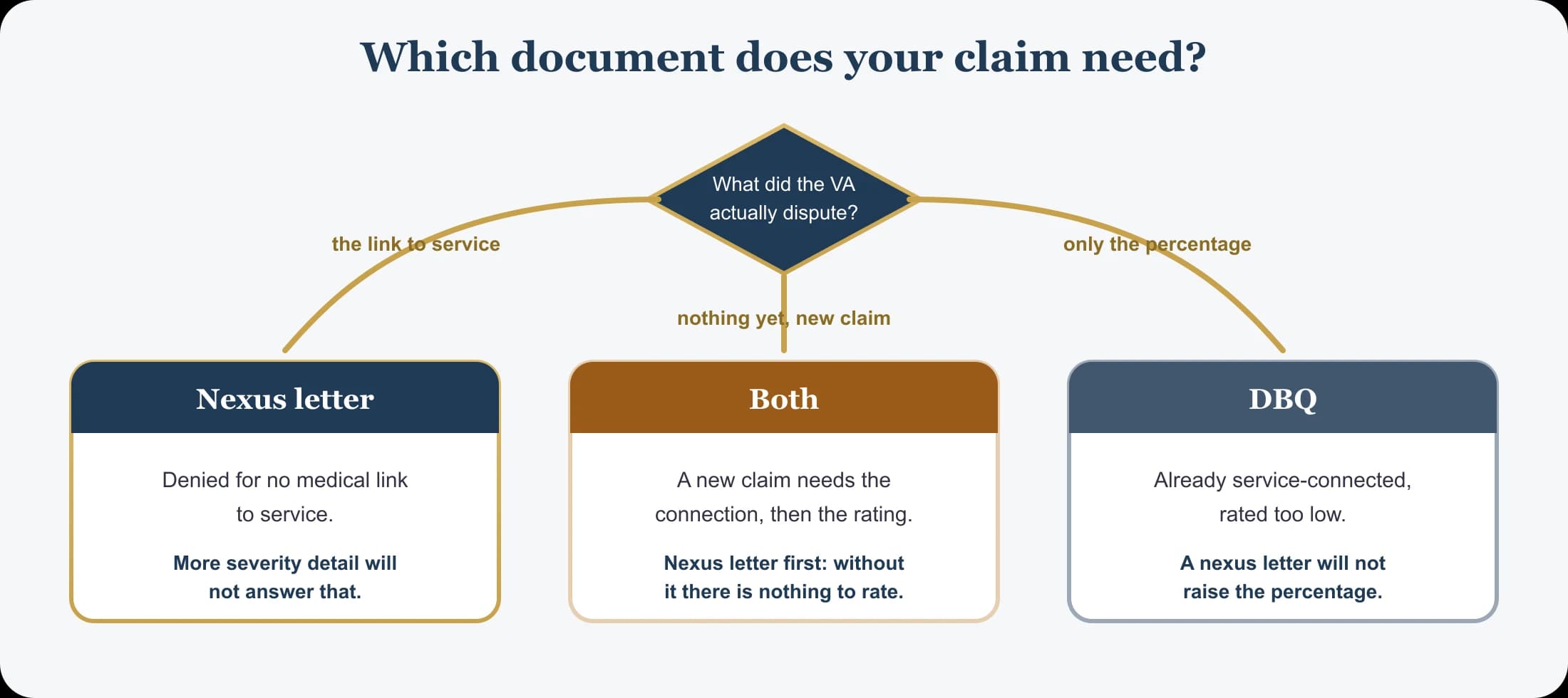
The practical consequence: if your claim was denied because the VA found no medical link to service, submitting a more detailed DBQ will not fix it. You are answering a question the VA did not ask. The denial calls for a causation opinion, which means a nexus letter.
If your claim was denied on the nexus, our guide to what to do when the VA rejects a nexus letter covers the reasons and the appeal paths.
Who Can Complete Each One
Nexus letter
Any licensed clinician qualified to speak to your condition. The VA weighs relevant expertise and reasoning, so a specialist in the right field carries natural weight. Your VA provider must assist when you ask, and VHA policy expressly contemplates VA clinicians giving causality opinions, provided they include a clear rationale and the standard probability language. The same policy notes VHA providers often lack access to military records and may not be familiar with service-specific health issues, which is one reason veterans often seek an independent opinion as well.
DBQ
A VA or contract examiner during a C&P exam, or a private clinician you arrange yourself. A privately completed DBQ is legitimate evidence, though the VA still decides how much weight it carries and may still order its own examination.
Your VA provider is also obligated to help with both documents when you ask. See our guide to VA Directive 1134, the policy that puts that duty on the provider.
For the full breakdown of which providers the VA takes seriously, see who can write a nexus letter.
When Your Claim Needs Both
The two documents are complements, not alternatives, and a large share of strong claims include both. Three situations call for the pair.
- 1
A new claim for an unestablished condition
You need the nexus letter to get service connection granted, and the DBQ to make sure the rating reflects how severe the condition actually is. Winning the connection at 0 or 10 percent because severity was never documented is a hollow victory.
- 2
A secondary condition
The nexus letter ties the new condition to the already service-connected one, and the DBQ documents the new condition's severity for its own rating.
- 3
A supplemental claim after a denial
If the denial was about the link, lead with the nexus letter. If your condition has also worsened since the original decision, add a current DBQ so the rating reflects the present picture.
The sequencing matters more than most veterans expect. Service connection comes first: without it there is nothing to rate, and severity evidence has nothing to attach to.
Common Mistakes
Sending a DBQ to fix a nexus denial
The most frequent error. The VA said it could not connect the condition to service; more severity detail does not answer that. It needs a causation opinion.
Expecting a nexus letter to raise a rating
The mirror image. A nexus letter argues connection. Once the condition is service-connected, the percentage moves on clinical findings, which is DBQ territory.
Treating a DBQ remark as a nexus opinion
A one-line comment in a remarks box rarely carries a records review, a rationale, or the probability language, so it usually carries little weight.
Filing the letter after the C&P exam
The examiner reviews the claims file. An opinion already in the file frames the exam; one that arrives afterward has to overcome an opinion already on the record.
Using a DBQ for a condition with no matching form
Not every condition has a published DBQ. When none fits, a detailed clinical narrative from your provider does the same work.
Which Document Does Your Claim Need?
Check your situation
0 of 5 checked
Check each one that is true for you. Your result updates as you go.
What your claim needs
Start with your decision letter
Nothing here points clearly one way yet. The fastest way to tell is to read what the VA actually said: if it questioned the link to service, you need a nexus letter; if it granted the condition but rated it low, you need severity evidence.
Get a free case review →This is general information, not medical or legal advice. The VA decides every claim on its own facts.
Not Sure Which One Your Claim Needs?
The first consultation is free. A licensed clinician reads your denial letter or rating decision and tells you which document actually answers the VA's objection, including when the honest answer is that you do not need a nexus letter at all. The VA still makes the rating decision; what we control is the quality of the medical opinion.
Frequently Asked Questions
What is the difference between a nexus letter and a DBQ?
A nexus letter is a private medical opinion explaining why your condition is connected to your service, and it decides whether the claim is granted. A DBQ is a standardized VA form documenting how severe the condition is, and it drives the rating percentage. They answer different questions and are not interchangeable.
Can a DBQ prove service connection?
No. A DBQ records current severity for rating purposes and generally does not address causation at all. If the VA denied your claim for lack of a medical link to service, a more detailed DBQ will not resolve it; that requires a nexus letter with a records review, a medical rationale, and an at-least-as-likely-as-not opinion.
Do I need both a nexus letter and a DBQ?
Often, yes. A new claim for an unestablished condition typically needs the nexus letter to win service connection and a DBQ so the rating reflects the real severity. If the condition is already service-connected and only the percentage is in dispute, a DBQ alone may be enough.
Can my private doctor complete a DBQ?
Yes. A privately completed DBQ is legitimate evidence the VA must consider. The VA still decides how much weight it carries and may order its own examination anyway. The private DBQ documents severity; it does not establish service connection.
How is a C&P exam different from a DBQ?
A C&P exam is the VA's own examination of you, ordered when the VA decides an examination is needed to decide the claim. A DBQ is a form. The examiner often completes a DBQ during the C&P exam, and when asked, also gives a medical opinion on causation, so the exam can produce both severity findings and a nexus opinion.
Should I submit a nexus letter before my C&P exam?
Generally yes. The examiner ordinarily reviews your claims file, so an opinion already in the file is evidence that is in front of them. A letter submitted after the exam has to overcome an opinion already on the record, which is a harder position even when the reasoning is strong.
Does a DBQ from the VA examiner help or hurt my claim?
It depends entirely on what it records. A DBQ that captures your symptoms accurately supports an appropriate rating. One completed on a day your symptoms were mild, or that omits functional limits, can understate the condition. Reviewing it against your own records matters, and lay statements can fill gaps it misses.
What if there is no DBQ form for my condition?
Not every condition has a published DBQ. When no form fits, a detailed clinical narrative from your provider covering the same ground, meaning findings, frequency, and functional impact, does the same work. The VA rates on the evidence, not on whether it arrived on a particular form.
Related guides
- What is a nexus letterThe definitional primer on the document itself.
- What a nexus letter must includeThe elements the VA reads for in every letter.
- VA Directive 1134The policy that obligates your VA provider to help with both documents.
- Who can write a nexus letterWhich providers the VA takes seriously.
- How to get a nexus letterThe full process, start to finish.
- Nexus letter exampleA full annotated sample letter, section by section.
- When the VA denies a nexus letterThe common reasons, and how to fix each one.
- Nexus letters, explainedThe complete overview of nexus letters and claims.
Citations & References
- Disability Benefits Questionnaires, the VA's public DBQ forms by condition (VA.gov) https://www.benefits.va.gov/compensation/dbq_publicdbqs.asp
- VA claim exam (compensation and pension exam), what to expect (VA.gov) https://www.va.gov/disability/va-claim-exam/
- 38 CFR 3.326, VA examinations (eCFR) https://www.ecfr.gov/current/title-38/section-3.326
- 38 CFR 3.159, VA assistance in developing claims, including definitions of evidence (eCFR) https://www.ecfr.gov/current/title-38/section-3.159
- 38 CFR 4.2, Interpretation of examination reports (eCFR) https://www.ecfr.gov/current/title-38/section-4.2
- 38 CFR 3.303, Principles relating to service connection (eCFR) https://www.ecfr.gov/current/title-38/section-3.303
- 38 CFR 3.102, Reasonable doubt (eCFR) https://www.ecfr.gov/current/title-38/section-3.102
- 38 U.S.C. 5107, Claimant responsibility and benefit of the doubt (Cornell LII) https://www.law.cornell.edu/uscode/text/38/5107
- VA disability, evidence needed to support your claim (VA.gov) https://www.va.gov/disability/how-to-file-claim/evidence-needed/