
Migraines, VA Disability Claims
How to Obtain a Nexus Letter for Migraines to Support Your VA Disability Claim
Medically reviewed by the Patriot Path Medical Team
Licensed MD reviewers • Last updated:
A nexus letter for migraines can be one of the most influential documents in a VA disability claim. It acts as a medical bridge, connecting your current migraine condition to your time in military service.
Migraines are complex conditions that can be difficult to prove as service-connected, especially if the diagnosis happened after discharge. A well-prepared nexus letter strengthens your case by clearly explaining the medical reasoning that ties your migraines to events or exposures during service.
This guide provides a detailed look at what a nexus letter for migraines is, why it is important, and how you can prepare for and obtain one that gives VA decision-makers the information they need to evaluate your claim fairly.
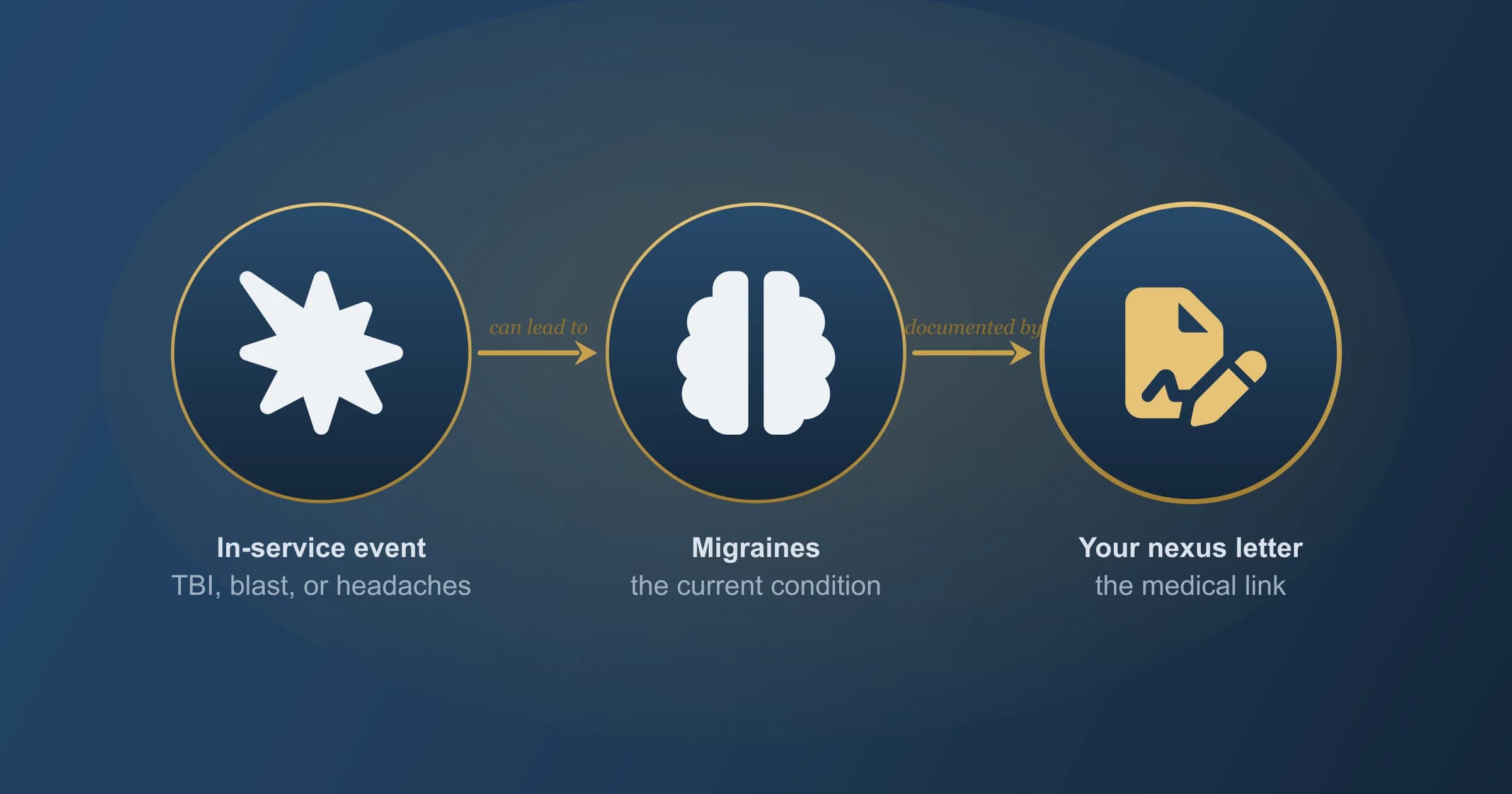
Key takeaways
- A nexus letter for migraines gives the medical opinion that ties your migraines to your military service.
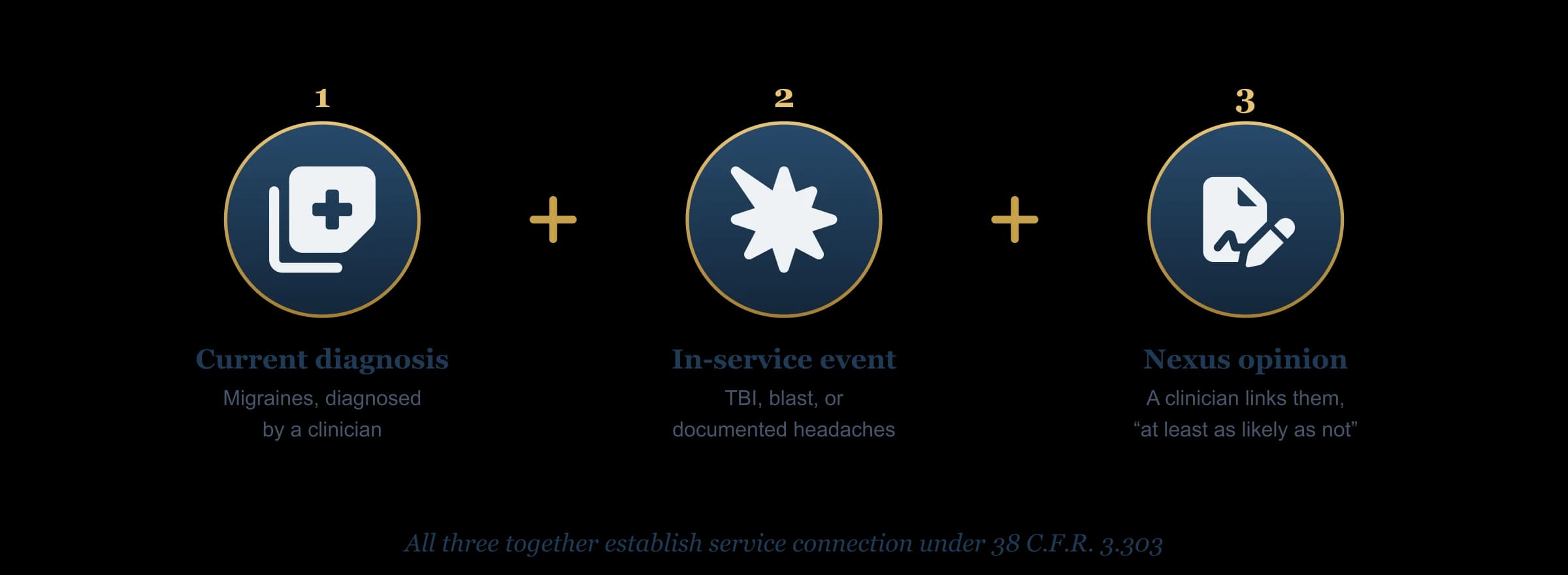
- Direct service connection needs three things: a current migraine diagnosis, an in-service event or documented headaches, and a clinician's nexus opinion.
- The opinion has to say your migraines are at least as likely as not related to service, which means a 50 percent or greater probability.
- The VA rates migraines under Diagnostic Code 8100 on how often the attacks are prostrating and how much they affect work.
- The letter is strongest when it documents attack frequency, severity, and work impact, not just the connection.
Understanding the Purpose of a Nexus Letter
A nexus letter is a written medical opinion from a licensed healthcare provider that directly answers the question: “Is your disability connected to your military service?”
For VA claims, the letter often uses the phrase “at least as likely as not,” meaning there is a 50% or greater probability that the condition is service-related. That threshold is the benefit-of-the-doubt rule in 38 U.S.C. 5107(b).
The nexus letter for migraines is especially important because migraines are diagnosed primarily through patient history rather than a definitive lab test. This makes it essential for a qualified medical professional to review your records and explain how the evidence supports a connection to your service.
Direct service connection for migraines rests on three things. A nexus letter for migraines is what ties them together:
Why Migraine Claims Are Often Difficult
Migraines are common among service members and veterans, but they are not always well-documented in service records. Many people experienced headaches during service but never sought medical attention, often because they assumed it was a temporary issue or due to the demands of deployment.
There are several common service-related causes of migraines, including:
- Traumatic brain injuries (TBIs) from training accidents or combat incidents
- Blast exposure during deployment
- Neck or spinal injuries that contribute to chronic headaches
- Stress and fatigue from high-intensity operational environments
- Environmental exposures such as extreme heat, dehydration, or chemical fumes
Because migraines may develop months or even years after an injury, the connection to service is not always obvious without a medical explanation. That is where a nexus letter for migraines becomes essential, it fills the gap between your medical records and your service history.
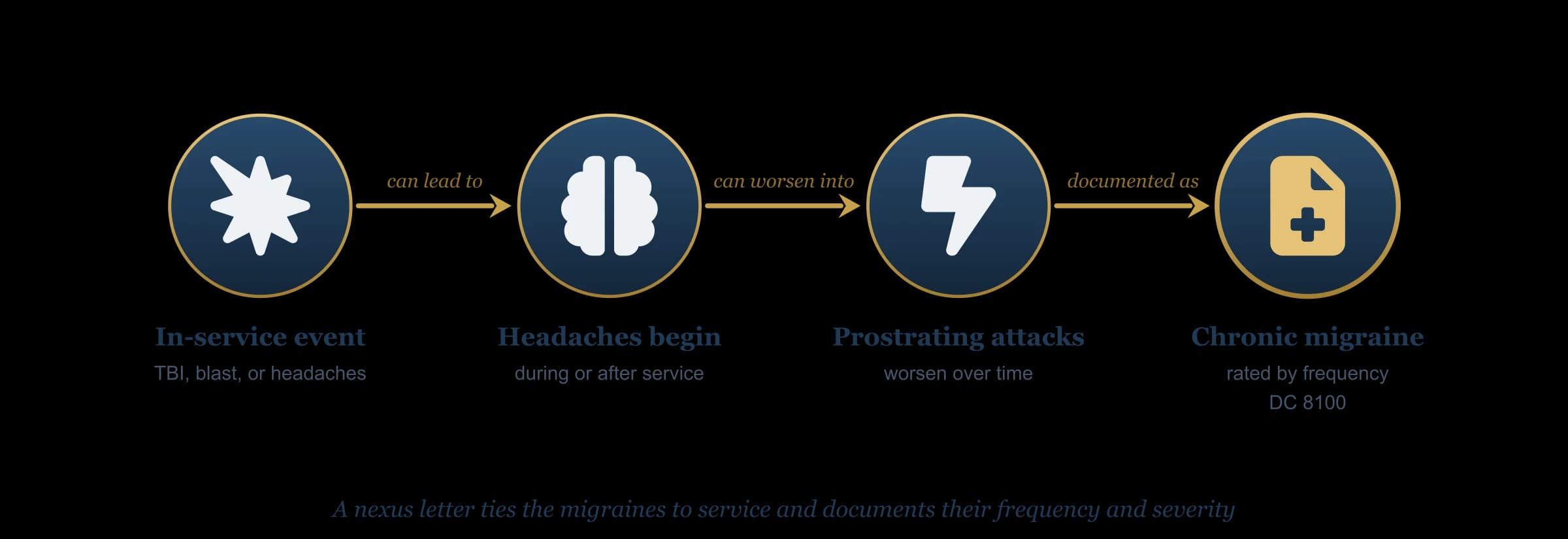
Here is how a service event can turn into a rated migraine condition over time. A strong letter walks through each step:
How the VA Rates Migraines
Migraines are rated under Diagnostic Code 8100 in the VA's Schedule for Rating Disabilities. The VA looks at the frequency, severity, and impact of migraine attacks to determine the disability rating:
The four rating levels climb with how often the attacks are prostrating, meaning severe enough that you have to stop what you are doing:
- 50%: Very frequent, completely prostrating, and prolonged attacks that cause severe work-related limitations or economic inadaptability
- 30%: Prostrating attacks occurring on average once a month over the last several months
- 10%: Prostrating attacks averaging once every two months
- 0%: Less frequent attacks that do not meet the higher thresholds
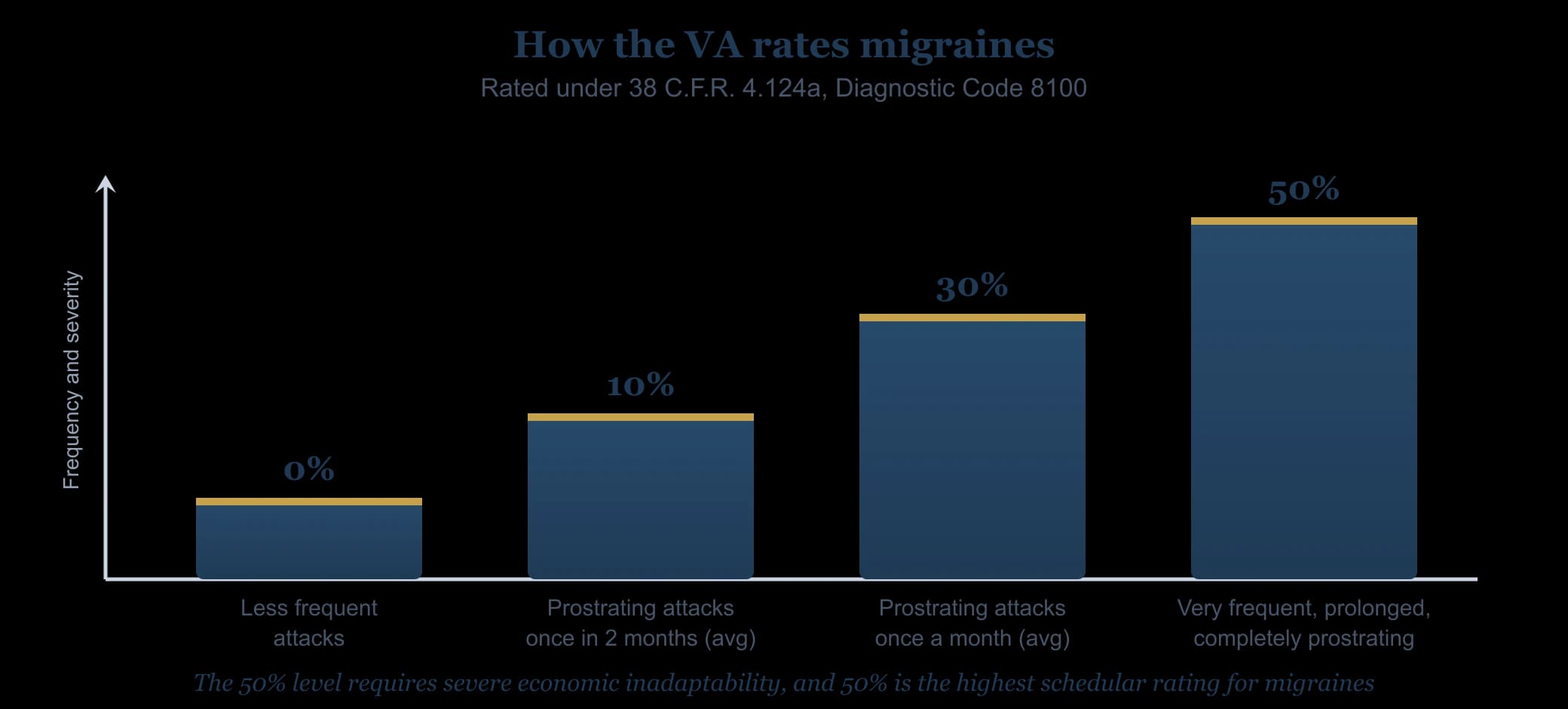
A key word in the schedule is prostrating. The VA is not counting every headache, only the attacks bad enough to stop you in your tracks, so the letter and your records should describe those attacks plainly. 50 percent is the highest schedular rating for migraines.
A strong nexus letter for migraines should not only connect the condition to service but also describe the symptoms and their impact in a way that aligns with these rating criteria.
While the letter does not need to mimic the VA's wording exactly, it should give decision-makers enough detail to match the medical evidence with the correct rating level.
Key Qualities of a Strong Nexus Letter for Migraines
The effectiveness of a nexus letter comes down to its content and credibility. A strong letter will:
- 1
Be written by a qualified healthcare provider
A neurologist or headache specialist is ideal, but a primary care provider can also provide a strong opinion if they are familiar with your case and have reviewed your full medical history.
- 2
Use VA-appropriate language
The phrase “at least as likely as not” should be used when stating the connection between your migraines and your service.
- 3
Be evidence-based
Reference specific medical records, service treatment records, diagnostic tests, and relevant medical literature.
- 4
Address rating-relevant details
Include information on attack frequency, severity, duration, triggers, and the impact on your ability to work.
- 5
Provide clear medical reasoning
Explain not just that a link exists, but why it exists based on your history, symptoms, and known medical connections.
The wording of the opinion matters most. The VA reads it closely, and it has to clear a 50 percent probability to count:
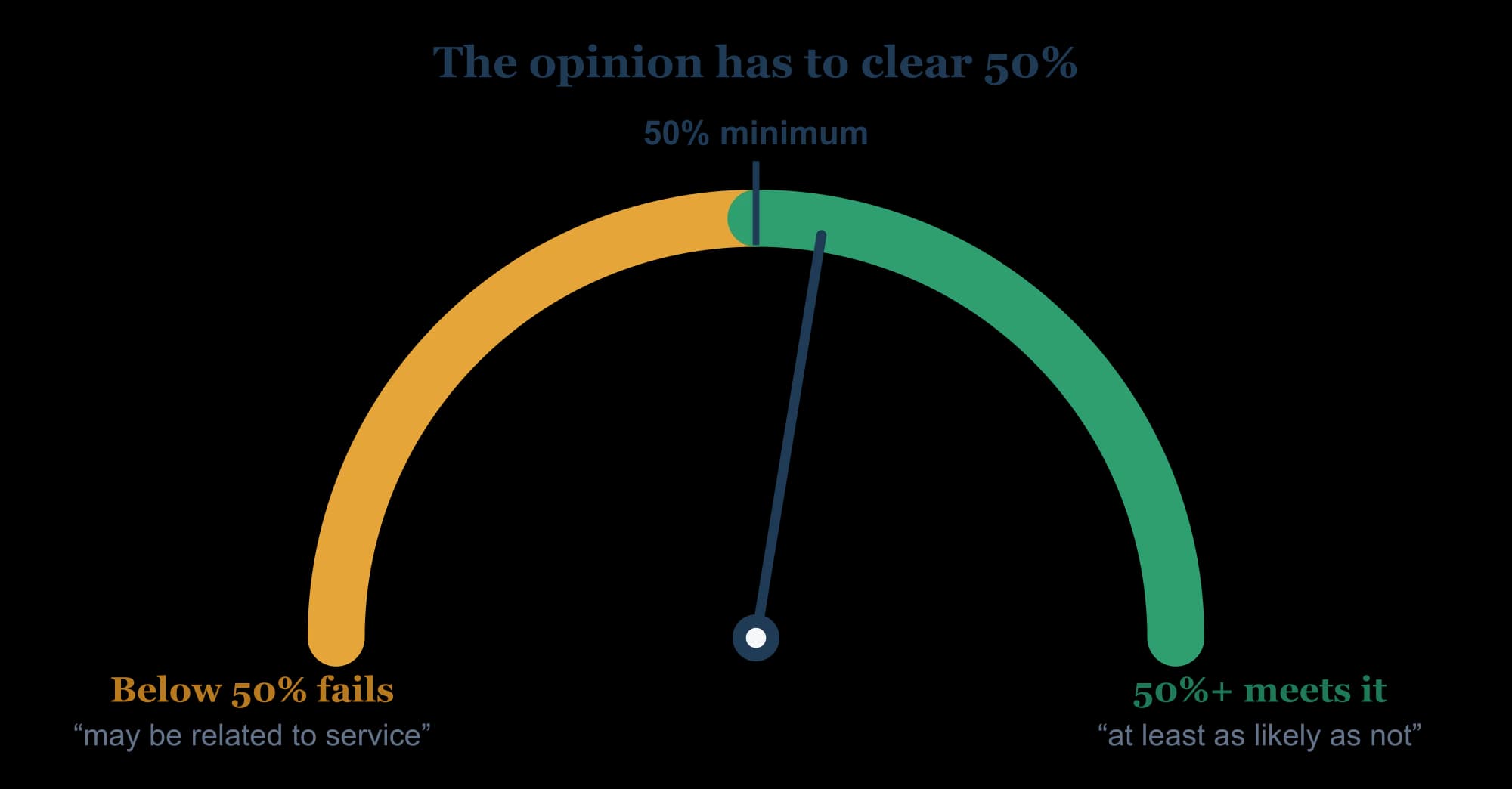
Put simply, a strong nexus letter for migraines does two jobs at once. It states the connection in the language the VA requires, and it documents the frequency, severity, and work impact that decide your rating.
Step-by-Step: How to Get a Nexus Letter for Migraines
- 1
Gather All Relevant Records
Start by collecting:
- Service treatment records
- Post-service medical records
- VA examination reports
- Incident reports from training or deployment
- Any imaging or diagnostic results related to head injuries or neurological symptoms
It is also recommended to keep a migraine diary for at least three months. Record the date, start time, duration, severity, possible triggers, treatment used, and how each migraine affected your ability to function. This diary can serve as evidence and help your doctor provide more accurate details in the nexus letter.
- 2
Choose a Qualified Medical Provider
If possible, work with a neurologist or headache specialist who understands migraine conditions. If that is not an option, a primary care physician who has treated you for migraines and reviewed your records can also write a valid letter. The key is that the provider must be licensed and competent to diagnose and treat migraine conditions.
- 3
Explain the VA's Standard to Your Provider
Some providers are unfamiliar with VA claim language. Give them a clear explanation of what “at least as likely as not” means in the context of VA claims. You can also share the VA's Headaches Disability Benefits Questionnaire (DBQ) so they understand what information the VA uses to rate migraines.
- 4
Request Specific Content for the Letter
Ask your provider to include:
- A clear statement of whether your migraines are at least as likely as not related to your service
- The medical reasoning behind the opinion
- References to specific records or incidents
- Details on the severity, frequency, and work impact of your migraines
- Any relevant medical research supporting the connection
- 5
Review the Letter Before Submission
Check the letter for:
- The provider's name, credentials, and signature
- A list of records reviewed
- A clear opinion using VA's standard language
- A logical explanation supported by evidence
Supporting Evidence That Works Well with a Nexus Letter
A nexus letter for migraines is strongest when supported by other evidence. Consider submitting:
- 1
Migraine diaries
Show a clear pattern of attacks and their effects.
- 2
Buddy statements
Observations from family members, coworkers, or others who have witnessed your migraine episodes.
- 3
Medical literature
Research linking certain service-related conditions or injuries to migraines.
- 4
Work records
Documentation of missed work or accommodations due to migraines.
This supporting evidence can help the VA understand the full impact of your condition. The VA's guidance on the evidence needed to support a claim explains what to submit and how it is weighed alongside a medical opinion.
How to Talk to Your Doctor About Writing a Nexus Letter for Migraines
Approaching a doctor about writing a nexus letter can feel intimidating, but being prepared helps:
- 1
Bring all relevant documents
Service and medical records, migraine diary, and any prior VA decisions.
- 2
Be clear about what you are asking for
Explain that the letter should connect your migraines to your service and provide medical reasoning.
- 3
Give examples of strong language
Show sample phrases such as “It is at least as likely as not that the patient's migraine condition is related to...”.
- 4
Allow time
Writing a thorough nexus letter takes time. Schedule your request well before you need to submit it.
Conclusion
A nexus letter for migraines can be a critical factor in a VA disability claim, as it bridges the gap between your medical condition and your service history.
By gathering strong evidence, working with a qualified provider, and ensuring the letter addresses key details, you can give decision-makers the information they need to evaluate your claim accurately.
Contact Patriot Path today to learn how our nexus letter services can help you build a stronger case and improve your chances of success.
Related guides
Is Your Migraine Claim Ready?
Score your claim
0 of 4 in hand
Check each item you already have in hand. Your score updates as you go.
Start with the basics. Get your migraines diagnosed and gather any service records that show head injuries, blasts, or headaches during service.
Have a clinician build the missing pieces →Ready to Strengthen Your Migraine Claim?
Patriot Path's licensed MDs write independent nexus letters built to meet the VA's evidentiary standards, with a records review, clear medical reasoning, and the required opinion language. Up to five conditions per engagement.
Frequently Asked Questions
What should a nexus letter for migraines include?
It should clearly state the provider's credentials, list the records reviewed, give an “at least as likely as not” opinion, and explain the reasoning with supporting evidence. A strong nexus letter for migraines also describes the condition's severity and its impact on daily life.
Does the letter have to come from a neurologist?
No, any licensed medical provider familiar with your case can write it. However, a neurologist or headache specialist may make the nexus letter for migraines more persuasive.
How does the VA rate migraines?
The VA rates migraines under Diagnostic Code 8100 based on attack frequency, severity, and work impact. A nexus letter for migraines should align with these criteria where possible.
Can migraines be linked to TBI?
Yes, medical research recognizes that migraines can result from traumatic brain injury. A nexus letter for migraines should explain this connection if it applies to your case.
Can the same nexus letter be used for an appeal?
Yes, you can use the same nexus letter for migraines during an appeal if the information is still accurate and relevant. Updating it with any new evidence may make it even stronger.
Citations & References
- 38 CFR 4.124a, Schedule of ratings, neurological conditions (Diagnostic Code 8100, migraine) (eCFR). https://www.ecfr.gov/current/title-38/chapter-I/part-4/subpart-B/section-4.124a
- 38 U.S.C. 5107, Claimant responsibility; benefit of the doubt (U.S. Code). https://uscode.house.gov/view.xhtml?req=granuleid:USC-prelim-title38-section5107&num=0&edition=prelim
- Mayo Clinic, Migraine: symptoms and causes. https://www.mayoclinic.org/diseases-conditions/migraine-headache/symptoms-causes/syc-20360201
- The Migraine Trust, Keeping a migraine diary. https://migrainetrust.org/live-with-migraine/self-management/keeping-a-migraine-diary/
- VA.gov, Evidence needed to support your claim. https://www.va.gov/disability/how-to-file-claim/evidence-needed/