
Nexus Letter for Depression Secondary to TBI
Medically reviewed by the Patriot Path Medical Team
Licensed MD reviewers • Last updated:
A service-connected traumatic brain injury can cause depression, and VA has a rule that sometimes concedes that link outright, but what VA will not concede on its own is which of your symptoms belong to the brain injury and which belong to the depression, and that single question decides whether a separate depression rating pays you anything.
Depression after a head injury is not an unusual outcome, and VA wrote a rule that says so. Under 38 CFR 3.310(d)(1)(iv), in a veteran with a service-connected TBI, depression is held to be the proximate result of that TBI, in the absence of clear evidence to the contrary, if it manifested within 3 years of a moderate or severe TBI or within 12 months of a mild one. VA's own manual restates that as a direct instruction to award service connection at M21-1 V.iii.12.B.3.e. If you fall outside the window or your injury was never classified the way the rule requires, you have not lost. 38 CFR 3.310(d)(2) says the severity levels and time limits do not preclude service connection, and that VA will develop and decide the claim under generally applicable principles instead. That is the case this page was built for, because it is the case almost nobody writes about.
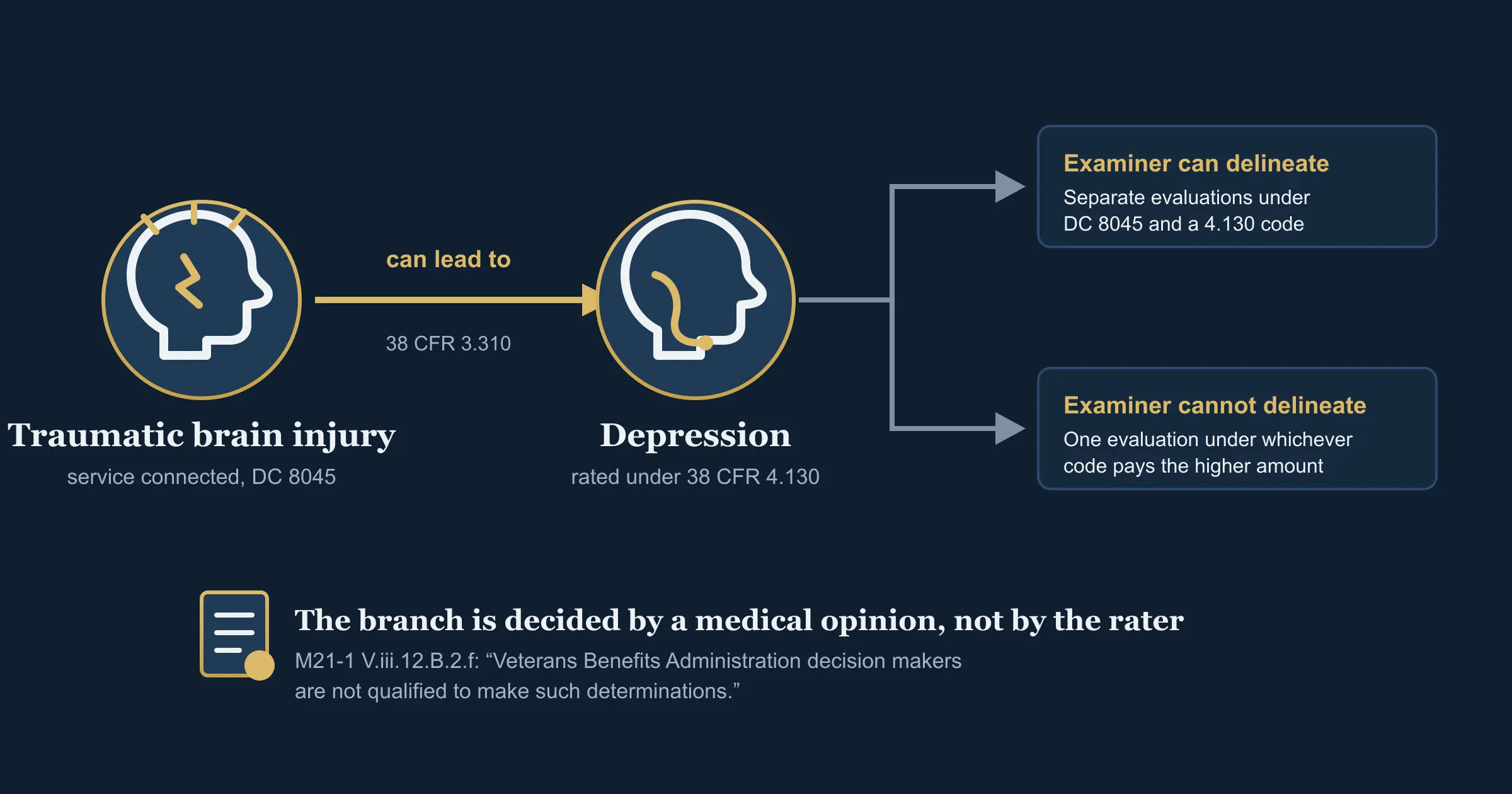
The question the claim actually turns on comes later, and it is not whether the TBI caused the depression. It is delineation. Diagnostic Code 8045 routes emotional and behavioral dysfunction over to the mental-disorder schedule only where a mental disorder has actually been diagnosed, and M21-1 V.iii.12.B.2.d then sorts every case into one of three branches according to whether an examiner can separate the two sets of symptoms. The section below on the three branches works through where you land and what each branch is worth. What belongs up here is who decides it. The manual requires clear and unequivocal medical opinion evidence on that question, tells its own adjudicators they are not competent to supply the answer, forbids the rater from ordering another examination to get one, and instructs that where the record leaves the question open the manifestations are to be treated as not separable. Nobody inside the process is going to go and find that answer for you.
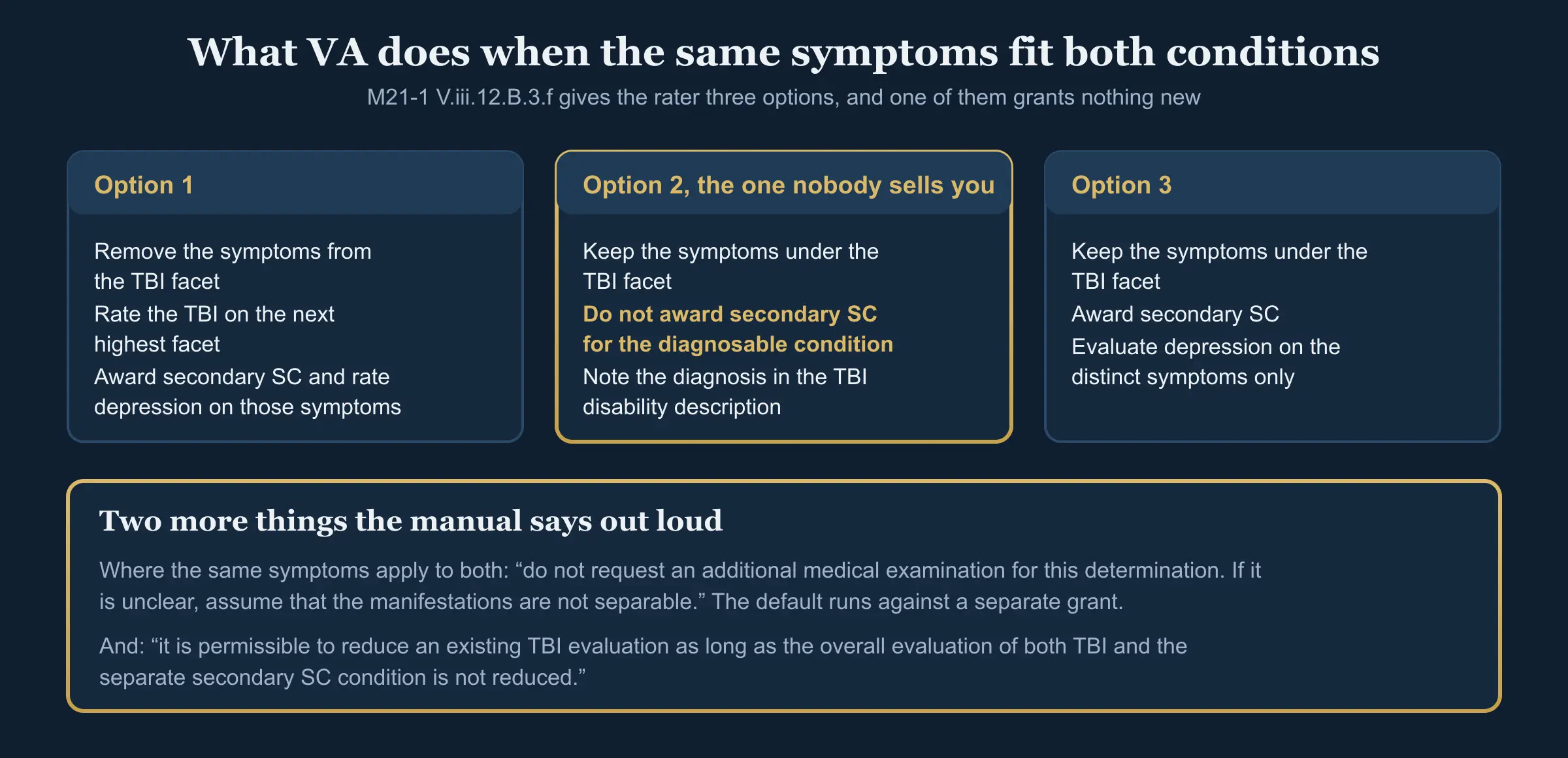
Now the part almost nobody puts near the top of a page like this one. Winning does not guarantee a bigger check. Once the same symptoms sit on both sides, M21-1 V.iii.12.B.3.f hands the rater three options, and one of them keeps the symptoms under the TBI facet, awards no secondary service connection at all, and simply names the condition in the description of the service-connected TBI. The same topic also lets VA move the TBI number down, so long as the two conditions together do not finish lower than they started. The honesty section further down quotes all of that in full. So entitlement and payment are two different questions. File anyway. Service connection is the win. It establishes the condition, it opens VA care for it, and it turns a future worsening into an increased-rating claim on something already granted rather than a fresh fight over causation. No VA source we retrieved gives a distribution of how often each of the three branches is chosen, so we will not guess one for you.
What this page does that the pages ranking above it do not: it quotes the adjudication manual the raters actually work from, by paragraph number, instead of stopping at the regulation. It holds DC 8045 and its ten facets next to the mental-disorder schedule so you can see which of your symptoms are already being counted. It is written for the veteran outside the presumption window as well as the one inside it. It says out loud that a grant can leave your rating flat. And it explains why the product that decides this claim is a delineation opinion, written and signed by a properly qualified clinician on our Medical Team, rather than a generic nexus letter that only says the injury caused the depression.
The 38 CFR 3.310(d) Window, and the Escape Hatch If You Missed It
38 CFR 3.310(d) is the shortest route this claim has, and it is the reason some veterans with depression after a service-connected TBI never need to buy anything from anyone. The regulation names five conditions that, in a veteran who has a service-connected traumatic brain injury, "shall be held to be the proximate result of the service-connected traumatic brain injury (TBI), in the absence of clear evidence to the contrary". Depression is one of them, and it is the only mental-health diagnosis on the list. Read that closing clause carefully, because it cuts both ways in the same breath. It hands you the causation element without an opinion when you land inside the rule's severity and timing limits, and it still leaves VA free to deny where the record holds clear evidence to the contrary. What it does not decide is whether the depression is ever rated separately from the TBI once service connection is granted. That is a different question, it turns on whether an examiner can delineate your symptoms, and it is the question the rest of this page is about.
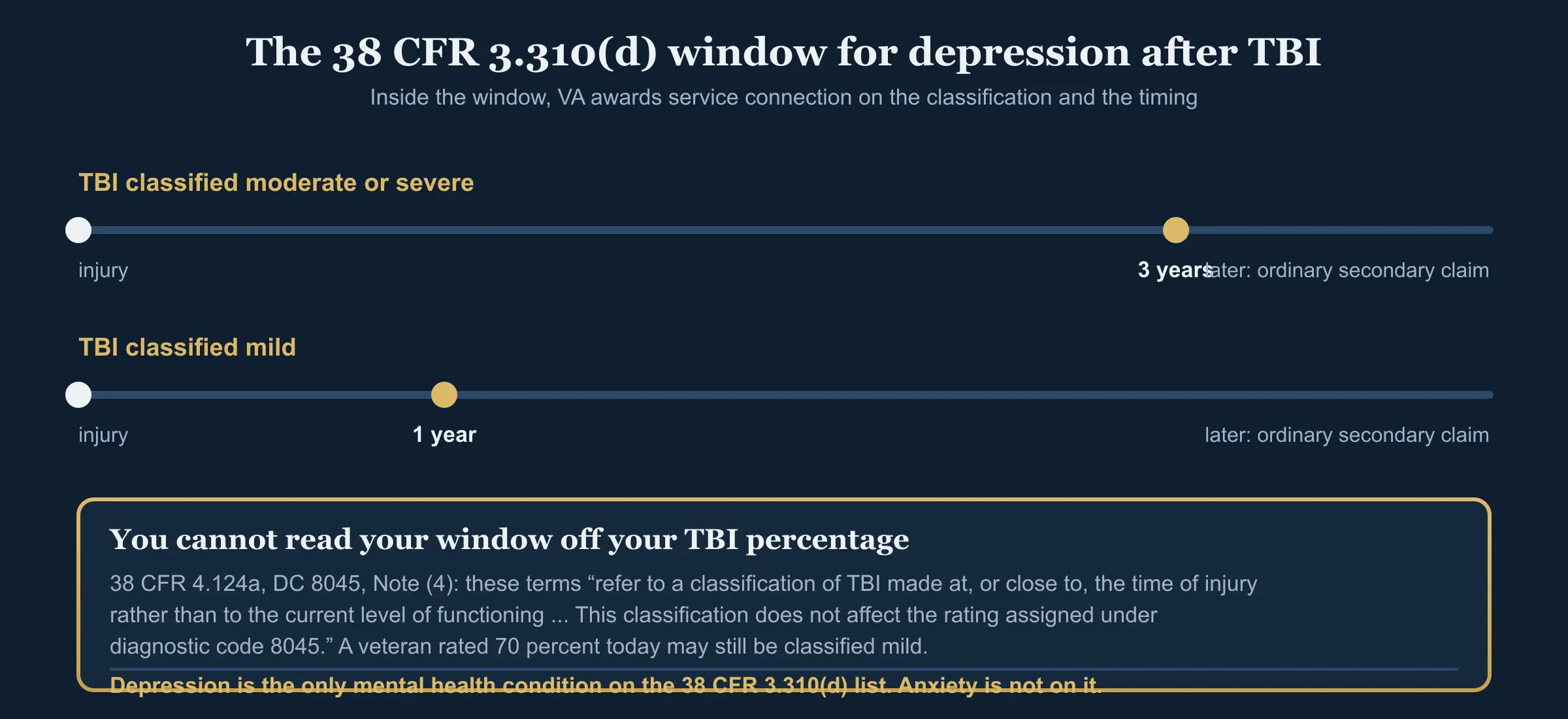
Moderate or severe TBI: three years
"Depression if manifest within 3 years of moderate or severe TBI"
The regulation states both windows in a single sentence at 38 CFR 3.310(d)(1)(iv): "Depression if manifest within 3 years of moderate or severe TBI, or within 12 months of mild TBI". VA's adjudication manual turns the moderate and severe row into an instruction to the rater at M21-1 V.iii.12.B.3.e: award SC if depression manifested within three years after the TBI. Note what neither source supplies. Nothing in the regulation's text or in that manual row defines what counts as the date of manifestation, so the date VA works from is a question about what your records show rather than a rule you can look up.
Mild TBI: twelve months
"or within 12 months of mild TBI"
Same sentence, shorter clock. The manual's mild row at M21-1 V.iii.12.B.3.e reads award SC if depression manifested within one year after the TBI, which is the same period the regulation writes as 12 months. Which of the two windows applies to you is decided entirely by the severity classification in your file, and that classification is not the thing most veterans assume it is. It is covered below, because getting it wrong is the most expensive mistake available on this claim.
Anxiety, PTSD, insomnia and every other mental-health diagnosis: no window, because they are not on the list
Not named anywhere in 38 CFR 3.310
Depression is the only mental-health condition in the paragraph, and that is a measurement rather than an impression. The literal count of the word anxiety across the whole of 38 CFR 3.310, in any capitalization, is zero. If your diagnosis is an anxiety disorder, PTSD or insomnia, 3.310(d) gives you nothing at all, and the claim proceeds instead under the general secondary rule at 3.310(a) or the aggravation rule at 3.310(b), where the medical opinion carries the entire weight. VA's manual does list anxiety and PTSD among the behavioral and emotional TBI residuals at M21-1 V.iii.12.B.1.e, which is a clinical description of what TBI can produce and confers none of the benefit that (d)(1) confers.
If You Missed the Window, Paragraph (d)(2) Says That Is Not the End
This is the most veteran-favorable sentence in the regulation, and not one of the five competing pages we measured states it. Paragraph (d)(2) exists precisely to stop a rater treating (d)(1) as a pass-fail checklist:
"Neither the severity levels nor the time limits in paragraph (d)(1) of this section preclude a finding of service connection for conditions shown by evidence to be proximately due to service-connected TBI. If a claim does not meet the requirements of paragraph (d)(1) with respect to the time of manifestation or the severity of the TBI, or both, VA will develop and decide the claim under generally applicable principles of service connection without regard to paragraph (d)(1)."
Read what that actually does. Missing the severity level, missing the time limit, or missing both, does not preclude service connection. It removes a shortcut, and it removes nothing else. The claim is then developed and decided on ordinary secondary service-connection principles, which is another way of saying the evidence has to carry it.
That split is the honest answer to the question we are asked most often about this claim, which is why anyone would pay for a medical opinion for something VA already presumes. If your depression is documented inside the window and the severity classification in your file is on your side, you may not need one, and we would rather say so than sell you one. Inside (d)(1) the regulation is doing the work an opinion would otherwise do, and the sensible move is to file and see what comes back. Outside the window the position reverses completely. There is no presumption left to lean on, the claim is decided on generally applicable principles, and what stands between your file and a denial is a qualified physician's opinion explaining, on your actual records, how the service-connected TBI caused or aggravated the depression. That is the fact pattern where a nexus letter is decisive, and it is the fact pattern nobody writes for.
One point on the standard you are meeting out there, because it is widely misattributed. 38 CFR 3.102 directs that where a reasonable doubt arises, "such doubt will be resolved in favor of the claimant", and it defines reasonable doubt as one that "exists because of an approximate balance of positive and negative evidence which does not satisfactorily prove or disprove the claim". 38 USC 5107(b) puts the same test in the statute and calls it the benefit of the doubt. Neither text states the threshold as a probability phrase at all. VA opinion practice conventionally renders it as one, and pages routinely quote that rendering back to these two citations as though it were their wording; we counted it against the retrieved text of both and it appears zero times in each. The standard itself is the approximate balance the regulation describes, and a physician opinion is written to reach it.
Note (4): You Cannot Read Your Window Off Your Rating Percentage
Everything in (d)(1) turns on one word somewhere in your file, mild or moderate or severe, and the most common error we see is a veteran inferring that word from his current TBI percentage. Note (4) under Diagnostic Code 8045 forecloses that in two sentences:
Note (4): The terms "mild," "moderate," and "severe" TBI, which may appear in medical records, refer to a classification of TBI made at, or close to, the time of injury rather than to the current level of functioning. This classification does not affect the rating assigned under diagnostic code 8045.
So the classification and the percentage are two unrelated facts. A veteran rated 70 percent for TBI residuals today can still be classified mild, because the classification was fixed at or close to the time of the injury while the percentage describes how he functions now. The number on his award letter tells him nothing about which window applies. If he assumes severe because he is rated high, he will measure himself against the three-year window, conclude he is comfortably inside it, and file without the opinion the claim actually needed.
The real inputs sit in the regulation's own severity table at 38 CFR 3.310(d)(3)(i), and there are five of them: structural imaging of the brain, loss of consciousness (LOC), alteration of consciousness or mental state (AOC), post-traumatic amnesia (PTA), and the Glasgow Coma Scale (GCS), which for this purpose is measured at or after 24 hours. The mild column of that table reads normal structural imaging, LOC of 0 to 30 minutes, AOC of a moment up to 24 hours, PTA of 0 to 1 day, and GCS of 13 to 15. Every one of those is a contemporaneous fact, so the documents that decide your window are your service treatment records and any record made of the injury itself at the time.
Two further rules in 38 CFR 3.310(d)(3)(ii) usually run in the veteran's favor and are worth knowing before you go looking. The first fixes the timing: "The determination of the severity level under this paragraph is based on the TBI symptoms at the time of injury or shortly thereafter, rather than the current level of functioning." The second removes the need for a clean sweep: "VA will not require that the TBI meet all the criteria listed under a certain severity level in order to classify the TBI at that severity level. If a TBI meets the criteria in more than one category of severity, then VA will rank the TBI at the highest level in which a criterion is met, except where the qualifying criterion is the same at both levels." One qualifying criterion at the higher level is enough. A veteran whose imaging was normal and whose GCS was 14, but whose post-traumatic amnesia ran past a day, is not automatically mild on those facts.
One limit worth stating rather than papering over: no VA source we retrieved gives any distribution of how often a severity classification is missing from a file altogether, and none says what VA does when the contemporaneous records simply do not exist. If yours are silent, treat severity as a contested fact rather than a settled one, and expect it to be argued from whatever the record does contain.
One last thing, because it can save you a filing. Under M21-1 V.iii.12.B.3.g, where one of the five 38 CFR 3.310(d) conditions is identified in the evidence of record while VA is processing a claim unrelated to your service-connected TBI, "a claim for that secondary condition must be invited." The manual puts that duty on VA, not on you. If your records already show depression after a service-connected TBI and no invitation ever came, that is worth raising in writing.
The Three Branches: How VA Decides Whether Depression Gets Its Own Rating
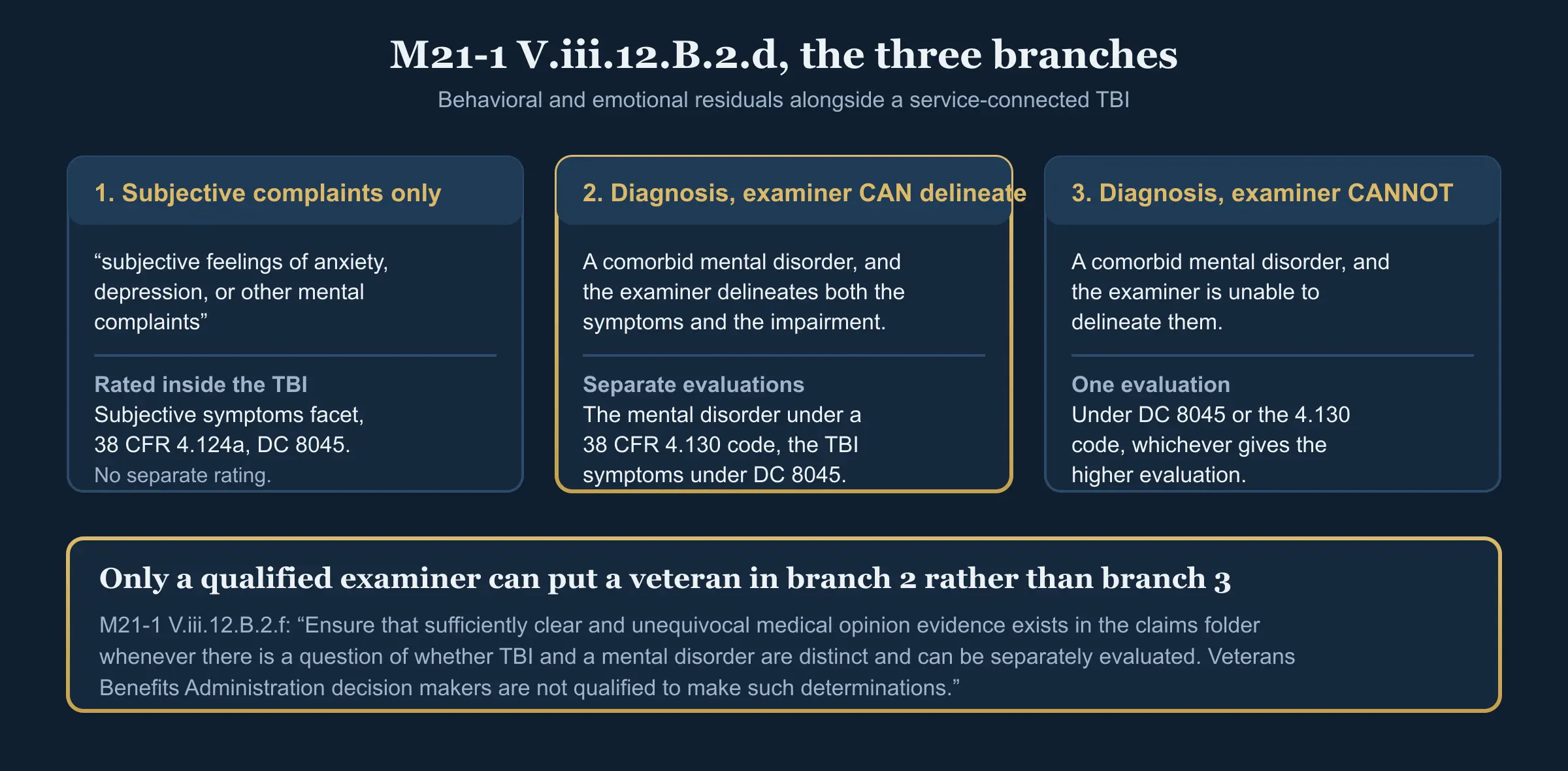
Whether your depression turns into a second rating on top of your TBI rating is not decided by how bad the depression is. It is decided by whether a qualified examiner can say, in writing, which of your behavioral and emotional symptoms belong to the traumatic brain injury and which belong to the depression. VA's adjudication manual sets out three branches for exactly this situation at M21-1, Part V, Subpart iii, Chapter 12, Section B, Topic 2, block d, and not one of the five competitor pages we measured cites the manual at all. Here are the three branches in the manual's own words.
Branch 1
Where
"the Veteran has subjective feelings of anxiety, depression, or other mental complaints"
VA does this
"evaluate in the subjective symptoms facet under 38 CFR 4.124a, DC 8045." The manual adds a one-line note: "Subjective mental complaints are not a distinct comorbid diagnosis."
What it means for you
Complaints without a diagnosis stay inside the TBI table. There is no second diagnostic code, no second evaluation, and nothing to combine. This branch is where a veteran lands when the mood symptoms are in the treatment notes as reported feelings and nowhere as a diagnosis. It is also the branch a nexus letter cannot argue you out of, because the missing element is a clinical diagnosis, not an opinion.
Branch 2
Where
"the Veteran has a comorbid mental disorder and/or neurocognitive disorder, and the examiner is able to delineate both symptoms, and occupational and social impairment"
VA does this
"assign separate evaluations for the mental disorder symptoms and/or neurocognitive disorder symptoms under the appropriate 38 CFR 4.130 DC, and the TBI symptoms under 38 CFR 4.124a, DC 8045."
What it means for you
This is the only branch that produces two evaluations, and note what unlocks it. Not the severity of the depression. Not the size of the TBI rating. The examiner being able to delineate. Read the condition closely and it asks for two separations, not one: the symptoms, and the occupational and social impairment. An opinion that sorts the symptoms into two lists but says nothing about which condition drives which part of the work and social impairment has answered half the question the manual asks.
Branch 3
Where
"the Veteran has a comorbid mental disorder or neurocognitive disorder, and the examiner is unable to delineate both symptoms, and occupational and social impairment"
VA does this
"assign a single evaluation under the DC (either under 38 CFR 4.124a, DC 8045 or the appropriate 38 CFR 4.130 DC) that provides the higher evaluation based on overall impaired functioning due to both conditions."
What it means for you
One evaluation FOR THE BEHAVIORAL AND EMOTIONAL SYMPTOMS, chosen by whichever set of criteria measures them better. Read the scope of that carefully, because it is narrower than it first sounds. What branch 3 collapses is the mental side of the claim, not the whole of it: physical residuals of the TBI that are genuinely separable still keep their own evaluation under DC 8045 and are combined under 38 CFR 4.25, which is exactly what happens in the worked example below. This branch is not a loss. But it is one evaluation rather than two on the symptoms most veterans are buying a letter about, and anyone expecting a second mental-health rating needs to know branch 3 exists before filing rather than after.
The manual closes the block by stating its own reach: "This guidance applies to all cognitive and behavioral/emotional TBI residuals as defined in M21-1, Part V, Subpart iii, 12.B.1.e." That list of behavioral and emotional residuals begins with depression and also names agitation and irritability, impulsivity, aggression, anxiety, and PTSD.
The Same Rule, Written Into the Regulation Itself
A manual can be revised. The regulation behind it is the stronger anchor, and it says the same thing from the other direction. 38 CFR 4.124a, Diagnostic Code 8045, Note (1), in full:
Note (1): There may be an overlap of manifestations of conditions evaluated under the table titled "Evaluation Of Cognitive Impairment And Other Residuals Of TBI Not Otherwise Classified" with manifestations of a comorbid mental or neurologic or other physical disorder that can be separately evaluated under another diagnostic code. In such cases, do not assign more than one evaluation based on the same manifestations. If the manifestations of two or more conditions cannot be clearly separated, assign a single evaluation under whichever set of diagnostic criteria allows the better assessment of overall impaired functioning due to both conditions. However, if the manifestations are clearly separable, assign a separate evaluation for each condition.
38 CFR 4.124a, Diagnostic Code 8045, Note (1)
Put the two texts side by side and they are one rule approached from opposite ends. Note (1) starts from the manifestations and asks whether they are clearly separable. The manual starts from the examiner and asks whether that person is able to delineate. Same test, same outcome, and the practical consequence is the one veterans are almost never told: the branch is settled in the medical record, not at the rating desk. Note (1) also settles something the branches table leaves implicit. Where the manifestations ARE clearly separable, a separate evaluation for each condition is not a favour the rater grants. It is what the regulation directs. And where they are not, the single evaluation goes to whichever criteria allow the better assessment of overall impaired functioning due to both conditions, which is a comparison between two rating tables rather than a choice between two diagnoses. The section on the delineation opinion below takes up the harder half of this, which is that the rating activity is barred from answering the separability question itself, VA will not develop further evidence to answer it, and an unanswered question resolves against you.
VA's Own Worked Example, on This Exact Pair
The manual does not leave this abstract. At M21-1 V.iii.12.B.2.e it works a single example, and the example is TBI and major depression. This is VA instructing its own rater how to decide the claim you are about to file, and it is the most persuasive thing available on the subject.
- Situation
- "VA examination shows the Veteran has numerous behavioral/emotional symptoms (depression that severely affects the Veteran's work and family relationships, frequent suicidal thoughts, confusion, apathy, and unpredictability), and meets the diagnostic criteria for both TBI and major depression. The examiner was unable to delineate which behavioral/emotional symptoms are associated with TBI and which are associated with major depression. Evaluation under 38 CFR 4.130 criteria would result in the higher evaluation for the behavioral/emotional symptoms due to TBI and major depression."
- Result
- "Assign an evaluation for the behavioral/emotional residuals due to TBI and major depression under 38 CFR 4.130, DC 9434, as this provides the highest evaluation based on the behavioral/emotional symptoms. Assign a separate evaluation under 38 CFR 4.124a, DC 8045 for the remaining physical symptoms and combine the evaluations under 38 CFR 4.25."
- Explanation
- "Separate evaluations are warranted in this case because the physical symptoms of TBI are clearly separable from the behavioral/emotional symptoms."
Read what actually happened there, because it cuts against the intuition. The examiner could NOT delineate. That is branch 3, the single-evaluation branch, and the veteran still did well. The mental and the behavioral symptoms went together into one evaluation under 38 CFR 4.130, Diagnostic Code 9434, because that set of criteria produced the higher evaluation for those symptoms. What was separated was not depression from TBI, but the PHYSICAL residuals of the TBI from the behavioral and emotional ones. Those physical residuals kept their own evaluation under DC 8045, and the two were combined under 38 CFR 4.25. So the split that paid here was mind from body, not depression from brain injury. If your TBI has separable physical residuals, that is a line worth making sure your records draw clearly, and it is a different piece of evidence from the delineation opinion.
Now the arithmetic, because it is what makes the branch matter and no competitor page shows it. Diagnostic Code 8045 does not add your ten facets up. It scores each facet on its own and then sets the entire TBI percentage from the single highest one, so nine facets can score above zero and put nothing whatever on your award letter. The level-to-percentage conversion behind that is stated once on this page, in the side-by-side rating section below, and every reference here points back to it. What belongs in this section is where branch 1 leaves your mood symptoms. In the printed table the subjective symptoms facet is written out at levels 0, 1 and 2 only, with no level 3 row and no total row before the next facet begins, so on our reading of that table the facet cannot carry the TBI evaluation past the level 2 percentage standing alone. We flag that as our reading of the printed table rather than a sentence VA has written anywhere. And the regulation's own illustration of a level 0 subjective symptom is "mild or occasional headaches, mild anxiety," which shows how little the facet route can be worth while the symptoms stay subjective. Three further limits belong here, all of which cut against the way this claim is usually sold. First, the route to the mental-disorder criteria is conditional, not automatic. DC 8045 says to "Evaluate emotional/behavioral dysfunction under [38 CFR] 4.130 ... when there is a diagnosis of a mental disorder," and where no such diagnosis exists the emotional and behavioral symptoms stay in the TBI table. The square brackets are ours and they are there to be honest about the edit: the source writes that section with the section symbol, and the words the ellipsis replaces are the schedule's own parenthetical title for it. Nothing else has been changed and no word has been dropped. Our page on depression secondary to chronic pain walks through what the 38 CFR 4.130 criteria then require. Second, a grant on this claim can leave the combined figure exactly where it was, and it can arrive alongside a reduction on the TBI side. The honesty section further down quotes the manual sentence that permits that and sets out all three options open to the rater. Third, one correction that is easy to pick up elsewhere: the presumptive list at 38 CFR 3.310(d) names depression and does not name anxiety, so an anxiety claim after a TBI is built under the ordinary secondary rules instead. The presumption section gives the count behind that. Finally, the trap the DC 8045 table sets for veterans who read it carefully. Note (4) fixes the mild, moderate and severe classification at or close to the time of injury and expressly detaches it from the rating assigned under DC 8045, which means your TBI percentage tells you nothing about which presumptive window is yours. That note is quoted in full in the presumption section. The classification lives in your injury-era records. Go find them before you assume which window applies.
The VA Rating for Depression Secondary to TBI: DC 8045 and DC 9434, Side by Side
Two different rating tables can end up measuring the same veteran, and they do not work alike. The traumatic brain injury sits under 38 CFR 4.124a, Diagnostic Code 8045. Major depressive disorder sits under 38 CFR 4.130, Diagnostic Code 9434. Which table your symptoms are measured on decides what they are worth, and the answer is not the same for every symptom you have. Of the five competitor pages measured on September 3, 2026, two cite DC 8045 and never reach 38 CFR 4.130 at all, and one cites 4.130 and never mentions 8045. None of the five puts the two side by side. Here they are together, with the criteria in the regulation's own words, followed by a map of which side rates which symptom.
The TBI side: ten facets, and only the highest one pays
Start here, because this is the side you most likely already carry a percentage for, and its arithmetic is unlike anything else in the rating schedule. 38 CFR 4.124a gathers ten facets of cognitive impairment and other residuals of TBI into a single table, scores each facet on its own from 0 to 3 with a fifth and highest level labeled "total," and then pays on exactly one of them. The regulation directs a 100 percent evaluation if "total" is the level of evaluation for one or more facets. Where no facet reaches total, it sets the whole percentage from the level of the single highest facet, converting it in these terms: "0 = 0 percent; 1 = 10 percent; 2 = 40 percent; and 3 = 70 percent." Nine of your ten facets can score above zero and add nothing whatever to the number. That conversion is the hinge of everything else on this page, and this is the one place we state it. Every later reference on the page points back to this table.
Level 0: 0 percent
The regulation's own illustrations of a level 0 subjective symptom are "mild or occasional headaches, mild anxiety." Real symptoms, no percentage.
Level 1: 10 percent
In the subjective symptoms facet, "Three or more subjective symptoms that mildly interfere with work; instrumental activities of daily living; or work, family, or other close relationships."
Level 2: 40 percent
The same facet at "moderately interfere" rather than mildly. Note the jump: one level up the scale is four times the percentage.
Level 3: 70 percent
The regulation's example is that you "assign a 70 percent evaluation if 3 is the highest level of evaluation for any facet." The subjective symptoms facet is printed at levels 0, 1 and 2 only, with no level 3 row, so a 3 has to come from one of the other facets. We flag that last point as our reading of the printed table rather than a sentence VA has written.
Level total: 100 percent
Reached facet by facet, not by adding anything up. One facet at total carries the entire evaluation.
The mental-disorder side: one question, asked about the whole person
Now the same veteran, measured on the other table. The contrast with DC 8045 is the thing worth holding onto. Where the TBI side scores ten facets separately and then pays on one, 38 CFR 4.130 has no facets at all. It asks a single question, how far occupational and social impairment reaches, and the symptoms named under each percentage are illustrations of that level rather than a checklist to be ticked off. That difference is why the two tables can return different numbers on one set of complaints, and it is why M21-1 V.iii.12.B.2.d asks a delineating examiner for the occupational and social impairment as well as the symptoms. Impairment is the only currency this side deals in. Two tiers regularly surprise veterans, and both land harder here than they would on a depression claim with no brain injury behind it. The 10 percent tier reaches "symptoms controlled by continuous medication," so a veteran whose mood is steady on an antidepressant has not thereby fallen off the formula. And the 0 percent tier describes a mental condition that has been formally diagnosed whose symptoms are not severe enough either to interfere or to require continuous medication, which means a diagnosis by itself can be rated at zero. Set that against the TBI side and you have the whole tension of this claim in one line. Under DC 8045 you reach this table only once a mental disorder has been diagnosed, on the routing condition quoted in the three-branch section above. The diagnosis is the entry ticket to the formula below. It is not, on its own, a percentage. If you want these criteria worked through in a claim with no TBI in it, our page on depression secondary to chronic pain does that at length; here they are as a reference, quoted from the section as it stood on the August 10, 2026 issue date.
100 percent
"Total occupational and social impairment, due to such symptoms as: gross impairment in thought processes or communication; persistent delusions or hallucinations; grossly inappropriate behavior; persistent danger of hurting self or others; intermittent inability to perform activities of daily living (including maintenance of minimal personal hygiene); disorientation to time or place; memory loss for names of close relatives, own occupation, or own name."
70 percent
"Occupational and social impairment, with deficiencies in most areas, such as work, school, family relations, judgment, thinking, or mood, due to such symptoms as: suicidal ideation; obsessional rituals which interfere with routine activities; speech intermittently illogical, obscure, or irrelevant; near-continuous panic or depression affecting the ability to function independently, appropriately and effectively; impaired impulse control (such as unprovoked irritability with periods of violence); spatial disorientation; neglect of personal appearance and hygiene; difficulty in adapting to stressful circumstances (including work or a worklike setting); inability to establish and maintain effective relationships."
50 percent
"Occupational and social impairment with reduced reliability and productivity due to such symptoms as: flattened affect; circumstantial, circumlocutory, or stereotyped speech; panic attacks more than once a week; difficulty in understanding complex commands; impairment of short- and long-term memory (e.g., retention of only highly learned material, forgetting to complete tasks); impaired judgment; impaired abstract thinking; disturbances of motivation and mood; difficulty in establishing and maintaining effective work and social relationships."
30 percent
"Occupational and social impairment with occasional decrease in work efficiency and intermittent periods of inability to perform occupational tasks (although generally functioning satisfactorily, with routine behavior, self-care, and conversation normal), due to such symptoms as: depressed mood, anxiety, suspiciousness, panic attacks (weekly or less often), chronic sleep impairment, mild memory loss (such as forgetting names, directions, recent events)."
10 percent
"Occupational and social impairment due to mild or transient symptoms which decrease work efficiency and ability to perform occupational tasks only during periods of significant stress, or symptoms controlled by continuous medication."
0 percent
"A mental condition has been formally diagnosed, but symptoms are not severe enough either to interfere with occupational and social functioning or to require continuous medication."
Which Symptom Goes on Which Side
This is the question a veteran actually arrives with, and it is the one no page competing for this search answers. Read the two tables above closely and you will notice something unsettling: several of the same complaints appear on both. "Chronic sleep impairment" is a named symptom at the 30 percent mental-disorder tier, and "frequent insomnia" is one of the regulation's examples in the DC 8045 subjective symptoms facet at level 1. "Mild anxiety" is a level 0 example on the TBI table, and "anxiety" is a named symptom at 30 percent on the mental-disorder table. The regulation resolves it with one condition rather than by sorting the symptoms themselves. DC 8045 routes emotional and behavioral dysfunction to 38 CFR 4.130 when there is a diagnosis of a mental disorder, and where there is no such diagnosis it keeps those same symptoms in the TBI facets table. So the identical complaint changes sides depending on whether a clinician has diagnosed a mental disorder, and nothing else about the symptom has to change at all. That is why this is a records question before it is an argument.
Mild or occasional headaches, mild anxiety
TBI, DC 8045 subjective symptoms facet, level 0
These are the regulation's own examples at level 0, which converts to 0 percent. The single occurrence of the word anxiety anywhere in DC 8045 and its facets table is this one, and it sits here as an example of a subjective symptom. It is not a mental-disorder rating criterion, and it should never be read as one.
Intermittent dizziness, daily mild to moderate headaches, tinnitus, frequent insomnia, hypersensitivity to sound, hypersensitivity to light
TBI, DC 8045 subjective symptoms facet, level 1
Verbatim, the regulation's examples of findings that might be seen where three or more subjective symptoms mildly interfere with work or with close relationships. Level 1 converts to 10 percent, and only if this is your highest facet.
Marked fatigability, blurred or double vision, headaches requiring rest periods during most days
TBI, DC 8045 subjective symptoms facet, level 2
The regulation's examples at moderate interference, converting to 40 percent. It is also the top row this facet is printed with, so on our reading of the table this is as far as subjective symptoms alone can carry the TBI evaluation.
Subjective feelings of anxiety, depression, or other mental complaints, with no diagnosis in the record
TBI, DC 8045 subjective symptoms facet
M21-1 V.iii.12.B.2.d puts them there and adds a one-line note that subjective mental complaints are not a distinct comorbid diagnosis. Nothing crosses to 38 CFR 4.130, because the routing condition in DC 8045 has not been met.
Depression, agitation and irritability, impulsivity, aggression, anxiety, PTSD
Either side, decided by whether a mental disorder has been diagnosed
This is M21-1 V.iii.12.B.1.e's list of behavioral and emotional TBI residuals, and every item on it is a TBI residual and a potential 38 CFR 4.130 diagnosis at the same time. Diagnosed, it goes to the mental-disorder formula. Undiagnosed, DC 8045 keeps it. The symptom did not move. The record did.
Depressed mood, chronic sleep impairment, mild memory loss, panic attacks weekly or less often
38 CFR 4.130, once a mental disorder is diagnosed
These are the named symptoms at the 30 percent tier. Note what the tier actually measures, which is occasional decrease in work efficiency and intermittent periods of inability to perform occupational tasks. The symptoms illustrate that level of impairment. They do not add up to it, and no count of them produces a percentage on their own.
Attention and concentration deficits, memory and processing and learning impairment, planning and judgment difficulties
TBI facets table, unless carried as a diagnosed neurocognitive disorder
M21-1 V.iii.12.B.1.e lists these as cognitive TBI residuals, and the DC 8045 facets table is built for exactly them. Where the record instead carries a diagnosed neurocognitive disorder, 38 CFR 4.126(c) provides that neurocognitive disorders are evaluated under the general rating formula for mental disorders, and that neurologic deficits or other impairments "stemming from the same etiology (e.g., a head injury) shall be evaluated separately and combined with the evaluation for neurocognitive disorders."
The Four Diagnostic Codes This Claim Can Touch
Four entries in the 38 CFR 4.130 schedule are worth knowing by number before you file, because which one your diagnosis lands on changes what a second evaluation could add. Then one correction, because it is being made in public on this topic and it will send you to the wrong regulation. 38 CFR 4.126(d) is not the rule here. Its full text reads: "When a single disability has been diagnosed both as a physical condition and as a mental disorder, the rating agency shall evaluate it using a diagnostic code which represents the dominant (more disabling) aspect of the condition (see § 4.14)." Read the trigger. It is "a single disability ... diagnosed both as a physical condition and as a mental disorder," which is a rule about one condition being framed two ways, physical against mental, and about which framing dominates. Depression secondary to a traumatic brain injury is not that. It is two diagnoses, each with its own diagnostic code, and the question is whether their manifestations can be separated rather than which label is more disabling. The authorities that actually govern are DC 8045 Note (1) and 38 CFR 4.14, both quoted elsewhere on this page.
DC 9304: Major or mild neurocognitive disorder due to traumatic brain injury
The code veterans miss, and it is the one that can quietly decide the value of this claim. M21-1 V.iii.12.B.2.d writes its branches around "a comorbid mental disorder and/or neurocognitive disorder," so a veteran already carrying a 9304 diagnosis is inside the same three-branch rule as one carrying a depression diagnosis. Check your rating decision for this code before you assume a depression grant adds anything.
DC 9434: Major depressive disorder
The code in VA's own worked example on this exact pairing. It shares the General Rating Formula with 9304 under 38 CFR 4.130, Note 2: "Ratings under diagnostic codes 9201 to 9440 will be evaluated using the General Rating Formula for Mental Disorders." Same formula, same impairment question, one set of percentages. So where a veteran is already evaluated under 9304, a grant under 9434 usually adds no separate percentage, because both codes are being measured by the identical criteria on the identical impairment.
DC 9400: Generalized anxiety disorder
Also inside the 9201 to 9440 range, so also on the General Rating Formula. Worth naming here for one reason: 38 CFR 3.310(d) lists depression and does not list anxiety, so an anxiety diagnosis after a TBI is rated on the same table but reaches it by a different service-connection route.
DC 9411: Posttraumatic stress disorder
Named in the M21-1 V.iii.12.B.1.e list of behavioral and emotional TBI residuals, and in the 9201 to 9440 range as well. A veteran already rated under 9411 is in the same position as one rated under 9304: the depression would be measured by criteria that are already being applied.
One guardrail on how to use the table above. Section 4.130 supplies criteria and nothing else. It is an introductory paragraph naming the DSM-5, a flat list of diagnostic codes, and two rating formulas, and it carries no instruction anywhere about what to do when a veteran holds more than one diagnosis. We counted it in the text in force on the August 10, 2026 issue date. The phrase "same manifestation" occurs zero times. Any form of the word "pyramid" occurs zero times. The phrase "single evaluation" occurs zero times. The section does not cross-reference 38 CFR 4.14 at any point. So if you are told that 4.130 is the reason your depression and your TBI have to share one evaluation, the section being cited does not contain that rule. The rule lives in 4.14 and in DC 8045 Note (1), it turns on manifestations rather than on two diagnoses sitting in the same body system, and this page treats it where those provisions are quoted. Nothing on this page can tell you what percentage your own claim would produce, and nobody who has not read your file can either.
You Can Win This Claim and Your Check Can Stay Exactly the Same
Read this before you spend a dollar with anyone, including us. A veteran can file this claim, prove it, have the VA grant service connection for depression secondary to his service-connected traumatic brain injury, and then open his next deposit to find the same number that was there before. That is not a rare accident and it is not a processing error. It is one of three outcomes VA's own adjudication manual instructs the rater to choose between, and it is written into the manual as plainly as the other two. We measured five of the pages competing for this topic on September 3, 2026. Not one of them tells a veteran this. Zero of the five cite 38 CFR 4.14, the rule that actually causes it, by number. Zero of the five cite the M21-1 manual at all. The case for commissioning an opinion is further down this page and it is a real case, but it is not the first thing you should read, and we are not going to put it first.
Route one: the same symptoms cannot be paid for twice
The rule is 38 CFR 4.14, and it is four sentences long. It opens with "The evaluation of the same disability under various diagnoses is to be avoided." It closes with "Both the use of manifestations not resulting from service-connected disease or injury in establishing the service-connected evaluation, and the evaluation of the same manifestation under different diagnoses are to be avoided." Depression after a TBI is the textbook setting for that rule, because the flattened mood, the irritability, the disrupted sleep and the social withdrawal may already be the symptoms holding up your TBI evaluation. While you are here, correct one misattribution, because it is common and it will send you looking in the wrong section of the schedule. The merge rule is not in 38 CFR 4.130. We counted the strings in the text of that section as it stood on the August 10, 2026 issue date: "same manifestation" appears zero times, "pyramid" in any form appears zero times, and "single evaluation" appears zero times. Section 4.130 never cross-references 4.14 at all. It is an introductory paragraph, a flat list of diagnostic codes and two rating tables, and it carries no instruction whatever about how to handle two diagnoses at once. If a page tells you 4.130 collapses your ratings, that page is citing the wrong provision. The authority is 4.14, and 4.14 is about manifestations rather than about diagnoses sharing a body system.
38 CFR 4.14, full text as of the August 10, 2026 issue date; string counts taken from the text of 38 CFR 4.130 at the same issue date
Route two: the rater may take back the facet your symptoms were holding up
Diagnostic Code 8045 does not add your TBI symptoms together. 38 CFR 4.124a sorts them into ten facets, scores each facet on its own, and then pays on the single highest one, at the level-to-percentage conversion set out in the rating section above. One facet carries the entire TBI percentage. So if the emotional and behavioral symptoms you are about to move into a separate depression evaluation are the same symptoms scoring your highest facet, pulling them out lowers the facet that was paying you. M21-1 V.iii.12.B.3.f tells the rater to consider doing precisely that. Where the symptoms are also being used for the highest level of an 8045 facet, the instruction is to "consider removing evaluation of the facet, and use the next highest-evaluated facet as the evaluation for the TBI residuals, as long as the symptoms of that facet are not used to establish SC for one of the five diagnosable conditions." The same block then says the quiet part in one sentence: "Depending on the most advantageous combined evaluation, it is permissible to reduce an existing TBI evaluation as long as the overall evaluation of both TBI and the separate secondary SC condition is not reduced." Read both halves of that sentence. VA may move the number down on the TBI side. The same sentence forbids the two together from finishing lower than where they started, which is a floor and not a promise of anything above it.
M21-1 V.iii.12.B.3.f; 38 CFR 4.124a, DC 8045, level-to-percentage paragraph
Route three: the default, and nobody at VA is going to go get the answer
This is the route no competitor describes, and it is the one that operates when nothing in your file answers the delineation question. Where the same symptoms apply to both the TBI and the secondary condition, M21-1 V.iii.12.B.3.f directs the rater to weigh the evidence already in hand, forbids requesting a further medical examination to settle the point, and then supplies the tiebreak: if it is unclear, the manifestations are to be assumed not separable. Sit with each half of that. VA will not order the examination that would settle whether your depression is separable from your TBI. And where the record already in front of the rater does not settle it, the instruction is to assume that it is not, which is the assumption that ends in one evaluation rather than two. That is branch 3 of the table above, reached not by a finding but by a default. The manual is equally direct about who is not in a position to supply the missing answer, and the delineation section below quotes it: the rating agency needs clear and unequivocal medical opinion evidence on distinctness and disclaims its own competence to reason to it. So the tie goes against a separate grant. The only thing that breaks it is a qualified opinion someone put in the file before the decision was written.
M21-1 V.iii.12.B.3.f, table row 2; M21-1 V.iii.12.B.2.d, row 3; M21-1 V.iii.12.B.2.f
Option 1: Move the symptoms across, and grant
Remove the symptoms from the TBI facet, evaluate the TBI under the next highest-evaluated facet that does not contain those symptoms, award secondary service connection for the diagnosable condition, and evaluate that condition using those symptoms. This is the option in which the depression gets an evaluation of its own. It is also the option in which the TBI number can fall, because the facet those symptoms were holding up is the facet that just came out.
Option 2: Keep the symptoms, and do not grant at all
Keep the symptoms under the TBI facet, do not award secondary service connection for the diagnosable condition, and ensure the diagnosable condition is included with the description of the service-connected TBI disability in the rating decision. Stated without softening, because every other page on this topic leaves it out: on this option there is no separate depression grant. Not a zero percent grant. No grant. The word depression is added to the description of a disability you already had, the symptoms stay where they were, and nothing else about your award changes.
Option 3: Keep the symptoms, and grant on what is genuinely left over
Keep the symptoms under the TBI facet, award secondary service connection for the diagnosable condition, and evaluate that condition based on the distinct symptoms. This is the option that rewards a careful separation the most, because what the depression is worth here is measured by the symptoms shown to be its own rather than by the ones already spoken for on the TBI side.
Why the grant is still worth having, even in a year when it pays nothing
None of the above is a reason to skip this claim, and we would be doing you real harm if we let it read that way. A grant that adds nothing to this year's payment is not the same thing as a denial, and the reasons sit in the same sources as the bad news. What follows is only what those sources support. None of it is a prediction about your claim, and no one who has not read your file can make you one.
- Service connection is a status rather than a payment. 38 CFR 3.310(a) provides that when service connection is established for a secondary condition, "the secondary condition shall be considered a part of the original condition." The causal link stops being the argument. If the depression worsens later, the question in front of the rater is what the evaluation should be, not whether VA accepts that your TBI is behind it.
- The manual builds in a floor, and it is worth knowing where the floor is. M21-1 V.iii.12.B.3.f instructs the rater to work these cases "while ensuring that the claimant receives the highest overall evaluation under the provisions of 38 CFR 4.25 (Combined Ratings Table)", and it permits reducing an existing TBI evaluation only "as long as the overall evaluation of both TBI and the separate secondary SC condition is not reduced." That is protection against going backwards. It is not a guarantee of going forwards.
- One regulation points away from lumping rather than toward it. 38 CFR 4.126(c) provides that neurocognitive disorders are evaluated under the general rating formula for mental disorders, and that neurologic deficits or other impairments "stemming from the same etiology (e.g., a head injury) shall be evaluated separately and combined with the evaluation for neurocognitive disorders", cross-referencing the combined ratings table at 38 CFR 4.25. Separation is written into the schedule where the impairments are genuinely different in kind.
- VA's own worked example on this exact pairing ends in two evaluations, not one, and it is quoted in full in the three-branch section above. The examiner there could not delineate the behavioral and emotional symptoms at all, which is the branch everyone fears, and the physical residuals of the TBI still came out and were combined under 38 CFR 4.25. So the split that paid in VA's own illustration was mind from body rather than depression from brain injury. If your TBI has separable physical residuals, making sure your records draw that line clearly is a piece of evidence worth gathering on its own account.
- The Board has broken TBI residuals out into separate compensable ratings on facts of that shape. In decision 22002703 the Board granted a separate rating for bilateral dry eye syndrome, a separate rating for tension and migraine headaches, a separate 10 percent rating for vertigo and a separate 10 percent rating for a head scar, each as a residual of a service-connected traumatic brain injury with major depressive disorder. Read it for exactly what it is and no more. The depression in that case was already inside the caption of the service-connected disability and was never separately adjudicated, so the decision shows physical residuals separating cleanly, not a mood disorder doing so.
- VA's manual treats this as a claim worth raising, which is a fair answer to anyone who tells you not to bother. Under M21-1 V.iii.12.B.3.g the duty to invite the secondary claim falls on VA rather than on you once one of the five listed conditions turns up in your records, and the presumption section above quotes that instruction and explains what to do if no invitation ever came.
- What none of this settles is the delineation question, and that is the honest reason to commission a physician opinion rather than a generic nexus letter. Route three is the default, VA will not order an examination to resolve it, and the manual disclaims its own adjudicators' competence to answer it. An opinion from a properly qualified examiner that separates which symptoms belong to the TBI and which to the depression, and says so in terms a rater can act on, is the one document that moves a claim off that default. It is not a promise of a higher combined evaluation, and any page that offers you one is selling past the evidence.
What the Delineation Opinion Has to Do, and Why VA Will Not Write It
Only one thing decides which of the three branches above your claim lands in, and it is not the severity of your depression or the size of your TBI rating. It is whether a qualified examiner can delineate which of your symptoms belong to the brain injury and which belong to the depression, and whether the resulting occupational and social impairment divides the same way. That is a medical finding rather than a rating decision, and VA's adjudication manual is unusually direct about who has to make it.
Ensure that sufficiently clear and unequivocal medical opinion evidence exists in the claims folder whenever there is a question of whether TBI and a mental disorder are distinct and can be separately evaluated. Veterans Benefits Administration decision makers are not qualified to make such determinations. The opinion may be provided by either an examiner assessing the TBI or an examiner assessing the mental disorder as long as the individual offering the opinion is properly qualified.
M21-1, Part V, Subpart iii, Chapter 12, Section B, Topic 2, block f. Read in full on September 3, 2026. Not one of the five competitor pages we measured cites M21-1 anywhere.
VA needs this opinion and will not supply the judgement itself
Read the first two sentences together. The manual requires the claims folder to contain medical opinion evidence that is clear and unequivocal on whether the TBI and the mental disorder are distinct, and then it tells its own adjudicators, in terms, that they are not qualified to make that determination. That is a rating agency disclaiming competence on the question its rating depends on. The manual does not care which clinician answers. It accepts an opinion from either the examiner assessing the TBI or the examiner assessing the mental disorder, so long as that person is properly qualified.
And VA will not order another examination to get it
The companion topic closes the other door. Where the same symptoms apply to both the TBI and the secondary condition, M21-1 V.iii.12.B.3.f instructs the rater to evaluate the evidence and determine whether the symptoms can be entirely associated with one disability versus the other, and to "not request an additional medical examination for this determination." It then supplies the default: "If it is unclear, assume that the manifestations are not separable." So an unanswered question is not a neutral gap in the record. It resolves against separation on its own.
That is the pincer, and it is the whole reason to buy
One rule says VA must have the opinion and cannot reason its way to the answer. The other says VA will not develop the evidence to obtain it and will assume against separation when the record leaves it open. Between those two sits the only piece of evidence a veteran can add that changes which branch he lands in. That is what we sell. Not a generic nexus letter that asserts a brain injury can cause depression, which on a service-connected TBI is often the easy half, but a delineation opinion that answers the question VA has told itself it cannot answer.
What the opinion is being asked to produce
Strip away the citations and the deliverable is short. A properly qualified clinician has to state, on your records, which mood and behavioral symptoms are attributable to the depression, which are attributable to the TBI residuals, and how the occupational and social impairment divides between the two, and then has to be willing to stand behind that division. Nothing about that is a legal argument, which is why we do not make one. It is a clinical judgement written so a rater can act on it without having to make the judgement himself, which the manual says he may not do. What the resulting branch is worth is a separate question, worked through in the sections above on the three branches and below on what a grant does and does not pay.
When the examiner says the question cannot be answered
The same manual block closes with a warning that is easy to skim past: "If a medical provider cannot make the required determination without resorting to mere speculation, then careful consideration must be given to whether that statement can be accepted under Jones v. Shinseki, 23 Vet.App. 382 (2010)." In plain terms, an opinion that shrugs is worse for you than no opinion at all, because it puts a qualified clinician on the record saying the delineation cannot be made, and the manual's default in that situation is to treat the manifestations as not separable. A letter that reaches no conclusion has spent your money establishing the branch you did not want. So the opinion has to land somewhere and show its work: what was reviewed, what was weighed, and why the examiner can divide these symptoms when another clinician might have said the question was unanswerable. The regulation on reasonable doubt makes the same distinction from the other side, describing a substantial doubt "within the range of probability as distinguished from pure speculation or remote possibility." Probability is workable. Speculation is not.
What the Opinion Has to Contain
This is the checklist we work from for this pairing, and it is deliberately narrower than a general nexus letter checklist. One honest note before it. Ten Board of Veterans' Appeals decisions were read in full for this page on September 3, 2026, and not one of them granted service connection for depression secondary to TBI on a veteran-obtained medical opinion. That is a sample of ten and not a survey, so it does not establish that no such grant exists. What it does give us is a precise picture of how these opinions fail, and most of this list comes from that.
A delineation finding that answers both halves of the question
M21-1 V.iii.12.B.2.d states the test in two parts: the examiner is able to delineate "both symptoms, and occupational and social impairment." An opinion that sorts the symptoms and says nothing about impairment has answered half of what the rater was told to look for. The finding should say which mood and behavioral symptoms are attributable to the depression, which are attributable to the TBI residuals, and how the impairment at work and in relationships divides between them. Where a symptom genuinely belongs to both, the opinion should say so and explain why, rather than quietly assigning it to one side.
The records actually reviewed, named one by one
This is the commonest way a competent opinion dies, and the recent Board decision set out further down this page is the illustration: an examiner described a broad review in her narrative, then recorded on the accompanying questionnaire that she had read only the prior VA examination reports, and the Board treated the gap as a defect in the factual premise rather than as a reasonable choice about scope. Do not leave that inference available to a rater. Name the service treatment records, the private treatment records, the VA examination reports and the rating decision individually, and date them. A list that can be checked against the claims folder is worth more than any adjective about thoroughness.
Direct engagement with the evidence that cuts against you
Whatever sits in your file pointing somewhere else, a note tying the low mood to a divorce, a job loss, a bereavement or a pre-service history, is in front of the rater whether the opinion mentions it or not. An opinion that names the contrary evidence and explains why the examiner reaches the conclusion anyway is doing the work that earns it weight. An opinion that walks past it invites the reader to assume the examiner never saw it, and that assumption does more damage than the contrary evidence itself usually would.
A factual premise the record supports
This is the failure veterans control least and worry about least. An opinion built on your own account of when the symptoms started is only as strong as the record's agreement with that account, and where an adjudicator has already found the account not credible, the opinion inherits the finding rather than curing it. The case below makes the point in the sharpest possible form, because the examiner's underlying medicine was never disputed and the opinion was still given no weight at all. Being right about the mechanism is not what carries a letter. That is why we ask you for documents rather than for a narrative, and why we would rather find the gap before the letter is written than have a rater find it afterwards.
The chronology, measured against the window that applies to you
Under 38 CFR 3.310(d)(1)(iv), depression is held to be the proximate result of a service-connected TBI, in the absence of clear evidence to the contrary, "if manifest within 3 years of moderate or severe TBI, or within 12 months of mild TBI." Two cautions the competing pages do not give you, both worked through in the presumption section. That list is closed and depression is the only mental-health condition on it, so an anxiety diagnosis takes the ordinary secondary route instead. And your severity classification cannot be read off your TBI percentage, because Note (4) fixes the classification at the time of injury and detaches it from the rating. Where the window is missed, the opinion carries the entire claim and has to supply a full causation rationale under 38 CFR 3.310(a), because paragraph (d)(2) removes the shortcut without preventing the grant and sends the claim to be developed and decided on generally applicable principles. That is the fact pattern we build for hardest, and it is the one nobody else builds for at all.
Baseline evidence, if the theory is aggravation
If the depression predates the injury and the TBI made it worse, the claim runs under 38 CFR 3.310(b) instead, and that rule carries a documentary requirement. VA will not concede aggravation without a baseline level of severity established by medical evidence, and the extent of aggravation is then measured by deduction from your current level. The aggravation section further down sets out the rule and both deductions in the regulation's own words. What the opinion has to do is identify the baseline record by name and date. Go looking for that record before you commission anything, because without it the theory is very hard to carry.
An author who is properly qualified, and a letter that says why
M21-1 V.iii.12.B.2.f accepts the opinion from either the TBI examiner or the mental disorder examiner "as long as the individual offering the opinion is properly qualified." Since the delineation question sits across both fields, the letter should state the author's credentials and the basis for competence on both sides of it rather than leaving a rater to infer either. Everything we produce is written and signed by a licensed clinician on the Patriot Path Medical Team, and on a mental health claim such as this one that involves a PsyD.
What we do not do
We write physician opinions, and that is the whole of it. We do not represent veterans, we do not file claims, we do not appeal them, and we cannot promise you a rating outcome. What a delineation opinion can do is put an answer to the separability question in front of the rater, from a qualified clinician, which is the one thing VA's own manual says its decision makers cannot supply for themselves. What the rating activity then does with your combined evaluation is theirs to decide, and on this claim in particular that decision can go several ways.
What the Medical Literature Shows, and What It Cannot Decide
The association between traumatic brain injury and depression is one of the better documented relationships in the post-injury literature. It is large, it is replicated, and it holds in military and VA populations as well as civilian ones. It is also not the thing that decides this claim. Every study below describes populations. None of them describes you, and none of them can answer the question that determines whether your depression is evaluated separately from your TBI at all. That is why the citations belong in an opinion rather than on their own, and why the honest version of this section states the limits alongside the numbers.
Pooled across 43 studies, people who have had a TBI develop depressive symptoms at roughly twice the rate of people who have not
The 2024 systematic review and meta-analysis in the American Journal of Emergency Medicine included 43 observational studies, 15 of which reported novel cases of depressive symptomology after TBI and 34 of which compared depressive symptoms in TBI participants with non-TBI participants. It reported an incidence of 13 percent among 724,842 TBI participants, and a relative risk of 2.10 comparing 106,083 TBI patients with 323,666 non-TBI controls. Its own conclusion is that individuals suffering from TBI are almost twice as likely to develop depressive symptomology compared to non-TBI individuals. Read the caveat the authors printed alongside it: 11 of the 43 included studies were deemed as having a high risk of bias. This is the strongest evidence tier available on the question, and it is still a pooled estimate built partly on studies its own reviewers flagged.
Depression after traumatic brain injury: A systematic review and Meta-analysis. Am J Emerg Med, December 2024. PMID 39305697
In hospitalized TBI patients, more than half met criteria for major depression at some point in the first year
The 2010 JAMA cohort followed 559 consecutively hospitalized adults with complicated mild to severe TBI. Two hundred ninety-seven of the 559, or 53.1 percent, met criteria for major depressive disorder at least once during follow-up. The point prevalences ranged between 31 percent at 1 month and 21 percent at 6 months, which is the finding that matters most for a claim: the risk is front-loaded into the months right after the injury rather than appearing years later. Risk was higher for those with major depression at the time of injury (RR 1.62, 95 percent CI 1.37 to 1.91) and with a prior history of major depression (RR 1.54, 1.31 to 1.82), and comorbid anxiety was far more common in the depressed group (60 percent against 7 percent, RR 8.77, 5.56 to 13.83). Only 44 percent of those with major depression received antidepressants or counseling, which is worth knowing if your own records look thinner than your memory of that year. POPULATION LIMIT, and it is a real one: this cohort is hospitalized adults with complicated mild to severe TBI. The 53.1 percent figure cannot be carried across to an uncomplicated concussion, and any opinion that does so has overstated its source.
Rates of major depressive disorder and clinical outcomes following traumatic brain injury. JAMA, May 19, 2010. PMID 20483970
After a first mild TBI, about one in eight develops genuinely new depressive symptoms within six months
This 2022 study in the Journal of Neuropsychiatry and Clinical Neurosciences followed 217 individuals with a first-time mild TBI, and its design does the thing most of the literature does not: it separates new-onset from recurrent depression. New-onset depressive symptoms developed in 12 percent of the cohort, whereas 11 percent of the cohort had recurrent depressive symptoms. Both groups were at higher risk for clinically significant postconcussive symptoms and incomplete functional recovery for the first 6 months postinjury. The new-onset figure is the cleanest number in this whole set for a veteran whose records show no mood treatment before the injury, because it is measured on exactly that population.
Prevalence and Correlates of Depressive Symptoms Within 6 Months After First-Time Mild Traumatic Brain Injury. J Neuropsychiatry Clin Neurosci, Fall 2022. PMID 35306831
In a large matched mild-TBI cohort the excess risk clustered in the first twelve months, but the outcome measured was affective disorders, not depression alone
A 2022 study in PM R drew 9,428 adult health plan members diagnosed with mild TBI between 2000 and 2007 from an integrated California health system and matched them against 18,856 control participants. Affective disorders were most prominent during the first 12 months, at 23 percent following mild TBI and 14 percent in the control group, and the four-year aggregate adjusted odds ratios for having an affective disorder after mild TBI were 1.2 (95 percent CI 1.1 to 1.2) for patients with prior affective disorders and 1.5 (1.5 to 1.6) for those without. READ THE OUTCOME DEFINITION BEFORE YOU USE THE NUMBER: the abstract defines affective disorder as depressive, anxiety, and adjustment disorders together. The 23 percent and both odds ratios describe that combined category. They are not depression-specific figures, and an opinion that quotes them as though they were has given the reviewer an easy reason to discount it.
Prevalence of depression and anxiety disorders following mild traumatic brain injury. PM R, July 2022. PMID 34156769
In more than 1.2 million US Army soldiers, mild TBI carried roughly triple the risk of a subsequent mental health diagnosis
The 2017 Journal of Neurotrauma analysis used medical encounter data for 1,261,297 soldiers between 2002 and 2011, identifying incident cases of mild TBI (79,505), PTSD (71,454) and mental health disorder (285,731). Overall incidence rates per 1,000 soldier years were 17.23 for mild TBI, 15.37 for PTSD and 67.99 for mental health disorder, and mild TBI was associated with increased risk for PTSD (RR 5.09, 95 percent CI 4.82 to 5.37) and for mental health disorder (RR 2.94, 2.84 to 3.04). This is the largest military-population citation in the set and the direct answer to any suggestion that post-TBI depression is a civilian phenomenon. SAY WHAT THE OUTCOME WAS: the paper defines mental health disorder as ICD-9 codes for depression and anxiety, excluding PTSD. RR 2.94 is therefore a combined depression-and-anxiety effect size, not a depression-only one, and it must never be written as one.
Risk Factors for Mild Traumatic Brain Injury and Subsequent Post-Traumatic Stress Disorder and Mental Health Disorders among United States Army Soldiers. J Neurotrauma, December 1, 2017. PMID 28895451
Inside VA itself, veterans who screened positive for TBI were about twice as likely to carry a depression diagnosis
This 2010 study in the Journal of Traumatic Stress used administrative records for 13,201 United States military veterans who were screened for traumatic brain injury in Department of Veterans Affairs facilities. Over 80 percent of the veterans with positive TBI screens had psychiatric diagnoses, and those with positive screens but without confirmed TBI status were three times more likely to have a posttraumatic stress disorder diagnosis and were two times more likely to have depression and substance-related diagnoses. It is the citation that puts the association inside the VA system, using VA's own records. POPULATION LIMIT: the doubled depression figure is reported for veterans with positive screens whose TBI status was not confirmed, so it describes a screening-positive population rather than a confirmed-TBI population, and the abstract reports these as verbal multiples with no confidence intervals or point estimates behind them.
Psychiatric diagnoses among Iraq and Afghanistan war veterans screened for deployment-related traumatic brain injury. J Trauma Stress, February 2010. PMID 20127725
Why a Brain Injury Can Produce Depression
An opinion that only reports that TBI and depression travel together is doing half the job. The reviewer also wants to see how, because a stated biological pathway is what separates a medical opinion from a correlation someone read on a website. Three reviews supply that pathway, and each of them is candid about how much is still unsettled.
The most useful of the three for a claim is the cytokine review, because its argument is about timing rather than magnitude. It holds that biomarker levels of cytokines peak within hours to days after the injury, yet pro-inflammatory cytokines may still be elevated above physiological levels months to years following TBI, which is the time frame in which post-TBI depression can persist. That is a biological clock that matches the clinical one, and it is the piece of mechanism reasoning that speaks directly to a chronology argument. It is also entirely verbal. That abstract carries no numeric values at all, and it concedes that in the context of post-TBI depression the role of inflammation is understudied.
Carry the caveats into the letter rather than leaving them out of it. The Brain Inj review states plainly that the neurobiological bases of depression after TBI remain largely unknown, and the neuroimaging systematic review concludes that the available data did not converge on a clear neuroimaging biomarker for depression after TBI. An opinion that names a plausible mechanism and says openly that the field has not settled on one reads as more careful, not less persuasive. There is no brain scan that can prove your depression came from your injury, and any page or letter suggesting otherwise is selling something the literature does not contain.
Four proposed biological pathways, and a review that says the basis remains largely unknown
A narrative review in Brain Injury naming the mechanisms by which a brain injury may produce depression: neuroinflammation, neuroendocrine dysregulation, metabolic abnormalities, and neurotransmitter and circuitry dysfunction. The abstract is qualitative and reports no percentages, effect sizes, sample sizes or study counts, and it states that the neurobiological bases of depression after TBI remain largely unknown. Use it to establish that a plausible mechanism exists, and quote its caveat in the same breath.
Neurobiological Mechanisms Of Depression Following Traumatic Brain Injury. Brain Inj, January 2, 2023. PMID 36373974
Inflammation that outlasts the injury, on the same clock as the depression
A mechanistic review arguing that TBI produces chronic neuroinflammation. Its timing claim is the one that helps a nexus argument and it is verbal rather than numeric: cytokine biomarker levels peak within hours to days after the injury, yet pro-inflammatory cytokines may still be elevated above physiological levels months to years following TBI, which is the time frame in which post-TBI depression can persist. It also notes that tumor necrosis factor alpha and interleukin 1 can signal directly at the neuronal synapse, and concedes that in the context of post-TBI depression the role of inflammation is understudied.
Depression following a traumatic brain injury: uncovering cytokine dysregulation as a pathogenic mechanism. Neural Regen Res, October 2018. PMID 30136679
Structural brain changes that replicate, and no biomarker that does
A systematic review in the Journal of Neurotrauma screened 2,035 citations and included 38 articles totaling 1,793 individuals, with a median sample size of 38.5. Most of the included work was cross-sectional (27 studies, 71 percent), and the modalities were structural MRI (17, 45 percent), diffusion tensor imaging (11, 29 percent), resting-state functional MRI (10, 26 percent), task-based functional MRI (4, 8 percent) and positron emission tomography (2, 4 percent). The most consistently replicated findings were reduced gray matter in the rostral anterior cingulate cortex, prefrontal cortex and hippocampus, along with damage in white matter tracts including the cingulum, internal capsule, superior longitudinal fasciculi, and anterior and posterior corona radiata. The review's own conclusion is the honest one to quote: the available data did not converge on a clear neuroimaging biomarker for depression after TBI.
Neuroimaging Correlates of Depression after Traumatic Brain Injury: A Systematic Review. J Neurotrauma, June 2022. PMID 35229629
What This Evidence Cannot Do for Your Claim
Everything above establishes two things and no more: that depression after TBI is common, and that there is a plausible biological route from one to the other. Association and plausibility are worth having. They are not proof that your depression came from your injury, and no study on this page can supply that proof, because none of them examined you. Any opinion that treats a population figure as though it settled an individual case has skipped the only step that actually persuades a reviewer.
Note carefully how much of this literature measures something wider than depression. The Army study's headline risk ratio covers depression and anxiety combined with PTSD excluded, and the matched mild-TBI cohort's 23 percent covers depressive, anxiety and adjustment disorders together. That matters here for a specific regulatory reason, worked through in the presumption section: depression is the only mental-health diagnosis VA's presumptive paragraph for TBI reaches, and an anxiety diagnosis is not on it. Studies that fold anxiety in with depression are describing a broader outcome than the one this claim is built on, and they should be quoted that way.
The literature also cannot answer the question that decides whether your depression is evaluated separately from your TBI at all. That question is whether a qualified examiner can delineate which of your symptoms belong to the brain injury and which belong to the depression, and M21-1 V.iii.12.B.2.f puts it squarely to a properly qualified medical provider rather than to the rating agency. No meta-analysis answers it for you. A clinician who has read your file can.
So the work an opinion has to do is chronological and individual. When was the injury, and what severity classification was recorded at or near the time of it, which is a classification point rather than a driver of the TBI percentage. When do the records first show mood symptoms. What was documented before the injury, and what was not. What competing explanations sit in the file, and why the evidence answers them. That is the argument. The studies are support for it, not a substitute for it.
The Board decisions further down this page make that point harder than any of this can. In the most recent of them the examiner's medical premise was accepted without argument and the opinion was still given no weight, because of what it had and had not read. The literature was never what failed there. The record review was, and the literature could not have saved it.
One further limit, stated because we would rather say so than fill the gap: no VA source we retrieved gives a distribution of outcomes for this claim. There is no published VA figure here for how often a depression-secondary-to-TBI claim ends in a separate evaluation rather than folding into the existing TBI rating, and we will not invent one.
Four Board Decisions, and What They Actually Decided
Only one of the five competitor pages measured for this build references Board of Veterans' Appeals decisions at all, and only in passing. Not one of them sets out what a decision actually held. That is a real gap, because Board decisions are the only place you can watch this exact claim being decided by real adjudicators on a real record. Ten were read in full for this page. Four are set out below: the two that granted service connection for a depressive disorder on a TBI-related theory, the one recent decision where an opinion squarely on depression secondary to a service-connected TBI was rejected, and one rating case that shows what happens after the grant. Read the denial most carefully. It is the one that tells you what your opinion has to do.
Citation Nr 1639970 (2016)
Granted. Service connection for a chronic psychiatric disability, to include major depressive disorder, anxiety disorder, and temperament disorder, as secondary to service-connected residuals of traumatic brain injury with headaches and a cervical spine disability. The finding of fact reads: "It is at least as likely as not that the Veteran's currently diagnosed psychiatric disability, to include major depressive disorder and anxiety disorder, is secondary to his service-connected residuals of traumatic brain injury with headaches and cervical spine disability."
The route to this grant is the useful part, and it is not the route most veterans expect. Three separate VA examiners rejected the direct theory outright: the March 2011 and May 2013 TBI examinations both found the emotional and behavioral symptoms did not represent residuals of traumatic brain injury, and the May 2013 report stated that the depression and anxiety were not caused by the traumatic brain injury. The claim was won anyway, on an April 2012 VA psychology treatment consult noting a long history of chronic pain from the neck and head injury and identifying the chronicity and worsening of that pain syndrome as one likely source of the depression. The Board reasoned from the service-connected residuals, the headaches and the cervical spine disability, rather than from the TBI diagnosis itself. If your own TBI examiner has already said your mood symptoms are not TBI residuals, that is not the end of the analysis. The secondary theory can run through a service-connected residual instead. Two cautions on this decision. The word "private" appears in it zero times, so no privately obtained opinion carried it. And an anxiety disorder was swept into the grant, which is worth flagging because only depression is named in the five-condition list at 3.310(d). An anxiety component travels on the general secondary rule in 3.310(a) and never on that list, whatever a single decision happens to caption together.
Citation Nr 1541491 (2015)
Granted. Service connection for residuals of a TBI granted, and service connection for an acquired psychiatric disorder, depressive disorder, psychotic disorder, and anxiety disorder, granted. PTSD was denied for want of a current diagnosis.
What carried it was a VA treating psychiatrist, described in the decision as the Veteran's treating physician since June 2014, who diagnosed depressive disorder and opined that it originated from the January 1984 in-service TBI, and who then testified live at the hearing that the veteran had sequelae of the TBI affecting him cognitively and psychologically. Note the posture before you use this as a model, because it is different from yours if your TBI is already service connected. The TBI was granted in the very same decision, so this was a primary and a secondary decided together rather than a veteran building on an established TBI rating. Two private providers do appear in the record, a psychologist and a neurologist, but both opined that the TBI itself was service incurred. Neither addressed the psychiatric nexus. The lesson is about scope, not about who signs: an opinion that stops at the TBI cannot carry the depression claim, however well argued the rest of it is.
Citation Nr A25026643 (March 2025)
Denied. Entitlement to service connection for major depressive disorder, to include as secondary to the service-connected traumatic brain injury, denied. The Board found that the evidence persuasively weighed against finding the psychiatric disorder was caused or aggravated by the service-connected TBI.
This is the teaching case, and it is recent. A clinical psychologist prepared a December 2024 disability benefits questionnaire and medical opinion that the veteran submitted during the 90-day evidentiary window, squarely on depression secondary to the service-connected TBI. Describe her by posture, as the decision does: veteran-submitted, and expressly contrasted with the prior VA examination reports she reviewed. The Board's words on why it failed: "the Board finds that the opinion is inadequate, as it was not based on an accurate factual premise." She had written that she reviewed medical literature, self-reporting measures, an extensive interview and accessible mental health records, but the questionnaire itself said she reviewed only the prior VA examination reports, which meant she never saw the service treatment records showing no psychiatric issues, nor the private treatment records tying the depression to post-service life stressors. She also relied on the veteran's account of when his symptoms began, which the Board had already found not credible. The result was that the opinion had "no probative value." Here is the part that should change how you commission a letter: her underlying medicine was never questioned. The Board recorded without comment her statement that it was well known that TBI can cause major depression and insomnia. Being right about the mechanism earned her nothing. The opinion died on the record review and on the factual premise, which are the two things a veteran can actually control before the letter is written.
Citation Nr 22063413 (2022)
A rating case, not a service-connection case, and cited here only for one sentence: "The August 2020 rating decision combined the Veteran's TBI and depressive disorder disabilities under one 40 percent evaluation and continued the 40 percent rating, under Diagnostic Code 8045." The Board denied an initial rating in excess of 40 percent for the TBI with dizziness and an unspecified depressive disorder.
Depression was already service connected here. Nobody in this decision was arguing about whether it was secondary to the TBI. It is on the page because it shows the ordinary end state that no competitor page prepares veterans for: the mood disorder folded into the TBI evaluation under DC 8045 and rated as one disability, not broken out and combined as two. That is the fold-in, and it is the outcome the delineation question in the VA manual is there to decide. Do not read it as authority that depression is secondary to TBI, and do not read the reverse either. It is a picture of what the rating sheet looks like after the argument is over.
The limit of this sample, stated plainly
Across the ten decisions read in full for this page, none granted service connection for depression secondary to TBI on a veteran-obtained opinion. Say that precisely: none found in this sample of ten decisions. Not none exists. Ten decisions out of a corpus of many thousands is an illustration, not a survey, and a sample that small cannot establish an absence. Anyone who tells you a privately obtained opinion cannot win this claim is drawing a conclusion the evidence does not carry, and so would we be if we phrased it any other way. What the sample does support is narrower and more useful. In the one decision here where a veteran-submitted opinion addressed this exact question, it lost on record review and factual premise rather than on medicine, and in both grants the opinion the Board reasoned from came from a clinician who had actually treated the veteran and could speak to his chronology. That is a reason to insist your opinion document exactly which records were reviewed, engage the contrary evidence by name, and answer the delineation question in the manual's own terms, which M21-1 V.iii.12.B.2.f requires to be answered with sufficiently clear and unequivocal medical opinion evidence. It is not a reason to conclude that such a letter cannot succeed.
Board of Veterans' Appeals decisions are not precedent and bind nobody. Under 38 CFR 20.1303 a prior Board decision is considered binding only with regard to the specific case decided, and every case is decided on its own facts under the applicable law. The four above are illustrations of how adjudicators reasoned on records that were not yours. They are not authority you can rely on, and no outcome here predicts an outcome in your claim.
If Your Depression Came First: Aggravation by a Service-Connected TBI
Of the five competitor pages measured for this build, exactly one cites 38 CFR 3.310(b) at all, and it does so generically across every secondary condition. Not one addresses the case in front of you: depression that already existed, made worse by a service-connected traumatic brain injury. That matters because the presumptive route at 38 CFR 3.310(d) is built entirely around depression appearing after the injury, so a veteran whose depression predates the TBI is outside it before he starts, and causation is a hard argument when the condition was already there.
Aggravation is the theory that fits. 38 CFR 3.310(b) provides that any increase in severity of a nonservice-connected disease or injury that is proximately due to or the result of a service-connected disease or injury, and not due to the natural progress of the nonservice-connected disease, will be service connected. Read the object of that sentence carefully, because veterans routinely misread it: what gets service connected is the increase in severity, not the depression. You are not asking VA to accept that the TBI made you depressed. You are asking it to find that the TBI made an existing depression worse, and then to measure how much worse. The regulation's own authority line cites 38 U.S.C. 1110 and 1131. Everything else on this claim turns on one piece of paper you either have or do not have.
The baseline is the whole claim
38 CFR 3.310(b) states that VA will not concede aggravation unless the baseline level of severity of the nonservice-connected disease or injury is established by medical evidence created before the onset of aggravation, or by the earliest medical evidence created at any time between the onset of aggravation and the receipt of medical evidence establishing the current level of severity. In plain terms, VA has to be able to see where your depression stood before the TBI made it worse. The regulation looks to medical evidence for that, and VA's adjudication manual, M21-1 Part V, Subpart ii, 2.D.1.c (updated May 1, 2026), also lets the baseline rest on "any other credible evidence, including lay evidence, that supports establishment of the baseline", with a note that lay evidence on its own may not be sufficient. For a mood disorder that means the pre-injury treatment notes, the screening scores, the medication list and any hospitalizations, dated and sourced. If those records exist, get them in front of the examiner and have the opinion recite them. If they do not exist, say so honestly in the opinion and identify the earliest records that do, because the regulation's second route is expressly built for that situation. The rating activity then determines the baseline and current levels of severity under the Schedule for Rating Disabilities, 38 CFR part 4.
The rating activity will determine the baseline and current levels of severity under the Schedule for Rating Disabilities (38 CFR part 4) and determine the extent of aggravation by deducting the baseline level of severity, as well as any increase in severity due to the natural progress of the disease, from the current level.
38 CFR 3.310(b), text in force on the eCFR issue date of 2026-08-10
One caution about that quoted sentence. The regulation's text still recites both deductions, the baseline and any increase due to the natural progress of the disease. VA's adjudication manual, M21-1 Part V, Subpart ii, 2.D.1.a (updated May 1, 2026), records the Federal Circuit's holding in Spicer v. McDonough, 61 F.4th 1360 (Fed. Cir. 2023), and says VA "will apply the broader but-for standard and will no longer consider natural progress of the NSC disability when deciding a claim based on aggravation of an NSC disability by an SC disability." Block 1.g of the same section still has the rater deduct the baseline level of severity from the current level.
Is this claim ready to file
The first three items are absolute prerequisites rather than points, and not one of them is something a nexus letter can supply. The six below them are scored, and they are what decides how strong an opinion can be. The one that matters most is the item about a qualified examiner having already addressed in writing which symptoms belong to the TBI and which to the depression, because that is the question this entire claim turns on.
0 of 10 in hand, but a requirement is not met yet
Start with the head injury. A secondary claim under 38 CFR 3.310 attaches to a disability the VA has already service-connected, so until the TBI is service-connected, or that claim is at least on file and moving, there is nothing for a depression opinion to attach to. That is a filing, not a purchase, and no nexus letter can stand in for it. Board decisions do occasionally grant a TBI and a psychiatric disorder in the same decision, Citation Nr 1541491 among them, but that is a different procedural posture from the one this page is written for, and it is not something you can buy your way into.
Nothing to buy at this stage. When that piece is in place, our page on TBI and VA disability covers how the ten facets are scored, and our page on depression and VA disability covers the mental-disorder criteria.
Frequently Asked Questions
If depression is presumed after a TBI, why would I need a nexus letter at all?
Often you do not, and we would rather tell you that than sell you a letter. 38 CFR 3.310(d)(1) holds depression to be the proximate result of a service-connected TBI, in the absence of clear evidence to the contrary, where it manifested within 3 years of a moderate or severe TBI or within 12 months of a mild one. M21-1 V.iii.12.B.3.e turns that into a plain instruction to the rater to award service connection when the timing and the severity line up, and a companion block puts a duty on VA to invite the secondary claim when one of those conditions surfaces in your records during an unrelated claim. If your dates fall inside that window, a letter is usually not what stands between you and the grant, and the free consultation is where we say so. Outside the window everything changes. Paragraph (d)(2) removes the shortcut without preventing the grant: neither the severity levels nor the time limits preclude service connection, and the claim is then developed and decided on generally applicable principles instead. Ordinary principles mean an ordinary secondary claim, and an ordinary secondary claim is carried by a medical opinion. There is also a second question no presumption touches: whether the depression earns an evaluation of its own on top of the TBI evaluation. That one is decided by delineation.
Will this raise my rating?
Sometimes, and no honest page can promise it. Service connection and a bigger payment are two different outcomes. M21-1 V.iii.12.B.3.f tells the rater to avoid pyramiding between the initial TBI evaluation and the symptoms now associated with the secondary condition, and it then permits the TBI evaluation itself to be moved down underneath an unchanged total, and allows an outcome in which no separate award is made at all. The honesty section on this page quotes that instruction and sets out all three options open to the rater. M21-1 V.iii.13.1.h says the same thing from the mental-health side: avoid separate evaluations based on the same manifestations, because to warrant separate evaluations the symptoms considered must be distinct and not overlap. 38 CFR 4.14 is the regulation underneath all of it, and the Board section shows a real rating sheet where the TBI and the depressive disorder ended up as one evaluation rather than two. What actually moves the number is whether your depression symptoms are separable from the symptoms already holding up a DC 8045 facet level.
What does delineation mean, and who is allowed to do it?
Delineation is a qualified examiner stating, in writing, which of your symptoms and which part of your occupational and social impairment belong to the TBI and which belong to the depression. M21-1 V.iii.12.B.2.d makes it the hinge of the claim, and the three-branch section on this page sets out what each answer produces. Who may write it is answered directly in M21-1 V.iii.12.B.2.f. The opinion may be provided by either an examiner assessing the TBI or an examiner assessing the mental disorder, as long as the individual offering the opinion is properly qualified, and the same block tells VA's own adjudicators that they are not the ones to make the determination. That is why this is a clinical task rather than a rating task. Our letters are written and signed by a licensed MD, PsyD or PhD on the Patriot Path Medical Team, and because this is a mental health claim, that involves a PsyD.
Does my TBI percentage tell me which window applies to me?
No, and this trips up a lot of veterans. The mild, moderate and severe labels are a classification made at, or close to, the time of injury rather than a description of how you function now, and Note (4) under DC 8045 detaches that classification from the rating assigned. The presumption section on this page quotes the note in full. The presumptive window in 3.310(d) runs off the classification, not off your percentage, so the number on your award letter answers a different question from the one you are asking. 38 CFR 3.310(d)(3) supplies the table VA uses, built on structural imaging, loss of consciousness, alteration of consciousness, post-traumatic amnesia and the Glasgow Coma Scale, and 3.310(d)(3)(ii) confirms the determination rests on the TBI symptoms at the time of injury or shortly thereafter rather than the current level of functioning. It also says VA will not require the TBI to meet every criterion at a level, and that where criteria in more than one category are met VA ranks the TBI at the highest level in which a criterion is met, except where the qualifying criterion is the same at both levels. Every one of those five inputs is a contemporaneous observation, so the documents that decide your window are whatever was written down about the injury at the time or shortly after it, and the service treatment records are the first place to look for them.
Is anxiety covered the same way depression is?
No, and the gap is not a technicality. Nothing in 38 CFR 3.310 reaches an anxiety diagnosis, which is a measured absence rather than an impression; the presumption section on this page gives the literal count behind that. Depression is the only mental-health condition on the (d)(1) list and the only mental-health row in the corresponding M21-1 V.iii.12.B.3.e table. An anxiety disorder secondary to a service-connected TBI is still perfectly claimable, but it proceeds under the ordinary secondary rule in 38 CFR 3.310(a), or the aggravation rule in 3.310(b), and it needs a medical opinion from the outset because no presumption reaches it. Do not be misled by the one place anxiety does appear inside DC 8045: mild anxiety is given as an example under the subjective symptoms facet at level 0, which is a rating example rather than a route to service connection. Note also that M21-1 V.iii.12.B.1.e lists depression, anxiety, agitation and irritability, impulsivity, aggression and PTSD together among the behavioral and emotional residuals of TBI, so the manual recognises the clinical association even where the regulation grants no presumption.
What if my depression started before the injury?
Then the theory is aggravation rather than causation, and 38 CFR 3.310(b) sets the price of admission: VA will not concede aggravation without a documented baseline level of severity, and it then measures the increase by deduction from your current level. The aggravation section on this page quotes the rule in full and explains which deduction VA's manual still applies. So the first job is not the opinion, it is finding the record that documents how severe the depression was beforehand. A prior history of depression is not disqualifying, and the literature section shows it is a well documented risk factor for depression after the injury rather than an answer to it.
What if VA already rated my TBI and my depression together?
That is an ordinary outcome rather than an error, and it is precisely the situation M21-1 V.iii.12.B.3.f addresses. Where the same symptoms apply to both, the manual tells the rater to evaluate the evidence and determine whether the symptoms can be entirely associated with one disability versus the other, and not to request an additional medical examination for this determination, and that if it is unclear, assume that the manifestations are not separable. Read that twice, because it is the reason this page exists. VA will not order a new examination to settle the delineation question, and its stated default when the answer is unclear runs against a separate evaluation. The only way the question gets a better answer is if someone qualified puts one into the file. The Board section on this page describes a decision in exactly that posture, where a rating decision had folded the two disabilities together under one evaluation. If your own decision reads that way, what changes it is new evidence separating the two sets of symptoms, filed as a supplemental claim, not an argument about the wording of the existing decision.
What happens if the examiner cannot tell the symptoms apart?
You do not lose service connection, but you lose a separate evaluation for the behavioral and emotional symptoms. That is branch 3, and the three-branch section quotes what the rater is directed to do and works through VA's own example of it, which is on our exact facts and which still ended in two evaluations because the physical residuals of the TBI were separable even though the mood symptoms were not. There is also a limit on an examiner simply declining to answer. M21-1 V.iii.12.B.2.f warns that where a medical provider cannot make the required determination without resorting to mere speculation, careful consideration must be given to whether that statement can be accepted under Jones v. Shinseki, 23 Vet.App. 382 (2010). An opinion that shrugs is worse for you than no opinion at all, and the delineation section explains why.
How long after the injury can depression still be connected?
There is no outer limit in the regulation. The 3-year and 12-month figures in 38 CFR 3.310(d)(1)(iv) mark the edge of a presumption, not the edge of service connection, and 3.310(d)(2) says so directly. Past those dates you are in an ordinary secondary claim in which the opinion does the work. The literature sets no cut-off either. The strongest evidence tier available on the question is a 2024 systematic review and meta-analysis pooling 43 studies, which reported a relative risk of 2.10 for depressive symptomology after TBI, and the literature section on this page sets out that finding, the cohort studies behind the timing of the risk, and the caveats that go with each of them. What matters for a late claim is the mechanism rather than the prevalence, and the same section covers the one review whose timing argument reaches years rather than months. No VA source gives a distribution of how often late-onset claims succeed, so we will not invent one.
What makes a nexus opinion get thrown out?
Two things, and the recent Board decision set out in full on this page shows both: an incomplete record review, and a factual premise the adjudicator had already rejected. Neither has anything to do with the medicine, which in that case was not disputed at all. The lesson is concrete. An opinion must name every category of record it rests on, including the service treatment records and the private treatment records, and must address the contrary evidence head on rather than around it. Board decisions are not precedent under 38 CFR 20.1303, so read that one as an illustration of how adjudicators weigh opinions rather than as a rule.
What do you actually provide?
A clinician-written medical opinion built for this claim, not a template. That means a documented review of the records we are given, including the service treatment records and the private treatment records, a statement of the mechanism connecting the injury to the depression, and, where the evidence supports it, the delineation M21-1 V.iii.12.B.2.f asks for: which symptoms and which part of the occupational and social impairment belong to the TBI, and which belong to the depression. Every letter is written and signed by a licensed MD, PsyD or PhD on the Patriot Path Medical Team, and on a mental health claim like this one you speak with a PsyD before you pay. We do not name individual clinicians publicly, which keeps their opinions independent; the credentials are verifiable on request. We do not file claims, represent veterans, appeal decisions or argue cases. We write the medical evidence; you or your accredited representative file it. We also read the record for what it will not support. If your file cannot sustain a delineation opinion, or if your dates already put you inside 38 CFR 3.310(d), we will tell you that rather than write around it.
What does a nexus letter from Patriot Path cost?
One flat fee of $1,500, and the first consultation is free. On this claim we would rather spend that consultation on two questions before you spend anything: whether 38 CFR 3.310(d) already reaches your depression on its dates, and whether your records can support a delineation opinion at all. If the answer to the first is yes, or the answer to the second is no, we will say so, and you will not have paid us to find that out.
Start with a free consultation
Bring us the TBI rating decision, whatever documents the injury itself, and the treatment records for the depression, and we will tell you what the claim needs before anyone writes anything. That includes telling you when a letter is not the answer. If your dates put you inside 38 CFR 3.310(d), or if the records cannot support an opinion that separates the TBI symptoms from the depression symptoms, we will say so at the consultation rather than after the invoice.
Related guides
- TBI and VA disabilityRead this first if you do not yet know which DC 8045 facets your rating was built from, because those are the symptoms a delineation opinion has to work around.
- Depression and VA disabilityHow depression is evaluated on the mental-disorder schedule, which is the rating a separate grant would actually be paid on.
- Nexus letter for migraines and headaches secondary to TBIThe sibling claim from the same injury, and a useful contrast because headaches get no presumption at all under 38 CFR 3.310(d).
- Nexus letter for seizures secondary to TBIAnother of the five 3.310(d) conditions from the same injury: unprovoked seizures, which the rule reaches only after a moderate or severe TBI but with no time limit.
- Nexus letter for depression secondary to chronic painSame diagnosis, different primary disability, worth reading if a service-connected pain condition is also in your file and could carry the theory.
- Nexus letter exampleAn annotated sample letter, so you can see what a written opinion looks like before you commission one.
- What is a nexus letterThe primer, if this is the first one of these documents you have had to think about.
- VA Directive 1134, nexus letters and DBQsUseful before you ask a treating provider for anything, because it covers who completes which document and what VA does with it.
Citations & References
- 38 CFR 3.310, Disabilities that are proximately due to, or aggravated by, service-connected disease or injury, including the TBI provisions at (d) (eCFR) https://www.ecfr.gov/current/title-38/section-3.310
- 38 CFR 3.102, Reasonable doubt (eCFR) https://www.ecfr.gov/current/title-38/section-3.102
- 38 CFR 4.14, Avoidance of pyramiding (eCFR) https://www.ecfr.gov/current/title-38/section-4.14
- 38 CFR 4.124a, Schedule of ratings, neurological conditions, including Diagnostic Code 8045 (eCFR) https://www.ecfr.gov/current/title-38/section-4.124a
- 38 CFR 4.126, Evaluation of disability from mental disorders (eCFR) https://www.ecfr.gov/current/title-38/section-4.126
- 38 CFR 4.130, Schedule of ratings, mental disorders, including Diagnostic Code 9434 (eCFR) https://www.ecfr.gov/current/title-38/section-4.130
- 38 CFR 4.25, Combined ratings table (eCFR) https://www.ecfr.gov/current/title-38/section-4.25
- 38 CFR 20.1303, Nonprecedential nature of Board decisions (eCFR) https://www.ecfr.gov/current/title-38/section-20.1303
- 38 USC 1110, Basic entitlement for wartime disability compensation https://uscode.house.gov/view.xhtml?req=granuleid:USC-prelim-title38-section1110&num=0&edition=prelim
- BVA Citation Nr 1639970 (2016) https://www.va.gov/vetapp16/files5/1639970.txt
- BVA Citation Nr 1541491 (2015) https://www.va.gov/vetapp15/files5/1541491.txt
- BVA Citation Nr A25026643 (2025) https://www.va.gov/vetapp25/files3/A25026643.txt
- BVA Citation Nr 22063413 (2022) https://www.va.gov/vetapp22/files11/22063413.txt
- BVA Citation Nr 22002703 (2022) https://www.va.gov/vetapp22/files1/22002703.txt
- Depression after traumatic brain injury: A systematic review and Meta-analysis. Am J Emerg Med. 2024 (PMID 39305697) https://pubmed.ncbi.nlm.nih.gov/39305697/
- Bombardier et al. Rates of major depressive disorder and clinical outcomes following traumatic brain injury. JAMA. 2010 (PMID 20483970) https://pubmed.ncbi.nlm.nih.gov/20483970/
- Delmonico et al. Prevalence of depression and anxiety disorders following mild traumatic brain injury. PM R. 2022 (PMID 34156769) https://pubmed.ncbi.nlm.nih.gov/34156769/
- Roy et al. Prevalence and Correlates of Depressive Symptoms Within 6 Months After First-Time Mild Traumatic Brain Injury. J Neuropsychiatry Clin Neurosci. 2022 (PMID 35306831) https://pubmed.ncbi.nlm.nih.gov/35306831/
- Risk Factors for Mild Traumatic Brain Injury and Subsequent Post-Traumatic Stress Disorder and Mental Health Disorders among United States Army Soldiers. J Neurotrauma. 2017 (PMID 28895451) https://pubmed.ncbi.nlm.nih.gov/28895451/
- Psychiatric diagnoses among Iraq and Afghanistan war veterans screened for deployment-related traumatic brain injury. J Trauma Stress. 2010 (PMID 20127725) https://pubmed.ncbi.nlm.nih.gov/20127725/
- Medeiros et al. Neuroimaging Correlates of Depression after Traumatic Brain Injury: A Systematic Review. J Neurotrauma. 2022 (PMID 35229629) https://pubmed.ncbi.nlm.nih.gov/35229629/
- Neurobiological Mechanisms Of Depression Following Traumatic Brain Injury. Brain Inj. 2023 (PMID 36373974) https://pubmed.ncbi.nlm.nih.gov/36373974/
- Depression following a traumatic brain injury: uncovering cytokine dysregulation as a pathogenic mechanism. Neural Regen Res. 2018 (PMID 30136679) https://pubmed.ncbi.nlm.nih.gov/30136679/
M21-1 is VA's adjudication procedures manual, the field guide its own decision makers work from. It is published through VA's KnowVA portal, which serves its pages through JavaScript, so the sections cited on this page are named rather than linked. This page cites M21-1 Part V, Subpart iii, 12.B.1.e, 12.B.2.d, 12.B.2.e, 12.B.2.f, 12.B.3.e, 12.B.3.f and 12.B.3.g from article 554400000180832, and 13.1.h from article 554400000180520, each read in full, browser rendered, on September 3, 2026. It also cites Part V, Subpart ii, 2.D.1.a, 2.D.1.c and 2.D.1.g from article 554400000180484, read on October 6, 2026.