
Secondary claim guide
Nexus Letter for Seizures Secondary to TBI
Medically reviewed by the Patriot Path Medical Team
Licensed MD reviewers • Last updated:
Under 38 CFR 3.310, seizures can be secondary to a service-connected TBI. If the TBI was moderate or severe and the seizures unprovoked, the regulation holds them to be its result absent clear evidence to the contrary, and VA's manual says the link needs no medical opinion. A nexus letter works outside that rule, or where VA names another cause.
The severity that counts is how the original injury is classified, not what your TBI is rated today. Outside the rule are a mild TBI, seizures found to have been provoked, a severity the evidence cannot establish, and a seizure disorder that began before the TBI. Whether the seizures were provoked is a question of fact, and under 38 USC 5107(b), when the evidence on it is in approximate balance after VA weighs it, the benefit of the doubt goes to the veteran. This page covers each, along with the rule that a physician verify the seizures, how post-traumatic epilepsy is rated, and why a grant may not raise your combined rating.
An illustrative example
A former combat engineer has a service-connected TBI from a vehicle blast in 2008. His service treatment records note that he was briefly knocked out, and nothing more. In 2016 he has his first seizure, a neurologist diagnoses epilepsy after testing, and he files assuming VA's TBI seizure rule covers him because his TBI is already service connected.
It may not. On VA's severity table, a loss of consciousness of 30 minutes or less, with nothing else in a higher column, points to a mild TBI, and the seizure rule reaches only moderate or severe ones. Two things are worth doing before anyone drafts a letter: gather what the men in his vehicle saw, because VA's manual lets lay statements help establish how severe the injury was, and find out whether anything in the records places it in a higher column. If it stays mild, the claim is decided on the ordinary evidence, and that is the case a reasoned medical opinion is for.
An illustrative composite written to show how the severity rule works. It is not a client, not a case result, and not a prediction about any claim.
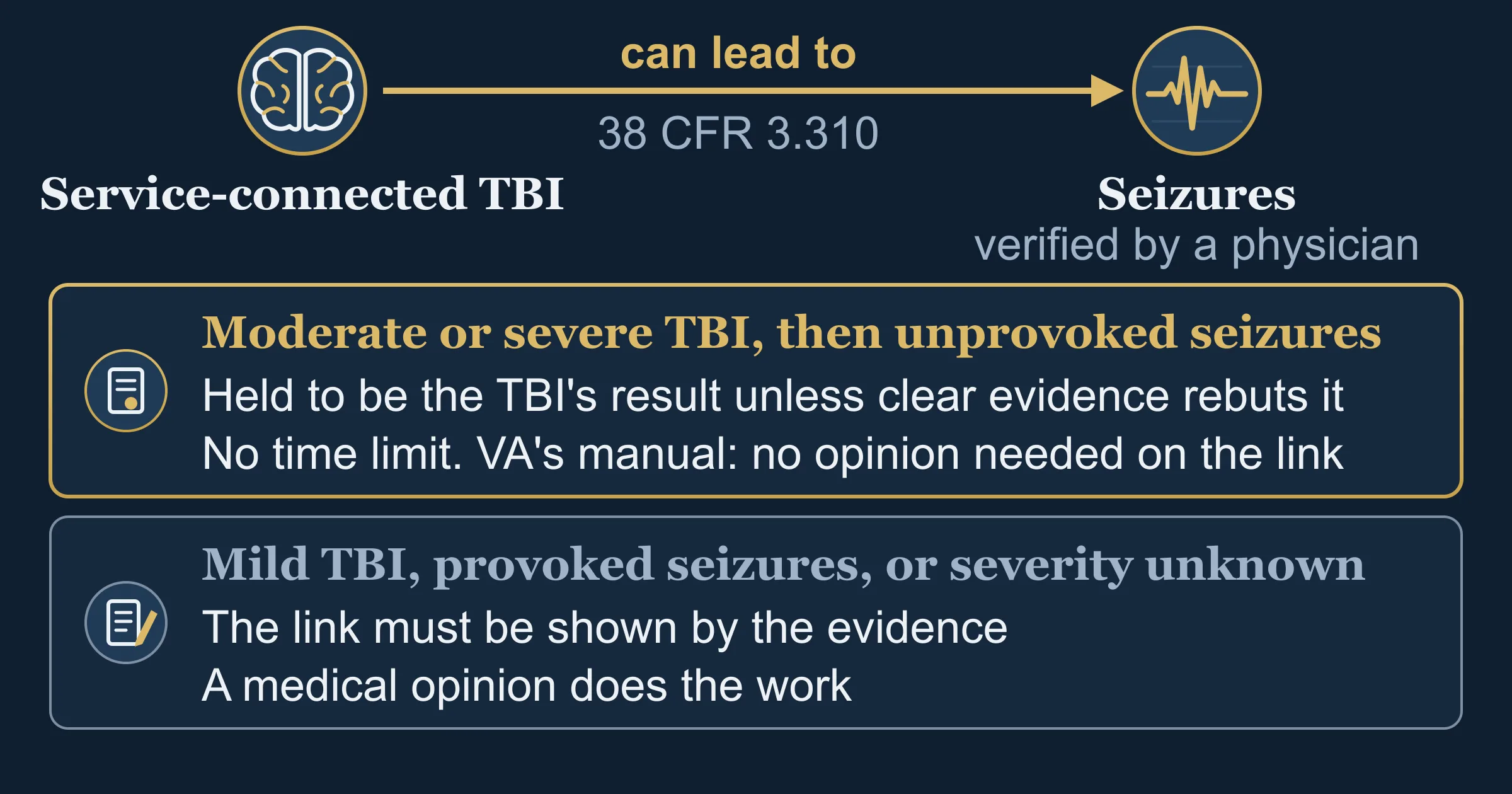
The 38 CFR 3.310(d) Rule for Unprovoked Seizures After a TBI
Since January 16, 2014, one paragraph of VA's secondary service connection regulation has supplied the link for five conditions, unless there is clear evidence to the contrary. Without a rule like it, the link has to be shown by the evidence, whether a VA examination, treatment records or a private medical opinion. 38 CFR 3.310(d)(1) opens:
“In a veteran who has a service-connected traumatic brain injury, the following shall be held to be the proximate result of the service-connected traumatic brain injury (TBI), in the absence of clear evidence to the contrary:”38 CFR 3.310(d)(1)
“Unprovoked seizures following moderate or severe TBI;”38 CFR 3.310(d)(1)(ii)
Read closely, a claim sits inside that entry when the first three points below are true and there is no clear evidence to the contrary; the fourth is what the entry leaves out.
- 1
The TBI is service connected
The rule applies only "in a veteran who has a service-connected traumatic brain injury". It does not service connect the TBI itself. That is the primary claim. VA has to service connect the TBI for this rule to apply, but it can decide both claims together, so the seizure claim does not have to wait for the TBI grant.
- 2
The TBI was moderate or severe
Mild does not qualify. Of the five conditions in 3.310(d)(1), depression is the only one that reaches a mild TBI. How VA decides the severity, and why your current TBI rating does not tell you, is the next section.
- 3
The seizures are unprovoked
The regulation uses the word and does not define it. The standalone word provoked appears nowhere in 3.310, and nowhere in the VA manual sections we read. What happens when a seizure had another trigger, or when the records leave it unclear, is covered below.
- 4
There is no time limit
Three of the five entries carry a window: dementias within 15 years, depression within 3 years or 12 months, and hormone deficiency within 12 months. The seizure entry has none, and neither does the Parkinsonism entry. A first seizure many years after the injury is not outside the rule for that reason alone.
Two limits on the rule matter. It holds the seizures to be the TBI's result "in the absence of clear evidence to the contrary", so it is a rule VA can rebut on evidence, not an automatic grant. And it decides only service connection. The rating is a separate step, covered further down.
Whether evidence of another cause is clear is decided on the whole record, so a VA opinion naming another cause is evidence to answer, not the end of the claim. In a 2026 Board decision set out below, a VA neurologist called the injury moderate and the seizures unprovoked but attributed them to a later fall. The Board made no finding that the injury was moderate or that the seizures were unprovoked, and it used the words 'clear evidence' only when reciting the regulation. It noted that no medical opinion of record weighed against the neurologist's before it denied the claim. Where a VA examiner names another cause, an opinion that addresses that cause by name is the evidence that can answer it.
What VA's manual tells its raters
The adjudication manual, M21-1, implements the rule in Part V, Subpart iii, Chapter 12, Section B, Topic 3. Its table at Block 3.e reads, for unprovoked seizures with an initial TBI severity of moderate or severe: "award SC." The dementia, depression and hormone-deficiency rows each add a time condition. The seizure row does not.
Block 3.a then carries the sentence that matters most on this page:
“Important: There is no need to obtain a medical opinion to determine whether the above conditions are associated with TBI when there is a TBI of a qualifying degree of severity.”M21-1, Part V, Subpart iii, Chapter 12, Section B, Block 3.a
If you are inside the rule, you may not need us
We write nexus letters, and this is still the honest reading. Where your service-connected TBI was moderate or severe and a physician has diagnosed unprovoked seizures, VA's own manual tells the rater there is no need to obtain a medical opinion on the link. Unless the record points to another cause, paying for one would buy an answer to a question the regulation has already answered. What such a claim may still need is evidence of the injury's severity, a clear diagnosis, and a clinical statement that the seizures are unprovoked, which the sections below cover.
One sentence in the same block reads, more broadly, that entitlement under 3.310(d) "depends upon the initial severity of the TBI and the period of time between the injury and onset of the secondary illness." That is true of three of the five conditions. It is not true of unprovoked seizures, whose own row in the manual's table carries no time condition, so do not let anyone tell you the seizures started too late to count under this rule.
The manual also has an instruction for the case where nobody filed. Block 3.g says that where one of the five conditions is identified in the evidence while VA is processing a claim unrelated to the service-connected TBI, "a claim for that secondary condition must be invited." And Block 3.h records that the rule took effect January 16, 2014, as a liberalizing regulation, which the manual tells raters to apply when setting effective dates and retroactive benefits.
Mild, Moderate or Severe: How VA Classifies the Original Injury
One of the findings that decides whether a seizure claim sits inside the rule is not a medical opinion about the seizures. It is how severe the brain injury was when it happened or shortly afterward. 38 CFR 3.310(d)(3) gives VA a table for that.
| Factor | Mild | Moderate | Severe |
|---|---|---|---|
| Structural imaging | Normal | Normal or abnormal (appears in more than one column; severity is decided on the other criteria) | Normal or abnormal (appears in more than one column; severity is decided on the other criteria) |
| Loss of consciousness (LOC) | 0 to 30 minutes | More than 30 minutes and less than 24 hours | More than 24 hours |
| Alteration of consciousness or mental state (AOC) | A moment up to 24 hours | More than 24 hours (moderate and severe share this criterion; severity is decided on the other criteria) | Same as moderate |
| Post-traumatic amnesia (PTA) | 0 to 1 day | More than 1 day and less than 7 days | More than 7 days |
| Glasgow Coma Scale (GCS), measured at or after 24 hours | 13 to 15 | 9 to 12 | 3 to 8 |
How the table is applied
38 CFR 3.310(d)(3)(ii) sets three rules. The classification is "based on the TBI symptoms at the time of injury or shortly thereafter, rather than the current level of functioning." A TBI does not need to meet every criterion in a column. And where it meets criteria in more than one column, VA ranks it "at the highest level in which a criterion is met, except where the qualifying criterion is the same at both levels."
The manual fills in that exception at Block 3.c. Because normal structural imaging, abnormal structural imaging and an alteration of consciousness over 24 hours can each appear at more than one level, VA classifies on the other criteria. If no other criteria are present, an alteration of consciousness over 24 hours is classified moderate, normal imaging mild, and abnormal imaging moderate.
So, outside those shared criteria, one criterion is enough. A loss of consciousness under 30 minutes does not make an injury mild if the post-traumatic amnesia lasted more than a day, because that single criterion places it in the moderate column, or in the severe column if the amnesia lasted more than 7 days.
The classification is VA's to make
Block 3.a of the manual says the determination of initial severity "is adjudicative", although "based on medical evidence", and continues: "That means the rating activity must decide the facts, such as initial severity, that correspond with the legal standard set forth in the regulation." A physician can describe what the documented findings show. A physician cannot decide which column the injury falls in, and an opinion that claims to is overstepping.
Your TBI rating does not tell you your severity
Note (4) to Diagnostic Code 8045 says the terms mild, moderate and severe TBI "refer to a classification of TBI made at, or close to, the time of injury rather than to the current level of functioning. This classification does not affect the rating assigned under diagnostic code 8045." The manual repeats the point from the other side at Block 2.b: a medical classification of severity at the time of the acute trauma "has no bearing on evaluation for Department of Veterans Affairs (VA) compensation purposes."
A veteran rated 70 percent for TBI residuals today can still have had a mild injury, and a veteran rated 10 percent can have had a severe one. The rating tells you about now. The rule asks about then.
Proving severity years later
If your records from the day of the injury are thin, Block 3.d of the manual lists evidence that may be relevant: lay statements from the veteran, lay statements from witnesses to the injury, history the veteran gave in later medical reports including VA examinations, and service treatment record findings at any time after the TBI. Its note says: "The evidence that establishes the initial severity of the TBI does not necessarily have to be contemporaneous to the injury as long as it relates to the condition of TBI at or shortly after the time of the injury."
The manual's worked example is a claim for Parkinsonism, not seizures, but the rule it applies is the same one. A Korean War veteran's discharge examination mentioned a TBI without enough detail to classify it. He stated that he lost consciousness during the Battle of Chosin Reservoir, and earlier VA examination reports recorded his account that fellow soldiers told him he was unconscious for almost an hour after two grenades exploded near him. The manual's analysis: his statement was credible and consistent with the circumstances of his service, "and therefore sufficient to determine that he experienced a moderate level of TBI during service."
Gathering that evidence is mostly a records and lay-statement task, and it is worth doing before anyone pays for an opinion. A statement is useful only if it is accurate: it should describe what the person saw, remembers or was told, and say which, because the manual's example turned on the statement being credible and consistent with the circumstances of service.
When the severity cannot be determined
Block 3.c also covers the case where the evidence will not settle it: "If the level of severity cannot be determined based on the available evidence, then apply the provisions of 38 CFR 3.310 (a) and (b) and order a VA examination/medical opinion as necessary." The claim does not end there. It moves to the ordinary secondary-claim rules, which is the subject of the next section.
Where a Nexus Letter Does the Work: Post-Traumatic Epilepsy Outside the Rule
Falling outside 3.310(d)(1) does not end a seizure claim. Where the TBI's severity is what keeps a claim outside the rule, the next paragraph of the regulation says so in terms:
“Neither the severity levels nor the time limits in paragraph (d)(1) of this section preclude a finding of service connection for conditions shown by evidence to be proximately due to service-connected TBI. If a claim does not meet the requirements of paragraph (d)(1) with respect to the time of manifestation or the severity of the TBI, or both, VA will develop and decide the claim under generally applicable principles of service connection without regard to paragraph (d)(1).”38 CFR 3.310(d)(2)
Under those general principles, the link between the TBI and the seizure disorder is not presumed. A claim outside the rule for another reason, such as a provoked seizure after a moderate or severe TBI, is decided on the same general principles under 38 CFR 3.310(a). Two routes within those principles need no link to the TBI at all: seizures that began in service can be service connected directly, and epilepsies are on the chronic-disease list in 38 CFR 3.309(a), so for a veteran with qualifying service, epilepsy that reached a 10 percent level within one year of separation can be presumed service connected under 38 CFR 3.307. For a claim brought as secondary to the TBI, the link has to be shown by the evidence, and VA's manual, at Part IV, Subpart i, Chapter 1, Section B, Block 1.e, says that medical expertise is ultimately required to establish entitlement to service connection on a secondary basis. That medical evidence can come from a VA examination, treating records or a private opinion. Here is where that applies.
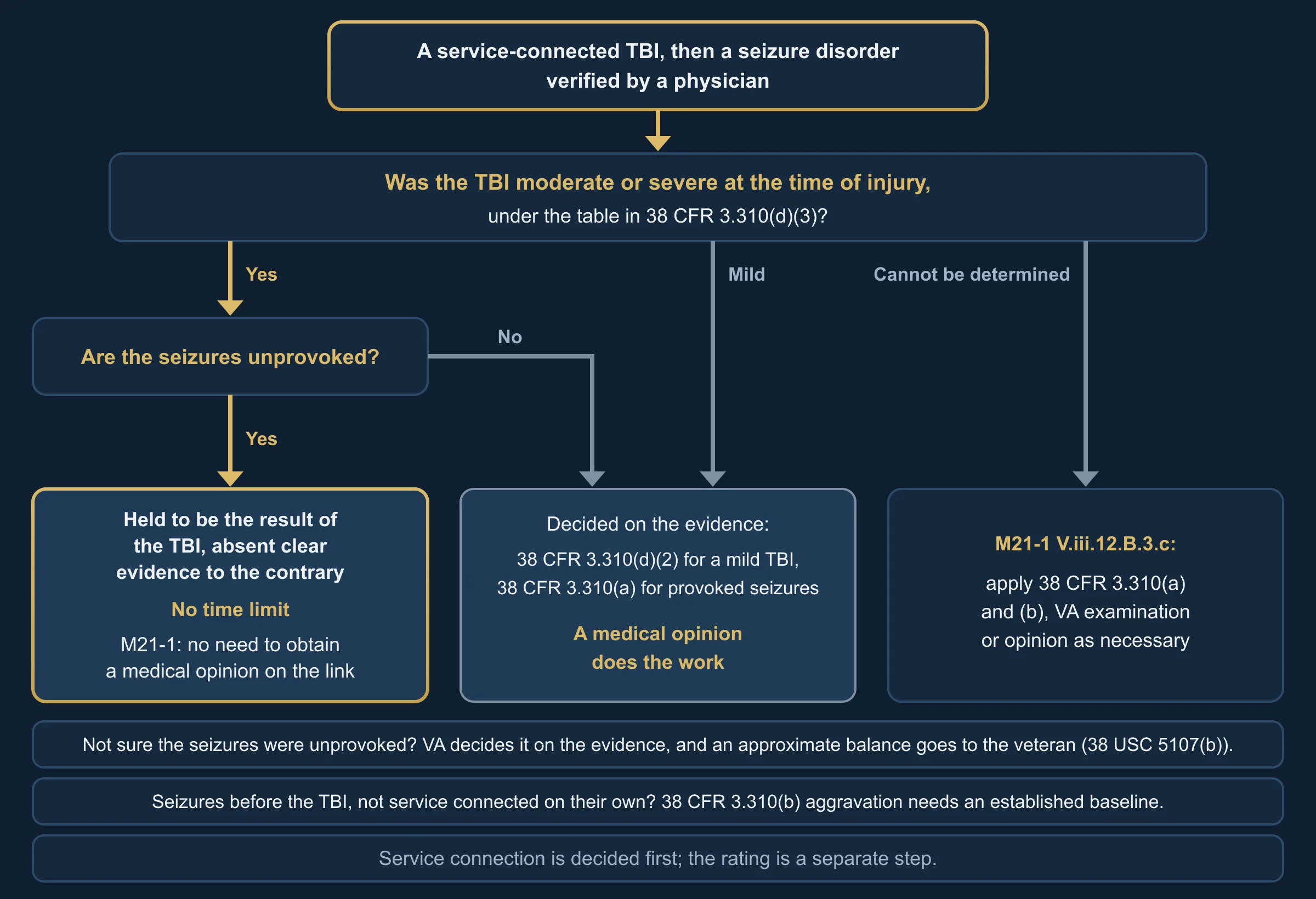
After a mild TBI
The seizure entry in 3.310(d)(1) does not reach a mild TBI at any interval, so a mild-TBI seizure claim brought as secondary to the TBI is a (d)(2) claim. The research on long-term seizure risk after mild brain injury is mixed, as the evidence section below sets out, which is exactly why a population figure cannot carry this claim and an individual opinion has to. The opinion has to explain why, for this veteran, the seizure disorder is at least as likely as not a result of the TBI, with the timeline, the injury and the other possible causes in the record addressed by name.
When the seizures were provoked
Because neither the regulation nor the manual defines unprovoked, the clinical literature is where the distinction lives, and it should be cited as literature, not as VA policy. A recommendation published in Epilepsia in 2010 defines an acute symptomatic seizure as "a clinical seizure occurring at the time of a systemic insult or in close temporal association with a documented brain insult," suggests treating as acute symptomatic the events "occurring within 1 week of stroke, traumatic brain injury, anoxic encephalopathy, or intracranial surgery", and says acute symptomatic seizures "must be distinguished from unprovoked seizures". A seizure in the first week after the injury therefore sits outside the word unprovoked in that literature. It does not make the seizures that come later provoked, and the literature counts it among the risk factors for later unprovoked seizures. Whether a later seizure was provoked by something else present at the time is a clinical judgment the records should state. Whether a seizure was provoked is a question of fact for VA. Under 38 USC 5107(b), when there is an approximate balance of positive and negative evidence on an issue material to the claim, VA gives the benefit of the doubt to the claimant, so a record that leaves the question in approximate balance after VA weighs it does not by itself take the claim outside the rule. That is why a treating clinician's statement on whether the seizures were provoked matters on either path. A seizure that falls outside the rule's word is not barred from service connection; it is decided on the evidence under the general secondary rule in 38 CFR 3.310(a), like any secondary condition the (d)(1) list does not cover.
When the severity cannot be established
As the severity section explains, the manual sends that claim to 38 CFR 3.310(a) and (b), with a VA examination or opinion as necessary. A VA opinion may be favorable. If it is negative, incomplete, or skips a question, there is more than one answer. Treating records that address the link are evidence in their own right; an inadequate VA opinion is VA's to correct, as the Board required in one decision below; and a private medical opinion can answer the specific question the VA opinion left open.
When the seizure disorder came first
A veteran who had seizures before the TBI is not claiming that the TBI caused them. If the seizures began in service, or began before service and worsened during it, they may be service connected in their own right under 38 CFR 3.303(a), which covers a disease "incurred coincident with service" or, if it preexisted service, "aggravated therein"; that claim does not run through 3.310 and is outside this page. Where the seizure disorder is not service connected on its own, the theory against the TBI is aggravation, set out next, and VA's manual rates it only on the difference between the current and baseline levels of severity.
Aggravation: a seizure disorder the TBI made worse
38 CFR 3.310(b) provides for service connecting "any increase in severity of a nonservice-connected disease or injury that is proximately due to or the result of a service-connected disease or injury". Its text still recites a deduction for natural progress. VA's manual has moved past that. Part V, Subpart ii, Chapter 2, Section D, Block 1.a, updated May 1, 2026, records the Federal Circuit's holding in Spicer v. McDonough, 61 F.4th 1360 (Fed. Cir. 2023), and says VA "will apply the broader but-for standard and will no longer consider natural progress of the NSC disability when deciding a claim based on aggravation of an NSC disability by an SC disability." It also says permanent worsening is not required.
What still decides these claims is the baseline: how severe the seizure disorder was before the TBI made it worse. Block 1.c lets the baseline rest on medical evidence created before the aggravation, the earliest medical evidence after it, or "any other credible evidence, including lay evidence, that supports establishment of the baseline", with a note that lay evidence on its own may not be sufficient. Block 1.f is the hard edge: "if no baseline can be established, no aggravation can be demonstrated", and such a claim must be denied once VA's duty to assist is fulfilled. The same block adds: "Do not assume a baseline of 0 percent when a baseline cannot be established by the available evidence." That sentence does not help a veteran who hopes an undocumented earlier period will be treated as seizure free. Earlier neurology records, medication history and seizure logs are what to look for first.
Block 1.h covers a worsening that does not move the rating: where the current and baseline levels fall at the same evaluation, VA is to "grant SC and assign a noncompensable evaluation."
Why a bare statement is not enough
The manual says the threshold for VA to order its own examination on a secondary claim is low, though there is still a threshold and examinations are not provided automatically, and it names kinds of evidence that may give the claim credibility, including the veteran's own statement describing the symptoms and how they relate to the primary disability, a medical treatise establishing a known relationship, and "a VA regulation or procedure" that defines the relationship. It also says that "A generalized statement merely asserting a conclusion that a condition is secondary to an SC disability is not sufficient" for that purpose. Writing only that your seizures come from your TBI is that kind of statement, and it is a long way from a grant.
Does a Doctor Have to See a Seizure? The Physician-Verification Rule
Epilepsy has its own verification rule in the rating schedule, and its exact words matter.
“When there is doubt as to the true nature of epileptiform attacks, neurological observation in a hospital adequate to make such a study is necessary. To warrant a rating for epilepsy, the seizures must be witnessed or verified at some time by a physician. As to frequency, competent, consistent lay testimony emphasizing convulsive and immediate post-convulsive characteristics may be accepted. The frequency of seizures should be ascertained under the ordinary conditions of life (while not hospitalized).”38 CFR 4.121, Identification of epilepsy
“Seizures must be witnessed or verified by a physician to warrant service connection (SC) for epilepsy. Verification may be by an electroencephalogram (EEG), which measures electrical activity in the brain. A physician does not have to witness an actual seizure before a diagnosis of epilepsy can be accepted for evaluation purposes. Verification by a physician based upon factors other than observing an actual seizure is sufficient.”M21-1, Part V, Subpart iii, Chapter 12, Section A, Block 1.b
Read the two together and four points follow. The regulation attaches the rule to the rating ("to warrant a rating for epilepsy"), and the manual applies it earlier, at service connection. Both say witnessed or verified, so a physician does not have to have seen a seizure, and the regulation adds that it can have happened "at some time". An EEG is one way to verify, not a requirement. And lay testimony may be accepted on how often the seizures happen if it is competent and consistent; the rule that allows it is in 4.121 and speaks only to frequency.
A spouse, coworker or friend who has seen your seizures can describe what happened during and right after them, which is the testimony 4.121 says may be accepted on frequency when it is competent and consistent. That is a different question from whether the attacks are epileptic, which is the physician's to verify.
A normal EEG does not end the claim
Because the manual names the EEG, a normal one can look like the end of the claim. It is not that simple. A 2010 review of routine outpatient EEGs at a VA medical center notes, as background from earlier studies, that a single routine outpatient EEG has been reported to have a sensitivity of 29 to 55 percent for epileptic discharges in suspected epilepsy. That range was reported by other studies, not measured in that one. In a 2017 Dutch study of 104 people with a first unprovoked seizure and a normal routine EEG, who then had a sleep-deprived or an ambulatory EEG, the follow-up test picked up epileptiform discharges in 45 percent (sleep-deprived) and 63 percent (ambulatory) of the patients clinically diagnosed with epilepsy. Epilepsy is diagnosed clinically, from the history, the witnessed events and the testing together.
What a nexus letter cannot do here
Verification and causation are separate questions, and a nexus letter only answers the second. If no physician has diagnosed a seizure disorder or verified your seizures, no opinion about the TBI can supply that. The step is a neurologist, not a letter.
Not every seizure-like event is epileptic
Psychogenic nonepileptic seizures look like epileptic seizures and are a different diagnosis. An International League Against Epilepsy task force report calls video EEG, which records an event together with brain activity, "the gold standard" for telling them apart, while setting out lower levels of diagnostic certainty for patients who cannot get one.
Both conditions appear in veterans after brain injury. In a 2018 study across three VA epilepsy monitoring units, with diagnoses confirmed by continuous video EEG, PTSD was present in 64 percent of veterans with psychogenic seizures and 13 percent of veterans with epilepsy. In a 2015 study at one VA monitoring unit, veterans with psychogenic seizures were more likely than those with epilepsy to cite a TBI as the cause, and the TBI they reported was mild in 87 percent of cases against 37 percent. These are referred samples, not population rates, and they say nothing about any one veteran. What they show is why the diagnosis should be settled by a neurologist before anyone writes about cause.
We found no guidance in VA's manual that addresses psychogenic nonepileptic seizures by name, and this page does not cover how such a claim is decided. If that is your diagnosis, the claim is a different claim, and your treating clinicians are the place to start.
How Post-Traumatic Epilepsy Is Rated, and Whether It Adds to Your TBI Rating
When seizures are service connected and evaluated separately from the TBI, they are rated under the epilepsy codes in 38 CFR 4.124a; when they can instead be folded into the TBI evaluation is covered further down this section. Grand mal epilepsy, Diagnostic Code 8910, is rated under the formula for major seizures, and petit mal, Diagnostic Code 8911, under the formula for minor seizures. The two kinds are defined by notes printed just before the formula.
- Major seizure
- "A major seizure is characterized by the generalized tonic-clonic convulsion with unconsciousness."
- Minor seizure
- "A minor seizure consists of a brief interruption in consciousness or conscious control associated with staring or rhythmic blinking of the eyes or nodding of the head (“pure” petit mal), or sudden jerking movements of the arms, trunk, or head (myoclonic type) or sudden loss of postural control (akinetic type)."
| Rating | Criteria, as printed |
|---|---|
| 100 percent | Averaging at least 1 major seizure per month over the last year |
| 80 percent | Averaging at least 1 major seizure in 3 months over the last year; or more than 10 minor seizures weekly |
| 60 percent | Averaging at least 1 major seizure in 4 months over the last year; or 9-10 minor seizures per week |
| 40 percent | At least 1 major seizure in the last 6 months or 2 in the last year; or averaging at least 5 to 8 minor seizures weekly |
| 20 percent | At least 1 major seizure in the last 2 years; or at least 2 minor seizures in the last 6 months |
| 10 percent | A confirmed diagnosis of epilepsy with a history of seizures |
Each row from 20 to 80 percent offers alternatives joined by or. The 10 percent row is different: it needs a confirmed diagnosis and a history of seizures together.
The three notes under the formula
- Note (1): "When continuous medication is shown necessary for the control of epilepsy, the minimum evaluation will be 10 percent. This rating will not be combined with any other rating for epilepsy." The bar on combining reaches other epilepsy ratings only.
- Note (2): "In the presence of major and minor seizures, rate the predominating type."
- Note (3): "There will be no distinction between diurnal and nocturnal major seizures."
Jacksonian and focal motor or sensory epilepsy (Diagnostic Code 8912) and diencephalic epilepsy (8913) are rated as minor seizures, except that in the presence of major and minor seizures the predominating type is rated. Psychomotor seizures (8914) are rated as major seizures when "characterized by automatic states and/or generalized convulsions with unconsciousness", and otherwise as minor seizures for the brief transient episodes the code lists.
Separate from the TBI rating, but only where the symptoms are separate
The TBI rating itself, Diagnostic Code 8045, sends seizures out of its own table. Its physical-dysfunction paragraph lists "seizures" among the residuals to evaluate "under an appropriate diagnostic code", and continues: "Evaluate each condition separately, as long as the same signs and symptoms are not used to support more than one evaluation, and combine under § 4.25 the evaluations for each separately rated condition." The table of ten facets that produces the TBI percentage does not contain the word seizure at all.
Note (1) to Diagnostic Code 8045 adds the condition that decides the money: "If the manifestations of two or more conditions cannot be clearly separated, assign a single evaluation under whichever set of diagnostic criteria allows the better assessment of overall impaired functioning due to both conditions. However, if the manifestations are clearly separable, assign a separate evaluation for each condition." 38 CFR 4.14 states the general version: "the evaluation of the same manifestation under different diagnoses" is to be avoided.
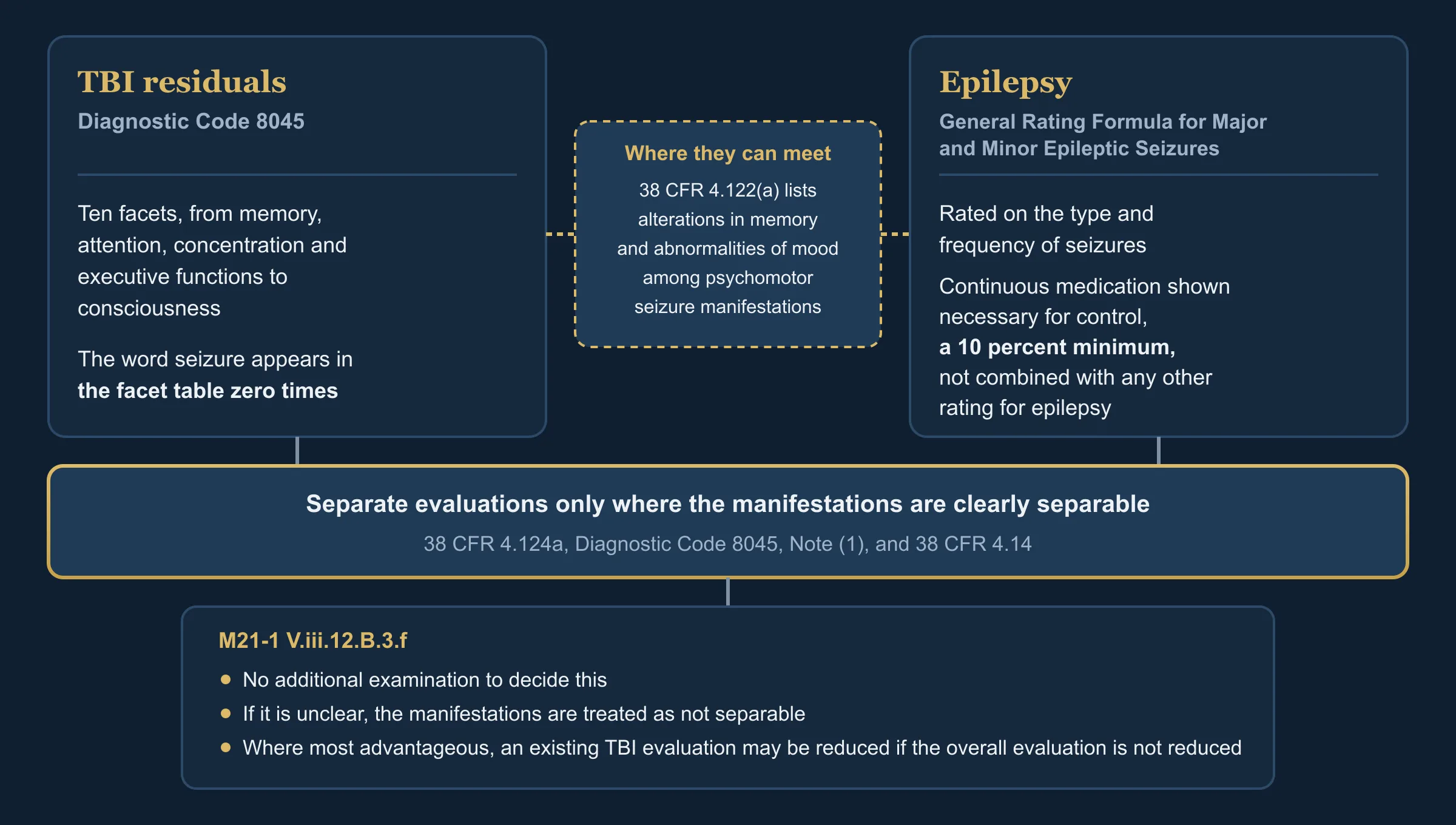
What the manual tells raters to do when a 3.310(d) condition is granted
Block 3.f of the TBI section tells raters to avoid pyramiding between the TBI evaluation and the symptoms now associated with the secondary condition, while "ensuring that the claimant receives the highest overall evaluation" under the combined ratings table. Then it says: "Depending on the most advantageous combined evaluation, it is permissible to reduce an existing TBI evaluation as long as the overall evaluation of both TBI and the separate secondary SC condition is not reduced."
Where the same symptoms apply to both disabilities, the rater is told to decide whether they belong entirely to one or the other and to "do not request an additional medical examination for this determination. If it is unclear, assume that the manifestations are not separable." Where they are clearly associated with one disability, the rater chooses the most advantageous of three options, and Option 2 keeps the symptoms under the TBI and does not award secondary service connection for the diagnosable condition, which is instead listed in the description of the TBI disability.
Where the two ratings can meet
In our reading, the overlap surface for seizures is narrower than it is for a mental-health residual of a TBI, because the epilepsy formula scores the type and frequency of seizures, which no TBI facet measures. Narrower is not none. 38 CFR 4.122(a) lists, among the manifestations of psychomotor seizures, "alterations in thinking (not open to reason), alterations in memory, abnormalities of mood or affect", and the TBI table has facets for memory and for neurobehavioral effects. In one 2026 Board decision set out below, VA examiners identified episodes of abnormal memory as a manifestation of the seizure disorder, and the Board kept them out of the TBI rating. Where the same symptoms could be counted toward both, that is the separability question, and since the manual tells the rater not to order an examination to resolve it, a clinician's account already in the file is the evidence that can keep it from defaulting to not separable.
Why a grant may not raise your combined rating
Put the pieces together and the honest answer is that service connection for the seizures is a real win that may or may not change your payment. Where continuous medication is shown necessary for the control of epilepsy, Note (1) sets a 10 percent minimum. Separate evaluations combine under 38 CFR 4.25, which is not addition. And where symptoms move from a TBI facet to the seizure rating, the manual lets VA reduce the TBI evaluation, where that gives the most advantageous combined evaluation, so long as the overall evaluation is not reduced. Anyone who promises that a seizure grant will raise your combined rating is promising something the rules do not.
Seizures and work
The epilepsy codes carry an unusual paragraph headed Epilepsy and Unemployability. It begins: "Rating specialists must bear in mind that the epileptic, although his or her seizures are controlled, may find employment and rehabilitation difficult of attainment due to employer reluctance to the hiring of the epileptic." Where there is a definite history of unemployment, it directs full development to find out whether the epilepsy is the determining factor, through a survey of education, occupations, places of employment and reasons for leaving, wages and number of seizures, conducted with the veteran's permission.
The rating formula is also set out, with the rest of the seizure claim, on our seizures condition page.
What the Research Shows About Post-Traumatic Epilepsy
Post-traumatic epilepsy is the clinical name for epilepsy that follows a brain injury. The research below can support a physician's reasoning. It cannot answer the question VA asks, which is about one veteran. Every figure comes from the published abstract of the study cited, in the units the authors used.
Risk rises with the severity of the injury
A population study of 4,541 children and adults in Olmsted County, Minnesota, published in the New England Journal of Medicine in 1998, compared new unprovoked seizures after brain injury with the rate expected in the population. The standardized incidence ratio was 1.5 after mild injury (95 percent confidence interval 1.0 to 2.2), with no increase over the expected number after five years; 2.9 after moderate injury (1.9 to 4.1); and 17.0 after severe injury (12.3 to 23.6). Those are ratios against the expected rate, not percentages of patients. The study's definitions of mild, moderate and severe are clinical ones and are not VA's table.
Ten-year risk in adults hospitalized for TBI
A Swedish national register study of 111,947 adults hospitalized for a first TBI between 2000 and 2010, against 325,881 matched controls, reported a 10-year epilepsy risk of 2.6 percent after mild TBI, 12.9 percent after focal cerebral injury, and 0.9 percent in the controls. Mild injuries managed without a hospital stay were not in the study.
In post-9/11 veterans
A 20-year matched cohort of 292,200 post-9/11 veterans, published in Epilepsia in 2025, found that veterans with a TBI had an adjusted hazard ratio of 6.76 for a later epilepsy diagnosis (95 percent confidence interval 6.33 to 7.21), with a median of 3.3 years from TBI documentation to the epilepsy diagnosis. The abstract does not split that figure by TBI severity. In an earlier study of 256,284 Iraq and Afghanistan veterans in VA care, a prior TBI was associated with higher odds of epilepsy: an adjusted odds ratio of 18.77 for penetrating TBI and 1.64 for other TBI. That study was cross-sectional, so it shows association, not cause.
Onset can come many years later
In the Vietnam Head Injury Study, 53 percent of 421 veterans with penetrating brain wounds had developed epilepsy by 15 years after injury. Their relative risk of developing epilepsy, against the age-matched general population, fell from about 580 in the first year to 25 after 10 years. When 199 of the study's veterans, whose injuries were mostly penetrating, were examined 30 to 35 years after injury, 87 had seizures, and 11 of those 87 (12.6 percent) reported that their epilepsy began more than 14 years after the injury. Penetrating combat wounds are a different injury from a closed head injury, so those figures do not transfer to a closed TBI. A Danish registry study of 1.6 million young people found epilepsy risk still raised more than 10 years after injury, at a relative risk of 1.51 after mild and 4.29 after severe brain injury. Late onset is consistent with the regulation's choice to give the seizure entry no time limit.
The evidence on mild TBI conflicts
The Minnesota study found no excess after mild injury beyond five years, while the Danish study found a raised risk beyond ten. They used different definitions of mild injury, different populations and different outcome measures. A 2026 study of 1,000 Azerbaijani veterans of the Second Karabakh War with mild TBI reported epilepsy within five years in 4.5 percent, against 1.3 percent of 1,000 veterans without TBI, and 5.7 against 2.3 percent after blast versus non-blast injury; it was not a US or VA cohort. We found no US veteran estimate for mild TBI alone.
Seizures in the first week are a different event
In a 1990 trial of 404 patients with serious head trauma, preventive phenytoin reduced seizures in the first week (3.6 percent against 14.2 percent on placebo) and did not prevent later ones; by two years, 21.1 percent of the placebo group had late seizures. That fits the clinical distinction between a seizure provoked by the acute injury and the unprovoked seizures of epilepsy. A first-week seizure is still relevant to what follows. A 2003 analysis of 783 high-risk patients from seizure-prevention trials listed early seizures among the factors linked to a higher risk of later unprovoked seizures, and the Swedish study of 111,947 adults above identified a seizure during the hospital stay for the injury as a risk factor for epilepsy.
After a first seizure following the injury
Among 63 adults with moderate to severe TBI, taking part in a trial of preventive phenytoin, who had a first late seizure (one more than seven days after the injury), an estimated 86 percent had another late seizure within about two years of the first. In a Swedish register study of people hospitalized for a TBI, the estimated 10-year risk of an epilepsy diagnosis after a first post-traumatic seizure was 41.1 percent, and 62.3 percent after focal cerebral injury, while after mild injuries the risk was similar to that after a first seizure in people with no prior TBI. The abstract does not say whether seizures in the first week were counted. The Swedish authors urged caution in diagnosing epilepsy from a first post-traumatic seizure.
What this means for the opinion
The research is clear that risk rises with severity, that it can last for years, and that it is real in veterans. It is not settled for mild TBI. That is the claim the regulation leaves to the evidence, and it is why an opinion on a mild-TBI seizure claim has to be about this veteran: the injury as documented, the timing of the first seizure, the diagnosis and how it was verified, and the other explanations in the record, with the literature stated accurately, including the part that does not help.
What a Nexus Letter for Seizures After a TBI Should Contain
These are the elements an opinion on this claim needs, in the order a rater reading it needs them.
- The records reviewed, namedService treatment records for the injury, any later TBI evaluations and VA examinations, neurology records, EEG and imaging reports, and the medication history. An opinion that does not say what it reviewed gives the rater no reason to trust it.
- The diagnosis, and how it was verifiedThe seizure disorder named, and the physician verification the rating schedule and the manual both require, whether by a witnessed event, an EEG, or other clinical findings.
- The injury, described rather than classifiedWhat the records and statements show about loss of consciousness, altered consciousness, post-traumatic amnesia, the coma scale and imaging at or near the time of injury. The classification is VA's to make, so the opinion describes the findings and leaves the column to the rater.
- The timeline, including the first weekWhen the injury happened, when the first seizure happened, and whether any seizure came within the first week, which the clinical literature treats as acute symptomatic rather than unprovoked, and also as a risk factor for later unprovoked seizures.
- Unprovoked or not, and whyA clinical statement on whether the seizures are unprovoked, with the reasons. The regulation turns on the word, so the answer bears on which path the claim takes. If the injury was moderate or severe and the treating records already describe the seizures as unprovoked, the rule may answer the link without a letter.
- Other possible causes, addressed by nameWhatever else in the record could explain the seizures, weighed openly. An opinion that ignores the other candidates reads as advocacy; one that weighs them and explains its conclusion is the kind a rater can rely on.
- Which symptoms belong whereWhere any symptoms could be counted toward both the TBI and the seizure rating, a clinical account of which belong to which. The manual tells the rater not to order an examination to sort this out, and to treat the symptoms as not separable if it is unclear.
- The literature, stated accuratelyThe relationship between brain injury and epilepsy, including what the research does not settle for mild TBI, applied to this veteran rather than offered in place of reasoning.
- The standard, stated as a conclusionAt least as likely as not, as a conclusion rather than a hedge. That phrase does not appear in the statute; 38 USC 5107(b) says that when there is an approximate balance of positive and negative evidence regarding any issue material to the determination of a matter, VA shall give the benefit of the doubt to the claimant. 38 CFR 3.102 adds that reasonable doubt is not a means of reconciling actual conflict or a contradiction in the evidence. The balance is weighed across all the evidence, not triggered by one document.
What we cannot do
We cannot supply a diagnosis or a physician verification your records do not contain, and we cannot decide how severe your TBI was; VA makes that finding. We will not write an opinion your records do not support. We cannot guarantee an outcome or predict a percentage. We write physician medical opinions; we do not represent veterans or file claims.
Who can write this kind of opinion, and how VA weighs a medical opinion, is covered in our guide to who can write a nexus letter.
What the Board of Veterans' Appeals Has Decided
We opened 62 Board decisions and read about 45 that were on topic at the level of the ORDER and the holding. The eight below show the range, denials and remands included. One gap should be stated up front: we did not find a grant of seizures secondary to a service-connected TBI, at any severity, that was won on a private medical opinion. The two secondary grants below rested on a VA examiner's statement and on VA treatment records, and neither states the TBI's severity. The grant below in which the Board found a private opinion highly probative, 26003596, was on a direct basis. That is not proof none exists, and the search was not exhaustive, so nothing here is a grant rate or a trend.
Board decisions are not precedent. Under 38 CFR 20.1303, previously issued Board decisions will be considered binding only with regard to the specific case decided, and each case presented to the Board is decided on its own facts.
Citation Nr 25010058 (2025)
Granted: service connection for a seizure disorder, secondary to a service-connected TBI.
The decisive evidence was a VA examiner who gave a negative opinion on a different theory, aggravation by PTSD, while listing TBI among the known causes of seizures. The Board wrote that "his opinion indicates that a common cause of seizures is TBI", found it persuasive, and resolved reasonable doubt in the claimant's favor. The decision does not cite 3.310(d) and does not state the TBI's severity.
Why it matters. A VA examination can carry the claim, even one written to answer another question. Read every examination in the file before paying for anything.
Citation Nr A23001048 (2023)
Granted: service connection for a residual seizure disorder, on a secondary basis.
The Board wrote that "Eleven VA medical records indicate a 'seizure disorder secondary to old head injury'", dated from 1996 to 2001, and found the nexus element satisfied. The negative VA opinions lost because they said there was no current diagnosis and did not address later VA records showing one. No private opinion was involved.
Why it matters. Years of treating notes that consistently link the seizures to the head injury are evidence in their own right.
Citation Nr 26003596 (2026)
Granted: service connection for complex partial seizure disorder, on a DIRECT basis under 38 CFR 3.303, not as secondary to a service-connected TBI.
The Board recorded that a VA specialist called the in-service TBI mild and said it "would be unlikely to cause seizures 30 years later." A private physician reviewed the file and cited the literature for the opposite view. The Board wrote: "The Board finds the aforementioned private medical opinions submitted in support of the claim to be highly probative", added that "several VA medical specialists and examiners have indicated that the Veteran's current seizures are a residual of his in-service TBI or could be", framed the dispute as "whether a TBI can cause seizures 30 years later", noted that no likely alternative cause had been identified, and found the evidence approximately balanced. It made no severity finding of its own.
Why it matters. The closest decision we found to the mild-TBI question, and it was decided on a different legal basis. The Board found a reasoned private opinion highly probative and added that several VA specialists and examiners had said the seizures are or could be a TBI residual. With VA opinions on the other side resting on the 30-year delay (one also on the injury's mildness) and no alternative cause identified, it found the evidence approximately balanced.
Citation Nr 25008291 (2025) and Citation Nr 26005061 (2026)
Remanded in 2025, then denied in 2026: service connection for a seizure disorder, including as secondary to service-connected concussions with headaches.
The 2025 remand records that an earlier denial had been vacated because the Board did not adequately address whether the veteran was "presumptively entitled to service connection for his seizures under 38 C.F.R. § 3.310(d)(1)(ii)". In 2026 the Board relied on a June 2021 opinion from a VA neurologist, obtained on an earlier remand, which it recorded as classifying the 1978 injury as moderate because the original emergency room and hospital records showed "persistent altered level of consciousness for over one hour which resolved over the ensuing 24 hours" (the table in 38 CFR 3.310(d)(3)(i) places an alteration of consciousness of "a moment up to 24 hrs" in the mild column), and as calling the seizures unprovoked but attributing them to "the fall with brain trauma in late 2015 leading to epilepsy/seizure onset in February 2016". After the 2025 remand, the veteran canceled the VA examination it ordered on severity and clear evidence, so the Board decided the claim on the evidence of record and said that evidence which may have been favorable could not be considered. It gave the June 2021 opinion great probative value and denied. In its 3.310(d) analysis the Board twice wrote that there was no evidence the seizures manifested "within three years of a moderate or severe traumatic brain injury or within 12 months of a mild traumatic brain injury", citing 3.310(d)(1)(iv), the depression entry. The seizure entry, 3.310(d)(1)(ii), has no time window. The Board's other reasons under (d)(1)(ii) were the neurologist's opinion that the seizure disorder and the TBI are not medically related, the 25-year gap he described, and his attribution of the seizures to the 2015 fall.
Why it matters. Not a clean example of the rule being rebutted. The Board made no finding that the TBI was moderate or that the seizures were unprovoked, and VA examiners disagreed on both. The table in 38 CFR 3.310(d)(3) places an alteration of consciousness of a moment up to 24 hours in the mild column, and the neurologist's stated basis, as the Board recorded it, was an altered level of consciousness for over one hour that resolved over the ensuing 24 hours. It used the words 'clear evidence' only when reciting the regulation, and it also applied a time window the seizure entry does not have. The veteran canceled the examination the 2025 remand ordered on severity and clear evidence. The Board gave great probative value to a detailed VA neurologist's opinion naming a later head injury, and no medical opinion in the file answered it.
Citation Nr 21073034 (2021)
Denied: service connection for seizures, including as secondary to a service-connected TBI.
A private practitioner had described the seizure disorder as status post traumatic brain injury. The Board wrote that "the practitioner did not support the opinion with adequate rationale", that it was unclear whether the practitioner had formed an opinion or transcribed the veteran's statements, and gave greater weight to two VA opinions that reasoned from the 38-year gap, normal imaging and an EEG with no seizure focus.
Why it matters. Here, one private note that called the seizure disorder status post TBI, with no rationale and possibly repeating the veteran's own account, lost to two VA opinions that gave reasons. Compare A23001048, where eleven VA treating notes calling the seizures secondary to the head injury carried the nexus against VA opinions that had missed the current diagnosis.
Citation Nr A26017035 (2026)
Remanded: a TBI rating appeal in which the seizures were argued to be part of the TBI.
The private opinion said the TBI likely causes or aggravates psychogenic nonepileptic seizures, in language the Board listed as speculative ("potentially contributing", "may trigger"), and the Board found "this opinion is speculative, and therefore of no probative value." It found the VA opinion inadequate too, as conclusory.
Why it matters. Here, the Board listed the opinion's hedged phrases as speculative, cited Obert, and gave it no probative value, even though it cited medical studies. Separately, and not a reason the Board gave, the opinion's seizure theory was psychogenic nonepileptic seizures, a different diagnosis from epilepsy. The remand asks whether the veteran has seizures caused or aggravated by the TBI without naming a type.
Citation Nr 26001646 (2026)
Rating appeal for insomnia disorder with TBI: the ORDER denies higher ratings, though the Board's conclusions of law and reasons assign 70 percent from October 24, 2023. The seizure disorder was separately rated.
The veteran's separately rated conditions, including a "seizure disorder at 20 percent from April 10, 2013", were all secondary to the TBI, and the Board held that "any symptoms considered in these secondary service-connected disabilities may not be used to evaluate his traumatic brain injury", citing 38 CFR 4.14.
Why it matters. A separate seizure rating is real, and the symptoms it rates are then taken out of the TBI's.
Citation Nr 26004805 (2026)
Granted: higher staged ratings for TBI, 10 percent and then 40 percent.
The Board wrote that "the VA examiners identified episodes of abnormalities of memory as a manifestation of his seizure disorder" and held that counting them again toward the TBI would be pyramiding under 38 CFR 4.14. The seizures in this case were separately service connected, and the decision does not say on what basis, so it is not an example of a secondary grant.
Why it matters. The overlap the rating section describes happens. Episodes of memory loss that VA examiners tied to the seizures were rated with the seizure disorder, and the Board refused to count them again toward a higher TBI memory level.
Three cautions. Every grant above granted service connection or a rating on its own record, and none shows that private or VA opinions win as a class. 26003596 is a direct-service-connection decision and should not be read as a secondary one. And we found no decision that reduced a TBI rating when seizures were separately granted, so the manual's permission to do that is stated on this page as the manual's, not as something we saw happen.
Is There a Claim Here, and Does It Need a Letter?
Check your file
Tick what is true of your file today. The first two items are requirements, and a letter about the seizures can supply neither. The items after them are not scored. All but the last are evidence a rater or a physician will want to see; the last is not evidence to collect, but a sign you may not need a letter.
Nothing is ticked yet. A result appears here as you go.
Frequently Asked Questions
Are seizures after a TBI automatically service connected?
No. On one path the regulation supplies the link: if VA finds that your service-connected TBI was moderate or severe at the time of injury, and a physician has verified seizures that are unprovoked, 38 CFR 3.310(d)(1)(ii) holds them to be its result unless there is clear evidence to the contrary, with no time limit, and VA's manual says there is no need to obtain a medical opinion on the link. Even then, VA still decides the severity, and whether the seizures are unprovoked, on the evidence, and clear evidence of another cause can rebut the rule. A secondary claim that falls short on the TBI's severity is decided under 3.310(d)(2) on the ordinary principles of service connection; other secondary seizure claims go under 3.310(a), or 3.310(b) where a seizure disorder that came first was made worse.
My TBI was classified as mild. Can I still claim my seizures?
First check how VA's own table classifies it. A mild label in a medical record is not VA's finding: VA classifies the original injury itself under the table in 38 CFR 3.310(d)(3), from evidence about the injury at or shortly after the time it happened, including lay statements from you and from witnesses, and that evidence need not date from the injury itself. If VA's classification is mild, you can still claim, but not under the seizure rule, which reaches only moderate or severe TBI. Under 38 CFR 3.310(d)(2) the claim is decided under the ordinary principles of service connection, so the link has to be shown by evidence, which can come from a VA examination, treating records or a reasoned private opinion; VA's manual says medical expertise is ultimately required on a secondary claim. The research on long-term seizure risk after mild TBI is mixed, which is why that evidence has to address your own record.
My first seizure came years after the injury. Is it too late?
Not under the seizure rule, which has no time limit, unlike the entries for dementia, depression and hormone deficiency. Research has found raised epilepsy risk more than ten years after brain injury. Outside the rule, a long gap is something the medical opinion has to explain rather than a bar.
Does a doctor have to see me have a seizure for VA to accept it?
No. 38 CFR 4.121 says the seizures must be witnessed or verified at some time by a physician, and VA's manual says a physician does not have to witness an actual seizure; verification by other factors, such as an EEG, is sufficient. People who have seen your seizures can describe them for the purpose of how often they happen.
My EEG was normal. Does that end my claim?
Not by itself. VA's manual names the EEG as one way to verify seizures, not the only way. A single routine EEG can miss epileptic activity, and epilepsy is diagnosed from the history, the witnessed events and the testing together. If no physician has diagnosed a seizure disorder, the next step is a neurologist.
How does VA decide whether my TBI was mild, moderate or severe?
From a table in 38 CFR 3.310(d)(3) covering imaging, loss of consciousness, altered consciousness, post-traumatic amnesia and the coma scale, applied to the injury at the time it happened or shortly afterward. A single criterion in a higher column is enough, except for entries the table places in more than one column: normal imaging, abnormal imaging, and an alteration of consciousness over 24 hours. For those, VA classifies on the other criteria, and with nothing else, normal imaging is mild, and abnormal imaging or an alteration of consciousness over 24 hours is moderate. Lay statements from you and from witnesses can count if VA finds them credible, so each should say what the person saw, remembers or was told, and which. The decision is VA's. Your current TBI rating does not reflect it.
Will a seizure rating raise my combined rating?
Not necessarily. When seizures are rated on their own, they are rated under the epilepsy codes, and the TBI facet table does not mention seizures, but a symptom that could count toward both ratings, such as memory or mood changes, can be counted only once. VA's manual tells the rater to ensure the highest overall evaluation: it allows an existing TBI evaluation to be reduced if the overall evaluation is not reduced, treats unclear overlapping symptoms as not separable, and, where overlapping symptoms are clearly tied to one condition, has the rater choose the most advantageous of three options, one of which keeps those symptoms in the TBI rating without a separate secondary grant. Separate ratings also combine under 38 CFR 4.25, which is not addition.
What if my seizures were diagnosed as psychogenic or nonepileptic?
That is a different diagnosis from epilepsy, and we found no guidance in VA's manual that addresses it by name. An International League Against Epilepsy task force calls video EEG the gold standard for that diagnosis, and sets out lower levels of diagnostic certainty for patients who cannot get one. This page does not cover how such a claim is decided. Your treating clinicians are the place to start.
How much does a nexus letter for seizures after a TBI cost?
Pricing for physician-authored nexus letters is on our pricing page. Read the section on the 3.310(d) rule first: if your TBI was moderate or severe and your seizures are unprovoked, VA's manual says no medical opinion is needed on the link.
Related guides
- Seizures and epilepsy: VA disabilityThe full seizure claim, direct and secondary, and the rating table row by row.
- Traumatic brain injury and VA disabilityThe primary claim: how a TBI is service connected and rated under Diagnostic Code 8045.
- Nexus letter for headaches secondary to TBIAnother TBI residual that carries its own diagnosis, and the manual's two-branch test for a separate headache rating.
- Nexus letter for depression secondary to TBIThe one 38 CFR 3.310(d) condition that reaches a mild TBI, and how VA separates a mental disorder from the TBI rating.
- Why you need a nexus letter for a secondary conditionThe general rules for secondary claims under 38 CFR 3.310.
Start With the Records From the Day of the Injury
Start with a free consultation. Tell us about your TBI rating decision, the records from the injury and your neurology records, and we will give you a straight answer on whether a medical opinion would add anything, including whether VA's own rule may already cover the link. If it would not, we will tell you that before you pay.
Citations & References
- 38 CFR 3.310, Disabilities that are proximately due to, or aggravated by, service-connected disease or injury, including paragraph (d) (eCFR) https://www.ecfr.gov/current/title-38/section-3.310
- 38 CFR 4.121, Identification of epilepsy (eCFR) https://www.ecfr.gov/current/title-38/section-4.121
- 38 CFR 4.122, Psychomotor epilepsy (eCFR) https://www.ecfr.gov/current/title-38/section-4.122
- 38 CFR 4.124a, Schedule of ratings, neurological conditions and convulsive disorders, including Diagnostic Codes 8045 and 8910 to 8914 (eCFR) https://www.ecfr.gov/current/title-38/section-4.124a
- 38 CFR 4.14, Avoidance of pyramiding (eCFR) https://www.ecfr.gov/current/title-38/section-4.14
- 38 CFR 4.25, Combined ratings table (eCFR) https://www.ecfr.gov/current/title-38/section-4.25
- 38 CFR 3.102, Reasonable doubt (eCFR) https://www.ecfr.gov/current/title-38/section-3.102
- 38 CFR 3.303, Principles relating to service connection (eCFR) https://www.ecfr.gov/current/title-38/section-3.303
- 38 CFR 3.307, Presumptive service connection for chronic, tropical, or prisoner-of-war related disease (eCFR) https://www.ecfr.gov/current/title-38/section-3.307
- 38 CFR 3.309, Disease subject to presumptive service connection, including epilepsies in paragraph (a) (eCFR) https://www.ecfr.gov/current/title-38/section-3.309
- 38 CFR 20.1303, Nonprecedential nature of Board decisions (eCFR) https://www.ecfr.gov/current/title-38/section-20.1303
- 38 USC 5107, Claimant responsibility; benefit of the doubt (govinfo, United States Code 2023 edition) https://www.govinfo.gov/content/pkg/USCODE-2023-title38/html/USCODE-2023-title38-partIV-chap51-subchapI-sec5107.htm
- M21-1, Part V, Subpart iii, Chapter 12, Section B, Traumatic Brain Injury, Blocks 1.e, 2.a to 2.g and 3.a to 3.h (VA KnowVA, article 554400000180832) https://www.knowva.ebenefits.va.gov/system/templates/selfservice/va_ssnew/help/customer/locale/en-US/portal/554400000001018/content/554400000180832/M21-1-Part-V-Subpart-iii-Chapter-12-Section-B-Traumatic-Brain-Injury-TBI
- M21-1, Part V, Subpart iii, Chapter 12, Section A, Neurological Conditions and Convulsive Disorders, Block 1.b (VA KnowVA, article 554400000180519) https://www.knowva.ebenefits.va.gov/system/templates/selfservice/va_ssnew/help/customer/locale/en-US/portal/554400000001018/content/554400000180519/M21-1-Part-V-Subpart-iii-Chapter-12-Section-A-Neurological-Conditions-and-Convulsive-Disorders
- M21-1, Part V, Subpart ii, Chapter 2, Section D, secondary service connection and aggravation, Blocks 1.a, 1.c, 1.f, 1.g and 1.h (VA KnowVA, article 554400000180484) https://www.knowva.ebenefits.va.gov/system/templates/selfservice/va_ssnew/help/customer/locale/en-US/portal/554400000001018/content/554400000180484/M21-1-Part-V-Subpart-ii-Chapter-2-Section-D-Secondary-Service-Connection-SC-and-Aggravation-of-Non-Service-Connected-NSC-Disabilities
- M21-1, Part IV, Subpart i, Chapter 1, Section B, Block 1.e, the examination threshold on secondary claims (VA KnowVA, article 554400000180495) https://www.knowva.ebenefits.va.gov/system/templates/selfservice/va_ssnew/help/customer/locale/en-US/portal/554400000001018/content/554400000180495/M21-1-Part-IV-Subpart-i-Chapter-1-Section-B-Evidentiary-Standards-for-Finding-an-Examination-or-Opinion-Necessary
- Annegers JF, et al. A population-based study of seizures after traumatic brain injuries. N Engl J Med. 1998 (PubMed) https://pubmed.ncbi.nlm.nih.gov/9414327/
- Karlander M, et al. Post-traumatic epilepsy in adults: a nationwide register-based study. J Neurol Neurosurg Psychiatry. 2021 (PubMed) https://pubmed.ncbi.nlm.nih.gov/33687971/
- Vadlamani S, et al. Mediators of epilepsy risk after traumatic brain injury: A 20-year U.S. veteran cohort study. Epilepsia. 2025 (PubMed) https://pubmed.ncbi.nlm.nih.gov/39729030/
- Pugh MJ, et al. The prevalence of epilepsy and association with traumatic brain injury in veterans of the Afghanistan and Iraq wars. J Head Trauma Rehabil. 2015 (PubMed) https://pubmed.ncbi.nlm.nih.gov/24695268/
- Salazar AM, et al. Epilepsy after penetrating head injury. I. Clinical correlates: a report of the Vietnam Head Injury Study. Neurology. 1985 (PubMed) https://pubmed.ncbi.nlm.nih.gov/3929158/
- Raymont V, et al. Correlates of posttraumatic epilepsy 35 years following combat brain injury. Neurology. 2010 (PubMed) https://pubmed.ncbi.nlm.nih.gov/20644150/
- Christensen J, et al. Long-term risk of epilepsy after traumatic brain injury in children and young adults: a population-based cohort study. Lancet. 2009 (PubMed) https://pubmed.ncbi.nlm.nih.gov/19233461/
- Shafiyev J, et al. Electroencephalographic findings and 5-year risk of posttraumatic epilepsy after mild traumatic brain injury: Insights from Second Karabakh War veterans. Epilepsia. 2026 (PubMed) https://pubmed.ncbi.nlm.nih.gov/41642101/
- Temkin NR, et al. A randomized, double-blind study of phenytoin for the prevention of post-traumatic seizures. N Engl J Med. 1990 (PubMed) https://pubmed.ncbi.nlm.nih.gov/2115976/
- Temkin NR. Risk factors for posttraumatic seizures in adults. Epilepsia. 2003 (PubMed) https://pubmed.ncbi.nlm.nih.gov/14511390/
- Haltiner AM, et al. Risk of seizure recurrence after the first late posttraumatic seizure. Arch Phys Med Rehabil. 1997 (PubMed) https://pubmed.ncbi.nlm.nih.gov/9344302/
- Karlander M, et al. Risk of Epilepsy Following a First Posttraumatic Seizure: A Register-Based Study. Neurol Clin Pract. 2025 (PubMed) https://pubmed.ncbi.nlm.nih.gov/39600560/
- Beghi E, et al. Recommendation for a definition of acute symptomatic seizure. Epilepsia. 2010 (PubMed) https://pubmed.ncbi.nlm.nih.gov/19732133/
- LaFrance WC Jr, et al. Minimum requirements for the diagnosis of psychogenic nonepileptic seizures: a staged approach: a report from the International League Against Epilepsy Nonepileptic Seizures Task Force. Epilepsia. 2013 (PubMed) https://pubmed.ncbi.nlm.nih.gov/24111933/
- Salinsky M, et al. Psychiatric comorbidity and traumatic brain injury attribution in patients with psychogenic nonepileptic or epileptic seizures: A multicenter study of US veterans. Epilepsia. 2018 (PubMed) https://pubmed.ncbi.nlm.nih.gov/30144027/
- Salinsky M, et al. Traumatic brain injury and psychogenic seizures in veterans. J Head Trauma Rehabil. 2015 (PubMed) https://pubmed.ncbi.nlm.nih.gov/24901325/
- Bozorg AM, et al. The yield of routine outpatient electroencephalograms in the veteran population. J Clin Neurophysiol. 2010 (PubMed) https://pubmed.ncbi.nlm.nih.gov/20461015/
- Geut I, et al. Detecting interictal discharges in first seizure patients: ambulatory EEG or EEG after sleep deprivation? Seizure. 2017 (PubMed) https://pubmed.ncbi.nlm.nih.gov/28797915/
M21-1 citations name the part, subpart, chapter, section and block. The manual is published on VA's KnowVA portal, which loads its text with JavaScript, so a link may open an apparently empty page for a moment. The manual text quoted here was read on October 4, 2026. Figures from studies come from each PubMed abstract.