
Welcome to Patriot Path
Nexus Letters for Seizure Disorders
Licensed Physician, MD | Patriot Path Medical Team
Specializing in VA neurological evaluations and independent medical opinions • Last updated: October 2026
Board-certified physicians specializing in VA disability documentation. Meet our clinicians → • Our review process →
Seizures can start years after the event that caused them, such as a head injury or a toxic exposure in service. Epilepsy is unpredictable and disabling. It can cost you your license, your job, and your independence. The VA rates it by how often the seizures hit, so the record of your seizures is everything.
Where VA's own rules do not already supply the link, a nexus letter ties the seizures to their cause. Our physicians connect your seizure disorder to your service, or to a service-connected condition like a TBI, in the language the VA expects. One flat fee of $1,500, and the first consultation is free.
How VA Rates Seizure Disorders
The VA rates epilepsy under 38 C.F.R. § 4.124a, DC 8910 (grand mal) and DC 8911 (petit mal), using one General Rating Formula. The rating turns on how often you have seizures and what kind. Here is the formula:
| Rating | What it generally takes | Monthly pay (approx) |
|---|---|---|
| 100% | An average of at least 1 major seizure a month over the last year. | ~$3,939/mo |
| 80% | An average of at least 1 major seizure every 3 months over the last year; or more than 10 minor seizures a week. | ~$2,102/mo |
| 60% | An average of at least 1 major seizure every 4 months over the last year; or 9 to 10 minor seizures a week. | ~$1,435/mo |
| 40% | At least 1 major seizure in the last 6 months, or 2 in the last year; or 5 to 8 minor seizures a week. | ~$796/mo |
| 20% | At least 1 major seizure in the last 2 years; or at least 2 minor seizures in the last 6 months. | ~$357/mo |
| 10% | A confirmed diagnosis of epilepsy with a history of seizures. (Also the minimum if you need daily medication to control it.) | ~$180/mo |
Two definitions drive the formula. A major seizure is a generalized convulsion with loss of consciousness. A minor seizure is a brief lapse: staring or blinking, a sudden jerk, or a sudden loss of posture, without a full convulsion. A few rules follow. If you have both kinds, the VA rates the type that happens more. If you need continuous medication to keep seizures controlled, the minimum rating is 10%. And there is no difference between a daytime and a nighttime major seizure. Because the rating turns on frequency, keep a seizure log.
Pay figures are approximate 2026 rates (effective December 1, 2025) for a single veteran with no dependents. Check VA.gov for current amounts.
Estimate your seizure rating (DC 8910/8911)
The rating turns on how often your seizures happen. Answer based on your seizure history over the past year or two. A major seizure is a convulsion with loss of consciousness; a minor seizure is a brief lapse. This is a rough orientation, not a rating decision.
Making a VA Disability Claim for Seizure Disorders
A VA disability claim for a seizure disorder needs three things to line up:
A current diagnosis, witnessed or verified by a physician
38 C.F.R. 4.121 is specific to epilepsy and has no equivalent for most conditions: to warrant a rating, the seizures must be witnessed or verified at some time by a physician. The rule is written as 'witnessed or verified', so a physician does not have to see a seizure happen, but the regulation does not define what verification requires and VA decides that on the record in front of it. On frequency, the same section says competent, consistent lay testimony emphasizing convulsive and immediate post-convulsive characteristics may be accepted, which is permission for the rater rather than a guarantee, and it does not reach whether the attacks are epileptic.
A service connection
Either a cause in service (a head injury or toxic exposure), or a link to a service-connected condition such as a TBI.
A medical nexus
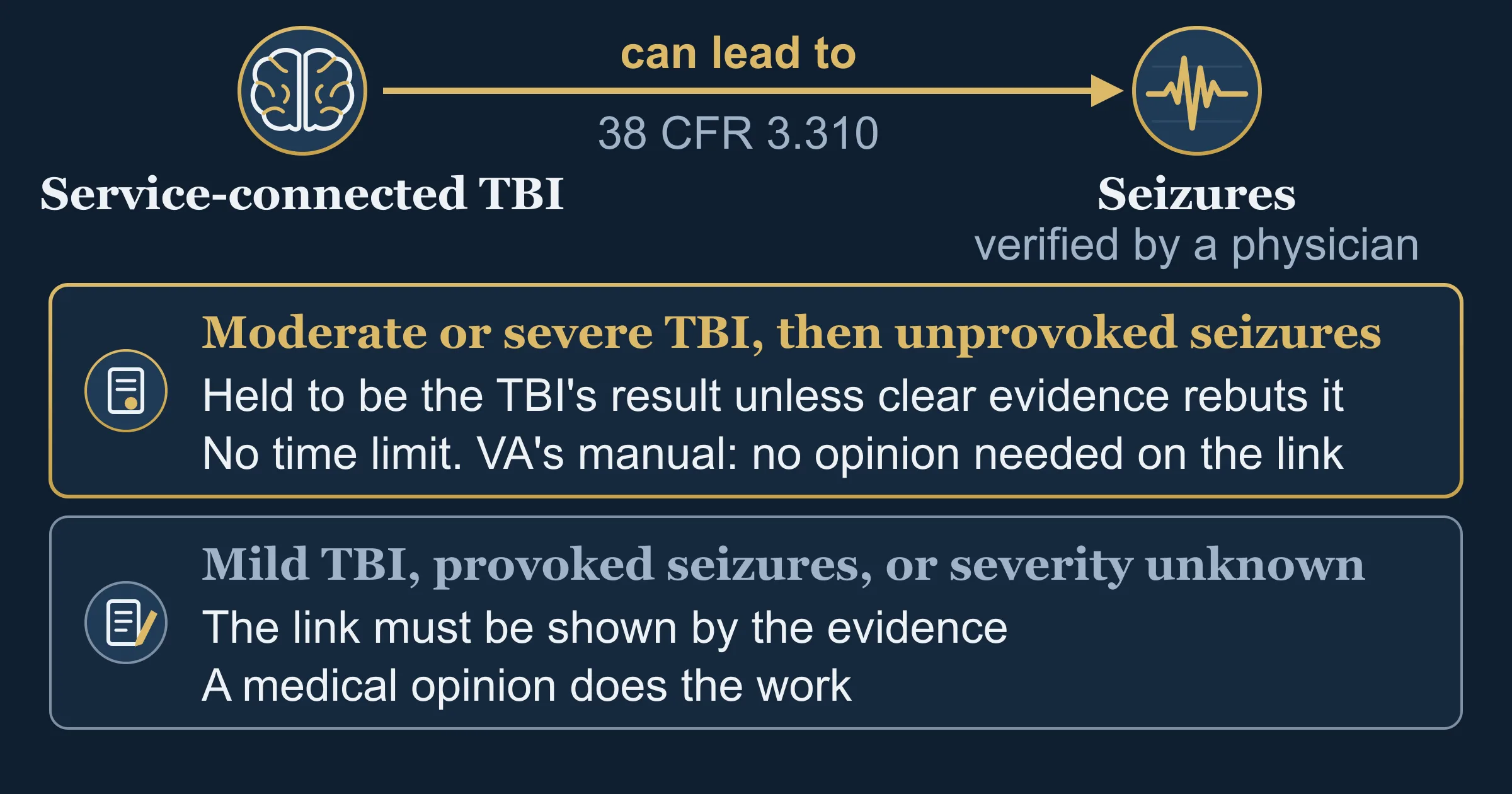
A qualified opinion that the seizure disorder is 'at least as likely as not' connected to your service or a service-connected cause, unless a regulation already supplies the link, as 38 C.F.R. 3.310(d) does for unprovoked seizures after a moderate or severe service-connected TBI.
Seizures can start long after the cause, which makes the link hard to prove without help. One path is post-traumatic epilepsy after a service-connected TBI, and on that path a nexus letter is not always needed: where the TBI was classified moderate or severe and the seizures are unprovoked, VA's own adjudication manual tells the rater there is no need to obtain a medical opinion on whether the seizures are associated with the TBI. An opinion earns its keep where VA points to another cause, where the TBI was mild, where the seizures were provoked, where the initial severity cannot be established from the records, or where the claim otherwise falls outside 38 C.F.R. 3.310(d). The 'at least as likely as not' standard (a 50% or better chance) comes from the benefit-of-the-doubt rule in 38 U.S.C. § 5107(b), carried out in 38 C.F.R. § 3.102.
How to Connect Seizure Disorders to Service
There are a few ways to tie a seizure disorder to your service. For seizures, a service-connected head injury is the link the regulations address most directly.
Secondary connection
A service-connected condition caused the seizures (38 C.F.R. § 3.310).
- A TBI. Post-traumatic epilepsy after a service-connected brain injury can be claimed as secondary, and 38 C.F.R. 3.310(d) addresses it directly. Nexus letter for seizures secondary to TBI →
- Other brain conditions. A stroke, brain injury, or other service-connected neurological condition can trigger seizures.
Direct connection
The cause happened in service.
- A head injury. A blast, fall, or impact in service that injured the brain.
- Toxic exposure. Some toxic exposures are linked to seizure disorders.
Aggravation
You had a seizure disorder before service, and service made it permanently worse.
- Worsened by service. The seizures got more frequent or more severe during active duty, beyond normal change over time.
Secondary Conditions
Seizures can have a cause behind them, and they reach into the rest of life. Documenting both directions gives VA the full picture of what the seizures have done.
A seizure disorder may be secondary to
- A TBI. Post-traumatic epilepsy after a service-connected head injury can be claimed as secondary, and where the injury was classified moderate or severe the regulation holds unprovoked seizures to be its result, absent clear evidence to the contrary. Nexus letter for seizures secondary to TBI →
- Other brain conditions. A stroke or other service-connected brain condition can trigger seizures.
Conditions that may follow seizures
- Depression or anxiety. Living with unpredictable seizures wears on mental health and can be claimed as secondary.
- Injuries from seizures. Falls and injuries during a seizure can themselves be service-connected.
- Unemployability (TDIU). Seizures can cost you a driver's license and steady work. TDIU can pay at the 100% rate, if you qualify, even when the schedular rating is lower.
What to Gather - Evidence Checklist
Gather these before you file or ask for a letter. For seizures, the seizure log and the diagnosis carry the claim, because the rating turns on how often they happen.
Frequently Asked Questions
How does the VA rate seizures?
By how often they happen, under 38 C.F.R. 4.124a (DC 8910 and 8911). It runs from 10% for a confirmed diagnosis with a history of seizures up to 100% for an average of at least one major seizure a month over the last year. Minor seizures are rated on their own frequency scale.
What counts as a major versus a minor seizure?
A major seizure is a generalized convulsion with loss of consciousness. A minor seizure is a brief lapse, like staring, blinking, a sudden jerk, or a sudden loss of posture, without a full convulsion. The VA uses both in the rating formula.
Can seizures after a TBI be service-connected?
Yes, and if your TBI was classified moderate or severe at the time of injury, 38 C.F.R. 3.310(d) goes further: it holds unprovoked seizures to be a proximate result of the TBI in the absence of clear evidence to the contrary, with no time limit attached. Whether the seizures then get their own rating on top of the TBI rating is a separate question. Diagnostic Code 8045, Note (1) allows a separate evaluation only where the manifestations of the two conditions are clearly separable, and where they are not, VA assigns a single evaluation under whichever criteria better assess overall impaired functioning. VA may also reduce an existing TBI evaluation when the same symptoms move across, so long as the overall evaluation of both conditions is not reduced.
I take medication and rarely have seizures now. Can I still be rated?
Yes. If you need continuous medication to control epilepsy, the minimum rating is 10%. Keep your medication records, and keep logging any breakthrough seizures.
Do I need a nexus letter?
It depends on the path. If your TBI was classified moderate or severe at the time of injury and the seizures are unprovoked, 38 C.F.R. 3.310(d) already holds the seizures to be a proximate result of the TBI in the absence of clear evidence to the contrary, and VA's adjudication manual tells the rater there is no need to obtain an opinion on that association. An opinion earns its keep where VA points to another cause, where the TBI was mild, where the seizures were provoked, where the initial severity cannot be established from the records, or where the claim rests on service directly rather than on a service-connected TBI.
What does it cost, and how do we start?
Patriot Path charges $1,500 flat for a nexus letter, and the first consultation is free. Book a consultation and we will give you a straight answer on whether a letter can help your claim.
The rating turns on frequency. Make sure yours is on the record.
Let our physicians prepare a seizure-disorder nexus letter that meets the VA's evidence standards and supports the benefits you earned.
Sources & Regulatory References
- VA disability compensation (VA.gov) https://www.va.gov/disability/
- 2026 VA disability compensation rates (VA.gov) https://www.va.gov/disability/compensation-rates/veteran-rates/
- 38 CFR 4.124a, Schedule of ratings, neurological conditions, including DC 8910/8911 and the seizure formula (eCFR) https://www.ecfr.gov/current/title-38/section-4.124a
- 38 CFR 3.310, Secondary service connection (eCFR) https://www.ecfr.gov/current/title-38/section-3.310
- 38 CFR 3.303, Principles relating to service connection (eCFR) https://www.ecfr.gov/current/title-38/section-3.303
- 38 U.S.C. 5107, Benefit of the doubt (Cornell LII) https://www.law.cornell.edu/uscode/text/38/5107