
Welcome to Patriot Path
Nexus Letters for Traumatic Brain Injury
Licensed Physician, MD | Patriot Path Medical Team
Specializing in VA neurological evaluations and independent medical opinions • Last updated: October 2026
Board-certified physicians specializing in VA disability documentation. Meet our clinicians → • Our review process →
TBI is a signature wound of the post-9/11 wars, and one of the hardest to prove on paper. A blast, an IED, a vehicle rollover, a hard fall in training. The hit may have seemed minor at the time, and the records may say nothing. Years later the memory gaps, the headaches, and the short fuse are still there.
A nexus letter ties it together. Our physicians connect your brain injury, and the symptoms that came with it, to your service, in the language the VA expects. One flat fee of $1,500, and the first consultation is free.
How VA Rates TBI
The VA rates TBI under 38 C.F.R. § 4.124a, Diagnostic Code 8045. An exam scores how the injury affects ten areas of how your brain works, from memory to judgment to consciousness. Your single worst area sets the rating. The levels line up like this:
| Rating | What it generally takes | Monthly pay (approx) |
|---|---|---|
| 100% | A 'total' level in any one area. For example, you are not oriented to person, place, time, or situation, or you cannot communicate at all. | ~$3,939/mo |
| 70% | Your worst area is at level 3. For example, near-constant trouble with memory, judgment, or getting along with people. | ~$1,808/mo |
| 40% | Your worst area is at level 2. For example, frequent memory or attention problems that get in the way of daily tasks. | ~$796/mo |
| 10% | Your worst area is at level 1. For example, mild but real trouble with memory or focus. | ~$180/mo |
| 0% | All areas at level 0. A diagnosed TBI, but no measurable loss of function yet. Still service-connected. | $0/mo |
Two things make TBI different. First, your rating comes from your single worst area, not the total of all ten. Second, a TBI symptom that carries its own diagnosis can be rated under its own code and combined with the TBI rating, but only where its manifestations are not the same ones already used to score an area of the TBI evaluation. Migraines (DC 8100), a mental health condition like PTSD or depression (38 C.F.R. § 4.130), seizures, and hearing loss or tinnitus from the same blast are each candidates for a separate evaluation on that test, which is why a TBI claim can result in several ratings rather than one. It does not automatically raise your combined rating. The 'mild', 'moderate', or 'severe' label from the day you were injured does not set your rating.
Pay figures are approximate 2026 rates (effective December 1, 2025) for a single veteran with no dependents. Check VA.gov for current amounts.
How the VA scores a TBI
The TBI exam, and the rating, work through ten areas of how your brain functions. Each one gets a level. Here is the short version.
- 1
Ten areas get scored
Memory and attention, judgment, social interaction, orientation, motor activity, visual-spatial sense, subjective symptoms (like headaches or dizziness), neurobehavioral effects (like irritability), communication, and consciousness.
- 2
Each area gets a level from 0 to 3, or 'total'
Level 0 means normal. Level 3 means severe. 'Total' is the worst, and it is only used for the most serious areas.
- 3
Your highest single area sets the rating
Level 0 is 0%, level 1 is 10%, level 2 is 40%, level 3 is 70%, and a 'total' in any area is 100%. The areas are not added up.
- 4
Separate diagnoses can be rated on their own
If a symptom has its own diagnosis, like migraines or PTSD, it can be rated under its own code and combined with the TBI rating, but only where its manifestations are separable from the ones already scoring an area above. It does not automatically raise your combined rating.
Get tested. A neuropsychological exam documents these areas far better than a short office visit, and the rating turns on what is in the record.
Making a VA Disability Claim for TBI
A VA disability claim for a TBI needs three things to line up:
A current diagnosis
A TBI diagnosis, ideally backed by neurology and neuropsychological testing that documents the ten areas the rating uses.
A service connection
An in-service head injury or blast exposure, even if it was written off as minor at the time.
A medical nexus
A qualified opinion that your TBI is 'at least as likely as not' connected to that in-service event.
The nexus is where TBI claims fall apart, when the original injury was never documented. A blast that rang your bell on patrol may never have made it into your medical record. Where the record does not already show the link, a nexus letter can supply it: a written medical opinion connecting your brain injury, and the symptoms you live with, to your service. The 'at least as likely as not' standard (a 50% or better chance) comes from the benefit-of-the-doubt rule in 38 U.S.C. § 5107(b), carried out in 38 C.F.R. § 3.102.
How to Connect TBI to Service
A TBI claim is a direct claim when it is tied to a head injury in service. The conditions the brain injury caused are claimed on their own, and whether one earns a separate rating depends on whether its symptoms can be separated from those already rating the TBI.
Direct connection
A head injury happened in service.
- Blast exposure. An IED, RPG, mortar, or breaching blast, even with no visible wound.
- Impact injuries. A vehicle rollover, a fall, a training accident, or a sports or combatives injury.
Secondary connection
A service-connected condition led to the head injury (38 C.F.R. § 3.310).
- A fall or blackout. A service-connected condition that caused a fall, a seizure, or a blackout that led to a head injury.
Aggravation
You had a head injury before service, and service made the residuals permanently worse.
- Worsened by service. An old head injury whose symptoms got worse after an in-service blast or impact.
Secondary Conditions
TBI can bring other conditions with it. The same blast or impact, and the brain injury itself, can drive a long list of them. One that carries its own diagnosis can be rated under its own code where its symptoms are clearly separate from those already used to rate the TBI, which does not automatically raise your combined rating.
A TBI claim can also be secondary to
- A service-connected fall or seizure. If a service-connected condition caused the accident that injured your head.
- Blast exposure already on file. If the same in-service blast is already tied to your tinnitus or hearing loss, that record supports the TBI too.
Conditions that can be secondary to a TBI
- Migraines and post-traumatic headaches. Where the headache disorder is distinctly diagnosed and its symptoms are separable from those rating the TBI, it can be evaluated under DC 8100. Nexus letter for headaches secondary to TBI →
- PTSD, depression, or anxiety. Mood and behavior changes can follow a brain injury. Without a diagnosed mental disorder, they are scored inside the TBI rating. A diagnosed condition like PTSD or depression is rated on its own only where an examiner can separate its symptoms from those of the TBI; if not, VA assigns one rating for both under whichever code gives the higher evaluation. Depression is the route 38 C.F.R. 3.310(d) addresses directly, and our dedicated guide covers it. Nexus letter for depression secondary to TBI →
- Seizures. A brain injury can lead to post-traumatic epilepsy. Nexus letter for seizures secondary to TBI →
- Tinnitus and hearing loss. The blast that caused the TBI can damage hearing at the same time.
What to Gather - Evidence Checklist
Gather these before you file or ask for a letter. For TBI, the testing and the proof of the in-service event do the heavy lifting.
Frequently Asked Questions
How does the VA rate a TBI?
Under 38 C.F.R. 4.124a, Diagnostic Code 8045. An exam scores ten areas of how your brain works, from memory to consciousness. Your single worst area sets the rating: level 0 is 0%, level 1 is 10%, level 2 is 40%, level 3 is 70%, and a 'total' in any area is 100%. The areas are not added together.
Can I be rated for my TBI and my migraines and PTSD?
You can be, and it is worth raising. Symptoms that carry their own diagnosis, like migraines (DC 8100) or PTSD (rated under 4.130), can be rated under their own codes and combined with the TBI rating, which is why a TBI claim can result in several ratings rather than one. It is conditional, though: the separate evaluation holds only where those manifestations are not the same ones already used to score an area of the TBI evaluation.
My head injury is not in my records. Can I still claim it?
Yes. Not every blast or fall was written up. Buddy statements, incident reports, deployment history, and a current diagnosis can together show the injury happened. A medical opinion, from a VA examiner, a treating provider or a private physician, can then tie them to your TBI.
Does the 'mild TBI' label hurt my claim?
Not for the TBI itself. 'Mild', 'moderate', and 'severe' describe the injury on the day it happened, and the rating schedule says that label does not affect the TBI rating, which is based on how the injury affects you now, across those ten areas. The label can matter for some secondary claims. Under 38 C.F.R. 3.310(d), VA holds unprovoked seizures, parkinsonism, certain dementias, and certain hormone-deficiency diseases to be the result of a service-connected TBI, absent clear evidence to the contrary, only after a moderate or severe injury (the dementia and hormone entries also have time limits), and holds depression after a mild injury to be its result only if the depression appeared within 12 months. A claim outside those limits is not barred: VA decides it on the evidence under 3.310(d)(2), which is where a medical opinion does the work.
Do I need a nexus letter for a TBI?
Not always. It can help, especially when the original injury was not documented. VA needs evidence linking your current TBI to the in-service event, and that evidence can come from a VA examination, treating records or a private medical opinion such as a nexus letter backed by testing.
What does it cost, and how do we start?
Patriot Path charges $1,500 flat for a nexus letter, and the first consultation is free. Book a consultation and we will give you a straight answer on whether a letter can help your TBI claim.
Guides for this condition
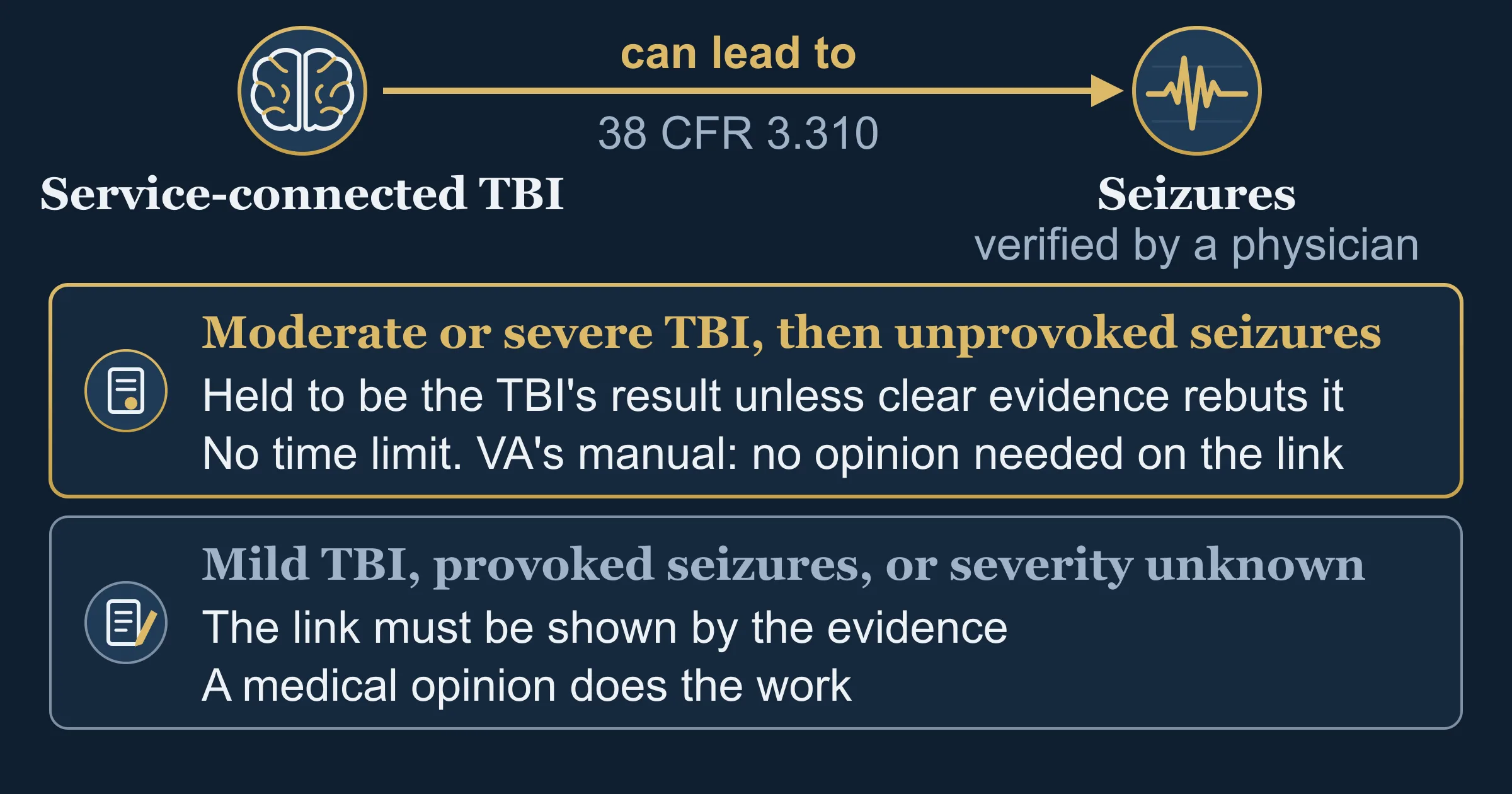 Nexus Letter for Seizures Secondary to TBISeizures after a service-connected TBI: when VA's manual says the link needs no opinion, when a nexus letter helps, and how post-traumatic epilepsy is rated.Read the guide
 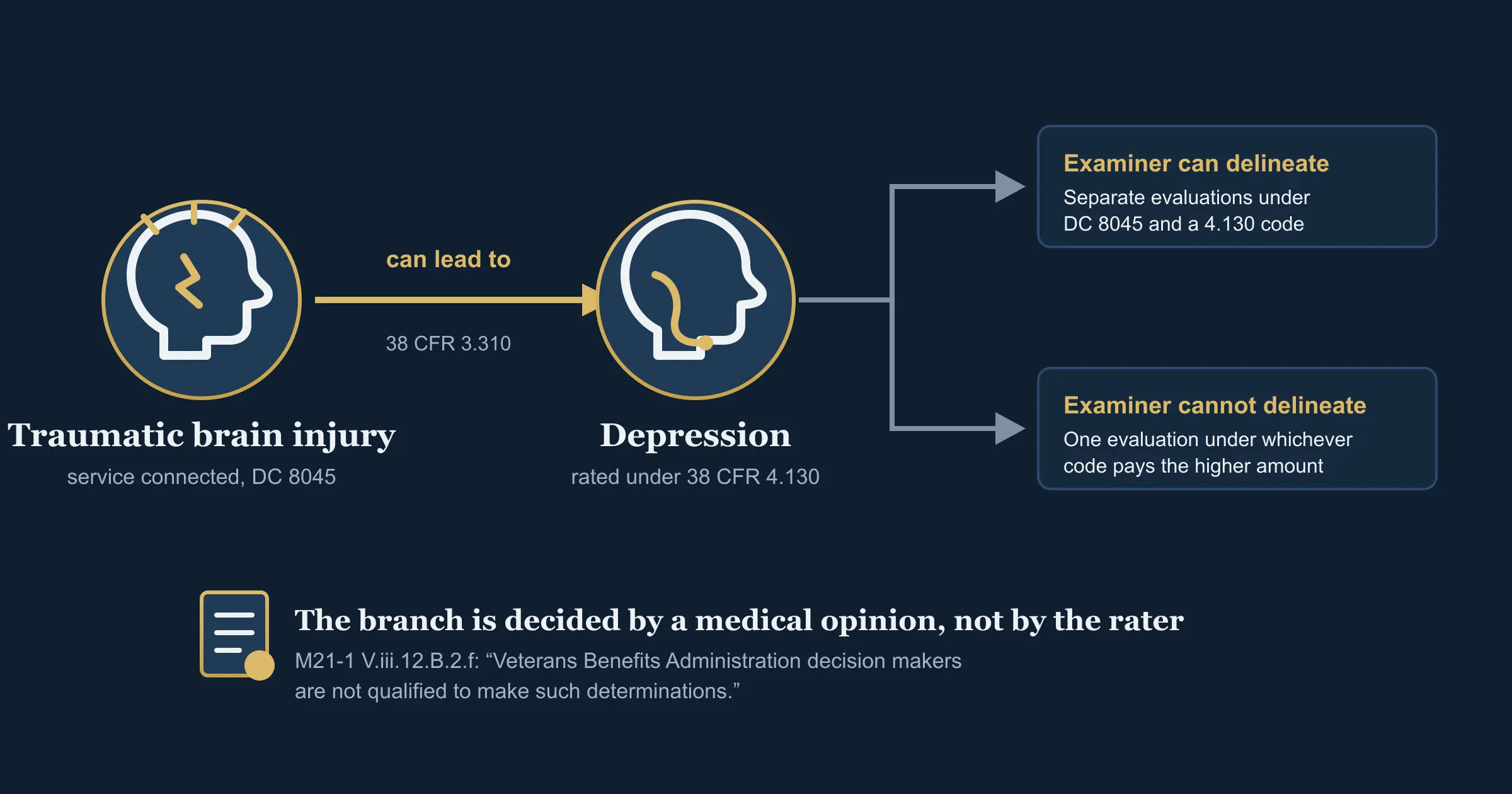 Nexus Letter for Depression Secondary to TBIDepression after a service-connected TBI can be a secondary VA claim. What the nexus letter must prove, and when the VA rates the two conditions separately.Read the guide
  Nexus Letter for Migraines and Headaches Secondary to TBIHeadaches and migraines after a service-connected TBI can be a secondary VA claim. What the nexus letter must prove, and when VA rates them separately.Read the guide
The injury was real, even if the paperwork missed it.
Let our physicians prepare a TBI nexus letter that meets the VA's evidence standards and supports the benefits you earned.
Sources & Regulatory References
- VA disability compensation (VA.gov) https://www.va.gov/disability/
- 2026 VA disability compensation rates (VA.gov) https://www.va.gov/disability/compensation-rates/veteran-rates/
- 38 CFR 4.124a, Schedule of ratings, neurological conditions, including DC 8045 TBI (eCFR) https://www.ecfr.gov/current/title-38/section-4.124a
- 38 CFR 3.310, Secondary service connection (eCFR) https://www.ecfr.gov/current/title-38/section-3.310
- 38 CFR 3.303, Principles relating to service connection (eCFR) https://www.ecfr.gov/current/title-38/section-3.303
- 38 U.S.C. 5107, Benefit of the doubt (Cornell LII) https://www.law.cornell.edu/uscode/text/38/5107