
VA Secondary Claims
Nexus Letter for Depression Secondary to Chronic Pain
Medically reviewed by the Patriot Path Medical Team
Licensed MD reviewers • Last updated:
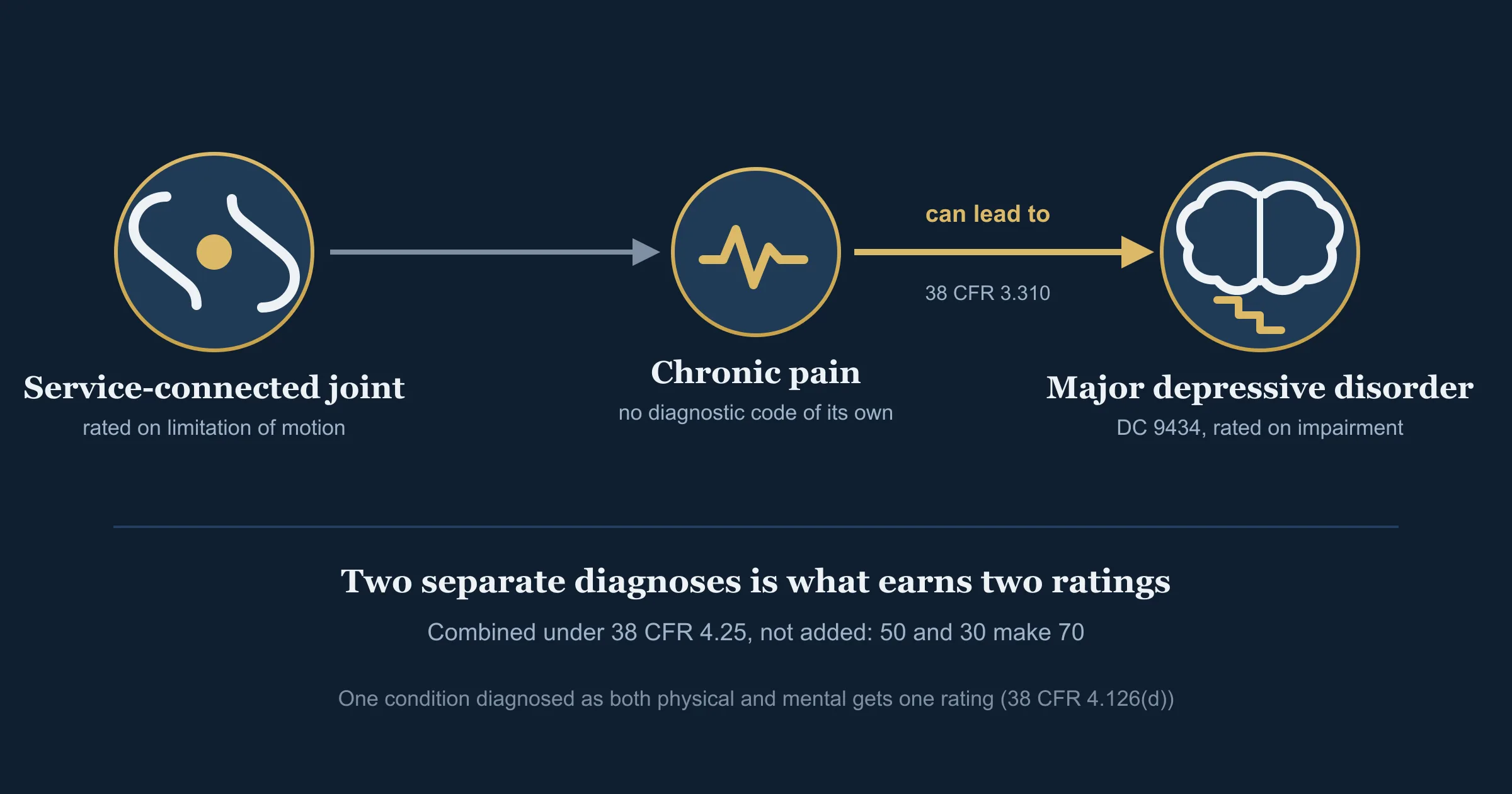
If the VA already rates a painful service-connected condition, and a clinician has recorded a DSM-5 depressive diagnosis in your records, you can claim the depression as secondary under 38 CFR 3.310. Where it is separately diagnosed with symptoms of its own, the two are evaluated separately and combined under 38 CFR 4.25 rather than one absorbing the other. The part almost every page gets wrong is what moves that rating. The mental-disorder schedule at 38 CFR 4.130 does not contain the word pain even once. Your pain is what proves the connection; it is not what sets the percentage. What sets the percentage is how much the depression costs you at work and in your relationships.
An illustrative example
A veteran carries a 20 percent rating for a lumbosacral strain from a 2009 injury. The back has not improved. He stopped coaching his daughter's team, stopped seeing friends, and has been on an antidepressant for two years. His primary care notes say low mood, poor sleep and lost interest, but nobody has written a diagnosis down.
Two things have to happen before this claim can be won, and only one of them involves us. A clinician has to record an actual DSM-5 diagnosis, because for a mental condition the VA still requires one. Then a medical opinion has to explain why that depression is at least as likely as not caused or worsened by the service-connected back, and it has to describe the damage in the language the rating formula actually reads: work and social functioning.
A composite drawn from common fact patterns, not a real client. It illustrates the sequence, not a predicted outcome.
What this claim has to establish
Secondary service connection is short in the regulation and demanding in practice. 38 CFR 3.310(a) says a disability which is proximately due to or the result of a service-connected disease or injury shall be service connected. Applied here that is three things: a musculoskeletal condition the VA already rates, a current diagnosis of depression, and medical evidence connecting the two.
VA's own manual states the causation standard in terms most competing pages have not caught up with. M21-1 V.ii.2.D.1.b says service connection on a secondary basis requires a showing that the secondary disability is the result of, or would not have occurred but for, a service-connected disability. That but-for language comes from Spicer v. McDonough, 61 F.4th 1360 (Fed. Cir. 2023), and VA adopted it as the broader standard, replacing the stricter proximate-cause framing still quoted elsewhere.
The same block carries something useful that almost nobody publishes: to establish causation, the primary disability need not be service-connected, or even diagnosed, at the time the secondary disability is incurred, citing Frost v. Shulkin, 29 Vet.App. 131 (2017). So a veteran whose low mood started years before the VA finally granted the back claim is not barred by the sequence.
For the rating ladder, the estimator and the other routes to a depression claim, see our page on depression and VA disability.
For how secondary claims work generally, see why you need a nexus letter for a secondary condition.
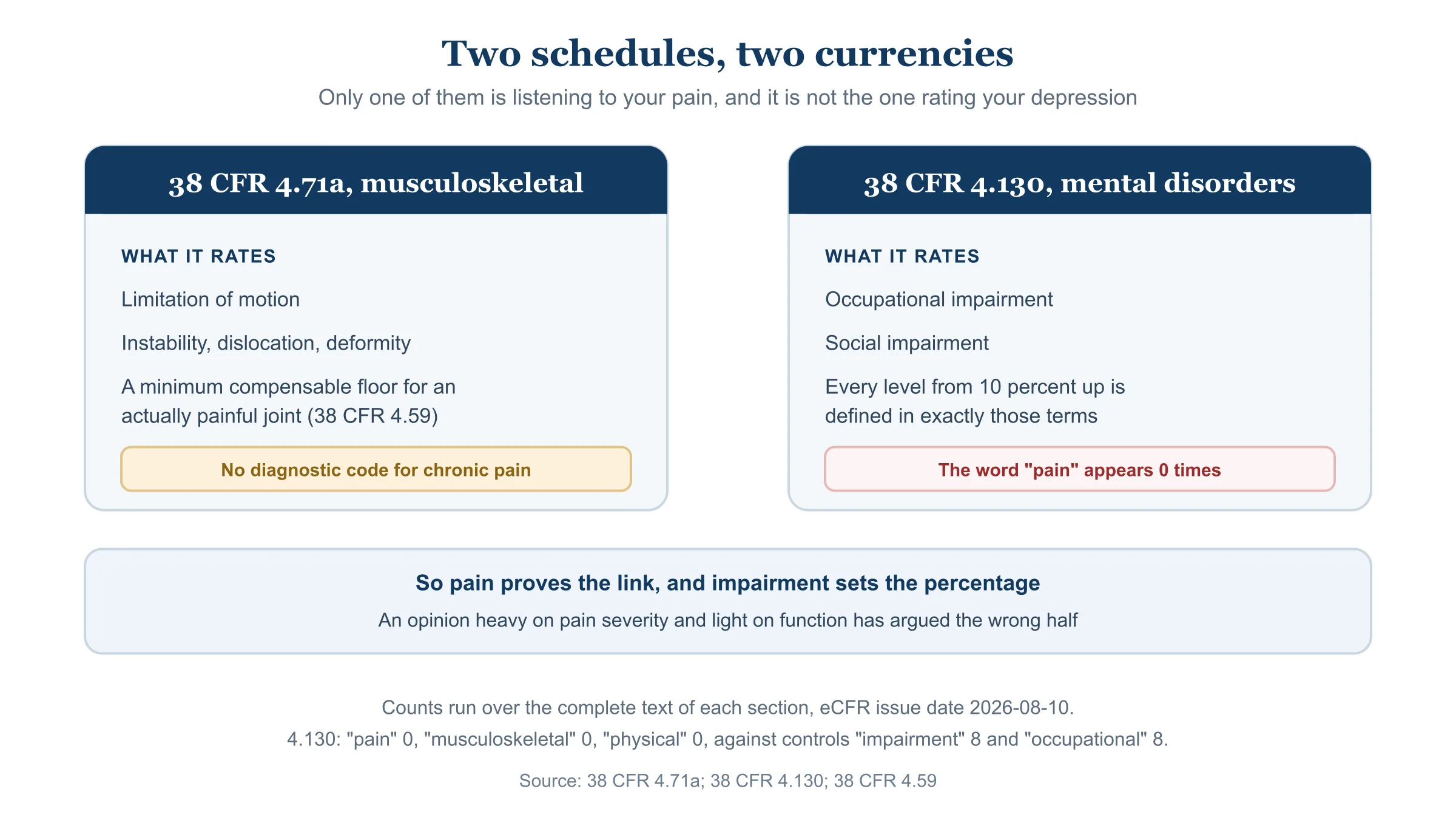
Your pain does not raise your depression rating, and this is the most useful thing on this page
The two schedules involved speak different languages, and only one of them is listening to your pain. An opinion that spends four paragraphs on pain severity and one sentence on function has argued the wrong half of the claim.
The mental-disorder schedule never mentions pain
Read the complete text of 38 CFR 4.130 and count. The word pain appears zero times. So does musculoskeletal. So does physical. Every rating level from 10 percent upward is phrased the same way, as occupational and social impairment, and the listed symptoms are introduced as examples with the words due to such symptoms as. The formula measures what the depression costs you in working and relating to people, and it has no line at all for how much you hurt.
So pain does two jobs, and neither is setting the percentage
Pain proves the causal link under 38 CFR 3.310, which is the entitlement question. And pain is what produces the impairment the formula does measure. What it cannot do is add anything on its own. An opinion that spends four paragraphs on pain severity and one sentence on function has argued the wrong half of the claim.
What the formula does read
Missed shifts, jobs left, tasks that take longer, concentration failures, withdrawal from people you used to see, and the reliability problems that follow bad nights. Note also that the 10 percent level is met by symptoms controlled by continuous medication, so an antidepressant prescribed for pain-driven depression is itself a documented pathway to a compensable rating.
On the physical side, pain is rated through function too
There is no diagnostic code for chronic pain. Searching the complete text of 38 CFR 4.71a for chronic pain, pain syndrome, pain disorder, myofascial and complex regional returns nothing on any of them, while the word pain by itself appears two dozen times. Pain is everywhere in the schedule as a symptom and nowhere as a ratable entity.
What pain does earn on the musculoskeletal side is a floor. 38 CFR 4.59 says it is the intention to recognize actually painful, unstable, or malaligned joints, due to healed injury, as entitled to at least the minimum compensable rating for the joint. That is a floor and not a ceiling: it sets the minimum available under whichever diagnostic code actually applies to that joint, and Petitti v. McDonald, 27 Vet.App. 415 (2015), held that the entitlement does not require objectively observed pain on motion. The word actually is still doing work. The same section says the joints involved should be tested for pain on both active and passive motion, in weight-bearing and nonweight-bearing and, if possible, against the opposite undamaged joint, and Correia v. McDonald, 28 Vet.App. 158 (2016), read that sentence as a testing requirement. An exam that records none of it is worth raising.
38 CFR 4.40 is the provision that makes pain count at all, and it is conditional in a way worth quoting in full: functional loss may be due to pain, supported by adequate pathology and evidenced by the visible behavior of the claimant undertaking the motion. Both halves are requirements. The sentence veterans should know is the one right after: a part which becomes painful on use must be regarded as seriously disabled.
What Saunders gives you, and the case that takes half of it back
Competitor pages either ignore this line of cases or oversell it. Both are mistakes, because the honest version is genuinely useful and the oversold version sends veterans to a denial.
Saunders v. Wilkie (2018)
886 F.3d 1356 (Fed. Cir.)
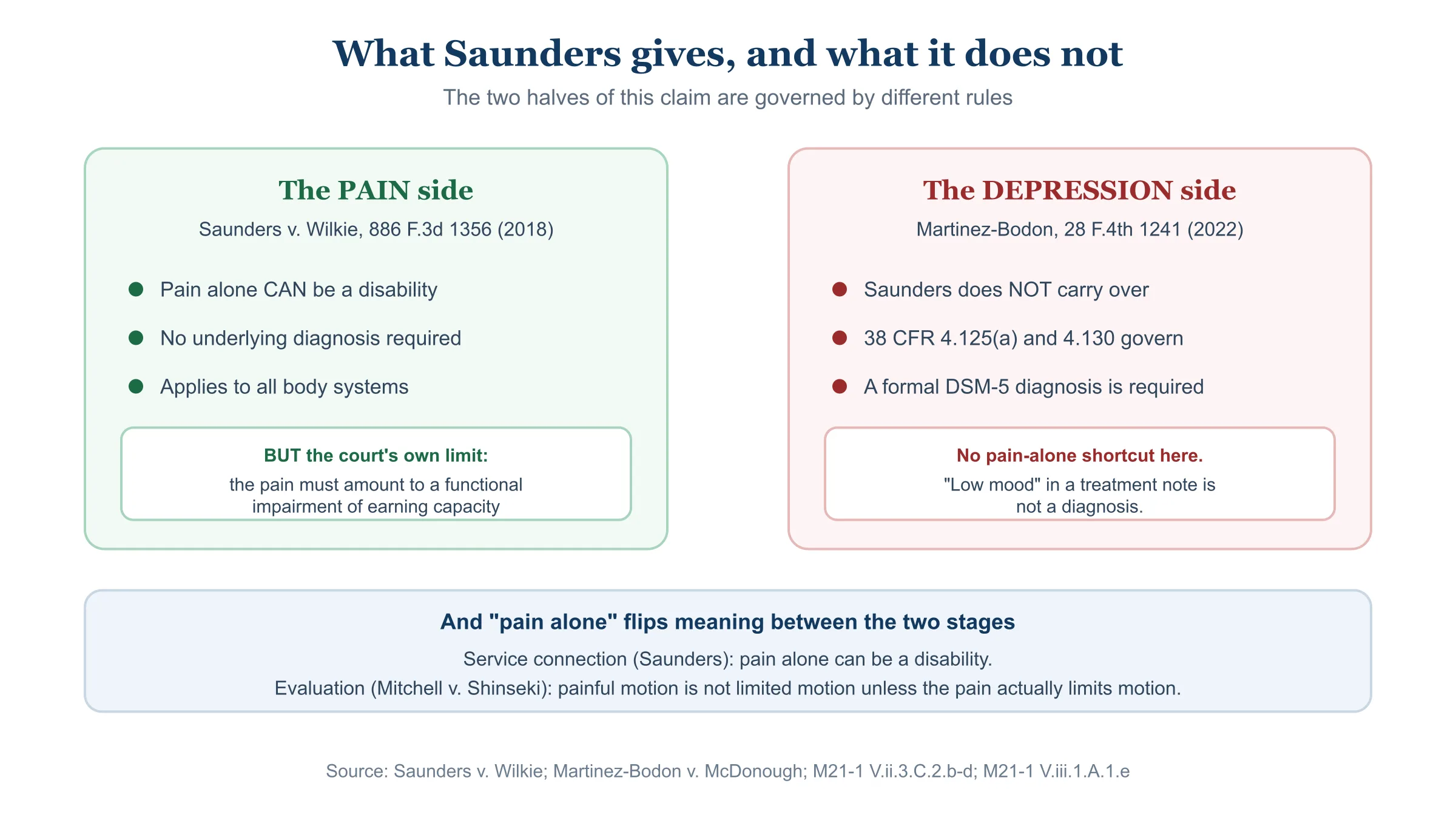
Pain alone can be a disability under 38 USC 1110 even with no diagnosed underlying condition. It overturned the older rule from Sanchez-Benitez. So the painful condition itself can be the service-connected primary your depression attaches to.
Martinez-Bodon v. McDonough (2022)
28 F.4th 1241 (Fed. Cir.)
The same reasoning does NOT extend to the depression. 38 CFR 4.125(a) and 4.130 still require a formal DSM-5 diagnosis before a psychiatric condition can be service-connected. There is no pain-alone shortcut on the mental-health side.
The limit Saunders itself wrote down
The court did not say pain is automatically a disability, and it said so in terms. Its own words: we do not hold that a veteran could demonstrate service connection simply by asserting subjective pain; to establish a disability, the veteran's pain must amount to a functional impairment. It then set the threshold: the veteran will need to show that her pain reaches the level of a functional impairment of earning capacity.
VA's manual implements exactly that. M21-1 V.ii.3.C.2.b says subjective symptoms, such as complaints of pain, are not enough to establish the presence of a disability, and that the mere existence of pain or a condition is not enough; it must impair earning capacity, individually assessed. V.ii.3.C.2.c confirms Saunders applies to all body systems and to claims pending or received on or after April 3, 2018.
The other two elements of service connection are untouched. Saunders changed the law on what counts as a present disability. It did nothing to the in-service incurrence requirement or the nexus requirement.
The trap: pain alone means different things at two different stages
This is where a careless page inverts the law, so it is worth stating slowly. At the SERVICE-CONNECTION stage, pain alone can be a disability. That is Saunders.
At the EVALUATION stage, once a condition is already service-connected and the question is what percentage it earns, pain alone is not functional loss. M21-1 V.iii.1.A.1.e states the rule from Mitchell v. Shinseki, 25 Vet.App. 32 (2011): painful motion is not considered the same as limited motion unless the pain actually causes a loss of motion.
The accurate statement is in three parts, not two. At the service-connection stage pain alone can be a disability (Saunders). At the evaluation stage, pain alone still earns the minimum compensable rating for the joint under 38 CFR 4.59 (Petitti v. McDonald, 27 Vet.App. 415 (2015)), but it does not earn more than that on a range-of-motion code unless the pain actually causes loss of motion (Mitchell). What Saunders does not do is guarantee that your pain is compensably rated at all, and the Federal Circuit said so in Frazier v. McDonough, 66 F.4th 1353 (Fed. Cir. 2023): Saunders does not suggest that pain, such as painful motion in a joint, must in all cases be deemed a compensable disability under the rating schedule.
What the evidence shows, including the parts that do not help
A nexus letter is only as strong as the literature behind it, and on this topic the literature is more equivocal than it is usually presented. A physician who overstates it writes a weaker opinion, because a VA examiner reading the same papers will say so.
Veterans carry more pain than comparable civilians
In 67,696 adults from the National Health Interview Survey, 65.5 percent of US military veterans reported pain in the previous three months and 9.1 percent had severe pain, against 56.4 percent and 6.4 percent among nonveterans, unadjusted. The comparison is crude rather than matched, and the veterans in the sample were older and more often male, which cuts in the direction that inflates the gap. That is the population fact underneath these claims, and it says nothing about depression on its own. A separate VA primary-care study of patients with moderate to severe chronic musculoskeletal pain did find major depression independently associated with worse pain, greater disability and lower quality of life after accounting for PTSD.
Pain does precede first onset of depression or anxiety, for some pain sites
In 614 people with no lifetime history of depressive or anxiety disorder, followed four years, baseline pain predicted a first episode, with hazard ratios from about 2.0 to 4.0 across six pain locations, plus a dose-response for the number of pain sites. Two caveats travel with it. The study measured a combined depressive-or-anxiety endpoint and did not separate the two. And back pain specifically did not survive the strictest adjustment for pre-existing subthreshold symptoms, while joint pain and multi-site pain did.
Genetic evidence supports the direction for multisite pain only
A bidirectional Mendelian randomization study found genetically instrumented multisite chronic pain associated with major depressive disorder at an odds ratio of 1.78 per additional pain site. That is causal-inference evidence rather than correlation. The limit that must travel with it: the exposure was multisite pain, so the figure does not transfer to a veteran with one painful joint.
A medication pathway that rarely gets discussed
Among 70,997 Veterans Health Administration patients newly started on opioid analgesics with no depression diagnosis at baseline, 12 percent developed new-onset depression, and the risk tracked with how long they were on them. Notably it was duration and not dose that mattered, and the authors frame the finding as a clinical warning that use beyond about 30 days carries a risk of new-onset depression. For a veteran treated for years with opioids for a service-connected condition, that is a second, independently associated pathway worth pleading.
Three findings that cut the other way, and belong in the file
- The relationship is bidirectional. In 500 primary-care patients with back, hip or knee pain followed a year, change in pain predicted later depression severity and change in depression predicted later pain severity, and the authors described the two effects as comparable and equally strong. Writing that pain causes depression states about half of what the best matched study found.
- Depression predicts new back pain, not only the reverse. A meta-analysis of cohorts of people free of low back pain at baseline found that depressive symptoms raised the odds of developing it by about 60 percent, rising with severity.
- A twin study is the hardest single finding for this claim, and its conclusion should be quoted rather than softened. Among 1,269 twins, the crude association between chronic low back pain and later depression or anxiety symptoms shrank with adjustment and disappeared when twins were compared within pairs, which holds genetics and upbringing constant. The authors concluded that the relationship is not causal and is likely explained by confounding from shared familial factors. That conclusion should be read with its limits: the within-pair analyses were underpowered, with a monozygotic odds ratio of 1.86 whose confidence interval ran from 0.63 to 5.51, and the outcome was a single symptom item rather than diagnosed depression. So the fair reading is that within-family evidence does not confirm causation, not that the question is closed.
What that means for your letter
It means the letter should argue this veteran rather than the literature in general. The population data cannot tell anyone whether your depression came from your back, and a VA examiner knows that. What carries weight is a clinician who has the chronology, who can say the mood symptoms followed the injury and tracked its course, who addresses the obvious alternatives already in your record, and who explains why they still land on the service-connected pain.
The benefit-of-the-doubt rule at 38 USC 5107(b) and 38 CFR 3.102 turns on approximate balance of the evidence, and 3.102 says outright that it is not a means of reconciling an actual conflict in the evidence. Engaging with the contrary literature is not a weakness. It is how an opinion survives the examiner who raises it.
Will the VA fold the depression into the physical rating
This is the question that decides whether the claim is worth filing, and the honest answer is that it depends on how the claim gets characterized. The page's job is to make sure you plead it the way that survives either routing.
The affirmative authority is strong, and VA names depression first
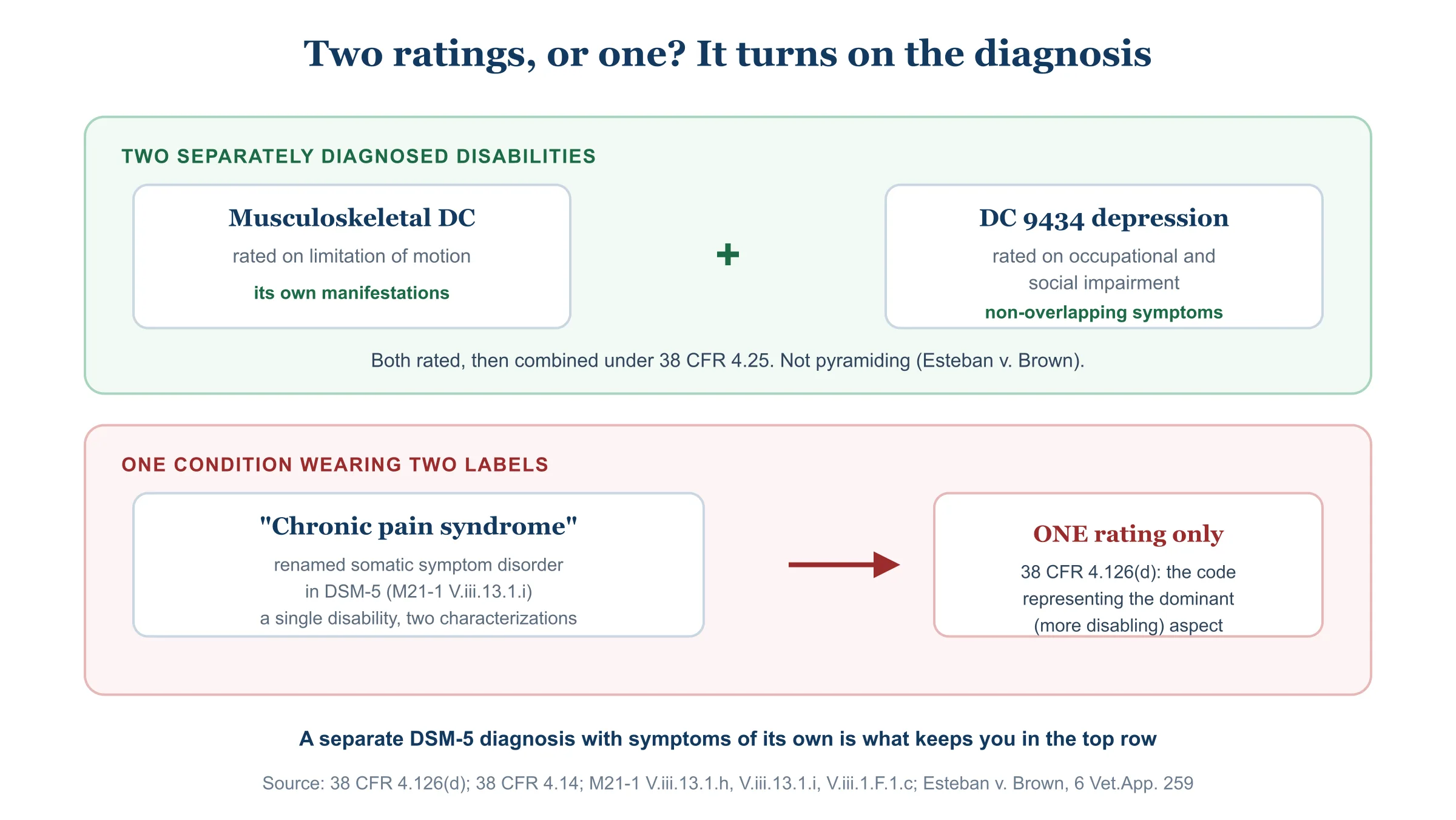
M21-1 V.iii.1.F.1.c addresses fibromyalgia, whose rating criteria at DC 5025 actually enumerate depression as one of the symptoms considered. Even there, the manual says the criteria do not exclude assignment of separate evaluations when disabilities are diagnosed secondary to fibromyalgia, and it lists depression first among the examples. That is a harder case than an ordinary back or knee claim, because no musculoskeletal code names depression at all, so it is strong support by the greater-includes-the-lesser.
The general rule points the same way. M21-1 V.ii.3.D.2.b states that separate evaluations are warranted where none of the symptomatology for any one condition duplicates or overlaps another, citing Esteban v. Brown, 6 Vet.App. 259 (1994). And M21-1 V.iii.13.1.h works a direct example: a veteran service-connected for PTSD later claims fibromyalgia, and the result is that fibromyalgia is service connected and rated separately, with the single limit that a symptom counted in one evaluation cannot be counted again in the other.
Read against 38 CFR 4.14, which bars evaluating the same manifestation under different diagnoses, that gives a clean test. A rating for lost range of motion and a rating for lost occupational and social functioning are different manifestations. Rating both is not pyramiding.
Where the fold can actually happen, and it is not where you would look
The Mental Disorders chapter does address this, and not in our favour by default. M21-1 V.iii.13.1.h tells raters to avoid separate evaluations based on the same manifestations, and says that to warrant separate evaluations the symptoms considered must be distinct and not overlap. What the chapter does NOT contain is a rule folding a separately diagnosed depressive disorder into a physical rating merely because the depression is secondary to pain. The only fold-in rule of that kind is expressly limited to insomnia.
The risk lives in the regulation instead. 38 CFR 4.126(d) says that when a single disability has been diagnosed both as a physical condition and as a mental disorder, the rating agency evaluates it under the diagnostic code representing the dominant, meaning more disabling, aspect. One disability, one rating.
And there is a specific route by which a pain claim becomes that single disability. M21-1 V.iii.13.1.i states that somatic symptom disorder was originally diagnosed as chronic pain syndrome and that the terminology was revised in DSM-5. The same block says such a condition may stem from an underlying disease such as arthritis and should be evaluated under the most appropriate diagnostic code based on the clinical picture, and its note adds that VA already recognizes low back pain syndrome as a form of somatic symptom disorder.
So if the record characterizes everything as one chronic pain syndrome wearing two hats, 4.126(d) can collapse it. If the record shows a rated musculoskeletal condition and a separately diagnosed depressive disorder with its own symptoms, it should not. We could not measure how often raters take each route; that would need a decision-sampling study nobody has published.
How to plead it so either routing works
Get a named DSM-5 diagnosis, not a description of low mood. This is the Martinez-Bodon requirement and it is also what M21-1 V.iii.1.F.1.c turns on: its note says that if signs and symptoms are not sufficient to warrant a diagnosis of a separate condition, they are evaluated with the musculoskeletal pain instead. The diagnosis is the hinge.
Then check which symptoms are actually being evaluated on each side, because the common advice here is wrong. The symptoms that support a separate evaluation are the ones that are not the pain: anhedonia, hopelessness, guilt and impaired concentration, with the 70 percent level also contemplating suicidal ideation.
Chronic sleep impairment is a different matter, and it is worth being precise because a lot of veterans are told to leave it out. It is one of the symptoms 38 CFR 4.130 names by hand at the 30 percent level. Meanwhile the words sleep and fatigue appear in the whole of 38 CFR 4.71a only once each, both inside DC 5025 for fibromyalgia. The spine, knee, hip, shoulder and ankle codes rate range of motion, ankylosis, instability and incapacitating episodes and contain no sleep criterion at all. So where poor sleep is a manifestation of the diagnosed depression, it belongs in the depression evidence rather than being kept out of it. 38 CFR 4.14 bars counting the same manifestation twice only where it is actually being evaluated under both codes.
Two real exceptions. If your primary is rated under DC 5025 for fibromyalgia, whose criteria do enumerate fatigue, sleep disturbance and depression, the overlap question is live and the symptoms have to be allocated. And fatigue specifically can appear on both ledgers even outside DC 5025, because 38 CFR 4.45(d) makes excess fatigability a factor in evaluating joint disability, though that is fatigue on repeated use of a joint rather than the general exhaustion of a depressive disorder.
What the depression rating is worth
Depression is rated under 38 CFR 4.130, Diagnostic Code 9434, major depressive disorder, on the General Rating Formula for Mental Disorders. The formula runs 0, 10, 30, 50, 70 and 100, and every level is stated as a degree of occupational and social impairment.
The listed symptoms are examples, introduced with the phrase due to such symptoms as. Ratings are not earned by matching the most symptoms on a list; they are earned by showing the level of impairment those symptoms produce. That is why the vocabulary of the nexus letter and the C&P evidence matters so much on this particular claim.
The 4.130 ladder, in plain words
- 100%Total occupational and social impairment. Symptoms such as gross impairment in thought processes, persistent delusions or hallucinations, or an intermittent inability to perform activities of daily living, including maintenance of minimal personal hygiene.
- 70%Deficiencies in most areas: work, school, family relations, judgment, thinking or mood. Suicidal ideation, near-continuous panic or depression, impaired impulse control, neglect of hygiene, inability to establish and maintain effective relationships.
- 50%Reduced reliability and productivity. Flattened affect, panic attacks more than once a week, impaired memory and judgment, disturbances of motivation and mood, difficulty maintaining effective work and social relationships.
- 30%Occasional decrease in work efficiency and intermittent inability to perform tasks, though generally functioning satisfactorily. Depressed mood, anxiety, chronic sleep impairment, mild memory loss.
- 10%Occupational and social impairment due to mild or transient symptoms which decrease work efficiency and the ability to perform occupational tasks only during periods of significant stress, or symptoms controlled by continuous medication.
- 0%A mental condition formally diagnosed, but symptoms not severe enough to interfere with functioning or to require continuous medication.
Note the 10 percent level carefully. It reads on symptoms of the diagnosed depressive disorder controlled by continuous medication, and the 0 percent row is written for a diagnosed condition whose symptoms do not require continuous medication. So being stable on an antidepressant is a fact the rater has to reckon with rather than a bar, though it is not a guarantee on its own, because the row is still framed as a degree of occupational and social impairment. An antidepressant prescribed for pain rather than for a diagnosed depressive disorder does not by itself meet this criterion. Note also that a 0 percent rating still establishes service connection, which protects the claim if the condition worsens later.
Combining is not adding
The depression rating and the musculoskeletal rating combine under 38 CFR 4.25, which uses a table rather than arithmetic. The regulation's own worked example: with a 50 percent disability and a 30 percent disability, the combined value will be found to be 65 percent, but the 65 percent must be converted to 70 percent. So 50 and 30 make 70, not 80. Anyone quoting you a simple sum is describing a different system.
Causation or aggravation, and why you should plead both
38 CFR 3.310 contains two theories with different burdens. Aggravation matters more here than on most secondary claims, because depression frequently predates the injury rather than following it.
Causation
38 CFR 3.310(a)
The service-connected condition caused the depression. VA's standard is but-for: the depression would not have occurred but for the pain. If granted, the secondary condition is treated as part of the original condition.
Aggravation
38 CFR 3.310(b)
You already had depression and service-connected pain made it worse. This route needs a documented baseline, and the rating reflects only the increase above it. It is the right theory when the depression clearly predates the injury.
One deduction was abolished and one survived
M21-1 V.ii.2.D.1.a records that, following Spicer v. McDonough, 61 F.4th 1360 (Fed. Cir. 2023), VA applies the broader but-for standard and will no longer consider natural progress of the nonservice-connected disability in an aggravation claim.
Note what did not change. 38 CFR 3.310(b) still recites the natural-progress deduction on its face, and the baseline deduction is very much alive: M21-1 V.ii.2.D.1.g says the evaluation assigned will reflect the difference between the current and baseline levels of severity. Two deductions existed, one is gone, and anyone telling you VA no longer deducts anything is wrong.
The baseline is where aggravation claims die
M21-1 V.ii.2.D.1.c requires the baseline level of severity to be established by medical evidence created before the onset of aggravation, or by the earliest medical evidence created between that onset and the evidence showing current severity, or by any other credible evidence including lay evidence that supports establishing the baseline. The manual adds that lay evidence on its own may not be sufficient to establish the baseline, though it can support one.
The consequence is blunt and stated in the manual at V.ii.2.D.1.f: if no baseline can be established, no aggravation can be demonstrated, and the claim must be denied. Two protections travel with it. The denial may come only after VA's duty to assist is fulfilled, and raters are told not to assume a baseline of zero percent when the evidence does not establish one.
So if you are running an aggravation theory, the mental-health record from before the injury is the whole case. Find it before anyone writes an opinion.
What an aggravation opinion must address to be usable at all
M21-1 V.ii.2.D.1.e sets out what a report must separately address to be adequate for rating a secondary claim based on aggravation. An opinion missing any of it can be returned as inadequate however favorable it sounds.
- The current level of severity of the nonservice-connected disability.
- An opinion on whether there has been any increase in severity that would not have occurred but for the service-connected disability, or whether it would have been less severe but for it, including where the service-connected disability has interfered with or impeded treatment.
- An adequate analysis, with medical considerations, supporting the opinion.
Notice the manual asks for but-for phrasing, not proximately due to. An opinion written in the language the rater is trained to look for is easier to act on.
What the Board has actually done with these claims
Four decisions, each read in full rather than summarized from a search result. All four granted service connection, not a percentage, for a depressive disorder secondary to service-connected musculoskeletal conditions. A private opinion was decisive in A23031913 and A21018879. In 1308171 and 1403578 the Board credited private and VA evidence together, and in 1403578 one of the two favorable letters came from the veteran's own VA treating psychiatrist. These four were selected because they granted; the Board also denies these theories, and a grant here predicts nothing about your claim.
Citation Nr A23031913
2023
- What was granted
- Granted service connection for an acquired psychiatric disorder, expressly including depressive disorder due to chronic pain syndrome, as secondary to service-connected disabilities. The finding of fact reads that the psychiatric disorder is proximately due to his chronic pain syndrome, secondary to the service-connected disabilities. The primaries were orthopedic: lower back, ankles and right knee.
- What it shows
- The closest case on this page's exact facts, and the strongest illustration of what a private opinion is for. A June 2019 VA examiner diagnosed generalized anxiety disorder and gave a negative nexus. The Board found that opinion inadequate and of no probative value, citing Nieves-Rodriguez v. Peake and Stefl v. Nicholson, and gave it no probative weight. Note the grant is service connection, not a percentage.
Citation Nr A21018879
2021
- What was granted
- Granted service connection for anxiety and major depressive disorder as at least as likely as not secondary to service-connected metatarsalgia and chronic paravertebral lumbar strain. Both primaries are musculoskeletal.
- What it shows
- Useful because the private evidence did two jobs: it reopened a previously final denial and then won the claim. A December 2014 VA examiner had opined against the link. What changed the outcome was a treating provider's letter, a private disability benefits questionnaire completed by the mental health provider, and a further private letter.
Citation Nr 1308171
2013
- What was granted
- Granted service connection for depression, the finding of fact being that competent and probative evidence links the depression to service-connected degenerative joint and disc disease of the lumbar spine with radiculopathy.
- What it shows
- The most quotable of the set, because the decision reproduces the private psychiatrist's reasoning: depression often arises out of medical conditions that involve chronic pain and limitation of function, and it is more likely than not that this veteran's depression arises from his service-connected back injury and its attendant chronic pain and limitation of function. That is what an adequate rationale looks like in one sentence.
Citation Nr 1403578
2014
- What was granted
- Granted service connection for depression secondary to service-connected knee disabilities, after reopening a previously final 2004 denial on new and material evidence.
- What it shows
- Included for the reopening pattern rather than as a private-versus-VA story, and the honest caveat matters: the favorable evidence was mixed, a private practitioner's letter alongside a letter from the veteran's own VA treating psychiatrist, and the Board credited the opinions, records and testimony collectively without weighing one against the other.
Board decisions are non-precedential under 38 CFR 20.1303. They are not binding on any other claim, including yours. They are useful as evidence of how these theories are argued and decided, and for nothing more.
What a strong letter contains for this claim specifically
General nexus letter advice is on our primer. These are the items that decide this particular claim and would not appear on a generic checklist.
- A named DSM-5 diagnosis, not a description of low moodThis is the Martinez-Bodon requirement and there is no way around it. Saunders lets pain be a disability without a diagnosis; it does not do the same for depression. A treatment note reading low mood, poor sleep is not a diagnosis, and under the fibromyalgia guidance symptoms short of a diagnosis get absorbed into the physical rating rather than earning their own.
- Impairment language, not pain languageBecause 38 CFR 4.130 contains no musculoskeletal or physical criterion of any kind and never uses the word pain, the opinion has to translate. Not how badly it hurts, but what it stopped him doing: shifts missed, work abandoned, relationships lost, concentration gone.
- The depressive symptoms that are not the painThe symptoms that support a separate evaluation are the ones that are not the pain: anhedonia, hopelessness, guilt and impaired concentration, with the 70 percent level also contemplating suicidal ideation. Chronic sleep impairment belongs here too, because 38 CFR 4.130 names it at the 30 percent level and no spine, knee, hip, shoulder or ankle code carries a sleep criterion. The exception is a primary rated under DC 5025 for fibromyalgia, whose criteria do enumerate fatigue, sleep disturbance and depression, where the allocation has to be worked out.
- Both theories, argued separatelyCausation under 3.310(a) and aggravation under 3.310(b), each with its own rationale and, for aggravation, a documented baseline. Depression that predates the injury is common on this claim, which makes the aggravation branch more important here than on most.
- The medication history, if there is oneLong-term opioid treatment for a service-connected condition is a documented and separate route to new-onset depression, and the risk tracks duration of use. If that is your history it belongs in the opinion as its own pathway, not folded into a general claim about pain.
- The chronology, tightlyThe evidence base is bidirectional, so sequence is what makes an individual case persuasive. Mood symptoms that began after the injury and tracked its course are the pattern an examiner finds hard to dismiss.
Is this claim ready to file
Three of these are absolute prerequisites rather than points, and none of them is something a nexus letter can supply. The rest is the evidence that decides how strong the claim is.
0 of 8 in hand, but a requirement is not met yet
Start with the physical claim. A secondary claim under 38 CFR 3.310 attaches to a disability the VA has already service-connected, so until the back, knee, hip, shoulder, neck or foot carries its own rating there is nothing for the depression to attach to. That claim comes first, and no nexus letter can substitute for it. Our page on musculoskeletal conditions and VA disability covers how those are rated.
Nothing to buy at this stage. When that piece is in place, our page on depression and VA disability covers the rating ladder and the other routes to a claim.
Start with a free consultation
We will look at your service-connected rating, your mental health records and your chronology, and tell you what the claim needs before anyone writes anything. If the answer is that you need a diagnosis first rather than a letter from us, that is what we will say.
Frequently Asked Questions
Will a worse pain level get me a higher depression rating?
No, and this catches a lot of people out. The mental-disorder rating formula at 38 CFR 4.130 does not contain the word pain anywhere in its text. Every rating level is defined as a degree of occupational and social impairment. Your pain is what proves the causal link under 38 CFR 3.310, and it is what produces the impairment, but it earns nothing on its own inside the mental schedule. An opinion should describe what the depression stopped you doing at work and with people, because that is the only thing the formula measures.
Can I get a separate rating for depression on top of my back or knee rating?
Yes, in the ordinary case. A musculoskeletal rating compensates lost motion and a depression rating under DC 9434 compensates lost occupational and social functioning, which are different manifestations, so 38 CFR 4.14 pyramiding is not offended. VA's own manual makes the point in a harder setting: for fibromyalgia, whose criteria actually list depression as a symptom, M21-1 V.iii.1.F.1.c still says separate evaluations are not excluded for conditions diagnosed secondary to it, and it names depression first. The two ratings then combine under 38 CFR 4.25, which is combining rather than adding: 50 and 30 make 70, not 80.
Is there a VA disability rating for chronic pain itself?
There is no diagnostic code for chronic pain. Searching the whole musculoskeletal schedule at 38 CFR 4.71a for chronic pain, pain syndrome and pain disorder returns nothing. Pain is rated through its functional consequence instead, mainly limitation of motion. 38 CFR 4.59 entitles an actually painful joint to the minimum compensable rating available under the diagnostic code that applies to that joint, which is usually 10 percent but depends on the code. That is a floor, not an extra rating on top.
Saunders says pain alone can be a disability. Does that mean I do not need a depression diagnosis?
No, and this is the most consequential misunderstanding on this topic. Saunders v. Wilkie, 886 F.3d 1356 (Fed. Cir. 2018), held that pain alone can be a disability under 38 USC 1110 without a diagnosed underlying condition, but only where the pain amounts to a functional impairment of earning capacity. It does not carry over to mental health claims. In Martinez-Bodon v. McDonough, 28 F.4th 1241 (Fed. Cir. 2022), the Federal Circuit held that 38 CFR 4.125(a) and 4.130 require a formal DSM-5 diagnosis before a psychiatric condition can be service-connected. So the pain side may not need a diagnosis; the depression side always does.
Could the VA decide my depression is just part of my pain condition?
It can happen, and it is worth understanding the mechanism. 38 CFR 4.126(d) says that when a single disability has been diagnosed both as a physical condition and as a mental disorder, VA rates it under the code representing the dominant aspect, so one rating instead of two. That becomes reachable if everything in your record is characterized as one chronic pain syndrome, because M21-1 V.iii.13.1.i explains that chronic pain syndrome was renamed somatic symptom disorder in DSM-5, and treats low back pain syndrome as a form of it. The protection is a separately diagnosed depressive disorder with symptoms of its own, which is a different posture from one condition wearing two labels.
My depression started before my back was service-connected. Am I out of luck?
No. VA's manual states that to establish causation the primary disability need not be service-connected, or even diagnosed, at the time the secondary disability is incurred, citing Frost v. Shulkin. Separately, if the depression genuinely predates the injury, aggravation under 38 CFR 3.310(b) is the theory that fits those facts, but plead causation as well and let the adjudicator choose. The aggravation route needs a documented baseline of how severe the depression was beforehand, and if no baseline can be established the manual instructs the rater to deny that theory, so those older records matter.
How strong is the medical evidence that chronic pain causes depression?
Strong enough to support an opinion and not strong enough to call it settled causation. The relationship is genuinely bidirectional: in 500 primary care patients with back, hip or knee pain, worsening pain predicted later depression and worsening depression predicted later pain, and the authors described the two effects as comparable and equally strong. Genetic causal-inference work supports the pain to depression direction at an odds ratio of 1.78 per additional pain site, though that was multisite pain rather than one joint. On the other side, depression predicts new low back pain, and a twin study found the low back pain association disappeared when twins were compared within pairs. A good letter argues your chronology rather than the population data.
Does long-term pain medication matter to this claim?
It can be its own pathway. In a study of 70,997 Veterans Health Administration patients newly started on opioid analgesics with no depression diagnosis at baseline, 12 percent developed new-onset depression, and the risk rose with how long they took them rather than with the dose. If you have been treated for years with opioids for a service-connected condition, that is a second causal route worth pleading alongside the pain itself. Never change or stop a prescription to strengthen a claim; that is a decision for you and your prescriber on medical grounds.
What rating does depression secondary to chronic pain usually get?
There is no usual figure and anyone quoting one is guessing. Depression is rated under DC 9434 on the General Rating Formula at 0, 10, 30, 50, 70 or 100 percent, and the level turns entirely on the degree of occupational and social impairment shown in your records. Two points worth knowing: the 10 percent level is met by symptoms controlled by continuous medication, so being stable on an antidepressant does not mean zero, and a 0 percent rating still establishes service connection, which protects you if things worsen later.
What does a nexus letter from Patriot Path cost?
One flat fee of $1,500, and the first consultation is free. If that consultation shows the depression has not yet been formally diagnosed, we will tell you to get that first, because no opinion can service-connect a psychiatric condition the record has never named.
Related guides
- Nexus letter for IBS secondary to PTSDThe sibling spoke where a physical condition attaches to a rated mental one, the reverse of this page's direction.
- Why you need a nexus letter for a secondary conditionThe umbrella page on how secondary claims work under 38 CFR 3.310.
- What is a nexus letterStart here if you have not commissioned one of these before.
- Musculoskeletal conditions and VA disabilityHow VA rates back, neck, knee, hip, shoulder and foot conditions, and what 38 CFR 4.59 guarantees for a painful joint.
Citations & References
- 38 CFR 4.130, Schedule of ratings, Mental disorders (eCFR) https://www.ecfr.gov/current/title-38/section-4.130
- 38 CFR 4.126, Evaluation of disability from mental disorders (eCFR) https://www.ecfr.gov/current/title-38/section-4.126
- 38 CFR 4.125, Diagnosis of mental disorders (eCFR) https://www.ecfr.gov/current/title-38/section-4.125
- 38 CFR 4.71a, Schedule of ratings, Musculoskeletal system (eCFR) https://www.ecfr.gov/current/title-38/section-4.71a
- 38 CFR 4.59, Painful motion (eCFR) https://www.ecfr.gov/current/title-38/section-4.59
- 38 CFR 4.40, Functional loss (eCFR) https://www.ecfr.gov/current/title-38/section-4.40
- 38 CFR 4.14, Avoidance of pyramiding (eCFR) https://www.ecfr.gov/current/title-38/section-4.14
- 38 CFR 4.25, Combined ratings table (eCFR) https://www.ecfr.gov/current/title-38/section-4.25
- 38 CFR 3.310, Disabilities that are proximately due to, or aggravated by, service-connected disease or injury (eCFR) https://www.ecfr.gov/current/title-38/section-3.310
- 38 CFR 3.102, Reasonable doubt (eCFR) https://www.ecfr.gov/current/title-38/section-3.102
- 38 USC 1110, Basic entitlement for wartime disability compensation https://uscode.house.gov/view.xhtml?req=granuleid:USC-prelim-title38-section1110&num=0&edition=prelim
- 38 USC 5107, Claimant responsibility; benefit of the doubt https://uscode.house.gov/view.xhtml?req=granuleid:USC-prelim-title38-section5107&num=0&edition=prelim
- Saunders v. Wilkie, 886 F.3d 1356 (Fed. Cir. 2018) https://law.justia.com/cases/federal/appellate-courts/cafc/17-1466/17-1466-2018-04-03.html
- Martinez-Bodon v. McDonough, 28 F.4th 1241 (Fed. Cir. 2022) https://law.justia.com/cases/federal/appellate-courts/cafc/21-1328/21-1328-2022-03-15.html
- BVA Citation Nr A23031913 (2023) https://www.va.gov/vetapp23/Files11/A23031913.txt
- BVA Citation Nr A21018879 (2021) https://www.va.gov/vetapp21/Files11/A21018879.txt
- BVA Citation Nr 1308171 (2013) https://www.va.gov/vetapp13/Files1/1308171.txt
- BVA Citation Nr 1403578 (2014) https://www.va.gov/vetapp14/Files1/1403578.txt
- Nahin RL. Severe pain in veterans: the effect of age and sex, and comparisons with the general population. J Pain. 2017 (PMID 27884688) https://pubmed.ncbi.nlm.nih.gov/27884688/
- Kroenke K et al. Reciprocal relationship between pain and depression: a 12-month longitudinal analysis in primary care. J Pain. 2011 (PMID 21680251) https://pubmed.ncbi.nlm.nih.gov/21680251/
- Gerrits MMJG et al. Pain and the onset of depressive and anxiety disorders. Pain. 2014 (PMID 24012953) https://pubmed.ncbi.nlm.nih.gov/24012953/
- Outcalt SD et al. Chronic pain and comorbid mental health conditions: independent associations of posttraumatic stress disorder and depression with pain, disability, and quality of life. J Behav Med. 2015 (PMID 25786741) https://pubmed.ncbi.nlm.nih.gov/25786741/
- Reciprocal interaction between depression and pain: a bidirectional Mendelian randomization study. Pain. 2022 (PMID 34924553) https://pubmed.ncbi.nlm.nih.gov/34924553/
- Fernandez M et al. Chronic low back pain and the risk of depression or anxiety symptoms: a longitudinal twin study. Spine J. 2017 (PMID 28267634) https://pubmed.ncbi.nlm.nih.gov/28267634/
- Pinheiro MB et al. Symptoms of depression and risk of new episodes of low back pain: a systematic review and meta-analysis. Arthritis Care Res. 2015 (PMID 25989342) https://pubmed.ncbi.nlm.nih.gov/25989342/
- Scherrer JF et al. Prescription opioid duration, dose, and increased risk of depression in 3 large patient populations. Ann Fam Med. 2016 (PMID 26755784) https://pubmed.ncbi.nlm.nih.gov/26755784/