
Welcome to Patriot Path
Nexus Letters for Depression
Licensed Psychologist, PhD, Counseling Psychology | Patriot Path Medical Team
Specializing in VA mental health evaluations and independent psychological assessments • Last updated: June 2026
Board-certified physicians and licensed psychologists specializing in VA disability documentation. Meet our clinicians → • Our review process →
Depression is one of the most common conditions veterans face. It is also one the VA most often misses. Even with a clear diagnosis, claims get denied when the link to service is not on paper.
A nexus letter can be the deciding factor. Our psychologists and physicians write evidence-based letters that tie your depression to your service, or to another service-connected condition, in plain, VA-ready language.

How VA Rates Depression (DC 9434)
VA rates depression under 38 C.F.R. § 4.130, DC 9434, the same General Rating Formula used for all mental health conditions. The level depends on how much it affects your work and your relationships, not on matching every symptom. Use the estimator below to see roughly where your situation may fall.
| Rating | What it generally takes | Monthly pay (approx) |
|---|---|---|
| 0% | Diagnosed, but symptoms are mild enough that they do not affect work or social life and need no regular medication. | $0 |
| 10% | Mild symptoms that lower work efficiency only during stress, or symptoms controlled by continuous medication. | ~$180/mo |
| 30% | Occasional dips in work efficiency; generally functioning well, with normal routine, self-care, and conversation. | ~$552/mo |
| 50% | Reduced reliability and productivity: panic attacks more than once a week, memory or concentration trouble, flattened mood. | ~$1,133/mo |
| 70% | Deficiencies in most areas (work, family, mood, judgment): near-continuous depression or panic, suicidal thoughts. | ~$1,808/mo |
| 100% | Total occupational and social impairment: symptoms so severe you cannot work or keep relationships. | ~$3,939/mo |
Pay figures are approximate 2026 rates (effective December 1, 2025) for a single veteran with no dependents. Check VA.gov for current amounts.
Estimate your likely rating
Answer a few quick questions. This gives a rough idea of where your condition may fall on the VA's scale. It is not a rating decision or medical advice.
Making a VA Disability Claim for Depression
When you file a VA disability claim for depression, three things need to line up:
A current diagnosis
A depression diagnosis that meets DSM-5 criteria, from a qualified clinician (38 C.F.R. § 4.125).
A service connection
Either depression that began in service, or a link to another service-connected condition.
A medical nexus
A qualified opinion that the depression is 'at least as likely as not' connected to your service.
The nexus is where most claims fall apart. A nexus letter supplies it: a written medical opinion that ties your depression to your service or to another condition. The 'at least as likely as not' standard (a 50% or better chance) comes from the benefit-of-the-doubt rule in 38 U.S.C. § 5107(b), carried out in 38 C.F.R. § 3.102.
How to Connect Your Depression to Service
There are a few ways to tie depression to your service. For depression, the secondary path is often the strongest.
Direct connection
Depression began during service or came from a service event.
- Onset in service. Symptoms started during active duty, or right after a specific trauma, stress, or injury.
- Records help. Mental health treatment noted in your service records is strong direct evidence.
Secondary connection
Another service-connected condition caused or worsened your depression (38 C.F.R. § 3.310).
- From chronic pain. Ongoing pain from a service-connected condition can lead to depression. Our dedicated guide covers the evidence, the two ratings, and why pain severity does not move the mental rating. Depression secondary to chronic pain →
- From sleep apnea or TBI. Service-connected conditions in other body systems commonly drive depressive symptoms. Our dedicated guide covers the TBI route, the evidence it needs, and how the two ratings interact. Depression secondary to TBI →
Aggravation
You had depression before service, and service made it permanently worse.
- Worsened by service. Symptoms intensified during active duty, beyond their natural progression.
Secondary Conditions
Depression rarely travels alone. These links point to conditions in other body systems, since VA normally evaluates the psychiatric disability as a whole under one rating formula. Documenting them can strengthen your claim.
Depression may be secondary to
- Sleep apnea. Poor sleep and low oxygen affect mood and concentration.
- Chronic pain or injuries. Ongoing pain and lost function from a service-connected injury can lead to depression. VA requires a recorded DSM-5 diagnosis before the depression can be service connected at all (38 C.F.R. 4.125(a); Martinez-Bodon v. McDonough). Nexus letter for depression secondary to chronic pain →
- Traumatic brain injury (TBI). Neurological changes after a head injury can affect how mood is regulated. Our dedicated guide covers what a depression-after-TBI claim has to show and how the VA rates the two conditions. Nexus letter for depression secondary to TBI →
- Hearing loss. Studies link hearing loss with depression, though the research shows an association that runs in both directions rather than settled cause and effect. The claim turns on an individual medical opinion, and the mental rating is based on psychiatric symptoms rather than on the hearing loss the audiogram already rates. Nexus letter for depression secondary to hearing loss →
Conditions that may be secondary to depression
- Insomnia or fatigue. Depression often disrupts sleep and energy.
- Weight and appetite changes. Depression can drive weight gain or loss.
- Cardiovascular strain. Low activity and chronic stress can raise blood pressure.
What to Gather - Evidence Checklist
Gather these before you file or ask for a letter. Tick each off as you go.
Frequently Asked Questions
What is a depression nexus letter?
A written medical opinion from a licensed clinician that links your depression to your service, or to another service-connected condition, at the 'at least as likely as not' standard.
How does the VA rate depression?
Depression is rated 0 to 100 percent under 38 C.F.R. 4.130 (DC 9434), based on how much it affects your work and relationships. If you have more than one mental health diagnosis, VA normally assigns one evaluation for the psychiatric disability as a whole.
Can depression be secondary to another condition?
Yes. Depression can be service connected under 38 C.F.R. 3.310 as secondary to a physical condition such as chronic pain, sleep apnea, a TBI, or hearing loss. Where depression is diagnosed alongside another service-connected mental disorder, VA normally evaluates the psychiatric disability as a whole under the single General Rating Formula at 38 C.F.R. 4.130, because 38 C.F.R. 4.14 bars evaluating the same manifestation under two diagnoses. That is about the evaluation, not about whether you can claim it: depression can still be service connected as secondary to another service-connected mental disorder under 38 C.F.R. 3.310. Our guide to a nexus letter for depression secondary to chronic pain covers the musculoskeletal route in detail, including why the mental rating turns on occupational and social impairment rather than on pain severity. Our guide to a nexus letter for depression secondary to TBI covers the head-injury route, which 38 C.F.R. 3.310(d) treats differently. Our guide to a nexus letter for depression secondary to hearing loss covers why that claim's mental rating is scored on psychiatric symptoms rather than on the hearing test.
Do I need a nexus letter?
Often, yes. If your depression was diagnosed after service, or you are claiming it as secondary to another condition, a nexus letter is usually what links it and decides the claim.
What does it cost, and how do we start?
Patriot Path charges $1,500 flat for a nexus letter, and the first consultation is free. Book a consultation and a clinician will tell you straight whether a letter can help.
Guides for this condition
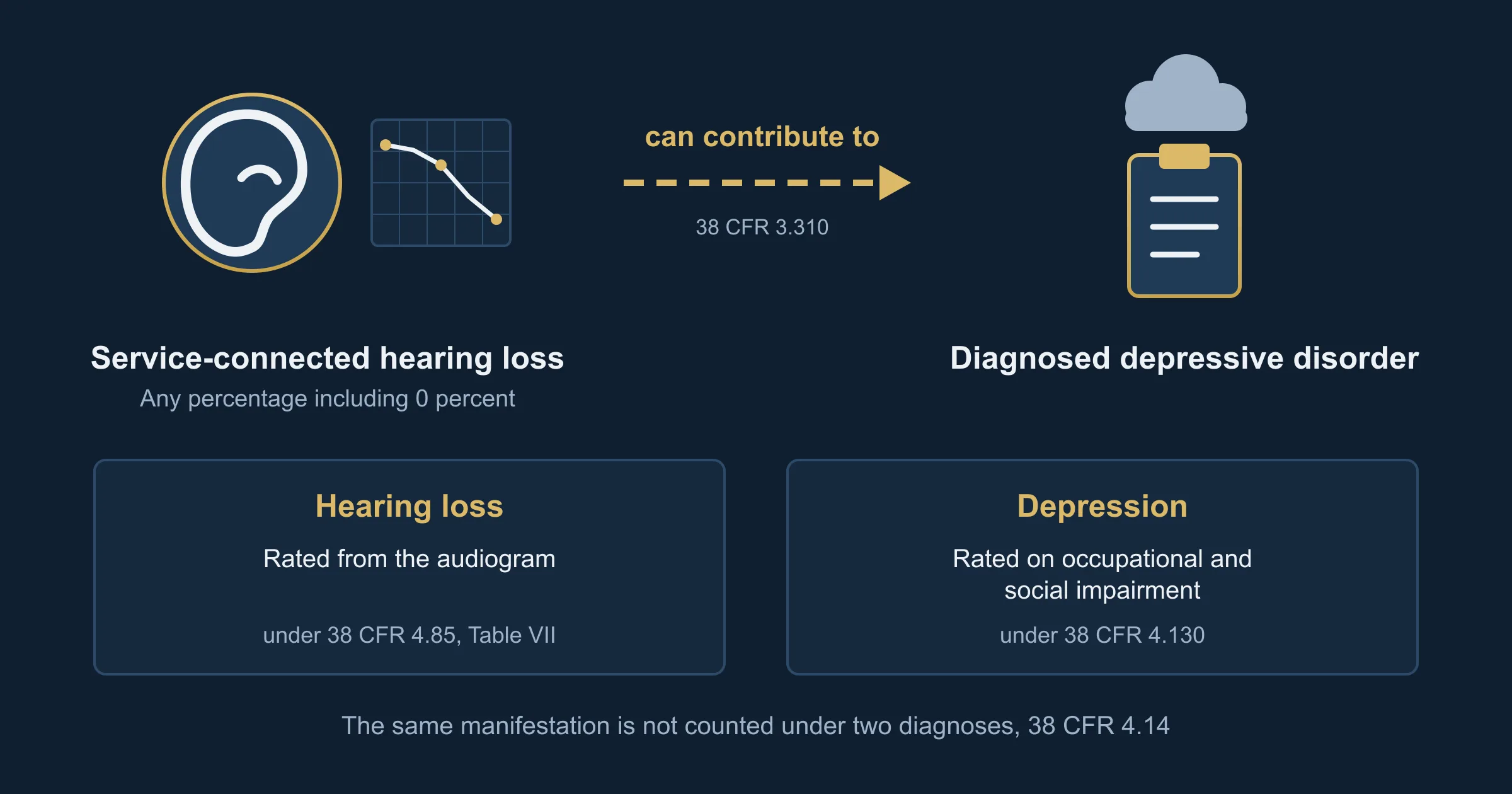 Nexus Letter for Depression Secondary to Hearing LossDepression secondary to service-connected hearing loss, even at 0 percent: what the opinion must show, why the ratings use separate tests, and the research.Read the guide
 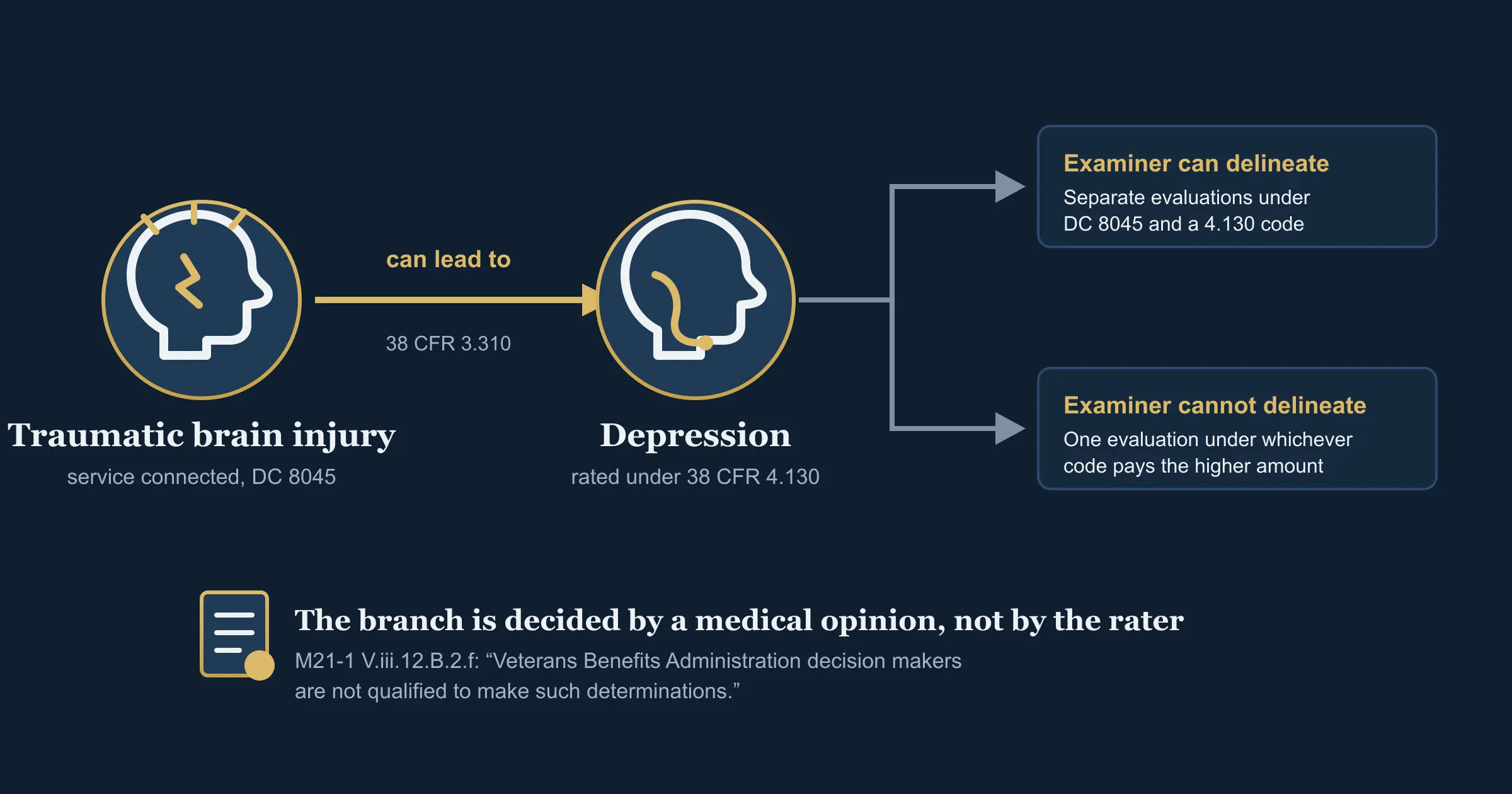 Nexus Letter for Depression Secondary to TBIDepression after a service-connected TBI can be a secondary VA claim. What the nexus letter must prove, and when the VA rates the two conditions separately.Read the guide
  Nexus Letter for Depression Secondary to Chronic PainHow to prove depression is secondary to service-connected chronic pain, why pain severity does not raise the rating, and what Saunders does not give you.Read the guide
 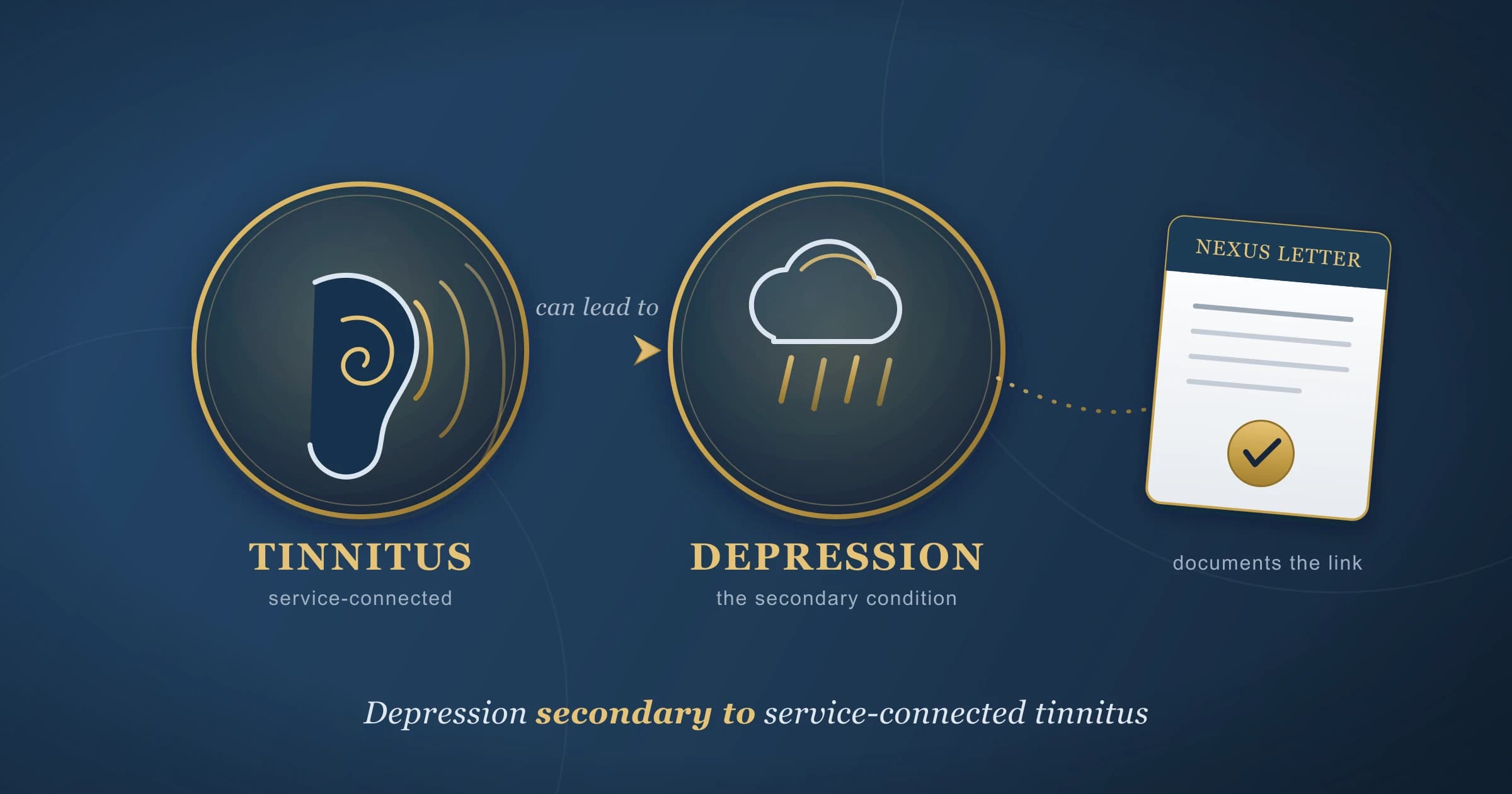 Nexus Letter for Depression Secondary to TinnitusDepression from service-connected tinnitus can be claimed as secondary. What the nexus letter must prove, the VA rating, and the language, from our physicians.Read the guide
You fought for our country, not the paperwork
Let our clinicians prepare a depression nexus letter that meets the VA's evidence standards and supports the benefits you earned.
Sources & Regulatory References
- VA disability compensation (VA.gov) https://www.va.gov/disability/
- 38 CFR 4.130, Schedule of ratings, mental disorders (eCFR) https://www.ecfr.gov/current/title-38/section-4.130
- 38 CFR 3.303, Principles relating to service connection (eCFR) https://www.ecfr.gov/current/title-38/section-3.303
- 38 CFR 3.310, Secondary service connection (eCFR) https://www.ecfr.gov/current/title-38/section-3.310
- 38 U.S.C. 5107, Benefit of the doubt (Cornell LII) https://www.law.cornell.edu/uscode/text/38/5107