
VA Secondary Claims
Nexus Letter for IBS Secondary to PTSD
Medically reviewed by the Patriot Path Medical Team
Licensed MD reviewers • Last updated:
If the VA already rates your PTSD, you can claim irritable bowel syndrome as secondary to it under 38 CFR 3.310, and an IBS rating combines with your PTSD rating under 38 CFR 4.25 rather than being absorbed by it. What decides these claims is a medical opinion that explains the mechanism and reaches at least as likely as not. But before you commission one, check whether you qualify for the Gulf War presumptive route, because it reaches the same diagnostic code without any medical opinion at all, and a secondary opinion can work against it.
An illustrative example
A veteran carries a 50 percent PTSD rating from a 2011 deployment. Cramping and urgency started a few years after he came home, bad enough that he plans his day around where the bathrooms are. His gastroenterologist diagnosed IBS in 2019 and the notes say the flares track his worst PTSD weeks.
He files for IBS secondary to PTSD. The claim turns on one question: is there a medical opinion, from someone who read the file, explaining why this veteran's gut symptoms are at least as likely as not caused or worsened by his service-connected PTSD. The frequency of his pain then sets what the rating is worth.
A composite drawn from common fact patterns, not a real client. It illustrates the sequence, not a predicted outcome.
What a secondary claim has to establish here
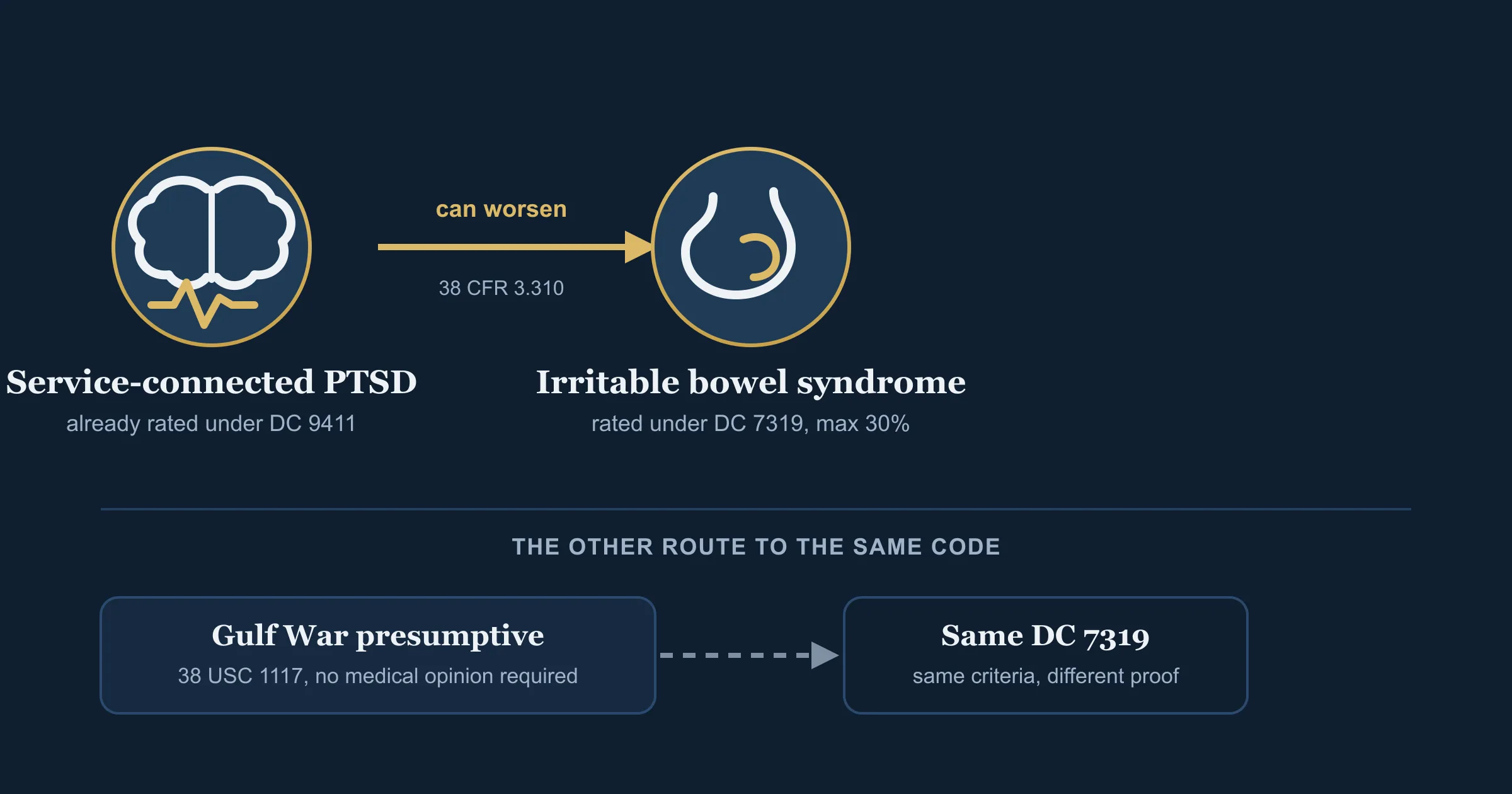
Secondary service connection is short in the regulation and demanding in practice. 38 CFR 3.310(a) says a disability which is proximately due to or the result of a service-connected disease or injury shall be service connected. Applied here that is three things: PTSD the VA already rates, a current diagnosis of irritable bowel syndrome, and medical evidence connecting the two.
VA's own adjudication manual states the causation standard in a way most pages still get wrong. M21-1 V.ii.2.D.1.b says service connection on a secondary basis requires a showing that the secondary disability is the result of, or would not have occurred but for, a service-connected disability. That is but-for language, which came out of Spicer v. McDonough, 61 F.4th 1360 (Fed. Cir. 2023), and it has replaced the older proximate-cause phrasing many competing pages still quote.
The same block carries something genuinely useful that almost nobody publishes: to establish causation, the primary disability need not be service-connected, or even diagnosed, at the time the secondary disability is incurred. So a veteran whose gut symptoms began years before anyone put the words post-traumatic stress disorder in his chart is not barred by the sequence.
For the rating ladder, the symptom estimator and the other routes to an IBS claim, see our page on IBS and VA disability.
New to these documents? Start with our primer on what a nexus letter is.
Check the Gulf War route first, because it may cost you nothing
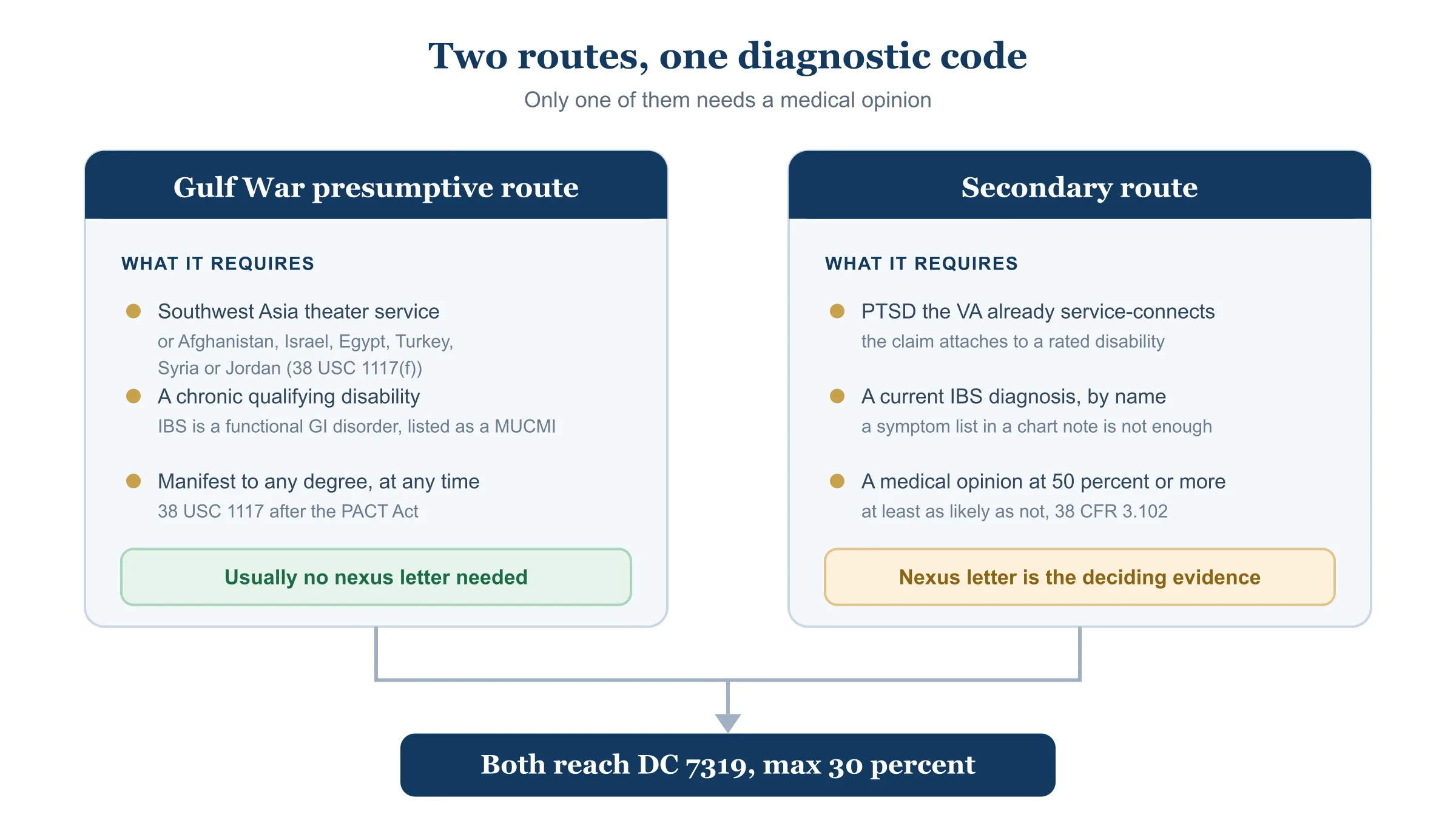
This is the part of the page that can save you the price of a letter, so it goes first rather than last. There are two independent routes to service connection for IBS, they reach the same diagnostic code, and they carry completely different proof burdens.
The Gulf War presumptive route
38 USC 1117, 38 CFR 3.317
For a veteran who served in the Southwest Asia theater during the Gulf War period, VA presumes the link to service. No cause has to be proved and no nexus letter is required. IBS reaches this route as a functional gastrointestinal disorder, which the regulation lists as a medically unexplained chronic multisymptom illness.
The secondary route
38 CFR 3.310
For everyone else, and for Gulf War veterans whose IBS is better explained by a service-connected condition, the claim runs through PTSD. This route needs a current diagnosis and a medical opinion that reaches at least as likely as not. This is the route this page is about.
What the presumptive route actually requires, and two places the sources disagree
Start with where you served, and read the statute rather than the regulation, because they no longer say the same thing. 38 CFR 3.317(e)(2) defines the Southwest Asia theater of operations as Iraq, Kuwait, Saudi Arabia, the neutral zone between Iraq and Saudi Arabia, Bahrain, Qatar, the United Arab Emirates, Oman, the Gulf of Aden, the Gulf of Oman, the Persian Gulf, the Arabian Sea, the Red Sea, and the airspace above those locations. That list is out of date. The PACT Act amended 38 USC 1117(f), which now defines a Persian Gulf veteran as one who served in the Southwest Asia theater of operations, Afghanistan, Israel, Egypt, Turkey, Syria, or Jordan during the Persian Gulf War. If you served in any of those six added locations, the regulation's narrower list is not the end of the question and you should not be turned away on it.
The same lag affects the threshold, and in the same direction. 38 CFR 3.317(a)(1)(i) still says the disability must have become manifest either during service in the Southwest Asia theater or to a degree of 10 percent or more not later than December 31, 2026. Congress removed both limits in the PACT Act. 38 USC 1117(a)(1) now reads that compensation is payable to a Persian Gulf veteran with a qualifying chronic disability that became manifest to any degree at any time. The regulation has not been updated to match, and VA's own manual applies the statutory standard at M21-1 VIII.ii.1.A.1.c.
One precision point, because it is the kind of thing an adjudicator notices. The regulation does not actually name irritable bowel syndrome in its operative list. That list has three entries, and the third is functional gastrointestinal disorders, excluding structural gastrointestinal diseases. IBS appears once in the section, inside an explanatory note. The statute is where IBS is named outright, at 38 USC 1117(a)(2)(B). Cite the statute for the name and the regulation for the category.
Note what the exclusion does. Functional gastrointestinal disorders exclude structural gastrointestinal diseases, and M21-1 VIII.ii.1.A.1.h names inflammatory bowel disease and gastroesophageal reflux disease as examples of what falls outside. So this route is open for IBS and closed for Crohn's, ulcerative colitis and GERD. Do not let anyone tell you otherwise.
Why a secondary opinion can work against a Gulf War veteran
Here is the part no competing page raises, and it matters most for exactly the veterans most likely to buy a letter.
M21-1 VIII.ii.1.A.1.j says, in the manual's own words, that a disability which is affirmatively shown to have resulted from a cause other than service in a 38 USC 1117 location may not be compensated. A nexus letter attributing your IBS to service-connected PTSD is, by design, affirmative evidence of a cause other than Gulf War service. It is capable of undercutting the presumptive route it is competing with.
That does not mean a Gulf War veteran should never claim IBS as secondary to PTSD. Sometimes the secondary theory is simply the true one, and sometimes the presumptive route is unavailable because the service does not qualify. It means the order of operations matters, and that this is a decision to make deliberately rather than by accident.
You do not get to file the two theories as separate claims and pick the winner. M21-1 II.iii.1.A.2.f is explicit that a claim for service connection encompasses all potential theories, claimed or unclaimed, and that a denial of service connection is a denial for all potential theories whether the rating addressed them or not. VA must read the claim liberally for other theories, but only when doing so would benefit the claimant, and it need not develop a theory that would provide no additional benefit.
The practical consequence is simple. If both routes are genuinely open to you, get advice before you put a secondary opinion in the file, because one decision resolves both theories at once.
One thing we could not verify, stated plainly rather than glossed over: there is no provision requiring VA to adjudicate whichever theory is most favorable to you. The nearest language, at M21-1 VIII.ii.1.C.1.h, is about how to bundle symptoms within a single Gulf War rating, not about choosing between theories of service connection. Anyone who tells you VA must pick your best theory is overstating it.
The two routes even look different on the rating sheet
A small detail that shows these are genuinely separate mechanisms rather than two ways of saying the same thing. M21-1 VIII.ii.1.C.2.d gives the hyphenated code for a Gulf War functional gastrointestinal disorder as 8873-7319, where the 88 series flags an undiagnosed illness or medically unexplained multisymptom illness. A secondary grant is coded plainly as 7319. Same criteria, same money, different proof burden and a different code.
What the evidence actually shows, including the parts that do not help
A nexus letter is only as good as the literature behind it, and a physician who overstates that literature writes a weaker letter, not a stronger one. Here is the honest picture on PTSD and irritable bowel syndrome in veterans.
The association is real and replicated, and most of the evidence comes from veterans
A 2019 systematic review and meta-analysis in the Journal of Gastroenterology and Hepatology pooled 8 studies covering 648,375 subjects. Most of those studies were conducted on US army veterans, which describes where the evidence comes from rather than showing the effect is larger there. It found PTSD associated with IBS at a pooled odds ratio of 2.80 (95 percent confidence interval 2.06 to 3.54). The funnel plot was roughly symmetrical and the Egger test was not significant for publication bias, though with only 8 studies that test has little power to detect it.
The single largest study in that pool, looked at on its own
The biggest contributor to that pooled figure is a retrospective cohort of 603,221 Iraq and Afghanistan veterans newly entering VA care, which is roughly 93 percent of the meta-analysis total, so it is not independent corroboration of it. On its own it found that close to 20 percent had a diagnosed gastrointestinal disorder, that veterans with a mental health diagnosis were at least twice as likely to have one, and that IBS was the gastrointestinal disorder most strongly associated with mental health conditions in both men and women.
The mechanism has a name, and it is a hypothesis rather than a fact
The proposed physiology is corticotropin-releasing factor, the principal mediator of the stress response, acting in both brain and gut through two receptor subtypes. Activating CRF type 1 stimulates colonic motor function and induces visceral hypersensitivity, while CRF type 2 counter-regulates it, and IBS is hypothesized to reflect a signaling balance shifted toward CRF type 1. The authors present this as a proposal, and the evidence base is substantially preclinical. A letter should describe it as a proposed mechanism, because that is what it is.
Four findings that cut the other way, and belong in the file
- In 337 women veterans in VA primary care, the tested exposure was trauma history and it survived adjustment for PTSD and depression. PTSD was a covariate rather than the exposure under test, so this is not a finding that PTSD fails to predict IBS. What the authors say is that depression and PTSD were significantly more common in IBS cases than controls, but that neither substantially explained the association between trauma and increased IBS risk.
- In that 603,221-veteran cohort, the PTSD result is sex-specific. Among men, the increased risk of IBS was greatest among those with PTSD. Among women, the increased risk across all gastrointestinal disorders was greatest among those with depression.
- A matched case-control of first-time deployers, drawn from Defense Medical Surveillance System encounter data, found self-reported diarrhea or vomiting during deployment significantly associated with later functional gastrointestinal disorders, while self-reported war-related stressors showed no consistent effect. Two limits keep this in proportion: the study never measured PTSD, so a null on deployment stressors is not a finding about a PTSD diagnosis, and only 22 of its 129 cases were IBS.
- In a 2023 survey of 858 US veterans, prior infectious enteritis carried a higher adjusted odds ratio for IBS (4.44) than PTSD did (3.09), and anxiety (3.47) also outranked PTSD in the same model.
What that means for your letter
Two things. First, an odds ratio is not a risk ratio, and IBS is a common outcome, so a pooled odds ratio of 2.80 does not mean PTSD triples anyone's risk. Half the pooled studies were cross-sectional and cannot establish which condition came first. A letter that says PTSD causes IBS is claiming more than the literature supports and invites a VA examiner to say so.
Second, the competing explanations are not a weakness to hide. A physician who addresses the post-infectious route and the depression confound, and explains why this veteran's history still points at PTSD, has written the opinion that survives review. The benefit-of-the-doubt rule at 38 USC 5107(b) and 38 CFR 3.102 turns on approximate balance of the evidence, and 3.102 says outright that it is not a means of reconciling an actual conflict in the evidence. Addressing the conflict beats ignoring it.
An IBS rating is added to your PTSD rating, not absorbed by it
This is the question veterans ask most, usually phrased as whether the VA will just say the stomach problems are part of the PTSD. The answer is no, and the reason is checkable rather than a matter of opinion. Combining is not adding, though: under 38 CFR 4.25 a 50 percent PTSD rating and a 30 percent IBS rating combine to 65 percent, which rounds to 70, not to 80.
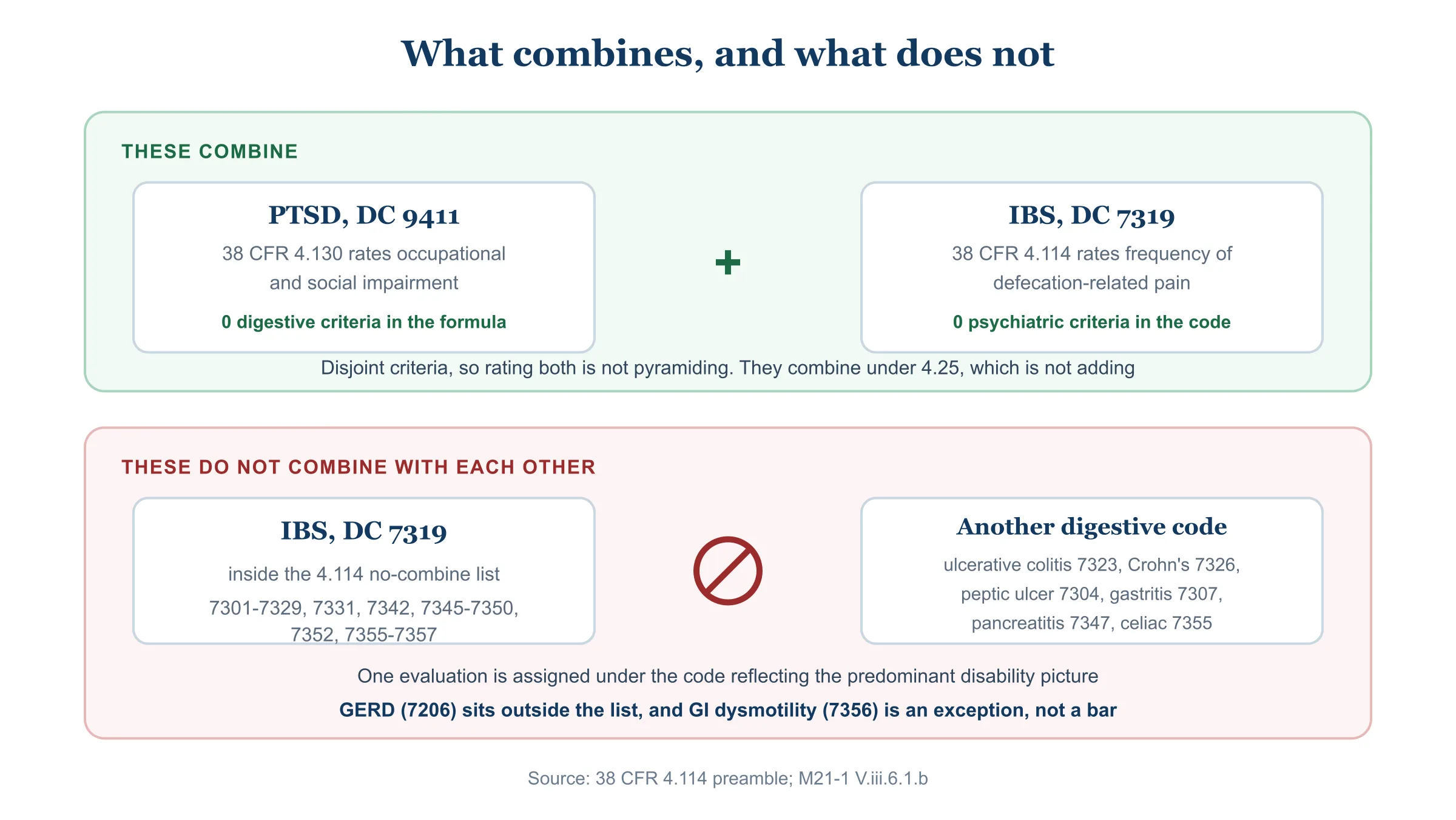
The General Rating Formula for Mental Disorders at 38 CFR 4.130 rates occupational and social impairment. Read its complete text and count the digestive terms: gastrointestinal appears zero times, digestive zero, bowel zero, abdominal zero, stomach zero, diarrhea zero. There is no digestive criterion anywhere in the formula, so the mental-disorder criteria themselves give nothing for an IBS evaluation to be folded into.
One rule can still produce a single evaluation, and it is worth knowing about rather than being surprised by. 38 CFR 4.126(d) says that when a single disability has been diagnosed both as a physical condition and as a mental disorder, the rating agency evaluates it under the diagnostic code representing the dominant, meaning more disabling, aspect of the condition. That reaches the case where one condition carries both labels, for example gut symptoms characterized as somatic symptom disorder. It does not reach two separately diagnosed conditions, which is the ordinary IBS and PTSD case.
38 CFR 4.14 bars evaluating the same manifestation under different diagnoses. It does not bar holding two ratings for two conditions that share a cause. A PTSD evaluation is built from psychiatric symptoms and occupational impairment. A DC 7319 evaluation is built from the frequency of defecation-related abdominal pain and stool symptoms. Disjoint criteria, so rating both is not pyramiding.
VA's manual reaches the same result on the closest facts it addresses. M21-1 V.iii.13.1.h works an example of a veteran service-connected for PTSD who later claims fibromyalgia, and the result is that fibromyalgia is service connected and rated separately from PTSD, with the single limit that a symptom already counted in one evaluation cannot be counted again in the other.
Why the absence of a fold-in rule is meaningful
It would be fair to ask whether the manual is simply silent. It is not, and the proof is next door. M21-1 V.iii.13.1.k says that where insomnia is secondary to or a symptom of another service-connected disability, a separate secondary evaluation is not warranted and the insomnia symptoms are included in the evaluation for the primary disability. That is an explicit fold-in rule, and it sits in the same chapter and the same topic as the physical-condition block above.
So the manual writes a fold-in rule when it means one. It wrote none for gastrointestinal conditions. There is also a stronger case pointing the same way: M21-1 V.iii.1.F.1.c says the fibromyalgia criteria at DC 5025 do not exclude separate evaluations for conditions diagnosed secondary to fibromyalgia, and it names irritable bowel syndrome as one of them. That is a harder case than ours, because the fibromyalgia criteria actually list IBS as a symptom while the mental-disorder formula lists no digestive symptom at all.
One honest limit. There is no M21-1 provision addressing IBS secondary to PTSD by name, in either direction. Everything above is one inferential step from the general rules. The step is sound and nothing in the manual contradicts it, but we are not going to tell you the manual names this pairing, because it does not.
The pyramiding trap that is real, and it is not this one
The rule that will actually cost you money sits inside the digestive schedule. The preamble to 38 CFR 4.114 reads: Do not combine ratings under diagnostic codes 7301 through 7329 inclusive, 7331, 7342, 7345 through 7350 inclusive, 7352, and 7355 through 7357 inclusive, with each other. Instead a single evaluation is assigned under the code reflecting the predominant disability picture, elevated one level if the overall severity warrants. M21-1 V.iii.6.1.b states the same prohibition.
DC 7319 sits inside 7301 through 7329. So if the VA already rates you for ulcerative colitis (7323), Crohn's disease (7326), peptic ulcer disease (7304), chronic gastritis (7307), chronic pancreatitis (7347) or celiac disease (7355), a separate IBS rating on top is prohibited, and winning the secondary claim may add service connection without adding a dollar.
One code inside the range is an exception rather than a bar. DC 7319 carries a note sending other functional digestive symptoms it does not cover to gastrointestinal dysmotility syndrome at DC 7356, and M21-1 V.iii.6.1.b reads that note as allowing the two evaluations to be combined case by case, so long as the symptoms behind each do not overlap under 38 CFR 4.14. That is not a promise of both. It means DC 7356 should not be treated as an automatic bar the way the codes above are.
Two things soften that. GERD is Diagnostic Code 7206, which sits outside the no-combine list, so that bar does not apply to an IBS and GERD pair, though 38 CFR 4.14 still forbids counting the same symptom twice. And since May 19, 2024 there is a worked exception for hiatal hernia. The full prohibition is wider than the first range suggests, so read it in full: 7301 through 7329 inclusive, 7331, 7342, 7345 through 7350 inclusive, 7352, and 7355 through 7357 inclusive. Your rating decision letter lists the codes you already carry, and that single fact can decide whether this claim is worth filing.
What a DC 7319 rating is worth
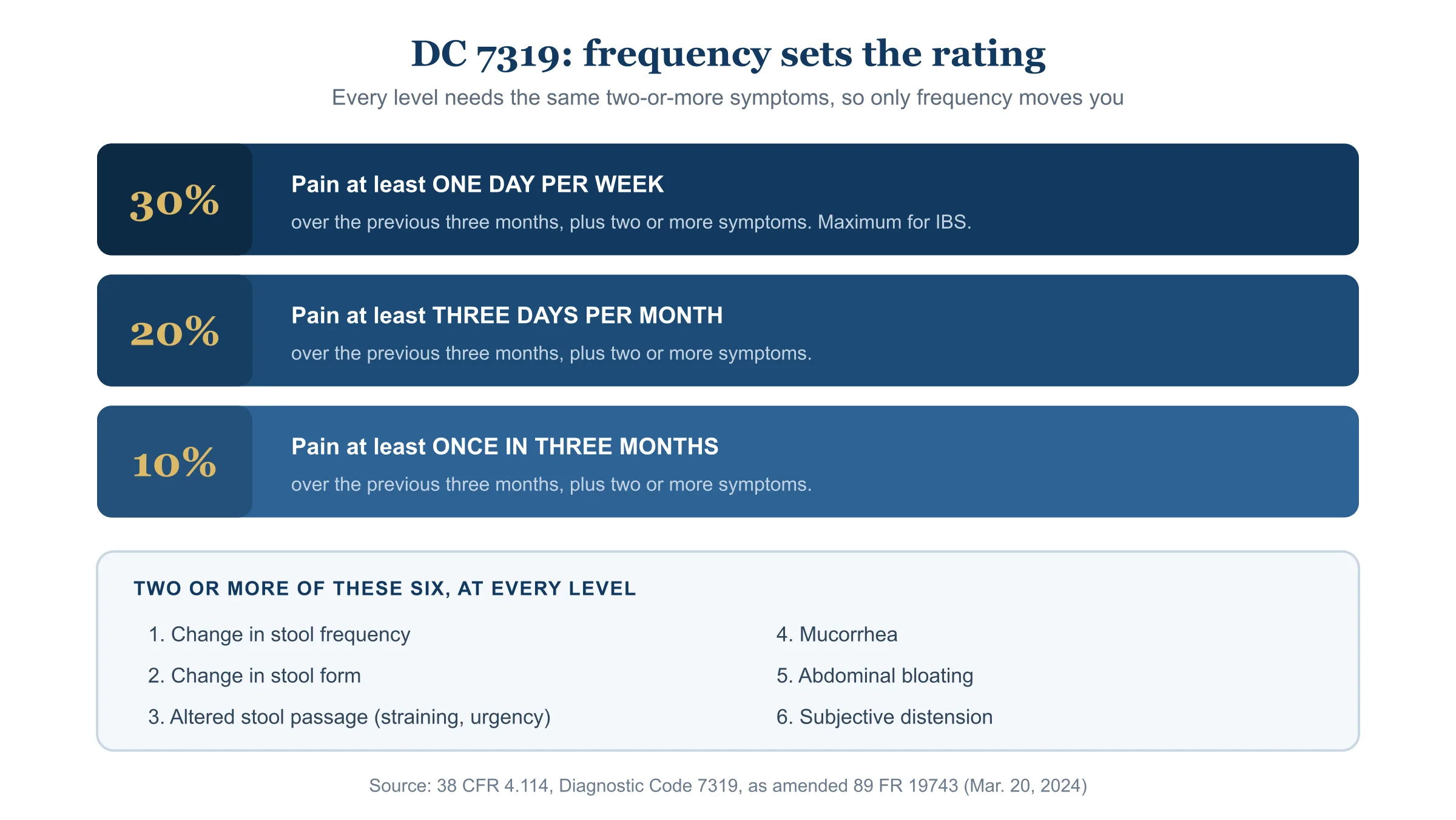
The VA rewrote this code in the 2024 digestive amendment, and the current version turns on frequency rather than the old mild, moderate and severe wording. Every level requires two things at once: abdominal pain related to defecation at a stated frequency over the previous three months, and two or more of the same six listed symptoms.
The six symptoms, in the regulation's own order, are change in stool frequency, change in stool form, altered stool passage meaning straining or urgency, mucorrhea, abdominal bloating, and subjective distension.
The DC 7319 ladder, in plain words
- 30%Abdominal pain related to defecation at least one day per week during the previous three months, plus two or more of the six symptoms. This is the maximum for IBS.
- 20%Abdominal pain related to defecation at least three days per month during the previous three months, plus two or more of the six symptoms.
- 10%Abdominal pain related to defecation at least once during the previous three months, plus two or more of the six symptoms.
30 percent is the ceiling for IBS itself. Anyone quoting you a higher IBS figure is either describing a different diagnostic code or describing your combined rating, which is a different number.
Why a symptom diary is the highest-value document you can produce
Read the ladder again and notice that all three levels share the same six symptoms. The only variable that moves you between 10, 20 and 30 percent is how often the pain happens. That makes frequency the whole rating, and frequency is the one thing your medical records almost never capture, because you do not see your doctor on your bad days.
38 USC 5107(b) requires VA to consider all information and lay and medical evidence of record. IBS has no confirmatory test, so your own dated account of how often defecation-related pain occurs is evidence VA is statutorily obliged to weigh, and it maps directly onto criteria written in the language of days per week and days per month. A three-month log costs nothing and is worth more here than on almost any other claim, but only if it is accurate. Record what actually happened on each day, including the good days, and never round toward a rating tier. VA weighs a log against your treatment records, and a log that does not match them damages the claim it was meant to support.
Causation or aggravation, and why you should plead both
38 CFR 3.310 contains two distinct theories, and they carry different burdens. Only one of them is often argued, and a claim decided on causation alone leaves the aggravation theory unaddressed.
Causation
38 CFR 3.310(a)
Your service-connected PTSD caused the IBS. The manual's standard is but-for: the IBS would not have occurred but for the PTSD. If it is granted, the secondary condition is treated as part of the original condition.
Aggravation
38 CFR 3.310(b)
You already had IBS and service-connected PTSD made it worse. This route needs a documented baseline, and the rating reflects only the increase above it. It is the route to use when the IBS clearly predates the PTSD.
One deduction was abolished and one survived
Almost every page on this topic still describes the aggravation rule as it read before 2026, so this is worth getting exactly right.
M21-1 V.ii.2.D.1.a, change date May 1, 2026, says that in accordance with the holding in Spicer v. McDonough, 61 F.4th 1360 (Fed. Cir. 2023), VA will apply the broader but-for standard and will no longer consider natural progress of the nonservice-connected disability when deciding a claim based on aggravation. The same block says permanent worsening is not required, and that aggravation includes cases where the service-connected disability has interfered with or impeded treatment for the other condition. That last route matters here, because PTSD interfering with treatment adherence is a recognizable pattern in gastrointestinal care.
Note carefully what did not change. 38 CFR 3.310(b) still recites the natural-progress deduction on its face, but Spicer held that regulation unlawful to the extent it is inconsistent with 38 USC 1110, and M21-1 V.ii.2.D.1.a now instructs raters accordingly. If a decision deducts natural progress from your aggravation award, Spicer is the authority to cite. The baseline deduction, by contrast, is very much alive: M21-1 V.ii.2.D.1.g says the evaluation assigned will reflect the difference between the current and baseline levels of severity. Two deductions existed, one is gone, and anyone telling you VA no longer deducts anything in an aggravation claim is wrong.
The baseline is where aggravation claims die
M21-1 V.ii.2.D.1.c requires the baseline level of severity to be established by medical evidence created before the onset of aggravation, or by the earliest medical evidence created between the onset of aggravation and the evidence showing your current severity, or by any other credible evidence including lay evidence that supports establishing the baseline.
The consequence is blunt and it is stated in the manual at V.ii.2.D.1.f: if no baseline can be established, no aggravation can be demonstrated, and the claim must be denied. Two protections travel with that. The denial may come only after VA's duty to assist has been fulfilled, and raters are told not to assume a baseline of zero percent when the evidence does not establish one.
So if you are running an aggravation theory, the pre-PTSD gastrointestinal record is the whole case. Find it before anyone writes an opinion.
What an aggravation opinion has to address to be usable at all
M21-1 V.ii.2.D.1.e sets out what a report must separately address to be adequate for rating a secondary claim based on aggravation. It is worth reading as a checklist, because an opinion missing any of it can be returned as inadequate no matter how favorable it sounds.
- The current level of severity of the nonservice-connected disability.
- An opinion on whether there has been any increase in severity that would not have occurred but for the service-connected disability, or whether the condition would have been less severe but for it, including where the service-connected disability has interfered with or impeded treatment.
- An adequate analysis, with medical considerations, supporting the opinion.
Notice the phrasing the manual asks for is but-for, not proximately due to. An opinion written in the older language is not fatal, but one written in the language the rater is trained to look for is easier to act on.
What the Board has actually done with these claims
Three decisions, read in full rather than summarized from a search result. Each granted service connection for IBS as secondary to PTSD, and each shows something different about how these are won.
Citation Nr 23065835
December 13, 2023
- What was granted
- Granted service connection for IBS as secondary to PTSD, alongside GERD and hypertension on the same theory. The finding of fact reads that, affording the veteran the benefit of the doubt, his diagnosed IBS is related to his service-connected PTSD.
- What it shows
- This is the clearest illustration of what a private opinion is for. The Board weighed private treating-clinician opinions against March 2020 VA examiner opinions and found the VA opinions of little probative value, because the VA examiner did not acknowledge or discuss the veteran's private opinions, DBQs and treatment records. The grant was service connection only; the Board assigned no percentage and remanded the unemployability question.
Citation Nr A23035432
December 12, 2023
- What was granted
- Granted service connection for IBS as secondary to service-connected PTSD, and separately for obstructive sleep apnea on the same theory. The finding of fact was that the probative evidence showed the IBS was caused by the service-connected PTSD.
- What it shows
- The favorable evidence was a private opinion from a gastroenterology specialist, which the Board gave high probative value because it rested on an in-person examination. Worth being straight about what this case is not: the VA examiner did not oppose the claim here. The Board credited both opinions and treated them as mutually reinforcing, so this is a case about a private opinion supplying an express nexus statement the VA paperwork lacked, not about beating a hostile examiner.
Citation Nr A25028989
March 28, 2025
- What was granted
- Granted service connection for IBS as secondary to PTSD on an AGGRAVATION theory, finding at least an approximate balance of the evidence as to whether the veteran's IBS is aggravated by his service-connected PTSD.
- What it shows
- The most instructive of the three on the point this page makes above. The Board rejected the unfavorable VA examinations as inadequate because they addressed causation but never aggravation, citing Atencio v. O'Rourke, 30 Vet. App. 74 (2018), for the rule that an adequate opinion must give separate rationales for both. Two honest caveats: a VA C&P examiner gave a favorable opinion in this case and the Board relied on it, and one opinion the decision later groups with the private examiners was in fact from a VA treating provider.
Board decisions are non-precedential under 38 CFR 20.1303. They are not binding on any other claim, including yours. They are useful as evidence of how these theories are actually argued and decided, and for nothing more than that.
What a strong letter contains for this claim specifically
General nexus letter advice is on our primer. These are the items that matter for IBS secondary to PTSD and would not appear on a generic checklist.
- A named IBS diagnosis, not a symptom listService connection needs a current disability. Cramping and urgency in a treatment note is not a diagnosis. If your provider believes the criteria are met, ask that the diagnosis be recorded by name rather than left as a symptom list. VA's own manual notes that diagnosing a functional gastrointestinal disorder normally requires symptom onset at least six months before diagnosis and symptoms sufficient to diagnose the specific disorder at least three months before, so the chronology in your record matters.
- The mechanism, described as a proposalA physician who explains the corticotropin-releasing factor pathway and calls it a proposed mechanism is more credible than one who asserts a settled causal chain. The literature does not support a settled chain and a VA examiner will know that.
- Both theories, argued separatelyCausation under 3.310(a) and aggravation under 3.310(b), each with its own rationale. Atencio is the authority for why one paragraph covering both is not enough, and A25028989 is the Board applying it.
- The competing explanations, addressed rather than ignoredIf you had gastroenteritis on deployment, the post-infectious route is in your record whether your letter mentions it or not. So is any depression diagnosis. An opinion that names them and explains why PTSD is still at least as likely as not the operative cause is far harder to dismiss than one that pretends they do not exist.
- A baseline, if you are claiming aggravationThe pre-aggravation severity, sourced to a dated record. Without it the manual instructs the rater to deny the aggravation theory outright.
- Your Gulf War service status, considered before anything is writtenIf you served in the Southwest Asia theater, raise it with whoever writes your opinion before they write it, for the reason set out earlier on this page.
Is this claim ready to file
Three of these are absolute prerequisites rather than points, and no medical opinion can supply any of them. The rest are the evidence that decides the strength of the claim.
0 of 8 in hand, but a requirement is not met yet
Start with the PTSD rating. A secondary claim under 38 CFR 3.310 attaches to a disability the VA has already service-connected, so until the PTSD carries its own rating there is nothing for the IBS to attach to. That claim comes first, and no nexus letter can substitute for it.
Nothing to buy at this stage. When that piece is in place, our page on IBS and VA disability covers the rating ladder and the other routes to a claim.
Start with a free consultation
We will look at your PTSD rating, your gut records, and your service history, and tell you which route fits before anyone writes anything. If the answer is that you do not need a letter from us, that is what we will say.
Frequently Asked Questions
Can I get a separate VA rating for IBS if I already have a PTSD rating?
Yes. The General Rating Formula for Mental Disorders at 38 CFR 4.130 rates occupational and social impairment and contains no digestive criterion at all, so an IBS evaluation is not absorbed into a PTSD evaluation. The two ratings are built from different criteria and combine under 38 CFR 4.25, which is combining rather than adding: a 50 percent and a 30 percent rating combine to 65 percent, which rounds to 70. The pyramiding rule at 38 CFR 4.14 bars rating the same manifestation twice under different diagnoses, which is not what is happening here. One limit to know about: 38 CFR 4.126(d) directs a single evaluation under the dominant aspect where one disability has been diagnosed both as a physical condition and as a mental disorder, which reaches gut symptoms characterized as somatic symptom disorder rather than two separately diagnosed conditions.
Will an IBS rating always add money to my check?
Not always, and this is the trap most pages miss. The preamble to 38 CFR 4.114 prohibits combining ratings under diagnostic codes 7301 through 7329 inclusive, 7331, 7342, 7345 through 7350 inclusive, 7352, and 7355 through 7357 inclusive with each other, and IBS at DC 7319 is inside that first range. So if you already hold a rating for ulcerative colitis, Crohn's disease, peptic ulcer disease, chronic gastritis, chronic pancreatitis or celiac disease, a separate IBS rating on top is not permitted, and VA assigns one evaluation under the code reflecting the predominant disability picture. Two qualifications. GERD is DC 7206, outside the list entirely, so that bar does not reach an IBS and GERD pair. And gastrointestinal dysmotility syndrome at DC 7356 is treated as an exception rather than a bar, because M21-1 V.iii.6.1.b reads the DC 7319 note as allowing those two evaluations to be combined case by case where the symptoms do not overlap. Find out which code you already carry before you spend anything.
What is the highest VA rating for IBS?
30 percent. Under 38 CFR 4.114, Diagnostic Code 7319, the 30 percent level requires abdominal pain related to defecation at least one day per week during the previous three months, plus two or more of six listed symptoms. 20 percent requires that pain at least three days per month and 10 percent at least once in three months, each with the same two-or-more symptom requirement. There is no higher level for IBS itself.
Do I need a nexus letter if I am a Gulf War veteran?
Possibly not, and you should check before you buy one. For a veteran who served in the Southwest Asia theater, IBS can be service-connected presumptively as a functional gastrointestinal disorder, with no proof of cause and no medical opinion required. Be aware that a nexus letter attributing your IBS to PTSD is affirmative evidence of a cause other than Gulf War service, and VA's manual says a disability affirmatively shown to have resulted from a cause other than service in a qualifying location may not be compensated on that presumptive basis. If both routes are open to you, get advice on the order before putting a secondary opinion in the file.
Does service in Afghanistan qualify for the Gulf War presumptive for IBS?
Yes, under the statute, and this is a place where the regulation is out of date and can mislead you. 38 CFR 3.317 mentions Afghanistan only in paragraph (c), which covers a separate list of infectious diseases, and its theater definition does not include Afghanistan. But the PACT Act amended 38 USC 1117(f), which now defines a Persian Gulf veteran as one who served in the Southwest Asia theater of operations, Afghanistan, Israel, Egypt, Turkey, Syria, or Jordan during the Persian Gulf War. The statute governs. If a decision turns you away on the regulation's narrower list, 38 USC 1117(f) is the authority to cite.
Is there still a deadline for the Gulf War presumptive?
The regulation and the statute disagree, and the statute governs. 38 CFR 3.317(a)(1)(i) still says the disability must have become manifest to a degree of 10 percent or more not later than December 31, 2026. The PACT Act removed both limits from the governing statute, and 38 USC 1117(a)(1) now provides for compensation where a qualifying chronic disability became manifest to any degree at any time. The regulation has not caught up, and VA's adjudication manual applies the statutory standard.
My IBS started before my PTSD was diagnosed. Am I out of luck?
No. VA's manual states that to establish causation the primary disability need not be service-connected, or even diagnosed, at the time the secondary disability is incurred. Separately, if the IBS genuinely predates the PTSD, the stronger theory is usually aggravation under 38 CFR 3.310(b) rather than causation, which means your opinion needs a documented baseline of how severe the IBS was before the PTSD worsened it.
How strong is the medical evidence linking PTSD to IBS?
Strong enough to support an opinion, and not strong enough to call it settled causation. A 2019 meta-analysis of 8 studies covering 648,375 subjects, most of them US army veterans, found a pooled odds ratio of 2.80. But an odds ratio is not a risk ratio, half the pooled studies were cross-sectional and cannot establish sequence, and there are real findings on the other side: one large veteran cohort found depression outranked PTSD for women, one study of women veterans found trauma history rather than PTSD survived adjustment, and the best-designed deployment study found deployment diarrhea significant while war-related stressors showed no consistent effect. A good letter engages with all of that.
Does the VA rate IBS on how bad my symptoms are or how often they happen?
How often. The 2024 rewrite of Diagnostic Code 7319 replaced the old mild, moderate and severe wording with frequency of abdominal pain related to defecation over the previous three months. All three levels require the same two-or-more symptoms, so frequency is the only variable that moves the rating. That is why a dated symptom log is the single highest-value document you can produce for this claim.
What does a nexus letter from Patriot Path cost?
One flat fee of $1,500, and the first consultation is free. If that consultation shows you are better served by the Gulf War presumptive route, or that an existing digestive rating means a separate IBS rating cannot be combined, we will tell you that rather than sell you a letter you do not need.
Related guides
- Nexus letter for erectile dysfunction secondary to PTSDThe other PTSD secondary spoke where the medication pathway matters as much as the condition itself.
- Nexus letter for sleep apnea secondary to PTSDThe most common PTSD secondary claim, and the one with the clearest rating mechanics.
- Nexus letter for AFib secondary to PTSDA PTSD secondary claim for a heart-rhythm condition: granted in some Board decisions, with mixed research (a small association in one veteran study, no significant link in another) and no proof of cause.
- What is a nexus letterStart here if you have not written or commissioned one of these before.
Citations & References
- 38 CFR 4.114, Diagnostic Code 7319, Irritable bowel syndrome (eCFR) https://www.ecfr.gov/current/title-38/section-4.114
- 38 CFR 4.130, Schedule of ratings, Mental disorders (eCFR) https://www.ecfr.gov/current/title-38/section-4.130
- 38 CFR 4.14, Avoidance of pyramiding (eCFR) https://www.ecfr.gov/current/title-38/section-4.14
- 38 CFR 4.25, Combined ratings table (eCFR) https://www.ecfr.gov/current/title-38/section-4.25
- 38 CFR 4.126, Evaluation of disability from mental disorders (eCFR) https://www.ecfr.gov/current/title-38/section-4.126
- 38 CFR 4.113, Coexisting abdominal conditions (eCFR) https://www.ecfr.gov/current/title-38/section-4.113
- 38 CFR 3.310, Disabilities that are proximately due to, or aggravated by, service-connected disease or injury (eCFR) https://www.ecfr.gov/current/title-38/section-3.310
- 38 CFR 3.317, Compensation for certain disabilities occurring in Persian Gulf veterans (eCFR) https://www.ecfr.gov/current/title-38/section-3.317
- 38 CFR 3.102, Reasonable doubt (eCFR) https://www.ecfr.gov/current/title-38/section-3.102
- 38 USC 1117, Compensation for disabilities occurring in Persian Gulf War veterans https://uscode.house.gov/view.xhtml?req=granuleid:USC-prelim-title38-section1117&num=0&edition=prelim
- 38 USC 5107, Claimant responsibility; benefit of the doubt https://uscode.house.gov/view.xhtml?req=granuleid:USC-prelim-title38-section5107&num=0&edition=prelim
- BVA Citation Nr 23065835 (Dec. 13, 2023) https://www.va.gov/vetapp23/Files12/23065835.txt
- BVA Citation Nr A23035432 (Dec. 12, 2023) https://www.va.gov/vetapp23/Files12/A23035432.txt
- BVA Citation Nr A25028989 (Mar. 28, 2025) https://www.va.gov/vetapp25/Files3/A25028989.txt
- Ng QX et al. Systematic review with meta-analysis: the association between post-traumatic stress disorder and irritable bowel syndrome. J Gastroenterol Hepatol. 2019 (PMID 30144372) https://pubmed.ncbi.nlm.nih.gov/30144372/
- Maguen S et al. Association of mental health problems with gastrointestinal disorders in Iraq and Afghanistan veterans. Depress Anxiety. 2014 (PMID 23494973) https://pubmed.ncbi.nlm.nih.gov/23494973/
- Shin A et al. The prevalence, humanistic burden, and health care impact of irritable bowel syndrome among United States veterans. Clin Gastroenterol Hepatol. 2023 (PMID 35964894) https://pubmed.ncbi.nlm.nih.gov/35964894/
- Malhotra D et al. Self-reported gastrointestinal disorders among veterans with Gulf War illness with and without posttraumatic stress disorder. Neurogastroenterol Motil. 2023 (PMID 36942766) https://pubmed.ncbi.nlm.nih.gov/36942766/
- White DL et al. Trauma history and risk of the irritable bowel syndrome in women veterans. Aliment Pharmacol Ther. 2010 (PMID 20528828) https://pubmed.ncbi.nlm.nih.gov/20528828/
- Porter CK et al. Risk of functional gastrointestinal disorders in U.S. military following self-reported diarrhea and vomiting during deployment. Dig Dis Sci. 2011 (PMID 21643738) https://pubmed.ncbi.nlm.nih.gov/21643738/
- Nozu T, Okumura T. Corticotropin-releasing factor receptor type 1 and type 2 interaction in irritable bowel syndrome. J Gastroenterol. 2015 (PMID 25962711) https://pubmed.ncbi.nlm.nih.gov/25962711/