
VA Secondary Claims
Nexus Letter for Erectile Dysfunction Secondary to PTSD
Medically reviewed by the Patriot Path Medical Team
Licensed MD reviewers • Last updated:
A nexus letter is the medical opinion that ties your erectile dysfunction to your service-connected PTSD, or to the medication you take for it. The VA does not presume that link, so the claim usually turns on this one document. Two things surprise veterans here. The rating for erectile dysfunction is 0 percent, and that is exactly why it is worth claiming, because it is what opens Special Monthly Compensation. And the medication route is often the stronger of the two arguments, not the weaker one.
An illustrative example
A veteran carries a service-connected PTSD rating and has been on sertraline for three years. The erectile dysfunction started a few months after the prescription did. He never filed for it, partly because he did not want to raise it, and partly because someone told him it rates 0 percent so there is no point.
When he did file, the VA denied it. The prescription was in his record and his PTSD was service-connected, but nothing in the file said why one led to the other, and the examiner blamed his age and blood pressure.
A physician then wrote an opinion that named the medication, explained the mechanism, cited the placebo-controlled evidence on antidepressants and sexual function, and addressed both whether the medication caused the condition and whether it made an existing problem worse. The claim was granted, and with it Special Monthly Compensation at the K rate.
A composite example for illustration, not a real client. Outcomes depend on your own facts and evidence.
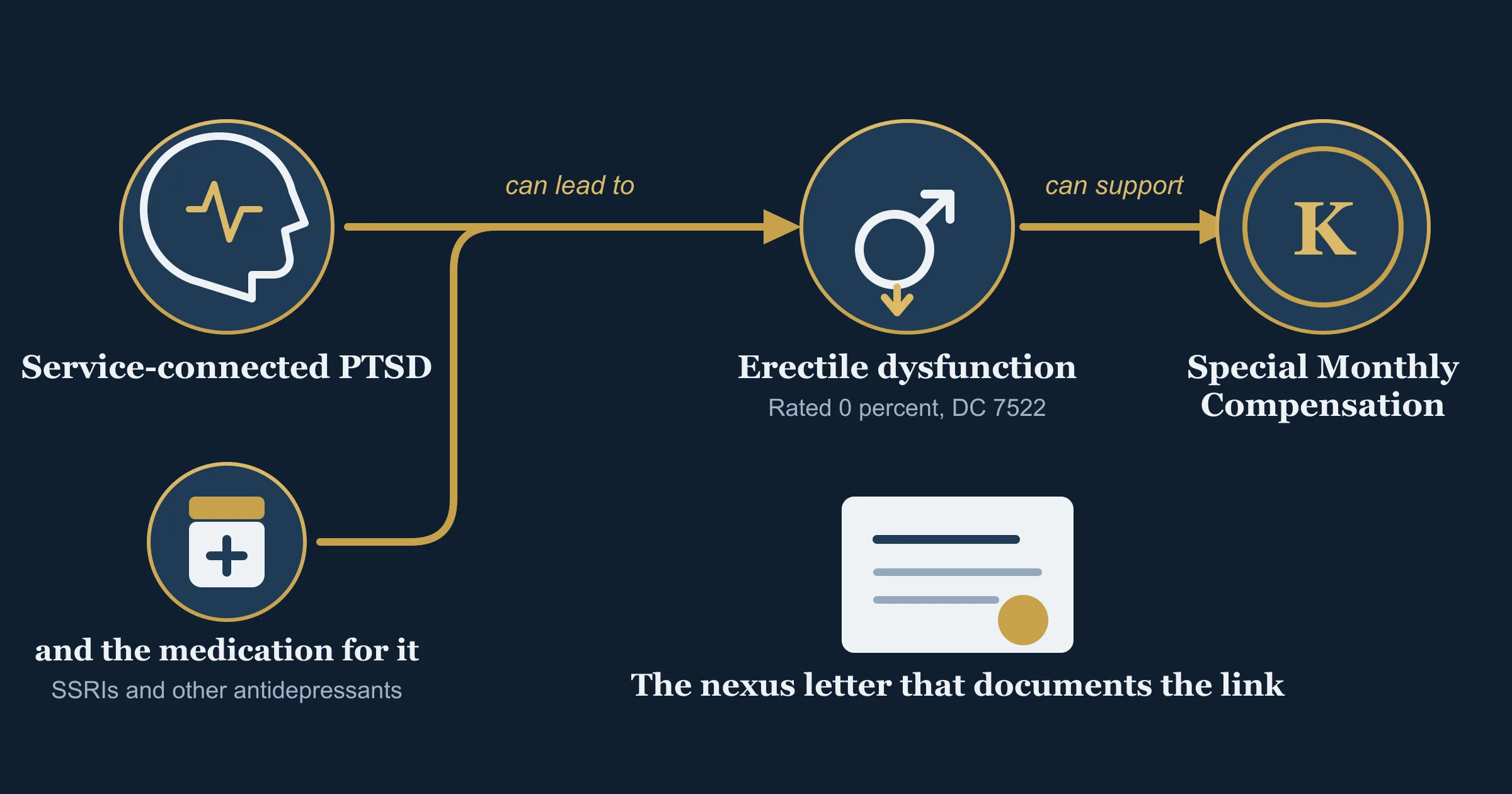
What a Secondary Claim Means Here
A direct claim connects a condition to something that happened in service. A secondary claim connects it to a condition the VA has already service-connected. The rule that allows it is 38 C.F.R. 3.310, and its operative sentence is short: except as provided in 38 C.F.R. 3.300(c), disability which is proximately due to or the result of a service-connected disease or injury shall be service connected.
Erectile dysfunction secondary to PTSD fits that in two different ways, and the difference matters when the letter is written. Either the PTSD itself is what brought the condition on, or the medication prescribed to treat the PTSD did. VA's own manual confirms the second route is available: entitlement can rest on a multi-link causal chain between a service-connected disability and the loss of use, and it is not limited to certain disabilities.
One common objection does not hold. Your PTSD did not have to be rated, or even diagnosed, at the time the erectile dysfunction started. VA's manual says so directly, citing Frost v. Shulkin. What has to be settled before the secondary claim can succeed is that the PTSD is service-connected now.
The claim rests on your service-connected PTSD, so that rating needs to be settled first.
New to these documents? Start with our primer on what a nexus letter is.
What the Research Actually Shows, and Why That Helps You
Most pages on this topic tell you that PTSD causes erectile dysfunction. The veteran-specific research does not say that cleanly, and pretending otherwise sets a claim up to be picked apart by an examiner who has read the same literature. Here is the honest version, which is also the more useful one.
The direct PTSD link is real but mixed
A 2021 systematic review of 43 studies of veterans and military personnel found PTSD associated with a higher risk of at least one sexual difficulty, with the clearest links to overall sexual function, desire, satisfaction, and distress. For erectile dysfunction specifically, the review described the findings as mixed. A 2013 cross-sectional study of 4,755 Iraq and Afghanistan veterans treated at one VA medical center did find PTSD to be a significant risk factor for sexual dysfunction, where sexual dysfunction was counted from diagnosis codes or from a prescription written for erectile dysfunction. Prevalence there was 5.5 percent, which the authors say under-counts the real figure.
The strongest single study cuts the other way
A 2023 study of a nationally representative sample of 921 male US veterans put lifetime erectile dysfunction prevalence at 14.2 percent. After adjusting for sociodemographics and physical health conditions, probable PTSD was not significantly associated with it, while major depressive disorder, problem gambling and suicidal ideation were. In a further model considering all the mental-health variables together, major depressive disorder was the one that stayed independently associated. Probable PTSD failing to reach significance in the only nationally representative US veteran sample on this question is not proof that no association exists, but it is a failure to confirm one, and an examiner can find it as easily as we did.
The medication evidence is stronger and placebo-controlled
A meta-analysis restricted to patients without prior sexual dysfunction found that SSRIs and SNRIs, sertraline and paroxetine among them, produce significantly more treatment-emergent sexual dysfunction than placebo. Several other antidepressants did not differ from placebo. Sertraline and paroxetine are the two SSRIs the FDA has approved for PTSD.
Sexual dysfunction is not the same measurement as erectile dysfunction
Much of the literature measures a combined outcome covering desire, arousal, orgasm, ejaculation, erection, and satisfaction. A study reporting that 59.1 percent of patients developed sexual dysfunction on an antidepressant is not reporting an erectile dysfunction rate. Any letter that quietly converts one into the other is overstating its own source, and that is the kind of thing a VA reviewer catches.
What this means for your claim
What this means for your claim is practical. If you are on an antidepressant for service-connected PTSD, the medication pathway is usually the better-supported argument, and a letter built on it stands on placebo-controlled evidence rather than on a correlation an examiner can wave away. If you also carry a service-connected depression diagnosis, say so, because the depression association is the stronger one in the best veteran data. And nothing here requires you to abandon the PTSD-itself argument. It just should not be the only leg the letter stands on.
If depression is part of your picture, our page on depression and VA disability covers how that rating works.
Why a 0 Percent Rating Is the Whole Point
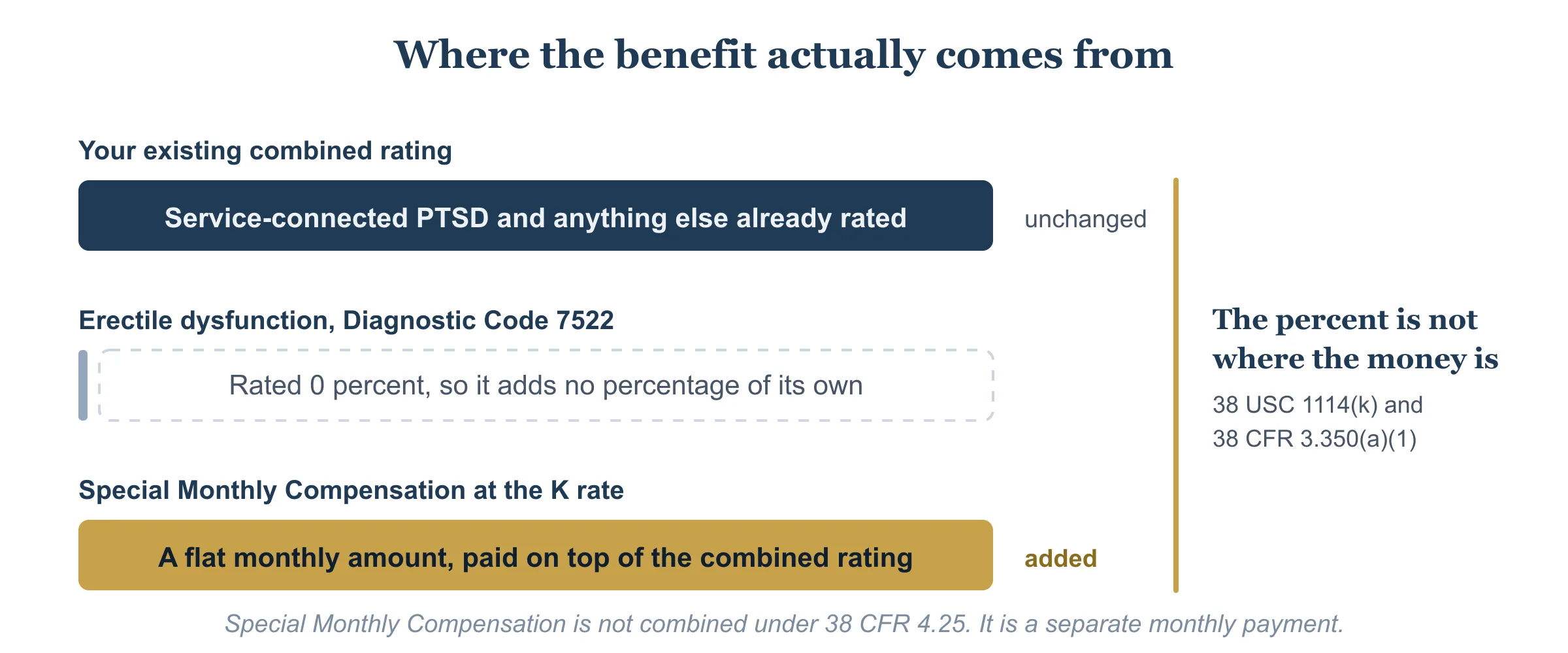
The VA rates erectile dysfunction under 38 C.F.R. 4.115b, Diagnostic Code 7522. The current entry is a single line with a single number: erectile dysfunction, with or without penile deformity, rated 0 percent. There is no higher tier. The older version of the code that turned on penile deformity was replaced when VA rewrote the genitourinary schedule, effective November 14, 2021.
So a granted erectile dysfunction claim adds nothing to your combined rating. Anyone who tells you your percentage will go up is wrong. The benefit is somewhere else, and it is real: Special Monthly Compensation at the K rate, paid for loss or loss of use of a creative organ. VA's own rate table says the K rate is added to your basic compensation for any disability rating from 0 to 100 percent, and the statute makes it independent of the rest of your compensation. As of the December 1, 2025 rates, SMC-K is $139.87 per month, and VA updates it with each cost-of-living adjustment.
One precision point that most pages get wrong, and that matters if you are quoting authority to the VA. 38 C.F.R. 3.350(a)(1) is the regulation that pays SMC at the K rate, but it never mentions erectile function. It defines loss of use of a creative organ through the acquired absence of a testicle, testicular atrophy measurements, or a biopsy showing absence of spermatozoa. The rule that erectile dysfunction itself qualifies comes from VA's adjudication manual, which directs the rater to award SMC based on loss of use of a creative organ where medical evidence shows the loss of erectile power secondary to a disease process. Cite the regulation for the payment and the manual for the rule, and keep them separate.
“Award SMC based on L/LOU of a creative organ if medical evidence of record shows ... the loss of erectile power secondary to a disease process, such as diabetes or multiple sclerosis, in a male Veteran.”M21-1, Part VIII, Subpart iv, Chapter 4, Section A, topic 4.c
The examples in that sentence are diabetes and multiple sclerosis, not PTSD. That is not a limit. A separate note in the same topic says entitlement may rest on a multi-link causal chain between a service-connected disability and the loss of use, and is not limited to certain disabilities. But it does tell you what the letter has to do: it has to build the chain, because the manual is not going to build it for you.
When the payment starts
One timing note. Where erectile dysfunction is the basis for SMC-K, the manual says the general effective-date rules of 38 C.F.R. 3.400 apply and the date generally coincides with the date service connection is awarded for the erectile dysfunction. That guidance sits in the manual topic written for the prostate-cancer situation, M21-1 V.iii.7.3.d, but it is stated for erectile dysfunction generally. It does not automatically reach back to the date your PTSD was granted.
For the full Special Monthly Compensation walkthrough and the eligibility estimator, see our guide to nexus letters for erectile dysfunction.
Your PTSD Rating Does Not Absorb the Claim
Veterans ask whether erectile dysfunction just gets swallowed by the PTSD rating, the way some complications get folded into the condition that caused them. It does not, and it is worth understanding why, because the answer is an absence rather than a rule.
There is a genuine fold-in rule in VA's manual, but it is written for diabetes: noncompensable complications of diabetes mellitus must be evaluated with the disease process under Diagnostic Code 7913. Nothing comparable exists for mental disorders. The mental-disorder rating schedule at 38 C.F.R. 4.130 contains no genitourinary, sexual, erectile, or creative-organ language at all. Its psychiatric diagnostic codes run through the General Rating Formula for Mental Disorders, and the one separate formula in the section, for the two eating-disorder codes, is equally silent on sexual function.
Pyramiding does not reach it either. 38 C.F.R. 4.14 bars evaluating the same manifestation under different diagnoses, and VA's manual explains that pyramiding means rating the same physical manifestations under two separate codes, with separate evaluations warranted where no symptomatology overlaps. The symptoms that drive a PTSD evaluation and the symptoms of erectile dysfunction are not the same symptoms.
The practical upshot is narrower than it sounds. Because Diagnostic Code 7522 pays 0 percent, nothing is being absorbed and nothing is being added. What you are protecting is the SMC-K award, not a percentage.
Caused By It, or Made Worse By It
These are two different claims with two different proofs, and collapsing them is one of the most common ways a letter gets less weight than it should. Decide which one your facts support before anyone starts writing.
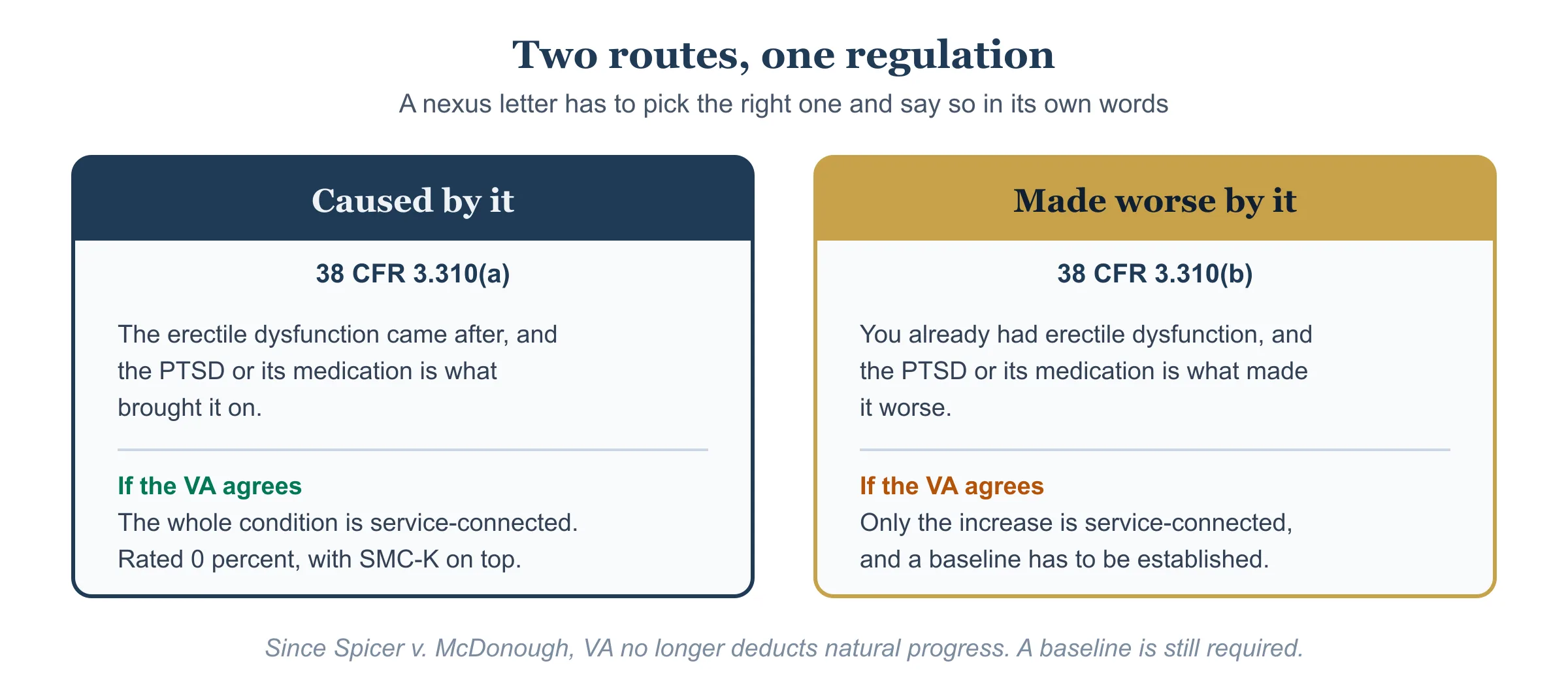
Caused by it
38 C.F.R. 3.310(a)
The erectile dysfunction came after, and the PTSD or its medication is what brought it on. If the VA agrees, the whole condition is service-connected. No baseline is needed, because there was nothing there before.
Made worse by it
38 C.F.R. 3.310(b)
You already had erectile dysfunction, and the PTSD or its medication made it worse. Only the increase is service-connected, and a baseline level of severity has to be established before the VA will concede aggravation at all.
One thing on this page that most sources still have wrong
Read 38 C.F.R. 3.310(b) today and it still tells the rating activity to deduct any increase in severity due to the natural progress of the disease. Many pages quote that clause as live law. VA has stopped applying it.
After Spicer v. McDonough, 61 F.4th 1360 (Fed. Cir. 2023), which held that the statute requires a but-for causation standard rather than a stricter proximate-cause standard, VA's manual says it will apply the broader but-for standard and will no longer consider natural progress when deciding an aggravation claim. The same passage says permanent worsening is not required either.
That is a meaningful change in your favor, and it is worth knowing when an older denial or an older article tells you otherwise.
The baseline is still required, and it is where these claims fail
The regulation says the baseline is established by medical evidence created before the onset of aggravation, or by the earliest medical evidence created between the onset of aggravation and the evidence establishing the current level. VA's manual adds a third route the regulation leaves out: any other credible evidence, including lay evidence, that supports establishment of the baseline. Lay evidence on its own may not be enough, but it can support the baseline and prompt the VA to develop the claim further.
If no baseline can be established, the manual is blunt: no aggravation can be demonstrated, and the claim is denied once the duty to assist is met. It also tells adjudicators not to assume a baseline of 0 percent when one cannot be established, which cuts both ways.
There is a quiet piece of good news in the same section. Aggravation is established by any increase in severity, whether or not it would produce a higher schedular evaluation. Where the baseline and the current level sit at the same level, the manual directs the rater to grant service connection and assign a noncompensable evaluation. On a code that pays 0 percent anyway, that is the outcome that carries SMC-K.
Can You Get VA Disability for Erectile Dysfunction Secondary to PTSD?
Yes, and the Board grants these claims. Three things have to be in place. A nexus letter supplies the third and ties the first two together.
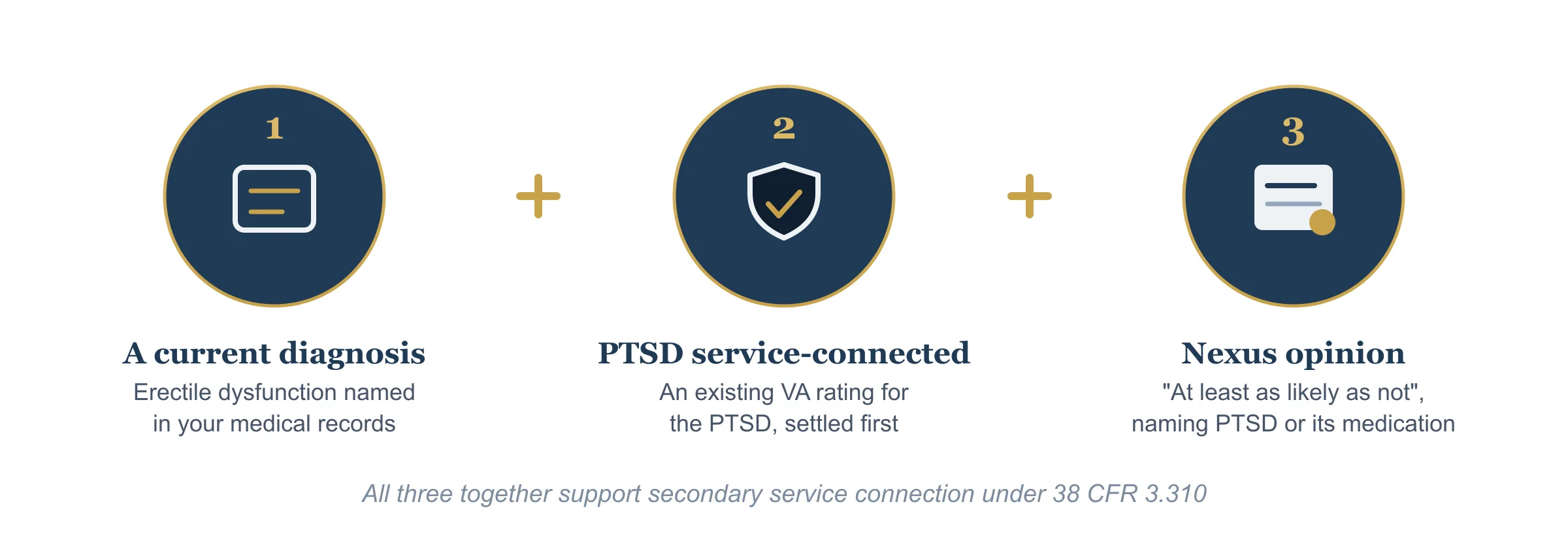
- 1
A current diagnosis
Erectile dysfunction named in your medical records by a provider. Reliance on medication or a device to function is part of what establishes it.
- 2
PTSD already service-connected
An existing VA rating for the PTSD. The secondary claim builds on it, so it has to be settled first, even though it did not have to exist when the erectile dysfunction started.
- 3
A medical nexus opinion
A qualified opinion that your erectile dysfunction is at least as likely as not caused or aggravated by your PTSD or the medication that treats it. This is the nexus letter.
The first two are gates, not points. Without a current diagnosis there is nothing to service-connect, and without a service-connected PTSD rating there is no secondary claim to bring, no matter how strong everything else looks.
Does Taking Medication Hurt the Claim?
No, and VA's manual is unusually clear about it. Special Monthly Compensation at the K rate is established even though the veteran can achieve erection and penetration with the use of medication. A separate section adds that the successful use of medication or a prosthetic implant to restore erectile ability does not preclude the award if the veteran is unable to complete the act of procreation.
The manual goes further than most veterans expect. Where an examination report shows a diagnosis of erectile dysfunction but indicates that the veteran can penetrate and ejaculate without medication, the rater is told to resolve reasonable doubt in the veteran's favor and interpret the report as establishing loss of use of a creative organ.
Read that as reassurance, not as instruction. Keep taking what you are prescribed, describe your symptoms accurately, and let the examiner record what is true. Whether to continue, change, or stop any medication is a decision for you and your prescriber on medical grounds, and it is never something to adjust for a claim.
The three exceptions the manual names
- An examination insufficient for rating purposes, meaning it lacks a valid rationale or an evidentiary basis.
- Specific evidence that the claimant's account of erectile dysfunction lacks credibility.
- A preponderance of the evidence to the contrary.
Two of those three are about the quality of the record rather than about your condition, which is a fair description of what a well-built claim file is for.
The Language the VA Requires
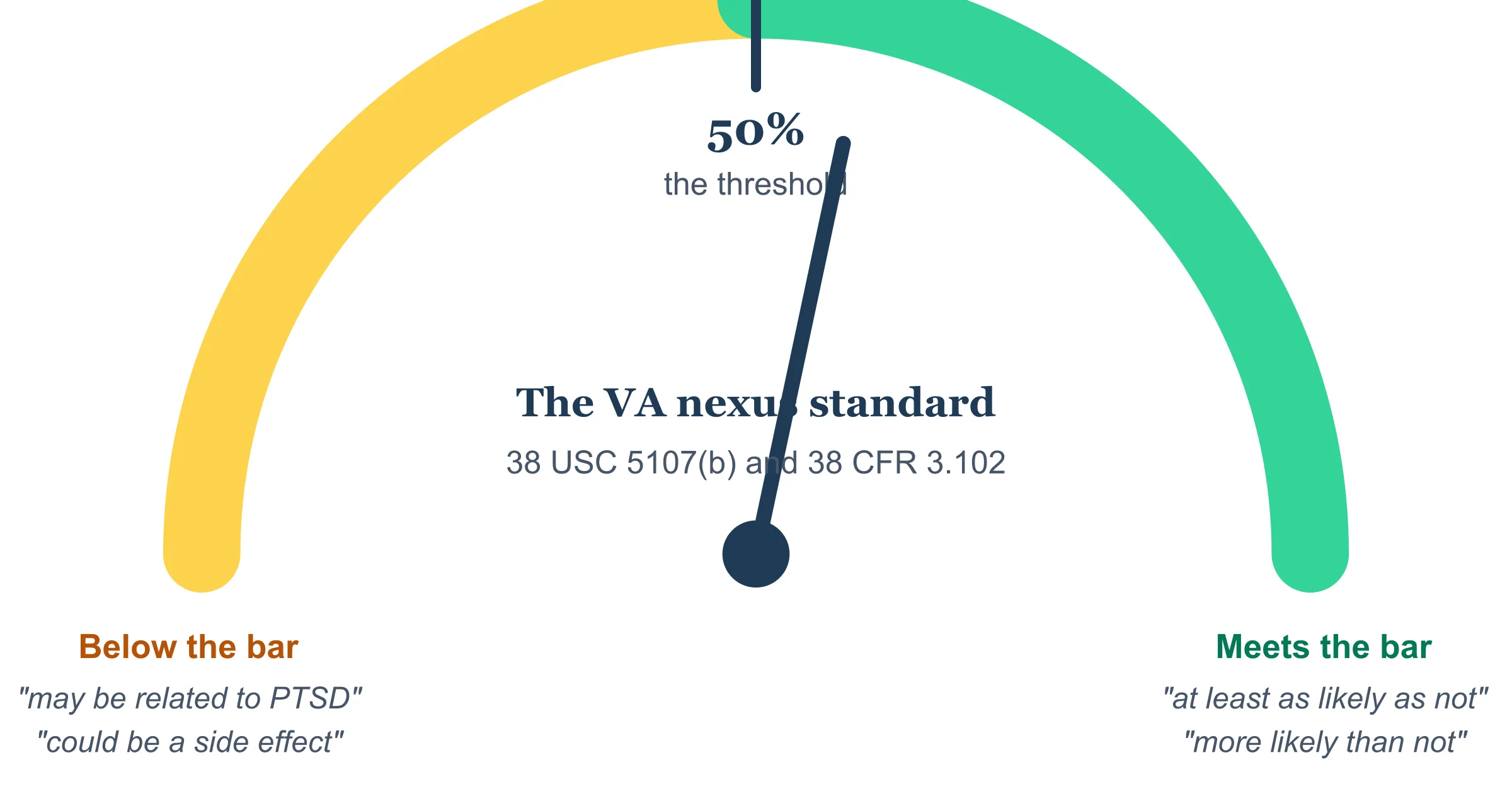
The VA reads these opinions closely, and small differences in wording change how much weight they carry. The threshold is 50 percent probability, which comes from the benefit-of-the-doubt rule in 38 U.S.C. 5107(b), carried out in 38 C.F.R. 3.102. An opinion that lands below it is not evidence the VA can act on.
Language that meets the bar
- “At least as likely as not caused or aggravated by the veteran's service-connected PTSD, and by the sertraline prescribed to treat it” Meets the threshold, names the secondary path, and names the medication. The standard to aim for.
- “More likely than not a result of the veteran's service-connected PTSD” Exceeds 50 percent, stronger than the minimum.
Language that fails
- “May be related to the veteran's PTSD” A possibility, not a probability. Below the standard.
- “Could be a side effect of his medication” "Could" does not reach the 50 percent bar, and an unnamed medication gives the rater nothing to work with.
Answer both questions
Say both prongs out loud. An opinion that addresses causation and stops there leaves the aggravation theory unexamined, and that omission is exactly what has cost VA examiners their credibility in these appeals.
What the Nexus Letter Must Include
VA's manual sets out what makes an opinion on secondary service connection by aggravation adequate. It is written for VA examiners, which makes it the clearest available description of what a rater is looking for. A private opinion that hits all of it is hard to set aside.
- 1The records actually reviewedName them. A private provider does not have to have read the entire claims file: the Court has held that an examiner needs to know the sufficient relevant facts, not every page. Saying which records informed the opinion is what makes that defensible.
- 2The current level of severityThe manual requires the opinion to separately address how severe the condition is now, not just whether it exists.
- 3The but-for question, answered directlyWhether the increase would not have occurred but for the service-connected disability, or whether the condition would have been less severe but for it. The manual specifically includes the situation where the service-connected disability interfered with or impeded treatment.
- 4The mechanism, in medical termsFor the medication route, name the drug and describe how it affects sexual function. For the PTSD route, describe the pathway you are relying on. A bare conclusion carries almost no weight.
- 5The literature, characterized accuratelyCite what the studies actually measured. Overstating a source is worse than citing a modest one, because it gives the VA a reason to discount the whole opinion.
- 6A baseline, if you are claiming aggravationWhat the condition looked like before, and what changed. Without it the aggravation claim has no floor to measure from.
- 7The probability statementAt least as likely as not, in those words, covering both causation and aggravation.
What the Board Has Actually Done With These Claims
Board of Veterans Appeals decisions are public, and they show a consistent pattern in this exact claim. Three decisions read in full for this page, chosen because each was won on a private medical opinion rather than on a VA examiner's:
Citation Nr A22006319 (2022)
- What was granted
- Service connection for erectile dysfunction as secondary to PTSD with obsessive compulsive disorder, neurocognitive disorder, and TBI, and Special Monthly Compensation under 38 U.S.C. 1114(k) for loss of use of a creative organ.
- What won it
- A private physician's opinion, and a second one from the same physician that reconciled an apparent conflict in the reported onset date and cited literature linking erectile dysfunction to antidepressants including sertraline. The VA-contracted examiner had declined to give an opinion without resorting to speculation, and the Board gave that nothing. Two other private opinions in the same file were also given no probative value, because they stated a conclusion with no rationale behind it.
The granted theory here included TBI alongside PTSD, so it is not a pure PTSD-medication case. It is the only one of the three that reached Special Monthly Compensation.
Citation Nr 23006025 (2023)
- What was granted
- Service connection for erectile dysfunction, on the finding that the evidence was in relative equipoise as to whether it was caused or aggravated by service-connected PTSD, to include the medications taken for PTSD symptoms.
- What won it
- A private treating provider who wrote that the sertraline and trazodone managing the veteran's PTSD both have the potential to cause sexual dysfunction as an adverse side effect, and that the existing condition could likely be aggravated by them. The Board called that opinion highly probative and held that although it was not clear the physician had reviewed the entire claims file, an examiner need only be informed of the sufficient relevant facts, which this one was. The VA evidence was split: the February 2017 examiner blamed hypogonadism and was found not probative for addressing causation only and never aggravation, while an August 2017 VA addendum did address aggravation and was found probative. The Board did not discredit that second VA opinion. It weighed the two against each other and resolved the balance in the veteran's favor.
Service connection only. No percentage and no Special Monthly Compensation were decided here.
Citation Nr A25018560 (2025)
- What was granted
- Service connection for erectile dysfunction as secondary to service-connected PTSD.
- What won it
- A private psychiatrist's opinion. The VA examiner attributed the condition to coronary artery disease and stents, and the Board discounted that opinion because it never addressed aggravation and because the examiner had himself conceded that the veteran's medications would affect his erectile function.
Service connection only. The medications named were a mood stabilizer and an anti-anxiety medication, not specifically an SSRI.
The pattern worth copying
One defect recurs in the VA opinions across these decisions: the examiner addressed whether the PTSD caused the condition and never addressed whether it made an existing condition worse. In Citation Nr 23006025 the Board cited El-Amin v. Shinseki, 26 Vet. App. 136 (2013) by name for the rule that an opinion addressing only causation does not address aggravation, and struck that examiner's opinion on it. In Citation Nr A25018560 the Board reached the same result on the erectile dysfunction claim without naming the case, discounting the examiner for failing to opine on aggravation; it cited El-Amin later in the same decision when remanding a separate sleep apnea claim for the identical defect. Three decisions are not a rule, and the Board denies these claims too. But an opinion that answers both questions cannot be set aside on that ground, which makes this a drafting instruction as much as an argument.
Board decisions are not precedential. Under 38 C.F.R. 20.1303, a Board decision is binding only on the specific case decided and does not establish VA policies or interpretations of general applicability. These are illustrations of how the evidence was weighed, not a prediction about your claim.
What to Give Your Provider
On this claim the pharmacy record often does more work than anything else in the file, because it puts a date on the prescription and a date on the symptoms. Gather these so the physician can write from the record rather than from your account of it.
The core file
- Your PTSD service-connection decisionThe VA letter or rating showing PTSD is service-connected, with the effective date.
- Your full medication historyEvery psychiatric medication, with start dates and dose changes. On the medication route this is the single most important document in the file.
- A current erectile dysfunction diagnosisProvider notes naming it. Notes about needing medication or a device to function count.
What strengthens it
- A timelineRoughly when your PTSD symptoms, your prescriptions, and your erectile dysfunction each began, so the physician can line them up.
- Anything showing what it was like beforeIf the problem predated the PTSD or the prescription, this is the baseline the aggravation claim needs, and it is the piece most files are missing.
- Your other health recordsDiabetes, blood pressure, cardiovascular history, and their medications. A letter that acknowledges them and explains why they do not account for the whole picture is far stronger than one that ignores them.
- Lay statementsShort statements about onset and impact. VA's manual accepts credible lay evidence as one route to establishing a baseline.
How to File the Secondary Claim
- 1File on VA Form 21-526EZClaim erectile dysfunction as secondary, and say what it is secondary to, in plain words: secondary to service-connected PTSD and to the medication prescribed for it. Naming both routes on the form keeps both open.
- 2Raise Special Monthly Compensation explicitlyAsk for SMC-K for loss of use of a creative organ. VA's manual says the issue may be raised within the scope of another claimed issue when the evidence shows entitlement, but naming it removes the guesswork.
- 3Submit the nexus letter with the claimFiling first and adding evidence later works, but a claim that arrives with the opinion already in it is decided on a complete record.
- 4Go to the examIf the VA schedules a Male Reproductive System DBQ or a C&P examination, attend it. Describe your symptoms accurately, including what medication does and does not change.
- 5If you are appealing a denial, use a Supplemental ClaimVA Form 20-0995 is the route when you have new and relevant evidence, and a nexus letter that addresses the ground the VA relied on is exactly that.
File sooner rather than later. The date you file usually sets the date benefits start, and a claim you put off is money left behind. For SMC-K specifically, the effective date generally follows the date service connection is awarded for the erectile dysfunction rather than reaching back to your PTSD grant.
If Your Claim Is Denied
Read the denial letter for the reason, because the reason tells you what the next piece of evidence has to be. Three come up repeatedly in these claims.
The examiner blamed something else
Age, blood pressure, diabetes, or cardiovascular disease. This is the most common denial, and the answer is not to pretend those factors are absent. It is an opinion that accounts for them and explains why the service-connected pathway still contributes at least as likely as not.
The opinion never addressed aggravation
If the examiner only asked whether PTSD caused the condition, the opinion is incomplete where aggravation was raised. That is the El-Amin problem, and it is a ground the Board has acted on.
No baseline for an aggravation claim
If you claimed the condition was made worse and nothing in the file shows what it was like before, the VA has nothing to measure. Lay evidence can help establish it, and VA's manual says so.
Who Should Write the Letter, and What It Costs
Any licensed physician can write a nexus letter. The ones the VA takes seriously come from providers who can explain the mechanism and characterize the literature accurately, rather than assert a conclusion. The Board decisions above make that concrete: in one of them, three private opinions were submitted and only the one with a rationale was given any weight.
Your VA provider is not barred from helping. VHA Directive 1134(3) requires providers, when requested, to assist patients in completing VA and non-VA medical forms and to provide medical statements about the patient's condition and functionality, except where specifically prohibited. In practice many VA providers do not have your service records in front of them and are not positioned to assess causation, which is why an independent opinion from an outside physician is the usual route. It is a practical limit, not a policy ban, and it is worth asking your own provider first.
Patriot Path physicians write letters built for this exact claim: records reviewed, the pathway you are actually relying on, the literature characterized as it reads, and the opinion in the language the VA requires, covering both causation and aggravation. One flat fee of $1,500, and the first consultation is free.
For what your VA provider is required to do when you ask, and what to do if they refuse, see our guide to VA Directive 1134.
Not sure who qualifies? See our breakdown of who can write a nexus letter, and what belongs in one in our guide to nexus letter requirements.
See the full scope of our nexus letter services and how the process works.
Is Your Secondary Claim Ready?
Score your claim
0 of 7 in hand
Check each item you already have in hand. The first two are gates, so the result tells you where you stand rather than just counting boxes.
Start with the PTSD itself. A secondary claim under 38 CFR 3.310 attaches to a disability the VA has already service-connected, so until the PTSD carries its own rating there is nothing for the erectile dysfunction to attach to. That claim comes first, and no nexus letter can substitute for it.
Talk to a clinician about the missing pieces →Give Your Secondary Claim Its Strongest Evidence
Your PTSD rating and your prescription history are already on the record. Let our physicians write the opinion that connects them, on the pathway your own facts actually support, and that answers both causation and aggravation.
Frequently Asked Questions
If erectile dysfunction is rated 0 percent, is it worth claiming?
Yes, and the 0 percent is the reason. Diagnostic Code 7522 pays no percentage, so a granted claim does not raise your combined rating. What it opens is Special Monthly Compensation at the K rate for loss of use of a creative organ, which VA adds to your basic compensation for any disability rating from 0 to 100 percent. As of the December 1, 2025 rates that is $139.87 per month, and VA updates it with each cost-of-living adjustment.
Can I claim erectile dysfunction as secondary to my PTSD medication rather than to the PTSD itself?
Yes. VA's adjudication manual says entitlement to Special Monthly Compensation for a creative organ may be based on a multi-link causal chain between a service-connected disability and the loss of use, and is not limited to certain disabilities. That covers service-connected PTSD leading to a prescribed medication leading to erectile dysfunction. On the evidence, this is often the stronger of the two arguments, because the antidepressant research includes placebo-controlled work while the direct PTSD to erectile dysfunction findings are mixed.
Does PTSD cause erectile dysfunction?
The honest answer is that PTSD is associated with sexual difficulties in veterans, and the findings specifically for erectile dysfunction are mixed. A 2021 systematic review of 43 veteran and military studies found the clearest associations with overall sexual function, desire, satisfaction and distress, and described the erectile dysfunction findings as mixed. A 2023 nationally representative study of US veterans found major depressive disorder, not probable PTSD, remained significantly associated after adjustment. A claim is stronger when the letter reflects that honestly and builds on the pathway your own facts support.
Do I need my PTSD to be service-connected first?
Your PTSD needs to be service-connected before the secondary claim can succeed, so if it is not rated yet, that claim comes first. But it did not have to be service-connected, or even diagnosed, at the time your erectile dysfunction started. VA's manual says so directly, citing Frost v. Shulkin.
Does taking medication for erectile dysfunction hurt my claim?
No. VA's manual says Special Monthly Compensation at the K rate is established even though the veteran can achieve erection and penetration with the use of medication, and that successful use of medication or a prosthetic implant does not preclude the award if the veteran is unable to complete the act of procreation. Keep taking what you are prescribed and describe your symptoms accurately. Any decision about your medication belongs with you and your prescriber, on medical grounds.
What if I already had erectile dysfunction before the PTSD or the medication?
Then you are claiming aggravation under 38 C.F.R. 3.310(b) rather than causation, and the claim turns on a baseline: what the condition looked like before it got worse. The baseline can come from medical evidence created before the onset of aggravation, from the earliest medical evidence in the relevant window, or from other credible evidence including lay evidence. If no baseline can be established, VA's manual says the claim must be denied, so this is the piece to gather first.
Will this raise my combined VA rating?
No. Diagnostic Code 7522 is a flat 0 percent, so it adds nothing under the combined ratings table. Anyone telling you your percentage will rise is describing something the rating schedule does not do. The money comes from Special Monthly Compensation, which is a separate payment rather than a percentage.
Does my PTSD rating absorb the erectile dysfunction claim?
No. There is a fold-in rule in VA's manual, but it is written for diabetes: noncompensable complications of diabetes must be evaluated with the disease process under Diagnostic Code 7913. No comparable rule exists for mental disorders, and the mental-disorder rating schedule at 38 C.F.R. 4.130 contains no genitourinary or sexual criteria at all. Pyramiding under 38 C.F.R. 4.14 does not reach it either, because the manifestations do not overlap.
When would my Special Monthly Compensation start?
VA's manual says that where erectile dysfunction is the basis for SMC-K, the effective date generally coincides with the date service connection is awarded for the erectile dysfunction, under 38 C.F.R. 3.400. It does not automatically reach back to the date your PTSD was granted, which is one more reason not to delay filing.
My C&P examiner blamed my age and blood pressure. Is the claim over?
No. That is the most common denial in these claims, and it is answerable. A strong private opinion does not pretend the other risk factors are absent; it accounts for them and explains why the service-connected pathway still contributes at least as likely as not. In two of the three Board decisions reviewed on this page, the VA examiner's negative opinion was set aside because it addressed causation only and never addressed aggravation.
What does it cost, and how do we start?
Patriot Path charges $1,500 flat for a nexus letter, and the first consultation is free. Book a consultation and a physician will review your situation and tell you honestly whether a letter can help your erectile dysfunction secondary to PTSD claim, including when it cannot.
Related guides
- Erectile dysfunction and the VAThe full rating and Special Monthly Compensation explainer.
- PTSD and VA disabilityRatings, stressors, and secondary conditions.
- Nexus letter for a secondary conditionThe general guide to secondary VA claims.
- Nexus letter for hypertension secondary to PTSDA sibling PTSD secondary claim.
- Nexus letter for sleep apnea secondary to PTSDAnother PTSD secondary claim, with a different rating mechanic.
- Nexus letter for AFib secondary to PTSDA PTSD secondary claim for a heart-rhythm condition, rated under Diagnostic Code 7010.
- Nexus letter for diabetic retinopathy secondary to diabetesWhere the diabetes fold-in rule under DC 7913 Note (1) does apply, worked through for an eye complication.
- How to write a nexus letterThe seven elements, the structure, and the wording.
- Nexus letter exampleSee the framework on a finished letter.
- VA Directive 1134What your VA provider is required to do when you ask.
Citations & References
- 38 CFR 4.115b, Ratings of the genitourinary system, including DC 7522 (eCFR) https://www.ecfr.gov/current/title-38/section-4.115b
- 38 CFR 3.350, Special monthly compensation ratings (eCFR) https://www.ecfr.gov/current/title-38/section-3.350
- 38 CFR 3.310, Secondary service connection and aggravation (eCFR) https://www.ecfr.gov/current/title-38/section-3.310
- 38 CFR 4.14, Avoidance of pyramiding (eCFR) https://www.ecfr.gov/current/title-38/section-4.14
- 38 CFR 4.130, Schedule of ratings, mental disorders (eCFR) https://www.ecfr.gov/current/title-38/section-4.130
- 38 CFR 3.102, Reasonable doubt and benefit of the doubt (eCFR) https://www.ecfr.gov/current/title-38/section-3.102
- 38 CFR 3.400, Effective dates (eCFR) https://www.ecfr.gov/current/title-38/section-3.400
- 38 USC 1114, Rates of wartime disability compensation, including subsection (k) (Cornell LII) https://www.law.cornell.edu/uscode/text/38/1114
- 38 USC 5107, Claimant responsibility and benefit of the doubt (Cornell LII) https://www.law.cornell.edu/uscode/text/38/5107
- VA current Special Monthly Compensation rates, including the SMC-K rate effective December 1, 2025 (VA.gov) https://www.va.gov/disability/compensation-rates/special-monthly-compensation-rates/
- M21-1 Part V, Subpart iii, Chapter 7, Genitourinary Disabilities, topic 4 (VA KnowVA) https://www.knowva.ebenefits.va.gov/system/templates/selfservice/va_ssnew/help/customer/locale/en-US/portal/554400000001018/content/554400000180593/M21-1-Part-V-Subpart-iii-Chapter-7-Genitourinary-Disabilities
- M21-1 Part VIII, Subpart iv, Chapter 4, Section A, Special Monthly Compensation, topic 4 (VA KnowVA) https://www.knowva.ebenefits.va.gov/system/templates/selfservice/va_ssnew/help/customer/locale/en-US/portal/554400000001018/content/554400000177480/M21-1-Part-VIII-Subpart-iv-Chapter-4-Section-A-Special-Monthly-Compensation-SMC
- M21-1 Part V, Subpart ii, Chapter 2, Section D, Secondary Service Connection and Aggravation (VA KnowVA) https://www.knowva.ebenefits.va.gov/system/templates/selfservice/va_ssnew/help/customer/locale/en-US/portal/554400000001018/content/554400000180484/M21-1-Part-V-Subpart-ii-Chapter-2-Section-D-Secondary-Service-Connection-SC-and-Aggravation-of-Non-Service-Connected-NSC-Disabilities
- VA Form 21-526EZ, Application for Disability Compensation (VA.gov) https://www.va.gov/find-forms/about-form-21-526ez/
- VA Form 20-0995, Supplemental Claim (VA.gov) https://www.va.gov/find-forms/about-form-20-0995/
- Bird ER, et al. Relationship Between Posttraumatic Stress Disorder and Sexual Difficulties: A Systematic Review of Veterans and Military Personnel. J Sex Med. 2021 (PubMed) https://pubmed.ncbi.nlm.nih.gov/34257051/
- Hosain GM, et al. Sexual dysfunction among male veterans returning from Iraq and Afghanistan: prevalence and correlates. J Sex Med. 2013 (PubMed) https://pubmed.ncbi.nlm.nih.gov/23088675/
- Way BM, et al. Erectile Dysfunction in a U.S. National Sample of Male Military Veterans. Mil Med. 2023 (PubMed) https://pubmed.ncbi.nlm.nih.gov/35792506/
- Serretti A, Chiesa A. Treatment-emergent sexual dysfunction related to antidepressants: a meta-analysis. J Clin Psychopharmacol. 2009 (PubMed) https://pubmed.ncbi.nlm.nih.gov/19440080/
- Montejo AL, et al. Incidence of sexual dysfunction associated with antidepressant agents: a prospective multicenter study of 1022 outpatients. J Clin Psychiatry. 2001 (PubMed) https://pubmed.ncbi.nlm.nih.gov/11229449/
- Board of Veterans Appeals, Citation Nr A22006319 (2022) https://www.va.gov/vetapp22/Files4/A22006319.txt
- Board of Veterans Appeals, Citation Nr 23006025 (2023) https://www.va.gov/vetapp23/Files1/23006025.txt
- Board of Veterans Appeals, Citation Nr A25018560 (2025) https://www.va.gov/vetapp25/Files2/A25018560.txt