
Welcome to Patriot Path
Nexus Letters for Erectile Dysfunction
Licensed Physician, MD | Patriot Path Medical Team
Specializing in VA genitourinary evaluations and independent medical opinions • Last updated: August 2026
Board-certified physicians specializing in VA disability documentation. Meet our clinicians → • Our review process →
Erectile dysfunction (ED) is one of the most under-claimed conditions. Veterans assume a 0 percent rating means no benefit. It usually means the opposite. ED qualifies for Special Monthly Compensation, a separate payment on top of your other ratings.
It is also one of the most common secondary conditions. Diabetes is a well-documented cause, and so are the medications prescribed for service-connected conditions, including the antidepressants used for PTSD and depression. Our physicians connect your ED to a service-connected cause in the language the VA expects. One flat fee of $1,500. The first consultation is free.
How VA Rates Erectile Dysfunction
The VA rates erectile dysfunction under 38 C.F.R. § 4.115b, Diagnostic Code 7522. The schedular rating is 0 percent. The real benefit comes through Special Monthly Compensation, explained below.
| Rating | What it generally takes | Monthly pay (approx) |
|---|---|---|
| 0% | Erectile dysfunction, with or without penile deformity. This is the schedular rating under DC 7522; it does not add a percentage on its own. | $0 |
The percent is not the point with this condition. It almost always qualifies for Special Monthly Compensation. That is a separate payment added on top of your other ratings.
Pay figures are approximate 2026 rates (effective December 1, 2025) for a single veteran with no dependents. Check VA.gov for current amounts.
Where the benefit comes from: Special Monthly Compensation
This condition pays through Special Monthly Compensation, not through the rating percent. Here is how it works.
- 1
The schedular rating is 0 percent
Under Diagnostic Code 7522, erectile dysfunction is rated at 0 percent. On its own, that adds no monthly payment.
- 2
It qualifies for SMC-K
The VA pays Special Monthly Compensation at the 'K' rate for loss of use of a creative organ. A service-connected case generally meets this.
- 3
It is paid on top
SMC-K is a flat monthly amount added on top of your combined disability rating. It is not folded into it. The amount is set by the VA and updated each year.
- 4
It stacks with the cause
It is usually secondary to another service-connected condition, like diabetes or PTSD. So you may be paid for both the cause and the SMC-K on top.
This payment has its own rules. A provider's statement that the condition is at least as likely as not tied to a service-connected condition is often what unlocks it.
Check your SMC-K eligibility
Erectile dysfunction is rated 0 percent, but it usually pays through Special Monthly Compensation (SMC-K), a flat monthly add-on. Answer two questions to see if you likely qualify. This is a rough orientation, not a decision.
Making a VA Disability Claim for Erectile Dysfunction
A VA claim for ED needs three things to line up:
A current diagnosis
An ED diagnosis in your medical records, from your provider.
A service connection
Most often a link to a service-connected condition like diabetes or PTSD. Or to the medication that treats one.
A medical nexus
A qualified opinion that your ED is 'at least as likely as not' caused or worsened by a service-connected condition or its treatment.
This is usually a secondary claim. Diabetes is a well-documented cause. PTSD and depression are associated with sexual difficulties in veterans, and the medications prescribed for them have placebo-controlled evidence behind them. A nexus letter ties it to that service-connected cause. That both connects the condition and supports the added payment. The 'at least as likely as not' standard (a 50% or better chance) comes from the benefit-of-the-doubt rule in 38 U.S.C. § 5107(b), carried out in 38 C.F.R. § 3.102.
How to Connect Erectile Dysfunction to Service
There are a few ways to tie this condition to your service. For most veterans the secondary path is the strongest. It so often flows from another service-connected condition or its medication.
Secondary connection
Another service-connected condition, or its treatment, caused or worsened your ED (38 C.F.R. § 3.310).
- Diabetes. Diabetes damages the nerves and blood vessels involved in erections. It is one of the most common causes.
- PTSD and depression. Service-connected mental-health conditions are associated with sexual difficulties in veterans, and the medications that treat them are the better-documented route.
- Medication. Antidepressants and blood-pressure drugs for service-connected conditions are frequent causes.
Direct connection
Your ED began in service, or from an in-service injury.
- In-service injury. A pelvic, spinal, or genital injury in service that affects erectile function.
- Onset in service. Symptoms that began and were documented while you served.
Secondary Conditions
This condition most often flows from another service-connected condition. That is the strength of these claims, and where the added payment comes from.
Erectile dysfunction may be secondary to
- Diabetes. Nerve and blood-vessel damage from diabetes is a leading cause of ED. Rated 0 percent under DC 7522, so the benefit a grant opens is Special Monthly Compensation rather than a higher rating. Nexus letter for ED secondary to diabetes →
- PTSD and depression. Service-connected mental-health conditions are associated with sexual difficulties in veterans, and the medications that treat them are the better-documented route. Nexus letter for ED secondary to PTSD →
- Medications. Antidepressants and blood-pressure drugs for service-connected conditions are frequent causes.
- Prostate cancer treatment. Surgery or radiation for service-connected prostate cancer often causes erectile dysfunction.
What erectile dysfunction can lead to
- Special Monthly Compensation (SMC-K). Loss of use of a creative organ qualifies for SMC-K, a separate payment on top of your ratings.
- Depression and relationship strain. ED can worsen or contribute to a mental-health condition. That condition may itself be claimable.
What to Gather - Evidence Checklist
Gather these before you file or ask for a letter. For ED, the records of the service-connected condition behind it do the heavy lifting.
Frequently Asked Questions
If erectile dysfunction is rated 0 percent, is it worth claiming?
Yes. The 0 percent schedular rating is not the benefit. The condition qualifies for Special Monthly Compensation for loss of use of a creative organ. That is a separate flat payment added on top of your other ratings. Many veterans leave this on the table.
What is SMC-K?
Special Monthly Compensation at the 'K' rate. It is paid for certain losses, including loss of use of a creative organ. That covers erectile dysfunction. It is a flat monthly amount, paid on top of your combined rating. The VA sets it and updates it each year.
Can I claim erectile dysfunction as secondary to diabetes or PTSD?
Yes, and it is the most common path. Diabetes is a well-documented cause, and so are the medications that treat service-connected conditions. A nexus letter ties your ED to that service-connected cause. Each route has its own dedicated guide, and the rating mechanics differ: the diabetes guide covers why a grant there is folded into the diabetes evaluation under DC 7913 Note (1) and never moves your percentage, while the PTSD guide covers claims based on the condition itself and on the medication prescribed for it.
Does the medication I take matter?
It can. Antidepressants and blood-pressure drugs prescribed for service-connected conditions are known causes. Your medication list can support a secondary claim.
Do I need a nexus letter for erectile dysfunction?
For most claims, yes. The VA needs a medical opinion tying your ED to a service-connected condition or its treatment. That opinion both connects the condition and supports the Special Monthly Compensation.
Guides for this condition
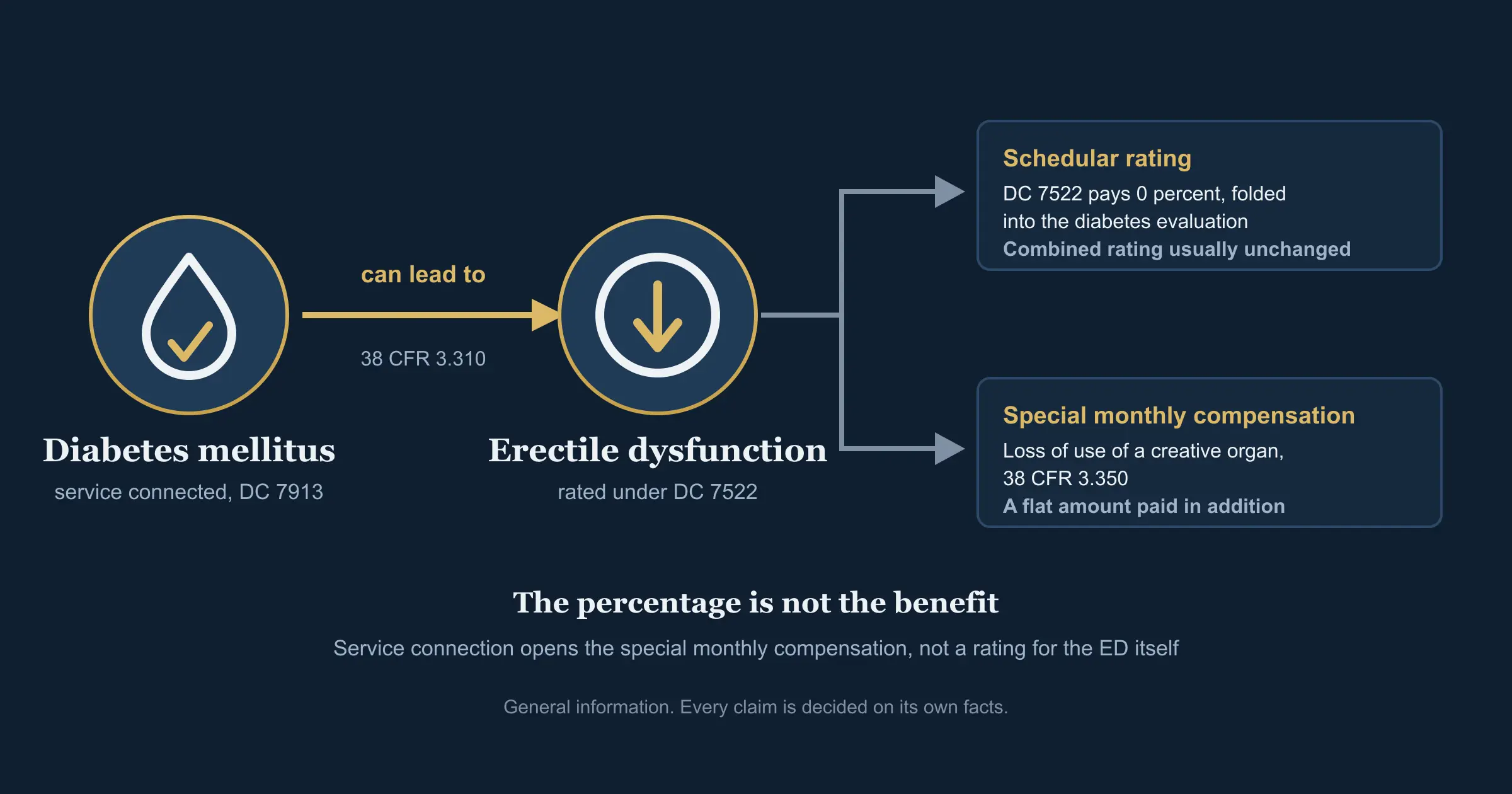 Nexus Letter for Erectile Dysfunction Secondary to DiabetesED secondary to service-connected diabetes never gets its own rating percentage. What the nexus letter must prove, and where the money actually comes from.Read the guide
 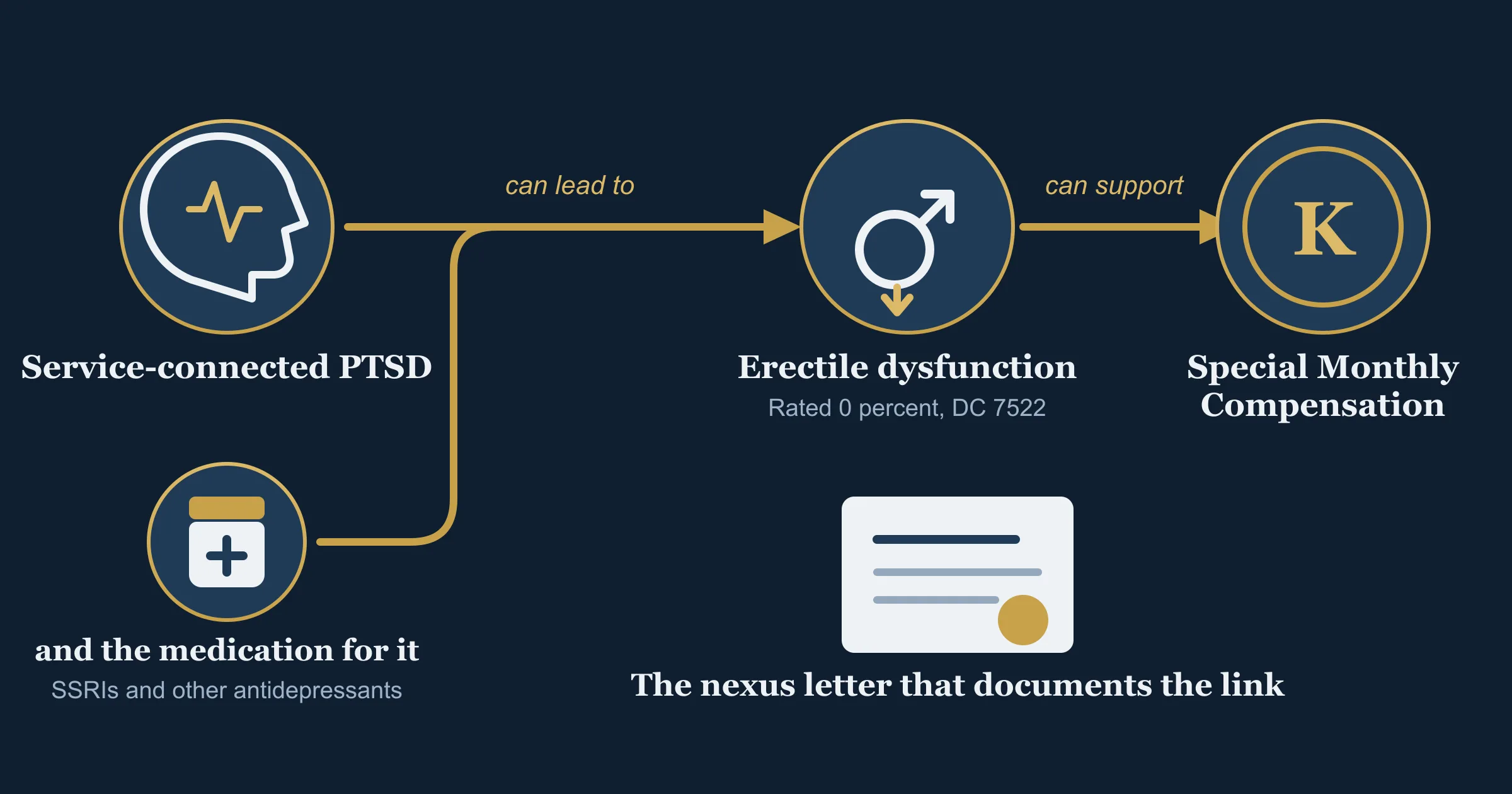 Nexus Letter for Erectile Dysfunction Secondary to PTSDErectile dysfunction secondary to PTSD or the medication that treats it. What the nexus letter must prove, and why a 0 percent rating is the whole point.Read the guide
A 0 percent rating, but a real benefit. Claim it.
Let our physicians connect your ED to its service-connected cause. That supports the Special Monthly Compensation you may be owed.
Sources & Regulatory References
- VA disability compensation (VA.gov) https://www.va.gov/disability/
- VA Special Monthly Compensation rates (VA.gov) https://www.va.gov/disability/compensation-rates/special-monthly-compensation-rates/
- 38 CFR 4.115b, Ratings of the genitourinary system, including DC 7522 (eCFR) https://www.ecfr.gov/current/title-38/section-4.115b
- 38 CFR 3.350, Special monthly compensation ratings (eCFR) https://www.ecfr.gov/current/title-38/section-3.350
- 38 CFR 3.310, Secondary service connection (eCFR) https://www.ecfr.gov/current/title-38/section-3.310
- 38 U.S.C. 1114, Special monthly compensation (Cornell LII) https://www.law.cornell.edu/uscode/text/38/1114