
VA Secondary Claims
Nexus Letter for Hypertension Secondary to PTSD
Medically reviewed by the Patriot Path Medical Team
Licensed MD reviewers • Last updated: August 2026
A nexus letter is the medical opinion that ties your high blood pressure to your service-connected PTSD. The VA does not presume the link, so a secondary claim usually turns on this one document. It states that your hypertension is at least as likely as not caused or aggravated by your PTSD, and it explains the medicine behind that conclusion. Get it right and a claim the VA would otherwise deny can be approved.
A veteran's story
James carried a 70 percent PTSD rating for years. At a routine visit, his primary care doctor started him on blood-pressure medication. He never thought to connect the two, so he never filed for it.
When he finally claimed high blood pressure, the VA denied it. His readings were in the record and his PTSD was service-connected, but nothing in the file explained why one led to the other. The VA treated the hypertension as ordinary and unrelated.
A physician then wrote a nexus letter that laid out the mechanism, chronic stress hormones from PTSD driving his blood pressure up over years, and cited the research behind it. On the supplemental claim, the VA connected the hypertension to his PTSD and paid it.
What a Secondary Claim Means
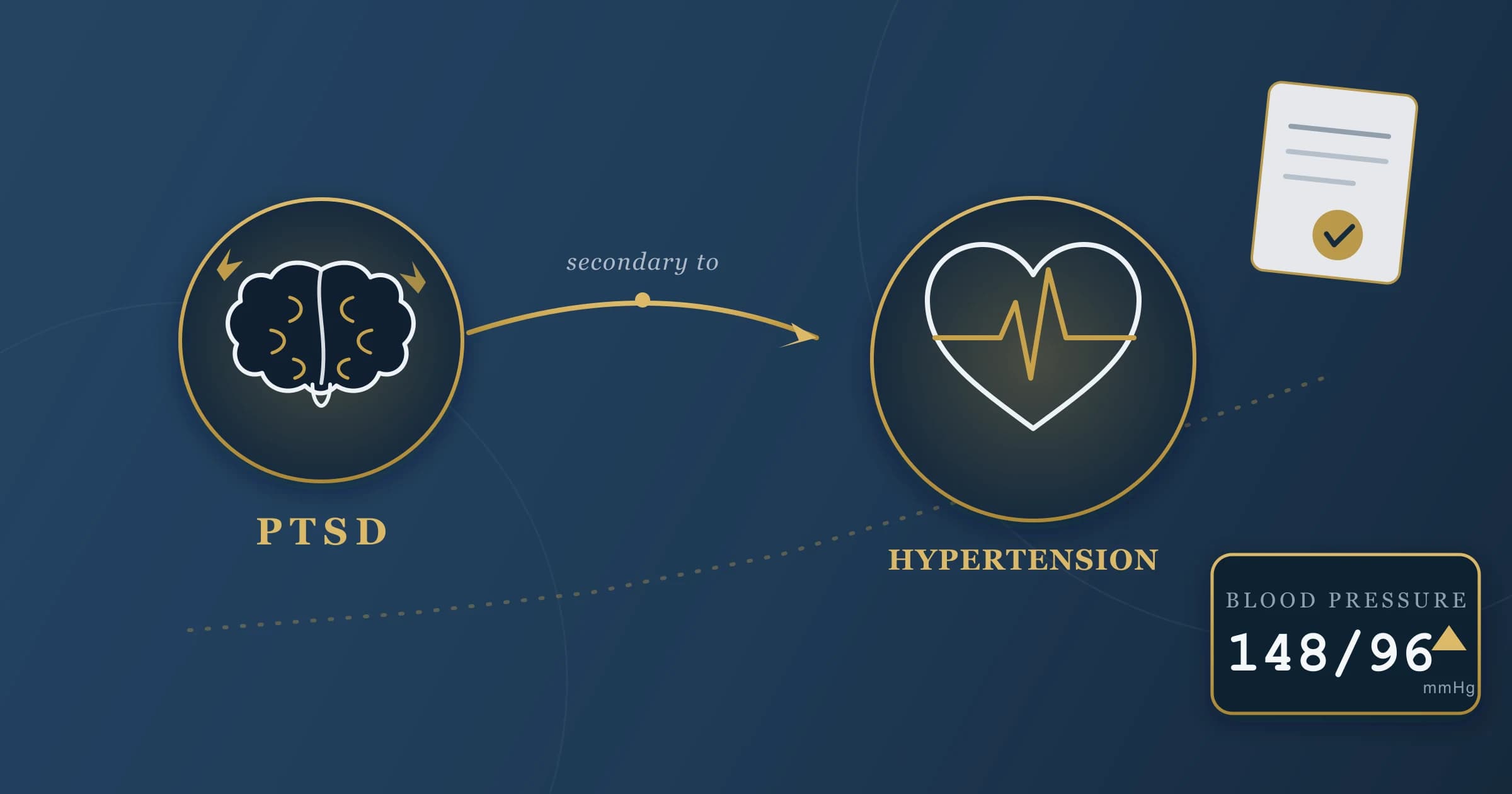
Most veterans think of service connection as a straight line: something happened in service, and it caused a condition. A secondary claim works differently. It connects a new condition to a condition the VA already service-connected, rather than to your service directly. The rule that allows it is 38 C.F.R. 3.310.
Hypertension secondary to PTSD fits this exactly. Your PTSD is already service-connected. Your high blood pressure came later. You are asking the VA to accept that the PTSD caused the hypertension, or made it worse than it would have been on its own. Aggravation counts too: if PTSD pushed a mild, controlled blood pressure into something more serious, that increase is claimable.
The catch is that the VA does not assume any of this. Unlike an Agent Orange presumptive claim, where the link is accepted for you, a secondary claim puts the burden on the evidence. That evidence is the nexus letter.
The claim rests on your service-connected PTSD, so that rating needs to be settled first.
New to these documents? Start with our primer on what a nexus letter is.
How PTSD Raises Blood Pressure
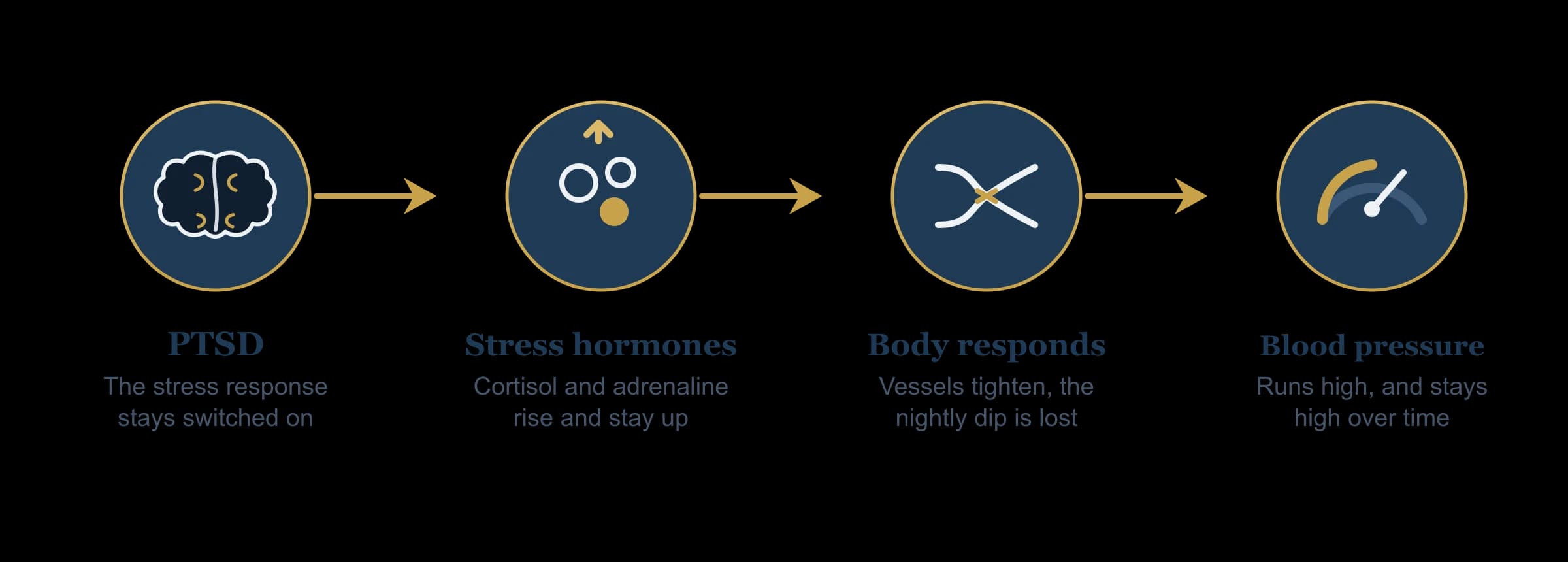
The connection is not a legal technicality. It is physiology, and it is well documented. PTSD keeps the body's stress response switched on, and a body under constant stress runs its blood pressure high.
Stress hormones and the nervous system
PTSD drives chronic activation of the sympathetic nervous system and the stress axis. That means sustained levels of cortisol, adrenaline, and norepinephrine. Those hormones constrict blood vessels and push the heart to work harder, and over years that raises resting blood pressure.
Disrupted sleep
PTSD brings nightmares, insomnia, and hyperarousal. Blood pressure is supposed to dip at night. When sleep is broken and the body never fully stands down, that nighttime dip is lost, and the cardiovascular strain adds up over time.
A documented pattern
This is not one veteran's theory. In a national study of roughly 300,000 veterans, PTSD was associated with a higher risk of developing hypertension, and treating the PTSD reduced that risk. Separate research has measured the elevated stress hormones directly in people with PTSD.
For a nexus letter, this matters because the VA weighs opinions that explain the mechanism far more heavily than a bare assertion. A physician who can name the pathway and cite the literature writes a letter an examiner cannot easily wave away.
The same chronic stress drives the symptoms of PTSD and the sleep disturbances that push blood pressure higher still.
Can You Get VA Disability for Hypertension Secondary to PTSD?
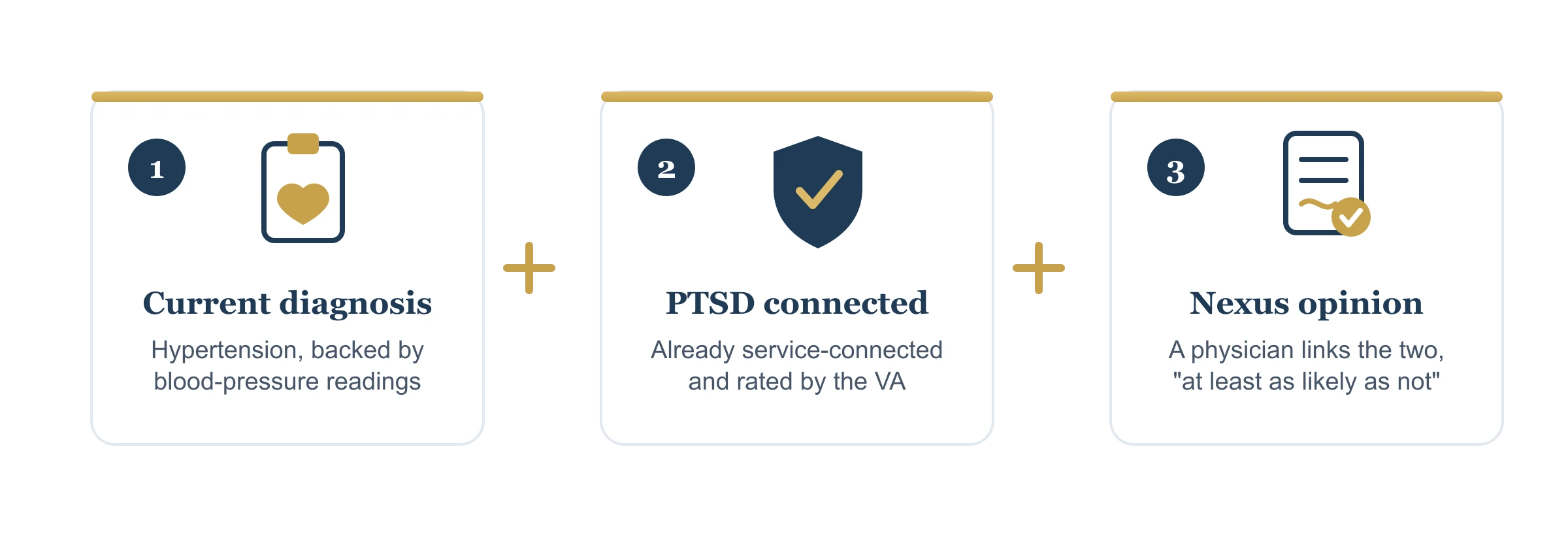
Yes, and it is one of the more common secondary claims. To win it, three things have to be in place. A nexus letter supplies the third and ties the first two together.
- 1
A current hypertension diagnosis
A diagnosis backed by blood-pressure readings in your records. The VA wants readings taken two or more times on at least three different days.
- 2
PTSD already service-connected
Your PTSD needs an existing service connection and rating. The secondary claim builds on it, so this has to be settled first.
- 3
A medical nexus opinion
A qualified opinion that your high blood pressure is at least as likely as not caused or aggravated by your PTSD. This is the nexus letter.
What a Strong Nexus Letter Includes
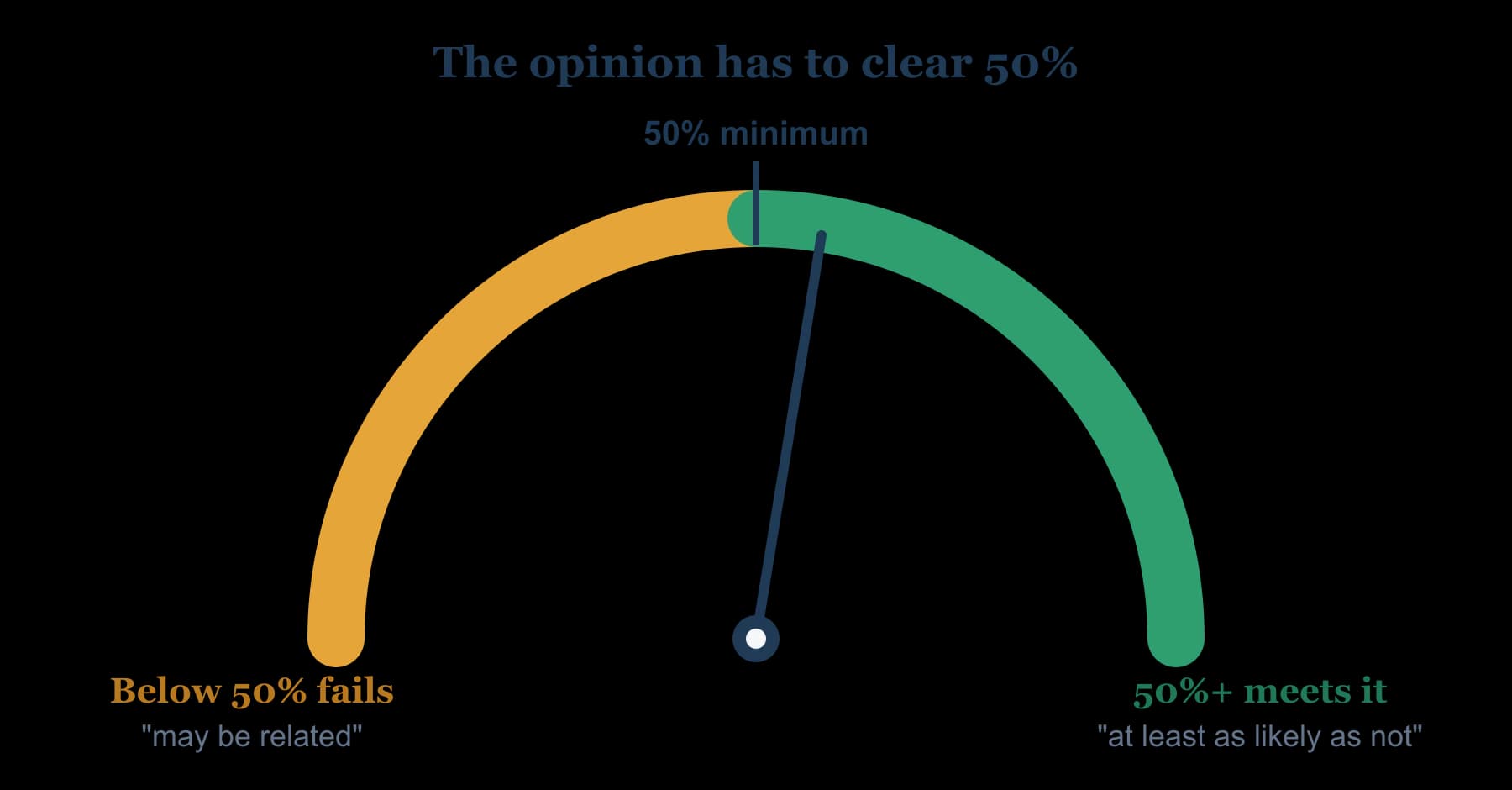
The VA reads a nexus letter closely, and small differences in wording change how much weight it carries. A strong letter for this claim names the records reviewed, states your current hypertension diagnosis, confirms your service-connected PTSD, explains the medical mechanism, cites supporting research, and closes with the opinion in the exact probability language the VA requires. That language is the piece veterans most often get wrong.
Language that meets the bar
- “At least as likely as not caused or aggravated by the veteran's service-connected PTSD” Meets the 50 percent threshold and names the secondary path. The standard to aim for.
- “More likely than not a result of the veteran's PTSD” Exceeds 50 percent; stronger than the minimum.
Language that fails
- “May be related to the veteran's PTSD” A possibility, not a probability. Below the standard.
- “Could be associated with stress” "Could" does not meet the 50 percent bar, and "stress" is not the service-connected condition.
Do not overlook aggravation
If your blood pressure existed before but PTSD made it worse, the letter should say so directly and describe the baseline. Aggravation is its own path to service connection under 38 C.F.R. 3.310(b), and a letter that documents the worsening can win even when the condition was not caused by PTSD outright.
What to Give Your Provider
A nexus letter is only as strong as the records behind it. Bring these so the physician can write from evidence rather than assumption.
The core file
- Your PTSD service-connection decisionThe VA letter or rating showing PTSD is service-connected, with the effective date.
- Blood-pressure readings or a home logReadings taken two or more times on at least three different days. A home log and your records both count.
- A current hypertension diagnosisProvider notes naming the diagnosis, with the readings that support it.
- Medication and treatment recordsYour blood-pressure medications and any dose changes, which show the history and the need for continuous control.
What strengthens it
- A timelineRoughly when your PTSD symptoms and your blood-pressure problems each began, so the physician can line them up.
- Lay statementsShort notes from family or coworkers about symptoms and how long you have dealt with them.
How the VA Rates Hypertension, and Where PTSD Fits
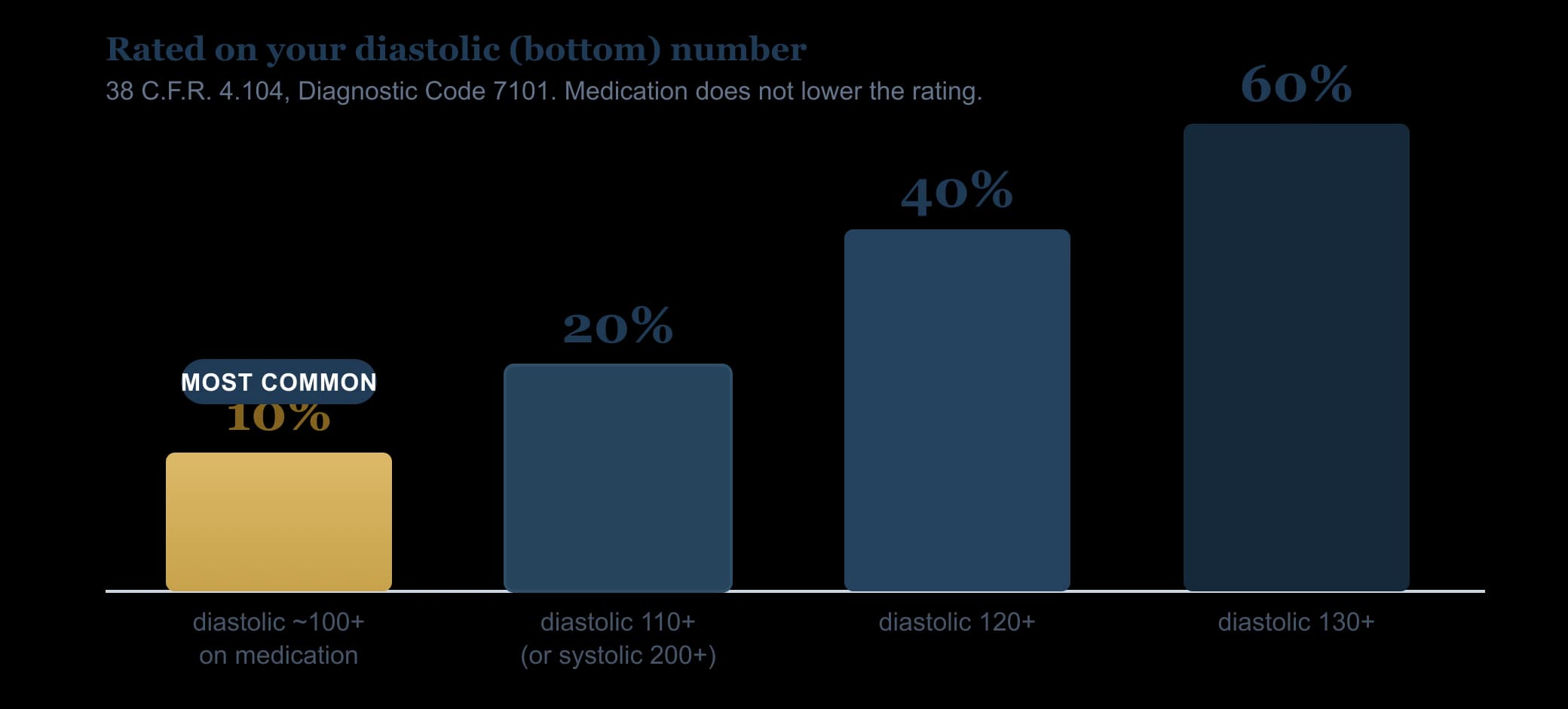
The VA rates high blood pressure under 38 C.F.R. 4.104, Diagnostic Code 7101, and the rating turns on your readings, mostly the diastolic (bottom) number. Ten percent is the lowest level the schedule prints, and there are three ways to reach it: diastolic pressure predominantly 100 or more, systolic pressure predominantly 160 or more, or, as a minimum evaluation, a history of diastolic pressure predominantly 100 or higher in a veteran who needs continuous medication to control it. Ten percent is not a floor, though. Where your current readings are non-compensable, that medication minimum needs both halves, and where one is simply absent DC 7101 prints no 0 percent tier, so 38 C.F.R. 4.31 supplies one and the grant can be assigned at 0 percent. Higher ratings require readings that stay high even on treatment.
Medication and separate ratings
Two things trip veterans up. First, taking medication does not lower your rating; the schedule builds the medicated veteran into the 10 percent minimum. What it does not do is guarantee 10 percent, because that minimum also needs pre-medication diastolic readings predominantly 100 or higher, which is why those older records matter. Second, hypertension is rated separately from any heart disease, so a secondary hypertension claim does not reduce or overlap with a heart condition you may also have.
For the full rating table, the readings behind each level, and the Agent Orange presumptive path, see our guide to nexus letters for high blood pressure.
Is Your Secondary Claim Ready?
Score your claim
0 of 6 in hand
Check each item you already have in hand. Your score updates as you go.
A few core pieces are missing. Start by confirming your PTSD service connection and gathering your blood-pressure readings.
Have a physician build the missing pieces →Finding a Provider to Write the Letter
Any licensed physician can write a nexus letter, but the ones the VA takes seriously come from providers who can explain the mechanism and cite the literature, not just state an opinion. Your VA provider is not barred from helping: VHA Directive 1134(3) requires providers, when requested, to assist with medical forms and provide medical statements, except where specifically prohibited. In practice many VA providers do not have your service records in front of them and are not positioned to assess causation, which is why an independent medical opinion from an outside physician is usually the route.
Patriot Path physicians write letters built for this exact claim: records reviewed, the PTSD-to-hypertension mechanism, supporting research, and the opinion in the language the VA requires. One flat fee of $1,500, and the first consultation is free.
Not sure who qualifies? See our breakdown of who can write a nexus letter, and what belongs in one in our guide to nexus letter requirements.
See the full scope of our nexus letter services and how the process works.
Why Act Sooner Rather Than Later
The date you file usually sets the date your benefits start, so a claim you put off is money left on the table. Filing now, even while you gather evidence, protects an earlier effective date.
It also helps your record. Blood pressure documented over time, alongside your PTSD history, makes the connection easier for a physician to establish and harder for the VA to dismiss. And when the evidence is roughly balanced, the law requires the VA to decide in your favor (38 U.S.C. 5107), which is exactly the edge a well-built nexus letter is meant to create.
Turn Your Readings Into an Approved Claim
Your blood pressure and your PTSD are both on the record. Let our physicians write the nexus letter that shows the VA why one led to the other.
Frequently Asked Questions
Does the VA automatically connect hypertension to PTSD?
No. There is no presumption for hypertension secondary to PTSD, so the VA will not make the link for you. You have to prove it, and the nexus letter is the piece of evidence that does. This is different from an Agent Orange presumptive claim, where the VA already accepts the connection.
Do I need my PTSD to be service-connected first?
For a secondary claim, yes. The claim builds on an already service-connected condition, so your PTSD needs an existing rating before hypertension can be tied to it. If your PTSD is not yet service-connected, that claim comes first, and you can pursue the hypertension once it is settled.
What blood-pressure readings does the VA want?
The VA looks for readings taken two or more times on at least three different days to confirm hypertension. A home blood-pressure log counts alongside your medical records. The more consistent the readings, the stronger the diagnosis behind your claim.
Does taking blood-pressure medication hurt my claim?
No. The rating rules build medication into the 10 percent level, so treating your high blood pressure does not lower your rating or weaken your claim. What matters is your history of readings and the connection to your PTSD. Keep filling your prescriptions and tracking your numbers.
Can I claim aggravation if I already had high blood pressure?
Yes. Under 38 C.F.R. 3.310(b), you can be service-connected for the amount your PTSD worsened a condition you already had. The nexus letter should describe your baseline blood pressure and how it changed, so the VA can see the aggravation rather than treating the hypertension as pre-existing and unrelated.
What does it cost, and how do we start?
Patriot Path charges $1,500 flat for a nexus letter, and the first consultation is free. Book a consultation and a physician will review your situation and tell you honestly whether a letter can help your hypertension secondary to PTSD claim.
Related guides
- Hypertension secondary to sleep apneaThe same rating mechanics with a different primary, including why this claim can be granted at 0 percent.
- Erectile dysfunction secondary to PTSDAnother PTSD secondary claim, where the benefit is Special Monthly Compensation rather than a percentage.
- Nexus letters for VA disability claimsThe full overview, start to finish.
- Nexus letter for a secondary conditionThe general guide to secondary VA claims.
- How to get a nexus letterThe full process, start to finish.
- How to write a nexus letterThe seven elements, the structure, and the wording.
- Nexus letter exampleSee the framework on a finished letter.
- Nexus letter success rateWhat a strong letter changes for a claim.
- High blood pressure and the VARatings, evidence, and the Agent Orange path.
- PTSD and VA disabilityRatings, stressors, and secondary conditions.
Citations & References
- 38 CFR 3.310, Secondary service connection and aggravation (eCFR) https://www.ecfr.gov/current/title-38/section-3.310
- 38 CFR 4.104, Schedule of ratings, cardiovascular system, including DC 7101 (eCFR) https://www.ecfr.gov/current/title-38/section-4.104
- 38 U.S.C. 5107, Claimant responsibility and benefit of the doubt (Cornell LII) https://www.law.cornell.edu/uscode/text/38/5107
- VA disability compensation (VA.gov) https://www.va.gov/disability/
- Burg MM, et al. Risk for Incident Hypertension Associated with PTSD in Military Veterans, and the Effect of PTSD Treatment. Psychosom Med. 2017 (PMC) https://pmc.ncbi.nlm.nih.gov/articles/PMC5285494/
- Wingenfeld K, et al. Effect of PTSD on 24-h urinary catecholamines and cortisol: Mind Your Heart Study. Psychoneuroendocrinology. 2015. doi:10.1016/j.psyneuen.2014.10.023 https://doi.org/10.1016/j.psyneuen.2014.10.023