
VA Secondary Claims
Nexus Letter for Sleep Apnea Secondary to PTSD
Medically reviewed by the Patriot Path Medical Team
Licensed MD reviewers • Last updated: July 2026
A nexus letter is the medical opinion that ties your sleep apnea to your service-connected PTSD. The VA does not presume the link, and it will not build it for you. This is also a claim where the honest picture matters more than the confident one: the medical literature supports an association between PTSD and obstructive sleep apnea, not a proven cause, and two studies that ran the direct comparison with overnight testing found no difference at all. That is not a reason to skip the claim. It is the reason the opinion has to be written carefully, and it is why this guide covers the sleep study the VA requires, the 2026 change to how aggravation claims are decided, and what the Board has actually granted.
An illustrative example
Ray came home from his second deployment and never really slept again. The VA service-connected his PTSD, and for years the sleep problems were filed in his mind under the same heading: the nightmares, the waking at three in the morning, the exhaustion that no weekend fixed.
It was his wife who noticed the other thing. He stopped breathing, over and over, and then gasped. A sleep study confirmed obstructive sleep apnea and his doctor prescribed a breathing assistance device. Ray filed a secondary claim, and the VA denied it. The C&P examiner wrote that sleep apnea is a physical airway obstruction and that PTSD does not cause airway obstruction.
What changed the outcome was not a louder assertion. It was a physician who read the whole file, addressed the examiner's reasoning head on rather than ignoring it, explained why the timeline and Ray's own record supported the connection in his particular case, and stated the opinion in the probability language the VA is required to weigh. On the supplemental claim, the VA granted service connection.
A composite example for illustration, not a real client. Outcomes depend on your own facts and evidence.
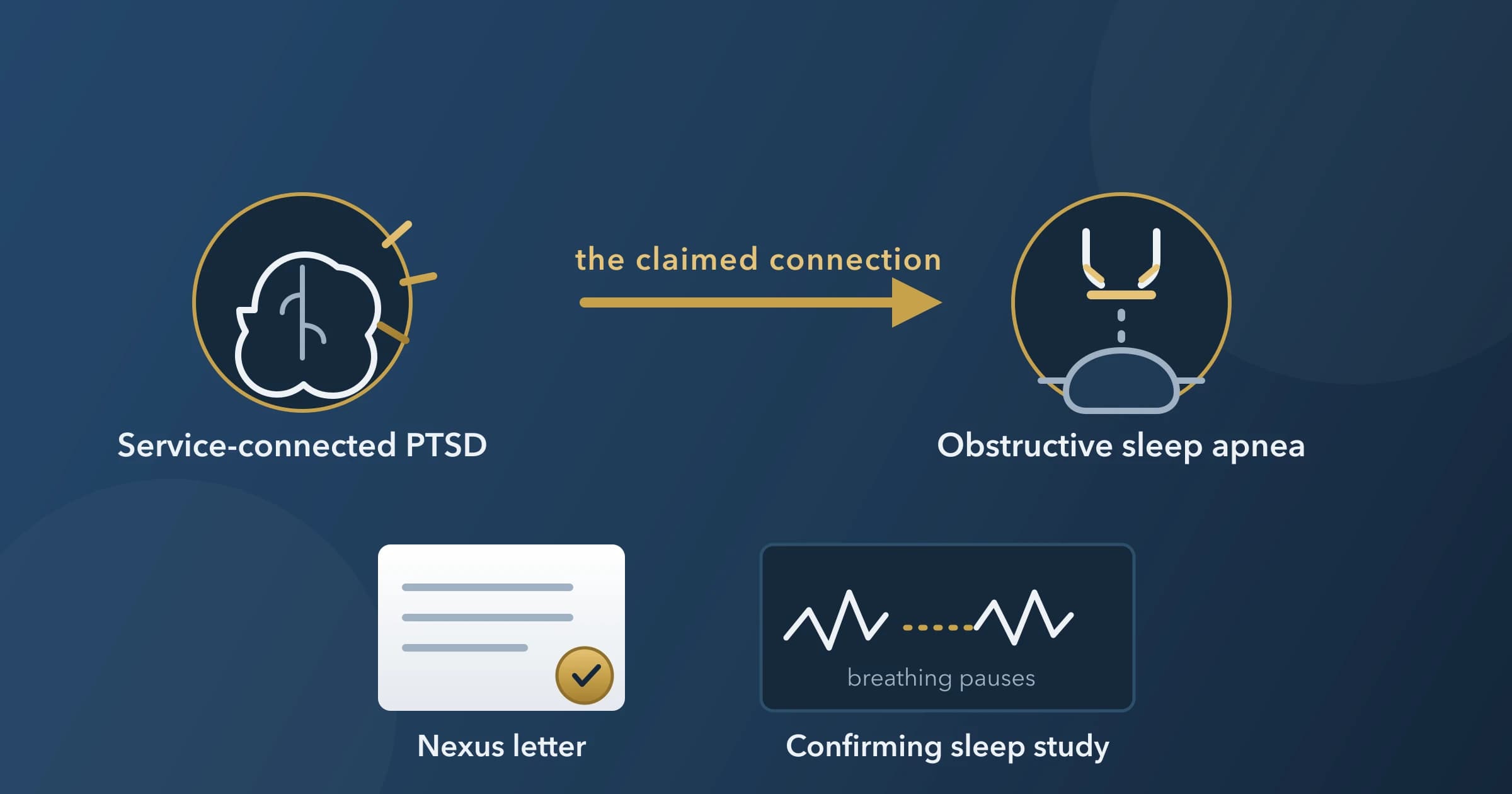
What Sleep Apnea Secondary to PTSD Means
Service connection does not have to run in a straight line from something that happened in service. Under 38 C.F.R. 3.310(a), a disability that is proximately due to or the result of a service-connected disease or injury is itself service connected, and the regulation goes on to say the secondary condition is then treated as part of the original one. Your PTSD is the anchor. The sleep apnea is what you are asking the VA to connect to it.
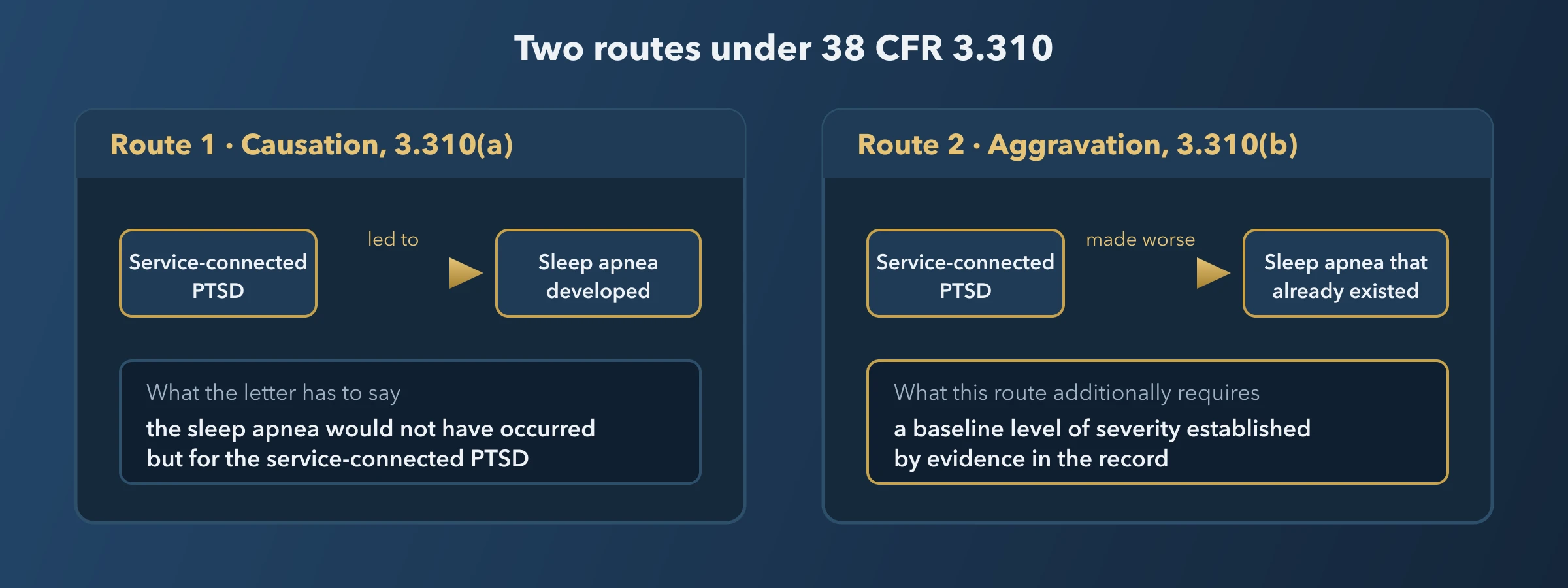
There are two ways to make that connection, and they are decided differently. The first is causation: your PTSD is the reason the sleep apnea developed. The second is aggravation under 38 C.F.R. 3.310(b): the sleep apnea already existed, and your PTSD made it worse. Most guides mention the second route in a sentence and move on. It deserves more, because VA changed how it decides those claims in May 2026, and that change is covered in its own section below.
One piece of vocabulary is worth correcting up front, because it shapes how a good letter is written. The VA's adjudication manual now instructs raters to award service connection for disabilities that are, in its words, the result of, or would not have occurred but for, a service-connected disability. That is a but-for standard, and it is broader than the strict proximate-cause framing that older guides on this topic still use. A clinician who writes to the narrower standard is holding the opinion to a bar the VA no longer applies.
What the VA will not do is join the dots on its own. There is no presumption connecting PTSD to sleep apnea. A rater looking at a file that contains a PTSD rating and a sleep apnea diagnosis has no basis to link them, and in practice will not. Somebody medically qualified has to say so on the record and explain why. That document is the nexus letter.
The claim rests on your service-connected PTSD, so that rating needs to be in place first.
New to these documents? Start with our primer on what a nexus letter is.
What the Research Actually Shows, and What It Does Not
You will find pages on this topic that open with a big number and a confident claim that PTSD causes sleep apnea. We are not going to do that, because the literature does not support it, and because a nexus letter built on an overstated premise is exactly the letter a C&P examiner takes apart. Here is the real state of the evidence, which is stronger in some places than veterans expect and weaker in others.
No study found says PTSD causes sleep apnea
Across the peer-reviewed sources reviewed for this page, not one claims causation. A critical review of sleep-disordered breathing in PTSD patients concluded that the literature supports an association in both combat-related and non-combat-related PTSD, and stated plainly that the exact mechanism linking the two is not fully understood. That is the honest framing, and it is also the framing a careful clinician uses. Association is not nothing: 38 C.F.R. 3.310 asks whether this veteran's condition is at least as likely as not the result of the service-connected disability, which is a question about one person's record, not a question about whether a general causal law has been proven.
The high prevalence numbers come from PTSD-only samples
A 2017 meta-analysis of 12 studies reported a pooled obstructive sleep apnea prevalence of 75.7 percent at an apnea-hypopnea index of 5 or above among patients with PTSD, with a 95 percent confidence interval running from 44.1 to 92.5 percent. That interval is so wide that the point estimate should not be repeated as a bare fact, and the analysis had no PTSD-negative comparison arm, so it cannot tell you how that rate compares with veterans who do not have PTSD. The same caution applies to a study of 105 Vietnam-era veterans with PTSD in which 69 percent had an apnea-hypopnea index above 10: no comparison group, and mean body mass index in that sample was 31.
Screening risk is not diagnosis
A 2015 study of 159 OEF, OIF, and OND veterans seeking PTSD treatment is widely quoted for the figure 69.2 percent. What that study found is that 69.2 percent screened at high risk for obstructive sleep apnea on a questionnaire, and that greater PTSD symptom severity increased the probability of screening positive even after controlling for age, smoking status, and central nervous system depressant use. Screening at high risk is not the same as having the disease, and any page that reports that number as 69 percent of veterans having sleep apnea has misread it.
Two studies ran the direct comparison and found no difference
This is the counterweight, and leaving it out would be dishonest. In 74 trauma-exposed male Australian Vietnam veterans, 40 of them with PTSD, studied with detailed overnight polysomnography, there was no difference in polysomnography-diagnosed sleep apnea between the PTSD and non-PTSD arms and no association between diagnosed sleep apnea and PTSD severity, even though the PTSD group scored much higher on questionnaire-based risk, 70 percent versus 38.2 percent. The authors attributed that gap to increased perception of sleep disturbances. Separately, among 200 consecutive VA sleep clinic referrals, rates of sleep apnea diagnosis did not differ by mental health diagnosis, though that sample was already selected for sleep symptoms in every arm, which can mask a real difference.
The strongest confounder-controlled evidence is a twin study, and it is cross-sectional
A 2024 co-twin control study of 181 male twins from the Vietnam Era Twin Registry, mean age 68.4, compared twins within pairs and adjusted for body mass index along with other sociodemographic, cardiovascular, and psychiatric factors including depression. Within pairs, each 15-point increase in PTSD Checklist score was associated with a 4.6 events-per-hour higher apnea-hypopnea index, and a current PTSD diagnosis was associated with a 10.5 events-per-hour higher index. Comparing twins is a powerful way to strip out shared genetics and early environment. But the design is explicitly cross-sectional, so it cannot establish that the PTSD came first; the diagnosis estimate rests on only 15 discordant pairs; and the population is elderly male Vietnam-era veterans, which is not a basis to generalize to women veterans or younger post-9/11 veterans.
One large military cohort found the relationship runs both ways
Among 65,915 U.S. military cohort members who had neither insomnia nor sleep apnea at the first time point in 2011 to 2013, a self-reported history of provider-diagnosed PTSD without current symptoms was associated with new-onset sleep apnea, and with new-onset comorbid sleep apnea and insomnia, by the second time point in 2014 to 2016. The detail that matters, and that gets flattened everywhere else: it was the group with a PTSD history but no current symptoms that predicted new-onset sleep apnea. Veterans who were currently symptomatic predicted new-onset insomnia instead. Sleep apnea and insomnia at the first time point also predicted newly reported PTSD, so the authors described the relationship as bi-directional. Sleep apnea here was provider-diagnosed and self-reported, and the authors noted findings were sometimes revealed by health care utilization, meaning detection effects are in play.
The proposed mechanism has been tested, and was not confirmed
A 2022 narrative review proposed that PTSD hyperarousal and hypervigilance may lower the arousal threshold and so increase sleep fragmentation from obstructive events, while sleep disturbance from apnea may in turn interfere with normal REM functioning and worsen nightmares. That is a hypothesis, offered in the weakest review design, and its authors wrote it in the conditional. In 2024 a study measured the four physiological traits that actually cause obstructive sleep apnea, comparing 21 veterans who had PTSD and sleep apnea with 27 who had sleep apnea alone, matched on age and body mass index. Upper airway collapsibility, muscle compensation, loop gain, and arousal threshold did not differ significantly. The authors concluded that the cause of the higher prevalence of sleep apnea in PTSD remains unclear. Any letter that leans on the low-arousal-threshold theory should know that it has been tested and not confirmed.
What the evidence does support about severity and treatment
Two findings sit closer to a veteran's day-to-day reality. In a case-controlled cohort at a military sleep center, patients with both PTSD and sleep apnea had lower quality of life and more daytime sleepiness than comparison groups, and showed significantly lower adherence and response to positive airway pressure therapy: sleepiness resolved in 82 percent of patients with sleep apnea alone, versus 62.5 percent of therapy-adherent and 21.4 percent of nonadherent patients who had both conditions. Read that precisely. It shows PTSD is associated with a worse symptom burden and a worse treatment response in people who have sleep apnea. It does not show that PTSD increases the underlying apnea-hypopnea index or structurally worsens the apnea itself.
There is one more finding that explains the whole confusing picture. A 2015 review noted that reported sleep apnea prevalence in PTSD populations ranges from 0 to 90 percent across polysomnography studies, and that a substantial part of that spread comes down to measurement technology, with studies using modern nasal cannula pressure transducers finding the highest rates and older thermistor equipment the lowest. The same review observed that there are no widely acknowledged, tested, or proven explanatory models for the relationship. When you see wildly different numbers quoted on this topic, that is why.
None of this means the claim is weak. It means the claim is individual. The VA is not asking your clinician to prove a population-level causal law; it is asking whether, on your records and your history, the connection is at least as likely as not. An opinion that states the evidence accurately, including its limits, and then explains why it applies to you specifically, is far harder for an examiner to dismiss than one that overstates a study and gets caught doing it.
The Sleep Study Requirement That Is Not in the Regulations
Before anything else in this guide matters, one gate has to be cleared, and you will not find it by reading 38 C.F.R. It lives in M21-1, the adjudication manual VA raters actually work from.
The manual is unambiguous. Where clinical examination leads to the conclusion that symptoms of sleep apnea are present, it directs that the subsequent diagnosis must be confirmed by sleep study for compensation purposes, and instructs raters not to establish service connection for sleep apnea that has not been confirmed by a sleep study. No study, no service connection, however strong the nexus letter is. This single provision is behind a large share of denials on this claim, and it is the first thing to check before you spend money on an opinion.
Home sleep studies can count. The manual directs that a home study be accepted only where it has been clinically determined that the veteran can appropriately be evaluated that way and a competent medical provider has evaluated the results. If your study was done at home, make sure the provider's interpretation is in the record, not just the raw output from the device.
There is a related trap for veterans whose records show upper airway resistance syndrome rather than sleep apnea. The manual treats upper airway resistance syndrome as a progression toward the potential development of sleep apnea, but states that in and of itself it does not meet the criteria of sleep-disordered breathing that defines sleep apnea and is not a ratable disability for compensation purposes, and it directs the rating activity to deny service connection where only that assessment is shown. A nexus letter resting on upper airway resistance syndrome alone will not carry a claim. If apnea is later confirmed by study, that is the moment to come back.
Read this before you file for an increase
This is the part almost no page on this topic will tell you. The same manual section addresses what happens on a claim for INCREASE where the file contains no sleep study confirming the diagnosis. Where service connection has been in effect for less than 10 years, VA is directed to obtain a sleep study, and if that study does not confirm the diagnosis, to prepare a proposal to sever service connection under 38 C.F.R. 3.105(d). In other words, filing for a higher rating on an unconfirmed diagnosis can put the service connection you already have at risk. If you are rated for sleep apnea and are not certain a confirming study is in your file, find out what is in there before you file for an increase, and talk it through with your provider or a Veterans Service Officer first. This is not a reason to never file. It is a reason to check first.
Can You Get VA Disability for Sleep Apnea Secondary to PTSD?
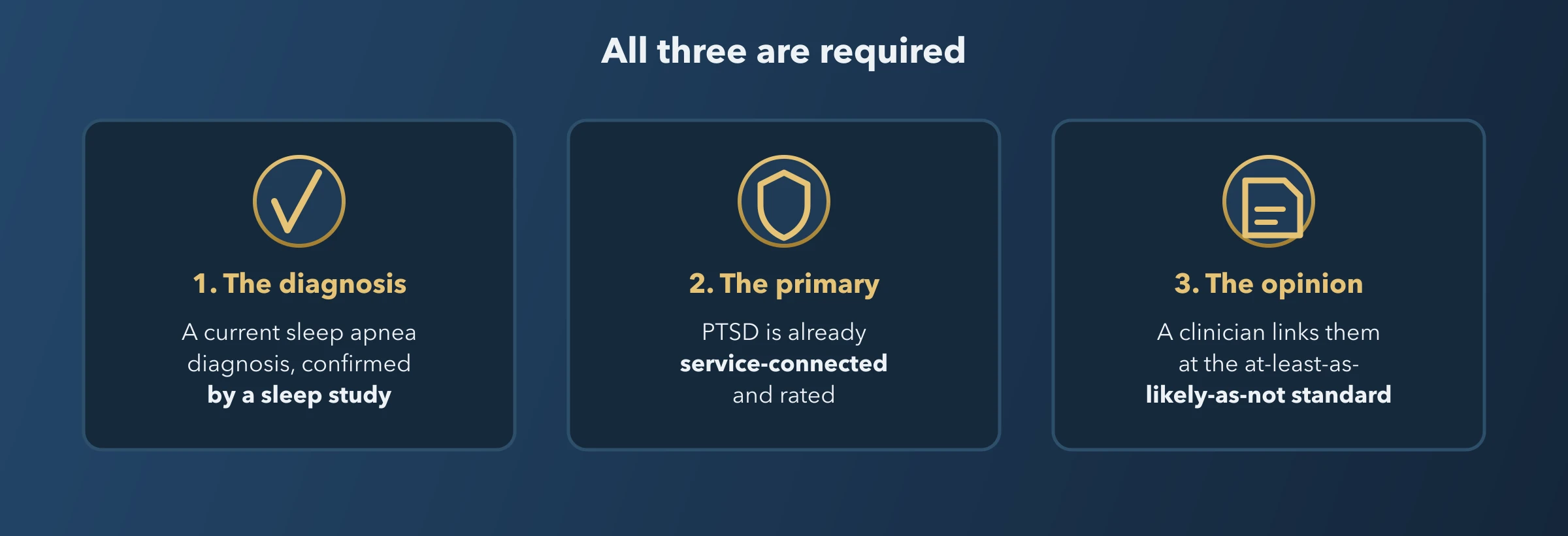
Yes, and the Board of Veterans' Appeals has granted exactly this claim. Sleep apnea keeps its own diagnostic code when it is service-connected on a secondary basis, and it is rated the same way a directly connected case would be. Three things have to be in place. The nexus letter supplies the third and ties the first two together.
- 1
Sleep apnea confirmed by a sleep study
A current diagnosis of sleep apnea documented by a sleep study, in-lab or an appropriately conducted home study interpreted by a competent medical provider. As the section above explains, VA's manual directs raters not to establish service connection without one.
- 2
PTSD already service-connected
Your PTSD needs an existing service connection and rating. The secondary claim builds on it, so that has to be settled first. The size of the PTSD rating does not control whether the secondary claim can be granted.
- 3
A medical nexus opinion
A qualified opinion that your sleep apnea is at least as likely as not caused or aggravated by your service-connected PTSD, with the reasoning behind it. This is the nexus letter.
The Language the VA Requires
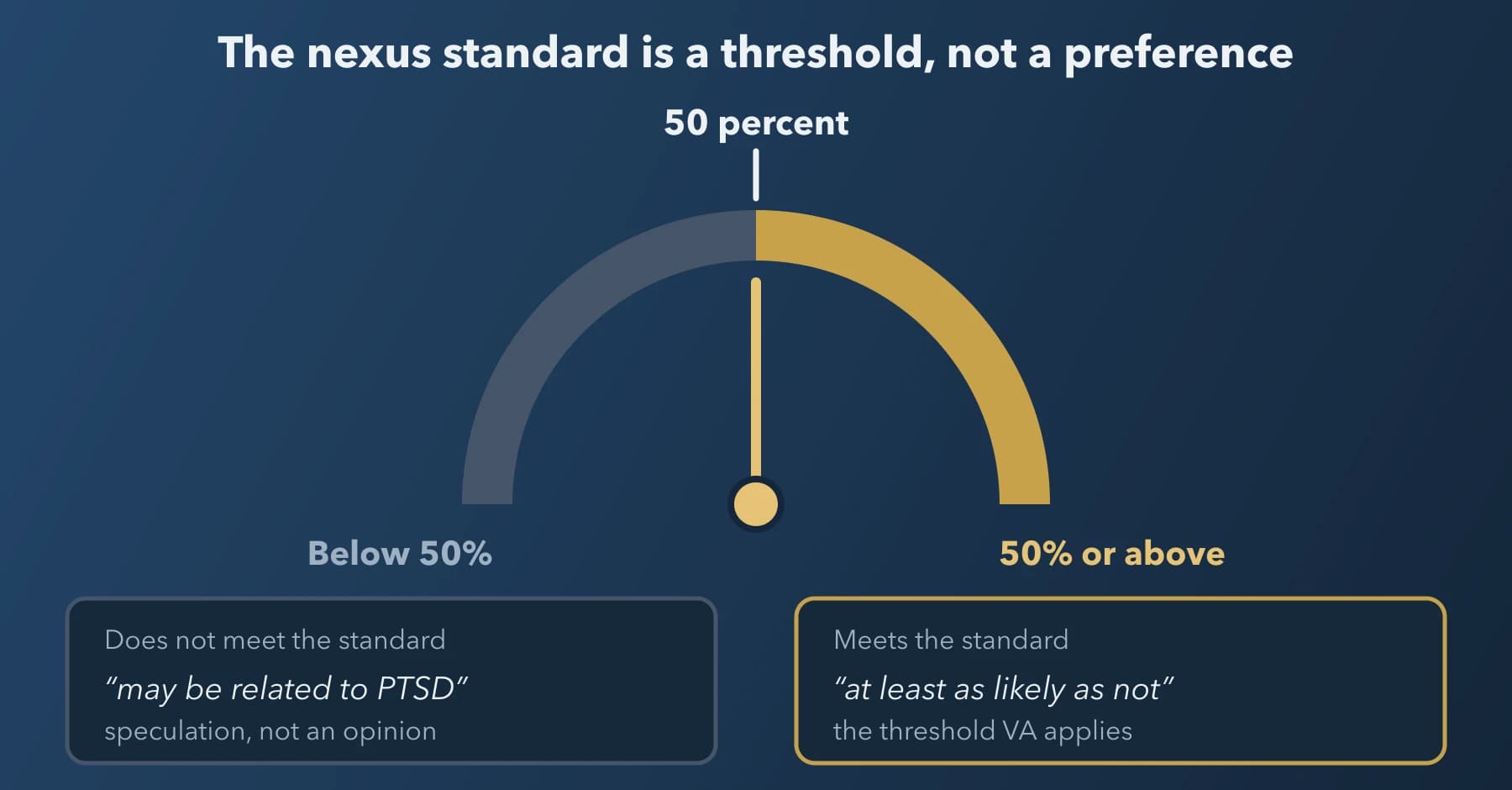
The VA reads a nexus letter closely, and small differences in wording change how much weight it carries. A strong letter names the records reviewed, states the sleep apnea diagnosis and the study that confirmed it, confirms the service-connected PTSD, explains the reasoning that connects them in this veteran's case, engages honestly with the state of the medical literature, and closes with the opinion in the probability language the VA uses. That standard exists because of the benefit-of-the-doubt rule at 38 U.S.C. 5107(b): when the evidence for and against is roughly balanced, the tie goes to the veteran. Two of the three Board decisions discussed below were won on exactly that rule.
Language that meets the bar
- “At least as likely as not caused or aggravated by the veteran's service-connected PTSD” Meets the 50 percent threshold and names both secondary theories. The standard to aim for.
- “More likely than not a result of the veteran's service-connected PTSD” Exceeds 50 percent; stronger than the minimum.
- “Would not have occurred but for the veteran's service-connected PTSD” Tracks the but-for language VA's own manual now uses after Spicer v. McDonough.
Language that fails
- “May be related to the veteran's PTSD” A possibility, not a probability. Below the standard.
- “There is a known association between PTSD and sleep apnea” True, and not an opinion about this veteran. A letter that only recites the literature has not answered the question the VA asked.
- “The veteran's sleep problems are consistent with his PTSD” Ambiguous. One Board decision gave a supportive letter minimal probative value for exactly this reason, calling its terminology ambiguous.
The single biggest difference between a letter that works and one that does not is rationale. In the decisions reviewed for this page, the Board described the winning private opinions as thorough, supported by a complete rationale, based on an interview with the veteran, a review of the medical records, and a review of the medical literature. A conclusion without that scaffolding is just an assertion, and assertions lose to reasoned negative opinions.
A good letter also anticipates the argument against it. On this claim the negative opinion is predictable, and it has appeared almost word for word in real decisions: sleep apnea is a physical obstruction of the airway, and PTSD does not cause a physical obstruction. An opinion that never engages with that reasoning leaves the examiner's position standing unopposed. One that addresses it directly, on this veteran's records, gives the adjudicator something to weigh.
The Aggravation Route, and the 2026 Change Most Guides Miss
If your sleep apnea existed before, or you cannot show PTSD caused it, the aggravation route under 38 C.F.R. 3.310(b) is not a consolation prize. One of the three Board grants discussed below came on aggravation, where the veteran expressly did not claim PTSD had caused the apnea. And the rules governing these claims changed on 1 May 2026 in ways that are more favorable to veterans, in a document most pages on this topic have not updated to reflect.
The standard is but-for causation, not strict proximate cause
VA's manual now directs raters to award service connection for disabilities that are the result of, or would not have occurred but for, a service-connected disability, and for aggravation of a non-service-connected disability that is the result of a service-connected disability. That change follows Spicer v. McDonough, 61 F.4th 1360 (Fed. Cir. 2023), in which the Federal Circuit held that the statutory phrase resulting from requires a but-for causation standard and that a stricter proximate causation standard is inconsistent with the statute. VA states it will apply the broader but-for standard.
Natural progress is no longer deducted
This is the change with real money attached. The text of 38 C.F.R. 3.310(b) still says the rating activity determines the extent of aggravation by deducting the baseline level of severity and any increase due to the natural progress of the disease. That regulatory text has not been amended. But VA's manual states that, in accordance with Spicer, VA will no longer consider natural progress of the non-service-connected disability when deciding a claim based on aggravation by a service-connected disability. Guides that still describe the natural-progress deduction as current practice are quoting a regulation without checking how VA now applies it.
Permanent worsening is not required
The manual states directly that permanent worsening of a non-service-connected disability by a service-connected disability is not required to establish service connection on the basis of aggravation under 38 C.F.R. 3.310(b). Veterans are sometimes told the opposite.
Baseline is still mandatory, and this is where aggravation claims fail
Nothing above removes the baseline requirement. The manual is explicit that if no baseline can be established, no aggravation can be demonstrated. The good news is that the manual is broader than the regulation on what can establish it: alongside medical evidence it allows any other credible evidence, including lay evidence, though it cautions that lay evidence on its own may not be sufficient. Practically, the baseline is the picture of your sleep apnea before the aggravation began. An earlier sleep study, the settings and pressures on an earlier device prescription, treatment notes, and a spouse's account of how things were then are the raw material a clinician uses to fix it.
An honest limit on the medical evidence for aggravation
We could not find a study measuring whether PTSD worsens the severity of sleep apnea that already existed. The closest evidence is indirect and should be described as such: the twin study's within-pair finding that higher PTSD symptom scores tracked a higher apnea-hypopnea index, which is cross-sectional; and the findings that PTSD is associated with reduced adherence and response to positive airway pressure therapy, which is about the clinical control of the condition and its consequences rather than its underlying physiology. A letter that claims the literature establishes PTSD aggravates existing sleep apnea is claiming more than the literature supports. A letter that reasons carefully from this veteran's own longitudinal record is on much firmer ground.
Will You Get Separate Ratings for Sleep Apnea and PTSD?
This is the question underneath the claim, and it is where a lot of published advice is simply wrong. You will read that sleep apnea and PTSD must be rated separately because one is respiratory and the other is mental. That reasoning does not hold, and a veteran who relies on it can be blindsided.
Start with what 38 C.F.R. 4.14 actually says. The rule against pyramiding directs that the evaluation of the same disability under various diagnoses is to be avoided, and its operative sentence bars the evaluation of the same manifestation under different diagnoses. Nothing in it carves out separate body systems. It even names cross-cutting manifestations, listing dyspnea, tachycardia, nervousness, and fatigability as things that may result from many causes. Being in different body systems is neither necessary nor sufficient.
The correct test is overlap of symptoms. VA's manual states it directly, citing Esteban v. Brown, 6 Vet. App. 259, 261-62 (1994): separate evaluations are warranted where none of the symptomatology for any one condition duplicates or overlaps another. That is the argument a well-built claim makes, and it is an argument about your specific symptoms rather than about categories.
A different rule, 38 C.F.R. 4.96(a), is sometimes mixed into this discussion, and it is worth being precise about what it does. It bars combining ratings under diagnostic codes 6600 through 6817 and 6822 through 6847 with each other, and directs a single rating under the code reflecting the predominant disability. That rule is confined to the respiratory codes in 38 C.F.R. 4.97. It has nothing to say about a mental disorder rated under 38 C.F.R. 4.130, where PTSD sits at Diagnostic Code 9411. So 4.96(a) is not the obstacle here. 4.14 is the rule that matters.
The overlap you should know about
Here is the part we would rather tell you now than have you discover in a decision letter. There is a genuine overlap surface between these two evaluations, and it sits at the 30 percent level of both. The General Rating Formula for Mental Disorders at 38 C.F.R. 4.130 expressly names chronic sleep impairment among the symptoms at its 30 percent level, while the 30 percent criterion under Diagnostic Code 6847 is persistent day-time hypersomnolence. Those are not identical, but they are adjacent, and an adjudicator applying the Esteban test to a record where sleep symptoms are the main thing documented on both sides has a real question in front of them.
So what should you expect? Separate evaluations for service-connected sleep apnea and service-connected PTSD are defensible, and the rules do not bar them. They are not automatic, and we are not going to tell you they are. We did not survey Board case law on how often overlap challenges to this particular pairing succeed, so we are not going to imply a pattern we have not verified. What helps is a record in which each condition's manifestations are documented on their own terms: the sleep study findings, the device and its necessity, and the daytime consequences on the apnea side, and the occupational and social impairment on the PTSD side. Records that describe both conditions only as trouble sleeping give an adjudicator the least to work with.
Sleep Apnea Is Not Insomnia, and the VA Rates Them Very Differently
Veterans often use trouble sleeping as one category. The VA does not, and the difference decides whether a claim pays anything at all.
Insomnia secondary to a service-connected disability generally does not get its own rating. VA's manual treats insomnia as a symptom of another condition and directs that where insomnia is shown to be secondary to, or a symptom of, an underlying service-connected disability, a separate secondary evaluation is not warranted for the insomnia. Service connection is established for the underlying primary disability, and the insomnia symptoms are included in the evaluation assigned under that primary diagnostic code. If your PTSD is service-connected and your sleep is broken by nightmares and hyperarousal, those symptoms count inside the PTSD evaluation. Filing insomnia as a separate secondary claim does not add a percentage.
Obstructive sleep apnea is a different matter. It is a diagnosed physiological condition, confirmed by a sleep study, with its own diagnostic code in the rating schedule. Nothing in VA's mental disorders chapter folds sleep apnea into a mental health evaluation; the phrase does not appear in that chapter at all. That is why a sleep apnea secondary claim is worth building and an insomnia secondary claim usually is not, and it is why the confirming study is the gate.
The practical takeaway is to claim what a clinician actually diagnoses. If your sleep is disturbed but no study has ever been done, the useful next step is a sleep study, not a claim form.
We wrote this out in full, with the same evidence, in our honest guide to insomnia secondary to tinnitus. The anchor condition is different there, but the rating rule for insomnia is the same one.
What Winning Looks Like: Three Real Board Decisions
The Board of Veterans' Appeals has granted service connection for sleep apnea secondary to PTSD, and reading how is more useful than any general advice. In all three decisions below, a private medical opinion was the evidence that carried the claim. Note carefully what each one granted: service connection, and nothing more. The Board did not assign a percentage in any of them, because it does not; the evaluation is set afterward by the Regional Office.
Citation Nr: A21018009
November 9, 2021Causation- The order granted entitlement to service connection for obstructive sleep apnea as secondary to posttraumatic stress disorder, and the finding of fact was that the veteran's obstructive sleep apnea is caused by or is the result of her service-connected PTSD.
- Two private opinions carried it: a private psychologist in April 2020 and a private psychiatrist in August 2020. The Board described the psychologist's opinion as thorough and supported by a complete rationale, based on an interview with the veteran, a review of her medical records, and a review of the medical literature, and afforded it significant weight.
- The Board gave no probative weight to a February 2020 VA examiner's negative opinion, finding it inadequate because the examiner had cited a medical journal article that supported the opposite conclusion. An internally contradictory negative opinion is a vulnerable one.
Citation Nr: 21066186
October 28, 2021Causation, decided on benefit of the doubt- The order granted service connection for sleep apnea secondary to service-connected posttraumatic stress disorder on a causation basis. The favorable opinion came from a private physician who examined the veteran and some of his records in January 2021 and opined it was more likely than not that the obstructive sleep apnea was secondary to the service-connected PTSD.
- The VA examiner, a nurse practitioner, had opined against the claim, reasoning that obstructive sleep apnea is a physical obstruction in the airway and that medical literature does not support that PTSD causes sleep apnea. This is the standard negative rationale on this claim, and it is worth knowing before you get it.
- Do not overstate this one. The Board gave both the negative VA opinion and the positive private opinion substantial probative weight. The private opinion balanced the evidence into equipoise rather than defeating the VA opinion, and the grant came from resolving reasonable doubt in the veteran's favor. A third supportive letter, from a VA physician, was given minimal probative value because the Board found its terminology ambiguous.
Citation Nr: 1648003
December 27, 2016Aggravation, expressly not causation- The order granted service connection for obstructive sleep apnea as secondary to service-connected PTSD. The decision records that the veteran did not assert his sleep apnea was caused by PTSD; he asserted it was aggravated by it. This is the aggravation route in practice.
- A March 2015 private physician letter and a May 2015 private psychologist letter supported the claim. Two VA examinations, in August 2012 and February 2014, had returned negative nexus opinions, and the Board found those opinions were not as thorough as the private opinion and held the evidence at least in equipoise.
- Read this one with its limits in mind. It predates the modern appeals system, and because an aggravation award compensates the degree of worsening above a baseline, it is a weaker illustration of a full award than a causation grant. It is included because it shows the aggravation theory can and does win.
One necessary caution about all three. Under 38 C.F.R. 20.1303, previously issued Board decisions are considered binding only with regard to the specific case decided. Prior decisions in other appeals may be considered to the extent they reasonably relate to a case, but each appeal is decided on the basis of its own individual facts in light of applicable procedure and substantive law. So none of these outcomes predicts yours. What they show is the kind of evidence the Board has found persuasive on this exact claim, and the pattern is consistent: a private opinion, from a clinician who reviewed the records and gave a complete rationale, weighed against a VA opinion that did not.
What VA Rating Can You Get for Sleep Apnea?
Once sleep apnea is service-connected, it is rated under 38 C.F.R. 4.97, Diagnostic Code 6847, at 0, 30, 50, or 100 percent. The evaluation turns on how the condition presents and how it is treated, not on what caused it, so a secondary grant is rated exactly the way a direct one would be, and the resulting evaluation is combined with your PTSD rating under the VA combined-ratings table rather than added to it.
One correction is worth making here, because the shorthand you will see everywhere is misleading. People say the 50 percent level is for CPAP. The criterion is a requirement for use of a breathing assistance device, and VA's manual is explicit that the test is medical necessity: use of a device absent a medical determination that it is necessary does not qualify, and necessity is a medical question. Two consequences follow. Many devices other than a CPAP machine qualify, including other positive airway pressure machines, nasopharyngeal appliances, oral appliances such as mandibular advancement devices, and implanted nerve stimulation devices. And if the competent medical evidence shows a qualifying device is medically required, the manual states that the fact the claimant is not actually using it as prescribed is not relevant. Never stop using a prescribed device to make a claim look worse. It will not help the rating, and it will hurt you.
We keep the full DC 6847 rating breakdown, tier by tier, along with sleep studies and every route to service connection, on our guide to sleep apnea and VA disability. That page is the one to read for rating mechanics.
What to Give Your Provider
In each Board decision above, the winning opinion came from a clinician who had reviewed the records and could explain the reasoning. That starts with what you hand over. The more of this your provider has, the less the letter has to assume.
The core file
- Your sleep study reportThe full report and the interpreting provider's reading, not just a summary line. This is the gate, so it comes first.
- Your PTSD service-connection decisionThe VA letter or rating showing PTSD is service-connected, with the effective date.
- Your device prescription and equipment recordsThe prescription, the type of device, and any documentation of why it is medically necessary.
- Mental health treatment recordsTherapy notes, medications, and screenings, which show the PTSD history and its severity over time.
What strengthens it
- Any earlier sleep testing or sleep-related notesEssential if you are claiming aggravation, because this is the raw material for the baseline.
- A personal statementIn your own words: the sleep you actually get, the daytime consequences, and how long each has been going on.
- A timelineRoughly when the PTSD symptoms began and when the sleep symptoms followed, so the clinician can address direction.
- Lay statementsA short note from a spouse or anyone who has observed your sleep. On this claim, a bed partner's account is often the earliest evidence that exists.
How to File the Secondary Claim
You file sleep apnea secondary to PTSD like any disability claim, but you present it as a secondary condition and lead with the nexus letter.
- 1Confirm the sleep study is in your fileBefore anything else. If no study confirms the diagnosis, that is the step to take first, and it is also the reason to be cautious about filing for an increase on an unconfirmed diagnosis.
- 2File VA Form 21-526EZThe Application for Disability Compensation. Name sleep apnea as secondary to your service-connected PTSD so the VA adjudicates it on that theory rather than opening a direct-service-connection claim your evidence was not built for.
- 3Name both theories if both applyIf the apnea may have preexisted the worsening, say caused or aggravated. An aggravation theory the VA was never asked to consider is one it will not decide.
- 4Attach the nexus letterThe physician opinion tying the sleep apnea to the PTSD in the language above, with its rationale. This is the centerpiece of the claim.
- 5Include your supporting evidenceThe sleep study, your device records, your PTSD treatment records, your personal statement, and any lay statements.
- 6Submit and track itFile at VA.gov, by mail, or through a VSO. Keep your own copy of the nexus letter: if the claim is denied and you file a Supplemental Claim, you will need to show what the examiner had in front of them.
A Veterans Service Officer can file this with you at no cost, and on this claim their value is procedural: making sure the theory is named correctly, that both causation and aggravation are on the table where both apply, and that you understand what is and is not already in your file. What a VSO cannot do is supply the medical opinion. That has to come from a clinician.
What to Expect at the C&P Exam
The VA will usually schedule a Compensation and Pension examination. For sleep apnea the examiner works through the sleep apnea Disability Benefits Questionnaire, reviewing your sleep study, your treatment, and your symptoms, and then gives an opinion on whether the condition is related to your service-connected PTSD.
Describe your symptoms accurately, including the days that are worse and the days that are better. The goal is an accurate record, not a dramatic one, and an account that matches your treatment notes and your nexus letter is what holds up. If something in your history is uncertain, say that it is uncertain rather than guessing; a confident wrong detail is worse for your claim than an honest gap.
Bring the documents, because on this claim the paperwork carries more weight than the conversation. The sleep study, the device prescription, and any documentation of medical necessity are the items that decide both service connection and the evaluation. If you use a device and it is helping, say so. Effective treatment does not defeat a claim, and as the rating section explains, VA's own manual makes necessity rather than compliance the test.
Finally, expect the examiner to consider other explanations, including body weight, age, and anatomy, and to consider whether the sleep apnea came first. Those are legitimate questions on this claim. They are answered by your records and by a nexus letter that addressed them in advance, not by anything you can say in the room.
If Your Claim Is Denied
Secondary sleep apnea claims are frequently denied the first time. A denial is not the end of the claim, and every Board decision described on this page began as a claim the VA had refused.
Start with the examiner's rationale rather than the decision letter, because that is usually where the claim actually died. On this claim the negative reasoning is predictable and narrow: sleep apnea is an airway obstruction, PTSD does not obstruct the airway, and the medical literature does not support causation. Read the exam report closely for what it did not do. Did it address the aggravation theory at all, or only causation? Did it engage with your private opinion or ignore it? Did it cite literature that actually supports its own conclusion? In the decisions above, the Board discounted VA opinions for exactly these kinds of failures.
The answer is a second opinion that engages the examiner's reasoning directly instead of simply repeating the original assertion, and that reasons from your records rather than from general prevalence figures. That is what you attach to a Supplemental Claim on VA Form 20-0995. If a confirming sleep study is what was missing, get the study first; no amount of opinion evidence substitutes for it.
We break down the most common reasons these claims fail, and how to fix each one, in our guide to why the VA denies nexus letters.
Who Should Write the Letter, and What It Costs
Any licensed clinician can write a nexus letter. What distinguishes the ones the VA credits is not the specialty on the letterhead but the work behind the opinion. It is worth noting what the Board actually relied on in the decisions above: a private psychologist, a private psychiatrist, and a private physician. None was described in those decisions as a sleep-medicine specialist. What the Board praised was thoroughness, a complete rationale, an interview with the veteran, a review of the records, and a review of the literature.
This claim does ask something specific of the writer, though. It sits across two fields, and the opinion has to be candid about a literature that supports an association rather than a proven cause while still reaching a defensible conclusion about this particular veteran. A letter that overstates the science invites the examiner to discredit it. A letter that only recites the science never answers the question. The work is in the middle.
Patriot Path's physicians write letters built for this exact claim: records reviewed, the sleep study and the PTSD history addressed, the medical literature characterized accurately including its limits, both causation and aggravation considered where the record supports them, and the opinion stated in the language the VA weighs. One flat fee of $1,500, and the first consultation is free. If a letter cannot help your claim, we will tell you that instead.
Not sure who qualifies? See our breakdown of who can write a nexus letter, what belongs in one in our guide to nexus letter requirements, and how the whole process works in our nexus letter process.
See our flat, upfront nexus letter pricing and what is included.
Is Your Secondary Claim Ready?
Work down the list. The first item is the gate, and the last is the one we write.
- A sleep study confirming the diagnosisIn-lab, or a home study a competent medical provider has interpreted. Without this, the claim does not clear VA's manual.
- PTSD is already service-connectedAn existing VA rating for PTSD, with an effective date.
- Your device prescription and necessity documentationWhat was prescribed, and the medical reason it is required.
- PTSD treatment records over timeNotes, medications, and screenings that show the history, not just the current diagnosis.
- Baseline evidence, if you are claiming aggravationEarlier sleep testing, earlier device settings, or treatment notes from before the worsening began.
- A personal statement and a lay statementYour own account, plus a bed partner's observations of your sleep.
- A nexus opinionA clinician's "at least as likely as not" opinion, with a full rationale, tying the sleep apnea to your PTSD. This is what we write.
Give Your Secondary Claim Its Strongest Evidence
Your PTSD rating and your sleep study are both on the record. Let our physicians write the nexus letter that explains to the VA how the two connect in your case, accurately and with the rationale the Board looks for.
Frequently Asked Questions
Does PTSD cause sleep apnea?
The honest answer is that no study we reviewed claims it does. The peer-reviewed literature supports an association between PTSD and obstructive sleep apnea, and one review of sleep-disordered breathing in PTSD states plainly that the exact mechanism linking the two is not fully understood. Two studies that ran the direct comparison with overnight polysomnography, one in 74 Australian Vietnam veterans and one in 200 VA sleep clinic referrals, found no difference in diagnosed sleep apnea between the PTSD and non-PTSD groups. That does not sink the claim, because the VA does not ask whether PTSD causes sleep apnea in general. It asks whether, on your records, your sleep apnea is at least as likely as not caused or aggravated by your service-connected PTSD.
Do I need a sleep study to get sleep apnea service-connected?
Yes. VA's adjudication manual directs that where clinical examination concludes symptoms of sleep apnea are present, the subsequent diagnosis must be confirmed by sleep study for compensation purposes, and instructs raters not to establish service connection for sleep apnea that has not been confirmed by a sleep study. This requirement is not in 38 C.F.R., which is why many veterans and many websites miss it. A home study can qualify where it was clinically appropriate and a competent medical provider evaluated the results.
Can filing for an increase put my sleep apnea rating at risk?
It can, in one specific situation, and this is worth knowing before you file. VA's manual directs that on a claim for increase where the file contains no sleep study confirming the diagnosis and service connection has been in effect for less than 10 years, VA obtain a sleep study, and if the study does not confirm the diagnosis, prepare a proposal to sever service connection under 38 C.F.R. 3.105(d). If you are already rated and are not sure a confirming study is in your file, find that out before filing for an increase. Talk it through with your provider or a Veterans Service Officer.
Will I get separate ratings for sleep apnea and PTSD?
Possibly, but it is not automatic and we will not promise it. The rule against pyramiding at 38 C.F.R. 4.14 bars evaluating the same manifestation under different diagnoses; it contains no exemption for conditions in different body systems, so the common claim that these must be rated separately because one is respiratory and one is mental is not a sound argument. The correct test, which VA's manual states citing Esteban v. Brown, is that separate evaluations are warranted where none of the symptomatology for one condition duplicates or overlaps another. There is a real overlap here: the General Rating Formula for Mental Disorders names chronic sleep impairment among its 30 percent symptoms, while the 30 percent criterion for sleep apnea is persistent day-time hypersomnolence. Separate evaluations are defensible, and what helps is a record documenting each condition's manifestations on their own terms.
What if my sleep apnea came before my PTSD symptoms got worse?
Then the aggravation route under 38 C.F.R. 3.310(b) is your theory, and it is a real one. A Board decision from December 2016 granted service connection for obstructive sleep apnea secondary to PTSD on aggravation, where the veteran expressly did not claim PTSD had caused it. Two points matter. VA's manual, changed on 1 May 2026 to apply Spicer v. McDonough, states that permanent worsening is not required and that VA will no longer consider natural progress of the non-service-connected disability when deciding an aggravation claim. But a baseline is still mandatory: the manual states that if no baseline can be established, no aggravation can be demonstrated. Earlier sleep studies, earlier device records, and treatment notes from before the worsening are what establish it.
Is insomnia from PTSD the same as sleep apnea for VA purposes?
No, and the difference decides whether a claim pays. VA's manual treats insomnia as a symptom of an underlying condition and directs that where insomnia is secondary to a service-connected disability, a separate secondary evaluation is not warranted; the insomnia symptoms are included in the evaluation for the primary disability. So insomnia from service-connected PTSD counts inside the PTSD rating rather than adding to it. Obstructive sleep apnea is a diagnosed physiological condition with its own diagnostic code, confirmed by a sleep study, and nothing in VA's mental disorders chapter folds it into a mental health evaluation. If your sleep is disturbed but no study has been done, a sleep study is the useful next step, not a claim form.
Is the 50 percent rating just for having a CPAP machine?
That shorthand is misleading. The criterion is a requirement for use of a breathing assistance device, and VA's manual states that the test is medical necessity, that use of a device absent a medical determination that it is necessary does not qualify, and that necessity is a medical question. Many devices other than a CPAP machine can qualify, including other positive airway pressure machines, nasopharyngeal and oral appliances, and implanted nerve stimulation devices. The manual also states that where the evidence shows a qualifying device is medically required, the fact that the claimant is not using it as prescribed is not relevant. Never stop using a prescribed device to affect a claim.
Has the Board actually granted this claim?
Yes. Three decisions reviewed for this page granted service connection for sleep apnea secondary to PTSD: one in November 2021 on causation, won on two private opinions after the Board found a VA examiner's negative opinion inadequate; one in October 2021 on causation, where a private physician's opinion balanced the VA opinion into equipoise and the grant came from the benefit-of-the-doubt rule; and one in December 2016 on aggravation. Each granted service connection only. No percentage was assigned in any of them, because the Board grants service connection and the evaluation is set afterward by the Regional Office. Under 38 C.F.R. 20.1303 those decisions are binding only with regard to the specific case decided, so none of them predicts your outcome.
Who should write the nexus letter, and what does it cost?
A licensed clinician who will review your records and give a complete rationale. In the Board decisions above the winning opinions came from a private psychologist, a private psychiatrist, and a private physician, and what the Board credited was the thoroughness of the reasoning rather than a particular specialty. Patriot Path charges $1,500 flat for a nexus letter, and the first consultation is free. Book a consultation and a clinician will review your situation and tell you honestly whether a letter can help your sleep apnea secondary to PTSD claim, including whether the sleep study requirement is already satisfied. If it cannot help, we will say so.
Related guides
- Erectile dysfunction secondary to PTSDAnother PTSD secondary claim, where the benefit is Special Monthly Compensation rather than a percentage.
- Sleep apnea and VA disabilityThe DC 6847 ratings, sleep studies, and every route to service connection.
- PTSD and VA disabilityHow the VA rates PTSD, and the claims it anchors.
- Nexus letters for sleep apneaThe full sleep apnea nexus guide, across every theory.
- Sleep apnea secondary to GERDThe sibling claim, when reflux rather than PTSD is the anchor.
- Sleep apnea secondary to kidney diseaseAnother sleep apnea secondary, with its own evidence pattern.
- Insomnia secondary to tinnitusWhy insomnia and sleep apnea are rated in completely different ways.
- Nexus letter for a secondary conditionHow secondary claims work, in general.
- What a nexus letter must includeThe seven elements the VA looks for.
- Who can write a nexus letterWhich providers the VA takes seriously.
- Nexus letter exampleSee the framework on a finished letter.
- When the VA denies a nexus letterThe common reasons, and how to fix them.
- Nexus letter vs. DBQHow the two documents differ, and when you need each.
Citations & References
- 38 CFR 3.310, Secondary service connection and aggravation (eCFR) https://www.ecfr.gov/current/title-38/section-3.310
- 38 CFR 3.105(d), Severance of service connection (eCFR) https://www.ecfr.gov/current/title-38/section-3.105
- 38 CFR 4.14, Avoidance of pyramiding (eCFR) https://www.ecfr.gov/current/title-38/section-4.14
- 38 CFR 4.96, Special provisions for the application of evaluation criteria for respiratory conditions (eCFR) https://www.ecfr.gov/current/title-38/section-4.96
- 38 CFR 4.97, Schedule of ratings, respiratory system, including DC 6847 sleep apnea syndromes (eCFR) https://www.ecfr.gov/current/title-38/section-4.97
- 38 CFR 4.130, Schedule of ratings, mental disorders, including DC 9411 posttraumatic stress disorder (eCFR) https://www.ecfr.gov/current/title-38/section-4.130
- 38 CFR 20.1303, Rule 1303, Nonprecedential nature of Board decisions (Cornell LII) https://www.law.cornell.edu/cfr/text/38/20.1303
- 38 U.S.C. 5107, Claimant responsibility and benefit of the doubt (uscode.house.gov) https://uscode.house.gov/view.xhtml?req=granuleid:USC-1999-title38-section5107&num=0&edition=2024
- M21-1 Part V, Subpart ii, Chapter 2, Section D, Secondary Service Connection and Aggravation of Non-Service-Connected Disabilities, updated May 1 2026 (VA KnowVA) https://www.knowva.ebenefits.va.gov/system/templates/selfservice/va_ssnew/help/customer/locale/en-US/portal/554400000001018/content/554400000180484/M21-1-Part-V-Subpart-ii-Chapter-2-Section-D-Secondary-Service-Connection-SC-and-Aggravation-of-Non-Service-Connected-NSC-Disabilities
- M21-1 Part V, Subpart ii, Chapter 3, Section D, Evaluating Disabilities, including the Esteban non-overlap rule (VA KnowVA) https://www.knowva.ebenefits.va.gov/system/templates/selfservice/va_ssnew/help/customer/locale/en-US/portal/554400000001018/content/554400000180489/M21-1-Part-V-Subpart-ii-Chapter-3-Section-D-Evaluating-Disabilities
- M21-1 Part V, Subpart iii, Chapter 4, Section A, Respiratory Conditions, including the sleep study requirement (VA KnowVA) https://www.knowva.ebenefits.va.gov/system/templates/selfservice/va_ssnew/help/customer/locale/en-US/portal/554400000001018/content/554400000180967/M21-1-Part-V-Subpart-iii-Chapter-4-Section-A-Respiratory-Conditions
- M21-1 Part V, Subpart iii, Chapter 13, Mental Disorders, including the insomnia fold-in rule (VA KnowVA) https://www.knowva.ebenefits.va.gov/system/templates/selfservice/va_ssnew/help/customer/locale/en-US/portal/554400000001018/content/554400000180520/M21-1-Part-V-Subpart-iii-Chapter-13-Mental-Disorders
- Board of Veterans' Appeals, Citation Nr: A21018009, November 9 2021, OSA secondary to PTSD granted on causation (VA.gov) https://www.va.gov/vetapp21/Files11/A21018009.txt
- Board of Veterans' Appeals, Citation Nr: 21066186, October 28 2021, sleep apnea secondary to PTSD granted on causation (VA.gov) https://www.va.gov/vetapp21/Files10/21066186.txt
- Board of Veterans' Appeals, Citation Nr: 1648003, December 27 2016, OSA secondary to PTSD granted on aggravation (VA.gov) https://www.va.gov/vetapp16/Files6/1648003.txt
- Jaoude P, et al. Sleep-disordered breathing in patients with post-traumatic stress disorder. Ann Am Thorac Soc. 2015 (PubMed) https://pubmed.ncbi.nlm.nih.gov/25535907/
- Krakow BJ, et al. Posttraumatic stress disorder and sleep-disordered breathing: a review of comorbidity research. Sleep Med Rev. 2015 (PubMed) https://pubmed.ncbi.nlm.nih.gov/25644985/
- Zhang Y, et al. Prevalence of obstructive sleep apnea in patients with posttraumatic stress disorder. Sleep Med. 2017 (PubMed) https://pubmed.ncbi.nlm.nih.gov/28735910/
- Shah AJ, et al. Posttraumatic Stress Disorder and Obstructive Sleep Apnea in Twins. JAMA Netw Open. 2024 (PubMed) https://pubmed.ncbi.nlm.nih.gov/38913378/
- Colvonen PJ, et al. Obstructive Sleep Apnea and Posttraumatic Stress Disorder among OEF/OIF/OND Veterans. J Clin Sleep Med. 2015 (PubMed) https://pubmed.ncbi.nlm.nih.gov/25665698/
- Baird T, et al. Detailed Polysomnography in Australian Vietnam Veterans With and Without Posttraumatic Stress Disorder. J Clin Sleep Med. 2018 (PubMed) https://pubmed.ncbi.nlm.nih.gov/30176975/
- DeViva JC, et al. Differences in sleep apnea among veterans with PTSD and other mental health conditions. Psychiatry Res. 2021 (PubMed) https://pubmed.ncbi.nlm.nih.gov/33894682/
- Chinoy ED, et al. The bi-directional relationship between post-traumatic stress disorder and obstructive sleep apnea and/or insomnia in a large U.S. military cohort. Sleep Health. 2022 (PubMed) https://pubmed.ncbi.nlm.nih.gov/36163136/
- McCall CA, Watson NF. A Narrative Review of the Association between Post-Traumatic Stress Disorder and Obstructive Sleep Apnea. J Clin Med. 2022 (PubMed) https://pubmed.ncbi.nlm.nih.gov/35054110/
- Brooker EJ, et al. The obstructive sleep apnoea endotypes are similar in elderly trauma-exposed veterans with and without diagnosed PTSD. Sleep Med. 2024 (PubMed) https://pubmed.ncbi.nlm.nih.gov/38330695/
- Lettieri CJ, et al. OSA Syndrome and Posttraumatic Stress Disorder: Clinical Outcomes and Impact of Positive Airway Pressure Therapy. Chest. 2016 (PubMed) https://pubmed.ncbi.nlm.nih.gov/26291560/
- VA Form 21-526EZ, application for disability compensation (VA.gov) https://www.va.gov/find-forms/about-form-21-526ez/
- VA Form 20-0995, supplemental claim (VA.gov) https://www.va.gov/find-forms/about-form-20-0995/