
Welcome to Patriot Path
Nexus Letters for Irritable Bowel Syndrome (IBS)
Licensed Physician, MD | Patriot Path Medical Team
Specializing in VA digestive evaluations and independent medical opinions • Last updated: June 2026
Board-certified physicians specializing in VA disability documentation. Meet our clinicians → • Our review process →
Irritable bowel syndrome is one of the signature conditions of Gulf War service. For veterans who served in Southwest Asia, the VA presumes that IBS and other unexplained digestive illnesses are tied to that service, no cause required. The way the VA rates IBS also changed in 2024, and the new rule can mean a higher rating than the old one.
A nexus letter helps where the presumption does not reach, or documents how often your symptoms hit. Our physicians connect your IBS to your service, or to a service-connected cause, in the language the VA expects. One flat fee of $1,500, and the first consultation is free.
How VA Rates Irritable Bowel Syndrome
The VA rates IBS under 38 C.F.R. § 4.114, Diagnostic Code 7319. The 2024 update changed the rule. It now turns on how often you have belly pain tied to bowel movements, plus two or more common IBS symptoms. Here is the rule, word for word, then what each level looks like.
"Abdominal pain related to defecation at least one day per week during the previous three months; and two or more of the following: (1) change in stool frequency, (2) change in stool form, (3) altered stool passage (straining and/or urgency), (4) mucorrhea, (5) abdominal bloating, or (6) subjective distension ... 30. Abdominal pain related to defecation for at least three days per month during the previous three months; and two or more of the following ... 20. Abdominal pain related to defecation at least once during the previous three months; and two or more of the following ... 10."
| Rating | What it generally takes | Monthly pay (approx) |
|---|---|---|
| 30% | Belly pain tied to bowel movements at least one day a week over the last three months, plus two or more IBS symptoms. This is the highest rating for IBS.Most Common | ~$552/mo |
| 20% | Belly pain tied to bowel movements at least three days a month over the last three months, plus two or more IBS symptoms. | ~$357/mo |
| 10% | Belly pain tied to bowel movements at least once in the last three months, plus two or more IBS symptoms. | ~$180/mo |
The rating turns on two things from the rule. First is how often you have belly pain that is tied to having a bowel movement, measured over the last three months: at least once supports 10%, at least three days a month supports 20%, and at least one day a week supports 30%. Second, you also need two or more of these IBS symptoms: a change in how often you go, a change in stool form (looser or harder), straining or a sudden urge to go, mucus in the stool, bloating, or a swollen belly. The most you can get for IBS itself is 30%. A symptom diary that tracks how often your pain hits, and which symptoms come with it, is the evidence that sets the level. One more point from the rule: this code also covers some other unexplained digestive problems, like ongoing indigestion, bloating, constipation, and diarrhea.
Pay figures are approximate 2026 rates (effective December 1, 2025) for a single veteran with no dependents. Check VA.gov for current amounts.
Estimate your likely IBS rating (DC 7319)
IBS is rated on how often you have belly pain tied to bowel movements, plus two or more IBS symptoms (a change in how often you go, a change in stool form, straining or urgency, mucus, bloating, or a swollen belly). Answer about the last three months. This is a rough guide, not a rating.
Making a VA Disability Claim for Irritable Bowel Syndrome (IBS)
A VA disability claim for IBS needs three things to line up:
A current diagnosis
An IBS diagnosis, or a record of ongoing unexplained digestive symptoms, from a provider.
A service connection
Either IBS that began in service, the Gulf War presumptive path, or a link to another service-connected condition.
A medical nexus
A qualified opinion that your IBS is 'at least as likely as not' connected to your service, or to a service-connected cause.
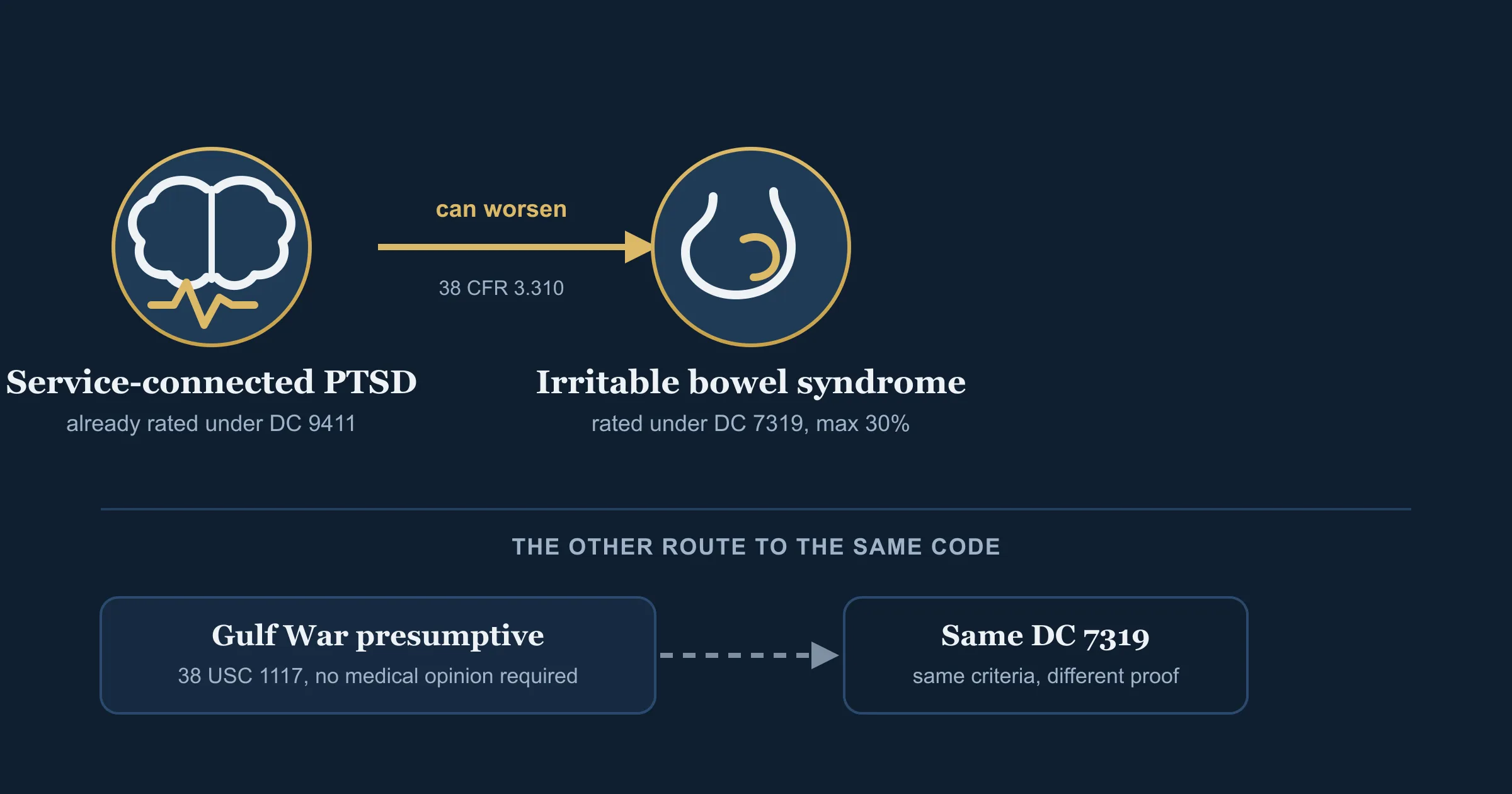
For Gulf War veterans, the presumptive path does the heavy lifting. IBS is treated as a medically unexplained chronic multisymptom illness, so if you served in the Southwest Asia theater, the VA presumes the link and you may not need a nexus letter for the IBS itself. A nexus letter earns its keep where the presumption does not reach: IBS in a veteran without qualifying Gulf War service, IBS that followed an in-service infection, or IBS worsened by a service-connected condition like PTSD (the gut and the nervous system are closely linked). The 'at least as likely as not' standard (a 50% or better chance) comes from the benefit-of-the-doubt rule in 38 U.S.C. § 5107(b), carried out in 38 C.F.R. § 3.102.
How to Connect Irritable Bowel Syndrome (IBS) to Service
There are a few ways to tie IBS to your service. For Gulf War veterans the presumptive path is usually the strongest, because IBS is presumptive as a medically unexplained chronic multisymptom illness.
Presumptive (Gulf War)
IBS is a Gulf War presumptive condition, treated as a medically unexplained chronic multisymptom illness (38 C.F.R. § 3.317). If you had qualifying service, the VA accepts the link.
- Qualifying service. Service during the Gulf War period in the Southwest Asia theater of operations, or in Afghanistan, Israel, Egypt, Turkey, Syria, or Jordan. Those six were added to 38 U.S.C. § 1117(f) by the PACT Act. The older list in 38 C.F.R. § 3.317(e) has not been updated, so read the statute.
- No nexus needed. On a presumptive claim you do not have to prove the cause. You need chronic symptoms and proof of qualifying service. The regulation still recites a 10 percent by December 31, 2026 threshold, but the PACT Act removed it from the governing statute, so 38 U.S.C. 1117 now reaches a qualifying chronic disability that became manifest to any degree at any time.
Direct connection
IBS began in service, or followed an in-service illness.
- Symptoms in service. Ongoing diarrhea, constipation, or belly pain documented while you served.
- After an in-service infection. IBS that began after a gut infection on active duty (post-infectious IBS) can support a direct claim.
Secondary connection
Another service-connected condition, or its treatment, caused or worsened your IBS (38 C.F.R. § 3.310).
- PTSD, anxiety, or depression. Service-connected mental-health conditions are associated with IBS, and the secondary route runs through a medical opinion. Our dedicated guide covers the evidence and the rating mechanics.
- Medication. Some medications taken for service-connected conditions can upset the digestive system and worsen IBS symptoms.
Secondary Conditions
IBS often travels with other service-connected conditions, both as a result and as a cause. Each link is worth documenting, but check how it would be rated first: an IBS rating combines with a rating from another body system, such as a mental-health rating, while 38 C.F.R. § 4.114 prohibits combining it with another digestive rating drawn from 7301 to 7329, 7331, 7342, 7345 to 7350, 7352, or 7355 to 7357.
IBS may be secondary to
- PTSD, anxiety, or depression. Service-connected mental-health conditions are associated with IBS in veterans, and this is one of the most common secondary IBS claims. Nexus letter for IBS secondary to PTSD →
- An in-service infection. A gut infection during service can lead to post-infectious IBS that lasts for years.
- Medication. Some drugs taken for service-connected conditions irritate the digestive system and can worsen IBS.
Conditions that may travel with IBS
- Anxiety and depression. Living with daily digestive symptoms can contribute to a mental-health condition, which may itself be claimable.
- GERD and other digestive conditions. Gulf War veterans often have more than one digestive condition. GERD is rated under DC 7206, which sits outside the 38 C.F.R. § 4.114 no-combine list, so that particular bar does not apply to a GERD and IBS pair, though § 4.14 still forbids counting the same symptom twice. Most other digestive codes cannot be combined with IBS, and the VA assigns a single evaluation under the code reflecting the predominant disability picture.
- Weight loss or malnutrition. Severe, ongoing symptoms can affect weight and nutrition, which the VA can consider in the overall picture.
What to Gather - Evidence Checklist
Gather these before you file or ask for a letter. For IBS, a record of how often your symptoms hit does the heavy lifting, because the rating turns on the frequency of your pain.
Frequently Asked Questions
How does the VA rate IBS?
Under 38 C.F.R. 4.114, Diagnostic Code 7319, updated in 2024. The rating turns on how often you have belly pain tied to bowel movements over the last three months, plus two or more IBS symptoms: at least once in three months is 10%, at least three days a month is 20%, and at least one day a week is 30%. The most you can get for IBS itself is 30%.
Is IBS a Gulf War presumptive condition?
Yes. IBS is a functional gastrointestinal disorder, and 38 C.F.R. 3.317 lists those as a medically unexplained chronic multisymptom illness. For veterans who served in the Southwest Asia theater of operations during the Gulf War period, the VA presumes the link to service, so you do not have to prove the cause. Two precision points, and on both of them the regulation is out of date while the statute governs. The PACT Act amended 38 U.S.C. 1117(f) to cover service in the Southwest Asia theater, Afghanistan, Israel, Egypt, Turkey, Syria, or Jordan, so the narrower theater list in 3.317(e) is not the last word. And while the regulation still recites a 10 percent by December 31, 2026 threshold, the statute now reaches a qualifying chronic disability that became manifest to any degree at any time.
Did the IBS rating rules change?
Yes. The 2024 update to 38 C.F.R. 4.114 rewrote Diagnostic Code 7319. The old rule rated IBS as mild, moderate, or severe and capped it at 30%. The new rule keeps the 30% maximum but ties the rating to how often you have belly pain related to bowel movements, plus two or more listed symptoms. A symptom diary matters more than ever under the new rule.
Can I claim IBS as secondary to PTSD?
Yes, and it is one of the most common secondary IBS claims. It needs a current IBS diagnosis, a service-connected mental-health condition, and a medical opinion connecting them. Our dedicated guide to a nexus letter for IBS secondary to PTSD covers the evidence, the causation and aggravation routes, and the one rating rule that decides whether the claim adds money.
Do I need a nexus letter for IBS?
If you have qualifying Gulf War service, IBS may be presumptive, so you may not need a nexus letter for the IBS itself. A nexus letter earns its keep where the presumption does not reach: IBS without qualifying Gulf War service, IBS that followed an in-service infection, or IBS secondary to a service-connected condition like PTSD. That medical opinion is what we write.
Gulf War service may already connect your IBS. Make the claim show it.
Let our physicians prepare an IBS nexus letter that meets the VA's evidence standards and supports the benefits you earned.
Sources & Regulatory References
- VA disability compensation (VA.gov) https://www.va.gov/disability/
- 2026 VA disability compensation rates (VA.gov) https://www.va.gov/disability/compensation-rates/veteran-rates/
- 38 CFR 4.114, Schedule of ratings, digestive system, including DC 7319 (eCFR) https://www.ecfr.gov/current/title-38/section-4.114
- 38 CFR 3.317, Compensation for Gulf War undiagnosed and chronic multisymptom illness (eCFR) https://www.ecfr.gov/current/title-38/section-3.317
- Gulf War illness and disability compensation (VA.gov) https://www.va.gov/disability/eligibility/hazardous-materials-exposure/gulf-war-illness-southwest-asia/
- 38 CFR 3.310, Secondary service connection (eCFR) https://www.ecfr.gov/current/title-38/section-3.310
- 38 U.S.C. 5107, Benefit of the doubt (Cornell LII) https://www.law.cornell.edu/uscode/text/38/5107