
Welcome to Patriot Path
Nexus Letters for GERD
Licensed Physician, MD | Patriot Path Medical Team
Specializing in VA digestive evaluations and independent medical opinions • Last updated: June 2026
Board-certified physicians specializing in VA disability documentation. Meet our clinicians → • Our review process →
GERD is one of the most common conditions veterans claim. It is also one of the most common secondary claims. Often the cause is another condition, like joint pain or PTSD, or the drugs that treat it. Tying GERD to a service-connected cause is where a nexus letter earns its keep.
There is a catch worth knowing. In 2024 the VA gave GERD its own rating code. The rating now turns on whether reflux has scarred the esophagus. Our physicians connect your GERD to your service, or to a service-connected condition, in the language the VA expects. One flat fee of $1,500, and the first consultation is free.
How VA Rates GERD
The VA rates GERD under 38 C.F.R. § 4.114, Diagnostic Code 7206. This code changed in 2024. The rating now turns on whether reflux has narrowed or scarred the esophagus (a stricture). It also turns on how much that affects your swallowing. Heartburn alone does not set the rating.
| Rating | What it generally takes | Monthly pay (approx) |
|---|---|---|
| 80% | Recurrent or hard-to-treat narrowing of the esophagus that makes swallowing difficult, with breathing food into the lungs, undernutrition, or major weight loss, plus surgery or a feeding tube to manage it. | ~$2,102/mo |
| 50% | Recurrent or hard-to-treat narrowing that makes swallowing difficult and needs stretching procedures three or more times a year, a steroid-assisted stretch at least once a year, or a stent. | ~$1,133/mo |
| 30% | Recurrent narrowing that makes swallowing difficult and needs a stretching procedure no more than twice a year. | ~$552/mo |
| 10% | Narrowing that needs daily medication to control swallowing, but is otherwise quiet. | ~$180/mo |
| 0% | A documented history of GERD without daily symptoms or daily medication. | $0 |
The 2024 update matters. A rating that pays now depends largely on a stricture, the narrowing or scarring reflux can cause, and on how much that affects swallowing. Read on the criteria alone, plain reflux controlled by daily medication without a stricture rates 0 percent. There is one route the code text does not spell out: VA's adjudication manual says a 10 percent evaluation can also be assigned under 38 C.F.R. § 4.7 where you require daily medication, without imaging documenting a stricture. Your endoscopy, swallowing records and prescription record all carry the claim, so make sure all three are in the file.
Pay figures are approximate 2026 rates (effective December 1, 2025) for a single veteran with no dependents. Check VA.gov for current amounts.
Estimate your GERD rating (DC 7206)
Answer a few questions about your esophagus and treatment over the past year. The 2024 code rates GERD on narrowing of the esophagus (a stricture) and how it affects swallowing. This is a rough orientation, not a rating decision.
Making a VA Disability Claim for GERD
A VA disability claim for GERD needs three things to line up:
A current diagnosis
A GERD diagnosis in your records, ideally with the endoscopy or swallowing-study findings that show any narrowing of the esophagus.
A service connection
GERD that began in service, or a link to another service-connected condition or the medication that treats it.
A medical nexus
A qualified opinion that your GERD is 'at least as likely as not' connected to your service, or to a service-connected cause.
Most GERD claims are won on the secondary path, where a nexus letter ties your GERD to another service-connected condition or the medication that treats it. The 'at least as likely as not' standard (a 50% or better chance) comes from the benefit-of-the-doubt rule in 38 U.S.C. § 5107(b), carried out in 38 C.F.R. § 3.102.
How to Connect GERD to Service
There are a few ways to tie GERD to your service. For many veterans the secondary path is the strongest. GERD often grows out of another service-connected condition or its medication.
Secondary connection
Another service-connected condition, or its treatment, caused or worsened your GERD (38 C.F.R. § 3.310).
- Anti-inflammatory medication. Long-term NSAIDs taken for a service-connected joint or back condition. Our dedicated page on GERD secondary to NSAIDs covers the mechanism and the evidence.
- Mental-health medication. Some medications for service-connected PTSD, depression, or anxiety can cause or worsen reflux.
Direct connection
GERD began in service, or was first diagnosed while you served.
- Symptoms in service. Treatment for reflux, heartburn, or stomach trouble in your service records.
- Onset soon after service. A diagnosis in the years right after service can still support a direct claim with the right medical opinion.
Aggravation
You had GERD before service, and service made it permanently worse.
- Worse during service. Your reflux progressed, or your treatment had to be stepped up, on active duty, beyond normal change over time.
Secondary Conditions
GERD sits at a crossroads. It is often caused by the treatment for another service-connected condition. It can also cause problems of its own. Both directions can support a claim.
GERD may be secondary to
- Anti-inflammatory medication. Long-term NSAIDs taken for service-connected joint or back pain. GERD secondary to NSAIDs →
- Mental-health conditions and their medications. PTSD, depression, and anxiety, and some of the medications that treat them, are linked to reflux.
- Sleep apnea. Sleep apnea and GERD often occur together and can worsen each other.
Conditions that may be secondary to GERD
- Esophageal stricture and Barrett's esophagus. Long-standing reflux can scar the esophagus or change its lining. That damage is rated on its own.
- Dental erosion. Stomach acid can wear down tooth enamel over time.
- Chronic cough and sleep disruption. Reflux at night can disrupt sleep and breathing, and may interact with other conditions.
What to Gather - Evidence Checklist
Gather these before you file or ask for a letter. For GERD, two sets of records do the heavy lifting. The first is your endoscopy and swallowing records. The second is the records of the service-connected condition behind it.
Frequently Asked Questions
How does the VA rate GERD?
Under 38 C.F.R. 4.114, Diagnostic Code 7206, updated in 2024. The rating turns on whether reflux has narrowed or scarred the esophagus. It also turns on how much that affects swallowing. It runs from 0 to 80 percent. Read on the code text alone, reflux without a stricture, controlled by daily medication, rates 0 percent. That is not the whole rule. VA's adjudication manual says a 10 percent evaluation can also be assigned under 38 C.F.R. 4.7 where you require daily medication and no imaging documents a stricture. The manual directs regional office raters and does not bind the Board, and 4.7 is a judgment call rather than an entitlement, so put your prescription record in the file alongside the endoscopy and swallowing studies.
Did the GERD rating rules change?
Yes. In 2024 the VA gave GERD its own code, Diagnostic Code 7206, instead of rating it like a hiatal hernia. The new code focuses on esophageal stricture and swallowing trouble. If your claim or records are from before the change, check which criteria apply.
Can I claim GERD as secondary to another condition?
Yes, and it is the most common path (38 C.F.R. 3.310). A nexus letter ties your GERD to the service-connected condition, or to the medication prescribed for it. Our dedicated guide to GERD secondary to NSAIDs covers the medication route in depth.
Is GERD a Gulf War presumptive?
GERD itself is not on the Gulf War presumptive list. Functional digestive disorders, like irritable bowel syndrome, are on it. GERD is usually connected directly, or as secondary to another service-connected condition or its treatment.
Do I need a nexus letter for GERD?
For most GERD claims, yes. Direct or secondary, the VA needs a medical opinion tying your GERD to your service or to a service-connected cause. That opinion is what we write.
Guides for this condition
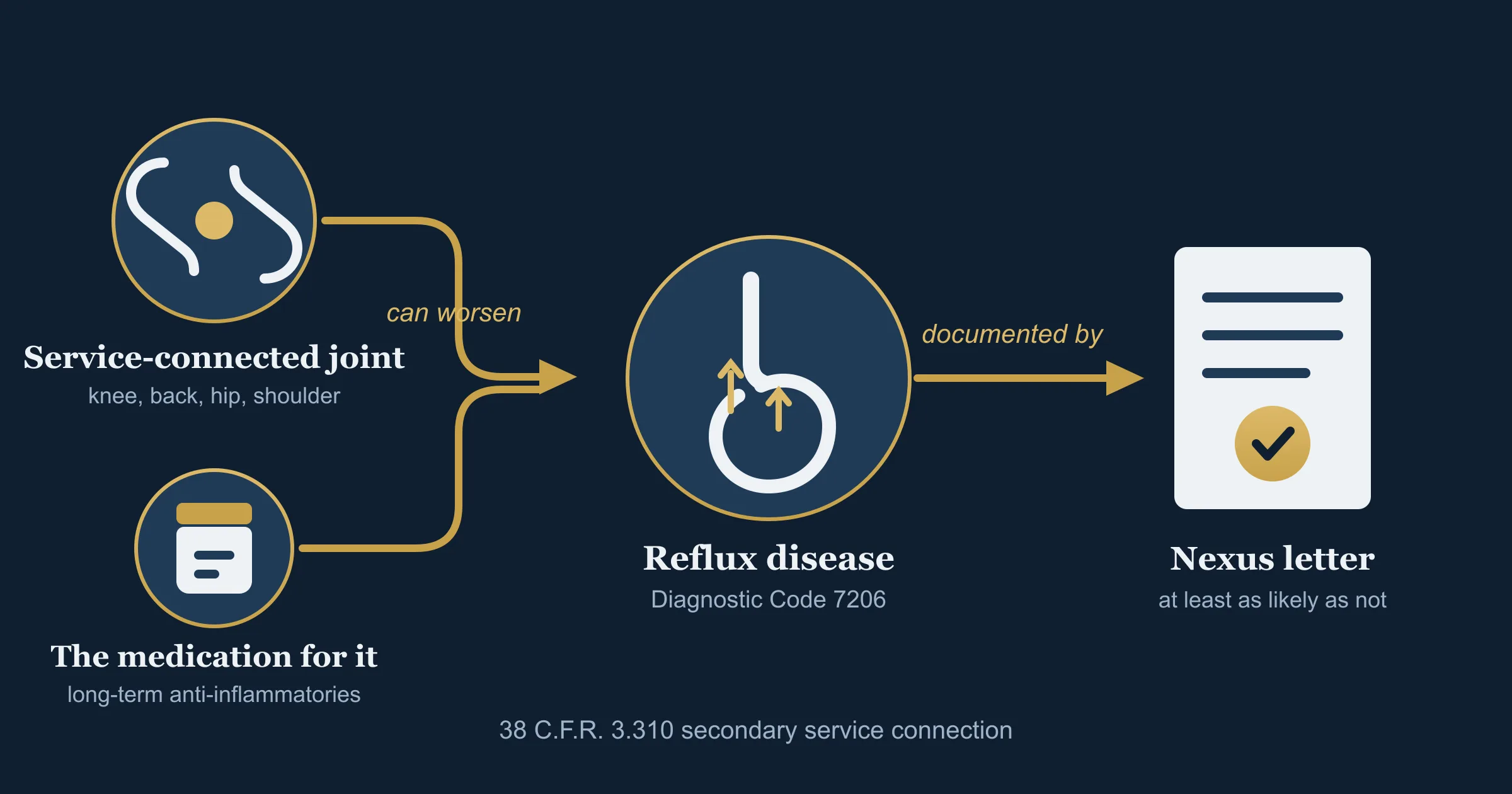 Nexus Letter for GERD Secondary to NSAIDsGERD from long-term NSAIDs taken for a service-connected condition. What the evidence really shows, what DC 7206 pays after 2024, and what the letter must say.Read the guide
 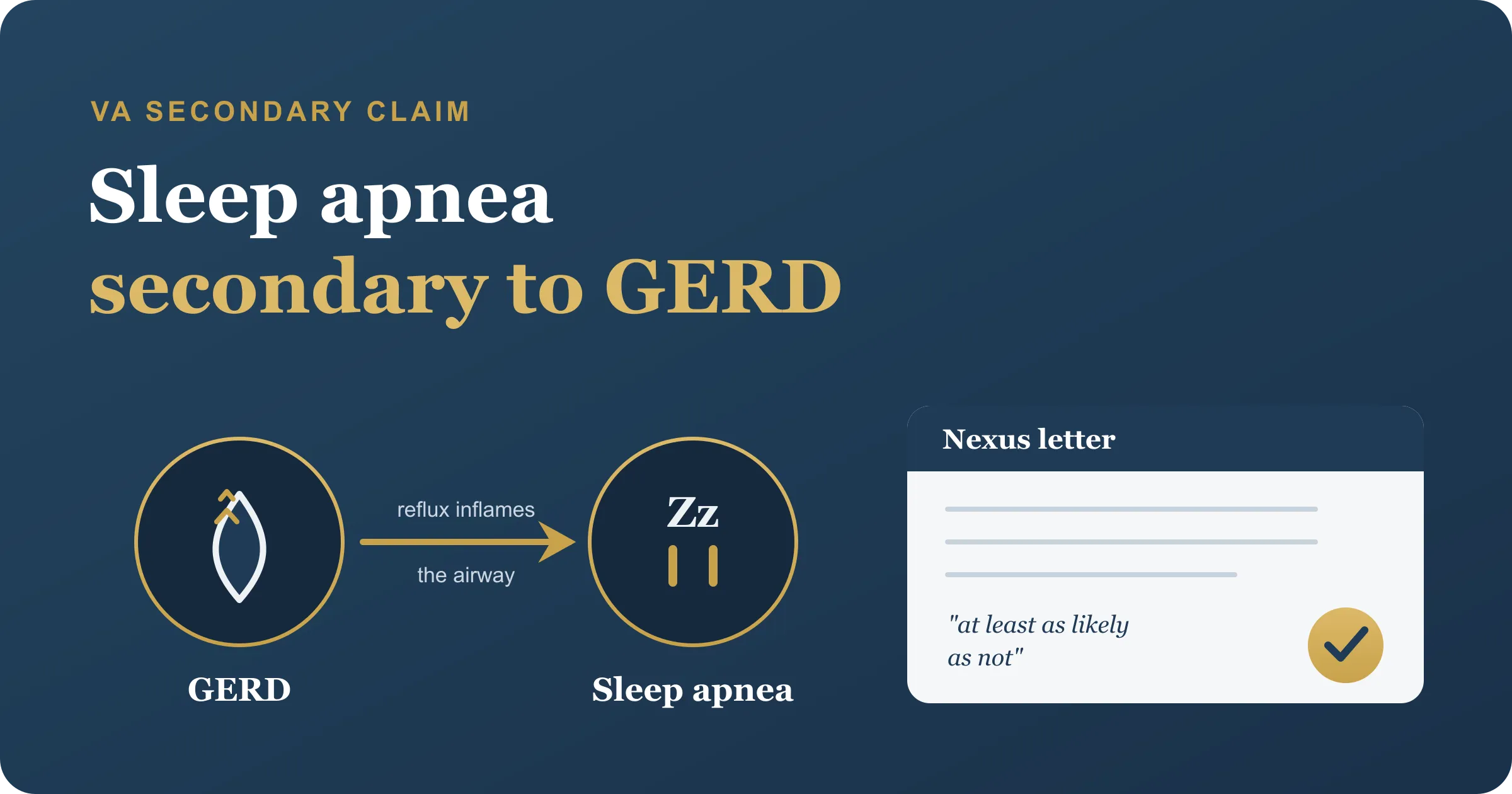 Nexus Letter for Sleep Apnea Secondary to GERDHow to connect sleep apnea to service-connected GERD for a VA claim: the medical link, the evidence needed, ratings, and a physician-written nexus letter.Read the guide
GERD is often a secondary claim. Connect it to the cause.
Our physicians can prepare a GERD nexus letter for you. It ties your reflux to your service, or to the service-connected condition behind it, to meet the VA's evidence standards.
Sources & Regulatory References
- VA disability compensation (VA.gov) https://www.va.gov/disability/
- 2026 VA disability compensation rates (VA.gov) https://www.va.gov/disability/compensation-rates/veteran-rates/
- 38 CFR 4.114, Schedule of ratings, digestive system, including DC 7206 (eCFR) https://www.ecfr.gov/current/title-38/section-4.114
- 38 CFR 4.113, Coexisting abdominal conditions (eCFR) https://www.ecfr.gov/current/title-38/section-4.113
- 38 CFR 3.310, Secondary service connection (eCFR) https://www.ecfr.gov/current/title-38/section-3.310
- 38 U.S.C. 5107, Benefit of the doubt (Cornell LII) https://www.law.cornell.edu/uscode/text/38/5107