
VA Secondary Claims
Nexus Letter for GERD Secondary to NSAIDs
Medically reviewed by the Patriot Path Medical Team
Licensed MD reviewers • Last updated:
A nexus letter is the medical opinion that ties your reflux to the anti-inflammatory medication you take for a service-connected condition. The Board of Veterans Appeals grants these claims, and it granted several of them in 2025 on exactly this theory. Two things on this page are not what you will read elsewhere. The mechanism most sites give you is the one the research does not support, and using it invites an examiner to take the letter apart. And a granted claim does not automatically pay, because the code that rates reflux was rewritten in 2024 and it no longer compensates heartburn on its own, though VA's manual does leave one route to 10 percent open on a daily-medication record.
An illustrative example
A veteran has a service-connected knee. For eleven years his VA provider has prescribed meloxicam, then naproxen, refilled without much discussion. The reflux crept in somewhere around year four. He assumed it was coffee and age.
He filed for GERD as secondary to the knee. The C&P examiner wrote that there were no records documenting NSAID use, and the claim was denied on that sentence alone.
The prescriptions had been in his file the whole time. A physician pulled the pharmacy record, named the drugs and the doses, explained what long-term anti-inflammatory use does to the lining of the esophagus and what it does not do, and answered both whether the medication caused the reflux and whether it made an existing problem worse.
A composite example for illustration, not a real client. Outcomes depend on your own facts and evidence.
What a Secondary Claim Means Here
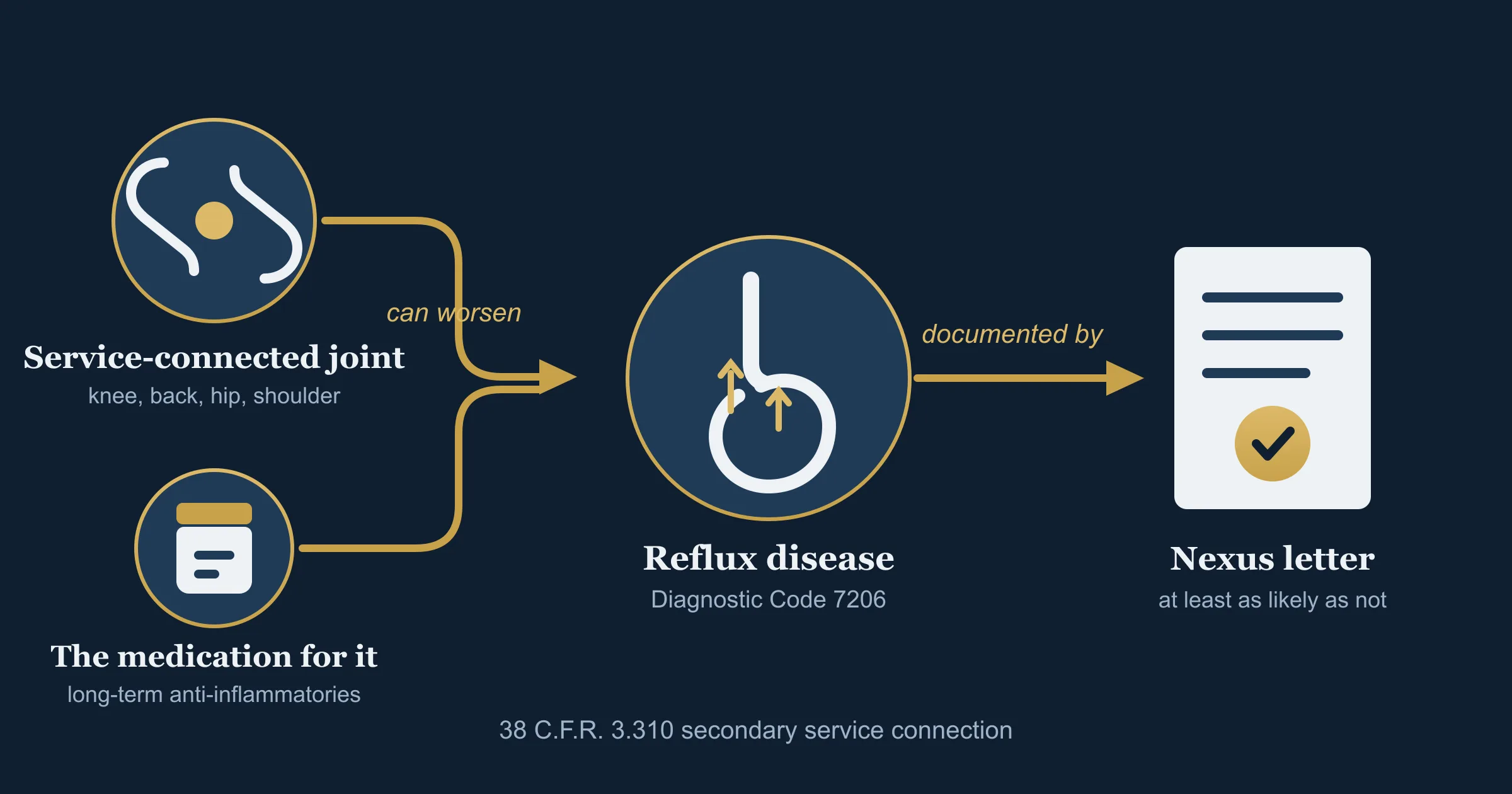
Nothing about this claim says the reflux started in service. It says the reflux came out of something the VA has already agreed it owes you for. That is what 38 C.F.R. 3.310 is for, and the operative sentence is short: except as provided in 38 C.F.R. 3.300(c), disability which is proximately due to or the result of a service-connected disease or injury shall be service connected.
This claim adds one link to that chain. The service-connected condition is usually a knee, a back, a hip, a shoulder or an ankle. The medication is what your provider prescribed to treat it. The reflux is what the medication is said to have caused or worsened. VA's adjudication manual states the causation test as whether the condition is the result of, or would not have occurred but for, a service-connected disability, and a prescription written for a service-connected condition sits comfortably inside that language.
There is one thing worth saying plainly, because it is the sort of gap a careful reader will look for and not find. VA's adjudication manual has no topic devoted to medication-caused secondary conditions, and no provision anywhere that names anti-inflammatories as a route to one. It does mention these drugs in passing elsewhere, in the section on dry eye syndrome, as one of several possible causes of a different condition, which is a long way from a rule you can cite for reflux. So the theory runs on the general causation language and nothing more specific. That is not a weakness, but it does mean your letter has to do the whole job of building the chain. If a page quotes you a manual section about medication side effects, check what it actually says: the closest thing in the manual is an informed-consent definition that belongs to a different kind of claim entirely.
For the rating explainer and the other routes to a reflux claim, see our page on GERD and VA disability.
New to these documents? Start with our primer on what a nexus letter is.
What NSAIDs Actually Do, and What They Do Not Do
Almost every page on this subject explains the link one of two ways. Either NSAIDs damage the stomach lining and therefore cause reflux, or NSAIDs relax the valve at the bottom of the esophagus and let acid up. The first is a real mechanism attached to the wrong condition. The second is not supported by the evidence at all. If your letter is built on either one, a VA examiner who reads the literature can dismantle it, and some of them do.
The claim that NSAIDs loosen the valve is not supported
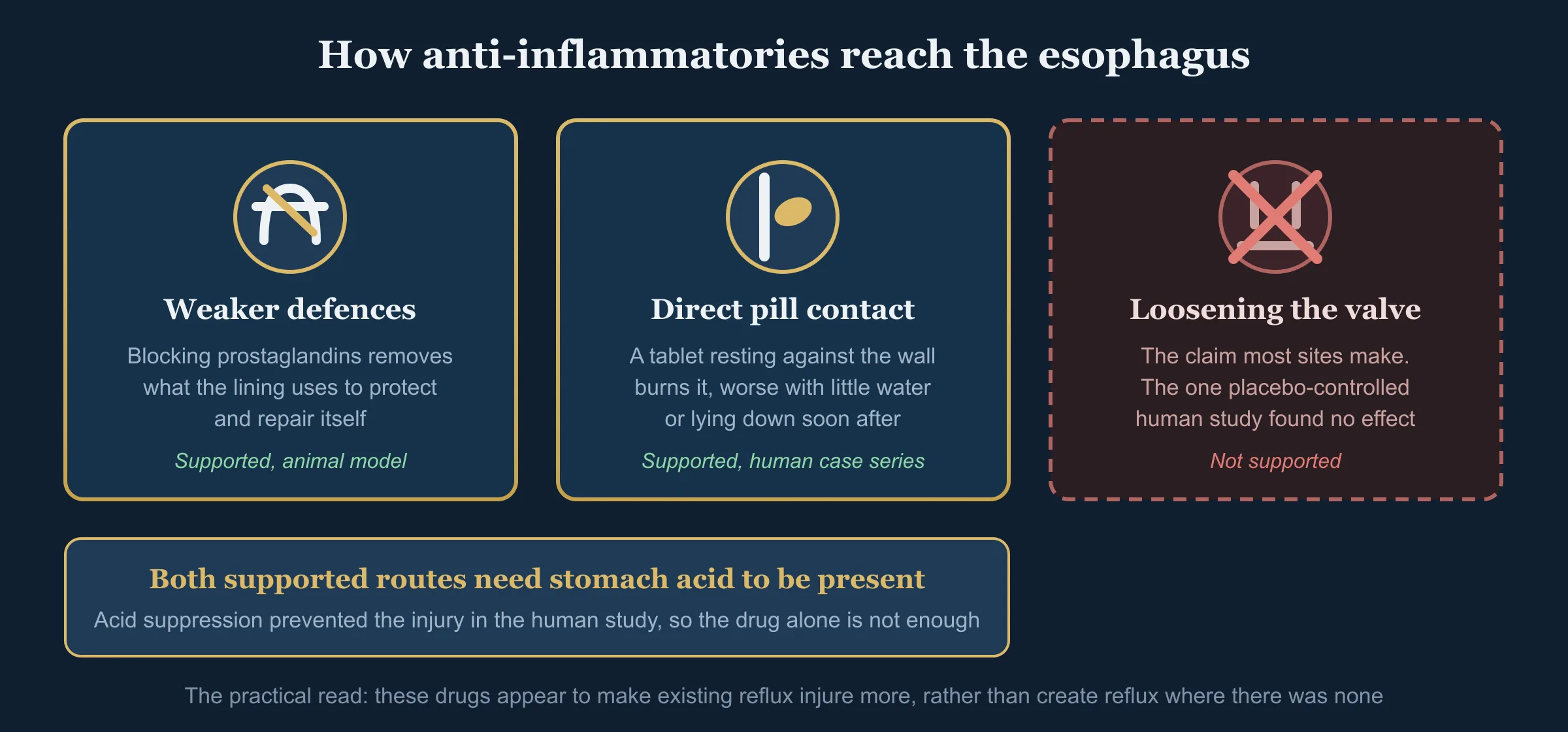
The one randomized, double-blind, placebo-controlled human study to measure it gave nine healthy volunteers aged 23 to 34 naproxen 500 mg twice daily for a week and analyzed eight. Nothing reached significance. Sphincter pressure sat at 32.3 mm Hg on placebo against 29.9 on naproxen, transient relaxations at 4.6 against 5.8 per 30 minutes, and reflux episodes, esophageal clearance and 24-hour acid exposure were unchanged. Those are small numbers of young healthy people over one week, so read it as a failure to find the effect rather than as proof there is none. Two other sources point the same way: a published review of the esophageal effects of these drugs concluded they do not alter lower esophageal sphincter or esophageal body motility, and a canine study of the COX-2 inhibitor celecoxib found sphincter pressure went up rather than down. What none of them supports is the claim you will read almost everywhere, that these drugs loosen the valve.
The supported mechanism is a weaker defence, not more acid
NSAIDs work by blocking prostaglandins, which are also what the lining of the gut uses to protect and repair itself. Keep two organs apart here, because the sources do. For the STOMACH the evidence is well established, and it is the mechanism the private physician gave in Citation Nr A25082162, the 2025 Board grant described below: these drugs inhibit cyclo-oxygenases, which blocks the gastroprotective prostaglandin that maintains gastric mucosal blood flow and protective mucus of the gastric lining, and that is a key element in NSAID-induced gastropathy. The Board found that opinion clear and well reasoned. For the ESOPHAGUS the equivalent evidence is thinner, it is animal work, and it is about aspirin specifically: in rabbits whose esophagus was perfused with acid and pepsin, aspirin made the lining measurably more permeable to both, and giving prostaglandin E2 beforehand cut that damage by more than 40 percent. Worth noticing that the two strongest strands of the esophageal story, this one and the endoscopy work below, both test aspirin rather than the prescription anti-inflammatories most veterans are actually on. A letter that borrows the stomach mechanism and quietly applies it to your esophagus has made the same swap this page is warning you about.
One human study cuts against this, and it is worth knowing why
In a double-blind, placebo-controlled crossover in 12 healthy men, diclofenac significantly reduced acid-induced heartburn, and it did so by suppressing the prostaglandin E2 that esophageal tissue overproduces when acid reaches it. That is the opposite of what a simple prostaglandin story predicts for symptoms, and an honest page has to say so rather than leave it out. It does not rescue the loosened-valve claim and it does not show these drugs are harmless to the esophagus. What it suggests is less comforting than it sounds: prostaglandin E2 appears to be part of how heartburn is FELT, so a drug that blocks it can blunt the warning while the exposure carries on. If that is right, how bad your symptoms are is a poor measure of what is happening to your esophagus, which is one more reason the rating code asks for an endoscopy instead.
A tablet can also injure the esophagus by sitting against it
Pill-induced injury is a separate route and a well described one. It clusters at the natural narrowings of the esophagus, is more common in older people, and is worse when a tablet is swallowed with little water or shortly before lying down. In a series of 78 patients with drug-induced esophagitis, the usual presentation was chest pain and painful or difficult swallowing rather than classic heartburn, and it healed after the drug was stopped and acid suppression started. Anti-inflammatories were among the leading causes in that series.
Both routes need acid to be present, which is the practical point
Seven days of low-dose aspirin produced visible esophageal injury in roughly 46 percent of healthy volunteers in one study, and in 40 percent of long-term users against 25 percent of matched non-users. Adding an acid-suppressing drug prevented it. That tells you the damage depends on stomach acid reaching the esophagus, not on the drug alone. Which means the veterans at real risk are the ones whose antireflux barrier is already imperfect. It also means visible injury on an endoscopy is not the same thing as reflux disease, and the two words should not be traded for each other.
The honest size of the effect, next to the one you have heard
For reflux symptoms the numbers are modest. A 2018 meta-analysis of 102 population studies of reflux symptoms, 460,984 subjects in total, reported odds of 1.44 (95 percent confidence interval 1.10 to 1.88) among NSAID and aspirin users, drawn from the subset of those studies that recorded medication use rather than from all 460,984, and the authors themselves called the association modest. Obesity carried a larger odds ratio in the same analysis. Among 13,993 patients who had an upper endoscopy, NSAIDs predicted reflux oesophagitis at odds of 1.29, against 3.10 for a hiatal hernia. Now the contrast: for bleeding from a peptic ulcer, non-aspirin NSAIDs carry odds around 7.4. That is the well-known NSAID number, it is roughly five times the reflux figure, and it belongs to a different condition. When a page tells you NSAIDs are strongly linked to acid-related disease and then illustrates it with your reflux, it has quietly swapped one for the other.
How strong is this literature, really
One paper has formally graded it. An umbrella review of 23 publications assessed 24 environmental risk factors for reflux disease and placed NSAID use in the suggestive evidence tier, concluding that none of the 24 factors, NSAIDs included, reached the level of convincing evidence. That is the honest ceiling, and stating it is not a concession. The VA standard is not scientific certainty. It is whether the connection is at least as likely as not on the evidence in your file, and a suggestive-tier association plus a documented decade of prescriptions plus a plausible timeline can meet that bar when a bare assertion cannot.
So the sentence that survives scrutiny is this one: long-term anti-inflammatory use appears to make existing reflux injure more and hurt more, rather than to create reflux in someone who had none. That is a narrower claim than the competition makes, and it is the one your file can actually support.
Caused By It, or Made Worse By It
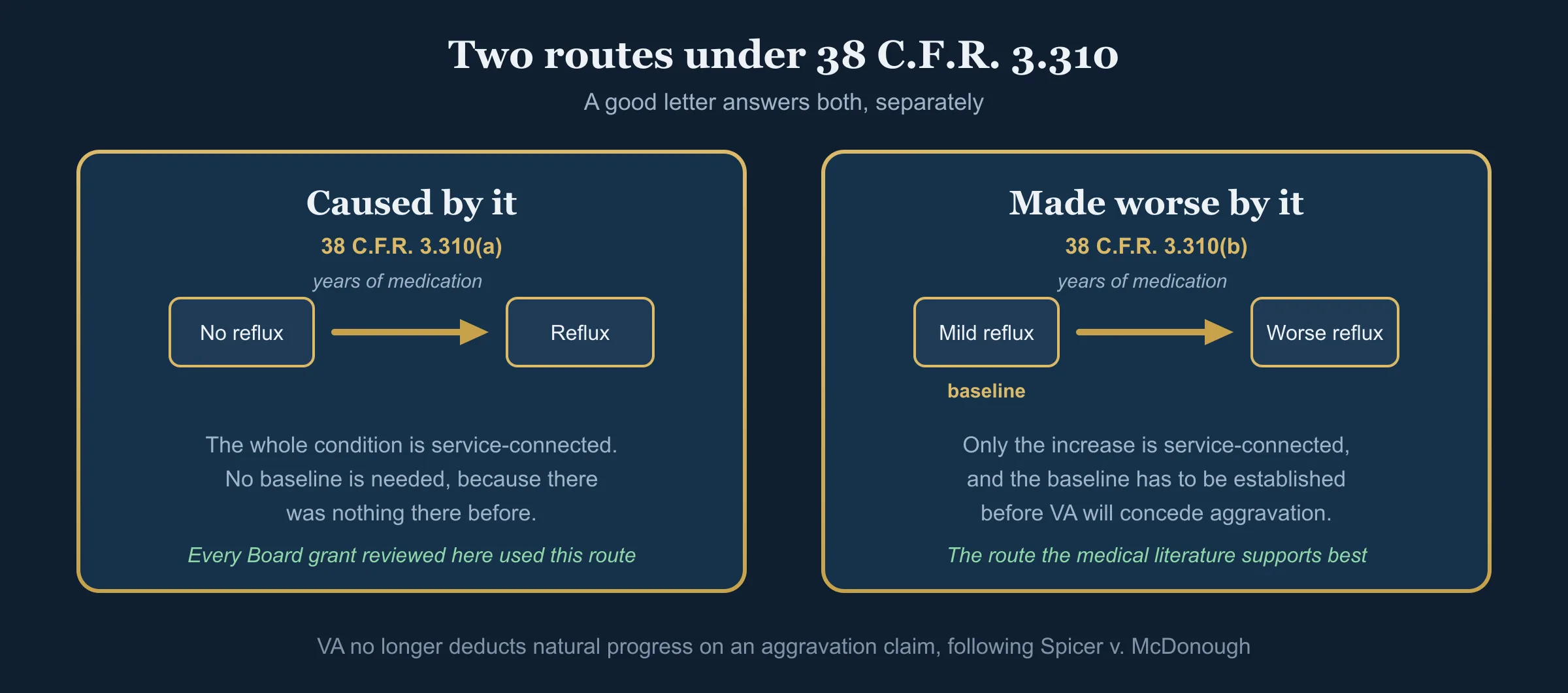
These are two different claims with two different proofs, and on this particular theory the distinction does more work than it does on most. The mechanism section above points at aggravation. All four grants read in full for this page were decided on causation. You should plead both, and here is why that is not a hedge.
Caused by it
38 C.F.R. 3.310(a)
The reflux came after the prescriptions, and the medication is what brought it on. If the VA agrees, the whole condition is service-connected. No baseline is needed, because there was nothing there before. All four grants read in full for this page were decided on this theory.
Made worse by it
38 C.F.R. 3.310(b)
You already had some reflux, and years of anti-inflammatories made it worse. Only the increase is service-connected, and a baseline level of severity has to be established before the VA will concede aggravation at all. This is the theory the medical literature supports most cleanly.
Why both, and in that order
An opinion that answers only whether the medication caused the condition leaves the aggravation question unexamined, and the Board has set VA opinions aside for exactly that omission in other secondary claims. The reverse is also true: leading with aggravation alone concedes that you had reflux first, which may not be your history and which invites a fight over a baseline you might not need.
The practical answer is that a good letter answers both questions explicitly, in the same document, and says which one the writer thinks the record supports. That costs a paragraph and it closes the most common route to a partial denial.
One thing most sources still have wrong
The aggravation regulation still carries a clause telling the rating activity to deduct any increase in severity due to the natural progress of the disease. It is quoted as live law all over the internet, including on pages about this exact claim. VA has stopped applying it.
After Spicer v. McDonough, 61 F.4th 1360 (Fed. Cir. 2023), which held that the statute requires a but-for causation standard rather than a stricter one, VA's manual says it will apply the broader standard and will no longer consider natural progress when deciding a claim based on aggravation. The manual's own deduction arithmetic omits it. That change dates from May 2026 and it runs in your favor.
Spicer carries a second consequence that matters here specifically, and it is worth being precise about who said what. The Federal Circuit held that the statute uses but-for causation. It did not use the phrase contributing cause. The Board did: in Citation Nr A25071899, decided August 26, 2025, it read Spicer to mean that a service-connected disability need only be a contributing cause, not the contributing cause, and on that reasoning it granted service connection for reflux secondary to chronic anti-inflammatory use for a service-connected lumbar spine and both knees, over four negative VA opinions. Board decisions are not precedent (38 C.F.R. 20.1303) and that one does not bind anyone deciding your claim. But if your denial says your weight, your diet or a hiatal hernia explains the reflux, the point survives on the statute alone: a harm can have more than one cause, and yours does not have to be the only one.
The baseline, if you are claiming aggravation
The regulation says the baseline is established by medical evidence created before the onset of aggravation, or by the earliest medical evidence created between the onset of aggravation and the evidence establishing the current level. VA's manual adds a route the regulation leaves out: any other credible evidence, including lay evidence, that supports establishment of the baseline. Lay evidence on its own may not be enough, but it can support the baseline and prompt the VA to develop the claim further.
If no baseline can be established, the manual is blunt: no aggravation can be demonstrated and the claim must be denied. Read the next sentence of the manual too, because it is the one that helps you. A claim may only be denied for lack of baseline evidence after VA has fulfilled its duty to assist, and that duty runs to developing the baseline. If your denial says there is no baseline and the file shows VA never went looking for one, that is a ground to raise rather than a closed door. The manual also tells adjudicators not to assume a baseline of zero percent when one cannot be established, which cuts both ways. And there is a quiet piece of good news in the same section. Aggravation is established by any increase in severity, whether or not it produces a higher schedular evaluation, and where the baseline and the current level sit at the same level the manual directs the rater to grant service connection at a noncompensable evaluation. On this code that still protects your effective date and your route to a future increase.
What a GERD Rating Is Actually Worth Now
This is where most of what you will read online is out of date, including on pages that say 2026 at the top. On May 19, 2024, VA rewrote the digestive schedule. Reflux disease got its own diagnostic code for the first time, DC 7206, and the old approach of rating it by analogy to a hiatal hernia under DC 7346 ended. DC 7346 was not deleted. It was hollowed out, and now reads only that a hiatal hernia is rated as an esophageal stricture under DC 7203.
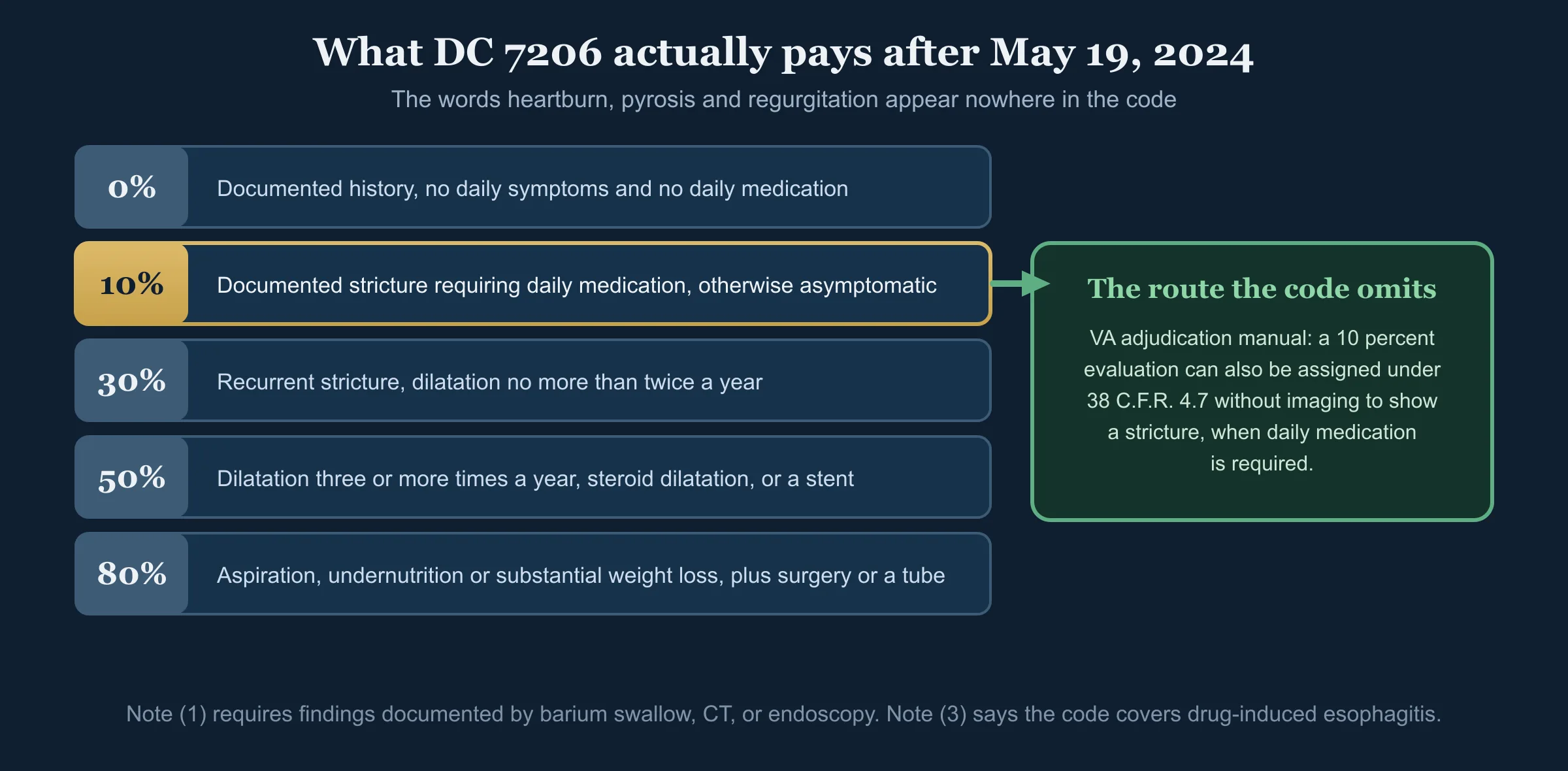
Here is the part nobody enjoys reading. The words heartburn, pyrosis, regurgitation and epigastric distress appear nowhere in DC 7206. Every compensable step on its ladder is written in the language of esophageal stricture and difficulty swallowing. VA said so on the record when it published the rule, that the functional impairment due to reflux disease would be evaluated based on the degree of esophageal stricture, and when commenters objected that not all reflux produces a stricture, VA answered that while this is true, no change was made.
So a veteran with genuinely miserable daily reflux, controlled on a proton pump inhibitor, with no stricture on any study, is looking at the bottom of that ladder on these criteria alone. Anyone promising you 30 percent for severe heartburn is quoting a rating table that has not existed since 2024. There is one route out of the bottom that the code text does not mention, and it is the next section.
The DC 7206 ladder, in plain words
- 0%Documented history without daily symptoms or requirement for daily medications.
- 10%Documented history of esophageal stricture that requires daily medications to control dysphagia, otherwise asymptomatic.
- 30%Documented history of recurrent esophageal stricture causing dysphagia which requires dilatation no more than 2 times per year.
- 50%Recurrent or refractory stricture causing dysphagia requiring dilatation 3 or more times per year, steroid dilatation at least once per year, or stent placement.
- 80%Recurrent or refractory stricture causing dysphagia with aspiration, undernutrition, or substantial weight loss as defined by 38 C.F.R. 4.112(a), plus surgical correction or a feeding tube.
Those rows are shortened into plain language; the governing text is the schedule itself, linked below. Note (1) to the code requires the findings to be documented by barium swallow, computerized tomography, or an upper endoscopy (esophagogastroduodenoscopy). Substantial weight loss is a defined term rather than a description: 38 C.F.R. 4.112(a) sets it at involuntary loss greater than 20 percent of baseline weight sustained for three months with diminished quality of self-care or work tasks.
The route to 10 percent the code text does not spell out
Read only the regulation and you would tell a veteran on a daily PPI, with no endoscopy showing a stricture, that he rates 0 percent. That would be wrong, and it is wrong in his favor.
VA's adjudication manual says two things the schedule does not. First, a diagnosis of reflux disease for service-connection purposes does not require documentation by medical imaging. Second, a 10 percent evaluation can also be assigned under 38 C.F.R. 4.7, the higher-of-two-evaluations rule, without imaging to document a stricture, when the veteran requires daily medications. VA said something similar in the 2024 rulemaking itself, treating daily medication as the objective measure at the 10 percent level, so this is not a stray manual gloss. Two cautions before you rely on it. The manual directs regional office raters and does not bind the Board, and 4.7 is a judgment call about which of two evaluations more nearly approximates your disability, not an entitlement. Ask for it by name, with the prescription record attached.
Above 10 percent, be realistic. Without documented recurrent or refractory stricture and a dilatation history, the schedular ladder does not offer much. That is worth knowing before you pay anyone to help you chase it.
One useful detail sits in Note (3) to DC 7206. The code applies to, among other things, drug-induced esophagitis. The schedule itself contemplates that a medication can be the cause, which is a small but real anchor for this theory.
A word on a popular argument that does not work here. Veterans are often told the VA has to rate them as if they were not taking their medication. That rule comes from Jones v. Shinseki, and it applies only where the diagnostic code does not already account for medication. DC 7206 accounts for it explicitly at the 10 percent level, which says requires daily medications, and DC 7304 does the same at its 20 and 40 percent levels, which say managed by daily prescribed medication. So the argument is unavailable on these codes. Note also that VA published a rule in February 2026 that would have changed this across the board and rescinded it ten days later; anything written in that window describes a rule that no longer exists.
If you already hold a GERD rating under the old DC 7346 criteria, VA's manual says the 2024 changes were not intended as a liberalization, directs raters to update the code, and applies the protection in 38 C.F.R. 3.951(a) so the evaluation is not reduced solely because the criteria changed. That protection is not absolute: the same provision allows a reduction where the disability itself has actually improved, shown by evidence of a change in physical condition. It shields you from the code rewrite, not from a genuine improvement.
Can You Add Gastritis or an Ulcer On Top?
If anti-inflammatories injured your esophagus, they may well have injured your stomach too, and the stomach evidence is the stronger of the two. So the question of what can be rated alongside what is a live one. The answer has four parts and most of them are counterintuitive.
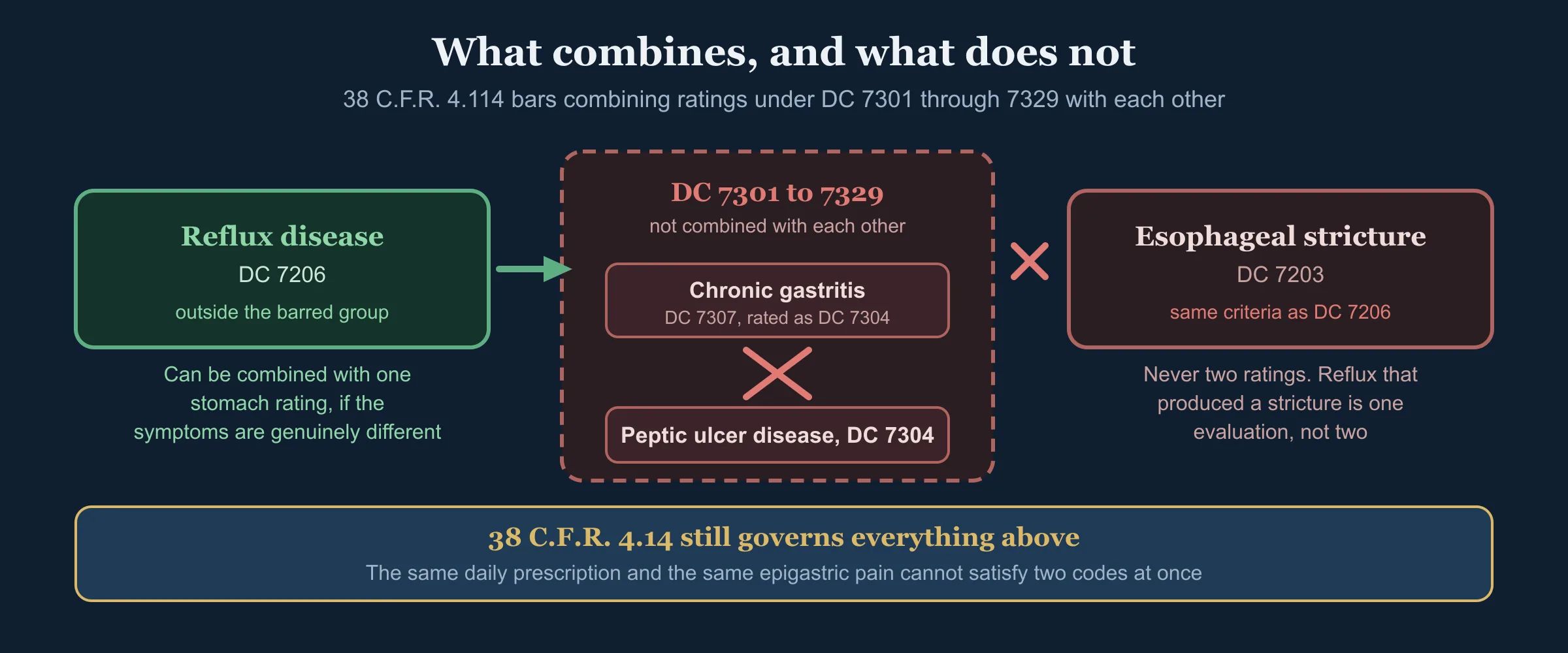
Reflux plus a stomach rating: not barred
The digestive schedule opens by directing that ratings under a specific list of codes are not to be combined with each other. That list runs 7301 through 7329, plus 7331, 7342, 7345 through 7350, 7352, and 7355 through 7357. DC 7206 is not in it, and neither is any other code in the 7200 series. VA's manual confirms the point in terms, saying that separately evaluating and combining a 7200-series code with a 7300-series code is not categorically prohibited. The manual also carves out a named exception that reads oddly against the regulation: hiatal hernia sits inside the barred range at DC 7346, but since May 19, 2024 it is rated under DC 7203, which is outside the range, so the manual treats it as combinable too. Most published guidance states the old blanket prohibition, and it understates what you can claim.
But only if the symptoms are genuinely different
Three rules survive. 38 C.F.R. 4.14 bars evaluating the same manifestation under different diagnoses. 38 C.F.R. 4.113 warns that coexisting abdominal diseases produce a common disability picture of pain, anemia and disturbances in nutrition, though it scopes that warning to the conditions named in the prefatory instruction to 38 C.F.R. 4.114 rather than to every digestive pairing. And the manual tells raters to consider carefully whether the criteria compensate the same facet of disability. In practice: if the same daily prescription and the same epigastric pain are used to satisfy the reflux code and the stomach code at once, that is one manifestation counted twice and it is barred.
Gastritis and peptic ulcer cannot be stacked with each other
This is where the stack-your-secondaries advice goes wrong. Chronic gastritis is DC 7307 and peptic ulcer disease is DC 7304, and both sit inside the not-combined list. Worse, DC 7307 has no criteria of its own: the schedule says to rate it as peptic ulcer disease. So the two would be graded on an identical ladder even if the rule did not exist. The correct outcome is a single evaluation under the predominant disability picture, elevated if the overall severity warrants. Note also that duodenal ulcer, the old DC 7305, no longer exists; a source still citing it predates 2024.
Do not ask for stricture and reflux as two ratings
DC 7203 is esophageal stricture and DC 7206 is reflux disease, and their criteria ladders are word for word identical apart from three words at the 80 percent level. Reflux that has produced a stricture is one evaluation, not two. Neither code is on the not-combined list, which is exactly what makes this easy to trip over.
None of this is a reason to file narrowly. It is a reason to have the letter address each diagnosed condition on its own symptoms, so a rater can see which facet belongs to which code. That is the difference between a claim that combines and a claim that gets collapsed into one evaluation.
Can You Get VA Disability for GERD Secondary to NSAIDs?
Yes, and the Board granted several of them in 2025 on this exact theory. Three things have to line up, and on this claim the second one carries more weight than veterans expect.
- 1
The primary condition is service-connected
An existing VA rating for the knee, back, hip, shoulder or other condition the anti-inflammatories were prescribed to treat. The secondary claim attaches to it, so it has to be settled first.
- 2
A documented prescription history
Records showing you actually took anti-inflammatories, over time, for that condition. This is the piece these claims are won and lost on, and it is the one thing in the list a letter cannot manufacture.
- 3
A current GERD diagnosis and a nexus opinion
Reflux disease named in your records, and a qualified opinion that it is at least as likely as not caused or aggravated by the medication. This is the nexus letter.
All three are gates rather than points, and none of them is something a nexus letter can supply. Without a service-connected primary there is no secondary claim to bring. Without a diagnosis there is nothing to service-connect. And without a prescription record the chronic-exposure premise the whole theory rests on has nothing to stand on.
The Language the VA Requires
The VA reads these opinions closely, and small differences in wording change how much weight they carry. Be clear about what the 50 percent figure is and is not. The benefit-of-the-doubt rule in 38 U.S.C. 5107(b) and 38 C.F.R. 3.102 works on the record as a whole: when the positive and negative evidence sit in approximate balance, you win. It is not a pass mark that each individual document has to clear. VA asks for opinions phrased as at least as likely as not because that is the wording that puts evidence into the balance. An opinion phrased as a bare possibility will not carry the claim on its own, but it is still evidence, it is still weighed, and a treating provider saying your reflux may be related to the medication can be enough of an indication to trigger VA's duty to give you an examination and an opinion. So it is worth filing rather than withholding.
Language that meets the bar
- “At least as likely as not caused by, and in the alternative aggravated by, the veteran's chronic use of naproxen prescribed for his service-connected lumbar spine disability” Meets the threshold, answers both prongs separately, and names the drug and the primary. The standard to aim for.
- “More likely than not aggravated beyond its natural course by, and at least as likely as not caused by, the meloxicam prescribed for his service-connected right knee” Exceeds the minimum on one prong while meeting it on the other, and it still names the drug and the primary. Stronger than the bar, and specific enough to act on.
Language that fails
- “May be related to his pain medication” A possibility, not a probability, and an unnamed medication gives the rater nothing to work with.
- “It is impossible to say without resorting to mere speculation” This resolves nothing and the Board can give it no weight either way. If a provider reaches this, the answer is a better-documented file, not a rewording.
One caution about a formulation you may see criticized. In Citation Nr A25014545 the Board called a private opinion vague for finding only that the condition was secondary to, related to, and slash or aggravated by the service-connected disabilities. That is a fair warning, but it is not a rule: in Citation Nr A25079771 a private opinion using almost identical wording was given significant probative weight, because it carried a rationale, the records it relied on, and the drugs by name. Read the two together for what they show rather than for a verdict on the phrase. In A25014545 the Board granted the claim, and it never said the private opinion lacked reasoning or gave it lesser weight; it noted the opinion cited studies on NSAIDs as a risk factor, folded it in with the rest of the evidence, and rested the grant on a VA examiner's opinion. So the phrase alone did not decide either case. What the record shows is that the specific opinion carried the weight.
Answer both questions
Say both prongs out loud, and separately. An opinion that addresses causation and stops there leaves the aggravation theory unexamined, which is the omission that has cost VA examiners their credibility in these appeals and can cost a private letter its weight just as easily.
What the Nexus Letter Must Include
The list below is not generic. Every item is something a Board decision reviewed for this page either credited an opinion for having or discounted an opinion for lacking.
- 1The actual drugs, doses and datesNot anti-inflammatories in general. The 2025 opinion the Board gave great probative value to named naproxen 500 mg twice daily and ibuprofen 200 mg as needed. Specificity is what turns a general theory into a statement about you.
- 2The mechanism, stated accuratelyThe winning opinion in that case explained that these drugs inhibit cyclo-oxygenases, which blocks the formation of gastroprotective prostaglandin that maintains gastric mucosal blood flow and increases protective mucus of the gastric lining, and called that a key element in NSAID-induced gastropathy. Note two things: that mechanism is about the stomach, so a letter reaching the esophagus has to say how it gets there, and it did not claim the sphincter had been loosened.
- 3The literature, characterized as it readsCite what the studies measured. A modest association described as modest is more durable than a strong one asserted without a source, because overstating a paper gives the VA a reason to discount the whole opinion.
- 4The records actually reviewedName them. In a September 2025 decision the Board gave great weight to a physician who had never examined the veteran in person, because the opinion was clear, well reasoned and supported by objective medical data from the treatment records.
- 5A direct answer on aggravation, separatelyWhether the condition would have been less severe but for the medication. If aggravation is the theory, the baseline goes here too.
- 6The other explanations, addressed head onWeight, diet, alcohol, smoking, a hiatal hernia, other prescriptions. An opinion that names them and explains why the medication still contributes at least as likely as not is far harder to set aside than one that ignores them.
- 7Its own reasoning, not a summary of everyone else'sIn Citation Nr A25047055, decided May 27, 2025, the veteran submitted two private opinions. The first was given significant probative value. The second was given minimal weight because the Board found it merely recycled, in its entirety, the previously discussed medical opinions of record without providing rationale or analysis. A letter has to think, not compile.
What the Board Has Actually Done With These Claims
Board of Veterans Appeals decisions are public. Five were read in full for this page, four grants and one denial. They were not chosen because they were favorable: one of them was won with no private opinion in the file at all, which is an awkward fact for a page like this one, and it is below. Read the note under each, because what was granted is narrower than it sounds.
Citation Nr A25082162 (September 2025)
- What was granted
- Service connection for gastroesophageal reflux disease, as secondary to NSAID use for a service-connected right ankle ligament sprain with lateral ankle instability.
- What won it
- A private physician's April 2024 opinion, which the Board ascribed great probative value. It named the prescriptions, gave the prostaglandin mechanism, and cited literature. The Board expressly noted the physician had not performed an in-person examination and relied on the treatment records, and gave the opinion great weight anyway because it was clear, well reasoned and supported by objective medical data. Two negative VA opinions were set aside: a nurse practitioner's for failing to address the veteran's own lay statement, and a second for being conclusory and showing very little indication she had reviewed the private opinion.
Service connection only. The Board assigned no percentage, and no percentage means no payment until the regional office assigns an evaluation.
Citation Nr A25079771 (September 2025)
- What was granted
- Service connection for gastroesophageal reflux disease as secondary to degenerative arthritis of the knees.
- What won it
- A private examiner's opinion, given significant probative weight, which relied on the veteran's statement, his in-service and post-service records, and the literature. The VA examiner had denied causation on the ground that no medical records documented the use of anti-inflammatories. The record contradicted that: he had been prescribed meloxicam as early as October 2018, and had been given Motrin in service in 1976. He also reported taking celecoxib, diclofenac, ibuprofen and meloxicam for his knees, though that list came from his own statement in support of claim rather than from the pharmacy record. The negative opinion collapsed on its own factual premise.
Service connection only, no percentage. This is the clearest illustration on this page of why the pharmacy record is the document that matters most.
Citation Nr A25076515 (September 2025)
- What was granted
- Service connection for gastroesophageal reflux disease, as secondary to service-connected lumbar degenerative arthritis.
- What won it
- A private nurse practitioner's report, which the Board noted had been compensated in exchange for the report and about which it was unclear whether the author had spoken to the veteran or reviewed her file. The Board gave that report and the negative VA examiner's findings equal probative weight, which put the evidence in equipoise, and the benefit-of-the-doubt rule decided it in her favor.
Service connection only. The useful lesson is that a private opinion does not have to defeat the VA examiner outright. Pulling the evidence to even is enough. Being a paid opinion did not disqualify it.
Citation Nr A25071899 (August 2025)
- What was granted
- Service connection for gastroesophageal reflux disease, as secondary to chronic use of non-steroidal anti-inflammatory medication prescribed to treat a service-connected lumbar spine and both knees.
- What won it
- Nothing the veteran bought. There was no positive medical opinion in the file at all. All four VA opinions were negative, and the Board granted anyway, by taking the concessions inside them and applying Spicer v. McDonough to hold that a service-connected disability need only be a contributing cause and not the contributing cause.
Included because leaving it out would be dishonest on a page selling nexus letters. It is the one decision here that shows a veteran winning without one. It is also the clearest authority on this page for the point that a competing explanation such as weight or a hiatal hernia does not by itself defeat the claim.
Citation Nr 1631884 (August 2016), a denial
- What was granted
- Nothing. Service connection for a gastrointestinal disorder, including as secondary to service-connected disability, was denied.
- What won it
- Nothing did, and that is the point. The veteran made this exact argument on 800 mg Motrin for service-connected knees, and four things sank it. There was no private nexus opinion at all: the Board noted the private treatment records contained no nexus opinions to controvert the VA examiner. He argued the medical literature himself, and as a layperson his interpretation was given no probative value while the examiner was free to read the same articles against him. The pharmacy data showed 557 tablets in total, which the examiner worked out to under five per month, and intermittent use sank the chronic-exposure premise. And the examiner observed that his reflux treatment plan had never recommended stopping the medication.
A 2016 legacy-system case, so it is older than the grants above. Its lessons are about evidence rather than procedure, which is why it still holds. Nothing here is a suggestion to change how you take a prescribed medication; that decision belongs with you and your prescriber, on medical grounds.
The pattern worth copying
Across the grants, what the Board credited was consistent: a stated mechanism, literature characterized accurately, the actual drug names and doses taken out of the record, and direct engagement with the veteran's own account. Only one case here was lost, and it turned on two things, neither of them wording. There was no private nexus opinion in the file at all, and the prescription record was thin enough that the examiner reduced it to under five tablets a month. One more case is worth naming because it is the one most often cited on this topic: Citation Nr A25014545, from February 2025, granted service connection for reflux secondary to NSAID use for service-connected knee and foot disabilities. It is a real decision and it is on point. It is also a weak illustration for a page like this one, because the opinion the Board credited came from a VA examiner, while the only private opinion in that case was the one it called vague.
You will find pages quoting a success rate for this theory. We do not have one and neither do they. The Board's search index is relevance-ranked, so counting the grants it returns measures the search engine rather than the outcomes, and no reliable denominator exists.
Board of Veterans Appeals decisions are not precedent. Under 38 C.F.R. 20.1303, previously issued Board decisions are binding only with regard to the specific case decided, and each case is decided on the basis of its own individual facts. These are illustrations of how evidence was weighed in other veterans' cases. They do not establish VA policy, they do not bind anyone deciding your claim, and they are not a prediction of your outcome. Note also that every grant described here was a grant of service connection, which is entitlement rather than money. The regional office assigns the evaluation afterward, and a noncompensable evaluation is a possible result.
What to Give Your Provider
On this claim the pharmacy record does more work than anything else in the file. It is what turns a general medical proposition into evidence about you, and it is the thing the losing veteran in the denial above did not have.
The core file
- Your complete prescription historyEvery anti-inflammatory, with drug names, doses, start dates and refill history, from both VA and private pharmacies. Fill counts matter: an examiner in one case computed tablets per month and used the answer against the veteran.
- Your service-connection decision for the primary conditionThe VA letter or rating for the knee, back, hip, shoulder or ankle the medication was prescribed for, with the effective date.
- A current GERD diagnosisProvider notes naming reflux disease. Any endoscopy, barium swallow or CT report, which is what the rating criteria are keyed to.
What strengthens it
- A timelineRoughly when the primary condition was diagnosed, when the prescriptions started, and when the reflux symptoms began, so the physician can line them up.
- Anything showing what your reflux was like beforeOnly needed if you are claiming the medication made an existing problem worse. This is the baseline, and it is the piece most files are missing.
- Your other risk factors, honestlyWeight history, hiatal hernia, smoking, alcohol, other prescriptions. A letter that addresses them is stronger than one that pretends they are absent, because the examiner will raise them anyway.
- Lay statementsShort statements about when the reflux started relative to the prescriptions, and what it is like to live with. One 2025 Board decision set a VA opinion aside for failing to address the veteran's own account.
How to File the Secondary Claim
- 1File on VA Form 21-526EZClaim GERD as secondary, and say what it is secondary to in plain words: secondary to the medication prescribed for the service-connected condition, naming both. Naming the medication route explicitly keeps it open.
- 2Claim the stomach conditions separately if you have themIf you also carry a diagnosis of gastritis or peptic ulcer disease, claim it by name and describe its own symptoms. Whether the ratings can combine turns on whether the manifestations are distinct.
- 3Submit the nexus letter and the pharmacy record togetherYou can file first and add evidence later, but on this claim the opinion and the prescription history are one exhibit. Sending them together is what stops an examiner writing that nothing documents your medication use.
- 4Go to the examIf the VA schedules an Esophageal Conditions DBQ or a C&P examination, attend it. Describe your symptoms accurately, including what the medication does and does not change.
- 5If you are appealing a denial, use a Supplemental ClaimVA Form 20-0995 is the route when you have new and relevant evidence, and a nexus letter that answers the ground the VA relied on is exactly that.
File sooner rather than later. The date you file usually sets the date benefits start, and a claim you put off is money left behind, even on a code where the first evaluation may be noncompensable.
If Your Claim Is Denied
Read the denial letter for the reason, because the reason tells you what the next piece of evidence has to be. Four come up repeatedly in these claims, and three of the four are answerable with documents you may already have.
No records document your medication use
The most common one, and the most often wrong. It was the stated basis of the negative VA opinion in a 2025 case where the record in fact showed four different anti-inflammatories. Pull your full pharmacy history from every source before you accept this reason.
Your use was not chronic enough
This one can be real. In the denial reviewed above, the examiner reduced the file to a tablet count and reached under five a month. If your use genuinely was long-term and daily, the refill record needs to show it.
The examiner blamed something else
Weight, diet, a hiatal hernia. Under Spicer the service-connected cause does not have to be the only cause or the main one, and the Board has granted on that reasoning over multiple negative opinions. The answer is an opinion that accounts for the other factors rather than ignoring them.
The opinion never addressed aggravation
If the examiner asked only whether the medication caused the reflux, the opinion is incomplete where aggravation was raised. On this theory, given what the literature actually supports, that is a real gap.
Who Should Write the Letter, and What It Costs
Any licensed physician can write a nexus letter. The ones the VA takes seriously come from providers who can explain the mechanism and characterize the literature accurately rather than assert a conclusion. Citation Nr A25047055 makes that concrete: two private opinions were submitted in the same case, and the one the Board found had merely recycled the other opinions of record without providing rationale was given minimal weight, while the one that reasoned from the records was given significant probative value.
Your VA provider is not barred from helping, and on this claim the prescriber is a natural person to ask, because the prescriptions are theirs. VHA Directive 1134(3) requires providers, when requested, to assist patients in completing VA and non-VA medical forms and to provide medical statements about the patient's condition and functionality, except where specifically prohibited. In practice many VA providers do not have your service records in front of them and are not positioned to assess causation, which is why an independent opinion from an outside physician is the usual route. It is a practical limit, not a policy ban, so ask first.
Patriot Path physicians write letters built for this exact claim: the prescription record read closely, the mechanism stated the way the evidence supports it rather than the way the internet repeats it, the competing explanations addressed, and the opinion in the language the VA requires, answering both causation and aggravation. One flat fee of $1,500, and the first consultation is free.
For what your VA provider is required to do when you ask, and what to do if they refuse, see our guide to VA Directive 1134.
Not sure who qualifies? See our breakdown of who can write a nexus letter, and what belongs in one in our guide to nexus letter requirements.
See the full scope of our nexus letter services and how the process works.
Is Your Secondary Claim Ready?
Where your claim stands
0 of 3 gates • 0 of 4 supporting
Check each item you already have in hand. The first three are gates rather than points, so the result tells you what to do next instead of adding up a score.
Start here, not with a letter
Start with the primary condition. A secondary claim under 38 CFR 3.310 attaches to a disability the VA has already service-connected, so until the knee, back, hip or shoulder carries its own rating there is nothing for the reflux to attach to. That claim comes first, and no nexus letter can substitute for it.
Read how secondary claims work first →Give Your Secondary Claim Its Strongest Evidence
Your prescription history is already on the record. Let our physicians read it closely and give you an independent opinion on what it supports: causation, aggravation, both, or neither, stated the way the evidence actually reads and in the language the VA requires.
Frequently Asked Questions
Can I claim GERD as secondary to NSAIDs taken for a service-connected condition?
Yes. 38 C.F.R. 3.310(a) service-connects a disability that is proximately due to or the result of a service-connected disease or injury, except as provided in 38 C.F.R. 3.300(c), and a medication prescribed to treat a service-connected condition sits inside that chain. The Board of Veterans Appeals granted several claims on precisely this theory in 2025. What it takes is a documented prescription history and a medical opinion that explains the connection at the at-least-as-likely-as-not standard. Board decisions are not precedent (38 C.F.R. 20.1303) and do not predict your outcome.
Do NSAIDs relax the valve at the bottom of the esophagus?
No, and this is the most common mistake made on this topic. The only randomized, double-blind, placebo-controlled human study to measure it found that a week of naproxen changed nothing: not lower esophageal sphincter pressure, not the number of transient relaxations, not reflux episodes, not 24-hour acid exposure. A published review reached the same conclusion, and a canine study of a COX-2 inhibitor found sphincter pressure rose rather than fell. The supported mechanism is different: these drugs block prostaglandins the esophageal lining uses to protect itself, and a tablet can also injure the lining by direct contact. Both routes depend on stomach acid being present.
How strong is the evidence that NSAIDs cause reflux?
Modest, and it is better to know that than to be surprised by it. A meta-analysis of 102 population studies covering 460,984 adults found odds of 1.44 for weekly heartburn or regurgitation among NSAID and aspirin users, which the authors themselves called a modest association. An endoscopy-based study of 13,993 patients put the odds at 1.29, against 3.10 for a hiatal hernia in the same model. An umbrella review that formally graded 24 risk factors for reflux disease placed NSAID use in the suggestive evidence tier and concluded none of the 24 reached convincing evidence. The VA standard is not scientific certainty, it is whether the link is at least as likely as not on your evidence.
Should I claim causation or aggravation?
Both, in one opinion. The literature supports aggravation more cleanly, because the evidence suggests these drugs make existing reflux injure and hurt more rather than create reflux where there was none. But every Board grant reviewed for this page was decided on causation under 38 C.F.R. 3.310(a), so leading with aggravation alone would concede a history you may not have. An opinion that answers both questions separately closes the most common route to a partial denial. Board decisions are not precedent (38 C.F.R. 20.1303) and do not predict your outcome.
What rating will I get for GERD?
Probably less than you expect, and the reason is a 2024 rule change. Reflux disease is now rated under Diagnostic Code 7206, and the words heartburn, pyrosis, regurgitation and epigastric distress appear nowhere in it. Every compensable step is written in terms of esophageal stricture and difficulty swallowing. There is one route that helps: VA's adjudication manual says a 10 percent evaluation can be assigned under 38 C.F.R. 4.7 without imaging to document a stricture when the veteran requires daily medications. Above 10 percent, the schedule wants a documented recurrent or refractory stricture and a dilatation history.
Is GERD still rated under Diagnostic Code 7346?
No. Before May 19, 2024 reflux disease was rated by analogy to a hiatal hernia under DC 7346. It now has its own code, DC 7206. DC 7346 still exists but reads only that a hiatal hernia is rated as an esophageal stricture under DC 7203. Several pages still publishing the old 10, 30 and 60 percent hiatal hernia table as the current GERD ratings are describing a schedule that ended two years ago. If you already hold a rating under the old criteria, VA's manual applies the protection in 38 C.F.R. 3.951(a) so it is not reduced solely because the criteria changed.
Can I get a separate rating for gastritis or an ulcer as well?
Possibly for one of them, alongside the reflux rating, but not for both stomach conditions together. DC 7206 is not on the digestive schedule's not-combined list, and VA's manual confirms that combining a 7200-series code with a 7300-series code is not categorically prohibited. But chronic gastritis (DC 7307) and peptic ulcer disease (DC 7304) are both on that list, and gastritis has no criteria of its own because the schedule rates it as peptic ulcer disease. Those two get a single evaluation under the predominant picture. And any combination still has to clear 38 C.F.R. 4.14, which bars evaluating the same manifestation twice.
Does the VA have to rate me as if I were not taking my medication?
Not on this code. That argument comes from Jones v. Shinseki and applies only where the diagnostic code does not already account for medication. DC 7206 accounts for it explicitly: its 10 percent level says the condition requires daily medications, and peptic ulcer disease under DC 7304 says managed by daily prescribed medication at its 20 and 40 percent levels. Keep taking what you are prescribed and describe your symptoms accurately; any decision about your medication belongs with you and your prescriber, on medical grounds.
What if my C&P examiner says there is no record of me taking NSAIDs?
Check, because examiners get this wrong. In Citation Nr A25079771, decided September 22, 2025, the examiner denied causation on exactly that ground while the record showed he had been prescribed meloxicam as early as 2018 and given Motrin in service, and the Board refused to credit the opinion because it contradicted the evidence. Request your complete pharmacy history from every VA and private source, including refill counts, and put it in front of whoever writes your opinion. Board decisions are not precedent (38 C.F.R. 20.1303) and do not predict your outcome.
My weight or a hiatal hernia is being blamed instead. Is the claim over?
No. Spicer v. McDonough held that the statute uses but-for causation, which allows a harm to have more than one cause, so the medication does not have to be the only explanation. In Citation Nr A25071899, decided August 26, 2025, the Board read that to mean a service-connected disability need only be a contributing cause and not the contributing cause, and granted a reflux claim on that reasoning despite four negative VA opinions. A strong opinion does not pretend the other risk factors are absent. It names them and explains why the medication still contributes at least as likely as not. Board decisions are not precedent (38 C.F.R. 20.1303) and do not predict your outcome.
Does it help if my doctor never examined me in person?
It does not disqualify the opinion. In Citation Nr A25082162, decided September 25, 2025, the Board noted that the private physician had not performed an in-person examination and had relied on the treatment records, then gave the opinion great probative value anyway because it was clear, well reasoned and supported by objective medical data. The weight came from the reasoning, not from the examination, so this is a point about quality rather than a shortcut. Board decisions are not precedent (38 C.F.R. 20.1303) and do not predict your outcome.
What does it cost, and how do we start?
Patriot Path charges $1,500 flat for a nexus letter, and the first consultation is free. Book a consultation and a physician will review your prescription history and your records and tell you honestly whether a letter can help your GERD secondary to NSAIDs claim, including when it cannot.
Related guides
- GERD and the VAThe full rating explainer and the other paths to service connection.
- GERD secondary to PTSDThe other medication and stress pathway to a reflux claim.
- Sleep apnea secondary to GERDThe same cluster, with the causal arrow running the other way.
- Nexus letter for a secondary conditionThe general guide to secondary VA claims.
- Back pain and VA disabilityA common service-connected primary behind long-term anti-inflammatory prescriptions.
- How to write a nexus letterThe seven elements, the structure, and the wording.
- Nexus letter exampleSee the framework on a finished letter.
- VA Directive 1134What your VA provider is required to do when you ask.
Citations & References
- 38 CFR 4.114, Schedule of ratings, digestive system, including DC 7206 and the not-combined rule (eCFR) https://www.ecfr.gov/current/title-38/section-4.114
- 38 CFR 4.113, Coexisting abdominal conditions (eCFR) https://www.ecfr.gov/current/title-38/section-4.113
- 38 CFR 4.112, Weight loss and nutrition, defining substantial weight loss (eCFR) https://www.ecfr.gov/current/title-38/section-4.112
- 38 CFR 4.14, Avoidance of pyramiding (eCFR) https://www.ecfr.gov/current/title-38/section-4.14
- 38 CFR 4.7, Higher of two evaluations (eCFR) https://www.ecfr.gov/current/title-38/section-4.7
- 38 CFR 3.310, Secondary service connection and aggravation (eCFR) https://www.ecfr.gov/current/title-38/section-3.310
- 38 CFR 3.102, Reasonable doubt and benefit of the doubt (eCFR) https://www.ecfr.gov/current/title-38/section-3.102
- 38 CFR 3.951, Preservation of disability evaluations (eCFR) https://www.ecfr.gov/current/title-38/section-3.951
- 38 CFR 20.1303, Nonprecedential nature of Board decisions (eCFR) https://www.ecfr.gov/current/title-38/section-20.1303
- 38 USC 5107, Claimant responsibility and benefit of the doubt (Cornell LII) https://www.law.cornell.edu/uscode/text/38/5107
- M21-1 Part V, Subpart iii, Chapter 6, Digestive Disabilities, including the GERD testing and evaluation topics (VA KnowVA) https://www.knowva.ebenefits.va.gov/system/templates/selfservice/va_ssnew/help/customer/locale/en-US/portal/554400000001018/content/554400000014523/M21-1-Part-V-Subpart-iii-Chapter-6-Digestive-Disabilities
- M21-1 Part V, Subpart ii, Chapter 2, Section D, Secondary Service Connection and Aggravation (VA KnowVA) https://www.knowva.ebenefits.va.gov/system/templates/selfservice/va_ssnew/help/customer/locale/en-US/portal/554400000001018/content/554400000180484/M21-1-Part-V-Subpart-ii-Chapter-2-Section-D-Secondary-Service-Connection-SC-and-Aggravation-of-Non-Service-Connected-NSC-Disabilities
- VA Form 21-526EZ, Application for Disability Compensation (VA.gov) https://www.va.gov/find-forms/about-form-21-526ez/
- VA Form 20-0995, Supplemental Claim (VA.gov) https://www.va.gov/find-forms/about-form-20-0995/
- Scheiman JM, et al. Effect of naproxen on gastroesophageal reflux and esophageal function: a randomized, double-blind, placebo-controlled study. Am J Gastroenterol. 1995 (PubMed) https://pubmed.ncbi.nlm.nih.gov/7733082/
- Bigard MA, Pelletier AL. Esophageal complications of non steroidal antiinflammatory drugs. Gastroenterol Clin Biol. 2004 (PubMed) https://pubmed.ncbi.nlm.nih.gov/15366675/
- Eusebi LH, et al. Global prevalence of, and risk factors for, gastro-oesophageal reflux symptoms: a meta-analysis. Gut. 2018 (PubMed) https://pubmed.ncbi.nlm.nih.gov/28232473/
- Systematic assessment of environmental factors for gastroesophageal reflux disease: an umbrella review of systematic reviews and meta-analyses. Dig Liver Dis. 2021 (PubMed) https://pubmed.ncbi.nlm.nih.gov/33339748/
- Medication use and risk of reflux oesophagitis. BMJ Open Gastroenterol. 2024 (PubMed) https://pubmed.ncbi.nlm.nih.gov/39689936/
- Sugimoto M, et al. Antiplatelet drugs are a risk factor for esophageal mucosal injury. Digestion. 2013 (PubMed) https://pubmed.ncbi.nlm.nih.gov/23774797/
- Aspirin renders the oesophageal mucosa more permeable to acid and pepsin (animal model). Eur J Gastroenterol Hepatol. 1995 (PubMed) https://pubmed.ncbi.nlm.nih.gov/8680906/
- Clinical and endoscopic characteristics of drug-induced esophagitis. World J Gastroenterol. 2014 (PubMed) https://pubmed.ncbi.nlm.nih.gov/25152603/
- Lanas A, et al. Nitrovasodilators, low-dose aspirin, other nonsteroidal antiinflammatory drugs, and the risk of upper gastrointestinal bleeding. N Engl J Med. 2000 (PubMed) https://pubmed.ncbi.nlm.nih.gov/10995862/
- Schedule for Rating Disabilities: The Digestive System, 89 FR 19735 (Mar. 20, 2024), effective May 19, 2024 (Federal Register) https://www.federalregister.gov/documents/2024/03/20/2024-05138/schedule-for-rating-disabilities-the-digestive-system
- Kondo T, et al. The Nonsteroidal Anti-inflammatory Drug Diclofenac Reduces Acid-Induced Heartburn Symptoms in Healthy Volunteers. Clin Gastroenterol Hepatol. 2015 (PubMed) https://pubmed.ncbi.nlm.nih.gov/25632805/
- de la Fuente SG, et al. Celecoxib (Celebrex) increases canine lower esophageal sphincter pressure. J Surg Res. 2002 (PubMed) https://pubmed.ncbi.nlm.nih.gov/12384079/
- Board of Veterans Appeals, Citation Nr A25082162 (2025) https://www.va.gov/vetapp25/Files9/A25082162.txt
- Board of Veterans Appeals, Citation Nr A25079771 (2025) https://www.va.gov/vetapp25/Files9/A25079771.txt
- Board of Veterans Appeals, Citation Nr A25076515 (2025) https://www.va.gov/vetapp25/Files9/A25076515.txt
- Board of Veterans Appeals, Citation Nr A25071899 (2025) https://www.va.gov/vetapp25/Files8/A25071899.txt
- Board of Veterans Appeals, Citation Nr A25047055 (2025) https://www.va.gov/vetapp25/Files5/A25047055.txt
- Board of Veterans Appeals, Citation Nr A25014545 (2025) https://www.va.gov/vetapp25/files2/A25014545.txt
- Board of Veterans Appeals, Citation Nr 1631884 (2016) https://www.va.gov/vetapp16/Files4/1631884.txt