
VA Claims Guides
Nexus Letter for Diabetes: When You Need One (and When You Don't)
Medically reviewed by the Patriot Path Medical Team
Licensed MD reviewers • Last updated: October 2026
The short answer
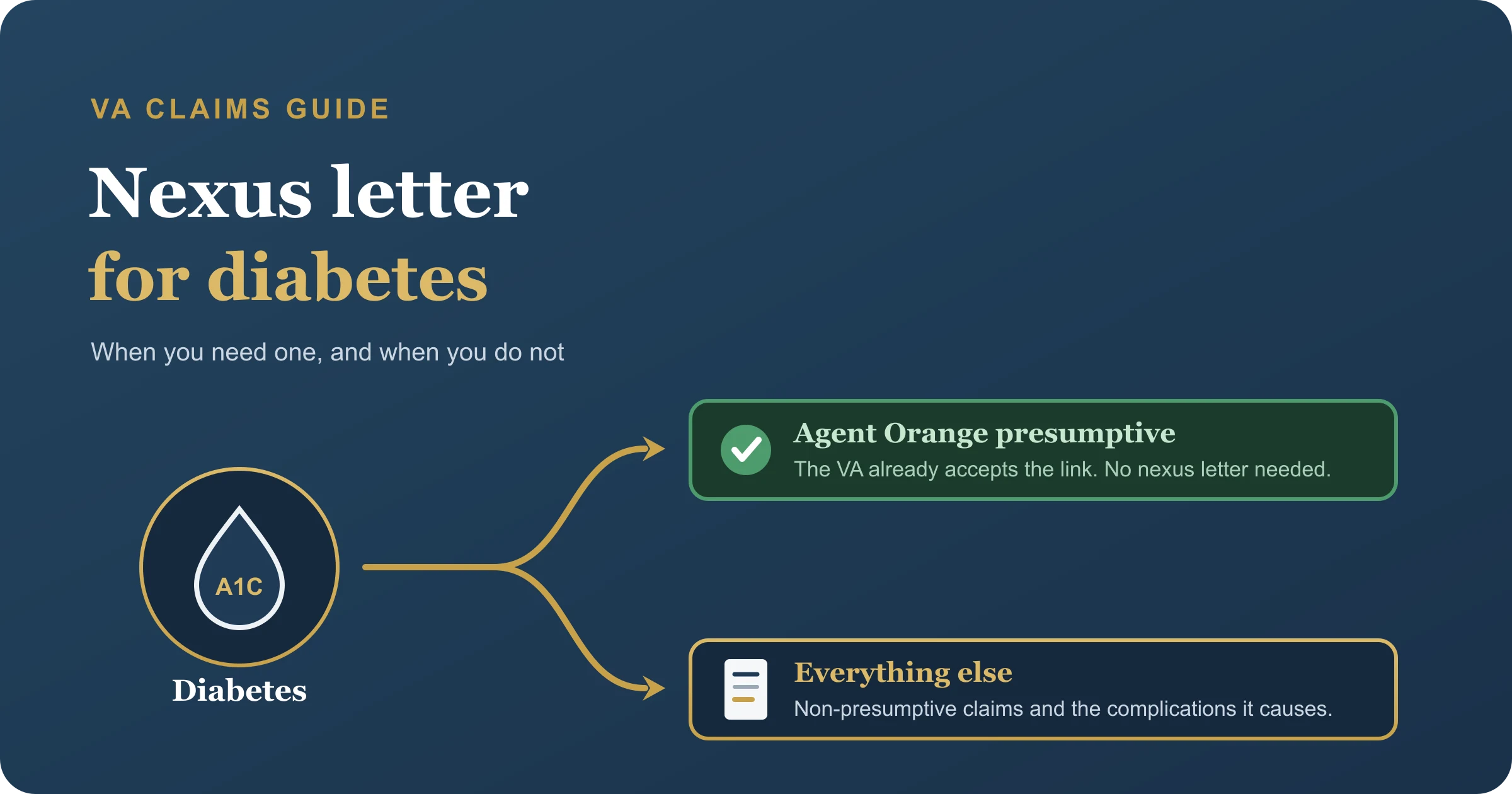
Many veterans with Type 2 diabetes do not need a nexus letter at all. Type 2 diabetes is on the VA's Agent Orange presumptive list, so if you served where the VA recognizes herbicide exposure, it already accepts the link between your service and your diabetes. A nexus letter earns its keep somewhere else: on claims that fall outside the presumption, and on a complication that a VA examiner attributed to another cause.
We write nexus letters for a living, so it would be easy to tell you that you need one. Most pages on this topic do. Here is the straight version instead.
Start Here: Two Ways Diabetes Gets Connected Without a Nexus Letter
A nexus letter exists to supply a medical link the record does not already contain. When the VA presumes the link for you, that job is already done, and paying for an opinion adds nothing. Diabetes has two presumptive routes, and most veterans only hear about the first.

1. The Agent Orange and herbicide presumption
Type 2 diabetes appears on the VA's list of diseases presumptively associated with herbicide exposure, under 38 C.F.R. 3.309(e). The regulation names it as "Type 2 diabetes (also known as Type II diabetes mellitus or adult-onset diabetes)", and VA.gov lists "Diabetes mellitus type 2" among its Agent Orange presumptive conditions. Note the scope: this route is written for Type 2 specifically. If the VA accepts that you served in a qualifying location during a qualifying period, you do not have to prove how your service caused the diabetes. The presumption does it.
What decides eligibility is where and when you served, and that list has grown. The PACT Act expanded the recognized locations beyond Vietnam to places including Thailand, Laos, Cambodia, Guam, American Samoa, and Johnston Atoll, each with its own date ranges. Because those criteria change, check the current list on VA.gov rather than trusting any roster frozen on a page like this one.
If you qualify here, you need a diagnosis and proof of service location, not a nexus letter.
2. The chronic-disease presumption, which is easy to overlook
There is a second route that has nothing to do with Agent Orange. 38 C.F.R. 3.309(a) lists diabetes mellitus as a chronic disease. Under 38 C.F.R. 3.307(a)(3), a chronic disease that becomes manifest to a degree of 10 percent or more within one year of separation can be presumptively service-connected, even though nothing in your service records mentions it. There is a service threshold too: 38 C.F.R. 3.307(a)(1) requires 90 days or more of qualifying service.
Two details decide this route. It is not enough that the diabetes was diagnosed inside that first year; it has to have reached at least 10 percent under the rating schedule within that year. And the 90-day service requirement has to be met. If both hold, the presumption may carry the claim on its own.
Diabetes at 10 percent or more within a year of separation, with 90 days of qualifying service? Check this route before paying anyone for an opinion.
For the qualifying locations, date ranges, and the full presumptive condition list, see our guide to Agent Orange exposure, and confirm the current criteria on VA.gov before you file.
When You Do Need a Diabetes Nexus Letter
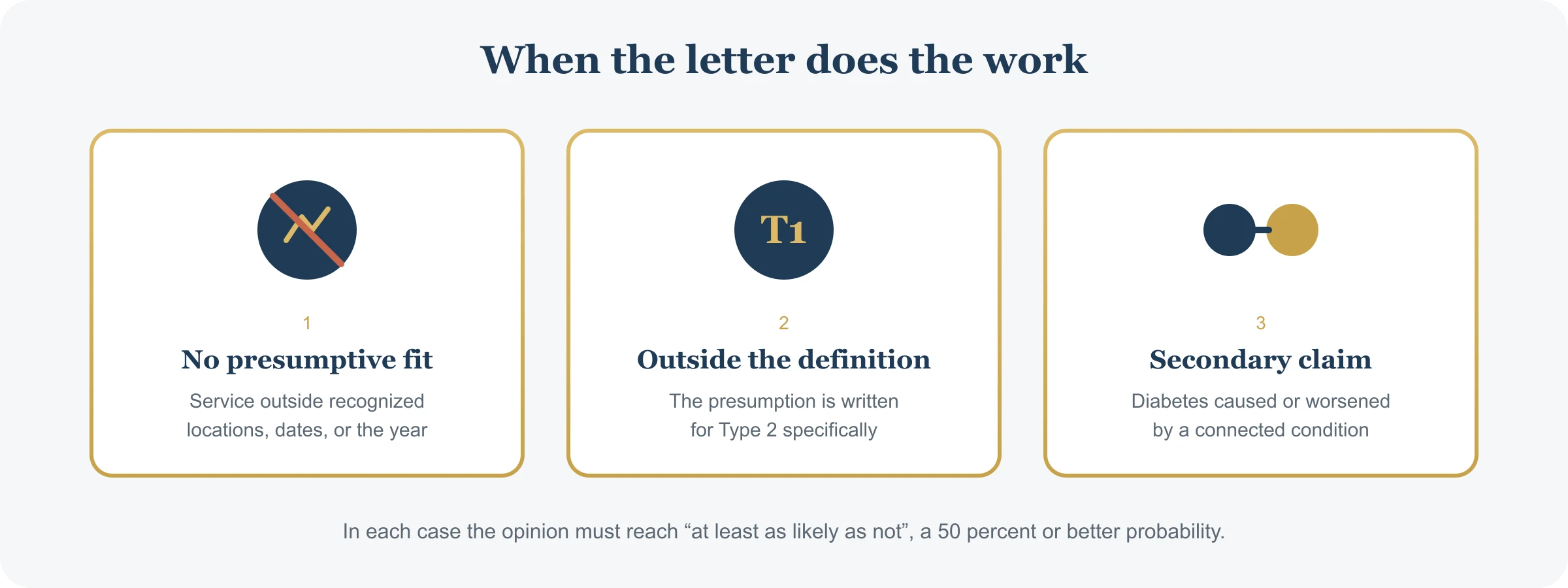
Outside those two routes, and unless diabetes was shown as such in service so that later manifestations are service connected under 38 C.F.R. 3.303(b), the claim needs medical evidence linking your diabetes to your service, and a medical opinion is one form of that evidence. Three situations where that comes up are set out below.
- 1
Your service does not fit a presumptive category
You believe an in-service exposure or event contributed to your diabetes, but you did not serve in a recognized herbicide location during a qualifying period, and you were not diagnosed within a year of separation. Here a physician has to reason from your actual records to a conclusion, because no presumption is available to lean on.
- 2
Your diagnosis falls outside the presumptive definitions
The herbicide presumption is written for Type 2 diabetes. If your diagnosis is Type 1, or the record is ambiguous about which you have, the presumption may not reach it, and the claim goes back to direct evidence and a medical opinion.
- 3
Your diabetes is secondary to a service-connected condition
Under 38 C.F.R. 3.310, a condition can be service-connected when a condition the VA already service-connected caused it, or made it measurably worse. If a service-connected condition or its long-term treatment contributed to your diabetes, that is a secondary claim, and it turns on a nexus opinion explaining the mechanism.
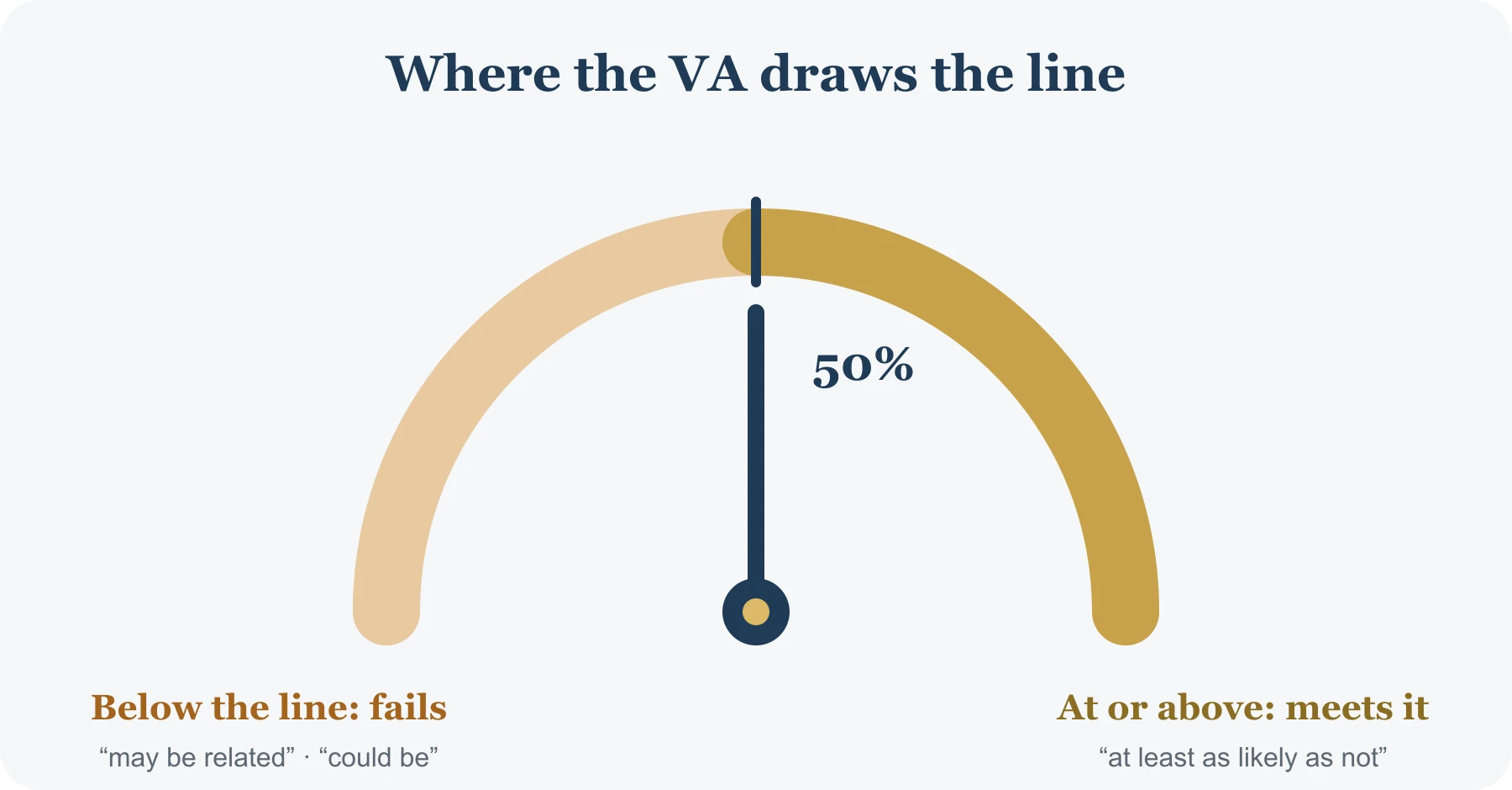
In all three, the opinion has to reach the VA's threshold: that the diabetes is at least as likely as not related to service or to the service-connected condition. That is a 50 percent or better probability, the benefit-of-the-doubt standard in 38 U.S.C. 5107(b), carried out in 38 C.F.R. 3.102.
Diabetes as the Anchor: Claiming the Complications
This is where nexus letters do their most valuable work on diabetes claims, and where the presumption cannot help you. Once diabetes is service-connected, whether by presumption or by evidence, the conditions it causes can be claimed under 38 C.F.R. 3.310, and each of those claims needs its own medical link. One procedural point that decides effective dates and is easy to miss: where the diabetes is ALREADY service-connected, M21-1 V.iii.11.2.c directs VA to treat a claim asserting a new diabetic complication as a claim for INCREASE rather than a new secondary service-connection claim, with effective dates under 38 CFR 3.400(o). Say what you are claiming and let VA characterize it, but know which rules apply.
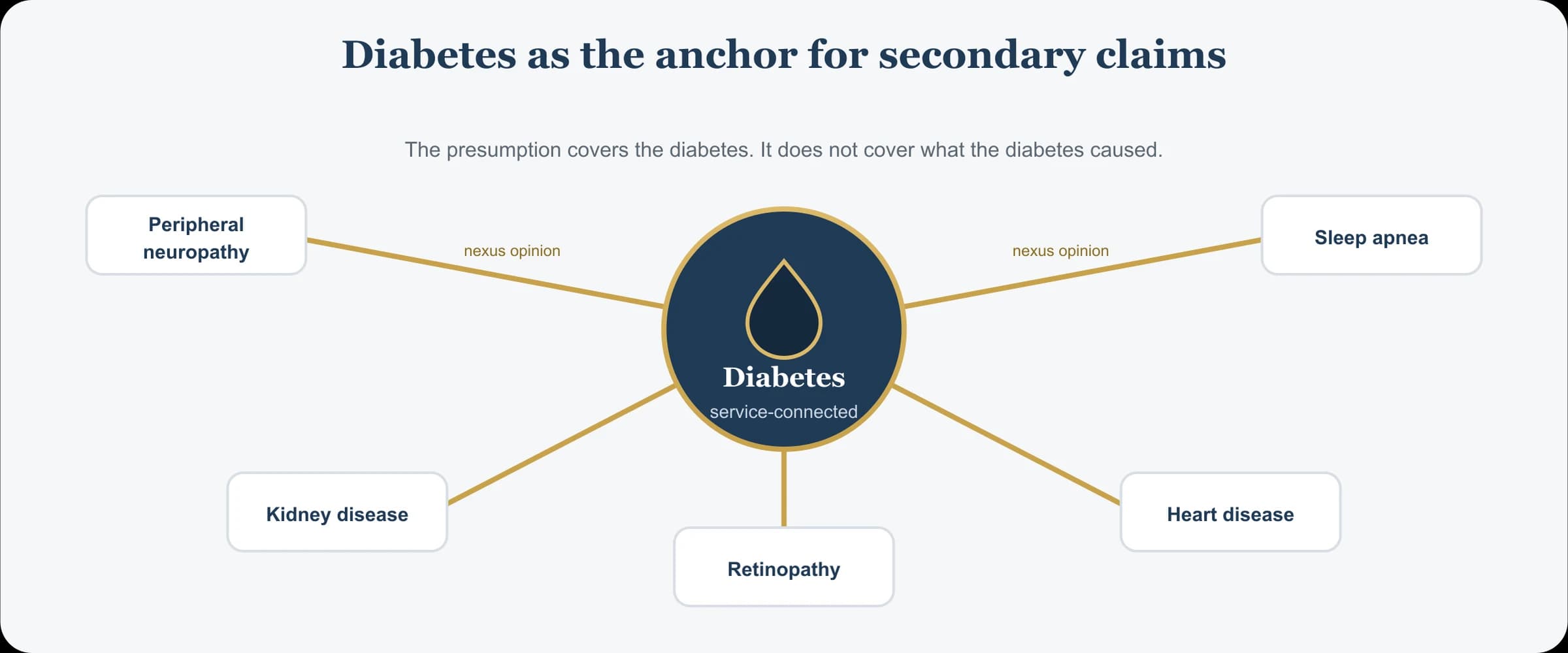
Peripheral neuropathy
Nerve damage in the feet, legs, or hands, which VA's adjudication manual calls a common complication of diabetes and one of the most common of its neurological complications. It is rated on the affected nerves rather than under the diabetes code. A neuropathy compensable under its own nerve code is evaluated separately and combined, unless it was used to reach a 100 percent diabetes rating. Under DC 7913 Note (1), one that is noncompensable, as several leg nerve codes are at the mild level, is treated as part of the diabetic process instead.
Kidney disease
Diabetic nephropathy is a well-documented consequence of long-standing diabetes and is evaluated under the genitourinary rules.
Diabetic retinopathy
Damage to the blood vessels of the retina, rated under DC 6040 on visual impairment or on documented treatment visits, whichever is higher. Under DC 7913 Note (1), a compensable retinopathy is evaluated separately unless it was used to support a 100 percent diabetes rating, and one rated 0 percent is part of the diabetic process.
Heart disease
Diabetes is an established cardiovascular risk factor. Ischemic heart disease has its own diagnostic code; as a complication of diabetes, under DC 7913 Note (1) it is evaluated separately when compensable unless it is part of the criteria used to support a 100 percent diabetes rating, and a noncompensable one is part of the diabetic process.
Sleep apnea
Can be claimed secondary to diabetes, argued through weight and metabolic pathways.
Erectile dysfunction
The one complication that always falls on the noncompensable side, and worth understanding before you file. It is rated 0 percent under DC 7522 whatever the findings, so under DC 7913 Note (1) it is evaluated as part of the diabetic process rather than separately, and a grant does not move your combined rating. The benefit it does unlock is special monthly compensation for loss of use of a creative organ.
The pattern is the same each time. Your diabetes is already service-connected, so the letter does not have to reargue that. It has to explain, from your records and the medical literature, why this particular complication is at least as likely as not caused or aggravated by the diabetes.
The general rules for these claims are in our guide to nexus letters for secondary conditions.
What a Diabetes Nexus Letter Must Include
The VA weighs a medical opinion on its reasoning, not on its letterhead. A letter that states a conclusion without showing the work is easy for an examiner to set aside. Five elements carry the weight.
The provider's credentials
Who is writing, their license and specialty, and why they are qualified to opine on diabetes or the complication at issue. An endocrinologist or internist carries natural weight here.
A stated records review
What the physician actually reviewed: service records, labs and A1C history, treatment notes, prior VA decisions, and the rating decision for the anchor condition on a secondary claim.
The diagnosis, with objective support
The diabetes diagnosis and the labs behind it, plus the treatment regimen. On a complication claim, the diagnosis of the complication too.
A reasoned medical rationale
The why. The letter walks from your documented history to the conclusion and cites supporting literature. On a secondary claim it names the mechanism rather than asserting a link.
The opinion in the VA's language
A clear statement that the condition is at least as likely as not related to service, or caused or aggravated by the service-connected condition.
Language that meets the bar
- “At least as likely as not caused or aggravated by the veteran's service-connected diabetes mellitus” Meets the 50 percent threshold and names the secondary path.
- “More likely than not related to the veteran's in-service herbicide exposure” Exceeds the minimum and identifies the pathway.
Language that fails
- “May be related to the veteran's diabetes” A possibility, not a probability. Below the standard.
- “Is consistent with a diabetic process” Describes a picture without stating a probability, so it carries little weight.
For the full element-by-element breakdown see our guide to nexus letter requirements, a finished sample in our annotated nexus letter example.
What a Diabetes Nexus Letter Costs
Physician-written nexus letters generally run from several hundred dollars to two thousand or more. The spread reflects whether the provider actually reviews your records, whether the letter cites literature, and the writer's credentials.
Patriot Path charges a flat $1,500, with a free first consultation. On a diabetes claim that consultation matters more than usual, because the honest answer is often that you do not need a letter. If your service fits a presumptive route, our physicians will tell you that rather than sell you an opinion you can win without.
See our flat-rate pricing and the full scope of our nexus letter services.
Common Mistakes on Diabetes Claims
These are the patterns our physicians see most often in the files veterans bring us. Every one is avoidable.
Buying a letter you did not need
The most expensive mistake on this particular condition. If your service fits a recognized herbicide location and period, the presumption already establishes the link. Check that first.
Claiming only the diabetes
The opposite error. Veterans get diabetes service-connected and stop, leaving neuropathy, kidney, eye, and heart complications unclaimed. Under DC 7913 Note (1), each one that is compensable in its own right is evaluated separately unless it is part of the criteria used to support a 100 percent diabetes rating; one that is noncompensable is treated as part of the diabetic process and still belongs in the record.
A letter with no mechanism
An opinion that asserts a connection without explaining how diabetes produced the complication reads as a guess. Naming the pathway and citing the literature is what makes it persuasive.
Hedged probability language
May be related, consistent with, could be connected. Anything that does not reach at least as likely as not fails the standard no matter how sound the reasoning around it.
No records behind the opinion
A letter that never says what was reviewed carries little weight. Bring labs, A1C history, treatment notes, and the rating decision for the anchor condition.
After Service Connection: How the VA Rates Diabetes
Once diabetes is service-connected, the VA rates it under 38 C.F.R. 4.119, Diagnostic Code 7913. The evaluation turns on how much management the condition requires, from oral medication or a restricted diet at the lower levels up through insulin, regulation of activities, and episodes requiring hospitalization at the higher ones. The cause of the diabetes does not change the rating, so a presumptive claim and an evidence-based claim are rated the same way.
Complications that are compensable in their own right are rated separately under their own diagnostic codes, unless they are part of the criteria used to support a 100 percent diabetes rating, which is why claiming them matters so much to your combined rating. DC 7913 Note (1) sets the other half of that rule: complications that are noncompensable are considered part of the diabetic process under DC 7913 instead, so they are service connected without adding a percentage. Erectile dysfunction is the clearest example, because DC 7522 carries a single flat 0 percent.
For the full rating breakdown, the evidence the VA wants, and how our physicians handle these claims, see our Type 2 diabetes and VA disability page.
Do You Need a Diabetes Nexus Letter?
Check your situation
0 of 5 checked
Check each one that is true for you. Your result updates as you go.
Nothing here points to a presumptive route yet. If you believe your service contributed to your diabetes but you do not fit a presumptive category, the claim will rest on direct evidence and a medical opinion. A free consultation is the cheapest way to find out which applies.
Get a free case review →This is general information, not medical or legal advice. The VA decides every claim on its own facts.
Find Out Whether You Actually Need One
The first consultation is free, and on a diabetes claim it often ends with us telling you the presumption already covers you. When a letter is the right move, our physicians write it from your records in the language the VA requires. The VA still makes the rating decision; what we control is the quality of the medical opinion.
Frequently Asked Questions
Do I need a nexus letter for a diabetes VA claim?
Often not. Type 2 diabetes is on the VA's Agent Orange presumptive list, so if you served in a recognized herbicide location during a qualifying period, the VA already accepts the connection and a nexus letter adds little. You need one when your service does not fit a presumptive route, when your diagnosis falls outside the presumptive definitions, or when you are claiming diabetes secondary to another service-connected condition.
Is diabetes an Agent Orange presumptive condition?
Type 2 diabetes is. 38 CFR 3.309(e) names Type 2 diabetes, also known as Type II diabetes mellitus or adult-onset diabetes, among the diseases presumptively associated with herbicide exposure, and VA.gov lists diabetes mellitus type 2 among its Agent Orange presumptive conditions. The regulation is written for Type 2 specifically. Eligibility also depends on where and when you served, and the PACT Act expanded those locations, so confirm the current criteria on VA.gov.
Can diabetes be service-connected without Agent Orange?
Yes, by two other routes. Diabetes mellitus is listed as a chronic disease in 38 CFR 3.309(a), so under 38 CFR 3.307(a)(3) it can be presumptively service-connected if it became manifest to a degree of 10 percent or more within one year of separation, for a veteran with 90 days or more of qualifying service under 38 CFR 3.307(a)(1). Outside that, diabetes can be service-connected on direct evidence with a medical opinion, or as secondary to an already service-connected condition under 38 CFR 3.310.
What conditions can I claim secondary to diabetes?
Complications a veteran may claim include peripheral neuropathy, kidney disease, diabetic retinopathy, heart disease, sleep apnea, and erectile dysfunction. Each needs medical evidence, from a VA examination or a private opinion, linking it to your service-connected diabetes. Where a complication is compensable in its own right it is rated under its own diagnostic code and combined with your other ratings under 38 CFR 4.25, unless it is part of the criteria used to support a 100 percent diabetes rating. Where it is not, DC 7913 Note (1) treats it as part of the diabetic process, so it is service connected without changing the percentage. Erectile dysfunction falls on that second side of the line, and the benefit that follows it is special monthly compensation rather than a higher rating.
Do I still need a nexus letter for complications if my diabetes is presumptive?
Not always. The presumption covers the diabetes itself, not what it caused, so each complication still needs medical evidence showing it is at least as likely as not caused or aggravated by the diabetes. VA's own examination can supply that evidence: its manual (M21-1 V.iii.11.1.g) requires the diabetes examination to address all diabetic complications present, and an examination that misses one must be returned as insufficient. A private nexus letter earns its place when VA's examiner attributes the complication to something else, when the evidence is otherwise against you, or when the diabetes itself is not yet service connected. If the examination simply never addressed the complication, raise that with VA first.
What VA rating does diabetes get?
Diabetes is rated under 38 CFR 4.119, Diagnostic Code 7913. The level turns on how much management the condition requires, from oral medication or a restricted diet at the lower levels through insulin, regulation of activities, and episodes requiring hospitalization at the higher ones. The cause does not change the rating. Note (1) to DC 7913 then sets two limits on rating complications separately: a complication that is compensable in its own right is evaluated separately unless it is part of the criteria supporting a 100 percent evaluation, and a complication that is noncompensable is treated as part of the diabetic process under DC 7913 rather than separately.
Who should write a diabetes nexus letter?
A licensed physician who can speak to the condition and will actually review your records. An endocrinologist or internist carries natural weight on diabetes, and on a complication claim a specialist in that system helps. Under VHA Directive 1134 your VA provider must assist when you ask and may give a causality opinion, though that policy notes its providers often lack access to military records, which is one reason veterans often seek an independent opinion as well.
What does a diabetes nexus letter cost?
Market prices generally run from several hundred dollars to two thousand or more depending on the records review and the credentials behind it. Patriot Path charges a flat $1,500 with a free first consultation, and on diabetes claims our physicians will tell you honestly when a presumptive route means you do not need a letter at all.
Related guides
- Type 2 diabetes and VA disabilityRatings under DC 7913, the presumptive path, and our letter service.
- Agent Orange exposureQualifying locations and dates, and the presumptive condition list.
- Peripheral neuropathyEvery nerve code in the rating schedule, whatever caused the damage.
- Peripheral neuropathy secondary to diabetesWhich nerve codes pay 10 percent at the mild level and which pay 0, and when a letter helps.
- Sleep apnea secondary to diabetesA worked secondary claim with diabetes as the anchor.
- Erectile dysfunction secondary to diabetesThe complication VA does not pay a percentage for, and where the money actually comes from.
- Diabetic retinopathy secondary to diabetesHow treatment visits, not screening exams, count toward the eye rating, and when a 0 percent retinopathy is part of the diabetic process.
- Why you need a nexus letter for a secondary conditionThe general guide to secondary VA claims.
- What a nexus letter must includeThe elements the VA looks for in any nexus letter.
- Nexus letter exampleA full annotated sample letter, section by section.
- Who can write a nexus letterWhich providers the VA takes seriously.
Citations & References
- 38 CFR 3.309, Disease subject to presumptive service connection, including the herbicide-exposure list and chronic diseases (eCFR) https://www.ecfr.gov/current/title-38/part-3/section-3.309
- 38 CFR 3.307, Presumptive service connection, including the chronic-disease and herbicide-exposure provisions (eCFR) https://www.ecfr.gov/current/title-38/part-3/section-3.307
- 38 CFR 3.310, Disabilities that are proximately due to, or aggravated by, service-connected disease or injury (eCFR) https://www.ecfr.gov/current/title-38/part-3/section-3.310
- 38 CFR 4.119, Schedule of ratings, endocrine system, including DC 7913 diabetes mellitus (eCFR) https://www.ecfr.gov/current/title-38/part-4/section-4.119
- 38 CFR 3.102, Reasonable doubt (eCFR) https://www.ecfr.gov/current/title-38/section-3.102
- 38 U.S.C. 5107, Claimant responsibility and benefit of the doubt (Cornell LII) https://www.law.cornell.edu/uscode/text/38/5107
- Agent Orange exposure and VA disability benefits, including presumptive conditions and qualifying locations (VA.gov) https://www.va.gov/disability/eligibility/hazardous-materials-exposure/agent-orange/
- VA disability, evidence needed to support your claim (VA.gov) https://www.va.gov/disability/how-to-file-claim/evidence-needed/