
Secondary claim guide
Peripheral Neuropathy Secondary to Diabetes: The Nerve Decides the Rating
Medically reviewed by the Patriot Path Medical Team
Licensed MD reviewers • Last updated:
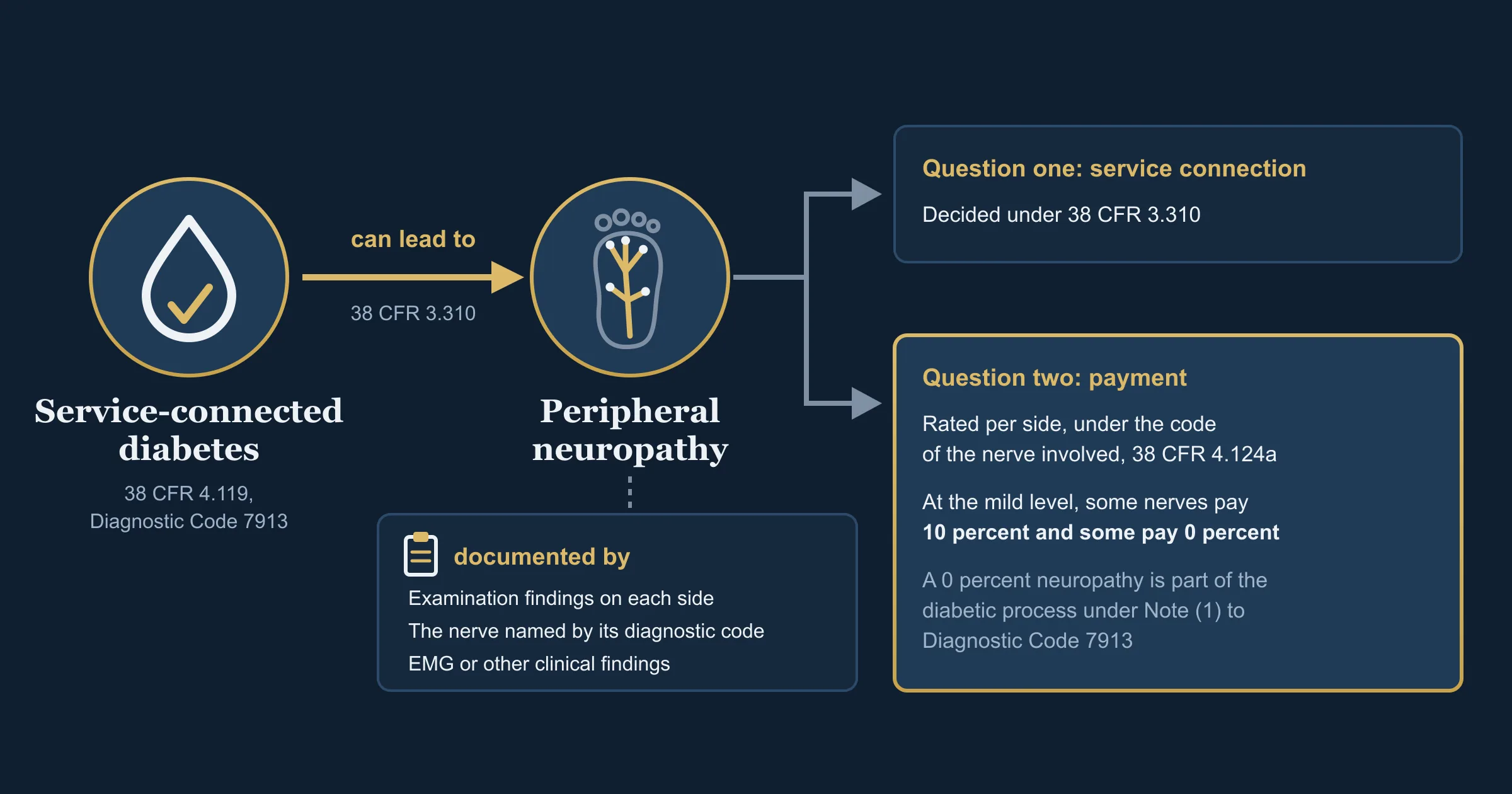
Peripheral neuropathy caused by service-connected diabetes can be service connected, and VA's own manual works through that exact pairing. Whether it pays is a separate question. At the mild level, some leg nerve codes pay 10 percent and others pay 0, and a 0 percent neuropathy is folded into the diabetes rating.
Two more things belong up front. If your diabetes is already service connected, VA processes a new neuropathy as a claim for increase on the diabetes, not as a fresh secondary claim. And if a VA examination has already documented the neuropathy and tied it to your diabetes, you may not need to buy a nexus letter at all. A letter earns its place in narrower cases, set out below.
An illustrative example
A veteran service connected for type 2 diabetes at 20 percent has burning and numbness across the tops of both feet. His diabetes examiner also completes the neuropathy questionnaire, names the superficial peroneal nerve on each side, and calls the involvement mild and wholly sensory. The decision includes the neuropathy with the diabetes as a noncompensable complication, and he goes looking for a letter saying diabetes caused it.
VA never disputed the cause. It accepted the link and rated the nerve it was told was involved, at a level where that nerve pays 0. The open questions concern the record: which nerve the documented findings follow, whether his treating records agree, and whether every finding reached the file. A letter restating causation would answer a question no one asked.
An illustrative composite written to show how the rating rules work. It is not a client, not a case result, and not a prediction about any claim.
Is Peripheral Neuropathy Secondary to Diabetes Service Connected?
It can be, and of the questions on this page it is the one least likely to be the problem. The rule is 38 CFR 3.310(a): "disability which is proximately due to or the result of a service-connected disease or injury shall be service connected." The paragraph continues: "When service connection is thus established for a secondary condition, the secondary condition shall be considered a part of the original condition." For diabetes, the manual gives that sentence real consequences, as the filing lane below shows.
VA's adjudication manual treats diabetic neuropathy as a recognized complication, not a novel theory. Its endocrine chapter, M21-1 Part V, Subpart iii, Chapter 11, says: "One of the most common disabilities is peripheral neuropathy." That is a clinical statement about the disease, not a statement about how frequently veterans claim it or win.
The same chapter settles the premise with a worked rating example. Block 4.b describes a veteran whose diabetes is controlled by insulin, restricted diet and regulation of activities, and who also has "diabetic peripheral neuropathy compensable at 10 percent." The instruction: "Rate the diabetes mellitus at 40 percent and separately evaluate the compensable complication of diabetic peripheral neuropathy in accordance with the note under 38 CFR 4.119, DC 7913." The example names no nerve, no code and no side. Its lesson is narrower than it looks: a neuropathy that is compensable in its own right gets its own evaluation beside the diabetes. Whether yours is compensable is the rest of this page.
The one precondition a letter cannot supply
The diabetes has to be service connected, or be granted in the same decision. In Citation Nr A25052623 (2025) the Board denied diabetes and then disposed of the neuropathy in both legs in one sentence: "As the Board herein denies service connection for diabetes mellitus, however, secondary service connection is not available, and the Veteran has not raised any other theory of service connection." Like every Board decision on this page, it binds only its own case under 38 CFR 20.1303. If your diabetes is not yet granted, start with the lane section below and our guide to nexus letters for diabetes.
How Does VA Rate Diabetic Peripheral Neuropathy?
Not as one condition called neuropathy. The diabetes code, DC 7913, holds no neuropathy criteria; the word appears zero times in 38 CFR 4.119. The nerves are rated under 38 CFR 4.124a, the schedule for diseases of the peripheral nerves, and four rules shape every result.
- 1Every nerve has its own code and ladder38 CFR 4.124a, 4.120, 4.123 and 4.124Each nerve has a code and a scale from mild through moderate to severe incomplete paralysis, then complete; among the leg nerves, only the sciatic has a moderately severe step. 38 CFR 4.120 points raters to "the site and character of the injury, the relative impairment in motor function, trophic changes, or sensory disturbances." Neuritis and neuralgia codes borrow the same scale, capped by 4.123 and 4.124.
- 2Each side is its own evaluation38 CFR 4.124a"The ratings for the peripheral nerves are for unilateral involvement; when bilateral, combine with application of the bilateral factor." A left foot and a right foot are two evaluations. The section on both feet covers the factor.
- 3Sensory-only involvement has a ceiling38 CFR 4.124a; M21-1 V.iii.12.A.2.a to 2.c"When the involvement is wholly sensory, the rating should be for the mild, or at most, the moderate degree." Numbness, tingling, burning and lost feeling are sensory; weakness, reflex changes and muscle wasting are not. The manual restates the rule at Part V, Subpart iii, Chapter 12, Section A, Block 2.a, and Block 2.b draws the line: mild fits symptoms that are "recurrent but not continuous", of lower grade, or over a smaller area; moderate is kept for "the most significant and disabling cases of sensory-only involvement". Block 2.b then adds a limit: the rule "does not mean that if there is any impairment that is non-sensory (or involves a non-sensory component) such as a reflex abnormality, weakness, or muscle atrophy, the disability must be evaluated as greater than moderate." Block 2.c adds that "A very minimal reflex or motor abnormality potentially could also be consistent with mild incomplete paralysis."
- 4Mild is the floor once a diagnosis existsM21-1 V.iii.12.A.2.cBlock 2.c calls mild "the lowest level of evaluation for each nerve", the default for symptoms "however slight, as long as they were sufficient to support a diagnosis". A diagnosis gets a nerve to mild. Whether mild pays depends on the nerve, which is the next section.
The rater, not the examiner, picks the level
Block 2.d changes how to read an examination report: "The rating activity, not the examining medical professional, determines whether the overall evidentiary record shows the severity of the condition meets the criteria for a classification of mild, moderate, moderately severe, or severe." Its two examples run in both directions. In the first, an examiner calls the disability mild while the DBQ records muscle weakness, atrophy and diminished reflexes, so the complete record "warrants a higher evaluation". In the second, an examiner who calls wholly sensory findings severe produces a rating no higher than moderate.
Neither an examiner's adjective nor a private physician's is the rating; the rater reads the recorded findings. A25083201, in the Board section, shows the Board applying Block 2.b's mild-versus-moderate line to sensory-predominant arm neuropathy; like every Board decision here, it is non-precedential under 38 CFR 20.1303.
Every nerve code in the schedule, whatever caused the damage, is laid out on our peripheral neuropathy condition page.
Which Nerves Pay 10 Percent at Mild, and Which Pay 0?
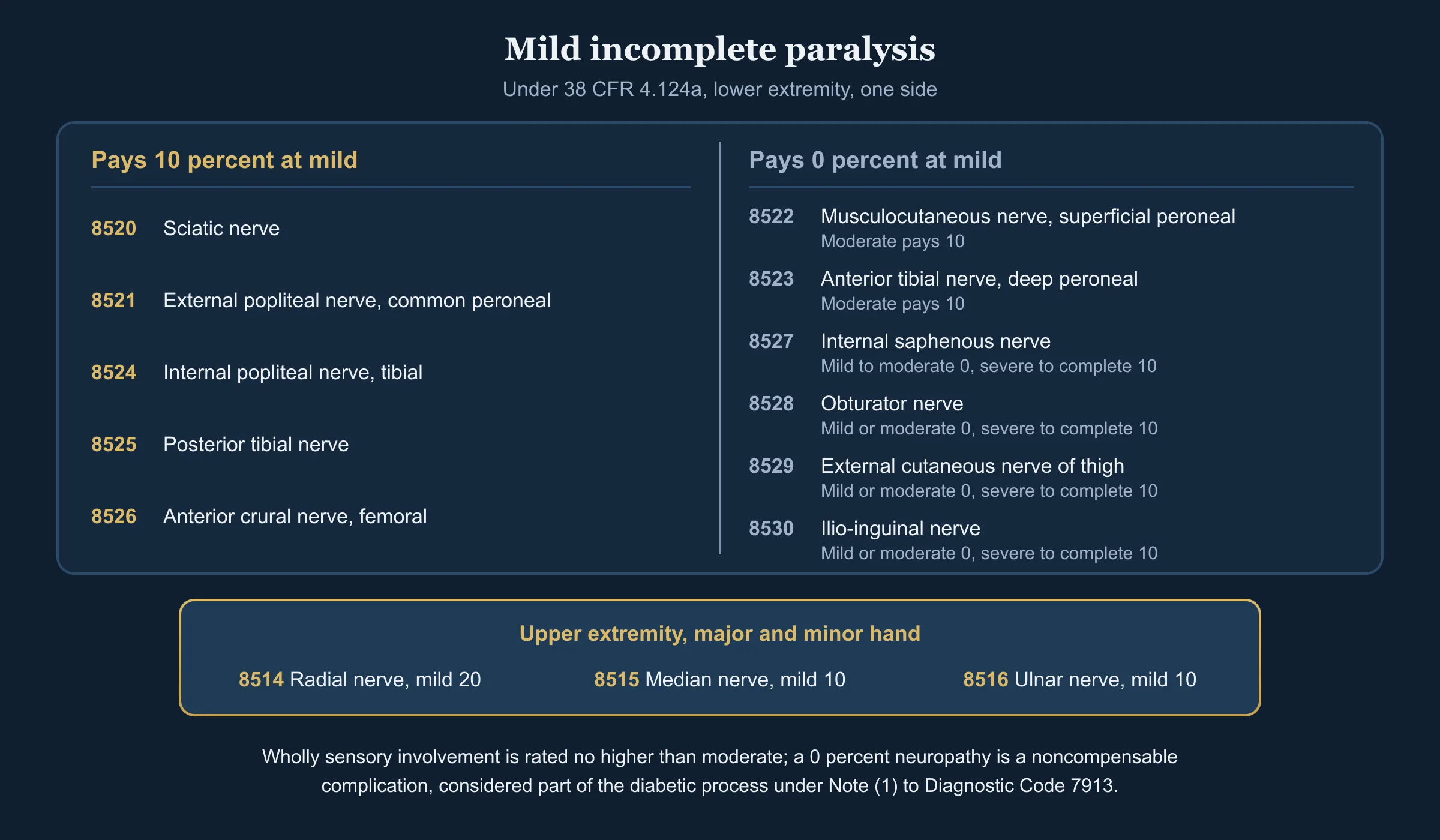
This is the table the rest of the page turns on: the leg nerve codes in 38 CFR 4.124a, one side at a time, read cell by cell from the regulation. Look at the mild column. Five codes pay 10 percent there. Six pay nothing.
Lower extremity, one side
| Code | Nerve, as 4.124a names it | Mild | Moderate | Moderately severe | Severe | Complete |
|---|---|---|---|---|---|---|
| 8520 | Sciatic nerve | 10 | 20 | 40 | 60 | 80 |
| 8521 | External popliteal nerve (common peroneal) | 10 | 20 | none | 30 | 40 |
| 8522 | Musculocutaneous nerve (superficial peroneal) | 0 | 10 | none | 20 | 30 |
| 8523 | Anterior tibial nerve (deep peroneal) | 0 | 10 | none | 20 | 30 |
| 8524 | Internal popliteal nerve (tibial) | 10 | 20 | none | 30 | 40 |
| 8525 | Posterior tibial nerve | 10 | 10 | none | 20 | 30 |
| 8526 | Anterior crural nerve (femoral) | 10 | 20 | none | 30 | 40 |
| 8527 | Internal saphenous nerve | 0 (mild to moderate) | 0 (mild to moderate) | none | 10 (severe to complete) | 10 (severe to complete) |
| 8528 | Obturator nerve | 0 (mild or moderate) | 0 (mild or moderate) | none | 10 (severe to complete) | 10 (severe to complete) |
| 8529 | External cutaneous nerve of thigh | 0 (mild or moderate) | 0 (mild or moderate) | none | 10 (severe to complete) | 10 (severe to complete) |
| 8530 | Ilio-inguinal nerve | 0 (mild or moderate) | 0 (mild or moderate) | none | 10 (severe to complete) | 10 (severe to complete) |
Upper extremity, one side (major hand / minor hand)
| Code | Nerve, as 4.124a names it | Mild | Moderate | Severe | Complete |
|---|---|---|---|---|---|
| 8514 | The musculospiral nerve (radial nerve) | 20 / 20 | 30 / 20 | 50 / 40 | 70 / 60 |
| 8515 | The median nerve | 10 / 10 | 30 / 20 | 50 / 40 | 70 / 60 |
| 8516 | The ulnar nerve | 10 / 10 | 30 / 20 | 40 / 30 | 60 / 50 |
Major means the dominant hand. Under 38 CFR 4.69 handedness is determined by the evidence of record or by testing on VA examination, and only one hand can be dominant.
Read the mild column twice. First, whether mild pays at all depends on the nerve. Under 8522 and 8523, moderate pays 10; under 8527 through 8530, mild and moderate share one row at 0 and only severe to complete pays, at 10.
Second, add the sensory ceiling. Wholly sensory involvement tops out at moderate, which caps it at 20 percent under 8520, 8521, 8524 and 8526, at 10 percent under 8522, 8523 and 8525, and at 0 under 8527 through 8530. That is arithmetic from the regulation's text, not a forecast for anyone's claim. In the arms, mild pays 10 percent under the median and ulnar codes and 20 under the radial code, on either hand.
What 0 percent means: the fold-in under Note (1)
A neuropathy on a 0 percent step has not been denied. It is a noncompensable complication, and Note (1) to DC 7913 in 38 CFR 4.119 says what happens to it: "Evaluate compensable complications of diabetes separately unless they are part of the criteria used to support a 100-percent evaluation. Noncompensable complications are considered part of the diabetic process under DC 7913." The manual's Example 1, at Part V, Subpart iii, Chapter 11, Block 4.a, tells raters to "Include the noncompensable complications under 38 CFR 4.119, DC 7913."
So a 0 percent neuropathy produces no separate percentage of its own. A compensable one is evaluated separately, subject to the exception in Note (1)'s first sentence. Whether a noncompensable neuropathy can still affect the diabetes rating depends on the 60 percent row, set out next.
Our guide to erectile dysfunction secondary to diabetes, another complication of diabetes, reads Note (1) at length.
Where a 0 percent neuropathy can still matter
The 60 percent row of DC 7913 requires one or more daily injections of insulin, restricted diet and regulation of activities, with episodes of ketoacidosis or hypoglycemic reactions requiring one or two hospitalizations per year or twice a month visits to a diabetic care provider, "plus complications that would not be compensable if separately evaluated." For a veteran who already meets every other element, a documented noncompensable neuropathy can supply the last one. Example 1 shuts the opposite reading: "Do not evaluate the diabetes mellitus at 60 percent simply because noncompensable complications are present."
The 100 percent row runs the other way. Beyond its own treatment and episode criteria it requires "either progressive loss of weight and strength or complications that would be compensable if separately evaluated." A compensable neuropathy used to reach 100 percent is not also evaluated separately; the manual's Block 4.c note gives the converse: "If compensable complications are not considered in reaching the 100- percent evaluation, they may be separately evaluated."
The full ladder of diabetes ratings is on our type 2 diabetes condition page.
Why Does the Examiner Have to Name the Nerve?
Because the code decides the pay, and the code follows the nerve. M21-1 Part V, Subpart iii, Chapter 12, Section A, Block 2.g puts this language in every peripheral nerve examination request: "Examiner: Please identify the specific nerve(s) affected. If you are unable to identify the specific nerve(s), please provide a rationale in the Remarks section." The block then tells the rater what to do with the answer.
The examiner names the nerve, and nothing conflicts
VA evaluates "the specific nerve under the appropriate DC."
The records conflict, but the nerves named sit in the same branch
VA evaluates "the nerve that is most beneficial to the Veteran as long as the DC supports the symptoms."
The nerves named sit in different branches, but the symptoms are not clearly tied to one nerve
VA evaluates "all symptoms shown in the medical evidence for the individual nerve(s) in the associated nerve branches."
The examiner cannot name the nerve, and nothing else documents it
VA rates arm symptoms under DC 8514, the radial nerve, and leg symptoms under DC 8521, the common peroneal nerve.
Set those defaults against the table: 8521 pays 10 percent at mild and 8514 pays 20. A record that names a nerve moves the result, because VA then rates that nerve, and some nerves pay 0 at mild. That does not make vagueness useful: an examiner who cannot name the nerve owes a rationale, and Block 2.h leaves it to the rater "to determine if the examination was sufficient to confirm the question and extent of peripheral nerve involvement." The record worth having is an accurate one, and the second row is why your treating records matter.
When one leg can carry more than one evaluation
Block 2.e sorts the leg nerves into five branches: sciatic (the sciatic, common peroneal, superficial peroneal, deep peroneal, tibial and posterior tibial nerves), femoral (the femoral and internal saphenous nerves), and the obturator, the external cutaneous nerve of the thigh and the ilio-inguinal, each on its own. Block 2.f allows separate leg evaluations for symptoms that "are separate and distinct, do not overlap, and are attributed to different lower extremity nerves", which means different branches. Within one branch, separate evaluations are "not warranted as this would constitute pyramiding." The manual's examples show both: 30 percent under DC 8521 plus 10 under DC 8526 across two branches, but a single 30 under DC 8521 for common peroneal and tibial involvement within the sciatic branch.
The arms differ. A note to Block 2.c says "Separate evaluations may not be assigned when evaluating an upper extremity peripheral nerve disability", pointing to the 4.124a note that combined nerve injuries "should be rated by reference to the major involvement, or if sufficient in extent, consider radicular group ratings." Both concern several nerves within one arm, not left against right, which the unilateral rule governs. And under Block 2.i, for nerve disabilities without a musculoskeletal injury, "such as diabetic neuropathy, the amputation rule does not apply."
Here a physician's opinion adds clinical value beyond causation: identifying, from the findings and any testing, which nerve and which branch the symptoms follow on each side.
What Happens When Both Feet or Both Hands Are Affected?
Each side is evaluated, then the two are combined with the bilateral factor in 38 CFR 4.26: the right and left ratings "will be combined as usual, and 10 percent of this value will be added (i.e., not combined) before proceeding with further combinations, or converting to degree of disability." Under 4.26(a), arms and legs mean the whole limb.
Using only what the regulations print: two 10 percent evaluations combine to 19 on the table in 38 CFR 4.25, whose caption reads "10 combined with 10 is 19", and 10 percent of 19 is 1.9, added rather than combined. 4.26 does not say how that figure is rounded, but its worked example treats two bilateral 10s as 21 and reaches 70 percent overall with a 60 and a 20. That is method, not forecast.
The factor needs a paying evaluation on each side
4.26(c): the factor "is not applicable unless there is partial disability of compensable degree in each of 2 paired extremities, or paired skeletal muscles." A left foot at 10 percent and a right foot at 0 is not a compensable pair. VA's manual agrees at Part V, Subpart iv, Chapter 1, Section C, Block 4.b: "The bilateral factor only applies when there are qualifying disabilities of the left and right sides." The nerve named on each side decides money here too.
Since April 16, 2023, 4.26(d) covers one situation in the veteran's favor: where the combined evaluation "is lower than what could be achieved by not including one or more bilateral disabilities in the bilateral factor calculation", those disabilities are combined separately "to achieve the combined evaluation most favorable to the veteran." Older explanations predate it.
An honest caveat. Neither 4.26 nor that manual block mentions neuropathy, and VA's endocrine and neurological chapters never use the word bilateral. Applying the factor to diabetic neuropathy is our reading of a general rule covering "compensable disabilities affecting the use of" both legs, not a sentence VA has written about diabetes. In A26009547 (non-precedential under 38 CFR 20.1303) each of the four limbs was its own issue.
Already Service Connected for Diabetes? It Is a Claim for Increase
Where your diabetes is already service connected, VA's manual does not treat a newly claimed neuropathy as a fresh secondary claim. M21-1 Part V, Subpart iii, Chapter 11, Block 2.c reasons that diabetic complications represent "medical progression or worsening of diabetes" and concludes that "a claim asserting new complications of SC diabetes is a claim for increase rather than a claim for secondary SC." Effective dates follow the increase rules in 38 CFR 3.400(o), and a note at Block 1.j adds that "Development of new diabetic complications is evidence of an ascertainable increase in the diabetic process."
Where the diabetes is not yet service connected, that block does not reach you. The diabetes is decided on its own evidence and the neuropathy, on a secondary theory, stands or falls with it: in A26009547 the neuropathy followed the diabetes grant, and in A25052623 it fell with the diabetes denial (both described in the Board section, and both non-precedential under 38 CFR 20.1303). For a first diabetes grant, Block 1.i sets the effective date of any separate evaluation of complications at, generally, the later of the date of claim or the date entitlement arose, and flags 38 CFR 3.114 and the Nehmer stipulation for a possible earlier date.
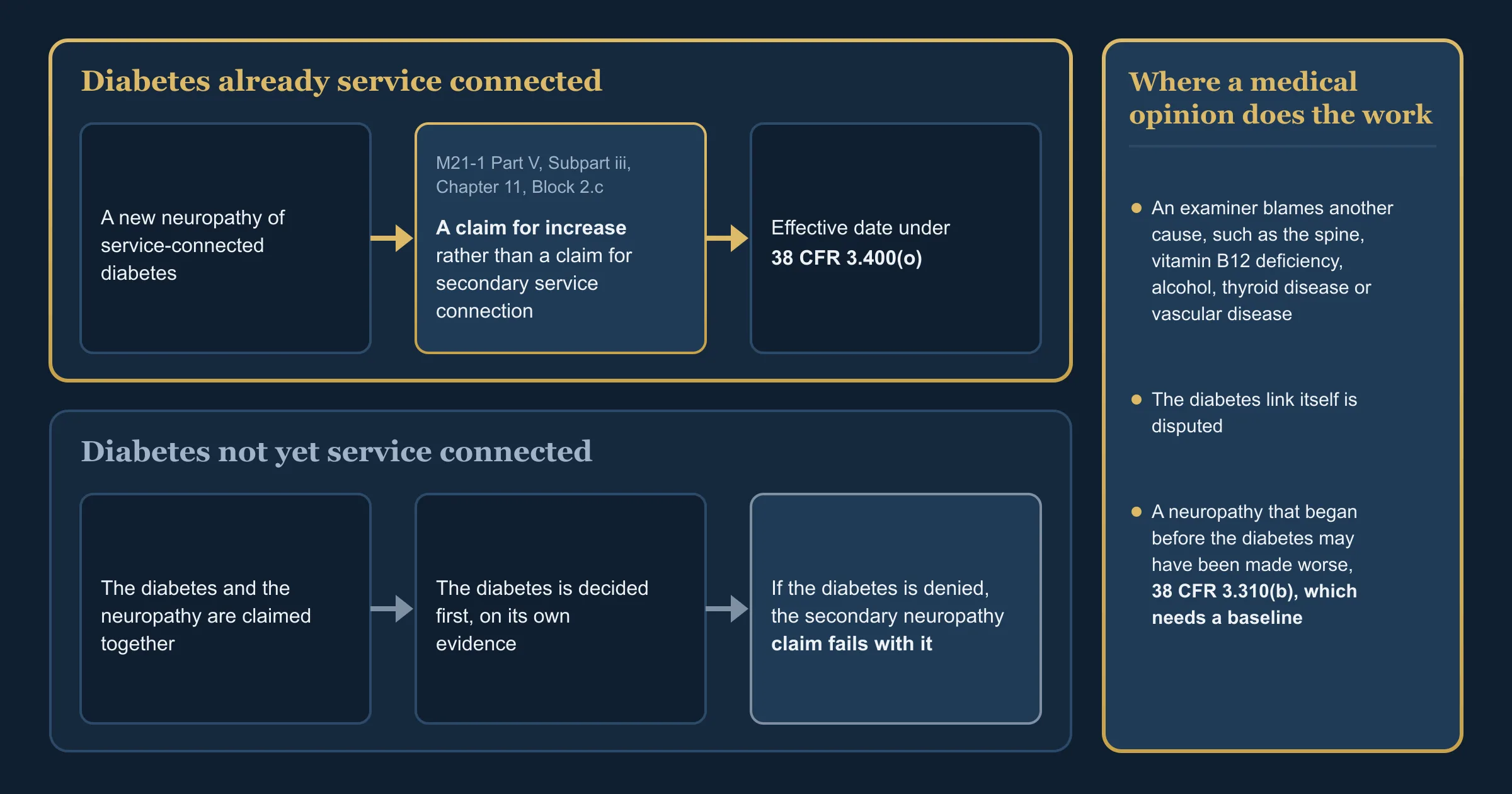
The reasoning behind this lane and its effective-date rules are set out at length in our guide to erectile dysfunction secondary to diabetes. If your diabetes is already granted, do not assume a brand-new secondary claim is the right frame.
When Do You Not Need to Buy a Nexus Letter?
We write nexus letters, and this section is here anyway. VA's examination process is built to find this complication.
The diabetes examination has to look for it
M21-1 V.iii.11.1.g
On a diabetes claim the manual directs VA to request the Diabetes Mellitus Disability Benefits Questionnaire, which "must address all diabetic complications present, to include completion of additional DBQs as appropriate". And: "If the examiner fails to address all diabetic complications and complete all necessary DBQs, the examination must be returned as insufficient."
VA's own example is this situation
M21-1 IV.i.3.C.1.g
The manual's chapter on insufficient examinations uses neuropathy as its example: a veteran examined for diabetes reports neuropathy symptoms, which "would trigger the examiner to also complete the Diabetic Sensory-Motor Peripheral Neuropathy Disability Benefits Questionnaire." When the examiner does not, the manual calls it "an insufficient examination" and directs a rework request.
VA is told to look past the claim form
M21-1 V.iii.11.1.f
Raters are to consider service connection "for expressly claimed or newly discovered, unclaimed complications", because "entitlement to any additional benefits based on complications would be considered within scope of the claim."
The Board record matches. In A26009547 the neuropathy link came from a November 2024 VA examiner, not a private physician. In A24086128 (2024) the Board granted neuropathy of both hands and both feet on a January 2023 VA examination recording "symptoms attributed to diabetic neuropathy", an August 2023 VA medical note, and statements from the veteran and his wife, with no private opinion. Both are non-precedential under 38 CFR 20.1303.
Read your file before you buy anything
If a VA examination documented the neuropathy, identified the nerves and linked them to the diabetes, and no other examiner blamed another cause, causation is answered, and a letter answering it again adds little. What is left, if anything, is the rating, and that turns on the recorded findings.
If your diabetes examination never addressed the neuropathy, the manual treats it as insufficient. Raise that with VA before treating it as a reason to pay for anything.
When Does a Nexus Letter Do Real Work?
When causation is actually disputed. Three situations produce that dispute, and VA's own manual names the first.
1. An examiner blames something other than the diabetes
Before conceding that a condition is a diabetic complication, Block 2.b of the endocrine chapter requires supporting medical evidence, and it uses neuropathy as its warning: lower-extremity symptoms "could represent the common complication diabetic peripheral neuropathy. However, they could also be due to another etiology such as a spinal injury, peripheral vascular disease or multiple sclerosis."
Clinicians agree. The American Diabetes Association's 2017 position statement says: "Diabetic neuropathy is a diagnosis of exclusion." Its differential table includes thyroid and kidney disease, vitamin B12 deficiency, alcohol, several named drugs, infections, and hereditary neuropathies. In the Rochester Diabetic Neuropathy Study, "Approximately 10% of diabetic patients had neurologic deficits attributable to nondiabetic causes."
The spine is not on the ADA's table, but a small study comparing mild lumbar spinal stenosis with diabetic polyneuropathy noted that in people with both "it may sometimes be difficult to separate signs and symptoms that could be attributed to either disease", and found electrophysiological testing helped tell them apart.
The opinion's value lies in working that differential out loud: each competing cause in the record, what the evidence shows about it (a B12 level, a thyroid panel, spine imaging, the distribution of findings, the order of events), and why the diabetic explanation is at least as likely as not.
Two Board decisions show the difference. In A25053568 a private treating physician's reasoned differential, together with supporting letters from VA treating physicians, the VA treatment records, lay statements and medical literature, outweighed negative VA opinions the Board found inadequate; in A25083201, with no private opinion in the file, the Board followed VA examinations that traced right-leg findings to the spine. Both are set out in the Board section and are non-precedential under 38 CFR 20.1303.
2. The diabetes link itself is disputed
Then the opinion that matters is about the diabetes, not the nerves, as the lane section explains. A26009547 in the Board section is the example (non-precedential under 38 CFR 20.1303).
3. The nerve problem came first
A neuropathy from another cause that predates the diabetes calls for an aggravation opinion. The next section covers it.
A question to raise with your physician, not a rule
In one long-term trial in the research section, of people with prediabetes, low or borderline-low B12 was more common with metformin than placebo; a separate VA registry study linked longer metformin use with more peripheral neuropathy but left open whether declining B12 explains it. Whether a neuropathy traced to metformin-related B12 deficiency counts as secondary to service-connected diabetes is not answered by any VA manual rule we found; it would rest on the general wording of 38 CFR 3.310. Ask a physician who has your lab results, and remember an examiner may cite B12 as a nondiabetic cause.
What If the Neuropathy Started Before the Diabetes?
Then the route is aggravation under 38 CFR 3.310(b): "Any increase in severity of a nonservice-connected disease or injury that is proximately due to or the result of a service-connected disease or injury, and not due to the natural progress of the nonservice-connected disease, will be service connected." That is a different fact pattern from the increase lane, which covers a new complication rather than an older condition the diabetes worsened.
Aggravation stands on a baseline: medical evidence created before the aggravation began, or the earliest medical evidence created afterward. VA's manual, updated May 1, 2026 to apply Spicer v. McDonough, also lets "any other credible evidence, including lay evidence" support it (Part V, Subpart ii, Chapter 2, Section D, Block 1.c), and says VA "will no longer consider natural progress of the NSC disability". Block 1.f is the hard edge: "if no baseline can be established, no aggravation can be demonstrated", and "Do not assume a baseline of 0 percent when a baseline cannot be established by the available evidence." Where a baseline exists, Block 1.g rates the difference between current and baseline levels, and Block 1.h grants at 0 percent where both fall on the same step.
Timing arguments cut both ways. In A24086128 a VA examiner reasoned that the "symptoms began in 2016 prior to the diagnosis of diabetes mellitus", yet on that record the Board found the evidence at least in equipoise on causation (non-precedential, 38 CFR 20.1303). If your records show nerve symptoms before a diabetes diagnosis, the opinion should answer causation and aggravation separately, and your earliest records are worth more than anything written today.
Does the Agent Orange Presumption Cover Diabetic Neuropathy?
Not a neuropathy that appears years later. 38 CFR 3.309(e) lists "Early-onset peripheral neuropathy", and 38 CFR 3.307(a)(6)(ii) requires it to have become "manifest to a degree of 10 percent or more within a year after the last date on which the veteran was exposed to an herbicide agent during active military, naval, or air service." For Vietnam service, 3.307(a)(6)(iii) makes the last presumed exposure the last day served there between January 9, 1962 and May 7, 1975.
VA's manual closes that door in terms. Part VIII, Subpart i, Chapter 1, Section C, Block 1.g keeps the one-year, 10 percent rule and says "Claims of SC for later-occurring onset of peripheral neuropathy can only be evaluated under other bases (for example, direct or secondary)." Block 1.f requires "a confirmed diagnosis of early-onset peripheral neuropathy", and Section B, Block 1.g lists chronic peripheral nervous system disorders, other than early-onset neuropathy, as having no positive association with herbicide exposure.
The secondary door is where diabetes comes in. Type 2 diabetes is itself on the 3.309(e) list, so a Vietnam veteran's diabetes can be granted on the presumption and a neuropathy that began decades later claimed as its complication. The chronic-disease presumption of 38 CFR 3.309(a) is a separate door this page does not cover.
In 23001867 (2023), a legacy appeal, the Board found the veteran "does not have early-onset peripheral neuropathy" because examiners found it late onset and not 10 percent disabling within a year of his last exposure, then granted on a direct theory after weighing a private note suggesting a B12 deficiency component. A VA examiner had found he did not have diabetes; the decision is cited only for the presumption line and is non-precedential under 38 CFR 20.1303.
Even the dioxin research has to account for diabetes: a study of Operation Ranch Hand veterans that found raised neuropathy risk in the high exposure group urged caution "until the relationship between pre-clinical diabetes mellitus and peripheral neuropathy is further evaluated".
What Evidence Moves a Diabetic Neuropathy Rating?
Once service connection is settled, the file needs findings a rater can place on the 4.124a ladder, nerve by nerve and side by side.
EMG, or enough clinical findings in its place
M21-1 V.iii.12.A.2.h
"Electromyography (EMG) results are required for evaluations of peripheral nerve disabilities unless there is a previous EMG test of record or the record contains sufficient clinical evidence to determine the extent of paralysis in the peripheral nerve." The block's note lists findings that may suffice: light touch sensation, deep tendon reflexes, certain median nerve signs, trophic changes, gait, muscle strength, and muscle atrophy.
Nerve conduction studies are not a VA requirement
M21-1 and 38 CFR 4.124a, term counts
The phrase nerve conduction appears zero times across the nine M21-1 articles read for this page, and 4.124a names neither EMG nor nerve conduction. The literature adds a caution: a 2016 review describes small-fiber neuropathy as diagnosed "in combination with normal nerve conduction", and a 2008 study noted that small fibres "cannot be investigated by routine electrophysiological tests". A normal result does not, by itself, rule out small-fiber disease.
The pattern the manual describes
M21-1 V.iii.11.2.h
Among the symptoms it lists, the endocrine chapter notes: "Findings are typically in a stocking-glove distribution." A pattern that departs from that is one reason an examiner looks for another cause.
Findings, stated rather than summarized
ADA 2017
The ADA's assessment includes a careful history, pinprick or temperature sensation, 128-Hz tuning fork vibration, and annual 10-g monofilament testing, which it calls "a useful clinical tool mainly for detecting more advanced neuropathy". Because the rater assigns the level, each test and result belongs in the record, for each side.
Complications that follow from it, and the examination itself
M21-1 V.iii.11.2.k and 11.1.h
The manual lists foot neuropathic ulcers, gait abnormalities and Charcot joints as related complications; any in your records belongs in the discussion. And on a claim limited to an increase in separately evaluated complications, missing the examination without good cause leads to denial unless other evidence suffices.
Tell every clinician and examiner what actually happens, fully and accurately, on good days and bad. The goal is a complete record of the condition as it is, not a choice of words.
What Does the Medical Research Show?
Research supports a physician's reasoning about one veteran; it cannot answer VA's question for him. Each finding is labelled for what it is.
Prevalence, from consensus and cohorts
The ADA's 2017 position statement, summarizing cited cohorts, says distal symmetric polyneuropathy may be present in at least 10 to 15 percent of people newly diagnosed with type 2 diabetes, rising to 50 percent after 10 years, and notes up to half may be asymptomatic. In the 1986 Rochester cohort, 45 percent of 278 people with type 2 diabetes had polyneuropathy but only 13 percent had symptomatic polyneuropathy. These civilian population figures do not show that any one veteran's neuropathy is diabetic.
Mechanism: plausible, not settled
The ADA describes oxidative and inflammatory stress damaging nerves in the setting of metabolic dysfunction, but says "the causes remain unknown". Reviews in 2012 and 2019 report that glucose control helps less in type 2 than in type 1 diabetes. An opinion presenting a settled mechanism overstates the science.
Diagnosis
A 2005 American Academy of Neurology case definition found symptoms alone relatively poor predictors and signs better, and that "The combination of neuropathic symptoms, signs, and electrodiagnostic findings provides the most accurate diagnosis of distal symmetric polyneuropathy." The ADA calls electrophysiological testing "rarely needed for diagnosis" unless features are atypical, the diagnosis unclear, or another cause suspected, and a 2009 practice parameter ranked blood glucose and serum B12 with metabolites among the highest-yield tests.
Metformin and vitamin B12: associations only
In the Diabetes Prevention Program Outcomes Study, of people with prediabetes, low or borderline-low B12 was more frequent with metformin than placebo at 5 years (19.1 versus 9.5 percent) and 13 years (20.3 versus 15.6 percent). A VA registry study of 210,004 veterans with diabetes, aged 50 and over, on long-term metformin found that longer metformin use went with higher adjusted odds of newly diagnosed peripheral neuropathy (1.57, 2.05 and 2.69 for successively longer use against a 6 to 18 month reference). Its adjustments did not include how long each veteran had had diabetes, which is itself a neuropathy risk factor, and the authors left open whether declining B12 explains it.
Veteran data, and what is missing
We found no study measuring how frequently veterans with diabetes have peripheral neuropathy, so we state no figure. A Seattle VA case-control study did link insensitivity to the 5.07 monofilament with foot ulceration (adjusted odds ratio 18.42, with a very wide interval of 3.83 to 88.47).
What this means for the opinion
The research supports what VA's manual already accepts, that neuropathy is a recognized diabetic complication, and the manual's other point, that other causes have to be excluded. It decides no individual claim. VA's standard is its own: under 38 CFR 3.102, where there is "an approximate balance of positive and negative evidence which does not satisfactorily prove or disprove the claim", the doubt is resolved in the claimant's favor.
What Should a Strong Opinion Contain?
Each element ties to a rule or decision earlier on this page. It is not a template, and no wording changes the standard VA applies.
- The diagnosis, with the findings behind itA named diagnosis and the examination and test findings that support it, since signs carry more weight than symptoms alone.
- The service-connected diabetes and its courseThe grant, its effective date, duration and treatment.
- Which nerve, which branch, which sideThe nerves the findings follow on each side, by nerve and, where the physician can say, by branch, so the rater can apply Blocks 2.f and 2.g.
- Sensory, motor, or bothReflex, strength, atrophy or trophic findings stated rather than labelled, because the rater assigns the level.
- The differential, worked throughThe other explanations the record raises, from the spine and vascular disease to B12, alcohol and thyroid disease, with the evidence on each: the reasoning the Board weighed, alongside the treating records, in A25053568 (non-precedential, 38 CFR 20.1303).
- The order of eventsWhen nerve symptoms began relative to the diabetes diagnosis, with causation and aggravation answered separately where the order is in doubt.
- Engagement with any negative VA opinionWhat the VA examiner concluded and why the author agrees or disagrees, with reasons.
- A medical probability, and nothing beyond itHow likely the link is, in medical terms, leaving service connection and the percentage to VA. VA weighs the whole record under 38 CFR 3.102; that standard does not depend on any document using particular words.
What we cannot do
We cannot supply a diagnosis your records lack, we will not write an opinion your records do not support, and we cannot predict a rating. We write physician medical opinions; we do not represent veterans or file claims.
The general elements VA looks for in any medical opinion are in our guide to what a nexus letter must include.
What Has the Board of Veterans' Appeals Decided?
We read six Board decisions in full, ORDER blocks included. They show the range, denials included, not a grant rate.
Board decisions are not precedent. Under 38 CFR 20.1303 a decision binds only the case it decided, and each of these six states that it "is not precedential and does not establish VA policies or interpretations of general applicability." Each entry is described only for the issue it decided.
Citation Nr A25053568 (2025)
Granted: service connection for left-hand peripheral neuropathy secondary to service-connected diabetes.
A private treating physician's letters explained why the hand neuropathy fit diabetic progression rather than ankylosing spondylitis or carpal tunnel syndrome, and the latest addressed the negative VA opinions, which the Board found inadequate for failing to "provide sufficient rationale". Letters from a VA rheumatologist and another VA physician, and the VA treatment records, supported the same conclusion; the Board weighed the evidence in combination.
Why it matters. A reasoned differential that answers the VA opinions, backed by the treating record, can carry the claim. The chain began in 2015; infer nothing about timing.
Non-precedential: binds only this case (38 CFR 20.1303).
Citation Nr A26009547 (2026)
Granted: diabetes on a direct basis, and peripheral neuropathy of each arm and each leg secondary to it, among other issues.
On the diabetes, the Board found an October 2025 private examiner's opinion "the most probative evidence of record" over a negative February 2025 VA examination, and noted that a September 2019 VA examiner had also linked the diabetes to service (that examiner was negative only on ulcerative colitis). On the neuropathy, a November 2024 VA examiner supplied the link for the arms, and the Board applied it to the legs as well.
Why it matters. The two-link chain: the private opinion, backed by a 2019 VA examiner, was on the diabetes, and the neuropathy followed the diabetes grant.
Non-precedential: binds only this case (38 CFR 20.1303).
Citation Nr A24086128 (2024)
Granted: peripheral neuropathy of both hands and both feet secondary to diabetes. Denied: a higher diabetes rating.
A July 2023 VA examiner pointed to cervical radiculopathy and carpal tunnel syndrome and wrote that the symptoms were "not consistent with the stock and gloves of diabetic neuropathy". Favorable VA evidence and lay statements, listed in the section on when you do not need a letter, stood on the other side, and the Board found the evidence "to at least be in equipoise".
Why it matters. VA's own records and lay evidence can be enough. Read your examination reports first.
Non-precedential: binds only this case (38 CFR 20.1303).
Citation Nr A25083201 (2025)
Denied: right-leg radiculopathy claimed as diabetic neuropathy. Denied: ratings above 10 percent (left arm) and 30 percent (right arm) for service-connected diabetic peripheral neuropathy.
An August 2023 examiner attributed all right-leg findings to radiculopathy, and the Board preferred that fuller examination to a 2022 neurology note. For each arm, rated under the median nerve code, the Board found the neuropathy "primarily manifest by sensory disturbances and pain" even though examiners had recorded reduced strength. It held the left arm "most analogous to mild incomplete paralysis" (a July 2022 examiner had attributed that arm's reduced grip and pinch strength to a nonservice-connected hand strain), and it left the right arm's 30 percent undisturbed as a favorable earlier finding.
Why it matters. The fuller examination decided cause, and the Board rated both arms as primarily sensory despite recorded strength findings.
Non-precedential: binds only this case (38 CFR 20.1303).
Citation Nr A25052623 (2025)
Denied: diabetes, and diabetic peripheral neuropathy of each leg.
Diabetes was diagnosed nearly 20 years after separation, and the only medical opinion, a May 2024 VA examination, was negative and found no diabetic neuropathy. With the diabetes denied, secondary service connection was unavailable.
Why it matters. The precondition. Confirm the diabetes grant, or its basis, first.
Non-precedential: binds only this case (38 CFR 20.1303).
Citation Nr 23001867 (2023)
Granted: peripheral neuropathy of both arms and both legs, on a direct basis tied to conceded herbicide exposure in Thailand.
The neuropathy was late onset, so the presumption was unavailable. A private neurologist's note suggesting a vitamin B12 deficiency component weighed against the claim, but the Board found the evidence in approximate balance and granted. A VA examiner had found the veteran did not have diabetes.
Why it matters. Cited only for the early-onset line and B12 as a competing cause; a legacy appeal, not a diabetes case.
Non-precedential: binds only this case (38 CFR 20.1303).
The favorable evidence came from private and VA treating physicians together in A25053568, and from VA examiners and records in A24086128 and on the neuropathy in A26009547. None shows that private or VA opinions win as a class; each turned on its own record.
Is There a Claim Here, and Does It Need a Letter?
Check your file
Tick what is true of your file today. The first two items decide whether there is a claim to bring. The rest are not a score; each is something a rater or physician will look for.
Nothing is ticked yet. A result appears here as you go.
Start With the Examination Already in Your File
A free consultation begins with your diabetes rating decision, any diabetes or nerve examination, and your treatment records. A clinician will tell you whether the open question is causation, the nerve, or nothing at all, and if a VA opinion already answers it, that is what we will say.
Frequently Asked Questions
Is peripheral neuropathy secondary to diabetes a VA disability?
It can be service connected under 38 CFR 3.310(a) once your diabetes is, and VA's manual gives a worked example of diabetes at 40 percent beside a separately evaluated neuropathy compensable at 10 percent. Whether yours pays depends on the nerve and the level; a 0 percent neuropathy is part of the diabetic process under Note (1) to DC 7913.
What is the VA rating for diabetic peripheral neuropathy?
There is no single rating. Each side is evaluated on its own under 38 CFR 4.124a, under the code of the nerve involved. In a leg, nerves in different branches can carry separate evaluations, but nerves in the same branch get one, and so do several nerves in one arm. At the mild level five leg nerve codes pay 10 percent while six pay 0; in the arms, mild pays 10 or 20 percent depending on the nerve. Wholly sensory involvement is capped at moderate. The table on this page sets out every code.
Why was my neuropathy rated 0 percent?
The nerve VA rated pays nothing at the level found. That is not a denial: the neuropathy is folded into the diabetes under Note (1) to DC 7913, and for a veteran who meets every other element of the diabetes 60 percent row, a documented noncompensable complication can supply its last element.
Do I file a secondary claim or a claim for increase?
If your diabetes is already service connected, VA's manual treats a new complication as a claim for increase on the diabetes, with effective dates under 38 CFR 3.400(o). If it is not, that rule does not reach you: the diabetes is decided on its own evidence, and the neuropathy follows it or fails with it.
Do I need a nexus letter for diabetic neuropathy?
Not always. VA's diabetes examination must address all diabetic complications present, and in one 2024 Board decision (A24086128, non-precedential under 38 CFR 20.1303) the neuropathy was granted on VA evidence and lay statements with no private opinion. A letter does real work when another cause is blamed, the diabetes link is disputed, or the neuropathy came first.
Does the bilateral factor apply if both feet have neuropathy?
Only if each side is compensable. 38 CFR 4.26(c) bars the factor unless there is compensable disability in each paired limb, so a 10 percent foot and a 0 percent foot get none. Since 2023, 4.26(d) drops a disability from the calculation where that helps. Applying this to diabetic neuropathy is our reading of the general rule.
Does Agent Orange exposure make my neuropathy presumptive?
Only early-onset peripheral neuropathy that reached 10 percent within a year of your last herbicide exposure. VA's manual says later-onset neuropathy can only be evaluated on other bases, such as direct or secondary, so for a Vietnam veteran whose neuropathy began years later, the route runs through the diabetes, itself on the presumptive list.
My neuropathy might be from low vitamin B12. Does that end the claim?
Not automatically. B12 deficiency is one cause a physician must consider, and research associates long-term metformin with lower B12, but no VA manual rule we found says whether metformin-related B12 neuropathy counts as secondary to diabetes. It is a question for a physician reading your lab results, not a settled rule.
How much does a nexus letter for diabetic neuropathy cost?
Pricing for physician-authored nexus letters is on our pricing page. Read the section on when you do not need a letter first: if a VA examination already links your neuropathy to your diabetes, the open question may be the recorded findings, not causation.
Related guides
- Nexus letter for erectile dysfunction secondary to diabetesA sibling complication of diabetes, with the full reading of Note (1) and of the claim-for-increase lane.
- Nexus letter for diabetesGetting the diabetes itself service connected, the step every claim on this page depends on.
- Agent Orange exposureThe herbicide presumptions, including the type 2 diabetes presumption and the narrow early-onset neuropathy window.
- Radiculopathy and VA disabilityThe spine-based nerve condition an examiner may name in place of diabetic neuropathy.
- How to get a nexus letterThe steps from gathering records to a signed medical opinion.
- Why you need a nexus letter for a secondary conditionThe general rules for secondary claims under 38 CFR 3.310.
Citations & References
- 38 CFR 4.124a, diseases of the peripheral nerves, including DC 8514 to 8516 and 8520 to 8530 (eCFR) https://www.ecfr.gov/current/title-38/section-4.124a
- 38 CFR 4.119, Schedule of ratings, endocrine system, including DC 7913 and Note (1) (eCFR) https://www.ecfr.gov/current/title-38/section-4.119
- 38 CFR 4.120, Evaluations by comparison (eCFR) https://www.ecfr.gov/current/title-38/section-4.120
- 38 CFR 4.123, Neuritis, cranial or peripheral (eCFR) https://www.ecfr.gov/current/title-38/section-4.123
- 38 CFR 4.124, Neuralgia, cranial or peripheral (eCFR) https://www.ecfr.gov/current/title-38/section-4.124
- 38 CFR 4.69, handedness for rating purposes (eCFR) https://www.ecfr.gov/current/title-38/section-4.69
- 38 CFR 4.25, combined ratings, including Table I (eCFR) https://www.ecfr.gov/current/title-38/section-4.25
- 38 CFR 4.26, Bilateral factor (eCFR) https://www.ecfr.gov/current/title-38/section-4.26
- 38 CFR 3.310, secondary service connection and aggravation, paragraphs (a) and (b) (eCFR) https://www.ecfr.gov/current/title-38/section-3.310
- 38 CFR 3.309, including paragraph (e), diseases associated with herbicide exposure (eCFR) https://www.ecfr.gov/current/title-38/section-3.309
- 38 CFR 3.307, including paragraph (a)(6), herbicide exposure timing and degree (eCFR) https://www.ecfr.gov/current/title-38/section-3.307
- 38 CFR 3.400, effective dates, including paragraph (o), increases (eCFR) https://www.ecfr.gov/current/title-38/section-3.400
- 38 CFR 3.102, Reasonable doubt (eCFR) https://www.ecfr.gov/current/title-38/section-3.102
- 38 CFR 20.1303, Board decisions binding only in the case decided (eCFR) https://www.ecfr.gov/current/title-38/section-20.1303
- M21-1, Part V, Subpart iii, Chapter 11, Endocrine Conditions, Blocks 1.f to 1.j, 2.b, 2.c, 2.h, 2.k and 4.a to 4.c (VA KnowVA, article 554400000180518) https://www.knowva.ebenefits.va.gov/system/templates/selfservice/va_ssnew/help/customer/locale/en-US/portal/554400000001018/content/554400000180518/M21-1-Part-V-Subpart-iii-Chapter-11-Endocrine-Conditions
- M21-1, Part V, Subpart iii, Chapter 12, Section A, Neurological Conditions and Convulsive Disorders, Blocks 1.d and 2.a to 2.i (VA KnowVA, article 554400000180519) https://www.knowva.ebenefits.va.gov/system/templates/selfservice/va_ssnew/help/customer/locale/en-US/portal/554400000001018/content/554400000180519/M21-1-Part-V-Subpart-iii-Chapter-12-Section-A-Neurological-Conditions-and-Convulsive-Disorders
- M21-1, Part VIII, Subpart i, Chapter 1, Section C, Ratings for Disabilities Associated With Herbicide Exposure, Blocks 1.c, 1.f and 1.g (VA KnowVA, article 554400000308860) https://www.knowva.ebenefits.va.gov/system/templates/selfservice/va_ssnew/help/customer/locale/en-US/portal/554400000001018/content/554400000308860/M21-1-Part-VIII-Subpart-i-Chapter-1-Section-C-Ratings-for-Disabilities-Associated-With-Herbicide-Exposure
- M21-1, Part VIII, Subpart i, Chapter 1, Section B, Developing Claims for Service Connection Based on Herbicide Exposure, Block 1.g (VA KnowVA, article 554400000177423) https://www.knowva.ebenefits.va.gov/system/templates/selfservice/va_ssnew/help/customer/locale/en-US/portal/554400000001018/content/554400000177423/M21-1-Part-VIII-Subpart-i-Chapter-1-Section-B-Developing-Claims-for-Service-Connection-SC-Based-on-Herbicide-Exposure
- M21-1, Part V, Subpart ii, Chapter 2, Section D, Secondary Service Connection and Aggravation of Non-Service-Connected Disabilities, Blocks 1.a to 1.h (VA KnowVA, article 554400000180484) https://www.knowva.ebenefits.va.gov/system/templates/selfservice/va_ssnew/help/customer/locale/en-US/portal/554400000001018/content/554400000180484/M21-1-Part-V-Subpart-ii-Chapter-2-Section-D-Secondary-Service-Connection-SC-and-Aggravation-of-Non-Service-Connected-NSC-Disabilities
- M21-1, Part IV, Subpart i, Chapter 3, Section C, Insufficient Examinations, Block 1.g (VA KnowVA, article 554400000180517) https://www.knowva.ebenefits.va.gov/system/templates/selfservice/va_ssnew/help/customer/locale/en-US/portal/554400000001018/content/554400000180517/M21-1-Part-IV-Subpart-i-Chapter-3-Section-C-Insufficient-Examinations
- M21-1, Part V, Subpart iv, Chapter 1, Section C, Coded Conclusion, Block 4.b, bilateral factor (VA KnowVA, article 554400000180525) https://www.knowva.ebenefits.va.gov/system/templates/selfservice/va_ssnew/help/customer/locale/en-US/portal/554400000001018/content/554400000180525/M21-1-Part-V-Subpart-iv-Chapter-1-Section-C-Coded-Conclusion
- Pop-Busui R, et al. Diabetic Neuropathy: A Position Statement by the American Diabetes Association. Diabetes Care. 2017 (PubMed; quotes read in PMC full text) https://pubmed.ncbi.nlm.nih.gov/27999003/
- Dyck PJ, et al. The prevalence by staged severity of various types of diabetic neuropathy, retinopathy, and nephropathy in a population-based cohort: the Rochester Diabetic Neuropathy Study. Neurology. 1993 (PubMed) https://pubmed.ncbi.nlm.nih.gov/8469345/
- Feldman EL, et al. Diabetic neuropathy. Nat Rev Dis Primers. 2019 (PubMed) https://pubmed.ncbi.nlm.nih.gov/31197153/
- Callaghan BC, et al. Diabetic neuropathy: clinical manifestations and current treatments. Lancet Neurol. 2012 (PubMed) https://pubmed.ncbi.nlm.nih.gov/22608666/
- England JD, et al. Practice parameter: the evaluation of distal symmetric polyneuropathy: the role of laboratory and genetic testing. PM R. 2009 (PubMed) https://pubmed.ncbi.nlm.nih.gov/19627867/
- England JD, et al. Distal symmetric polyneuropathy: a definition for clinical research. Neurology. 2005 (PubMed) https://pubmed.ncbi.nlm.nih.gov/15668414/
- Chan AC, Wilder-Smith EP. Small fiber neuropathy: Getting bigger! Muscle Nerve. 2016 (PubMed) https://pubmed.ncbi.nlm.nih.gov/26872938/
- Devigili G, et al. The diagnostic criteria for small fibre neuropathy: from symptoms to neuropathology. Brain. 2008 (PubMed) https://pubmed.ncbi.nlm.nih.gov/18524793/
- Adamova B, et al. Differential diagnostics in patients with mild lumbar spinal stenosis: the contributions and limits of various tests. Eur Spine J. 2003 (PubMed) https://pubmed.ncbi.nlm.nih.gov/12709857/
- Aroda VR, et al. Long-term Metformin Use and Vitamin B12 Deficiency in the Diabetes Prevention Program Outcomes Study. J Clin Endocrinol Metab. 2016 (PubMed) https://pubmed.ncbi.nlm.nih.gov/26900641/
- Serra MC, et al. Long-term metformin treatment and risk of peripheral neuropathy in older Veterans. Diabetes Res Clin Pract. 2020 (PubMed) https://pubmed.ncbi.nlm.nih.gov/33035597/
- McNeely MJ, et al. The independent contributions of diabetic neuropathy and vasculopathy in foot ulceration. Diabetes Care. 1995 (PubMed) https://pubmed.ncbi.nlm.nih.gov/7729300/
- Michalek JE, et al. Serum dioxin and peripheral neuropathy in veterans of Operation Ranch Hand. Neurotoxicology. 2001 (PubMed) https://pubmed.ncbi.nlm.nih.gov/11577805/
- Department of Veterans Affairs. Disease associated with exposure to certain herbicide agents: peripheral neuropathy. Fed Regist. 2013 (PubMed) https://pubmed.ncbi.nlm.nih.gov/24040683/
- Board of Veterans' Appeals, Citation Nr A25053568 (2025) https://www.va.gov/vetapp25/Files6/A25053568.txt
- Board of Veterans' Appeals, Citation Nr A26009547 (2026) https://www.va.gov/vetapp26/Files2/A26009547.txt
- Board of Veterans' Appeals, Citation Nr A24086128 (2024) https://www.va.gov/vetapp24/Files12/A24086128.txt
- Board of Veterans' Appeals, Citation Nr A25083201 (2025) https://www.va.gov/vetapp25/Files9/A25083201.txt
- Board of Veterans' Appeals, Citation Nr A25052623 (2025) https://www.va.gov/vetapp25/Files6/A25052623.txt
- Board of Veterans' Appeals, Citation Nr 23001867 (2023) https://www.va.gov/vetapp23/Files1/23001867.txt
M21-1 citations name the part, subpart, chapter, section and block. The manual is published on VA's KnowVA portal, which loads its text with JavaScript, so a link may open an apparently empty page for a moment. The manual text quoted here was read on September 23, 2026. Figures from studies come from each PubMed abstract, except the American Diabetes Association statement, which was read in full text.