
Secondary claim guide
Nexus Letter for Erectile Dysfunction Secondary to Diabetes
Medically reviewed by the Patriot Path Medical Team
Licensed MD reviewers • Last updated:
Erectile dysfunction caused by service-connected diabetes will not carry a rating percentage of its own, and it is still worth claiming. Those two sentences sit uncomfortably together, which is why almost nobody writes them down. The diagnostic code for erectile dysfunction has exactly one level and it is zero percent, and VA's own adjudication manual then folds a noncompensable diabetic complication into the diabetes evaluation itself. So the percentage does not move. What does move is special monthly compensation for loss of use of a creative organ, a flat amount the regulation says is payable in addition to your compensation, and the manual that governs it names diabetes by name. This page is about the medical opinion that gets you there, what it has to say, and which claim form it belongs on.
A composite scenario
A veteran service-connected at 20 percent for type 2 diabetes since 2016 develops erectile dysfunction that his urologist documents in 2024. He reads that a secondary claim can increase his rating, files for erectile dysfunction as a new secondary condition, and receives a rating decision granting service connection at zero percent. His combined rating is identical to what it was the week before. He assumes he has been cheated and files an appeal about the percentage.
The percentage was never the point, and the appeal is aimed at the one thing that cannot change. What he should have been told is that the zero percent grant is the gateway to special monthly compensation, that VA is supposed to consider that entitlement once the evidence shows it, and that if the medical record supported erectile dysfunction earlier than 2024 the argument worth making is about the effective date rather than the evaluation.
A composite illustration written to show a common misunderstanding. It is not a client, not a case result, and not a prediction about your claim.
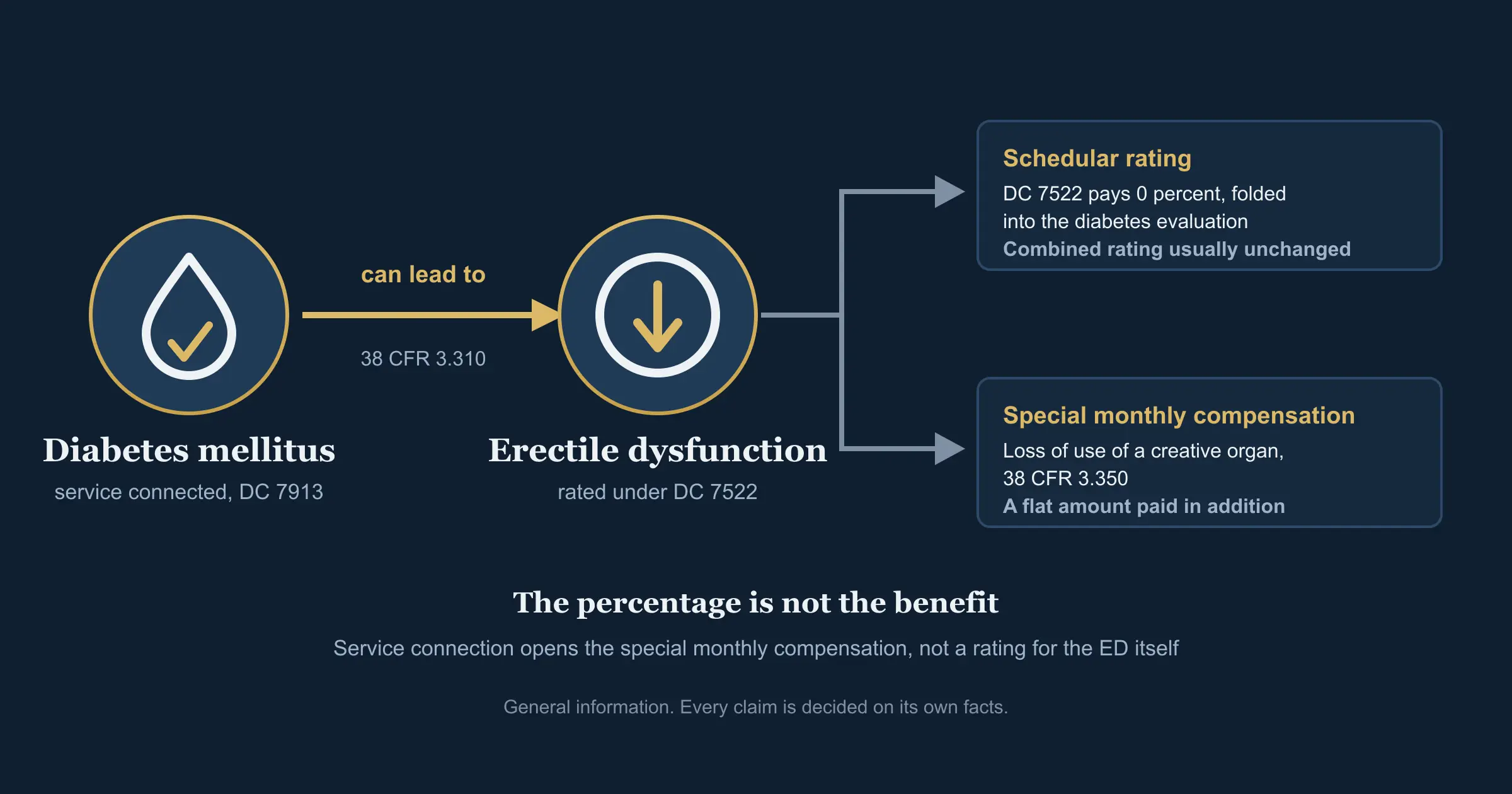
What This Claim Is, and What It Actually Pays
A secondary claim asks VA to service-connect a condition because an already service-connected condition caused it. The governing rule is 38 CFR 3.310(a): disability which is proximately due to or the result of a service-connected disease or injury shall be service connected. There is no presumption to lean on here. 38 CFR 3.310 names only two codified proximate-result rules, one for amputations and one for traumatic brain injury sequelae, and diabetes appears in neither. Everything turns on the medical opinion.
The structural precondition comes first and no letter can supply it. Your diabetes has to already be service connected. Citation Nr A25103884 is the cautionary version: the veteran's diabetes claim and his erectile dysfunction claim were denied together, and although the Board rejected his erectile dysfunction theory on several grounds, the diabetes route closed for a reason no evidence could cure. A VA examiner had actually opined that his erectile dysfunction was at least as likely as not due to diabetes mellitus. It made no difference, because the diabetes was not service connected, so there was nothing for the claim to attach to. A favourable opinion is worth nothing without the predicate. If your diabetes is not yet granted, that is the claim to bring first.
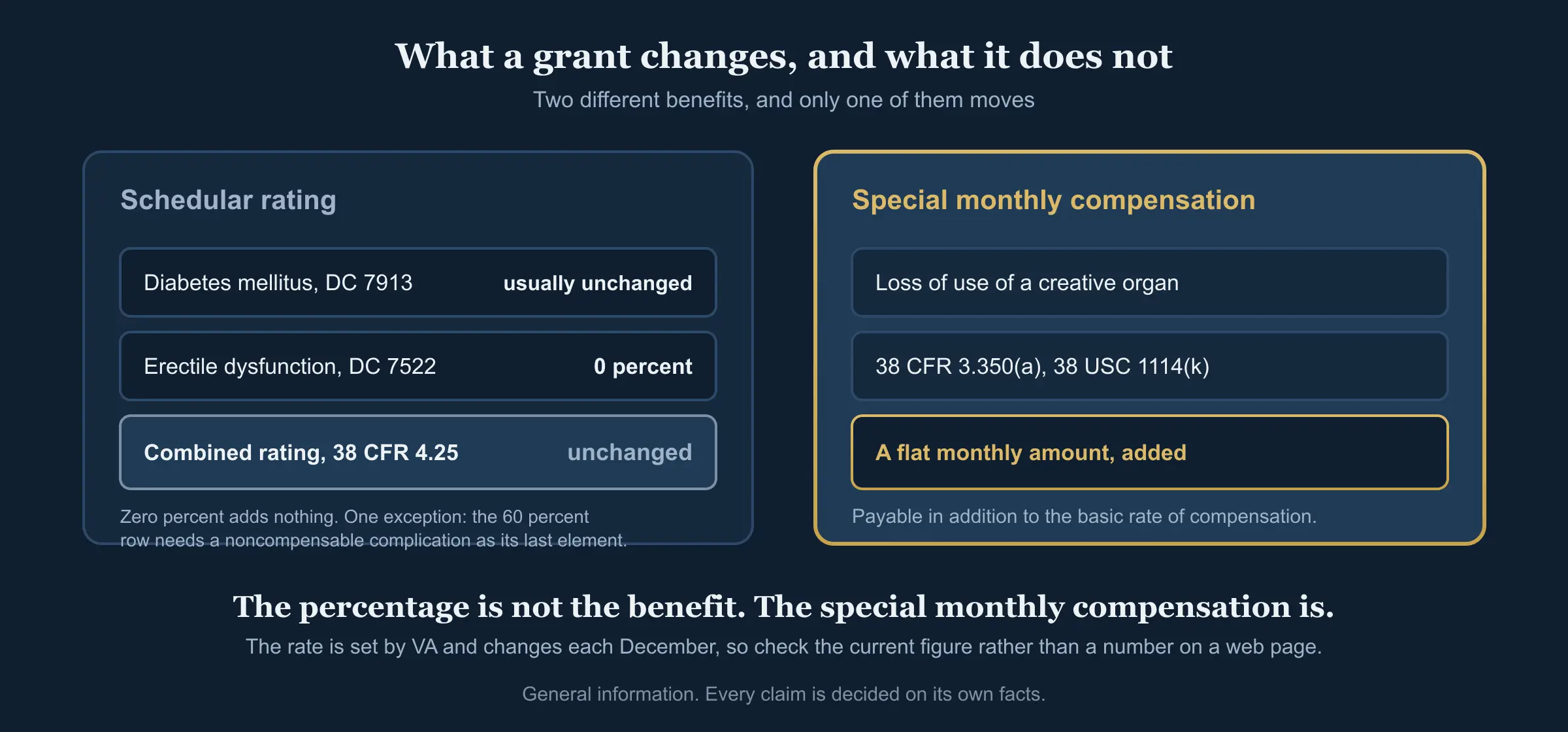
Now the part that gets buried. Assume you win. VA grants service connection for erectile dysfunction as proximately due to your service-connected diabetes. The schedular evaluation you receive is zero percent, and under VA's own adjudication manual it is then evaluated together with the diabetes rather than as a separate line. Your combined rating does not move, because zero percent contributes nothing to the combination described in 38 CFR 4.25. Nobody selling you a letter is likely to say that first, and it is the first thing you should know.
What follows the grant is special monthly compensation for loss of use of a creative organ. That is a flat monthly amount rather than a percentage, and 38 CFR 3.350(a) says it is payable in addition to the basic rate of compensation otherwise payable on the basis of degree of disability. It is not run through the combined ratings table at all. So the benefit is real and it is worth pursuing. It is simply not the benefit most pages imply.
One narrow exception is worth knowing about before you accept a flat zero, and it is not a route most claims can take. In Citation Nr A25080133 (2025) the Board awarded a compensable 20 percent for erectile dysfunction with no penile deformity, by applying the pre-November-2021 version of the diagnostic code as the more favorable version over an appeal period that reached back before the amendment, and rating by analogy under Webb v. McDonough. That veteran's erectile dysfunction was claimed as secondary to hypothyroidism rather than diabetes, and the reasoning turned on the reach of an old claim. If your claim stream genuinely predates November 14, 2021, raise it with whoever is helping you. For a claim filed today it is not available. The general rules for these claims are in our guide to nexus letters for secondary conditions.
The Rule Nobody Else States: Why Diabetes Is the Exception
Read only the regulation and you would conclude that erectile dysfunction stands on its own like any other diagnostic code. 38 CFR 4.115b lists it as an ordinary entry and says nothing about diabetes. The rule that changes the answer lives in the adjudication manual raters actually work from, and it takes four steps to reach. This is the same shape as the mistake that put wrong advice on one of our own pages in the past: the regulation read permissively, the manual said something narrower, and only the regulation had been checked.
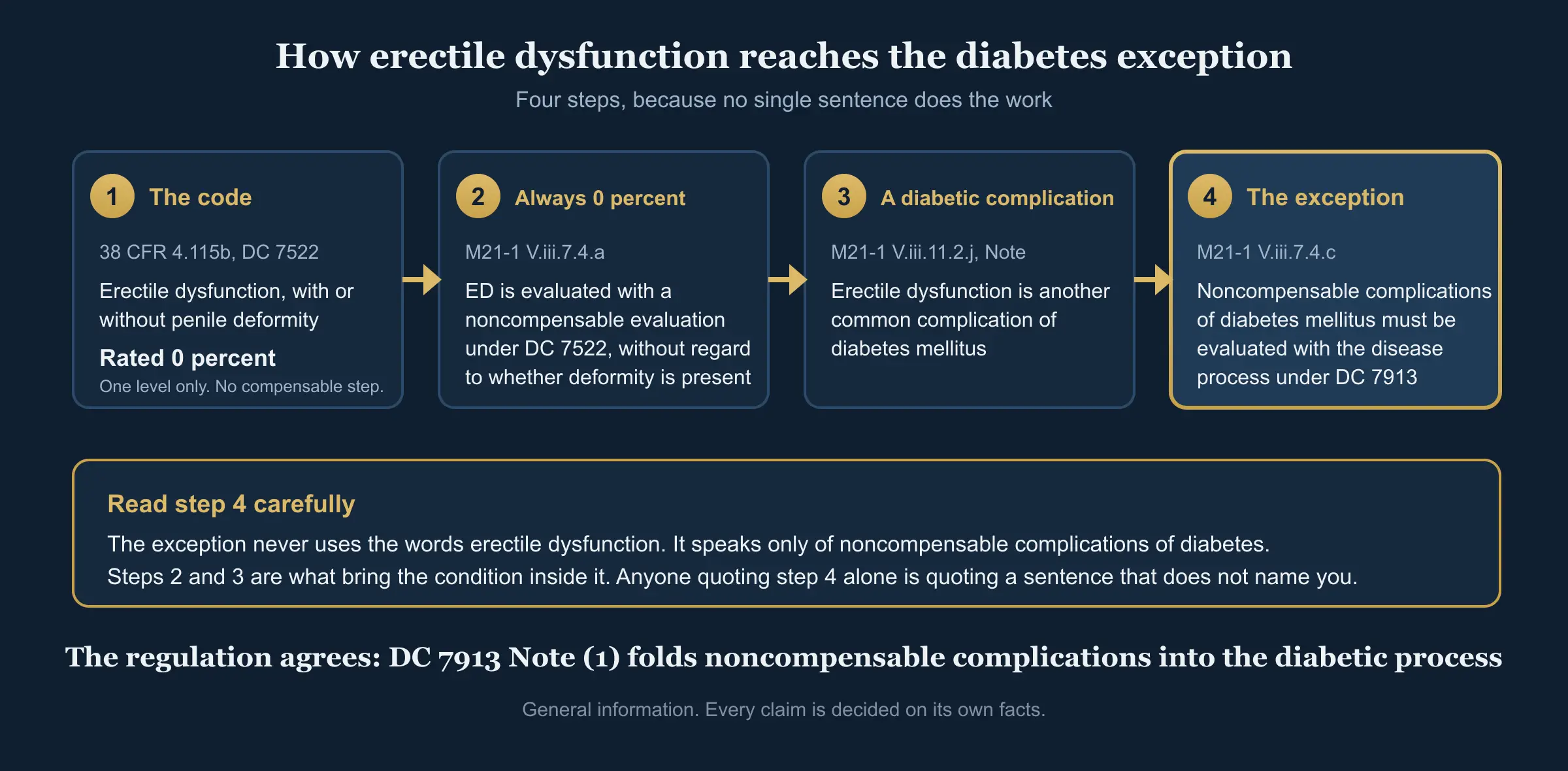
- 1Step 1. The code has one level, and it is zero38 CFR 4.115b, Diagnostic Code 7522The criterion line reads, in its entirety, "Erectile dysfunction, with or without penile deformity", rated 0, with footnote 1. There is no compensable step and no deformity tier. The deformity-tiered 20 percent version that many pages still quote was superseded on November 14, 2021 by 86 FR 54086. A Note printed with the code points the same way rather than away: a disease or traumatic injury of the penis resulting in scarring or deformity is itself rated under Diagnostic Code 7522, which is to say at the same zero. Footnote 1 does not award anything either; it says only "Review for entitlement to special monthly compensation under § 3.350 of this chapter."
- 2Step 2. The manual makes that noncompensable evaluation the rule, not the outcome of a bad examM21-1 V.iii.7.4.aThe manual instructs that erectile dysfunction is evaluated with a noncompensable evaluation under 38 CFR 4.115b, DC 7522 without regard to whether penile deformity is present. So the zero is not a finding about how bad your condition is. It is what the code pays.
- 3Step 3. The manual treats erectile dysfunction as a diabetic complicationM21-1 V.iii.11.2.j, NoteIn the endocrine chapter, a Note states: "Erectile dysfunction (impotence/retrograde ejaculation) is another common complication of diabetes mellitus." That is the sentence that puts your condition inside the category the next step operates on.
- 4Step 4. Noncompensable diabetic complications are evaluated with the diabetesM21-1 V.iii.7.4.c, ExceptionThe exception reads: "Noncompensable complications of diabetes mellitus must be evaluated with the disease process as provided in 38 CFR 4.119, DC 7913." Note what it does not say. It never uses the words erectile dysfunction. Your condition reaches this sentence through steps 2 and 3, not because the manual names it here.
The regulation agrees, which is the strongest position a citation can be in
This is not a case of the manual overriding the regulation. 38 CFR 4.119, Diagnostic Code 7913, Note (1) says: "Evaluate compensable complications of diabetes separately unless they are part of the criteria used to support a 100-percent evaluation. Noncompensable complications are considered part of the diabetic process under DC 7913." The manual applies that second sentence to erectile dysfunction. Regulation and manual say the same thing, and where that happens you are on the firmest ground available.
Note (1) is a rating-assignment rule, not a service-connection bar. It decides how the condition is evaluated once granted. It does not say the condition cannot be service connected, and the service connection is what unlocks the payment discussed further down.
It is worth being precise about what pyramiding does and does not do here, because it gets cited loosely. 38 CFR 4.14 forbids evaluating the same disability under various diagnoses and the same manifestation under different diagnoses. Glycemic control under DC 7913 and erectile function under DC 7522 are not the same manifestation, so 4.14 is not the reason for the fold-in. The reason is Note (1) and the manual exception above.
The multiple sclerosis contrast, and why it is not a grievance
The same manual block that creates the diabetes exception opens by doing the opposite for other systemic diseases. When evaluating residuals of a systemic disease process such as multiple sclerosis or amyotrophic lateral sclerosis and associated erectile dysfunction, the manual directs VA to award service connection for the erectile dysfunction and assign a separate evaluation for it, when it is otherwise appropriate to separately evaluate residuals. Read quickly, that sounds like diabetes veterans are being denied something.
They are not, and it matters that this page says so rather than selling the resentment. Diagnostic Code 7522 has exactly one level. A separate evaluation for a veteran with multiple sclerosis is a separate zero percent. The difference between the two groups is administrative, not financial: one veteran gets a separately listed zero percent issue on his rating sheet, the other gets the same condition described inside his diabetes evaluation. Neither receives a percentage for it, and both are compensated through the same special monthly compensation route.
One more thing the fold-in does not do
The 60 percent row of Diagnostic Code 7913 contains the phrase "plus complications that would not be compensable if separately evaluated", and it is easy to read that as a route to 60 percent once a noncompensable complication exists. VA's manual exists partly to close that reading. Its worked Example 1, at M21-1 Part V, Subpart iii, Chapter 11, Topic 4, Block a, sets out a veteran with noncompensable complications but without ketoacidosis or hypoglycemic reactions and instructs: "Do not evaluate the diabetes mellitus at 60 percent simply because noncompensable complications are present. Assign a 40-percent evaluation if there is a requirement of insulin, restricted diet, and regulation of activities. Include the noncompensable complications under 38 CFR 4.119, DC 7913."
There is one narrow way the fold-in can help, and it is worth knowing before you accept a flat no. The 60 percent row is a conjunctive list and a noncompensable complication is its last element. Every element has to be met before that level opens. So if your diabetes already requires insulin, a restricted diet and regulation of activities, and you have episodes of ketoacidosis or hypoglycemic reactions requiring one or two hospitalizations a year or twice-monthly visits to a diabetic care provider, then a documented noncompensable complication is the element that completes the 60 percent picture, and a documented erectile dysfunction is one. What Example 1 forecloses is the opposite claim, that noncompensable complications alone buy 60 percent. If you do not meet the episode criteria, this route is not open to you and Example 1 is the answer.
The 100 percent row closes the door from the top. Beyond its treatment and episode criteria it requires either progressive loss of weight and strength or complications that would be compensable if separately evaluated. A zero percent erectile dysfunction is not a compensable complication, so it can never be the element that carries a claim to 100 percent. The honest summary is that the erectile dysfunction evaluation itself never moves, and the one place documenting it can matter to your percentage is as the completing element of that 60 percent row.
Where the Money Actually Comes From
Special monthly compensation is a separate benefit from your disability rating. 38 CFR 3.350(a) provides that compensation under 38 USC 1114(k) is payable for each anatomical loss or loss of use of, among other things, one or more creative organs, and states that this special compensation "is payable in addition to the basic rate of compensation otherwise payable on the basis of degree of disability". It is a flat monthly amount. It does not enter the combined ratings table, so it is not diluted by your other ratings the way an added percentage would be, and it is payable whether your combined rating is 20 percent or 100 percent.
The regulation itself, though, never mentions erectile function. Its only spelled out loss-of-use test concerns the testicles, and the catch-all is the bare phrase "or other creative organ", which it does not define. The rule that brings erectile dysfunction inside that phrase is in the adjudication manual, and any page that cites the regulation as the source of it is citing something that is not there.
“Award SMC based on L/LOU of a creative organ if medical evidence of record shows ... the loss of erectile power secondary to a disease process, such as diabetes or multiple sclerosis, in a male Veteran”M21-1 Part VIII, Subpart iv, Chapter 4, Section A, Topic 4, Block c
Read that again, because it is the most useful sentence on this page. The manual that governs special monthly compensation names diabetes expressly as a qualifying disease process. The condition that VA declines to pay a percentage for is the same condition its manual names as a route to a flat additional payment. Diabetes does not cost the veteran the benefit. The benefit was never a percentage.
Two details that decide real cases
Medication that works does not disqualify you
The manual states that the successful use of medication or a prosthetic implant to restore erectile ability does not preclude the award, where the veteran is unable to complete the act of procreation. The genitourinary chapter goes further and instructs that where an examination report shows penetration and ejaculation without medication, the rater is to resolve reasonable doubt in the veteran's favor. So do not talk yourself out of the claim because a prescription helps.
You may not need to file a separate claim for it
The manual provides that entitlement to special monthly compensation for a creative organ may be based on a specific claim, or raised within the scope of another claimed issue when entitlement is shown in the evidence of record, and that it may rest on a multi-link causal chain rather than a fixed list of disabilities. A 2025 Board decision applied exactly that, finding erectile dysfunction to be a complication of the veteran's service-connected diabetes and awarding the benefit as an ancillary matter without a separate claim. Raise it in writing anyway. Relying on someone else to notice it is not a plan.
We do not print the dollar figure here, because VA adjusts it each December and a number frozen on a web page becomes wrong. The current rate is on VA's own special monthly compensation rates page, linked in the sources at the foot of this page.
If you want the four-step walkthrough of how special monthly compensation is established for erectile dysfunction generally, including causes other than diabetes, that lives on our erectile dysfunction condition page.
Which Claim You Are Actually Filing
This is the part most likely to be wrong on any page you read about this topic, including, until recently, parts of our own site. The plain reading of 38 CFR 3.310 says a condition caused by a service-connected disability is a secondary service-connection claim. For diabetic complications specifically, VA's manual says something different, and the difference changes both the form and the effective date.
“Because diabetes mellitus is an endocrine disorder with potential multi-system effects, onset of diabetic complications represents medical progression or worsening of diabetes, and diabetic complications are contemplated in the evaluation criteria under 38 CFR 4.119, DC 7913, a claim asserting new complications of SC diabetes is a claim for increase rather than a claim for secondary SC.”M21-1 Part V, Subpart iii, Chapter 11, Topic 2, Block c
The same block routes the effective date accordingly, to 38 CFR 3.400(o) for increases, and to 38 CFR 3.157 for periods before March 24, 2015. The two frameworks are reconcilable rather than contradictory, and 3.310(a) says so in its own second sentence: when service connection is established for a secondary condition, that condition shall be considered a part of the original condition.
If your diabetes is already service connected
M21-1 V.iii.11.2.c
This is the lane the manual is written for. Your claim is a claim for increase on the diabetes, and you should expressly raise entitlement to special monthly compensation for loss of use of a creative organ in the same submission rather than assuming it will be picked up. Effective-date rules for increases apply.
If your diabetes is not service connected yet
38 CFR 3.400, generally
The manual block above does not reach you, because it presupposes service-connected diabetes. Get the diabetes granted first. The effective-date rule for increases does not apply to a first-time grant either: 38 CFR 3.400(o)(2) says in terms that its provisions apply only where the records relate to a disability for which service connection has previously been established.
Why the effective date is often the argument worth having
Because the erectile dysfunction evaluation itself cannot move, the two things usually in play are whether the benefit is granted and when it starts. Several of the Board decisions we read produced real additional money on an effective-date argument rather than on a fresh nexus argument. In one, Citation Nr A21020112, the agency had already granted service connection for erectile dysfunction secondary to diabetes and awarded special monthly compensation, both effective March 2020; the Board moved both back to July 2009 on the basis that the disability had been present during the pendency of an earlier claim. In another, Citation Nr A26037703, a veteran who had claimed diabetes and erectile dysfunction together in 2011 and been denied was able to carry that original claim date forward when the diabetes was later granted on a herbicide basis. Money also moved in cases that were not about dates at all, so do not read this as the only route: in Citation Nr A25073239 the same decision that found the erectile dysfunction to be a diabetic complication also raised the diabetes evaluation and awarded special monthly compensation.
The practical consequence is that the date your erectile dysfunction first appears in your medical records matters as much as the opinion does. Go and find it before you file. A treatment note from years ago, a prescription record, a line in a primary-care history: these are what an effective-date argument is built from, and no letter written today can manufacture them.
The Medical Case a Letter Has To Make
A nexus opinion is not a literature review and it is not a statistic. It is a reasoned explanation of why this veteran's erectile dysfunction is at least as likely as not caused by his diabetes, written by someone qualified to say so. Statistics support that reasoning; they do not replace it. Here is what the strongest evidence actually shows, and how much weight each kind of finding can carry.
The mechanism is the argument, and it has been measured directly
The single strongest piece of evidence here is not a prevalence study. In a New England Journal of Medicine study, penile tissue taken from 21 diabetic and 42 nondiabetic men, all of them impotent and all undergoing penile prosthesis implantation, was tested in the laboratory. The comparison is therefore between diabetic and nondiabetic men who all had the condition, not against unaffected controls, which is what makes the pattern below informative about mechanism rather than about who gets it. In the diabetic tissue, both nerve-driven and endothelium-driven relaxation of the erectile smooth muscle were significantly impaired, both at P equal to 0.001, while relaxation triggered directly on the muscle itself was unaffected, and the degree of impairment correlated with how long the man had had diabetes. That last detail is what makes it useful: the defect sits precisely in the autonomic nerves and the vessel lining, which is exactly where diabetic microvascular disease acts. A letter that explains this pathway is doing something a citation count cannot.
The mechanism is multifactorial, and a good opinion says which parts apply to you
A 2025 narrative review in Endocrinology, Diabetes and Metabolism summarizes the accepted picture: diabetic erectile dysfunction arises from interacting pathways including endothelial dysfunction, accelerated atherosclerosis, autonomic and peripheral neuropathy, structural changes in the penis, and hormonal factors. The American Diabetes Association's own technical review of diabetic autonomic neuropathy, published in Diabetes Care, likewise lists erectile dysfunction among the recognized clinical manifestations of that neuropathy rather than treating it as an unrelated comorbidity. To be exact about who says what, because it matters when a letter is read by an adjudicator: those are clinical sources, not VA sources. VA's manual goes no further than calling erectile dysfunction a common complication of diabetes mellitus, and it does not adopt any position on the mechanism.
Two genetic analyses point the same direction, with one caveat about how independent they are
Mendelian randomization uses genetic variants to estimate causal direction where a trial would be impossible. A 2022 study in Andrology found type 2 diabetes associated with erectile dysfunction at an odds ratio of 1.15, with a 95 percent confidence interval of 1.05 to 1.25, and, importantly, that association survived adjustment for body mass index while body mass index's own effect did not. A separate 2023 analysis reached the same conclusion at an odds ratio of 1.19, confidence interval 1.084 to 1.300. The caveat, which matters and which most write-ups omit: both drew their erectile dysfunction outcome data from the same underlying genome-wide association study of 223,805 men, so these are two research groups analysing one shared dataset rather than a replication in a fresh sample. That is worth something, because the analytic choices differ, and it is worth less than two genuinely independent cohorts would be. Both are also estimates per unit of genetic liability, not a personal risk figure, and they should never be reported as a percentage increase in one man's chances.
The complications you already have are the best evidence in your file
A 2024 meta-analysis of 58 studies covering 66,925 men with diabetes found that among men who already have diabetes, erectile dysfunction was most strongly associated with the classic microvascular and neuropathic complications: diabetic neuropathy at an odds ratio of 3.47, retinopathy at 3.01, nephropathy at 2.67, and vascular disease at 2.75. These are cross-sectional associations rather than risks conferred. Their practical value is different and it is concrete: if you are already service connected for diabetic peripheral neuropathy or retinopathy, those ratings are documentary evidence that the same disease process is doing the same kind of damage elsewhere, and a good opinion will say so.
Timing and control both point the right way, with honest caveats
In the DCCT and EDIC cohort of 635 men with type 1 diabetes, those with measurable cardiovascular autonomic neuropathy had 2.65 times the odds of later developing erectile dysfunction and lower urinary tract symptoms, with a confidence interval of 1.47 to 4.79, after adjustment for glycemic control, blood pressure and age. The autonomic abnormality was measurable years before the symptoms appeared, which is the temporal ordering a causal argument wants. Two caveats travel with it: the cohort is type 1 rather than type 2, and the outcome combines erectile dysfunction with urinary symptoms. Separately, in 792 men with type 2 diabetes, HbA1c remained independently associated with erectile dysfunction after adjusting for age and duration of diabetes, at an odds ratio of 1.12.
How common it is, stated as what it is
A 2017 systematic review and meta-analysis of 145 studies covering 88,577 men found that erectile dysfunction affected an estimated 66.3 percent of men with type 2 diabetes, and in the eight of those studies that included healthy comparison groups, men with diabetes had roughly 3.5 times the odds of erectile dysfunction, at an odds ratio of 3.62 with a confidence interval of 2.53 to 5.16. Those are prevalence and odds figures from cross-sectional data. For context, the Massachusetts Male Aging Study found a combined 52 percent prevalence of some degree of impotence in community-dwelling men aged 40 to 70 with age the strongest single correlate, which is why an opinion that ignores your age and your other risk factors is weaker than one that addresses them.
The honest verdict, because it changes how the letter should be written
Diabetes to erectile dysfunction is more than an association and less than proof. What supports causation is a coherent mechanism measured directly in human tissue, two genetic analyses agreeing on direction, evidence that the autonomic damage precedes the symptom, and a dose-response relationship with glycemic control and with the other microvascular complications. What is missing is the thing that is missing for almost every question like this: nobody has randomized men to diabetes, and the two genetic analyses share an outcome dataset rather than replicating in separate samples.
That is not a weakness in your claim, because your claim does not need proof. The standard is whether the connection is at least as likely as not, and 38 CFR 3.102 resolves a genuine balance of positive and negative evidence in your favor. It does mean that an opinion asserting diabetes caused this, full stop, is weaker than one that walks the mechanism, addresses your other risk factors by name, and explains why the diabetic pathway is at least as likely as the alternatives.
Causation and aggravation are two questions, and both have to be answered
38 CFR 3.310(b) provides a second route: any increase in severity of a nonservice-connected condition that is proximately due to a service-connected disease, and not due to natural progress, will be service connected. It carries a hard evidentiary precondition. VA will not concede aggravation unless the baseline level of severity is established by medical evidence created before the onset of aggravation, or by the earliest medical evidence created between that onset and the evidence establishing the current level.
This matters more than it sounds. In a 2026 case the Board remanded a claim precisely because the VA examiner had answered only the causation question, holding that causation and aggravation are two separate inquiries and both must be answered. An opinion that addresses only one of them is an opinion VA can send back, and a remand is measured in years. If you have erectile dysfunction with a non-diabetic cause of its own, the aggravation route may be the stronger one, and either way the letter should close both doors.
What the Opinion Has To Say
The Board does not weigh medical opinions by who signed them. It weighs them by whether they explain themselves. The standard it cites is Nieves-Rodriguez v. Peake, and the practical test is whether the reasoning connects the evidence to the conclusion in a way a reader can follow.
A real example of a letter that did not do this
In a 2026 decision, Citation Nr A26001841, the Board granted the claim but was openly critical of the nexus letter. The private physician had written that the erectile dysfunction was most likely caused by or the result of the diabetes mellitus type II, and the Board observed that the opinion offered no supporting rationale for that conclusion. It still counted the opinion among its reasons, alongside a separate procedural error by the agency and the benefit of the doubt. Read that as a warning rather than a reassurance. The veteran won with a bare-conclusion letter and a second ground to lean on; a conclusion in the right words with nothing underneath it is exactly the kind of opinion the Board is entitled to discount, and on a record without that second ground it may be all that stands between a grant and a denial.
The contrast is a 2026 case where a private physician's opinion carried the claim outright, and the Board's finding of fact was unhedged: the veteran's diagnosed erectile dysfunction is caused by his service-connected diabetes mellitus, type II. The difference between those two letters is not the credential. It is the reasoning.
The elements
- A named current diagnosisErectile dysfunction, diagnosed by a clinician and recorded in your file. In Citation Nr A26004449 (2026) the Board denied a claim for want of a current disability where the records documented low libido but no erectile dysfunction diagnosis, and it reached that result even after considering functional impairment under Saunders v. Wilkie. That veteran's theory ran through a psychiatric condition rather than diabetes, but the first element is the same whatever the pathway: without the diagnosis there is nothing to service connect.
- The service-connected diabetes, with its datesThe rating, its effective date, and the course of the disease. Duration is not a formality here: the mechanism evidence ties the degree of impairment to how long the disease has been present.
- The mechanism, applied to you rather than recitedEndothelial dysfunction, autonomic neuropathy, microvascular disease, and how each shows up in your own records. If you carry a diabetic neuropathy or retinopathy rating, that is not background, it is evidence, and the opinion should say why.
- Your other risk factors, addressed head onAge, blood pressure, cardiovascular disease, smoking, medications, and any psychiatric condition or antidepressant. An opinion that ignores them looks like advocacy. An opinion that names them and explains why the diabetic pathway is still at least as likely as not is the one that survives a VA examiner's rebuttal.
- Both causation and aggravationAnswered separately and in terms, so the claim cannot be remanded for an incomplete opinion the way the 2026 case above was.
- The standard, stated correctlyAt least as likely as not, meaning a probability of at least 50 percent. It is worth knowing that this phrase does not appear in 38 CFR 3.102 or in 38 USC 5107; those sources speak of reasonable doubt and an approximate balance of positive and negative evidence. The shorthand is VA practice built on that standard rather than a quotation from it.
- An express mention of special monthly compensationLoss of use of a creative organ, named. This is the benefit that actually follows the grant, and the point of the letter is to put the entitlement squarely in front of the adjudicator rather than hoping it is inferred.
Any qualified clinician can write this, and that includes a VA provider, notwithstanding a widespread belief otherwise. That is a statement about what the directive permits, not a prediction that your own provider will agree; it names discomfort and conflict of interest as grounds to decline, and some facilities discourage the practice locally. Which providers VA takes seriously, and what VHA Directive 1134 actually permits, is covered in our guide to who can write a nexus letter.
What the Board Has Actually Decided
Board decisions do not bind anyone. Each states that it is not precedential, and no two records are alike. They are useful for a narrower reason: they show what persuaded an adjudicator and what did not, in cases with the same shape as yours. These are the ones we read in full.
Citation Nr A26024644 (2026)
A clean, single-issue causation grant. The finding of fact reads that the veteran's diagnosed erectile dysfunction is caused by his service-connected diabetes mellitus, type II, and it rested on a private physician's reasoned opinion.
Why it matters. The best available illustration that a well-reasoned private opinion can carry this claim on causation alone.
Citation Nr A26016963 (2026)
A diabetes-only grant, on proximate cause. Resolving reasonable doubt in the veteran's favor, the Board found the erectile dysfunction proximately due to his service-connected diabetes mellitus. A VA examiner's own examination language describing it as a complication of diabetes carried the claim, and a later contrary VA opinion was rejected as inadequately reasoned.
Why it matters. A VA examiner's own words can be your best evidence. Read your examination reports.
Citation Nr A26040886 (2026)
A grant in equipoise where a private opinion and a VA opinion could not be separated on the quality of their reasoning, with the order itself stating the grant was on a causation basis. Note that the grant was joint, to diabetes and a panic disorder, not to diabetes alone.
Why it matters. The benefit-of-the-doubt rule doing real work when two well-reasoned opinions disagree.
Citation Nr A26001841 (2026)
A grant, but the private nexus letter was expressly criticized. The physician wrote that the erectile dysfunction was most likely caused by or the result of the diabetes mellitus type II, and the Board observed that the opinion lacked supporting rationale. The Board did not discard it; it named the opinion among its reasons alongside a procedural error by the agency and the benefit of the doubt.
Why it matters. The cautionary one. A conclusion without reasoning is not evidence the Board has to credit.
Citation Nr A26006185 (2026)
A remand rather than a decision, because the VA examiner had failed to address whether the erectile dysfunction was aggravated by the service-connected diabetes. The Board stated that causation and aggravation are two separate inquiries and both must be answered.
Why it matters. Why an opinion that answers only causation costs you years rather than the claim.
Citation Nr A26039503 (2026)
The clearest modern statement of the rating position: erectile dysfunction is rated under 38 CFR 4.115b, Diagnostic Code 7522, which provides a maximum noncompensable rating with or without penile deformity, with special monthly compensation as the compensation that follows. The agency had granted the erectile dysfunction as secondary to a prostate disability; the Board granted earlier effective dates, resting on an alternative finding that the condition was also secondary to service-connected diabetes and hypertension and attaching the claim date of a pending diabetes increased-rating claim.
Why it matters. The rating rule under current law, stated by the Board in its own words.
Citation Nr A25073239 (2025)
The Board found erectile dysfunction to be a complication of the veteran's service-connected diabetes constituting loss of use of a creative organ, and awarded special monthly compensation as an ancillary benefit without requiring a separate claim, while giving the erectile dysfunction no separate percentage.
Why it matters. The mechanics of the whole page in one decision: no percentage, and the payment adjudicated as part of the claim already before VA. One caveat about reading it as the current rule. The Board denied the separate compensable rating under the pre-November-2021 version of Diagnostic Code 7522, because there was no penile deformity. The outcome is the same under the current code, which pays zero with or without deformity, but the reasoning is not the same reasoning.
Citation Nr A21020112 (2021)
Not a nexus case. Service connection for erectile dysfunction secondary to diabetes and the special monthly compensation award were already in place, effective March 2020. The Board moved both effective dates back to July 2009 because the disability had been present during the pendency of an earlier claim.
Why it matters. Where the real money often is once the percentage is off the table.
Citation Nr A25107555 (2025)
A staged diabetes rating in which the Board held that the veteran's erectile dysfunction, manifested by loss of erectile power without deformity of the penis, remained a noncompensable complication of the diabetes mellitus.
Why it matters. A recent, plainly worded statement of the fold-in applied to a real record.
Citation Nr A25103884 (2025)
A paired denial. The Board found neither the diabetes nor the erectile dysfunction related to service. The veteran had actually pleaded his erectile dysfunction as secondary to a service-connected knee disability, and that theory failed on the medical evidence; the diabetes theory, which the Board reached on its own, failed for a different reason, that the diabetes was not service connected. A VA examiner had opined the erectile dysfunction was at least as likely as not due to the diabetes, and it did not help.
Why it matters. The precondition, and how little a favourable opinion is worth without it. No service-connected primary, no secondary claim.
One caution about how to read these, using a decision above. The order in Citation Nr A26040886 grants service connection for erectile dysfunction secondary to service-connected diabetes mellitus type II AND panic disorder with insomnia, and its finding of fact is worded the same way. That is a joint attribution to two service-connected conditions, not a finding that diabetes alone caused the condition, and it should not be quoted as one. Where two service-connected conditions both plausibly contribute, the Board does not have to separate them. That is genuinely useful to know if your own record has more than one candidate, and it is a different proposition from a diabetes-only holding.
Is Your Claim Ready?
Score your claim
0 of 8 in hand
Tick what is already in your file today. Items three onward are what a strong opinion draws on, but the first two decide whether there is a claim to bring at all, so the verdict weighs them rather than adding up boxes.
Start here, not with a letter
Start with the diabetes itself. A secondary claim under 38 CFR 3.310 attaches to a disability the VA has already service-connected, so until the diabetes carries its own rating there is nothing for the erectile dysfunction to attach to. That claim comes first, and no nexus letter can substitute for it.
Get the Opinion That Actually Answers the Question
Your diabetes rating and your medical records are already on file. Let our physicians write the opinion that connects them, that walks the mechanism rather than asserting a conclusion, that answers causation and aggravation both, and that names the benefit this claim is really about.
Frequently Asked Questions
Will claiming erectile dysfunction raise my VA rating?
Not on its own, and any page that promises a higher percentage for the erectile dysfunction itself is wrong. Diagnostic Code 7522 has a single level, zero percent, with or without penile deformity, and VA's adjudication manual then evaluates a noncompensable diabetic complication together with the diabetes under Diagnostic Code 7913. A zero percent rating contributes nothing to the combined rating calculation in 38 CFR 4.25. The benefit that follows the grant is special monthly compensation for loss of use of a creative organ, which is a flat monthly amount paid in addition to your compensation rather than a percentage. There is one exception and it runs through the diabetes rather than through the erectile dysfunction: the 60 percent row of Diagnostic Code 7913 requires a noncompensable complication as its last element, so if your diabetes already meets the insulin, restricted diet, regulation of activities and ketoacidosis or hypoglycemic episode criteria, a documented complication is what completes it.
Then why bother claiming it at all?
Three reasons. Special monthly compensation for loss of use of a creative organ is real money and it is paid on top of everything else, at any combined rating. The grant establishes the condition as service connected, which opens VA care for it and turns any future dispute into an argument about degree rather than about causation. And the effective date, once established, is fixed. Veterans who leave this unclaimed for a decade are usually leaving the earlier effective date behind as well.
Do I file a new secondary claim, or a claim for an increase?
If your diabetes is already service connected, VA's manual treats a claim asserting new complications of service-connected diabetes as a claim for increase rather than a claim for secondary service connection, and routes the effective date to the rules for increases in 38 CFR 3.400(o). You should also expressly raise entitlement to special monthly compensation for loss of use of a creative organ in the same submission rather than assuming it will be picked up. If your diabetes is not service connected yet, that manual rule does not reach you and the diabetes claim comes first.
Does it matter that medication works for me?
No. VA's manual states that the successful use of medication or a prosthetic implant to restore erectile ability does not preclude an award of special monthly compensation where the veteran is unable to complete the act of procreation, and it directs raters to resolve reasonable doubt in the veteran's favor where an examination report suggests function without medication. Do not talk yourself out of the claim because a prescription helps.
Why does a veteran with multiple sclerosis get a separate rating for this and I do not?
The difference is administrative rather than financial. VA's manual does direct a separate evaluation for erectile dysfunction associated with a systemic disease such as multiple sclerosis or amyotrophic lateral sclerosis, where it is otherwise appropriate to separately evaluate residuals, and it makes noncompensable diabetic complications an exception to that. But Diagnostic Code 7522 has only one level, so that separate evaluation is a separate zero percent. One veteran gets a separately listed zero on his rating sheet and the other gets the same condition described inside his diabetes evaluation. Neither receives a percentage, and both reach the same special monthly compensation.
Is diabetes actually proven to cause erectile dysfunction?
It is strongly supported but not proven in the way that word is usually meant, and your claim does not need proof. What exists is a mechanism measured directly in human penile tissue, showing impaired nerve-driven and endothelium-driven relaxation in diabetic men with impairment tracking disease duration; two Mendelian randomization analyses agreeing that type 2 diabetes has a direct effect on erectile dysfunction, though they share one underlying outcome dataset rather than replicating in separate samples; evidence from a long-term cohort that autonomic nerve damage precedes the symptom; and a consistent relationship with glycemic control and with the other microvascular complications. The VA standard is whether the connection is at least as likely as not, not whether it is proven.
My erectile dysfunction could also be from my age or my blood pressure medication. Does that sink the claim?
Not by itself, and a good opinion will address those factors rather than avoid them. Erectile dysfunction is common in men over 40 regardless of diabetes, and a letter that ignores your age, cardiovascular history and medications reads as advocacy. The question is not whether diabetes is the only cause. It is whether the diabetic pathway is at least as likely as not a cause, which is a lower bar and one that reasoning about your particular record can meet.
What if my erectile dysfunction started before my diabetes was diagnosed?
Then the aggravation route under 38 CFR 3.310(b) is probably the stronger argument. It provides that an increase in severity of a nonservice-connected condition that is proximately due to a service-connected disease, and not due to natural progress, will be service connected. It carries a specific evidentiary requirement: the baseline level of severity has to be established by medical evidence created before the aggravation began, or by the earliest medical evidence available afterward. The opinion should answer causation and aggravation separately, because the Board has remanded claims where an examiner answered only one.
Can my VA doctor write this letter?
Yes. There is a widespread belief that VA clinicians are barred from writing opinions for their own patients, and it is not what VHA Directive 1134 says. Whether your VA provider will agree to write one is a separate question. The directive names discomfort with giving the opinion and conflict of interest as grounds for declining, and it sets out a notification and reconsideration process when a provider does. Some facilities also discourage the practice as a matter of local policy. Our guides to who can write a nexus letter and to VHA Directive 1134 cover what the directive actually permits.
How much does a nexus letter for this claim cost?
Pricing for physician-authored nexus letters and independent medical opinions is listed on our pricing page, in dollars, with no consultation required to see it. Read this page first. If your diabetes is not service connected yet, or if you have no diagnosis of erectile dysfunction in your records, a letter is not what you need today.
Related guides
- Nexus letter for erectile dysfunction secondary to PTSDThe other causal pathway, including the antidepressant route. Different rating mechanics, because the fold-in rule on this page is diabetes only.
- Nexus letter for diabetesGetting the diabetes itself service connected, and when the Agent Orange presumption means you do not need a letter at all.
- Nexus letter for peripheral neuropathy secondary to diabetesA sibling complication that can be compensable or folded into the diabetes rating, depending on which nerve is involved and at what level.
- Why you need a nexus letter for a secondary conditionThe general rules for secondary claims under 38 CFR 3.310.
- What a nexus letter must includeThe elements VA looks for in any nexus letter.
- Nexus letter exampleA full annotated sample letter, section by section.
- Who can write a nexus letterWhich providers VA takes seriously, and what VHA Directive 1134 actually says about VA clinicians.
Citations & References
- 38 CFR 4.115b, Ratings of the genitourinary system, including DC 7522 (eCFR) https://www.ecfr.gov/current/title-38/section-4.115b
- 38 CFR 4.119, Schedule of ratings, endocrine system, including DC 7913 and Note (1) (eCFR) https://www.ecfr.gov/current/title-38/section-4.119
- 38 CFR 3.350, Special monthly compensation ratings (eCFR) https://www.ecfr.gov/current/title-38/section-3.350
- 38 CFR 3.310, Disabilities proximately due to, or aggravated by, service-connected disease or injury (eCFR) https://www.ecfr.gov/current/title-38/section-3.310
- 38 CFR 3.400, Effective dates, including paragraph (o) for increases (eCFR) https://www.ecfr.gov/current/title-38/section-3.400
- 38 CFR 4.14, Avoidance of pyramiding (eCFR) https://www.ecfr.gov/current/title-38/section-4.14
- 38 CFR 4.25, Combined ratings table (eCFR) https://www.ecfr.gov/current/title-38/section-4.25
- 38 CFR 3.102, Reasonable doubt and benefit of the doubt (eCFR) https://www.ecfr.gov/current/title-38/section-3.102
- 38 USC 1114, Rates of wartime disability compensation, including subsection (k) (Cornell LII) https://www.law.cornell.edu/uscode/text/38/1114
- VA current Special Monthly Compensation rates (VA.gov) https://www.va.gov/disability/compensation-rates/special-monthly-compensation-rates/
- M21-1 Part V, Subpart iii, Chapter 7, Genitourinary Disabilities, topic 4 (VA KnowVA) https://www.knowva.ebenefits.va.gov/system/templates/selfservice/va_ssnew/help/customer/locale/en-US/portal/554400000001018/content/554400000180593/M21-1-Part-V-Subpart-iii-Chapter-7-Genitourinary-Disabilities
- M21-1 Part V, Subpart iii, Chapter 11, Endocrine Conditions, topics 2 and 4 (VA KnowVA) https://www.knowva.ebenefits.va.gov/system/templates/selfservice/va_ssnew/help/customer/locale/en-US/portal/554400000001018/content/554400000180518/M21-1-Part-V-Subpart-iii-Chapter-11-Endocrine-Conditions
- M21-1 Part VIII, Subpart iv, Chapter 4, Section A, Special Monthly Compensation, topic 4 (VA KnowVA) https://www.knowva.ebenefits.va.gov/system/templates/selfservice/va_ssnew/help/customer/locale/en-US/portal/554400000001018/content/554400000177480/M21-1-Part-VIII-Subpart-iv-Chapter-4-Section-A-Special-Monthly-Compensation-SMC
- VA Form 21-526EZ, Application for Disability Compensation (VA.gov) https://www.va.gov/find-forms/about-form-21-526ez/
- Saenz de Tejada I, et al. Impaired neurogenic and endothelium-mediated relaxation of penile smooth muscle from diabetic men with impotence. N Engl J Med. 1989 (PubMed) https://pubmed.ncbi.nlm.nih.gov/2927481/
- Kouidrat Y, et al. High prevalence of erectile dysfunction in diabetes: a systematic review and meta-analysis of 145 studies. Diabet Med. 2017 (PubMed) https://pubmed.ncbi.nlm.nih.gov/28722225/
- Yuan C, et al. Type 2 diabetes mellitus increases risk of erectile dysfunction independent of obesity and dyslipidemia: A Mendelian randomization study. Andrology. 2022 (PubMed) https://pubmed.ncbi.nlm.nih.gov/34842357/
- Zhu XB, et al. Type 2 diabetes mellitus and the risk of male infertility: a Mendelian randomization study. Front Endocrinol. 2023 (PubMed) https://pubmed.ncbi.nlm.nih.gov/38152129/
- Dilixiati D, et al. Risk factors for erectile dysfunction in diabetes mellitus: a systematic review and meta-analysis. Front Endocrinol. 2024 (PubMed) https://pubmed.ncbi.nlm.nih.gov/38638136/
- Pop-Busui R, et al. Cardiovascular autonomic neuropathy, erectile dysfunction and lower urinary tract symptoms in men with type 1 diabetes: findings from the DCCT/EDIC. J Urol. 2015 (PubMed) https://pubmed.ncbi.nlm.nih.gov/25584994/
- Lu CC, et al. Association of glycemic control with risk of erectile dysfunction in men with type 2 diabetes. J Sex Med. 2009 (PubMed) https://pubmed.ncbi.nlm.nih.gov/19473477/
- Hostnik B, et al. Erectile Dysfunction in Diabetes Mellitus: A Comprehensive Narrative Review of Pathophysiology, Genetic Association Studies and Therapeutic Approaches. Endocrinol Diabetes Metab. 2025 (PubMed) https://pubmed.ncbi.nlm.nih.gov/40960125/
- Vinik AI, et al. Diabetic autonomic neuropathy. Diabetes Care. 2003 (PubMed) https://pubmed.ncbi.nlm.nih.gov/12716821/
- Feldman HA, et al. Impotence and its medical and psychosocial correlates: results of the Massachusetts Male Aging Study. J Urol. 1994 (PubMed) https://pubmed.ncbi.nlm.nih.gov/8254833/
- Board of Veterans Appeals, Citation Nr A26024644 (2026) https://www.va.gov/vetapp26/Files3/A26024644.txt
- Board of Veterans Appeals, Citation Nr A26016963 (2026) https://www.va.gov/vetapp26/Files2/A26016963.txt
- Board of Veterans Appeals, Citation Nr A26001841 (2026) https://www.va.gov/vetapp26/Files1/A26001841.txt
- Board of Veterans Appeals, Citation Nr A26006185 (2026) https://www.va.gov/vetapp26/Files1/A26006185.txt
- Board of Veterans Appeals, Citation Nr A25073239 (2025) https://www.va.gov/vetapp25/Files9/A25073239.txt
- Board of Veterans Appeals, Citation Nr A21020112 (2021) https://www.va.gov/vetapp21/Files12/A21020112.txt
- Board of Veterans Appeals, Citation Nr A26040886 (2026) https://www.va.gov/vetapp26/Files4/A26040886.txt
- Board of Veterans Appeals, Citation Nr A26039503 (2026) https://www.va.gov/vetapp26/Files4/A26039503.txt
- Board of Veterans Appeals, Citation Nr A26037703 (2026) https://www.va.gov/vetapp26/Files4/A26037703.txt
- Board of Veterans Appeals, Citation Nr A26004449 (2026) https://www.va.gov/vetapp26/Files1/A26004449.txt
- Board of Veterans Appeals, Citation Nr A25107555 (2025) https://www.va.gov/vetapp25/Files12/A25107555.txt
- Board of Veterans Appeals, Citation Nr A25103884 (2025) https://www.va.gov/vetapp25/Files12/A25103884.txt
- Board of Veterans Appeals, Citation Nr A25080133 (2025) https://www.va.gov/vetapp25/Files9/A25080133.txt
The M21-1 links above open VA's KnowVA portal, which loads its text with JavaScript. If a link opens an apparently empty page, allow it a moment or open it in a standard browser tab. The manual text quoted on this page was read from those articles on September 8, 2026.