
Secondary claim guide
Diabetic Retinopathy Secondary to Type 2 Diabetes: How VA Rates Vision and Treatment Visits
Medically reviewed by the Patriot Path Medical Team
Licensed MD reviewers • Last updated:
Diabetic retinopathy from service-connected type 2 diabetes can be service connected, and VA's manual lists it as a diabetic eye complication. Payment is separate: VA rates it on corrected acuity and visual field or on documented treatment visits in the past year. Screening and monitoring visits do not count as treatment visits, and a 0 percent retinopathy is folded into the diabetes rating.
Three more things belong up front. In the 28 Board decisions we read, all four denials of service connection for diabetic retinopathy turned on whether it was diagnosed or whether the diabetes was service connected, not on the link between the two (Board decisions are non-precedential under 38 CFR 20.1303). If your diabetes is already service connected, VA processes a new retinopathy as a claim for increase on the diabetes, not as a fresh secondary claim. And if an eye doctor has diagnosed diabetic retinopathy and no one has named another cause, you may not need to buy a nexus letter at all. A letter earns its place in narrower cases, set out below.
An illustrative example
A Vietnam veteran is service connected for type 2 diabetes at 20 percent on the Agent Orange presumption. His yearly dilated eye exam finds mild nonproliferative diabetic retinopathy, his corrected vision is 20/20 in each eye, and he has had no injections, laser or surgery. VA includes the retinopathy with his diabetes as a noncompensable complication, and he goes looking for a letter saying diabetes caused it.
VA did not dispute the cause. It accepted the link and applied the eye formula: corrected vision of 20/40 or better in each eye pays 0 on the vision route, and his visits were for monitoring, which do not count as treatment visits. A letter restating causation would answer a question no one asked. What could change the number later is in his eye clinic records: treatment visits, if his eye doctor ever starts treating the retinopathy, or a measured loss of corrected vision or visual field.
This example is a composite we built to illustrate the rating rules. No client stands behind it, it reports no case result, and it predicts nothing about any claim.
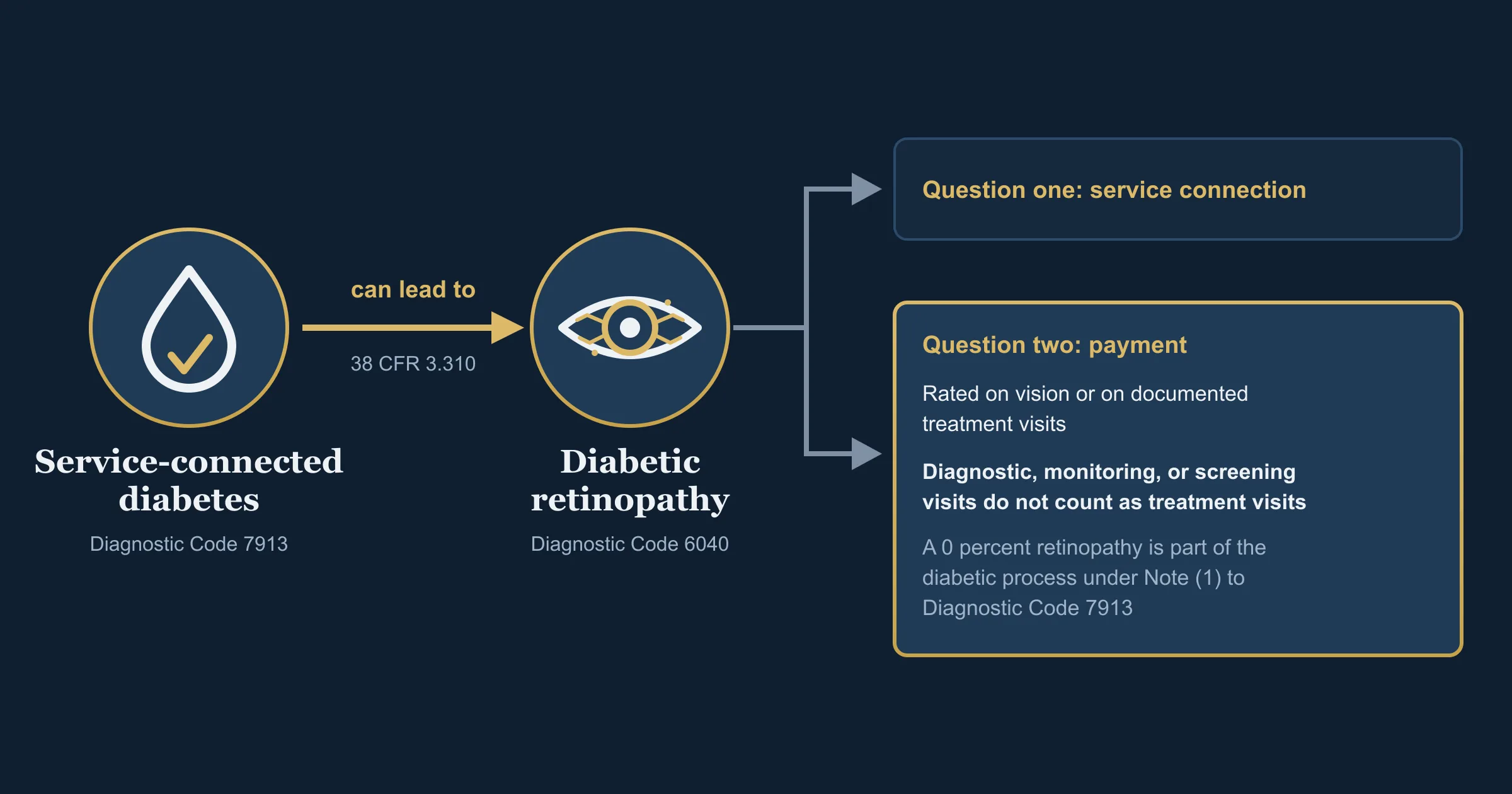
Is Diabetic Retinopathy Service Connected Secondary to Type 2 Diabetes?
It can be. In the 28 Board decisions we read for this page, no denial turned on the link itself; the details are below. The rule is 38 CFR 3.310(a): "disability which is proximately due to or the result of a service-connected disease or injury shall be service connected." The paragraph continues: "When service connection is thus established for a secondary condition, the secondary condition shall be considered a part of the original condition."
VA's adjudication manual names this exact pairing. M21-1 Part V, Subpart iii, Chapter 11, Block 2.i, the only live M21-1 text on retinopathy that a KnowVA search returned, opens: "Diabetic ophthalmological complications are largely due to blood vessel damage caused by high blood sugars such as leakage (hemorrhage) and/or blood vessel blockage." Its table of diabetic eye complications lists diabetic retinopathy first, described as "impairment or loss of vision due to damage affecting blood vessels of the retina", followed by cataract and glaucoma.
That is recognition, not an automatic grant. Block 2.b of the same chapter says: "Before conceding that a particular disability is a complication of diabetes, ensure that there is medical evidence of record supporting that determination." The manual has no rule that concedes retinopathy without evidence, and no rule that says a medical opinion is unnecessary. What the evidence has to be is left to the record; in the grants described below it was a diagnosis of diabetic retinopathy, in some with an examiner's opinion.
The manual also treats complications as part of a diabetes claim. Block 1.f: "As complications of diabetes mellitus are part of the evaluation criteria for the disease, entitlement to any additional benefits based on complications would be considered within scope of the claim." And Part V, Subpart ii, Chapter 3, Section A, Block 2.c adds that "A specific claim is not required to award a within-scope complication/residual", while requiring adequate medical evidence, "including an examination, if needed".
What the Board decisions we read show
In the 28 Board decisions we read for this page, each of the four denials of service connection for diabetic retinopathy turned on one of two things: whether retinopathy was diagnosed at all, or whether the diabetes was service connected. None turned on a finding that a diagnosed diabetic retinopathy was unrelated to service-connected diabetes. That is a count from our own reading, not a VA statistic, and it does not predict any claim.
Two grants show how short the analysis can be once both pieces exist. In 18160164 (2018) the Board wrote: "Both VA and private treatment records note a diagnosis of diabetic retinopathy. See, e.g., April 2017 VA examination and April 2016 Dr. E.T. examination. This indicates a link between the Veteran's currently service-connected type II diabetes mellitus and diabetic retinopathy." In A24074563 (2024): "A VA examination diagnosed the Veteran with type II diabetes and diabetic retinopathy as a complication of his diabetes. He is service connected for type II diabetes. As such, service connection for diabetic retinopathy is granted on a secondary basis." Both are non-precedential under 38 CFR 20.1303.
The one precondition a letter about your eyes cannot supply
The diabetes has to be service connected, or be granted in the same decision. In 18139908 (2018) the Board denied the diabetes, finding that a Navy veteran whose aircraft carrier it called a "blue water" vessel had no qualifying Vietnam service under the rules it applied in 2018, and held that "as there are no service-connected disabilities, the Veteran cannot be service connected on a secondary basis for lower extremity neuropathy and diabetic retinopathy." That 2018 decision does not tell you how current rules apply to your own service. In A25025331 (2025): "Although the Veteran is diagnosed with the disorders on appeal, secondary service connection is not available when the primary condition is not service connected." Both are non-precedential under 38 CFR 20.1303.
If your diabetes is not yet granted, start with our guide to nexus letters for diabetes.
Already Service Connected for Diabetes? Retinopathy Is a Claim for Increase
Where your diabetes is already service connected, VA's manual does not treat a newly claimed retinopathy as a fresh secondary claim. M21-1 Part V, Subpart iii, Chapter 11, Block 2.c reasons that the onset of diabetic complications "represents medical progression or worsening of diabetes" and concludes that "a claim asserting new complications of SC diabetes is a claim for increase rather than a claim for secondary SC." Block 1.j adds: "Development of new diabetic complications is evidence of an ascertainable increase in the diabetic process."
Block 2.c directs raters to consider the effective-date provisions for increases: 38 CFR 3.400(o), and 38 CFR 3.157 for periods before March 24, 2015. The operative text of 3.400(o)(2) is quoted below in full, because its conditions matter. It reaches back only to a date on which an increase is factually ascertainable, and only if a complete claim or intent to file a claim arrives within 1 year of that date.
Where the diabetes is not yet service connected, Block 2.c does not reach you. The diabetes is decided first, on the diabetes evidence, and a retinopathy claimed on a secondary theory stands or falls with it, as the precondition cases above show. For an initial claim, the 3.400 general rule is "the date of receipt of the claim or the date entitlement arose, whichever is later." VA's manual applies that rule to the diabetes and to "any separate evaluation of diabetic complications", and adds: "Consider entitlement to an earlier effective date, when applicable, under 38 CFR 3.114 and the Nehmer stipulation" (M21-1 Part V, Subpart iii, Chapter 11, Block 1.i).
Earliest date as of which it is factually ascertainable based on all evidence of record that an increase in disability had occurred if a complete claim or intent to file a claim is received within 1 year from such date, otherwise, date of receipt of claim. When medical records indicate an increase in a disability, receipt of such medical records may be used to establish effective date(s) for retroactive benefits based on facts found of an increase in a disability only if a complete claim or intent to file a claim for an increase is received within 1 year of the date of the report of examination, hospitalization, or medical treatment. The provisions of this paragraph apply only when such reports relate to examination or treatment of a disability for which service-connection has previously been established.38 CFR 3.400(o)(2)
If your diabetes was granted under an earlier herbicide-exposure policy that VA no longer applies, the manual's herbicide chapter tells raters not to propose severing that grant, and adds: "Once a disability has been service-connected (SC), even erroneously, and protection has attached, then the Veteran is entitled to increased evaluations for the disability, to SC for secondary conditions, and to awards of individual unemployability based solely or partly on those SC conditions" (M21-1 Part VIII, Subpart i, Chapter 1, Section C, Block 3.b).
The reasoning behind this lane is set out at length in our guide to erectile dysfunction secondary to diabetes. If your diabetes is already granted, do not assume a brand-new secondary claim is the right frame.
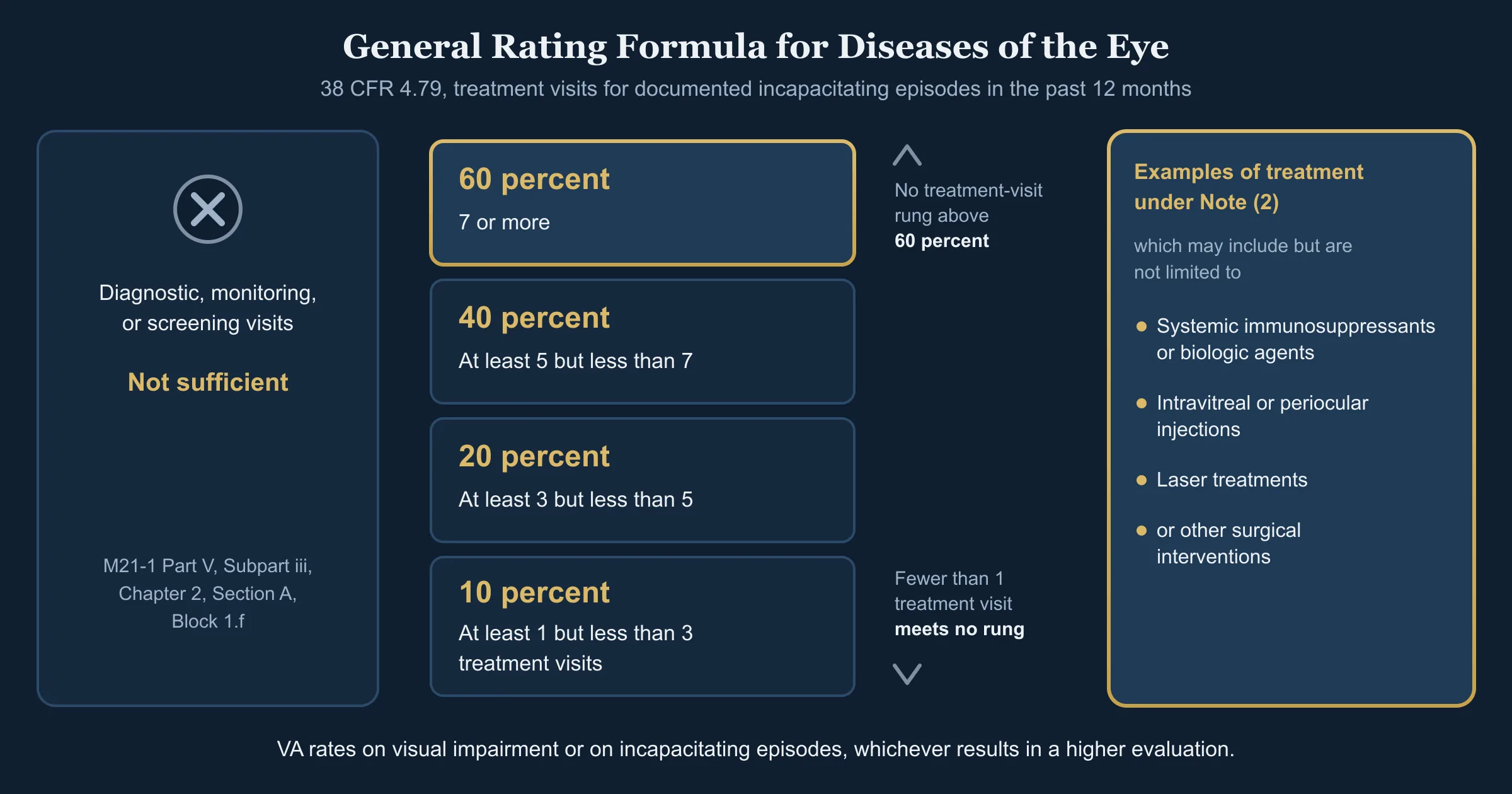
How VA Rates Diabetic Retinopathy: Vision or Treatment Visits
The diagnostic code is DC 6040 in 38 CFR 4.79. Its entry reads, in full, "6040 Diabetic retinopathy". It has no rating of its own, no note and no minimum. It sits in the list of eye diseases headed by the General Rating Formula for Diseases of the Eye, and it is rated by that formula because of where it sits. Glaucoma (DC 6012 and 6013) and cataract (DC 6027) say in their own entries to evaluate under the formula; DC 6040 does not, but the result is the same.
The formula offers two routes and takes the better one: "Evaluate on the basis of either visual impairment due to the particular condition or on incapacitating episodes, whichever results in a higher evaluation." Vision is one route. Documented treatment visits are the other.
General Rating Formula for Diseases of the Eye, 38 CFR 4.79, incapacitating episodes route (rows as printed)
| Row text | Rating |
|---|---|
| With documented incapacitating episodes requiring 7 or more treatment visits for an eye condition during the past 12 months | 60 percent |
| With documented incapacitating episodes requiring at least 5 but less than 7 treatment visits for an eye condition during the past 12 months | 40 percent |
| With documented incapacitating episodes requiring at least 3 but less than 5 treatment visits for an eye condition during the past 12 months | 20 percent |
| With documented incapacitating episodes requiring at least 1 but less than 3 treatment visits for an eye condition during the past 12 months | 10 percent |
The formula has no 0 percent row and no row above 60 percent.
Note (1): For the purposes of evaluation under 38 CFR 4.79, an incapacitating episode is an eye condition severe enough to require a clinic visit to a provider specifically for treatment purposes38 CFR 4.79, General Rating Formula for Diseases of the Eye
Note (2): Examples of treatment may include but are not limited to: Systemic immunosuppressants or biologic agents; intravitreal or periocular injections; laser treatments; or other surgical interventions38 CFR 4.79, General Rating Formula for Diseases of the Eye
The vision route: corrected acuity, then fields
Visual impairment is measured under 38 CFR 4.75 to 4.78 and converted to a percentage by the acuity table at DC 6061 to 6066, inside 4.79 itself. The measure is corrected vision, with one narrow exception. 4.76(b)(1): "Evaluate central visual acuity on the basis of corrected distance vision with central fixation, even if a central scotoma is present." The same paragraph lets the rater use the poorer eye's uncorrected or corrected acuity, whichever gives the better combined acuity, when its correcting lens differs by more than three diopters from the better eye's, the difference is not congenital or developmental, and the poorer eye or both eyes are service connected. Where a reading falls between two listed acuities, 4.76(b)(4) says to "use the visual acuity which permits the higher evaluation."
The examination itself has rules. 4.75(b): "The examination must be conducted by a licensed optometrist or by a licensed ophthalmologist. The examiner must identify the disease, injury, or other pathologic process responsible for any visual impairment found." And: "Unless medically contraindicated, the fundus must be examined with the claimant's pupils dilated." M21-1 Part V, Subpart iii, Chapter 2, Section A, Block 1.g adds that "Actual pathology, other than refractive error, is required to support impairment of visual acuity."
Field loss is a separate measurement. When service-connected acuity and field impairments are both present, 4.77(c) has the rater evaluate each, express the field defect as a level of acuity, and combine them under 38 CFR 4.25; the manual restates this at Block 1.e. In the DRCR Retina Network's Protocol S trial of 394 eyes with proliferative diabetic retinopathy in 305 US adults, mean peripheral visual field loss over 2 years was worse with panretinal laser than with ranibizumab injections (PMID 26565927), so field loss documented after laser is one situation where that route can matter.
Selected rows from the central visual acuity table, 38 CFR 4.79, DC 6061 to 6066 (corrected vision)
| One eye | The other eye | Rating |
|---|---|---|
| 20/40 | 20/40 | 0 percent |
| 20/50 | 20/40 | 10 percent |
| 20/50 | 20/50 | 10 percent |
| 20/70 | 20/40 | 10 percent |
| 20/100 | 20/40 | 10 percent |
| 20/200 | 20/40 | 20 percent |
| 5/200 (DC 6065) | 20/40 | 30 percent |
| No more than light perception (DC 6064) | 20/40 | 30 percent |
| Anatomical loss of the eye (DC 6063) | 20/40 | 40 percent |
| No more than light perception in both eyes (DC 6062) | 100 percent |
DC 6061 to 6064, and the 5/200-in-both-eyes row of DC 6065, carry a footnote: "Review for entitlement to special monthly compensation under 38 CFR 3.350." The table has no row for vision better than 20/40; 20/40 in each eye is 0 percent.
Put the two routes together and the arithmetic is plain. A retinopathy that leaves corrected vision at 20/40 or better in each eye, with no field defect and no treatment visits, meets no row on either route. A single documented treatment visit in 12 months reaches 10 percent on the episode route even when the vision route pays nothing. That is the regulation's text, not a forecast for anyone's claim.
How VA measures acuity and fields for every eye condition is laid out on our eye conditions page.
Why Screening Eye Exams Do Not Count, and What Does
The money on the episode route is in treatment visits, and VA's manual draws the line in one sentence.
An incapacitating episode, for the purpose of evaluating diseases of the eye, is a situation in which symptoms are severe enough to require a clinic visit to a provider specifically for treatment purposes.M21-1 Part V, Subpart iii, Chapter 2, Section A, Block 1.f
A clinic visit for diagnostic, monitoring, or screening purposes is not sufficient to satisfy the criteria for a clinic visit for treatment purposes.M21-1 Part V, Subpart iii, Chapter 2, Section A, Block 1.f, Note
So the dilated eye exams the diabetes guidelines recommend, the teleretinal photo, and the follow-up visit where the doctor looks and schedules the next look are not treatment visits on that wording. The manual does not itself name injections or laser; for examples of treatment it points to Notes (1) and (2) of 4.79, and Note (2) names "intravitreal or periocular injections; laser treatments; or other surgical interventions", among others, and says the examples are not limited to those.
Two things the text does not say. It does not define "documented", and it does not say whether a single visit that both monitors and treats counts as a treatment visit. We state no rule on either.
The proof is in the treatment records
In A25002903 (2025) the Board granted 60 percent for bilateral diabetic retinopathy with macular edema: "The Veteran has documented incapacitating episodes requiring 7 or more treatment visits in the past 12 months. The Veteran visits his provider for treatment purposes, including intravitreal injections, every 4-6 weeks". The VA examiner had recorded no incapacitating episodes without access to the private treatment records, and the Board held that finding inadequate. On vision alone the Board found the evidence supported "a rating of no higher than 10 percent under DC 6066."
In A25108548 (2025) private records showed "six intravitreal injections in his right eye within a one-year period between March 30, 2022, and March 30, 2023", which the Board held "meets the 40 percent rating criteria". It went no higher: "because the Board does not have records showing the time period over which the Veteran had this injection schedule, it cannot make this assumption." Dated records set the count; an undocumented schedule was not assumed.
In A25023528 (2025) the Board counted visit by visit across private and military treatment records, crediting one October 2023 injection from the veteran's own statement, found "ten treatment visits" from November 2022 to November 2023, and granted 60 percent. It added: "When counting the treatment visits, it is necessary to confirm the visits were for service-connected conditions."
When the visits are monitoring only
In A25071932 (2025), a type 1 diabetes case, VA records showed the veteran "sees an optometrist for monitoring of his bilateral diabetic retinopathy and bilateral cataracts"; he denied receiving treatment, and his corrected distance vision was 20/40 on the right and 20/20 or better on the left. The Board denied a compensable rating. His uncorrected right-eye vision was 20/200; corrected vision controlled.
A26038893 (2026) shows both sides in one appeal. The veteran received injections on June 3, July 15 and September 21, 2021, and the Board granted 20 percent from April 22 to September 21, 2021. After that, "He now sees his eye doctor every six months, though there is no indication of further injections after September 21, 2021", and the rating for the later period was 0 percent.
All of these decisions are non-precedential under 38 CFR 20.1303.
Periods before May 13, 2018 used a different test
DC 6040 and the treatment-visit formula date from May 13, 2018. The version in force on January 1, 2018 rated by duration, at 60 percent "With incapacitating episodes having a total duration of at least 6 weeks during the past 12 months", and listed retinopathy under DC 6006. In 18152891 (2018) the Board explained that "under the rating criteria in effect prior to May 13, 2018, an 'incapacitating episode' required prescribed bed rest". It found that left-eye vitreous hemorrhages before that date, for which the veteran was told to keep his head elevated and avoid strenuous activity rather than prescribed bed rest, did not support a higher rating on episodes. The Board cited the earlier laser, injections and vitrectomy as a reason to keep the 40 percent vision rating, not as episodes (non-precedential, 38 CFR 20.1303).
The manual's notes run both ways for older ratings. Block 1.f says the 2018 changes "were not liberalizing changes", and Block 1.j says the changes in rating criteria "should not be the basis for a reduction in disability rating unless medical evidence establishes that the disability has actually improved." The Board decisions we read did not draw the line in one place. In 18152891 (2018) the Board applied the bed-rest definition to vitreous hemorrhages that occurred before May 13, 2018. In 24033557 (2024) the Board wrote that "an increased evaluation based on the revised criteria cannot predate the effective date of the amendments", rated the period before March 26, 2018 on bed rest documented by a treating physician, and then granted 60 percent for the period beginning March 26, 2018 by counting intravitreal injection visits, about seven weeks before May 13, 2018. Both are non-precedential under 38 CFR 20.1303, and we state no rule for a period that straddles May 13, 2018.
Tell every clinician and examiner what actually happens with your eyes, fully and accurately. The rating turns on dated records of what was done at each visit, and the place to get them is your eye clinic.
Zero Percent Diabetic Retinopathy and Note (1) to the Diabetes Rating
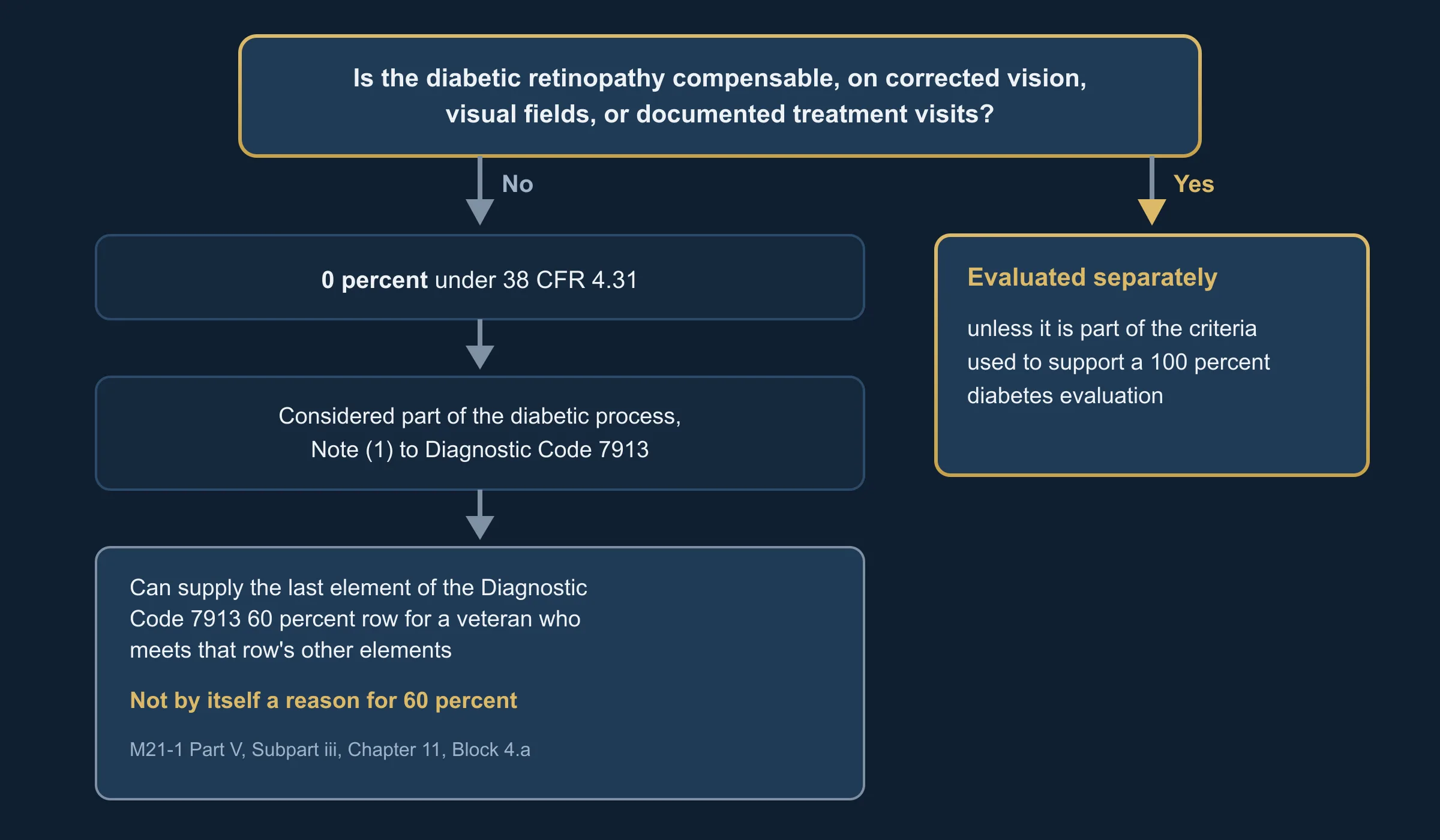
Mild retinopathy with corrected vision of 20/40 or better in each eye, no field defect and no treatment visits meets no row of the eye formula. The schedule then supplies the number. 38 CFR 4.31: "In every instance where the schedule does not provide a zero percent evaluation for a diagnostic code, a zero percent evaluation shall be assigned when the requirements for a compensable evaluation are not met."
Note (1): Evaluate compensable complications of diabetes separately unless they are part of the criteria used to support a 100-percent evaluation. Noncompensable complications are considered part of the diabetic process under DC 7913.38 CFR 4.119, DC 7913
A 0 percent retinopathy has not been denied. It is a noncompensable complication, and Note (1) places it inside the diabetes rating. M21-1 Part V, Subpart iii, Chapter 11, Block 2.b repeats both halves of the note, and Example 1 at Block 4.a tells raters to "Include the noncompensable complications under 38 CFR 4.119, DC 7913." In A26019674 (2026) the Board's conclusion of law was that "The Veteran's bilateral diabetic retinopathy is a noncompensable complication of diabetes considered part of the diabetic process. 38 C.F.R. 4.119, Diagnostic Code (DC) 7913." Older decisions reached the same result, among them 1803104 (2018), where the retinopathy was "incorporated into the Veteran's current 20 percent evaluation for diabetes mellitus, type II." Both are non-precedential under 38 CFR 20.1303.
A 0 percent grant still does something. The retinopathy is on the record as a complication of the diabetes. If the retinopathy later needs treatment or costs vision, the question is its rating, not whether it is connected, and the effective date of that increase is governed by 3.400(o)(2), quoted in the filing section.
Where a 0 percent retinopathy can still matter
The 60 percent row of DC 7913 reads, in full: "Requiring one or more daily injection of insulin, restricted diet, and regulation of activities with episodes of ketoacidosis or hypoglycemic reactions requiring one or two hospitalizations per year or twice a month visits to a diabetic care provider, plus complications that would not be compensable if separately evaluated." For a veteran who already meets every other element, a documented noncompensable retinopathy can supply the last one.
The manual shuts the opposite reading. Example 1 at Block 4.a: "Do not evaluate the diabetes mellitus at 60 percent simply because noncompensable complications are present." Its situation is a veteran with noncompensable complications but no ketoacidosis or hypoglycemic reactions, rated at 40 percent if insulin, restricted diet and regulation of activities are required.
When the retinopathy is compensable
Then Note (1)'s first sentence applies: a compensable complication is evaluated separately, unless it is part of the criteria used to support a 100 percent diabetes evaluation. The 100 percent row reads: "Requiring more than one daily injection of insulin, restricted diet, and regulation of activities (avoidance of strenuous occupational and recreational activities) with episodes of ketoacidosis or hypoglycemic reactions requiring at least three hospitalizations per year or weekly visits to a diabetic care provider, plus either progressive loss of weight and strength or complications that would be compensable if separately evaluated."
A compensable retinopathy used to meet that row is not also evaluated separately. The manual's Block 4.c note gives the converse: "If compensable complications are not considered in reaching the 100- percent evaluation, they may be separately evaluated." Note (1) does not say what happens when the 100 percent row is met by progressive loss of weight and strength instead; on its wording the exception applies only when the complications are part of the criteria used. The manual's worked example of a separately evaluated complication, Block 4.b, is peripheral neuropathy; none of its three examples names an eye condition.
Pyramiding is a different rule
The fold-in comes from Note (1), not from the pyramiding rule. 38 CFR 4.14 provides that "The evaluation of the same disability under various diagnoses is to be avoided", and bars "the evaluation of the same manifestation under different diagnoses". Retinopathy is evaluated on corrected vision, fields and treatment visits, none of which is a criterion in any DC 7913 row, so on our reading of the text 4.14 does not bar a diabetes rating and a compensable retinopathy rating side by side. Where 4.14 does bite is inside the eye, between eye conditions, covered next.
The full ladder of diabetes ratings is on our type 2 diabetes condition page.
Diabetic Retinopathy, Glaucoma and Cataract in the Same Eye
M21-1 lists all three as diabetic eye complications, and all three can route to the same formula. Diabetic retinopathy is DC 6040; angle-closure and open-angle glaucoma are DC 6012 and 6013, each with a "Minimum evaluation if continuous medication is required" of 10 percent; a preoperative cataract under DC 6027 is evaluated under the General Rating Formula. They are measured on the same eyes, with the same acuity and the same fields.
That is where 4.14 applies. Rating the same lost vision once under 6040 and again under 6013 would be "the evaluation of the same manifestation under different diagnoses". VA's manual puts it this way at Part V, Subpart ii, Chapter 3, Section D, Block 2.b: "Pyramiding is rating the same physical manifestations of a disability under two separate DCs. Separate evaluations are warranted where none of the symptomatology for any one condition duplicates or overlaps another (Esteban v. Brown, 6 Vet.App. 259, 261-62 (1994))."
In 24033557 (2024) the Board denied a separate rating for cataracts in eyes already rated for retinopathy: "the loss of visual acuity is being contemplated in the current evaluation of his service-connected bilateral eye disability." In A25071932 (2025) retinopathy and cataracts were carried as one bilateral eye disability. Both are non-precedential under 38 CFR 20.1303.
Each eye condition needs its own link
Service connection for retinopathy does not carry other eye conditions with it. In A26014308 (2026) the Board granted retinopathy on an April 2024 VA examiner's opinion but denied other vision impairment in the same eyes. In that same opinion the examiner explained that "cataracts are a normal age related finding, and dry eye syndrome is multifactorial", and of a May 2024 opinion on toxic exposure the Board said "the examiner merely mentioned diabetes as a potential risk factor". It also held that "As presbyopia is shown to be a refractive error, the disorder is not a disease or injury for purposes of service connection." In 18155185 (2018) the Board described age-related cataracts in the same eyes as "non-service-connected"; corrected vision was 20/40 or better in both eyes either way. Both are non-precedential under 38 CFR 20.1303.
When service-connected and non-service-connected findings cannot be pulled apart, the manual resolves it for the veteran, Block 2.c of the same section: "if it is not possible to differentiate the Veteran's symptoms from an SC and NSC disability, all symptoms should be deemed related to the SC disability and rated accordingly." It adds: "The decision that the symptoms of the SC and NSC disabilities cannot be separated is a medical determination."
Treatment visits for two conditions
A25023528 counted visits for a retinal detachment toward the retinopathy only because a VA examiner tied the detachment to the proliferative retinopathy, and the Board said visits must be "for service-connected conditions" (non-precedential, 38 CFR 20.1303). The regulation is silent on how to count one visit that treats both a service-connected and another eye condition, and on whether episode ratings for two eye conditions in the same eye may be combined. We state no rule on either.
One eye: the 20/40 rule and the 30 percent cap
4.75(c): "Subject to the provisions of 38 CFR 3.383(a), if visual impairment of only one eye is service-connected, the visual acuity of the other eye will be considered to be 20/40 for purposes of evaluating the service-connected visual impairment." The manual repeats it at Part V, Subpart iii, Chapter 2, Section A, Block 1.i, "either directly or by aggravation". Where retinopathy in both eyes is service connected, both eyes are measured as they are.
The exception in 3.383(a) pays as if both eyes were service connected, provided the non-service-connected impairment is not the result of the veteran's own willful misconduct, when, for impairment of vision in one eye from service-connected disability and in the other eye from non-service-connected disability, either "The impairment of vision in each eye is rated at a visual acuity of 20/200 or less" or "The peripheral field of vision for each eye is 20 degrees or less."
4.75(d): "The evaluation for visual impairment of one eye must not exceed 30 percent unless there is anatomical loss of the eye." That is the whole exception; the paragraph has no light-perception clause. The text is silent on how this cap interacts with a rating on the episode route, which is not based on visual impairment, so we make no claim either way.
Glaucoma's own rating rules, including the medication minimum, are on our glaucoma page.
Agent Orange: Type 2 Diabetes Is Presumptive, Diabetic Retinopathy Is Not
38 CFR 3.309(e) lists the diseases presumed service connected for a veteran exposed to an herbicide agent when the requirements of 3.307(a)(6) are met and the rebuttable presumption provisions of 3.307(d) are satisfied, and type 2 diabetes is on it: "Type 2 diabetes (also known as Type II diabetes mellitus or adult-onset diabetes)". Retinopathy is not. The string "retinopath" appears zero times in all of 3.309, and so does the word "eye". M21-1's herbicide rating chapter (Part VIII, Subpart i, Chapter 1, Section C, Block 1.d) lists "Type 2 diabetes mellitus" and says nothing about its complications.
So retinopathy reaches service connection through the diabetes, under 3.310, not through the presumption. In every decision in our set where herbicide exposure was conceded and the diabetes was service connected (18144832, 18149140, A24074563, A25034440), the retinopathy claim ran through the diabetes, as secondary to it or as a complication of the diabetic process, and in none of them as its own presumptive condition; A24074563 granted it "on a secondary basis", and A25034440 was denied for lack of a diagnosis before the link was reached. When the diabetes claim failed, in 18139908 and A25025331, the retinopathy failed with it. All are non-precedential under 38 CFR 20.1303.
For Vietnam service, 3.307(a)(6)(iii) presumes exposure for a veteran who "served in the Republic of Vietnam during the period beginning on January 9, 1962, and ending on May 7, 1975", unless affirmative evidence shows otherwise. The PACT Act's added locations are in the statute, 38 U.S.C. 1116, not in the text of 3.307(a)(6) as of the August 27, 2026 issue we read.
The research matches the legal route. A study of Operation Ranch Hand veterans found higher serum dioxin associated with more diabetes (relative risk 1.5), which supports the diabetes link, not a direct retinopathy link (PMID 9115019). One cross-sectional study of Korean Vietnam veterans reported more retinopathy among those with higher estimated exposure, but it did not specify diabetic retinopathy and estimated exposure by interview (PMID 12916744). We found no study measuring diabetic retinopathy as an outcome of Agent Orange exposure.
The herbicide presumptions themselves are covered in our Agent Orange guide.
When a Nexus Letter for Diabetic Retinopathy Actually Helps
We write nexus letters, and this section starts with when you do not need one. VA's own process is built to find this complication.
When you may not need a letter
On a diabetes claim, M21-1 Part V, Subpart iii, Chapter 11, Block 1.g directs that "The Diabetes Mellitus Disability Benefits Questionnaire must address all diabetic complications present, to include completion of additional DBQs as appropriate." And: "If the examiner fails to address all diabetic complications and complete all necessary DBQs, the examination must be returned as insufficient."
If your diabetes is service connected, an eye doctor has diagnosed diabetic retinopathy, and no examiner or decision has named another cause, the record may already hold the medical evidence VA's manual asks for, and a letter restating the link adds little. Treatment-visit counts do not need a letter either: they come from your treating eye clinic's records.
1. An examiner names another cause for the eye findings
Retinal changes are not all diabetic. A 2007 Lancet review describes hypertensive retinopathy as "retinal microvascular signs that develop in response to raised blood pressure" and notes that high blood pressure "increases the risk of both development of diabetic retinopathy and its progression" (PMID 17276782). A meta-analysis found retinal vein occlusion, a different retinal condition, linked more strongly to hypertension and hyperlipidemia than to diabetes (PMID 18474782). Age-related macular degeneration is a separate, age-driven cause of central vision loss in people over 55 (PMID 36996856), and a West Los Angeles VA teleretinal screening study referred patients to eye clinic as glaucoma suspects and for age-related macular degeneration as well as for retinopathy (PMID 26985625).
M21-1's warning about other causes, at Block 2.b, uses a neurological example and names no eye example, so any eye-specific competing-cause argument is a medical question rather than a manual rule. That is where an opinion does real work: naming each competing explanation in the record, what the findings show about it, and why the diabetic explanation is or is not at least as likely as not. Where diabetic and non-diabetic findings cannot be separated, the manual treats that separation as "a medical determination" and resolves an inseparable record for the veteran. In our 28-decision sample, no decision denied retinopathy because a doctor attributed it to hypertension; this is a situation to be ready for, not one we saw decided.
2. The diabetes claim itself is contested
Then the opinion that matters is about the diabetes, not the eyes. In A24056203 (2024) private opinions from a neurologist carried the diabetes claim: the Board found that they "bring the evidence addressing the cause of the Veteran's current diabetes mellitus at least into relative equipoise" against negative VA opinions. The retinopathy link then came from a VA opinion, and the Board found "a present diagnosis of diabetic retinopathy and a positive nexus opinion associating the condition with the Veteran's now service-connected diabetes mellitus, type II" (non-precedential, 38 CFR 20.1303).
3. An eye condition existed before the diabetes and got worse
That is aggravation under 38 CFR 3.310(b): "Any increase in severity of a nonservice-connected disease or injury that is proximately due to or the result of a service-connected disease or injury, and not due to the natural progress of the nonservice-connected disease, will be service connected." The regulation also requires a baseline: VA "will not concede" aggravation "unless the baseline level of severity of the nonservice-connected disease or injury is established by medical evidence created before the onset of aggravation or by the earliest medical evidence created at any time between the onset of aggravation and the receipt of medical evidence establishing the current level of severity of the nonservice-connected disease or injury."
VA's manual, updated May 1, 2026, applies a broader standard than the regulation's natural-progress sentence: "In accordance with the Spicer holding, the Department of Veterans Affairs (VA) will apply the broader but-for standard and will no longer consider natural progress of the NSC disability when deciding a claim based on aggravation of an NSC disability by an SC disability" (Part V, Subpart ii, Chapter 2, Section D, Block 1.a). Block 1.e lists what an aggravation examination must contain, including the current level of severity and an opinion with "an adequate analysis with medical considerations supporting the opinion." Block 1.g: "The evaluation assigned will reflect the difference between the current and baseline levels of severity." Block 1.h: "To justify SC, the degree of disability after aggravation does not have to be at least one level of evaluation higher than the baseline." Your earliest eye records are the baseline evidence, and an opinion has to work from them.
4. A VA exam recorded no treatment visits that your records show
In A25002903 and 24033557 VA examiners recorded no incapacitating episodes, and the Board found injection treatment in the records anyway; in 24033557 it wrote that "after a thorough review of the Veteran's records, the Board observes that the Veteran had received intravitreal injection treatments" (both non-precedential, 38 CFR 20.1303). The fix here is the dated treatment records themselves, in the file. A medical opinion that lays out the visit dates is one way to point the rater at them, not the only way.
What a Private Eye Record or Opinion Has to Contain
The clearest example in the Board decisions we read is a private document that could not establish a diagnosis.
In A25034440 (2025) the veteran's herbicide exposure and diabetes were conceded. The private evidence was an optometrist's photoscreening letter. In describing the evidence, the Board wrote: "The provider wrote that there was 'evidence of early diabetic retinopathy in one or both eyes' but did not provide a diagnosis for either eye, did not provide test results, and did not provide an etiology opinion." A June 2019 VA examiner found "there was insufficient evidence to confirm what the private examiner saw". VA examinations, including an August 2019 exam with a dilated fundus examination, found no retinopathy, and the Board found that "At no time during the pendency of the claim did the Veteran have a diagnosis of diabetic retinopathy". The Board denied on the missing diagnosis and did not reach the link (non-precedential, 38 CFR 20.1303).
18145236 (2018) turned on the same element from the other side: a single September 2010 VA note of mild retinopathy in the right eye was followed by a March 2013 VA record that found none in either eye, and the 2010 assessment "falls well outside the current appeal period". The Board found that "the weight of the evidence strongly supports a finding that the Veteran does not have a confirmed, consistent diagnosis of retinopathy and has not had such a diagnosis at any time during the appeal period" (non-precedential, 38 CFR 20.1303).
What the record needs, element by element
- A diagnosis, eye by eyeDiabetic retinopathy named as the diagnosis for each affected eye, current during the claim. VA's manual asks raters to "Cite the actual disease, injury, or other basic condition as the diagnosis, rather than a mere citation of impaired visual acuity, field of vision, or motor efficiency" (M21-1 Part V, Subpart iii, Chapter 2, Section A, Block 1.g). In 18158920 (2018) the Board preferred an eye-specific examination by an ophthalmologist to a general diabetes examination by a nurse practitioner on whether retinopathy existed, because "the January 2014 VA examination was conducted by an ophthalmologist and specific to the eyes" (non-precedential, 38 CFR 20.1303).
- The findings and test results behind itThe examination findings and the measured results: corrected acuity for each eye, any field testing, and what the retinal examination showed. VA's own examination standard in 38 CFR 4.75(b) requires a licensed optometrist or ophthalmologist, the identification of the disease responsible for any impairment, and a dilated fundus examination unless medically contraindicated. That rule governs VA's examination; it shows what a rater expects to see.
- An etiology opinion with reasons, where the link is in questionWhere the diabetic cause is disputed, a stated medical probability and the reasoning for it, including any competing cause in the record.
- Treatment visits, datedFor the rating, the dates and nature of each treatment visit in the past 12 months. These come from the treating clinic's records; a letter can summarize them but cannot replace them.
VA weighs the whole record under 38 CFR 3.102. Where there is "an approximate balance of positive and negative evidence which does not satisfactorily prove or disprove the claim", the doubt "will be resolved in favor of the claimant." That standard does not depend on any document using particular words.
What we cannot do
A diagnosis has to come from the clinicians who treat or examine you; a letter from us cannot create one your records lack. We will not sign an opinion the records cannot support, and no one can tell you in advance what rating VA will assign. We write the medical evidence; representing veterans and filing claims are outside our work.
The general elements VA looks for in any medical opinion are in our guide to what a nexus letter must include.
What the Medical Research Says About Diabetic Retinopathy
Research supports a physician's reasoning about one veteran; it cannot answer VA's question for him. Each finding is labelled for what it is and the group it came from.
A diabetes-specific complication
The American Diabetes Association's 2026 Standards of Care state: "Diabetic retinopathy is a highly specific neurovascular complication of diabetes, with prevalence strongly related to both the duration of diabetes and the level of chronic hyperglycemia" (PMID 41358886). A 2016 review describes "Complex interrelated pathophysiological mechanisms triggered by hyperglycaemia" behind it (PMID 27159554).
How frequent it is, and in whom
In a national US survey sample (NHANES 2005 to 2008) of adults with diabetes aged 40 and older, estimated prevalence was 28.5 percent, with retinopathy associated with higher HbA1c, longer diabetes duration, insulin use and higher systolic blood pressure; the abstract does not separate type 1 from type 2 (PMID 20699456). A pooled analysis of 35 population studies from around the world (1980 to 2008) found every retinopathy prevalence measure rose with diabetes duration, HbA1c and blood pressure, and was higher in type 1 than in type 2 diabetes (PMID 22301125).
Veteran samples, and what is missing
In a chart review of 200 patients with diabetes who had teleretinal imaging at Portland VA Medical Center clinics in 2010, 10 percent had diabetic retinopathy (PMID 26230276). At the West Los Angeles VA, 15 percent of 120 reviewed screening charts showed nonproliferative diabetic retinopathy (PMID 26985625). A national VA study found 74 percent of veterans with diabetes and no prior retinopathy were screened within 2 years, ranging from 27 to 86 percent by catchment area; that is a screening rate, not a prevalence (PMID 37419770). We found no national VA prevalence figure and state none.
Blood sugar and progression
In the ACCORD Eye study of 2,856 people with type 2 diabetes at high cardiovascular risk, 4-year progression (3 or more steps on the Early Treatment Diabetic Retinopathy Study photo scale, or needing laser or vitrectomy) was 7.3 percent with intensive glycemic treatment versus 10.4 percent with standard therapy (PMID 20587587). In the Veterans Affairs Diabetes Trial, among 858 participants with poorly controlled diabetes who had eye photos at baseline and 5 years, each 1 percent higher baseline HbA1c went with about 30 percent higher odds of progression (but not incidence); in the whole group, intensive treatment was not independently associated with retinopathy, and it went with lower incidence in participants aged 55 or younger and higher incidence in those aged 70 or older (PMID 24599110). In UKPDS 33, newly diagnosed type 2 patients randomized to intensive control had a 25 percent lower risk of a microvascular composite that included needing retinal laser, not retinopathy alone (PMID 9742976).
Blood pressure: two trials, two different comparisons
UKPDS 38, in 1,148 hypertensive patients with type 2 diabetes, compared a blood pressure target below 150/85 with a target below 180/105 and reported, after nine years, "a 34% reduction in risk in the proportion of patients with deterioration of retinopathy by two steps" (PMID 9732337). ACCORD Eye, in people with type 2 diabetes at high cardiovascular risk, compared systolic targets below 120 and below 140 and found that the lower target did not reduce progression (PMID 20587587). They tested different targets in different groups, and neither settles the question for an individual.
Progression rates
A 2019 systematic review that focused on eight population-based studies conducted after 2000 (five from Asia, one each from North America, the Caribbean and sub-Saharan Africa) reported annual incidence ranging from 2.2 to 12.7 percent and progression from 3.4 to 12.3 percent, and found progression to the proliferative stage higher in people with mild disease than in those with none at baseline; the authors called for more high-quality studies (PMID 30005958). None of those figures is from US veterans. We found no verified figure for the share of eyes with mild nonproliferative retinopathy that progress to proliferative disease in a fixed period, and state none.
Screening is not treatment
The ADA recommends: "People with type 2 diabetes should have an initial dilated and comprehensive eye examination by an ophthalmologist or optometrist at the time of the diabetes diagnosis." If any retinopathy is present, it recommends repeat dilated exams at least annually; if exams are normal and glycemic indicators are at goal, every 1 to 2 years may be considered (PMID 41358886). An exam done only to screen or monitor is the kind of visit VA's manual says is not sufficient for the episode count; whether a visit that also treats counts is a question the text leaves open.
Treatment, and why visit counts vary
The ADA states that "Panretinal laser photocoagulation therapy is indicated to reduce the risk of vision loss in individuals with high-risk PDR and, in some cases, severe nonproliferative diabetic retinopathy" and that "Intravitreous injections of anti-VEGF are indicated as first-line treatment for most eyes with diabetic macular edema that involves the foveal center and impairs visual acuity" (PMID 41358886). In the DRCR Retina Network's Protocol T trial of 660 people with visual acuity impairment from center-involved macular edema, median injections were 15, 16 and 15 over 2 years across the three drugs, with visits every 4 weeks in year 1; that is a trial protocol, not real-world VA frequency (PMID 26935357). In the DRCR Retina Network's Protocol V trial of 702 adults with type 1 or type 2 diabetes, each with center-involved macular edema in one eye and vision of 20/25 or better, there was "no significant difference in vision loss at 2 years whether eyes were initially managed with aflibercept or with laser photocoagulation or observation and given aflibercept only if visual acuity worsened"; aflibercept was later started in 25 percent of the laser group and 34 percent of the observation group (PMID 31037289). So not every diagnosed eye is treated at once, and real-world VA injection frequency is not measured in our sources.
The American Academy of Ophthalmology publishes a Preferred Practice Pattern for diabetic retinopathy (the 2024 Preferred Practice Pattern, published in Ophthalmology in 2025; PMID 39918521). Its PubMed record has no abstract, and we attribute no finding to it.
What this means for the opinion
The research supports what VA's manual already accepts, that diabetic retinopathy is a diabetic eye complication, and it explains why other retinal causes have to be considered. It decides no individual claim, and no study we found decides whether a given clinic visit is a treatment visit; that is a rating-schedule question.
What Board of Veterans' Appeals Decisions Show
We read 28 Board decisions at their ORDER blocks and holdings. These are the ones this page relies on, grants of service connection kept apart from decisions about the percentage. They show the range, denials included, not a grant rate.
Board decisions are not precedent. Under 38 CFR 20.1303, "previously issued Board decisions will be considered binding only with regard to the specific case decided." Each entry is described only for the issue it decided.
Service connection: is the retinopathy connected to the diabetes?
Citation Nr 18144832 (2018)
Granted: service connection for diabetic retinopathy, secondary to diabetes service connected on the herbicide presumption.
The Board found "the nexus component of secondary service connection has been satisfied" by a private eye-care record noting diabetic retinopathy and "diabetes with ocular involvement". It gave two VA opinions "minimal probative value": one "did not consider that the Veteran had diabetes", and the other "was not definitive".
Why it matters. An eye-care record that names the condition as diabetic carried the link where the VA opinions missed the diabetes or were tentative.
Non-precedential: binds only this case (38 CFR 20.1303).
Citation Nr A24056203 (2024)
Granted: diabetes secondary to service-connected sleep apnea, and diabetic retinopathy secondary to the diabetes.
Private opinions brought the diabetes evidence "at least into relative equipoise" against negative VA opinions. The retinopathy link came from a VA opinion that the retinopathy "is by definition caused by or a result of diabetes mellitus" (the examiner's words, recited by the Board).
Why it matters. The two-link chain: the contested opinion was about the diabetes; the retinopathy followed it.
Non-precedential: binds only this case (38 CFR 20.1303).
Citation Nr 18158920 (2018)
Granted: service connection for an eye disorder secondary to service-connected type II diabetes.
The Board found an ophthalmologist's eye-specific VA examination "more probative with respect to the diagnosis of diabetic retinopathy" than a general diabetes examination by a nurse practitioner, and noted "There are no contrary etiological opinions of record."
Why it matters. On whether retinopathy exists, an eye-specific examination by an eye specialist carried more weight.
Non-precedential: binds only this case (38 CFR 20.1303).
Citation Nr 18160164 (2018)
Granted: service connection for diabetic retinopathy.
VA and private records both diagnosed diabetic retinopathy, and the Board found that this "indicates a link" to the service-connected diabetes, adding: "There is no evidence counter to a finding that diabetic retinopathy is secondary to diabetes mellitus."
Why it matters. Diagnosis plus service-connected diabetes, with nothing contrary, closed the claim.
Non-precedential: binds only this case (38 CFR 20.1303).
Citation Nr A24074563 (2024)
Granted: service connection for diabetic retinopathy, on a secondary basis, for a Vietnam veteran with conceded herbicide exposure.
A VA examination diagnosed "diabetic retinopathy as a complication of his diabetes"; with the diabetes service connected, the Board granted "on a secondary basis."
Why it matters. Agent Orange diabetes, secondary retinopathy, decided in two sentences.
Non-precedential: binds only this case (38 CFR 20.1303).
Citation Nr A26014308 (2026)
Granted: diabetic retinopathy secondary to service-connected diabetes. Denied: other vision impairment, including undiagnosed illness.
The retinopathy grant rested on an April 2024 VA examiner's opinion that it "was at least as likely as not due to his diabetes mellitus type II". In the same opinion the examiner found the cataracts age related and the dry eye multifactorial, and the Board read it as showing they "were not caused or aggravated by the service-connected diabetes mellitus type II".
Why it matters. Each eye condition needs its own link; retinopathy's does not carry the others.
Non-precedential: binds only this case (38 CFR 20.1303).
Citation Nr A25034440 (2025)
Denied: service connection for diabetic retinopathy, with herbicide exposure and diabetes conceded.
In the Board's description, a private photoscreening letter "did not provide a diagnosis for either eye, did not provide test results, and did not provide an etiology opinion"; VA examinations found no retinopathy, and the denial rested on the missing diagnosis.
Why it matters. A screening result is not a diagnosis; this record lacked a diagnosis for either eye and the findings behind it.
Non-precedential: binds only this case (38 CFR 20.1303).
Citation Nr 18145236 (2018)
Denied: service connection for visual impairment, also claimed as diabetic retinopathy.
The Board found the record did "not establish a current diagnosis of visual impairment or diabetic retinopathy"; a single 2010 note fell "well outside the current appeal period" and a 2013 VA record found none.
Why it matters. A confirmed, consistent diagnosis during the appeal period is the first requirement.
Non-precedential: binds only this case (38 CFR 20.1303).
Citation Nr 18139908 (2018)
Denied: diabetic retinopathy claimed as secondary to diabetes, after the Board denied the diabetes itself, finding no qualifying Vietnam service under the rules it applied in 2018 to a Navy veteran who served offshore.
"as there are no service-connected disabilities, the Veteran cannot be service connected on a secondary basis for lower extremity neuropathy and diabetic retinopathy."
Why it matters. The precondition. Confirm the diabetes grant, or its basis, first.
Non-precedential: binds only this case (38 CFR 20.1303).
Citation Nr A25025331 (2025)
Denied: diabetic retinopathy claimed as secondary to diabetes that was not service connected.
"Although the Veteran is diagnosed with the disorders on appeal, secondary service connection is not available when the primary condition is not service connected."
Why it matters. A diagnosis does not carry a secondary claim without a service-connected primary condition.
Non-precedential: binds only this case (38 CFR 20.1303).
The percentage: what the retinopathy is rated
Citation Nr A25002903 (2025)
Granted: 60 percent for bilateral diabetic retinopathy with macular edema.
Private records showed treatment visits "including intravitreal injections, every 4-6 weeks". The VA examiner's no-episodes finding, made without those records, was held inadequate. Vision alone supported no more than 10 percent.
Why it matters. Treatment records turned a 10 percent vision rating into 60 on the episode route.
Non-precedential: binds only this case (38 CFR 20.1303).
Citation Nr 24033557 (2024)
Granted: an initial 40 percent before March 26, 2018 and 60 percent from that date for the bilateral eye disability (proliferative retinopathy with macular edema in the left eye, retinopathy in the right). Denied: a separate rating for bilateral cataracts.
For the period before March 26, 2018 a treating physician's letter documented bed rest for proliferative diabetic retinopathy. For the period beginning March 26, 2018, although "None of the VA examiner indicated that the Veteran has had an incapacitating episode", the Board listed intravitreal injection dates from the records and found more than seven treatment visits in a year; that period begins before the May 13, 2018 rule change. The cataracts were denied a separate rating because "the loss of visual acuity is being contemplated in the current evaluation".
Why it matters. Dated treatment records carried the rating where the VA examinations reported no episodes, and the same lost vision was rated once.
Non-precedential: binds only this case (38 CFR 20.1303).
Citation Nr A25023528 (2025)
Granted: an initial 60 percent, effective March 27, 2023, for bilateral diabetic retinopathy with right-eye pseudophakia and retinal detachment.
The Board counted "ten treatment visits" from November 2022 to November 2023, counted the detachment visits because a VA examiner tied the detachment to the retinopathy, and found rating periods under a year "not consistent with the regulation", because the eye formula "is based on visits per year."
Why it matters. Visits are counted one by one, and only for service-connected conditions.
Non-precedential: binds only this case (38 CFR 20.1303).
Citation Nr A25108548 (2025)
Granted: restoration of 20 percent, and 40 percent from March 30, 2022, but no higher.
Six documented intravitreal injections in one year met 40 percent. The Board would not assume a more frequent schedule the records did not show. On the reduction it held that while corrected vision "may have supported a decrease to 10 percent, the frequency of the Veteran's right eye injections did not support a decrease."
Why it matters. Documented frequency sets the rating, in both directions.
Non-precedential: binds only this case (38 CFR 20.1303).
Citation Nr A26038893 (2026)
Granted: 20 percent from April 22 to September 21, 2021. Denied: a compensable rating before and after that period.
Three injections in 2021 supported 20 percent for that period; afterward the veteran saw his eye doctor every six months with "no indication of further injections", and right-eye corrected vision was "20/20 or better".
Why it matters. Once the injections stopped and the veteran reported his retinopathy problems resolved, the later period was rated 0 percent; six-monthly eye visits in the record did not change that.
Non-precedential: binds only this case (38 CFR 20.1303).
Citation Nr A26019674 (2026)
Denied: a separate compensable rating for diabetic retinopathy with macular edema.
Records showed "mild nonproliferative diabetic retinopathy with macular edema" but no incapacitating episodes in any 12-month period on appeal, and the retinopathy was "rated with his service-connected diabetes mellitus, type II under DC 7913" as noncompensable.
Why it matters. Note (1) under current law: a diagnosis alone is not a percentage.
Non-precedential: binds only this case (38 CFR 20.1303).
Citation Nr A25071932 (2025)
Denied: an initial compensable rating for bilateral diabetic retinopathy with bilateral cataracts (the diabetes in this case was type 1).
The veteran saw an optometrist for monitoring, denied treatment, and had corrected distance vision of 20/40 right and 20/20 or better left.
Why it matters. Monitoring alone, with corrected vision at 20/40 or better, is 0 percent.
Non-precedential: binds only this case (38 CFR 20.1303).
Citation Nr 18152891 (2018)
Granted: 40 percent from July 12, 2012 for bilateral diabetic retinopathy.
Under the pre-May 13, 2018 criteria, vitreous hemorrhages without prescribed bed rest did not count as episodes, but acuity and field ratings "combined warrant a 40 percent rating", and the Board kept that rating through a better-vision stretch given "these multiple procedures and the fluctuation in the disability".
Why it matters. In this appeal the hemorrhages came before May 13, 2018, so the bed-rest definition applied to them, and the vision route still carried the rating.
Non-precedential: binds only this case (38 CFR 20.1303).
The favorable evidence came from private eye-care records in some decisions (18144832, A25002903, A25108548) and from VA examiners in others (18158920, A24074563, A26014308). None shows that private or VA evidence wins as a class; each turned on the record before it.
Is There a Diabetic Retinopathy Claim Here, and Does It Need a Letter?
Check your file
Check each statement your records support right now. The first two decide whether a retinopathy claim exists at all. The others carry no points; each names something a rater or a physician will look for in the file.
Tick the items that are true of your records today. Nothing here is scored.
Frequently Asked Questions
Is diabetic retinopathy secondary to diabetes a VA disability?
It can be service connected under 38 CFR 3.310(a) when your diabetes is service connected or is granted in the same decision, and if your diabetes is already service connected, VA's manual treats a claim for a new complication as a claim for increase. VA's manual also lists diabetic retinopathy as a diabetic eye complication. VA still needs medical evidence supporting it; in the Board grants we read (non-precedential under 38 CFR 20.1303) that was a diagnosis of diabetic retinopathy, in some with an examiner's opinion. Whether it pays is a separate question decided under the eye rating formula.
What is the VA rating for diabetic retinopathy?
Diabetic retinopathy is DC 6040, rated under the General Rating Formula for Diseases of the Eye on visual impairment or on incapacitating episodes, whichever is higher. The episode route pays 10, 20, 40 or 60 percent for at least 1 but less than 3, at least 3 but less than 5, at least 5 but less than 7, or 7 or more documented treatment visits in the past 12 months. The vision route uses corrected acuity; 20/40 in each eye is 0 percent.
Do my yearly eye exams count as treatment visits?
No. VA's manual says a clinic visit for diagnostic, monitoring, or screening purposes is not sufficient. 38 CFR 4.79 Note (2) gives intravitreal or periocular injections, laser treatments and other surgical interventions among its examples of treatment. The regulation does not say how a visit that both monitors and treats is counted.
Why was my diabetic retinopathy rated 0 percent?
Because no row of the eye formula was met, for example corrected vision of 20/40 or better in each eye and no documented treatment visits in 12 months, and 38 CFR 4.31 then assigns 0. Under Note (1) to DC 7913 a noncompensable complication is part of the diabetic process. For a veteran who meets every other element of the diabetes 60 percent row, it can supply that row's last element.
Do I file a secondary claim or a claim for increase?
If your diabetes is already service connected, VA's manual treats a new complication as a claim for increase on the diabetes, with effective dates under 38 CFR 3.400(o). If it is not, that rule does not reach you: the diabetes is decided first, and a retinopathy claimed as secondary follows it or fails with it.
Is diabetic retinopathy presumptive for Agent Orange?
No. 38 CFR 3.309(e) lists type 2 diabetes, and the word retinopathy appears nowhere in 3.309. For a veteran whose diabetes is granted on the herbicide presumption, retinopathy is connected through the diabetes under 3.310. No Board decision in our sample with conceded herbicide exposure and service-connected diabetes (non-precedential under 38 CFR 20.1303) treated the retinopathy as presumptive; A24074563 granted it on a secondary basis, and A25034440 was denied for lack of a diagnosis before the link was reached.
Can I get separate ratings for retinopathy, glaucoma and cataracts in the same eye?
Not for the same lost vision. All three are measured on the same acuity and fields, and 38 CFR 4.14 bars rating the same manifestation under different diagnoses; one Board decision (24033557, non-precedential under 38 CFR 20.1303) denied a separate cataract rating because the lost vision was already contemplated in the eye rating. Separate evaluations are possible only where the findings do not overlap, and the regulation is silent on how one visit that treats two eye conditions is counted.
Do I need a nexus letter for diabetic retinopathy?
Not always. If your diabetes is service connected and an eye doctor has diagnosed diabetic retinopathy with no other cause named, the link may already have the medical evidence VA's manual asks for. A letter does real work when an examiner names another cause, the diabetes claim itself is contested, or an eye condition that came first was made worse.
How much does a nexus letter for diabetic retinopathy cost?
Pricing for physician-authored nexus letters is on our pricing page. The consultation is free. If you go ahead, a licensed clinician reviews your records after the fee is paid, and you get a refund before drafting if an honest opinion cannot be supported. Read the section on when you may not need a letter first.
Related guides
- Nexus letter for diabetesGetting the diabetes itself service connected, the step every retinopathy claim depends on.
- Nexus letter for peripheral neuropathy secondary to diabetesA sibling complication of diabetes, rated nerve by nerve under its own schedule.
- Nexus letter for erectile dysfunction secondary to diabetesAnother complication of diabetes, with the long reading of Note (1) and of the claim-for-increase lane.
- Diabetic retinopathy and VA disabilityThe condition page: what diabetic retinopathy is, how DC 6040 is rated, and how it reaches service connection.
- Glaucoma and VA disabilityGlaucoma runs through the same eye rating formula, which matters when both conditions affect the same eye.
- Eye conditions and VA disabilityHow VA measures visual acuity and visual fields for every eye condition.
- Agent Orange exposureThe herbicide presumptions, including the type 2 diabetes presumption that retinopathy claims build on.
- Nexus letter for erectile dysfunction secondary to PTSDWhy the diabetes fold-in rule and the pyramiding rule are two different things.
- How to get a nexus letterThe steps from gathering records to a signed medical opinion.
Start With the Eye Records Already in Your File
Have your diabetes rating decision, any eye examination reports, and your eye clinic's treatment records at hand for a free consultation, so you can tell us what they show, and you will get a straight answer on whether a nexus letter can help. If the open question is the treatment-visit count or corrected vision, the records are the answer, and that is what we will say. If you go ahead, a licensed clinician reviews your full records after the fee, and if an honest opinion cannot be supported you get your money back before drafting begins.
Citations & References
- 38 CFR 4.79, Schedule of ratings, eye, including the General Rating Formula for Diseases of the Eye, DC 6040 and DC 6061 to 6066 (eCFR, issue date 2026-08-27) https://www.ecfr.gov/current/title-38/section-4.79
- 38 CFR 4.75, General considerations for evaluating visual impairment (eCFR, issue date 2026-08-27) https://www.ecfr.gov/current/title-38/section-4.75
- 38 CFR 4.76, Visual acuity (eCFR, issue date 2026-08-27) https://www.ecfr.gov/current/title-38/section-4.76
- 38 CFR 4.77, Visual fields (eCFR, issue date 2026-08-27) https://www.ecfr.gov/current/title-38/section-4.77
- 38 CFR 4.119, Schedule of ratings, endocrine system, including DC 7913 and Note (1) (eCFR, issue date 2026-08-27) https://www.ecfr.gov/current/title-38/section-4.119
- 38 CFR 4.31, Zero percent evaluations (eCFR, issue date 2026-08-27) https://www.ecfr.gov/current/title-38/section-4.31
- 38 CFR 4.14, Avoidance of pyramiding (eCFR, issue date 2026-08-27) https://www.ecfr.gov/current/title-38/section-4.14
- 38 CFR 4.25, Combined ratings table (eCFR, issue date 2026-08-27) https://www.ecfr.gov/current/title-38/section-4.25
- 38 CFR 3.310, secondary service connection and aggravation, paragraphs (a) and (b) (eCFR, issue date 2026-08-27) https://www.ecfr.gov/current/title-38/section-3.310
- 38 CFR 3.309, including paragraph (e), diseases associated with herbicide exposure (eCFR, issue date 2026-08-27) https://www.ecfr.gov/current/title-38/section-3.309
- 38 CFR 3.307, including paragraph (a)(6), herbicide exposure (eCFR, issue date 2026-08-27) https://www.ecfr.gov/current/title-38/section-3.307
- 38 CFR 3.383, special consideration for paired organs and extremities (eCFR, issue date 2026-08-27) https://www.ecfr.gov/current/title-38/section-3.383
- 38 CFR 3.400, effective dates, including paragraph (o), increases (eCFR, issue date 2026-08-27) https://www.ecfr.gov/current/title-38/section-3.400
- 38 CFR 3.102, Reasonable doubt (eCFR, issue date 2026-08-27) https://www.ecfr.gov/current/title-38/section-3.102
- 38 CFR 20.1303, Nonprecedential nature of Board decisions (eCFR) https://www.ecfr.gov/current/title-38/section-20.1303
- M21-1, Part V, Subpart iii, Chapter 11, Endocrine Conditions, Blocks 1.f, 1.g, 1.i, 1.j, 2.b, 2.c, 2.i and 4.a to 4.c (VA KnowVA, article 554400000180518) https://www.knowva.ebenefits.va.gov/system/templates/selfservice/va_ssnew/help/customer/locale/en-US/portal/554400000001018/content/554400000180518/M21-1-Part-V-Subpart-iii-Chapter-11-Endocrine-Conditions
- M21-1, Part V, Subpart iii, Chapter 2, Section A, Conditions of the Eyes, Blocks 1.e, 1.f, 1.g, 1.i, 1.j, 3.a and 3.b (VA KnowVA, article 554400000014461) https://www.knowva.ebenefits.va.gov/system/templates/selfservice/va_ssnew/help/customer/locale/en-US/portal/554400000001018/content/554400000014461/M21-1-Part-V-Subpart-iii-Chapter-2-Section-A-Conditions-of-the-Eyes
- M21-1, Part V, Subpart ii, Chapter 2, Section D, Secondary Service Connection and Aggravation of Non-Service-Connected Disabilities, Blocks 1.a, 1.e, 1.g and 1.h (VA KnowVA, article 554400000180484) https://www.knowva.ebenefits.va.gov/system/templates/selfservice/va_ssnew/help/customer/locale/en-US/portal/554400000001018/content/554400000180484/M21-1-Part-V-Subpart-ii-Chapter-2-Section-D-Secondary-Service-Connection-SC-and-Aggravation-of-Non-Service-Connected-NSC-Disabilities
- M21-1, Part V, Subpart ii, Chapter 3, Section D, Evaluating Disabilities, Blocks 2.b and 2.c (VA KnowVA, article 554400000180489) https://www.knowva.ebenefits.va.gov/system/templates/selfservice/va_ssnew/help/customer/locale/en-US/portal/554400000001018/content/554400000180489/M21-1-Part-V-Subpart-ii-Chapter-3-Section-D-Evaluating-Disabilities
- M21-1, Part V, Subpart ii, Chapter 3, Section A, Determining the Issues, Block 2.c (VA KnowVA, article 554400000180486) https://www.knowva.ebenefits.va.gov/system/templates/selfservice/va_ssnew/help/customer/locale/en-US/portal/554400000001018/content/554400000180486/M21-1-Part-V-Subpart-ii-Chapter-3-Section-A-Determining-the-Issues
- M21-1, Part VIII, Subpart i, Chapter 1, Section C, Ratings for Disabilities Associated With Herbicide Exposure, Blocks 1.d and 3.b (VA KnowVA, article 554400000308860) https://www.knowva.ebenefits.va.gov/system/templates/selfservice/va_ssnew/help/customer/locale/en-US/portal/554400000001018/content/554400000308860/M21-1-Part-VIII-Subpart-i-Chapter-1-Section-C-Ratings-for-Disabilities-Associated-With-Herbicide-Exposure
- ADA Professional Practice Committee. 12. Retinopathy, Neuropathy, and Foot Care: Standards of Care in Diabetes-2026. Diabetes Care. 2026 (PMID 41358886; PMC full text) https://pmc.ncbi.nlm.nih.gov/articles/PMC12690177/
- Lim JI, et al. Diabetic Retinopathy Preferred Practice Pattern (AAO PPP 2024). Ophthalmology. 2025 (PMID 39918521; AAO landing page) https://www.aao.org/education/preferred-practice-pattern/diabetic-retinopathy-ppp
- Wong TY, et al. Diabetic retinopathy. Nat Rev Dis Primers. 2016 (PubMed) https://pubmed.ncbi.nlm.nih.gov/27159554/
- Zhang X, et al. Prevalence of diabetic retinopathy in the United States, 2005-2008. JAMA. 2010 (PubMed) https://pubmed.ncbi.nlm.nih.gov/20699456/
- Yau JW, et al. Global prevalence and major risk factors of diabetic retinopathy. Diabetes Care. 2012 (PubMed) https://pubmed.ncbi.nlm.nih.gov/22301125/
- Azad N, et al. Association of blood glucose control and pancreatic reserve with diabetic retinopathy in the Veterans Affairs Diabetes Trial (VADT). Diabetologia. 2014 (PubMed) https://pubmed.ncbi.nlm.nih.gov/24599110/
- Tsan GL, et al. Assessment of diabetic teleretinal imaging program at the Portland Department of Veterans Affairs Medical Center. J Rehabil Res Dev. 2015 (PubMed) https://pubmed.ncbi.nlm.nih.gov/26230276/
- Tsui I, et al. Snapshot of Teleretinal Screening for Diabetic Retinopathy at the West Los Angeles Medical Center. Telemed J E Health. 2016 (PubMed) https://pubmed.ncbi.nlm.nih.gov/26985625/
- Davis M, et al. Geographic variation in diabetic retinopathy screening within the Veterans Health Administration. Prim Care Diabetes. 2023 (PubMed) https://pubmed.ncbi.nlm.nih.gov/37419770/
- Sabanayagam C, et al. Incidence and progression of diabetic retinopathy: a systematic review. Lancet Diabetes Endocrinol. 2019 (PubMed) https://pubmed.ncbi.nlm.nih.gov/30005958/
- UK Prospective Diabetes Study (UKPDS) Group. Intensive blood-glucose control with sulphonylureas or insulin compared with conventional treatment and risk of complications in patients with type 2 diabetes (UKPDS 33). Lancet. 1998 (PubMed) https://pubmed.ncbi.nlm.nih.gov/9742976/
- UK Prospective Diabetes Study Group. Tight blood pressure control and risk of macrovascular and microvascular complications in type 2 diabetes: UKPDS 38. BMJ. 1998 (PubMed) https://pubmed.ncbi.nlm.nih.gov/9732337/
- ACCORD Study Group and ACCORD Eye Study Group. Effects of medical therapies on retinopathy progression in type 2 diabetes. N Engl J Med. 2010 (PubMed) https://pubmed.ncbi.nlm.nih.gov/20587587/
- Diabetic Retinopathy Clinical Research Network. Aflibercept, Bevacizumab, or Ranibizumab for Diabetic Macular Edema: Two-Year Results from a Comparative Effectiveness Randomized Clinical Trial. Ophthalmology. 2016 (PubMed) https://pubmed.ncbi.nlm.nih.gov/26935357/
- Writing Committee for the Diabetic Retinopathy Clinical Research Network; Gross JG, et al. Panretinal Photocoagulation vs Intravitreous Ranibizumab for Proliferative Diabetic Retinopathy: A Randomized Clinical Trial. JAMA. 2015 (PubMed) https://pubmed.ncbi.nlm.nih.gov/26565927/
- Baker CW, et al. Effect of Initial Management With Aflibercept vs Laser Photocoagulation vs Observation on Vision Loss Among Patients With Diabetic Macular Edema Involving the Center of the Macula and Good Visual Acuity. JAMA. 2019 (PubMed) https://pubmed.ncbi.nlm.nih.gov/31037289/
- Wong TY, Mitchell P. The eye in hypertension. Lancet. 2007 (PubMed) https://pubmed.ncbi.nlm.nih.gov/17276782/
- O'Mahoney PR, Wong DT, Ray JG. Retinal vein occlusion and traditional risk factors for atherosclerosis. Arch Ophthalmol. 2008 (PubMed) https://pubmed.ncbi.nlm.nih.gov/18474782/
- Guymer RH, Campbell TG. Age-related macular degeneration. Lancet. 2023 (PubMed) https://pubmed.ncbi.nlm.nih.gov/36996856/
- Kim JS, et al. Impact of Agent Orange exposure among Korean Vietnam veterans. Ind Health. 2003 (PubMed) https://pubmed.ncbi.nlm.nih.gov/12916744/
- Henriksen GL, Ketchum NS, Michalek JE. Serum dioxin and diabetes mellitus in veterans of Operation Ranch Hand. Epidemiology. 1997 (PubMed) https://pubmed.ncbi.nlm.nih.gov/9115019/
- Board of Veterans' Appeals, Citation Nr 18144832 (2018) https://www.va.gov/vetapp18/Files10/18144832.txt
- Board of Veterans' Appeals, Citation Nr 18160164 (2018) https://www.va.gov/vetapp18/Files12/18160164.txt
- Board of Veterans' Appeals, Citation Nr 18158920 (2018) https://www.va.gov/vetapp18/Files12/18158920.txt
- Board of Veterans' Appeals, Citation Nr A24056203 (2024) https://www.va.gov/vetapp24/Files9/A24056203.txt
- Board of Veterans' Appeals, Citation Nr A24074563 (2024) https://www.va.gov/vetapp24/Files11/A24074563.txt
- Board of Veterans' Appeals, Citation Nr A26014308 (2026) https://www.va.gov/vetapp26/Files2/A26014308.txt
- Board of Veterans' Appeals, Citation Nr 18145236 (2018) https://www.va.gov/vetapp18/Files10/18145236.txt
- Board of Veterans' Appeals, Citation Nr A25034440 (2025) https://www.va.gov/vetapp25/Files4/A25034440.txt
- Board of Veterans' Appeals, Citation Nr 18139908 (2018) https://www.va.gov/vetapp18/Files10/18139908.txt
- Board of Veterans' Appeals, Citation Nr A25025331 (2025) https://www.va.gov/vetapp25/Files3/A25025331.txt
- Board of Veterans' Appeals, Citation Nr A25002903 (2025) https://www.va.gov/vetapp25/Files1/A25002903.txt
- Board of Veterans' Appeals, Citation Nr 24033557 (2024) https://www.va.gov/vetapp24/Files11/24033557.txt
- Board of Veterans' Appeals, Citation Nr A25023528 (2025) https://www.va.gov/vetapp25/Files3/A25023528.txt
- Board of Veterans' Appeals, Citation Nr A25108548 (2025) https://www.va.gov/vetapp25/Files12/A25108548.txt
- Board of Veterans' Appeals, Citation Nr A26038893 (2026) https://www.va.gov/vetapp26/Files4/A26038893.txt
- Board of Veterans' Appeals, Citation Nr A26019674 (2026) https://www.va.gov/vetapp26/Files3/A26019674.txt
- Board of Veterans' Appeals, Citation Nr A25071932 (2025) https://www.va.gov/vetapp25/Files8/A25071932.txt
- Board of Veterans' Appeals, Citation Nr 18152891 (2018) https://www.va.gov/vetapp18/Files11/18152891.txt
- Board of Veterans' Appeals, Citation Nr 18155185 (2018) https://www.va.gov/vetapp18/Files12/18155185.txt
- Board of Veterans' Appeals, Citation Nr 1803104 (2018) https://www.va.gov/vetapp18/Files1/1803104.txt
- Board of Veterans' Appeals, Citation Nr 18149140 (2018) https://www.va.gov/vetapp18/Files11/18149140.txt
M21-1 citations name the part, subpart, chapter, section and block. The manual is published on VA's KnowVA portal, which loads its text with JavaScript, so a link may open an apparently empty page for a moment. The manual text quoted here was read on October 6, 2026. CFR text is from the eCFR issue dated August 27, 2026. Figures from studies come from each PubMed abstract, except the American Diabetes Association's 2026 Standards, which were read in full text.