
Secondary claim guide
Nexus Letter for Hypertension Secondary to Type 2 Diabetes
Medically reviewed by the Patriot Path Medical Team
Licensed MD reviewers • Last updated:
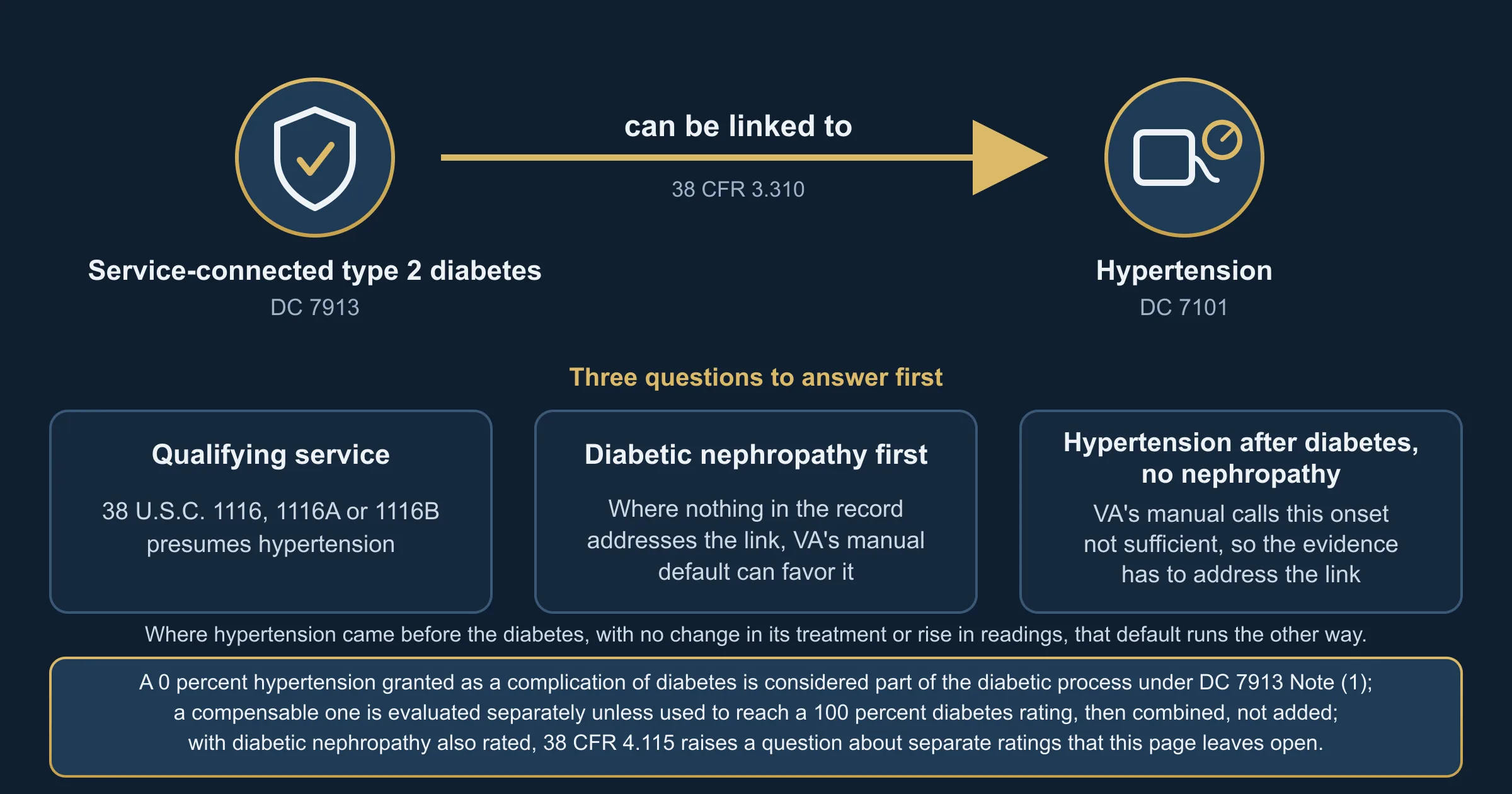
VA can service connect hypertension secondary to service-connected type 2 diabetes under 38 CFR 3.310. Absent record evidence specifically on the link, its manual treats hypertension after diabetes with diabetic nephropathy as a complication, not hypertension predating the diabetes without treatment changes or higher readings. A statute separately presumes hypertension for qualifying service. A grant can still pay 0 percent.
Three things belong up front. First, you may not need to buy a letter for the link. With qualifying service under 38 U.S.C. 1116, 1116A or 1116B, the statute presumes the hypertension. With diabetic nephropathy diagnosed before the hypertension began, and nothing in the record addressing the question, VA's manual tells raters to consider the hypertension a complication of the diabetes (M21-1 Part V, Subpart iii, Chapter 11, Block 2.e). And on an explicit claim, the same chapter tells VA to obtain its own medical opinion in two fact patterns (Block 2.g). A physician's opinion of your own does its real work where the manual's default does not carry the claim: hypertension that began after the diabetes with no diabetic nephropathy, which the manual calls not sufficient on its own, or a VA opinion that went against the link. Second, we make no promise that a grant raises what you are paid. A 0 percent hypertension granted as a complication is considered part of the diabetic process under DC 7913 Note (1), and a compensable one is evaluated separately unless it was used to reach a 100 percent diabetes rating, then combined with your other ratings rather than added; where diabetic nephropathy is also rated, 38 CFR 4.115 raises a question this page leaves open. Third, the research ties diabetes and high blood pressure together in both directions. In the Framingham cohort the link from diabetes to new hypertension held independently of body mass index, and in a second cohort, among middle-aged participants with newly diagnosed diabetes, it lost significance once body mass index was accounted for. No study can say that diabetes caused one veteran's hypertension.
An illustrative example
A veteran's type 2 diabetes was diagnosed on active duty and has been service connected at 20 percent since 2015, on an oral medication and a restricted diet. His blood pressure was normal at his visits through 2017. In 2019 his doctor diagnosed hypertension after a workup in which his diastolic readings ran in the 90s, and started him on daily medication. His kidney tests have been normal, and no doctor has diagnosed diabetic nephropathy. He files a claim saying the hypertension is a complication of his diabetes.
His hypertension began after his diabetes, without nephropathy, so VA's manual says that onset is not sufficient on its own, and nothing in his file yet addresses the link. On his explicit claim, the manual says a medical diagnosis or opinion "may be necessary" (M21-1 Part V, Subpart iii, Chapter 11, Block 2.g), and neither of the two fact patterns in which it tells raters to obtain one describes his facts in terms. A physician's opinion is one way his claim can get evidence that addresses the link: the timeline from his records, his weight and other risk factors, and why his hypertension is or is not the essential kind an examiner may reach for.
Suppose VA grants it. His readings are controlled and his diastolic pressure was never predominantly 100 or more before medication, so under DC 7101 and 38 CFR 4.31 the hypertension is rated 0 percent, and under DC 7913 Note (1) it is considered part of the diabetic process. His combined rating does not change. What the grant changes is the record: the hypertension is service connected, a later worsening is a claim for an increase, and the arteriosclerotic manifestations VA's manual lists can be claimed through it, each with its own claim.
This example is ours, assembled from the rules quoted on this page to show how they interact. It describes no client and no case result, and it predicts nothing about any claim.
Do You Need a Nexus Letter for Hypertension Secondary to Diabetes?
Sometimes not. A statute, a manual default and a chronic-disease presumption can each settle the link without a letter you pay for, and, on an explicit claim, in two fact patterns VA's manual tells raters to get a medical opinion of VA's own. M21-1 is VA's internal procedures manual, not a regulation; SC in its text means service connection.
Route one: qualifying service and the Agent Orange statutes
The diseases referred to in paragraph (1)(A) of this subsection are the following:
38 U.S.C. 1116(a)(2), the two entries relevant here
- (H) Diabetes Mellitus (Type 2).
- (M) Hypertension.
Both diseases are on the statute's own list. For a veteran who performed "covered service", each "shall be considered to have been incurred in or aggravated by such service, notwithstanding that there is no record of evidence of such disease during the period of such service", subject to section 1113 of title 38 (38 U.S.C. 1116(a)(1)). Covered service is service in the Republic of Vietnam from January 9, 1962 to May 7, 1975; in Thailand at any United States or Royal Thai base from January 9, 1962 to June 30, 1976; in Laos from December 1, 1965 to September 30, 1969; in Cambodia at Mimot or Krek, Kampong Cham Province from April 16 to April 30, 1969; or on Guam or American Samoa or in their territorial waters from January 9, 1962 to July 31, 1980, or on Johnston Atoll or a ship that called there from January 1, 1972 to September 30, 1977 (38 U.S.C. 1116(d)). Two companion sections apply the same list of diseases, hypertension included: 38 U.S.C. 1116A to service offshore of the Republic of Vietnam from January 9, 1962 to May 7, 1975, not more than 12 nautical miles seaward of a line the statute sets, and 38 U.S.C. 1116B to service in or near the Korean Demilitarized Zone from September 1, 1967 to August 31, 1971. For a veteran with any of that service, no link to the diabetes has to be proven for the hypertension. The presumption settles the link, not the readings. VA's manual says service connection for hypertension "requires current blood pressure readings (obtained during the claim period) which meet the regulatory definition" of hypertension or isolated systolic hypertension, and waives that for a diagnosis now controlled by (or asymptomatic with) medication only where a past competent diagnosis was made in service, on readings to a compensable degree within the one-year presumptive period of 38 CFR 3.307 and 3.309(a), or secondary to a service-connected disability (M21-1 Part V, Subpart iii, Chapter 5, Block 3.b). Keep taking your medication as prescribed.
The hypertension entry came from the PACT Act in 2022, and the Act phased it in. Its text applied the entry from enactment, August 10, 2022, to claimants for dependency and indemnity compensation and to veterans VA determines are terminally ill, homeless, under extreme financial hardship, more than 85 years old, or capable of demonstrating other sufficient cause, and "On October 1, 2026, for everyone not described in subparagraph (A)". Its retroactivity clause opens "Notwithstanding any Federal court decisions or settlements in effect on the day before the date of the enactment of this Act" and allows retroactive awards for this condition only to those dependency and indemnity compensation claimants (Pub. L. 117-168, section 404(d)(2), printed as a note to 38 U.S.C. 1116). VA's manual, as its own practice, lists August 10, 2022 as the date hypertension became subject to presumptive service connection based on herbicide exposure, and for retroactive payment points to 38 CFR 3.114(a) (M21-1 Part VIII, Subpart i, Chapter 1, Section C, Block 1.f).
The regulation's herbicide list does not carry hypertension. 38 CFR 3.309(e) has no hypertension entry, and its Note 2 says that "the term ischemic heart disease does not include hypertension". The hypertension presumption lives in the statute.
Timing matters when you read older decisions. In A22014656, decided July 29, 2022, twelve days before the PACT Act became law, the Board denied hypertension for a veteran whose herbicide exposure VA had conceded, stating that neither hypertension nor nephrolithiasis "are diseases subject to presumptive service connection based on herbicide exposure". That was the law that day, and the decision is binding only with regard to the specific case decided (38 CFR 20.1303); it says nothing about how the same facts would be decided now.
Route two: VA's manual default for diabetic nephropathy
Analyze the evidentiary record to determine if it contains evidence specifically addressing whether hypertension is or is not a complication of diabetes mellitus.
M21-1 Part V, Subpart iii, Chapter 11, Block 2.e, first sentence
In the absence of record evidence specifically addressing the question of whether hypertension is related to diabetes mellitus
M21-1 Part V, Subpart iii, Chapter 11, Block 2.e (topic change date November 29, 2016; the second item's two conditions are a sub-list in the source)
- consider hypertension to be a complication of diabetes mellitus when onset of hypertension occurred after a diagnosis of diabetes mellitus with diabetic nephropathy (The onset of hypertension after diabetes mellitus without diabetic nephropathy is not sufficient.), and
- do not consider hypertension to be a complication of diabetes mellitus when onset of hypertension was before diabetes mellitus (with or without diabetic nephropathy), and there has been no change in the treatment of hypertension or increase in blood pressure readings.
Read the condition first. The default applies only where nothing in the record specifically addresses the question. Once an examiner's or physician's opinion in the file addresses it, in either direction, the rater weighs that evidence instead, and the block's Important line says to evaluate its competency, credibility and probative value.
Within that condition the default cuts three ways. Diabetic nephropathy first and hypertension after: the manual says to consider the hypertension a complication. Hypertension first, with no change in its treatment and no rise in readings since: the manual says not to. Hypertension after the diabetes without nephropathy: the manual calls that onset "not sufficient", so a claim in that pattern needs evidence that addresses the link.
File the claim either way. The manual lets a rater raise unclaimed hypertension "only when the evidence supports a grant", and adds: "Do not raise the issue simply because the record shows hypertension and diabetes mellitus (even if there is diabetic nephropathy)." (Block 2.f.)
When VA's manual tells raters to obtain an opinion of VA's own
When there is an explicit claim as discussed above, obtain a medical diagnosis or opinion to determine if hypertension is a complication of diabetes mellitus in the following fact patterns:
M21-1 Part V, Subpart iii, Chapter 11, Block 2.g (each item's parts are a sub-list in the source)
- medical evidence shows hypertension was diagnosed before diabetes mellitus or before diabetic nephropathy, but there has been a subsequent change in the treatment of hypertension and/or an increase in blood pressure readings thereafter (particularly if this occurred after the onset of diabetic nephropathy), or
- medical evidence shows no clear indication as to when hypertension was diagnosed, or whether hypertension has worsened since the onset of diabetic nephropathy.
On an explicit claim in either pattern, a letter you buy would sit beside VA's own examiner's opinion, not fill an empty file. The block's Important line says that without an explicit claim, and with hypertension outside the scope of a diabetes evaluation, VA does not develop for a diagnosis or opinion on whether the hypertension is a complication of the diabetes, which is one more reason to claim the hypertension in terms.
Neither pattern describes, in terms, hypertension that began after the diabetes in a veteran with no diabetic nephropathy, the pattern Block 2.e calls not sufficient.
Route three: hypertension within a year of leaving service
38 CFR 3.309(a) lists "Cardiovascular-renal disease, including hypertension." among the chronic diseases, and 38 CFR 3.307(a)(3) requires that the disease "must have become manifest to a degree of 10 percent or more within 1 year" from separation. Hypertension that reached that level in time, judged against the DC 7101 rows set out in the rating section below, is a direct presumptive claim, subject to the other conditions of 38 CFR 3.307, with no diabetes link to prove.
Where a physician's opinion does its real work
- Hypertension that began after the diabetes, with no diabetic nephropathyThe manual's default does not carry this claim, so the opinion has to: the timeline from the records, why the hypertension is or is not essential hypertension, and the risk factors in the file. In 18150782 the Board granted on a private opinion that disagreed with a VA examiner's no-nephropathy reasoning, and in 18151620 it granted on the benefit of the doubt, finding two positive VA examiners' opinions and a negative one that noted no evidence of diabetic renal disease equally probative; neither decision states whether the hypertension began before or after the diabetes (both below).
- Hypertension first, then worse after the diabetes or the nephropathyThis is the aggravation route under 38 CFR 3.310(b), which needs a baseline level of severity, evidence of an increase from it, and evidence that the diabetes caused that increase. In 18145997 the Board granted hypertension as aggravated by diabetes on a VA examiner's opinion that turned on microalbuminuria. The decision recites no baseline and no change in readings or treatment, so it illustrates the opinion, not the baseline evidence an aggravation claim still needs.
- A VA opinion against the link that leaves something unansweredAn opinion that rests on normal kidney tests, or on essential hypertension, without addressing the rest of the record, or one with no rationale at all. In 1803039 the Board called the VA opinions "highly probative", one of them resting on normal renal function studies and essential hypertension, and denied with "no competent medical evidence of record that rebuts" them; in 1807829 it remanded to reconcile conflicting opinions.
How VA Decides Hypertension Secondary to Diabetes
Two paragraphs of one regulation do the work, and VA's manual sets out how a rater applies them.
(a) General. Except as provided in § 3.300(c), disability which is proximately due to or the result of a service-connected disease or injury shall be service connected. When service connection is thus established for a secondary condition, the secondary condition shall be considered a part of the original condition.
38 CFR 3.310(a)
(b) Aggravation of nonservice-connected disabilities. Any increase in severity of a nonservice-connected disease or injury that is proximately due to or the result of a service-connected disease or injury, and not due to the natural progress of the nonservice-connected disease, will be service connected. However, VA will not concede that a nonservice-connected disease or injury was aggravated by a service-connected disease or injury unless the baseline level of severity of the nonservice-connected disease or injury is established by medical evidence created before the onset of aggravation or by the earliest medical evidence created at any time between the onset of aggravation and the receipt of medical evidence establishing the current level of severity of the nonservice-connected disease or injury. The rating activity will determine the baseline and current levels of severity under the Schedule for Rating Disabilities (38 CFR part 4) and determine the extent of aggravation by deducting the baseline level of severity, as well as any increase in severity due to the natural progress of the disease, from the current level.
38 CFR 3.310(b)
Caused by the diabetes, or made worse by it
Paragraph (a) covers hypertension that is "proximately due to or the result of" the service-connected diabetes. Paragraph (b) covers hypertension you had anyway that the diabetes made worse. Which one applies starts with the timeline: hypertension diagnosed after the diabetes is argued under (a), and hypertension diagnosed first, then harder to control after the diabetes or the nephropathy, under (b). A claim can plead both. VA's manual, as its own practice, awards service connection under 38 CFR 3.310(a) and (b) for disabilities that are "the result of, or would not have occurred but for" a service-connected disability (M21-1 Part V, Subpart ii, Chapter 2, Section D, Block 1.a).
The baseline, and what changed after Spicer
38 CFR 3.310(b) still recites two deductions, the baseline and natural progress. VA's manual now applies only one of them. After Spicer v. McDonough, 61 F.4th 1360 (Fed. Cir. 2023), VA "will apply the broader but-for standard and will no longer consider natural progress of the NSC disability when deciding a claim based on aggravation", and "Permanent worsening of an NSC disability by an SC disability is not required" (M21-1 Part V, Subpart ii, Chapter 2, Section D, Block 1.a, VA practice). The baseline deduction survives: the rater must "deduct the baseline level of severity of the NSC disability from the current level" (Block 1.g).
The manual lets a baseline come from medical evidence created before the aggravation, the earliest medical evidence created between the onset of aggravation and the receipt of medical evidence establishing the current level of severity, or "any other credible evidence, including lay evidence, that supports establishment of the baseline", while noting that lay evidence on its own may not be sufficient (Block 1.c). If no baseline can be established after VA's duty to assist is met, the aggravation claim is denied, and the manual says "Do not assume a baseline of 0 percent" (Block 1.f). Since the award is the current level minus the baseline, a 0 percent baseline would deduct nothing, so that sentence runs against the claimant, not for him. And where the hypertension worsened but would rate at the same level before and after, the manual says to grant service connection at a noncompensable evaluation (Block 1.h).
For hypertension, the readings at the baseline matter: blood pressure readings and medication changes from before the diabetes or the nephropathy, set against the readings and medication after.
The standard of proof
38 CFR 3.102 resolves reasonable doubt in the veteran's favor and defines it as doubt that "exists because of an approximate balance of positive and negative evidence which does not satisfactorily prove or disprove the claim." The phrase "at least as likely as not", which medical opinions use, does not appear in 3.102; it is how opinions are written to reach that balance.
VA's diabetes chapter adds a caution of its own: "Before conceding that a particular disability is a complication of diabetes, ensure that there is medical evidence of record supporting that determination." (M21-1 Part V, Subpart iii, Chapter 11, Block 2.b.)
Does Diabetes Cause High Blood Pressure? What the Research Shows
The two conditions travel together, and the research reads the link in both directions. Every figure below is from the study's PubMed abstract.
They track each other, in both directions (Tsimihodimos, 2018)
In the Mexico City Diabetes Study and the Framingham Offspring Study, followed for 7 years, diabetes at baseline predicted new hypertension (in the Framingham cohort, odds ratio 3.14, 95 percent confidence interval 2.17 to 4.54) independently of sex, age, body mass index and familial diabetes. The reverse held too: hypertension at baseline predicted new diabetes (in the Framingham cohort, odds ratio 3.33, 95 percent confidence interval 2.50 to 4.44). People who developed either condition shared a metabolic syndrome picture, and the authors conclude that the two "track each other over time", with insulin resistance "one common feature of both prediabetes and prehypertension and an antecedent of progression" to each (PMID 29335249).
In middle-aged people with newly diagnosed diabetes, the link lost significance after adjustment for body mass index (Sasaki, 2020)
In a retrospective cohort of 2,136 middle-aged and 3,426 elderly participants who had a glucose tolerance test at baseline, followed for a median of 59 months, middle-aged participants with newly diagnosed diabetes had higher odds of new hypertension than those with normal glucose (odds ratio 1.55), as did those with impaired fasting glucose (1.40) or impaired glucose tolerance (1.49), and each of these was "no longer significant after adjustment for body mass index". In a subgroup analysis the risk was significantly higher with diabetes only in participants without obesity, and in the elderly group there was no difference. The authors call the risk "modest in participants with newly diagnosed type 2 diabetes and prediabetes" and set it against "the pronounced risk of hypertension in patients with diabetes reported in previous studies" (PMID 32933951).
Higher blood pressure can come first (Emdin, 2015)
In 4.1 million adults free of diabetes and cardiovascular disease, a 20 mm Hg higher systolic pressure went with a 58 percent higher risk of new-onset diabetes (hazard ratio 1.58, 1.56 to 1.59), and a meta-analysis of 30 prospective studies gave a pooled relative risk of 1.77 (1.53 to 2.05) for the same difference. The association weakened with age and with body mass index. This study measured blood pressure, not a hypertension diagnosis, and it runs in the reverse direction: higher pressure before diabetes (PMID 26429079).
A kidney pathway once nephropathy exists (Van Buren and Toto, 2011)
A review of hypertension in diabetic nephropathy says "Hypertension is highly prevalent in patients with diabetic nephropathy" and describes mechanisms that "result in renal sodium reabsorption and peripheral vasoconstriction". It is a review, not a study of its own, and its abstract gives no figures. Its full text discusses type 2 diabetes on its own in its epidemiology section: "In DM2, hypertension commonly exists prior to kidney disease. The common risk factors for glucose intolerance and hypertension (i.e. obesity) may explain this association." It adds: "Diabetes duration does not increase the incidence of hypertension, although the presence of impaired kidney function does." (PMID 21224028; full text PMC3221014.)
What that means for one veteran's claim
Read together, the studies show an association in both directions and a shared metabolic background. In the Framingham cohort the link from diabetes to new hypertension held independently of body mass index; in a second cohort, among middle-aged participants with newly diagnosed diabetes, it lost significance after adjustment for body mass index. A review describes a kidney pathway once nephropathy is present. None of them can say that diabetes caused one veteran's hypertension. That is the question a physician's opinion has to answer, from his own records.
VA's manual makes the same point from the other side. Its cardiovascular chapter notes: "The cause of hypertension is unknown in the vast majority of cases." (M21-1 Part V, Subpart iii, Chapter 5, Block 3.i, Note.) An examiner who calls a veteran's hypertension essential, meaning without an identified cause, is reasoning from that premise, and an opinion that does not engage with it leaves the examiner's conclusion standing.
Will a Hypertension Grant Raise Your Combined Rating?
It may or may not, and no one can promise either way. Two codes do the core work: DC 7101 rates the hypertension, and DC 7913's Note (1) decides whether that rating is evaluated separately from the diabetes. An aggravation grant deducts the baseline level from the current one (38 CFR 3.310(b)), and a rated diabetic nephropathy raises the 38 CFR 4.115 question set out in the next section.
DC 7101, Hypertensive vascular disease (hypertension and isolated systolic hypertension), the rows as printed with their ratings:
38 CFR 4.104, DC 7101
- 60 percent: Diastolic pressure predominantly 130 or more
- 40 percent: Diastolic pressure predominantly 120 or more
- 20 percent: Diastolic pressure predominantly 110 or more, or; systolic pressure predominantly 200 or more
- 10 percent: Diastolic pressure predominantly 100 or more, or; systolic pressure predominantly 160 or more, or; minimum evaluation for an individual with a history of diastolic pressure predominantly 100 or more who requires continuous medication for control
Printed under those rows, DC 7101's Note (1) defines the condition for VA: "the term hypertension means that the diastolic blood pressure is predominantly 90mm. or greater, and isolated systolic hypertension means that the systolic blood pressure is predominantly 160mm. or greater with a diastolic blood pressure of less than 90mm." Either one "must be confirmed by readings taken two or more times on at least three different days." VA's manual adds: "Do not establish SC for hypertension if the evidence does not contain blood pressure readings as specified in 38 CFR 4.104, DC 7101, Note 1." (M21-1 Part V, Subpart iii, Chapter 5, Block 3.i, Note.) The manual does not require the repeat readings on a claim for reevaluation, or where a past diagnosis is now controlled by medication as Block 3.b provides (Block 3.c). DC 7101 prints no 0 percent row. Under 38 CFR 4.31, where a code has none, "a zero percent evaluation shall be assigned when the requirements for a compensable evaluation are not met." The 10 percent row has three routes, joined by "or;": current diastolic readings predominantly 100 or more, current systolic readings predominantly 160 or more, or the medication minimum. VA's manual describes current readings as "readings from the period during which an effective date can be assigned" (M21-1 Part V, Subpart iii, Chapter 5, Block 3.e).
The medication minimum is the route at issue for controlled hypertension, and VA's manual narrows it. It applies "When current predominant blood pressure readings are non-compensable", and it needs both continuous medication for control and a past diastolic pressure, before medication was prescribed, predominantly 100 or more; the manual says not to assign it on one of the two by invoking the benefit of the doubt when the other is "simply not shown", though it says the benefit of the doubt "may be applicable to whether the evidence supports each criterion", such as whether the diastolic readings before medication were predominantly 100 or more (M21-1 Part V, Subpart iii, Chapter 5, Block 3.e). For the readings before medication, the manual says to "start with the more current of" two workups: the one that led to the diagnosis, if medication was prescribed then, or a later one that led to the prescription. It says to consider only readings taken during a diagnostic evaluation for hypertension, not normal readings from long before the diagnosis or minimally raised readings before active medical surveillance (Block 3.e, table).
Where current readings do not meet the regulatory definitions of hypertension or isolated systolic hypertension, the manual still allows service connection on a current diagnosis controlled by (or asymptomatic with) medication, if a past competent diagnosis was made in service, on readings to a compensable degree within the one-year presumptive period of 38 CFR 3.307 and 3.309(a), or secondary to a service-connected disability. For a grant on that exception, the manual's first Note says the evaluation "will be either 0 percent or 10 percent, depending on whether or not the predominant diastolic pressure was 100 or more before symptoms were controlled with medication" (Block 3.b).
Note (1):
38 CFR 4.119, DC 7913, Note (1), its two sentences shown as two lines
- Evaluate compensable complications of diabetes separately unless they are part of the criteria used to support a 100-percent evaluation.
- Noncompensable complications are considered part of the diabetic process under DC 7913.
What a hypertension grant does under DC 7913 Note (1)
| Hypertension evaluation | Under Note (1) | What changes |
|---|---|---|
| 0 percent | Considered part of the diabetic process | Service connection is on the record; this grant alone does not change the percentage. It can be one element of the 60 percent diabetes row, only with every other element of that row. |
| 10 percent or more, and not part of the criteria used to support a 100 percent diabetes evaluation | Evaluated separately | Combined with your other ratings under 38 CFR 4.25, not added, so the combined rating may or may not rise. Where diabetic nephropathy is also rated, see the 38 CFR 4.115 question in the next section. |
| Compensable, and part of the criteria used to support a 100 percent diabetes evaluation | Not evaluated separately | It counts toward the 100 percent diabetes evaluation instead of carrying its own rating. |
The 60 and 100 percent diabetes rows
The 60 percent row for DC 7913 ends "plus complications that would not be compensable if separately evaluated", so a 0 percent hypertension can be part of it. It is never enough alone: the row also requires one or more daily injection of insulin, a restricted diet, regulation of activities, and episodes of ketoacidosis or hypoglycemic reactions requiring one or two hospitalizations a year or twice a month visits to a diabetic care provider. VA's manual says: "Do not evaluate the diabetes mellitus at 60 percent simply because noncompensable complications are present." (M21-1 Part V, Subpart iii, Chapter 11, Block 4.a, Example 1.)
The 100 percent row requires, besides its insulin, diet, activity and episode criteria, "plus either progressive loss of weight and strength or complications that would be compensable if separately evaluated". A compensable complication used to reach that evaluation is not rated separately. The manual's worked example is an amputation, not hypertension: it would be "pyramiding" to rate the amputation separately where it was used to reach 100 percent, and "If compensable complications are not considered in reaching the 100- percent evaluation, they may be separately evaluated." (Block 4.c, Example 3 and Note.)
38 CFR 4.14 and DC 7913 Note (1)
38 CFR 4.14 ends: "the evaluation of the same manifestation under different diagnoses are to be avoided." DC 7913's criteria never mention blood pressure or hypertension, so a separate hypertension rating counts one manifestation twice only where the hypertension is a compensable complication used to reach the 100 percent diabetes row: VA's manual calls the parallel amputation case "pyramiding" (Block 4.c, Example 3), and its complications block points to 38 CFR 4.14 for avoiding pyramiding (Block 2.b). The limit the schedule states in terms is its own Note (1), and 38 CFR 4.25(b) makes separate ratings the default only "Except as otherwise provided in this schedule".
What a grant does even when the number does not move
Under 38 CFR 3.310(a), a secondary condition "shall be considered a part of the original condition." A later rise in your readings is then a claim for an increase in the hypertension rating, decided on your readings at that time.
Service-connected hypertension is also a route to three later claims. VA's manual tells raters, if additional arteriosclerotic manifestations are diagnosed in a veteran with service-connected hypertension, to grant service connection on a secondary basis for cerebral arteriosclerosis or thrombosis with hemiplegia, nephrosclerosis of the kidneys with impairment of renal function, or myocardial damage or coronary occlusion of the heart. Its Important line says "A claim for benefits is required", and its Notes add that arteriosclerosis "occurs with advancing age without preexisting hypertension" and that "The existence of arteriosclerosis does not imply/indicate prior hypertension." (M21-1 Part V, Subpart iii, Chapter 5, Block 3.g.) A nephrosclerosis grant has its own rating rule: 38 CFR 4.115b, DC 7507, reads "Rate according to predominant symptoms as renal dysfunction, hypertension or heart disease. If rated under the cardiovascular schedule, however, the percentage rating which would otherwise be assigned will be elevated to the next higher evaluation."
Diabetic Nephropathy, 38 CFR 4.115, and a Question This Page Leaves Open
Diabetic nephropathy matters twice on this claim. It drives VA's manual default above, and it raises a rating question that should not be answered for you in advance.
Separate ratings are not to be assigned for disability from disease of the heart and any form of nephritis, on account of the close interrelationships of cardiovascular disabilities. If, however, absence of a kidney is the sole renal disability, even if removal was required because of nephritis, the absent kidney and any hypertension or heart disease will be separately rated. Also, in the event that chronic renal disease has progressed to the point where regular dialysis is required, any coexisting hypertension or heart disease will be separately rated.
38 CFR 4.115, its fourth to sixth sentences
The regulation's fourth sentence names heart disease and nephritis, and its fifth and sixth sentences name hypertension in their exceptions. VA's manual, as its own practice, states the bar in terms of hypertension: "38 CFR 4.115 prohibits assignment of separate evaluations for renal dysfunction from nephritis and for hypertension except where" the sole renal disability is absence of a kidney, or nephritis has progressed to the point where regular dialysis is required (M21-1 Part V, Subpart iii, Chapter 5, Block 3.j). DC 7541 reads "Renal involvement in diabetes mellitus type I or II: Rate as renal dysfunction." (38 CFR 4.115b), and the manual calls that code "otherwise known as diabetic nephropathy" (M21-1 Part V, Subpart iii, Chapter 7, Block 2.b), adding: "When the renal impairment is a form of nephritis, 38 CFR 4.115 applies as discussed in M21-1, Part V, Subpart iii, 7.2.f."
The same chapter says the 4.115 provision "does not apply when evaluating other types of nephropathy because nephropathy is a broader diagnostic classification warranting its own evaluative approach", and that "Other types of nephropathy may be assigned separate evaluations for the renal impairment and heart disease and/or hypertension." (Block 2.c.) It also says "A nephropathy diagnosis is not dispositive for the purpose of making this distinction", tells raters "When the clinical evidence is unclear, request a medical opinion to determine whether the disability in question is a type of nephritis", and adds: "It is impermissible to evaluate a type of nephritis specifically identified in the rating schedule, such as gouty nephropathy, by analogy in an effort to achieve a higher disability evaluation." (Block 2.h.)
The question we do not answer
Whether a veteran's diabetic nephropathy is a form of nephritis, which brings in 4.115, or another type of nephropathy, which the manual says may be evaluated separately, is decided from the medical evidence in each case. Block 2.c does not name diabetic nephropathy either way. This page sets out the texts, does not take a position, and does not suggest describing a kidney disease either way. It also does not say that a kidney rating and a hypertension rating combine for anyone.
Why older kidney decisions are not a guide
The renal table changed on November 14, 2021. The manual's Note to Block 2.c says that before then "hypertension was included among the criteria for evaluation of renal dysfunction", and "hypertension" appears nowhere in today's 38 CFR 4.115a. A Board decision that rated diabetic kidney disease with hypertension under the earlier criteria tells you nothing about the figure today, so this page prints none.
The same rules, from the kidney side, are set out in our guide to kidney disease secondary to hypertension.
A Claim for an Increase, Not a Fresh Secondary Claim
Where your diabetes is already service connected, VA's manual does not treat newly claimed hypertension as a stand-alone secondary claim.
M21-1 Part V, Subpart iii, Chapter 11, Block 2.c reasons that diabetic complications represent medical progression of the diabetes and are contemplated in DC 7913, so "a claim asserting new complications of SC diabetes is a claim for increase rather than a claim for secondary SC." It then tells raters, when assigning effective dates for new diabetic complications, to "consider effective date provisions applicable to increases, specifically 38 CFR 3.400(o), and 38 CFR 3.157 for periods prior to March 24, 2015." Block 1.f adds, in a Note, that because complications are part of the evaluation criteria for diabetes, "entitlement to any additional benefits based on complications would be considered within scope of the claim."
If your diabetes is not yet service connected, the hypertension cannot be granted on this basis until it is; the two claims can be filed together.
How the increase rules work for a diabetic complication, including the one-year look-back in 38 CFR 3.400(o)(2), is set out in our guide to diabetic retinopathy secondary to diabetes.
What Board Decisions on This Claim Show
We read in full nine Board decisions on hypertension claimed as secondary to service-connected diabetes, chosen from a larger set found by web search and screened by reading their orders; the Board's own search returned an error when we tried it on November 7 and November 20, 2026. That makes them a convenience sample: they show how the arguments play out and give no rate of anything.
Under 38 CFR 20.1303, previously issued Board decisions "will be considered binding only with regard to the specific case decided." Each decision below was decided on its own facts, in the regulation's words "in light of applicable procedure and substantive law", and some of that law has changed since (see the first section above).
Granted
Citation Nr 18150782 (November 15, 2018)
Service connection for hypertension as secondary to service-connected diabetes granted, after a Court-ordered remand.
The Board found the October 2016 private opinion "the most probative medical opinion of record". The private examiner, Dr. A. A., opined the hypertension was more likely than not secondary to the diabetes, and "cited a study from the National Institute of Health, which recognized diabetes as a risk factor for the development of hypertension." In the Board's account, she "disagreed with the October 2014 VA examiner who found that without findings of diabetic nephropathy, hypertension cannot be a complication of diabetes."
Why it matters. The private opinion disagreed with the examiner's no-nephropathy premise and cited medical studies, and the Board found it reflected "a thorough review of the claims file" and "a sufficient rationale". The decision does not say whether the hypertension began before or after the diabetes, and it does not mention VA's manual; it is a weight-of-the-opinion causation grant.
Binding only with regard to the specific case decided (38 CFR 20.1303).
Citation Nr 18151620 (November 19, 2018)
Service connection for hypertension granted.
Two VA examiners found the hypertension at least as likely as not due to the diabetes. A May 2014 VA examiner found no link, noting "no evidence of diabetic renal disease, which according to VA guidelines is a necessary requirement to support a link." The Board wrote "The positive and negative opinions are equally probative." and found the hypertension "proximately due to or aggravated by" the diabetes, resolving reasonable doubt in the veteran's favor.
Why it matters. A negative opinion resting on the absence of kidney disease did not decide the claim where other opinions addressed the link. The decision does not say which guideline the examiner meant.
Binding only with regard to the specific case decided (38 CFR 20.1303).
Citation Nr 18145997 (October 30, 2018)
Service connection for hypertension granted on aggravation; two heart issues remanded.
The Board found "The evidence is at least in equipoise that the Veteran’s service-connected diabetes mellitus type II aggravates his hypertension." The positive opinion was a January 2007 VA examiner's: the hypertension pre-dated the diabetes and the nephropathy, but there was evidence of microalbuminuria, "an early sign of diabetic renal disease that can make pre-existing essential hypertension more difficult to control." A contrary opinion that the examiner "appears to have provided" in the January 2007 VA diabetes examination was "given no probative weight because there is no rationale provided."
Why it matters. Hypertension that came first can still be service connected on aggravation, here with early kidney involvement on the record. The decision treats the nephropathy as service connected, and its hypertension analysis identifies no baseline. The veteran had service in Vietnam, and the decision predates the PACT Act's hypertension entry in 38 U.S.C. 1116.
Binding only with regard to the specific case decided (38 CFR 20.1303).
Citation Nr 21069538 (November 18, 2021)
Reopened, and hypertension as secondary to service-connected type 2 diabetes granted.
The Board granted the claim on a March 2015 opinion by Dr. G.S. that the hypertension was more likely than not due to the diabetes, writing "While the March 2015 opinion is unsupported by medical rationale, there is no question to its conclusion.", together with VA treatment records indicating "his hypertension began when he was diagnosed with DMII."
Why it matters. Onset at the same time as the diabetes, documented in VA treatment records, carried weight here despite a thin opinion, on a record where the Board did not consider the one negative VA opinion it mentions, from May 2006, because the examination report was not in the claims file. The same decision, dated four days after the renal table changed on November 14, 2021, rated the kidney disease of the veteran, who had died in January 2017 during the appeal, under the earlier criteria, which counted hypertension; that figure is not a guide to today's renal table.
Binding only with regard to the specific case decided (38 CFR 20.1303).
Denied
Citation Nr A22014656 (July 29, 2022)
Service connection for hypertension denied.
The October 2020 VA examiner found "the Veteran's hypertension predated both the Veteran's diabetes as well are coronary artery disease" (sic) and, with the veteran's "history of obesity, alcohol use, and smoking history", concluded it was less likely than not due to or aggravated by his service-connected disabilities. No other medical opinion supported the claim. The Board also stated that hypertension was not then a disease presumed from herbicide exposure.
Why it matters. The examiner's timeline and the contributing factors the examiner named stood unanswered, and the Board found the evidence "fails to persuasively show" that service connection was warranted. The presumption statement was made twelve days before the PACT Act became law (see the first section above).
Binding only with regard to the specific case decided (38 CFR 20.1303).
Citation Nr 18145189 (October 26, 2018)
Essential hypertension, including as secondary to service-connected diabetes and herbicide exposure, denied, for a veteran who served in the Republic of Vietnam. The Board's statement that hypertension "is not deemed to be associated with herbicide exposure" predates the PACT Act's hypertension entry in 38 U.S.C. 1116 (see the first section above).
The veteran's own endocrinologist wrote in October 2000 that he was "already hypertensive when he was referred to me by [Dr. N] with newly diagnosed Diabetes in 1996." An October 2008 VA examination found the hypertension was not a complication "because they were diagnosed around the same time in 1996 and because the Veteran continued to have normal renal functions." The month before, the same endocrinologist had listed "Diabetes Complications has Nephropathy/Proteinuria" among the veteran's diagnoses, in a note that did not list hypertension as a complication. A later VA opinion noted that "essential hypertension, by definition, does not have an identifiable root cause". The Board gave the endocrinologist's later letter, listing hypertension as a complication, no weight because it carried no reasoning and contradicted his 2000 letter.
Why it matters. In the Board's words, "a medical opinion containing only data and conclusions is not entitled any weight". The Board gave weight instead to the VA medical opinion of record, which it said "provided a rationale and an analysis".
Binding only with regard to the specific case decided (38 CFR 20.1303).
Citation Nr 1803039 (January 17, 2018)
Service connection for hypertension denied.
The January 2013 VA examiner noted that "diabetic nephropathy is an important contributing factor to the development of hypertension in diabetic patients", found the veteran's renal function studies normal, and concluded the hypertension "was most likely essential in nature". The Board: "There is simply no medical opinion of record linking the disorder to service or to the Veteran's service-connected diabetes."
Why it matters. Nothing on the record engaged with the examiner's kidney and essential-hypertension reasoning. This is the gap a physician's opinion exists to fill, if the records support one.
Binding only with regard to the specific case decided (38 CFR 20.1303).
Citation Nr 23056502 (October 17, 2023)
Hypertension, including as secondary to service-connected diabetes, denied.
A May 2023 VA examiner opined the hypertension was less likely than not due to the diabetes "because hypertension and diabetes mellitus are not medically related", and less likely than not aggravated by the diabetes, with the rationale that the hypertension's management with "various agents" since 2005 was part of natural disease management and progression. The Board found that examiner's opinions "highly probative", and found the hypertension had preexisted service.
Why it matters. A categorical examiner premise stood unanswered, on a record where the hypertension also came first. Whether an opinion could have changed that turns on the records, which is why a physician has to read them first.
Binding only with regard to the specific case decided (38 CFR 20.1303).
Remanded
Citation Nr 1807829 (February 7, 2018)
Hypertension remanded for another VA examination.
A January 2012 VA opinion was positive in part, and the Board wrote "this opinion is not entirely clear." An April 2014 opinion was negative with "No specific rationale". A September 2014 examiner opined "that diabetes did not cause nor aggravate hypertension unless there was significant diabetic nephropathy" and attributed it to "genetics, heredity, and aging". A July 2016 letter from the veteran's VA treatment provider, a July 2017 DBQ and an October 2017 VA examination were positive. The Board found "another VA examination is required to reconcile the conflicting medical opinions of record."
Why it matters. Here the conflict sent the claim back for a reconciling examination; in 18151620 above, equally probative opinions were resolved in the veteran's favor instead. The Board wrote that the July 2016 opinion "did not appear to place any significance on whether the Veteran's diabetes mellitus caused significant diabetic nephropathy" and that "The medical opinions of record do not address direct service connection." The veteran had reported that his hypertension started in 1970 when he returned from Vietnam (this 2018 remand predates the PACT Act's hypertension entry in 38 U.S.C. 1116; see the first section above).
Binding only with regard to the specific case decided (38 CFR 20.1303).
These are nine decisions we chose to present, not a measurement, and they predict nothing about any claim. What recurs in them is the record: when the hypertension began, what the kidneys showed, and whether an opinion answered the other side.
What a Physician's Opinion on This Claim Has to Cover
An opinion earns its place by answering the questions an examiner and a rater will ask, from the veteran's own records.
- The timelineWhen the diabetes was diagnosed, when the hypertension was diagnosed and treated, and when any kidney finding appeared, from dated records rather than recollection. Block 2.e and Block 2.g both turn on that order, and Block 2.e speaks of the "onset of hypertension", so the opinion reads the blood pressure readings from before the diagnosis as well as its date.
- The kidney questionWhether there is diabetic nephropathy or early kidney involvement such as albumin in the urine, with the results, and what follows either way. Normal kidney tests do not end the analysis, and abnormal ones do not prove the link.
- Other causes and risk factorsAge, body weight, alcohol, smoking, family history, sleep apnea, medications, and anything else in the file, weighed rather than skipped. The research above reads body weight both ways.
- The essential hypertension defaultWhy this veteran's hypertension is, or is not, best explained as essential hypertension, since VA's manual itself notes that the cause of hypertension is "unknown in the vast majority of cases" (M21-1 Part V, Subpart iii, Chapter 5, Block 3.i, Note) and an examiner may stop there. A finding of essential hypertension does not answer the aggravation question under 38 CFR 3.310(b): in 18145997 the January 2007 VA examiner's aggravation opinion rested on microalbuminuria, "an early sign of diabetic renal disease that can make pre-existing essential hypertension more difficult to control."
- Aggravation, with a baselineWhere the hypertension came first: the readings and medication before the diabetes or the nephropathy, the readings and medication after, the reason for each change in medication where the records give one, and whether the diabetes made it worse, under 38 CFR 3.310(b).
- The blood pressure history behind the diagnosis and the ratingWhether the readings behind the diagnosis meet VA's definition in DC 7101 Note (1), a diastolic pressure predominantly 90 or more, or for isolated systolic hypertension a systolic pressure predominantly 160 or more with a diastolic below 90, as VA's manual applies that Note (Blocks 3.b and 3.i). Then the diastolic readings in the diagnostic workup before medication, because the 10 percent medication minimum under DC 7101 needs a past diastolic predominantly 100 or more.
- A rationale tied to sourcesThe medical reasoning, with the literature it rests on, and an answer to any VA opinion already in the file. In 18145997 an opinion with no rationale was given no probative weight, and in 1807829 one without a specific rationale was part of the conflict that sent the claim back.
The conclusion is stated as whether the hypertension is at least as likely as not caused by, or aggravated by, the service-connected diabetes, the form VA examiners and the Board use to reach the approximate balance 38 CFR 3.102 describes.
What a letter cannot do
It cannot supply a hypertension diagnosis, create diabetic nephropathy, move the date your hypertension began, or change what DC 7101 and DC 7913 pay. A physician on our team will not sign an opinion your records do not support, and a negative answer is a possible result.
The elements VA raters check in any medical opinion are covered in what a nexus letter must include.
Is There a Claim Here, and Does It Need a Letter?
Check your file
Tick each statement your records support today. The first asks whether the link is already settled. The second and third are requirements for this claim. The rest carry no points; each names a fact pattern that changes what you need.
Nothing here is scored. Tick only what your records say today.
When We Will Tell You Not to Buy a Letter
We write nexus letters. These are the situations, set out in the sections above, in which buying one for this claim does not make sense or cannot work.
- You have qualifying serviceThe statute presumes the hypertension, so service connection does not need a link to your diabetes. File on the presumption, with the blood pressure readings VA's manual requires (see the first section). Whether the hypertension also counts as a diabetic complication toward the 60 or 100 percent diabetes rows is a separate question that needs medical evidence of record (M21-1 Part V, Subpart iii, Chapter 11, Block 2.b).
- Your diabetic nephropathy came firstVA's manual default favors the link where nothing in the record addresses it. File first; a letter becomes worth considering if VA then goes the other way.
- Your hypertension came first and nothing about it has changedThe manual's default runs against the claim, and there is no worsening for an aggravation opinion to work with.
- There is no hypertension diagnosis yetYour own doctor comes first. No letter can supply a diagnosis.
- The only goal is a higher combined rating, and your blood pressure history supports only 0 percentA 0 percent hypertension granted as a complication is considered part of the diabetic process under DC 7913 Note (1), so the grant alone does not change the percentage; it can complete the 60 percent diabetes row only where the diabetes already meets every other element of that row. We cannot promise the number moves, and we will say so plainly on the consultation.
Frequently Asked Questions
Can hypertension be service connected secondary to type 2 diabetes?
Yes. Under 38 CFR 3.310(a), a disability that is proximately due to or the result of a service-connected condition is service connected, and 3.310(b) covers a non-service-connected condition made worse by one, once a baseline is established. Where no record evidence specifically addresses the question, VA's manual tells raters to consider hypertension a complication of diabetes when it began after a diagnosis of diabetes with diabetic nephropathy, and not to consider it one when it began before the diabetes and there has been no change in its treatment or increase in its readings; the manual calls onset after diabetes without nephropathy not sufficient on its own (M21-1 Part V, Subpart iii, Chapter 11, Block 2.e). Under 38 CFR 3.102, a reasonable doubt arising from an approximate balance of positive and negative evidence is resolved in the claimant's favor.
Does VA automatically treat hypertension as a complication of diabetes?
No. VA's manual default (M21-1 Part V, Subpart iii, Chapter 11, Block 2.e) applies only where nothing in the record specifically addresses the question, and it cuts both ways: diabetic nephropathy first and hypertension after favors the link, and hypertension first with no change in its treatment and no rise in readings runs against it. For hypertension that is not explicitly claimed, the manual also says not to raise the issue simply because the record shows both conditions, even with diabetic nephropathy (M21-1 Part V, Subpart iii, Chapter 11, Block 2.f), so claim it in terms. On an explicit claim, in two fact patterns, it tells VA to obtain a medical diagnosis or opinion of its own (Block 2.g).
Do I need a nexus letter for hypertension secondary to diabetes if I served in Vietnam?
Possibly not. 38 U.S.C. 1116(a)(2)(M) lists hypertension among the diseases presumed for a veteran with covered service, which includes the Republic of Vietnam from January 9, 1962 to May 7, 1975 and other places and periods in 1116(d). Two companion sections apply the same list of diseases: 38 U.S.C. 1116A to service offshore of the Republic of Vietnam in that period, not more than 12 nautical miles seaward of a line the statute sets, and 38 U.S.C. 1116B to service in or near the Korean Demilitarized Zone from September 1, 1967 to August 31, 1971. The PACT Act's text applied the hypertension presumption on enactment, August 10, 2022, to dependency and indemnity compensation claimants and five groups of veterans VA identifies, and to everyone else from October 1, 2026, with retroactive awards only for those dependency and indemnity compensation claimants. VA's manual, as its own practice, lists August 10, 2022 as the date hypertension became subject to presumptive service connection based on herbicide exposure, and for retroactive payment points to 38 CFR 3.114(a) (M21-1 Part VIII, Subpart i, Chapter 1, Section C, Block 1.f). The presumption settles the link, not the readings: VA's manual requires current blood pressure readings that meet the regulatory definition of hypertension or isolated systolic hypertension unless its medication exception applies (M21-1 Part V, Subpart iii, Chapter 5, Block 3.b). The presumption is in the statute, not in 38 CFR 3.309(e).
Will a hypertension grant raise my rating if my diabetes is already rated?
It may or may not. Under DC 7913 Note (1), a 0 percent hypertension granted as a complication of the diabetes is considered part of the diabetic process, and a compensable one is evaluated separately unless it was used to support a 100 percent diabetes evaluation. A separate rating is combined with your others under 38 CFR 4.25 rather than added, and where diabetic nephropathy is also rated, 38 CFR 4.115 raises a question about separate ratings that this page leaves open. DC 7101 prints no 0 percent row; 38 CFR 4.31 assigns 0 percent when the compensable criteria are not met, and for hypertension that requires continuous medication for control, the DC 7101 minimum of 10 percent needs a history of diastolic pressure predominantly 100 or more, which VA's manual reads as before medication was prescribed (M21-1 Part V, Subpart iii, Chapter 5, Block 3.e).
Does diabetes cause high blood pressure?
The research shows an association in both directions, not a settled cause. In the Framingham Offspring Study, diabetes at baseline predicted new hypertension and hypertension at baseline predicted new diabetes, and the authors describe the two as tracking each other over time. In a second cohort, the higher odds of new hypertension in middle-aged participants with newly diagnosed diabetes lost significance after adjustment for body mass index, whereas the Framingham link from diabetes to new hypertension held independently of body mass index. In 4.1 million adults, higher blood pressure went with a higher risk of new diabetes. No study can say that diabetes caused one veteran's hypertension; that is the question a physician's opinion weighs.
My hypertension started before my diabetes. Can I still claim it?
Possibly, as aggravation under 38 CFR 3.310(b). It needs a baseline level of severity, evidence that the hypertension got worse after the diabetes or the nephropathy began, such as a change in treatment or higher readings, and evidence that the diabetes caused that worsening. Where the treatment has not changed and the readings have not risen, VA's manual says not to consider the hypertension a complication of the diabetes, absent other evidence addressing it. In 18145997 (2018) the Board granted hypertension as aggravated by diabetes on a VA examiner's opinion that turned on microalbuminuria, in a decision binding only with regard to the specific case decided (38 CFR 20.1303). That decision recites no baseline and no change in readings or treatment, so it illustrates the opinion, not the baseline evidence an aggravation claim still needs.
Can hypertension be secondary to diabetes if my kidneys are normal?
It can be granted, but VA's manual does not presume it. First check what "normal" means in your records: a blood test of kidney function and a urine albumin result are different tests, and what the manual looks for is diabetic nephropathy, not one normal result. The manual calls onset of hypertension after diabetes without diabetic nephropathy not sufficient on its own, so the record needs evidence that addresses the link. In 18150782 (2018) the Board granted it on a private opinion that disagreed with a VA examiner's view that, without diabetic nephropathy, hypertension cannot be a complication of diabetes; in 1803039 (2018) it denied where nothing answered an examiner who relied on normal kidney studies. Each is binding only with regard to the specific case decided (38 CFR 20.1303).
Can hypertension and diabetic kidney disease both be rated?
That depends on a question this page leaves open. 38 CFR 4.115 bars separate ratings for heart disease and any form of nephritis, and VA's manual, as its own practice, bars separate evaluations for renal dysfunction from nephritis and for hypertension, except for an absent kidney as the sole renal disability or regular dialysis (M21-1 Part V, Subpart iii, Chapter 5, Block 3.j). The same manual says other types of nephropathy may be evaluated separately for the renal impairment and hypertension (Chapter 7, Block 2.c), and that a nephropathy diagnosis is not dispositive (Block 2.h). Whether a given diabetic nephropathy is a form of nephritis is decided from the medical evidence.
Is hypertension secondary to diabetes a secondary claim or a claim for an increase?
Where the diabetes is already service connected, VA's manual says a claim asserting new complications of service-connected diabetes is a claim for increase rather than a claim for secondary service connection, and tells raters to consider the effective-date provisions for increases, 38 CFR 3.400(o), and 38 CFR 3.157 for periods before March 24, 2015 (M21-1 Part V, Subpart iii, Chapter 11, Block 2.c). Where the diabetes is not yet service connected, the two claims can be filed together, and the hypertension can be granted on this basis only once the diabetes is.
How much does a nexus letter for hypertension secondary to diabetes cost?
The fee for a physician-authored nexus letter is listed on our pricing page, and the first consultation is free. If you go ahead, you pay the fee before a licensed clinician reviews your records, and if that review shows an honest opinion cannot be supported, you are refunded before drafting begins. If you have qualifying service under the Agent Orange statutes, or diabetic nephropathy diagnosed before your hypertension, tell us on the consultation; you may not need a letter.
Related guides
- Type 2 diabetes and VA disabilityHow DC 7913 rates the diabetes this claim rests on, and how its Note (1) treats complications.
- High blood pressure and VA disabilityHow DC 7101 rates hypertension on its own, and the other routes to it.
- Kidney disease secondary to hypertensionThe claim that can follow once hypertension is service connected, and whether a kidney grant adds to the hypertension rating.
- Hypertension secondary to sleep apneaThe same claimed condition with sleep apnea as the primary.
- Hypertension secondary to PTSDThe same claimed condition with PTSD as the primary.
- Diabetic retinopathy secondary to diabetesAnother diabetic complication, including the effective-date rule for a claim for increase.
- Peripheral neuropathy secondary to diabetesAnother diabetic complication, rated nerve by nerve.
- Erectile dysfunction secondary to diabetesA complication rated 0 percent, where the benefit is special monthly compensation.
- VA nexus letter for diabetesWhen the diabetes itself still needs service connection.
- Nexus letters for secondary conditionsHow secondary claims work under 38 CFR 3.310.
Bring the Timeline and the Kidney Results
For a free consultation, have your diabetes rating decision or the claim you filed, your blood pressure readings and the dates your hypertension was diagnosed and treated, your kidney results over time, including eGFR and urine albumin, your DD-214 if you may have qualifying service, and any VA examination on the hypertension at hand, so you can tell us what they show. You will get a straight answer on whether a physician's opinion can add anything. If the statute or VA's manual already settles the link, or the open question is the rating rather than the link, we will tell you. If you go ahead, the fee comes first, a licensed clinician then reviews the full file, and if an honest opinion cannot be supported you get your money back before drafting begins.
Citations & References
- 38 U.S.C. 1116, Presumptions of service connection for diseases associated with exposure to certain herbicide agents, paragraphs (a)(1), (a)(2)(H) and (M) and (d), with the PACT Act section 404(d)(2) statutory note (Cornell LII) https://www.law.cornell.edu/uscode/text/38/1116
- 38 U.S.C. 1116A, Presumptions of service connection for veterans who served offshore of the Republic of Vietnam (Cornell LII) https://www.law.cornell.edu/uscode/text/38/1116A
- 38 U.S.C. 1116B, Presumption of herbicide exposure for certain veterans who served in Korea (Cornell LII) https://www.law.cornell.edu/uscode/text/38/1116B
- 38 CFR 3.102, Reasonable doubt (eCFR, issue date 2026-08-27) https://www.ecfr.gov/current/title-38/section-3.102
- 38 CFR 3.307, Presumptive service connection for chronic, tropical or prisoner-of-war related disease, paragraph (a)(3) (eCFR, issue date 2026-08-27) https://www.ecfr.gov/current/title-38/section-3.307
- 38 CFR 3.309, Disease subject to presumptive service connection, paragraphs (a) and (e) with Note 2 (eCFR, issue date 2026-08-27) https://www.ecfr.gov/current/title-38/section-3.309
- 38 CFR 3.310, Disabilities that are proximately due to, or aggravated by, service-connected disease or injury, paragraphs (a) and (b) (eCFR, issue date 2026-08-27) https://www.ecfr.gov/current/title-38/section-3.310
- 38 CFR 3.400, Effective dates, paragraph (o) (eCFR, issue date 2026-08-27) https://www.ecfr.gov/current/title-38/section-3.400
- 38 CFR 4.14, Avoidance of pyramiding (eCFR, issue date 2026-08-27) https://www.ecfr.gov/current/title-38/section-4.14
- 38 CFR 4.25, Combined ratings table, paragraph (b) (eCFR, issue date 2026-08-27) https://www.ecfr.gov/current/title-38/section-4.25
- 38 CFR 4.31, Zero percent evaluations (eCFR, issue date 2026-08-27) https://www.ecfr.gov/current/title-38/section-4.31
- 38 CFR 4.104, Schedule of ratings, cardiovascular system, DC 7101 (eCFR, issue date 2026-08-27) https://www.ecfr.gov/current/title-38/section-4.104
- 38 CFR 4.115, Nephritis (eCFR, issue date 2026-08-27) https://www.ecfr.gov/current/title-38/section-4.115
- 38 CFR 4.115a, Ratings of the genitourinary system, dysfunctions (eCFR, issue date 2026-08-27) https://www.ecfr.gov/current/title-38/section-4.115a
- 38 CFR 4.115b, Ratings of the genitourinary system, diagnoses, DC 7507 and DC 7541 (eCFR, issue date 2026-08-27) https://www.ecfr.gov/current/title-38/section-4.115b
- 38 CFR 4.119, Schedule of ratings, endocrine system, DC 7913 and Note (1) (eCFR, issue date 2026-08-27) https://www.ecfr.gov/current/title-38/section-4.119
- 38 CFR 20.1303, Nonprecedential nature of Board decisions (eCFR, issue date 2026-08-27) https://www.ecfr.gov/current/title-38/section-20.1303
- M21-1, Part V, Subpart iii, Chapter 11, Endocrine Conditions, Blocks 1.f, 2.b, 2.c, 2.e, 2.f, 2.g, 4.a and 4.c (VA KnowVA, article 554400000180518) https://www.knowva.ebenefits.va.gov/system/templates/selfservice/va_ssnew/help/customer/locale/en-US/portal/554400000001018/content/554400000180518/M21-1-Part-V-Subpart-iii-Chapter-11-Endocrine-Conditions
- M21-1, Part V, Subpart iii, Chapter 5, Cardiovascular System Conditions, Blocks 3.b, 3.c, 3.e, 3.g, 3.i and 3.j (VA KnowVA, article 554400000014520) https://www.knowva.ebenefits.va.gov/system/templates/selfservice/va_ssnew/help/customer/locale/en-US/portal/554400000001018/content/554400000014520/M21-1-Part-V-Subpart-iii-Chapter-5-Cardiovascular-System-Conditions
- M21-1, Part V, Subpart iii, Chapter 7, Genitourinary Disabilities, Blocks 2.b, 2.c and 2.h (VA KnowVA, article 554400000180593) https://www.knowva.ebenefits.va.gov/system/templates/selfservice/va_ssnew/help/customer/locale/en-US/portal/554400000001018/content/554400000180593/M21-1-Part-V-Subpart-iii-Chapter-7-Genitourinary-Disabilities
- M21-1, Part V, Subpart ii, Chapter 2, Section D, Blocks 1.a, 1.c, 1.f, 1.g and 1.h, secondary service connection, aggravation and the baseline (VA KnowVA, article 554400000180484) https://www.knowva.ebenefits.va.gov/system/templates/selfservice/va_ssnew/help/customer/locale/en-US/portal/554400000001018/content/554400000180484/M21-1-Part-V-Subpart-ii-Chapter-2-Section-D-Secondary-Service-Connection-SC-and-Aggravation-of-Non-Service-Connected-NSC-Disabilities
- M21-1, Part VIII, Subpart i, Chapter 1, Section C, Block 1.f, dates on which herbicide-presumptive diseases, hypertension among them, became subject to presumptive service connection (VA KnowVA, article 554400000308860) https://www.knowva.ebenefits.va.gov/system/templates/selfservice/va_ssnew/help/customer/locale/en-US/portal/554400000001018/content/554400000308860/M21-1-Part-VIII-Subpart-i-Chapter-1-Section-C-Ratings-for-Disabilities-Associated-With-Herbicide-Exposure
- Tsimihodimos, et al. Hypertension and Diabetes Mellitus: Coprediction and Time Trajectories. Hypertension. 2018 (PubMed) https://pubmed.ncbi.nlm.nih.gov/29335249/
- Sasaki, et al. Risk of hypertension in middle-aged and elderly participants with newly diagnosed type 2 diabetes and prediabetes. BMJ Open Diabetes Res Care. 2020 (PubMed) https://pubmed.ncbi.nlm.nih.gov/32933951/
- Emdin, et al. Usual Blood Pressure and Risk of New-Onset Diabetes: Evidence From 4.1 Million Adults and a Meta-Analysis of Prospective Studies. J Am Coll Cardiol. 2015 (PubMed) https://pubmed.ncbi.nlm.nih.gov/26429079/
- Van Buren, Toto. Hypertension in diabetic nephropathy: epidemiology, mechanisms, and management. Adv Chronic Kidney Dis. 2011 (review; PubMed) https://pubmed.ncbi.nlm.nih.gov/21224028/
- Board of Veterans' Appeals, Citation Nr 18150782 (2018) https://www.va.gov/vetapp18/Files11/18150782.txt
- Board of Veterans' Appeals, Citation Nr 18151620 (2018) https://www.va.gov/vetapp18/Files11/18151620.txt
- Board of Veterans' Appeals, Citation Nr 18145997 (2018) https://www.va.gov/vetapp18/Files10/18145997.txt
- Board of Veterans' Appeals, Citation Nr 21069538 (2021) https://www.va.gov/vetapp21/Files11/21069538.txt
- Board of Veterans' Appeals, Citation Nr A22014656 (2022) https://www.va.gov/vetapp22/Files8/A22014656.txt
- Board of Veterans' Appeals, Citation Nr 18145189 (2018) https://www.va.gov/vetapp18/Files10/18145189.txt
- Board of Veterans' Appeals, Citation Nr 1803039 (2018) https://www.va.gov/vetapp18/Files1/1803039.txt
- Board of Veterans' Appeals, Citation Nr 23056502 (2023) https://www.va.gov/vetapp23/Files10/23056502.txt
- Board of Veterans' Appeals, Citation Nr 1807829 (2018) https://www.va.gov/vetapp18/Files2/1807829.txt
Manual citations name the part, subpart, chapter, section and block. The KnowVA site draws its text in with JavaScript, so a linked page can sit blank for a moment first. We read the manual text quoted here on November 20, 2026; the CFR text comes from the eCFR issue dated August 27, 2026; the statute and its PACT Act note come from Cornell's Legal Information Institute; study figures come from each PubMed abstract, and the full-text statements quoted from the Van Buren and Toto review come from PubMed Central (PMC3221014).