
Secondary claim guide
Nexus Letter for Kidney Disease Secondary to Hypertension
Medically reviewed by the Patriot Path Medical Team
Licensed MD reviewers • Last updated:
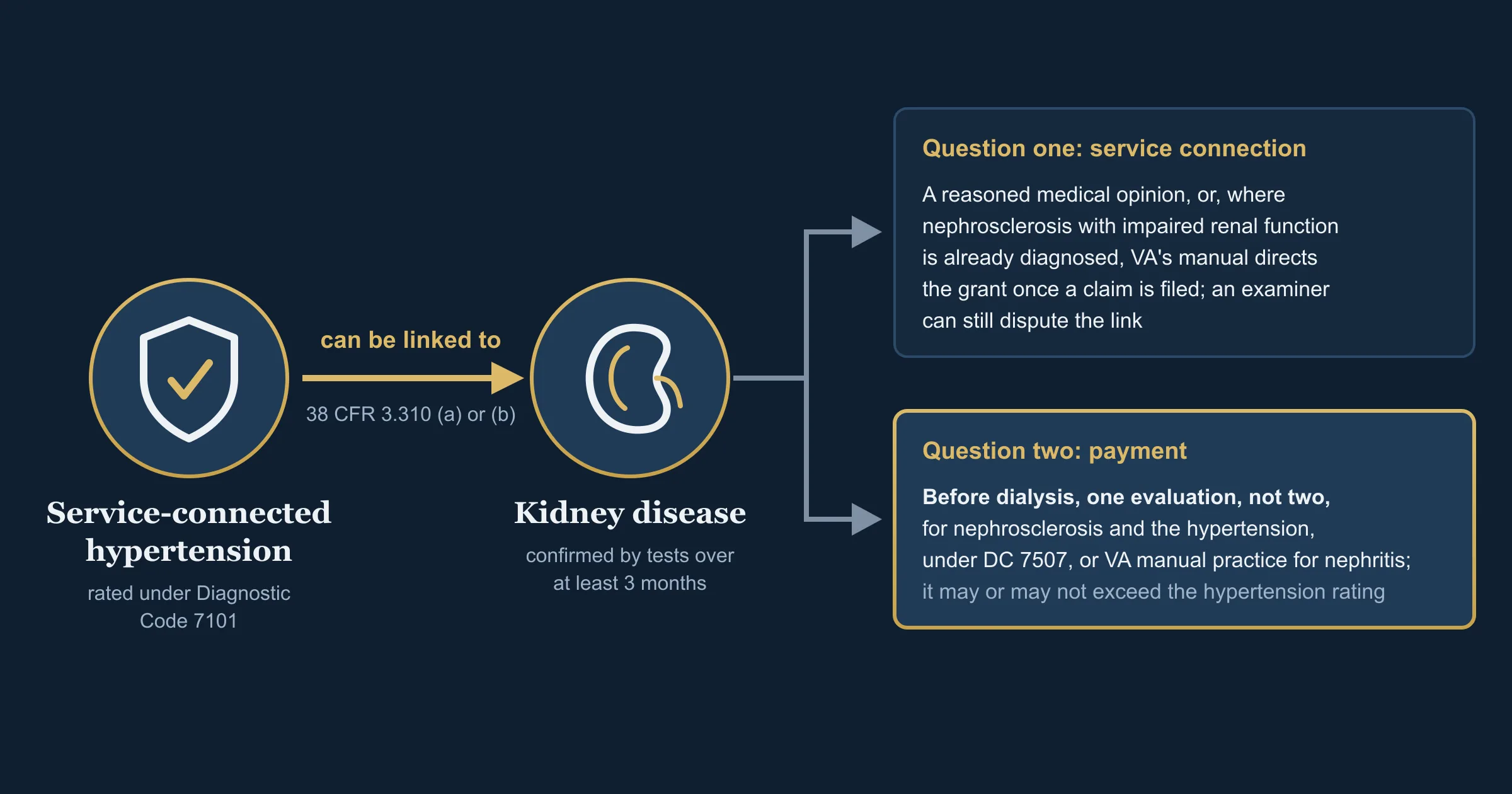
VA can service connect kidney disease secondary to service-connected hypertension under 38 CFR 3.310. Its manual directs the grant when nephrosclerosis with impaired kidney function is diagnosed, though a claim is still required. Before dialysis, VA rules can fold kidney disease and hypertension into one evaluation, which may or may not exceed the hypertension rating alone.
Three things belong up front. First, you may not need to buy a letter. Where your hypertension is service connected and your records already diagnose nephrosclerosis of the kidneys with impairment of renal function, VA's manual tells raters to grant service connection on a secondary basis (M21-1 Part V, Subpart iii, Chapter 5, Block 3.g). You still have to file a claim, and the same block cautions that arteriosclerosis occurs with advancing age without preexisting hypertension. Where the records leave the cause unclear, the manual tells VA to request a medical opinion. A physician's own opinion does its real work when there is something to answer: a VA decision or examiner against the link, another cause in your records that VA has not service connected, or an aggravation claim that needs a baseline under 38 CFR 3.310(b). Second, we make no promise that a kidney grant raises what you are paid: before dialysis the rules can give one evaluation for the kidney disease and the hypertension together, and that evaluation can stay where it is or come out higher. Third, studies tie higher blood pressure to later kidney disease, and the tie runs both ways; a chart label of hypertensive nephrosclerosis is a clinical judgement, not proof of what caused yours.
An illustrative example
A veteran has been service connected for hypertension at 10 percent since 2014. He takes daily blood pressure medication and has a documented history of diastolic readings predominantly 100 or more. Over the past two years his eGFR results have run between 48 and 56, and his primary care notes say chronic kidney disease stage 3a, with no cause written down. He files a claim for the kidney disease as secondary to his hypertension.
Because his records do not say what caused it, VA's manual tells the rater to request a medical opinion on whether it is a type of nephrosclerosis. Suppose the VA examiner says age is the more likely cause. That is where a physician's opinion can do real work: setting his blood pressure history against when the kidney results fell, his findings against what is expected at his age, and the other causes his records do or do not show.
Suppose VA then grants it as nephrosclerosis. His results sit in the band of the 30 percent renal row, but before dialysis the rules point to one evaluation for nephrosclerosis and hypertension, not a 30 percent kidney rating beside his 10 percent hypertension rating: DC 7507 rates nephrosclerosis by its predominant symptoms, and VA's manual practice bars a separate hypertension evaluation where the kidney disease is a form of nephritis, a question this page leaves open. By DC 7507's text, that one evaluation follows the 30 percent row if it is rated as renal dysfunction, and if it is rated as hypertension, under the cardiovascular schedule, the 10 percent that would otherwise be assigned is elevated to the next higher evaluation. Which route applies is the rater's decision, and we found no decision applying DC 7507 beside an existing DC 7101 evaluation, so this page does not predict the figure.
We built this example from the rules on this page to show how they fit together. It is not a client or a case result, and it predicts nothing about any claim.
Does VA Automatically Connect Kidney Disease to Service-Connected Hypertension?
Not automatically, since a claim is still required, but in one fact pattern VA's manual tells raters to grant. M21-1 is VA's internal procedures manual, not a regulation; SC in its text means service connection.
If additional arteriosclerotic manifestations are subsequently diagnosed in a Veteran with SC hypertension, grant SC on a secondary basis through the relationship to hypertension for any of the following:
M21-1 Part V, Subpart iii, Chapter 5, Block 3.g
- cerebral arteriosclerosis or thrombosis with hemiplegia
- nephrosclerosis of the kidneys with impairment of renal function, or
- myocardial damage or coronary occlusion of the heart.
Important: A claim for benefits is required to adjudicate a secondary SC claim for any of the arteriosclerotic manifestations.
M21-1 Part V, Subpart iii, Chapter 5, Block 3.g
Notes:
M21-1 Part V, Subpart iii, Chapter 5, Block 3.g, all three Notes
- Address SC for the above-listed cardiovascular conditions through the relationship to the hypertension when a sympathetic reading of the Veteran’s claim reasonably implies a claim for SC for those conditions.
- Arteriosclerosis occurs with advancing age without preexisting hypertension, and may occur in some younger individuals who are predisposed to arterial changes.
- The existence of arteriosclerosis does not imply/indicate prior hypertension.
The block's topic carries a change date of February 5, 2024; the version in force from November 15, 2021 differed only in a narrower sympathetic-reading Note. We could not verify earlier text, so nothing here says the manual read this way when the 2018 decisions below were made.
A Note added to the genitourinary chapter on March 19, 2026, after every Board decision on this page, covers records that name no cause:
As noted in M21-1, Part V, Subpart iii, 5.3.g, nephrosclerosis is a recognized arteriosclerotic manifestation of hypertension. Chronic kidney disease is not always a form of nephrosclerosis. When the clinical evidence is unclear, request a medical opinion to determine whether the disability in question is a type of nephrosclerosis.
M21-1 Part V, Subpart iii, Chapter 7, Block 2.f, second Note (added March 19, 2026)
A diagnosis on file did not by itself settle the link in 18160181 (2018). The Board found current diagnoses of hypertensive nephrosclerosis and chronic kidney disease, drawing on a June 2015 VA examination report and the treating provider's August 2015 letter together, without saying which recorded which, and still weighed the cause, setting the VA examiner's negative opinion, which blamed past kidney cancer, the nephrectomy and age, against the letter. It granted because the evidence was "at least evenly balanced" (binding only with regard to the specific case decided, 38 CFR 20.1303).
Where a physician's opinion does real work
An opinion earns its place when the file holds something to answer: a VA decision or opinion against the link, including one that answered a different question (A25024415) or leaned on a competing cause (18160181; 22003375); another cause in the record, such as diabetes (18146719), a renal tumor and nephrectomy (22003375, 18160181) or an inherited kidney disease (25001040); or an aggravation claim, which needs a baseline under 38 CFR 3.310(b). A cause VA already service connects is a route of its own under 38 CFR 3.310(a). Each decision is binding only with regard to the specific case decided (38 CFR 20.1303).
A record naming no cause is different: there the manual itself has VA request a medical opinion, which is not by itself a dispute.
How VA Decides Kidney Disease Secondary to Hypertension
One regulation gives two routes, and one standard of proof governs both.
Route one: the hypertension caused the kidney disease
Under 38 CFR 3.310(a), "disability which is proximately due to or the result of a service-connected disease or injury shall be service connected. When service connection is thus established for a secondary condition, the secondary condition shall be considered a part of the original condition." VA's manual asks whether the secondary disability is "shown to be the result of, or would not have occurred but for, an SC disability", and says "the primary disability need not be SC, or even diagnosed, at the time the secondary disability is incurred" (M21-1 Part V, Subpart ii, Chapter 2, Section D, Block 1.b).
Route two: the hypertension made it worse
Aggravation is 38 CFR 3.310(b), in full: "Any increase in severity of a nonservice-connected disease or injury that is proximately due to or the result of a service-connected disease or injury, and not due to the natural progress of the nonservice-connected disease, will be service connected. However, VA will not concede that a nonservice-connected disease or injury was aggravated by a service-connected disease or injury unless the baseline level of severity of the nonservice-connected disease or injury is established by medical evidence created before the onset of aggravation or by the earliest medical evidence created at any time between the onset of aggravation and the receipt of medical evidence establishing the current level of severity of the nonservice-connected disease or injury. The rating activity will determine the baseline and current levels of severity under the Schedule for Rating Disabilities (38 CFR part 4) and determine the extent of aggravation by deducting the baseline level of severity, as well as any increase in severity due to the natural progress of the disease, from the current level."
On its face the regulation names only medical evidence for the baseline and recites natural progress twice, and 4.115 calls the nephrosclerotic type "associated with natural progress." VA's manual, as its own practice, reads the rule more broadly: Block 1.a's Notes (May 1, 2026) say "Permanent worsening of an NSC disability by an SC disability is not required" and, in a Note the manual ties to Spicer v. McDonough, that VA "will apply the broader but-for standard and will no longer consider natural progress of the NSC disability when deciding a claim based on aggravation of an NSC disability by an SC disability" (NSC: not service connected).
The baseline survives. Block 1.c accepts "any other credible evidence, including lay evidence, that supports establishment of the baseline", though lay evidence "on its own, may not be sufficient"; Block 1.g keeps the deduction: "The evaluation assigned will reflect the difference between the current and baseline levels of severity." Block 1.f runs against the veteran: "if no baseline can be established, no aggravation can be demonstrated", and "Do not assume a baseline of 0 percent", though VA must first develop for one. Block 1.h allows a 0 percent grant. All of this is VA manual practice.
The standard: approximate balance, not proof
Under 38 CFR 3.102, "By reasonable doubt is meant one which exists because of an approximate balance of positive and negative evidence which does not satisfactorily prove or disprove the claim." Such doubt "will be resolved in favor of the claimant." The phrase "at least as likely as not" is not in 3.102; it is the conventional form of an opinion's conclusion, as in a VA examiner's opinion, as the Board recorded it in 25000604 (2025), that the kidney disease was "at least as likely as not proximately due to or a result of service-connected hypertension" (binding only with regard to the specific case decided, 38 CFR 20.1303).
What a VA examiner has to answer
For aggravation, the examiner must separately address "the current level of severity of the NSC disability"; whether "there has been any increase in severity of the NSC disability that would not have occurred but for an SC disability, or" "the NSC disability would have been less severe but for an SC disability, including where the SC disability has interfered with or impeded treatment for the NSC disability"; and "an adequate analysis with medical considerations supporting the opinion" (Block 1.e).
In A25024415 (2025) a VA opinion "only opined as to the issue of a TERA and not as secondary to hypertension" (a toxic exposure risk activity), and the Board remanded with but-for questions; in 23061641 (2023), also a remand, the examiner had skipped the kidney questionnaire the hypertension form called for. Both are binding only with regard to the specific case decided (38 CFR 20.1303).
Does High Blood Pressure Cause Kidney Disease? What the Research Shows
In large studies, higher blood pressure goes with a higher later risk of kidney disease. The association runs both ways, and no study can say what caused one veteran's kidney disease.
Long-running cohorts: higher pressure, higher later risk
Klag (1996) followed 332,544 men aged 35 to 57, screened from 1973 to 1975 for entry into the Multiple Risk Factor Intervention Trial, for end-stage renal disease through 1990: against below 120/80, systolic 210 or more or diastolic 120 or more carried a relative risk of 22.1 (the abstract gives no confidence interval), not explained by kidney failure soon after screening or, in 12,866 trial entrants, by baseline creatinine and urine protein (PMID 7494564). Hsu (2005) studied 316,675 Kaiser Permanente Northern California members with eGFR 60 or more and dipsticks negative for proteinuria or hematuria: against below 120/80, adjusted relative risks of end-stage renal disease ran from 1.62 (95 percent confidence interval 1.27 to 2.07) at 120 to 129 over 80 to 84 to 4.25 (2.63 to 6.86) at 210/120 or more. That screen only partly answers reverse causation; the conclusion reaches only "clinically evident baseline kidney disease" (PMID 15851645). In 10.5 million Korean adults, each 10 mm Hg higher systolic went with a 35 percent higher risk of new CKD at G3 to G5 (1.35 to 1.36), residual confounding not excluded (Chang, 2020, PMID 32305207); six pooled cohorts of 2,382,712 people gave relative risks for new CKD or end-stage renal disease of 1.56 (1.39 to 1.75) in women and 2.06 (1.64 to 2.60) in men at systolic 140 or more against below 120 (Weldegiorgis, 2020, PMID 33238919). All are observational.
Veterans
Lohr (2015) followed 15,221 veterans aged 70 or older with eGFR above 60 in VA primary care in upstate New York: new CKD occurred in 16 percent over a median of 19 quarters, with a higher hazard at systolic 140 to 149 or more than at 130 to 139; the abstract gives no hazard ratios (PMID 25537459). In the Million Veteran Program, Akwo (2021) followed 139,685 veterans who all had hypertension: where pressure stayed at 140/90 or above on three drugs including a thiazide, or four or more drugs were used, end-stage kidney disease ran 4.7 per 1,000 person-years against 1.6 otherwise, and among African American veterans the APOL1-adjusted incidence rate ratio was 1.98 (95 percent confidence interval 1.66 to 2.35, from the results text) (PMID 34148359; figures from the full text in PubMed Central). That compares hypertensive veterans with each other, not with normal blood pressure. The cohort also took in veterans who entered with an eGFR of 30 to 59, its adjusted models accounted for baseline eGFR, and the authors cite earlier studies reporting a higher risk of treatment-resistant hypertension in people with CKD (from the full text).
The link runs both ways
Hsu's background states the problem: "because renal disease itself can raise blood pressure, some investigators argue that ESRD seen in patients with hypertension is due to underlying primary renal disease" (ESRD: end-stage renal disease). Staplin (2022) begins: "It is well established that decreased kidney function can increase blood pressure (BP), but it is unproven whether moderately elevated BP causes chronic kidney disease (CKD) or glomerular hyperfiltration." The genetic studies split: Yu (2020) found genetic support for higher kidney function lowering blood pressure, that is, for reduced kidney function raising it, and no significant effect of blood pressure on kidney function (PMID 32454124); Staplin, in 311,119 White British UK Biobank participants, found 37 percent higher odds of CKD per genetically predicted 10 mm Hg higher systolic (1.29 to 1.45; PMID 36082669); Zheng (2022) found a causal signal in Europeans and none in East Asians (PMID 34999880); and Nierenberg (2021) found no association with progression in 3,074 people who already had CKD (PMID 35369652).
Treatment trials
SPRINT (2021) randomly assigned 9,361 people at raised cardiovascular risk, without diabetes or prior stroke, to a systolic target below 120 or below 140. Among those without CKD at entry, an eGFR fall of 30 percent or more to below 60 was more likely with the lower target (hazard ratio 3.67, 2.62 to 5.26), which the investigators read as "consistent with a hemodynamic reduction in glomerular pressure"; among those with CKD at entry, the kidney composite did not differ significantly, with few events (PMID 34010531; kidney results and the quotation from the full text in PubMed Central). In 3,041 participants followed through health records, post-trial eGFR slopes did not differ (Drawz, 2024, PMID 37883184). Kidney benefit from the lower target was not demonstrated.
What this means for a claim
The research supports an association and does not settle how much of it is cause, or in which direction; no source we found measures what share of veterans' kidney disease began with hypertension. That makes the question fair for a physician to weigh in one file, against that veteran's own dates, results and other risks, but not enough to answer it for him. An opinion that says the science settles it overstates the science.
Hypertensive Nephrosclerosis: What the Label Can and Cannot Show
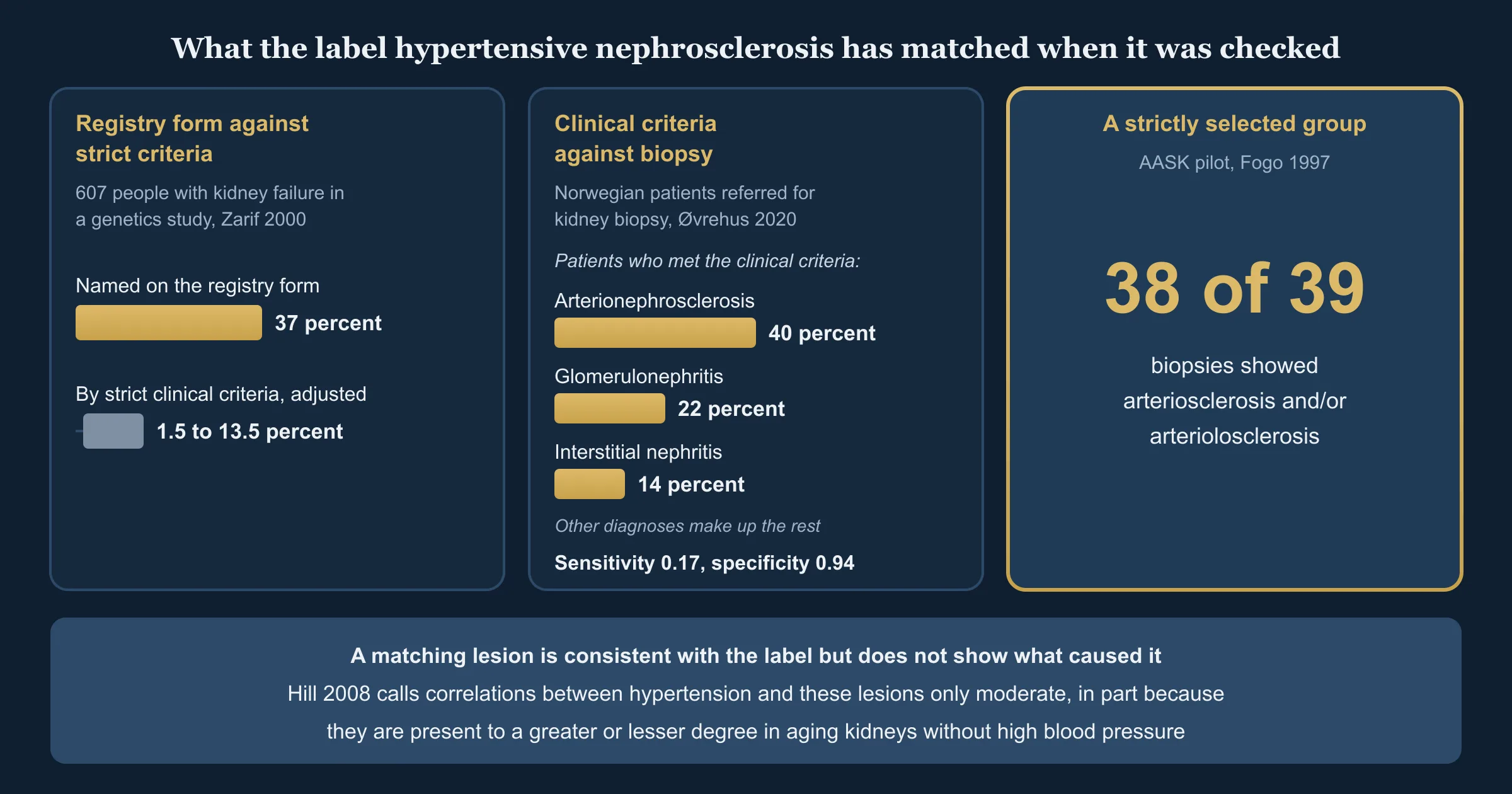
A chart can say hypertensive nephrosclerosis with no biopsy behind it. Checked against stricter tests, the label has matched in some groups and missed in others.
Clinical criteria against biopsy, in Norway
Øvrehus (2020) studied 4,920 Norwegian CKD patients referred for biopsy from 1988 to 2012 whose presentation was "consistent with, but not primarily suspicious for," hypertensive nephrosclerosis. The clinical criteria tested were blood pressure above 140/90, urine protein below 0.5 g a day, no blood in the urine and no diabetes. Against biopsy they had a sensitivity of 0.17 and a specificity of 0.94, and that cuts both ways. Among patients who met them, biopsy showed arterionephrosclerosis in 40 percent, glomerulonephritis in 22 percent and interstitial nephritis in 14 percent. But the criteria picked out only 153 of the 918 patients whose biopsy showed arterionephrosclerosis; the authors write that a negative result "would not give a clinical meaningful decrease of the disease probability" and tie the low accuracy to "an atypical phenotype with proteinuria and hematuria", so in this group, failing the criteria did not rule the disease out. These figures describe a white, biopsy-referred group only: the authors say it "probably included more atypical cases than found in clinical practice", so the criteria may perform better in clinical practice, and that generalizing to other regions should be done "with caution (and for African Americans not at all)" (PMID 32154455; figures beyond the abstract from the full text in PubMed Central).
The same registry, an optimized test
Hallan (2021), from the same registry group and so not an independent check, put the current criteria at a sensitivity of 0.13 and a specificity of 0.94; an optimized algorithm reached only 0.19 and 0.96, with 40 percent of its positives having other, treatable diagnoses (PMID 32613703).
Registry forms against strict criteria
Zarif (2000) studied 607 people with kidney failure in a genetics study, 73 percent African American. The registry form named hypertensive nephrosclerosis in 37 percent; strict criteria gave an adjusted 1.5 to 13.5 percent. Of the patients who could not be phenotyped as hypertensive nephrosclerosis, 14 were misdiagnosed, 14 had a urine protein-to-creatinine ratio above 2.0, and "insufficient data were available in the remainder", so the low figure partly reflects what the records did not show. Dropping only the rule that hypertension came first moved one count from 4 of 100 to 44 of 100, so the order of onset, which records can document, carries weight. Only 4 were biopsied, 1 consistent with the label (PMID 11071968).
Gene sequencing in early-onset disease
At one French centre, exome sequencing of 128 patients labelled with hypertensive nephropathy beginning before 45 found a single-gene diagnosis in 19 (15 percent): 7 percent with African ancestry, 30 percent without. It does not carry over to veterans diagnosed older (Serre, 2024, PMID 38471460).
The counterweight: a strictly selected group
In the AASK pilot, 38 of 39 biopsies from strictly selected non-diabetic hypertensive African American patients, with GFR 25 to 70 and no marked proteinuria, showed arteriosclerosis and/or arteriolosclerosis. The lesions were "consistent with" the diagnosis; the small study did not test whether hypertension caused them (Fogo, 1997, PMID 8995739).
Age
Hill's 2008 review calls correlations between hypertension and these lesions "only moderate", in part because they are present "to a greater or lesser degree in the normotensive, aging kidney" (PMID 18408477). Asghar (2023) set age-based thresholds for scarring from normotensive living donors, 7.1-fold to 36-fold higher at 70 or older than at 18 to 29. In patients who had a kidney removed for a tumor or a native kidney biopsy for a clinical reason, the risk of progressive CKD (kidney failure or a 40 percent fall in eGFR) was higher only when the scarring was abnormal for age. The measure is scarring, not the vascular lesion (PMID 37254246).
APOL1 in veterans of African ancestry
Among 121,492 Million Veteran Program participants of African ancestry, 12.8 percent carried two high-risk APOL1 variants. In this cross-sectional analysis, among participants without diabetes, that genotype without the p.N264K variant went with higher odds of CKD (1.72, 1.60 to 1.85) and end-stage kidney disease (3.94, 3.52 to 4.41) than low-risk genotypes without p.N264K; an exploratory analysis of participants with diabetes found smaller odds ratios, 1.3 for CKD and 1.8 for end-stage kidney disease (Hung, 2023, PMID 37798822; comparison groups and the diabetes figures from the full text). An AASK case-control study sharing an author with the review below linked the variants to kidney disease (odds ratio 2.57, 95 percent confidence interval 1.85 to 3.55, from the full text, Table 4) (Lipkowitz, 2013, PMID 22832513). Freedman and Cohen's opinion review says APOL1 nephropathies "are not initiated by systemic hypertension" and can raise blood pressure secondarily, while keeping a category "potentially related to hypertension" (PMID 26553514); "only a minority" of two-variant carriers develop kidney disease (Daneshpajouhnejad, 2022, PMID 35217848). This concerns people of recent African ancestry with two variants; nothing here means a veteran needs genetic testing to file or to win, or says how a rater weighs a genetic result.
How VA's manual draws the line
The manual's terms are rating terms. Block 2.e ("Characteristics of Nephritis") lists, under "Characteristics of nephrosclerotic nephritis", first "Originating in hypertension or arteriosclerosis." Block 2.c says the 4.115 heart-and-nephritis rule "does not apply when evaluating other types of nephropathy". Block 2.h says "A nephropathy diagnosis is not dispositive for the purpose of making this distinction." and "It is impermissible to evaluate a type of nephritis specifically identified in the rating schedule, such as gouty nephropathy, by analogy in an effort to achieve a higher disability evaluation." (M21-1 Part V, Subpart iii, Chapter 7.)
Why this page will not suggest a different label
We will not suggest describing hypertensive kidney disease as nephropathy, or as anything else, to get around 38 CFR 4.115, nor the reverse; the characterization is the physician's clinical call, then the rater's. For VA's manual, diagnosed nephrosclerosis with impaired renal function, with service-connected hypertension and a claim filed, is enough to direct the grant; for medicine, the label is a judgement that can be wrong, and an examiner can dispute it. Both are true.
What Counts as Chronic Kidney Disease, Medically and for VA
Medicine and VA's rating schedule each have their own test.
Medically, KDIGO 2024 defines chronic kidney disease as abnormalities of kidney structure or function, present for at least 3 months, with implications for health. The criteria are a GFR below 60 or a marker of kidney damage: albuminuria at an albumin-to-creatinine ratio (ACR) of 30 mg/g or more, urine sediment abnormalities, persistent hematuria, electrolyte and other abnormalities due to tubular disorders, abnormalities on histology, structural abnormalities on imaging, or a history of kidney transplantation.
KDIGO 2024 GFR categories (Table 2)
| GFR category | GFR, ml/min per 1.73 m² | KDIGO description |
|---|---|---|
| G1 | 90 or more | Normal or high |
| G2 | 60 to 89 | Mildly decreased |
| G3a | 45 to 59 | Mildly to moderately decreased |
| G3b | 30 to 44 | Moderately to severely decreased |
| G4 | 15 to 29 | Severely decreased |
| G5 | Below 15 | Kidney failure |
"In the absence of evidence of kidney damage, neither G1 nor G2 fulfills the criteria for CKD." (KDIGO 2024, Table 2.) Albuminuria has its own categories: A1 below 30 mg/g, A2 30 to 300 and A3 above 300.
KDIGO on chronicity and cause
KDIGO says not to assume chronicity from a single abnormal eGFR or ACR (Practice Point 1.1.3.2), to establish the cause from history, tests, imaging, and genetic and pathologic diagnosis (Practice Point 1.1.4.1), and suggests a biopsy "when clinically appropriate", graded 2D (Recommendation 1.1.4.1). It lists hypertension, diabetes, cardiovascular disease and prior acute kidney injury among CKD risk factors, an association rather than a finding about one person. The 2025 VA/DoD guideline reproduces these criteria and says: "These guidelines are not intended to represent VA or DOD policies."
VA's own duration test
Each renal row of 38 CFR 4.115a requires its finding "for at least 3 consecutive months during the past 12 months", apart from the 100 percent row's dialysis and transplant alternatives. VA's manual adds that an abnormal finding repeated 3 or more months later within 12 months documents chronicity, and that where clinical data are unavailable "a one-time finding may be used", with a second GFR reading scheduled three months later (Part V, Subpart iii, Chapter 7, Block 1.c). The table's Note accepts estimated GFR and creatinine-based approximations "when determined to be appropriate and calculated by a medical professional". And 4.115's "Albuminuria alone is not nephritis" is a rating statement about nephritis, not a clinical definition: a CKD diagnosis made on persistent albuminuria can meet KDIGO while no renal row above 0 percent applies.
How VA Rates a Kidney Grant Since November 14, 2021
Since November 14, 2021, renal dysfunction under 38 CFR 4.115a has been rated on GFR, dialysis and transplant status.
Renal dysfunction, 38 CFR 4.115a (rows as printed)
| Row text | Rating |
|---|---|
| Chronic kidney disease with glomerular filtration rate (GFR) less than 15 mL/min/1.73 m² for at least 3 consecutive months during the past 12 months; or requiring regular routine dialysis; or eligible kidney transplant recipient | 100 percent |
| Chronic kidney disease with GFR from 15 to 29 mL/min/1.73 m² for at least 3 consecutive months during the past 12 months | 80 percent |
| Chronic kidney disease with GFR from 30 to 44 mL/min/1.73 m² for at least 3 consecutive months during the past 12 months | 60 percent |
| Chronic kidney disease with GFR from 45 to 59 mL/min/1.73 m² for at least 3 consecutive months during the past 12 months | 30 percent |
| GFR from 60 to 89 mL/min/1.73 m² and either recurrent red blood cell (RBC) casts, white blood cell (WBC) casts, or granular casts for at least 3 consecutive months during the past 12 months; or GFR from 60 to 89 mL/min/1.73 m² and structural kidney abnormalities (cystic, obstructive, or glomerular) for at least 3 consecutive months during the past 12 months; or GFR from 60 to 89 mL/min/1.73 m² and albumin/creatinine ratio (ACR) ≥30 mg/g for at least 3 consecutive months during the past 12 months | 0 percent |
"Note: GFR, estimated GFR (eGFR), and creatinine-based approximations of GFR will be accepted for evaluation purposes under this section when determined to be appropriate and calculated by a medical professional." (38 CFR 4.115a.) The renal rows are 100, 80, 60, 30 and 0 percent; there is no 10 or 20 percent renal row.
In every instance where the schedule does not provide a zero percent evaluation for a diagnostic code, a zero percent evaluation shall be assigned when the requirements for a compensable evaluation are not met.
38 CFR 4.31, Zero percent evaluations
Where diagnostic codes refer the decision maker to these specific areas of dysfunction, only the predominant area of dysfunction shall be considered for rating purposes.
38 CFR 4.115a, preamble
Nephrosclerosis, arteriolar: Rate according to predominant symptoms as renal dysfunction, hypertension or heart disease. If rated under the cardiovascular schedule, however, the percentage rating which would otherwise be assigned will be elevated to the next higher evaluation.
38 CFR 4.115b, DC 7507
Apart from the 100 percent row's dialysis and transplant alternatives, no renal row above 0 percent applies at a GFR of 60 or more. DC 7502, "Nephritis, chronic", DC 7530, "Chronic renal disease requiring regular dialysis", DC 7534, "Atherosclerotic renal disease (renal artery stenosis, atheroembolic renal disease, or large vessel disease, unspecified)", and DC 7541, "Renal involvement in diabetes mellitus type I or II", each "Rate as renal dysfunction." DC 7500, "Kidney, removal of one", has a 30 percent minimum. The rater chooses the code from the whole record.
DC 7530 is for disease "requiring regular dialysis", yet A24001987 (2024) named it in its body, and DC 7534 in its conclusion, for a veteran never on dialysis, and A23032816 (2023) rated non-dialysis kidney disease under it. We build no advice on that coding (both binding only with regard to the specific case decided, 38 CFR 20.1303).
If you have read older descriptions
The eCFR's 4.115a texts for November 13 and 14, 2021 differ; the amendment, 86 FR 54085 (September 30, 2021), is cited through the eCFR because the Federal Register site was not reachable from our tools. VA's manual: "Prior to the revision of 38 CFR 4.115a effective on November 14, 2021, hypertension was included among the criteria for evaluation of renal dysfunction." (Chapter 7, Block 2.c, Note.) A Board percentage from before then is no expectation now, and we do not reprint the old criteria.
How DC 7101 rates the blood pressure itself is on our high blood pressure page.
Will a Kidney Grant Add to Your Hypertension Rating?
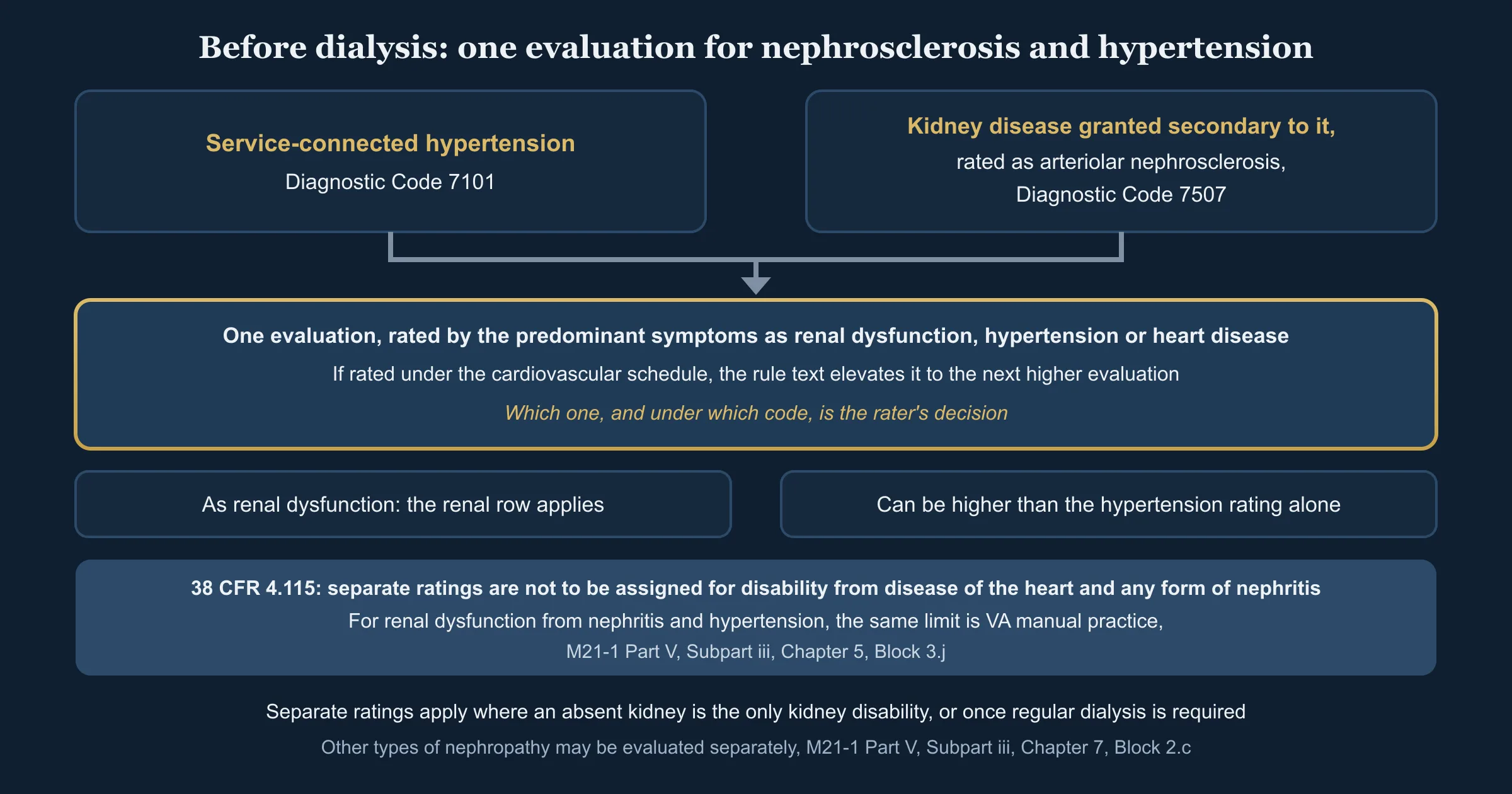
Before dialysis, the rules point to one evaluation, not two, for arteriolar nephrosclerosis and for kidney disease that is a form of nephritis, unless an absent kidney is the only kidney disability; VA's manual says other types of nephropathy may be evaluated separately. Where there is one evaluation, it can stay where the hypertension rating is or come out higher, and no one can promise which; under DC 7507, quoted below, it takes the renal row or a cardiovascular rating elevated to the next higher evaluation.
The nephrosclerotic type, originating in hypertension or arteriosclerosis, develops slowly, with minimum laboratory findings, and is associated with natural progress. Separate ratings are not to be assigned for disability from disease of the heart and any form of nephritis, on account of the close interrelationships of cardiovascular disabilities. If, however, absence of a kidney is the sole renal disability, even if removal was required because of nephritis, the absent kidney and any hypertension or heart disease will be separately rated. Also, in the event that chronic renal disease has progressed to the point where regular dialysis is required, any coexisting hypertension or heart disease will be separately rated.
38 CFR 4.115, sentences three to six
38 CFR 4.115 prohibits assignment of separate evaluations for renal dysfunction from nephritis and for hypertension except where
M21-1 Part V, Subpart iii, Chapter 5, Block 3.j (VA manual practice)
- the sole renal disability is absence of a kidney (even if that was due to nephritis), or
- nephritis has progressed to the point where regular dialysis is required.
Nephrosclerosis, arteriolar: Rate according to predominant symptoms as renal dysfunction, hypertension or heart disease. If rated under the cardiovascular schedule, however, the percentage rating which would otherwise be assigned will be elevated to the next higher evaluation.
38 CFR 4.115b, DC 7507
4.115's bar names heart disease and nephritis; hypertension appears only in its type sentence and the exceptions. Barring a separate hypertension evaluation beside renal dysfunction from nephritis before dialysis is how VA's manual applies 4.115, so this page labels it VA manual practice. DC 7507's elevation is rule text, which VA's manual repeats (Chapter 7, Block 2.f); we found no procedure or decision applying it beside an existing DC 7101 evaluation, and compute no elevated percentage.
VA's manual examples, M21-1 Part V, Subpart iii, Chapter 7, Block 2.g (codes and percentages only)
| Manual example | Separate evaluations |
|---|---|
| Example 1: DC 7101 Hypertension 10 with DC 7502 Nephritis 60 | not permitted |
| Example 2: DC 7500 Kidney, removal of one, history of glomerulonephritis 30 with DC 7101 Hypertension 20 | allowed, because absence of the kidney is the sole renal disability |
| Example 3: DC 7530 Nephritis 100 with DC 7101 Hypertension 10 | allowed if the 100 percent evaluation is based on the requirement for dialysis |
The open question: is this kidney disease a form of nephritis?
The bar reaches "any form of nephritis". The manual lists, under the heading "Characteristics of nephrosclerotic nephritis", first "Originating in hypertension or arteriosclerosis." (Chapter 7, Block 2.e) and says "Other types of nephropathy may be assigned separate evaluations for the renal impairment and heart disease and/or hypertension." (Block 2.c). Block 2.h adds: "A nephropathy diagnosis is not dispositive for the purpose of making this distinction." and "It is impermissible to evaluate a type of nephritis specifically identified in the rating schedule, such as gouty nephropathy, by analogy in an effort to achieve a higher disability evaluation."
Whether a veteran's kidney disease is a form of nephritis, which brings in 4.115, or another type of nephropathy, which the manual says may be evaluated separately, is decided from the medical evidence. This page sets out the texts, does not answer that question, and does not suggest describing the disease either way.
4.14 is a different rule
38 CFR 4.14 ends: "the evaluation of the same manifestation under different diagnoses are to be avoided." The 4.115a preamble considers "only the predominant area of dysfunction" and says "Distinct disabilities may be evaluated separately under this section, pursuant to § 4.14, if the symptoms do not overlap." 4.25(b) makes separate ratings the default but opens "Except as otherwise provided in this schedule", the hook for 4.115's bar. Today the renal rows measure GFR and DC 7101 measures blood pressure, so the single evaluation comes from 4.115 and manual practice, not 4.14; under the pre-2021 table, which used hypertension as a renal criterion, separate evaluations "would have been in violation of 38 CFR 4.14" (Chapter 7, Block 2.c, Note).
What the decisions show, in both directions
In 1802901 (2018) one evaluation of "30 percent, but no higher, for service-connected stage 2 renal disease with hypertension", under DC 7502, replaced the hypertension evaluation and exceeded it: 10 percent at the regional office, 20 as the Board set it for the earlier period. In 25000604 (2025), A24001987 (2024) and 18144383 (2018) the renal disease and the hypertension also sat in one rating, in 18144383 on the Board's own holding citing 4.115 and 4.14. All four used the pre-2021 table; we found no decision applying DC 7507 or rating kidney disease beside hypertension under today's table. The Board and regional offices have applied 4.115 this way although its bar names heart disease. Each decision is binding only with regard to the specific case decided (38 CFR 20.1303).
What a grant does even when the number does not move
Under 38 CFR 3.310(a) a secondary condition "shall be considered a part of the original condition." A later worsening is then a claim for an increase, and 3.400(o)(2) works on its own terms: "The provisions of this paragraph apply only when such reports relate to examination or treatment of a disability for which service-connection has previously been established." At regular dialysis the bar lifts, and a kidney grant can support later claims, such as sleep apnea secondary to it, each with its own medical support.
When two ratings are allowed
"If, however, absence of a kidney is the sole renal disability, even if removal was required because of nephritis, the absent kidney and any hypertension or heart disease will be separately rated." And: "Also, in the event that chronic renal disease has progressed to the point where regular dialysis is required, any coexisting hypertension or heart disease will be separately rated." (38 CFR 4.115.) Examples 2 and 3 above show each one. VA's manual adds a third case, for kidney disease that is not a form of nephritis: other types of nephropathy may be evaluated separately (Chapter 7, Block 2.c, quoted above).
DC 7101, 38 CFR 4.104 (rows as printed, for reference)
| Row text | Rating |
|---|---|
| Diastolic pressure predominantly 130 or more | 60 percent |
| Diastolic pressure predominantly 120 or more | 40 percent |
| Diastolic pressure predominantly 110 or more, or; systolic pressure predominantly 200 or more | 20 percent |
| Diastolic pressure predominantly 100 or more, or; systolic pressure predominantly 160 or more, or; minimum evaluation for an individual with a history of diastolic pressure predominantly 100 or more who requires continuous medication for control | 10 percent |
DC 7101 prints no 0 percent row; under 38 CFR 4.31 a 0 percent evaluation is assigned when the requirements for a compensable evaluation are not met. The medication route at 10 percent is for an individual with a history of diastolic pressure predominantly 100 or more who requires continuous medication for control.
Effective Dates: How Far Back a Kidney Grant Can Reach
The start date decides the back pay, so this section keeps to the rule texts.
Except as otherwise provided, the effective date of an evaluation and award of pension, compensation, or dependency and indemnity compensation based on an initial claim or supplemental claim will be the date of receipt of the claim or the date entitlement arose, whichever is later.
38 CFR 3.400, general rule
The effective date of any grant of SC for arteriosclerotic manifestations secondary to hypertension is the date of claim or date entitlement arose, whichever is later.
M21-1 Part V, Subpart iii, Chapter 5, Block 3.h
Important:
M21-1 Part V, Subpart iii, Chapter 5, Block 3.h
- Arteriosclerotic manifestations are not considered a worsening of hypertensive vascular disease (hypertension and isolated systolic hypertension) rated under 38 CFR 4.104, DC 7101. They are separate conditions which may be secondary to hypertensive vascular disease, but which nonetheless must be evaluated under rating criteria specific to their symptomology and the functions and anatomical localities they affect. Therefore, do not apply 38 CFR 3.400(o)(2) to allow an effective date prior to the date of claim, as this only applies to increases.
- If awarding SC for a disability as within scope of the hypertension claim, apply an effective date based on the date of claim for hypertension.
The within-scope sentence came with the February 5, 2024 change, so it is current practice, not a rule for older decisions; the 3.400(o)(2) instruction is also in the November 15, 2021 version. That route is a records question first: dated kidney findings while the hypertension claim was pending, and an opinion that dates the onset where the record allows. The kidney claim is not an increase of the hypertension rating. Once the kidney disease is service connected, a later claim that it worsened is an increase, and 3.400(o)(2) applies to that claim on its own terms.
What the Board did with the dates
In 25000604 (2025) the Board granted November 1, 2009, holding that entitlement "was reasonably raised by the record during the pending claim for an increased rating for hypertension" (Bailey v. Wilkie) and that "the evidence is at least in approximate balance regarding whether the Veteran's chronic renal disease began in 2009". In 23061641 (2023), the same veteran's earlier remand, renal disease had been assessed in August 2012 while the hypertension claim was pending. Both are binding only with regard to the specific case decided (38 CFR 20.1303).
In A25035038 (2025) the Board granted August 10, 2022. It put the earliest possible date at "June 29, 2022, the date VA received the Veteran's intent to file form. 38 C.F.R. § 3.155(b)" (the Board's words; we did not read 3.155), but held that a secondary grant "can be no earlier than the effective date of service connection for the primary disability", and the hypertension dated from August 10, 2022. It adopted the date the veteran's representative argued. The decision is binding only with regard to the specific case decided (38 CFR 20.1303).
Agent Orange, Other Presumptions and Chained Claims
However the hypertension was won, a secondary kidney claim rests on it.
Through the Agent Orange presumption for hypertension
The statute, 38 U.S.C. 1116(a)(2)(M), lists "Hypertension." for veterans with "covered service", which 1116(d) defines as service in the Republic of Vietnam from January 9, 1962 to May 7, 1975; at a United States or Royal Thai base in Thailand from January 9, 1962 to June 30, 1976; and in Laos, in Cambodia at Mimot or Krek, on Guam or American Samoa or in their waters, or on Johnston Atoll or a ship that called there, each for its stated period. Two companion sections extend the same list of diseases, hypertension included: 38 U.S.C. 1116A to service offshore of the Republic of Vietnam from January 9, 1962 to May 7, 1975, not more than 12 nautical miles seaward of a line the statute sets, and 38 U.S.C. 1116B to service in or near the Korean Demilitarized Zone from September 1, 1967 to August 31, 1971.
The PACT Act's section 404(d)(2), printed as a note to the statute, says the amendment took effect on enactment, August 10, 2022, and applies "On the date of the enactment" to claimants for dependency and indemnity compensation and to veterans VA determines are "terminally ill", "homeless", "under extreme financial hardship", "more than 85 years old" or "capable of demonstrating other sufficient cause", and "On October 1, 2026, for everyone not described in subparagraph (A)." Its retroactivity clause reads: "Notwithstanding any Federal court decisions or settlements in effect on the day before the date of the enactment of this Act, the Secretary of Veterans Affairs shall award retroactive claims for a condition under section 1116(a)(2)(M) of title 38, United States Code, as added by subsection (c) of this section, only to claimants for dependency and indemnity compensation under chapter 13 of such title described in subparagraph (A)(i) of this paragraph." VA's manual, as its own practice, lists August 10, 2022 as the date hypertension "became subject to presumptive SC based on herbicide exposure" and, for retroactive payment, points to 38 CFR 3.114(a) (M21-1 Part VIII, Subpart i, Chapter 1, Section C, Block 1.f). Under 3.114(a) the criteria must have been met on that date and continuously until the claim; a request received within 1 year of that date can reach back to it, and one received later can reach back no more than 1 year before the request.
38 CFR 3.309(e), at the eCFR issue of August 27, 2026, lists 14 diseases and no hypertension, kidney disease or nephritis; its Note 2 excludes hypertension from ischemic heart disease. The presumption's source is the statute. In A25005255 (2025) the Board said hypertension "is not a listed condition" there and granted it on a direct herbicide basis, "without application of presumptive service connection pursuant to the PACT Act"; the February 2024 VA hypertension examination gave no etiology opinion, and the Board relied on the National Academies' November 2018 move of hypertension to the category of "sufficient" evidence of an association. 25000681 (2025) granted hypertension "on a facts-found basis, for purposes of accrued benefits" after the veteran's death, for the period before the PACT Act, with a VA examiner's April 2024 advisory opinion in favor. Both are binding only with regard to the specific case decided (38 CFR 20.1303).
Kidney disease is on neither list. In 23005461 (2023), entered below, the Board could not grant kidney disease secondary to hypertension that was not service connected. Once the hypertension is granted, the kidney claim runs under 38 CFR 3.310; in A25035038 the Board held that veteran's kidney grant could be dated no earlier than his hypertension's service connection. These decisions are binding only with regard to the specific case decided (38 CFR 20.1303).
The chronic-disease presumption
38 CFR 3.309(a) lists "Cardiovascular-renal disease, including hypertension." with this parenthetical: "(This term applies to combination involvement of the type of arteriosclerosis, nephritis, and organic heart disease, and since hypertension is an early symptom long preceding the development of those diseases in their more obvious forms, a disabling hypertension within the 1-year period will be given the same benefit of service connection as any of the chronic diseases listed.)" This is the regulation's reason for a presumption, not a finding about any veteran's kidneys. It also lists "Nephritis." Such a claim is direct, not secondary: under 3.307(a)(3) the disease must be "manifest to a degree of 10 percent or more within 1 year" of separation, and 3.307(b) excepts intercurrent causes such as "active nephritis or acute endocarditis due to intercurrent infection". The renal table has no 10 percent row, and we do not work out how the window applies to it.
Former prisoners of war
For any former prisoner of war, 38 CFR 3.309(c)(1) presumes "Atherosclerotic heart disease or hypertensive vascular disease (including hypertensive heart disease) and their complications (including myocardial infarction, congestive heart failure, arrhythmia)." Whether 'complications' reaches nephrosclerosis is not stated in the regulation or in the manual section we read; we make no claim either way.
Chained claims through PTSD or sleep apnea
A kidney claim can end a chain, PTSD or sleep apnea to hypertension to kidney disease, each link with its own support; under the manual's causation block, quoted above, the hypertension need not be service connected when the kidney disease begins. 18142125 (2018) granted both links in one decision; 23005461 (2023) could not grant the kidney link without service-connected hypertension. Both are binding only with regard to the specific case decided (38 CFR 20.1303).
Through heart disease
In A22025743 (2022) a VA examiner found the kidney disease less likely due to hypertension but listed coronary artery disease as a risk factor. The Board granted coronary artery disease secondary to hypertension on a private physician assistant's opinion, and the kidney disease secondary to it. The decision does not address rating, and it is binding only with regard to the specific case decided (38 CFR 20.1303). On the regulation's own text, not the decision's, 4.115's heart-and-nephritis sentence would bear on rating a veteran in this position if the kidney disease is a form of nephritis, the open question above.
When diabetes is the cause on the record
DC 7541, "Renal involvement in diabetes mellitus type I or II", reads "Rate as renal dysfunction." The manual adds: "Important: When the renal impairment is a form of nephritis, 38 CFR 4.115 applies as discussed in M21-1, Part V, Subpart iii, 7.2.f." (Chapter 7, Block 2.b). In 18146719 (2018) a VA opinion resting on biopsy-proven diabetic nephropathy defeated the hypertension theory, which only the veteran's own statement supported; in 18144383 (2018), under the table in force before November 14, 2021, diabetic kidney disease and hypertension stayed in one rating (both binding only with regard to the specific case decided, 38 CFR 20.1303). For today's table, VA's manual says 4.115 applies where the renal impairment is a form of nephritis and that other types of nephropathy may be evaluated separately (Chapter 7, Blocks 2.b and 2.c); this page does not say which a given diabetic kidney disease is.
What a kidney grant can lead to
A service-connected kidney disease can support later claims, such as sleep apnea secondary to it, or anemia, each needing its own medical support and its own decision.
The first link of a PTSD chain has its own guide: hypertension secondary to PTSD.
So does the sleep apnea version: hypertension secondary to sleep apnea.
And once the kidney disease is service connected: sleep apnea secondary to kidney disease.
What Board Decisions on Kidney Disease and Hypertension Show
We opened 45 Board decision files, read each ORDER block, and rely on the 17 decisions this page cites: 13 below, A25005255, 25000681 and A22025743 in the routes section, and A23032816 in the rating section. The Board's own search was not reachable from our research tools, so the set came from web searches; the newest decision found is from April 2025. Read the lists as examples, never as rates. None of the 2023 to 2025 decisions we found grants or denies service connection for chronic kidney disease secondary to hypertension on the merits. Of those cited on this page, the ones that take up kidney disease and hypertension together are remands, effective-date decisions and a rating decision; the rest decide hypertension with no kidney issue, a polycystic kidney disease claim on service and herbicide exposure, or a kidney rating after a renal infarct. None we found applies DC 7507, or rates kidney disease beside hypertension under the table in force since November 14, 2021.
Under 38 CFR 20.1303, "Although the Board strives for consistency in issuing its decisions, previously issued Board decisions will be considered binding only with regard to the specific case decided." Each entry below is described only for the issue it decided.
Service connection granted
Citation Nr 22003375 (decided January 24, 2022)
Granted: service connection only, for "chronic kidney disease, including hypertensive nephropathy and hypertensive nephrosclerosis".
A March 2018 "private medical opinion", in the Board's words, was one of the four supports it named. A June 2017 VA questionnaire citing, in the Board's paraphrase, "multiple risk factors, especially his age" "lacks significant probative value" "given the established diagnosis of chronic kidney disease", "including hypertensive nephropathy and hypertensive nephrosclerosis", and because the examiner "failed to discuss or reconcile the medical article cited" and "did not acknowledge that nephrosclerosis (hardening of the kidney) may be due to hypertension of the renal arterioles". On literature, the Board cited Wallin v. West and Sacks v. West: article or treatise evidence alone can meet the nexus requirement where, under a case's facts, it shows "at least plausible causality", but not "solely by generic information in a medical journal or treatise". The record showed a right nephrectomy for a Bosniak 4 renal tumor and, by July 2018, "stage 5 chronic kidney disease due to hypertension".
Why it matters. A late-stage example; 4.115 and DC 7507 are not discussed.
Binding only with regard to the specific case decided (38 CFR 20.1303).
Citation Nr 18160181 (decided December 27, 2018)
Granted: service connection only, for "hypertensive nephrosclerosis and chronic kidney disease, secondary to service-connected hypertension on a causation basis"; the same order granted atrial fibrillation and cardiac arrhythmias "secondary to service-connected hypertensive heart disease on a causation basis".
The treating provider's August 2015 letter, with "no further explanation or rationale", got "some probative weight"; the June 2015 VA examiner blamed kidney cancer, the nephrectomy and age without a specific explanation ("somewhat limited probative value"). The Board found hypertensive nephrosclerosis among the current diagnoses from the examination report and the letter together. The evidence was "at least evenly balanced".
Why it matters. Not a 4.115 ruling: whether the now service-connected heart disease and nephrosclerosis can be rated separately was not decided.
Binding only with regard to the specific case decided (38 CFR 20.1303).
Citation Nr 18142125 (decided October 15, 2018)
Granted: "Entitlement to service connection for high blood pressure (hypertension), as secondary to the Veteran’s posttraumatic stress disorder (PTSD), is granted." and "Entitlement to service connection for chronic kidney disease, as secondary to the Veteran’s now service-connected hypertension, is granted."
Dr. H.S.'s March 2018 letter, based on "his interview with the Veteran, his review of the Veteran’s claims file, and the cited medical literature", and a March 2013 VA record ("probably due to sub-optimally controlled hypertension in a single functioning kidney") supported a finding of "proximately due to".
Why it matters. A chain granted in one decision; service connection only, and 4.115 is not discussed.
Binding only with regard to the specific case decided (38 CFR 20.1303).
Service connection denied
Citation Nr 18146719 (decided November 1, 2018)
Denied: "Entitlement to service connection for kidney disease, to include as secondary to service-connected hypertension, is denied." Direct and chronic-disease theories were decided too.
In the Board's account, a VA examiner tied the "progressive kidney disease" to "biopsy-proven diabetic nephropathy diagnosed in 2007", private records named diabetes "the primary cause", and "the only evidence" for the hypertension link was the veteran's lay statement. He had end-stage renal disease on dialysis.
Why it matters. A biopsy-proven different cause, unanswered by any medical opinion. Rating not reached.
Binding only with regard to the specific case decided (38 CFR 20.1303).
Citation Nr 25001040 (decided January 27, 2025)
Denied: "Service connection for polycystic kidney disease is denied." A direct herbicide theory (Thailand): the Board's finding covers causation or aggravation by the herbicide exposure only, so this is not a merits decision on kidney disease secondary to hypertension.
The Board gave probative value to the October 2024 VA examiner's negative opinion on the herbicide exposure. In the Board's account the same examiner indicated that the stage 4 chronic kidney disease "can be a result of polycystic kidneys, hypertension, and/or coronary artery disease" and noted that "Agent Orange exposure and hypertension cannot worsen polycystic kidneys"; the Board's finding reaches neither point. None of the treating physicians gave "a positive opinion that the kidney disorder is due to military service", and the disorder "is not listed as a presumptive condition based on herbicide exposure", in the Board's words.
Why it matters. An inherited disease and a negative opinion, with nothing medical against them. Rating not reached.
Binding only with regard to the specific case decided (38 CFR 20.1303).
Sent back for more development
Citation Nr 23005461 (decided January 27, 2023)
Remanded: "Entitlement to service connection for chronic kidney disease, claimed as secondary to malaria is remanded."
In the Board's account, a November 2022 VA examiner opined the kidney disease "was due to the Veteran's diagnosed hypertension", and a 2002 private provider had diagnosed "chronic renal insufficiency due to hypertension", but "because service connection is not already in effect for hypertension, the Board is unable to grant service connection for the claimed kidney disease secondary to hypertension at this time." It encouraged a supplemental hypertension claim based on Vietnam service.
Why it matters. No grant on the hypertension theory while the hypertension was not service connected; the kidney claim itself, claimed as secondary to malaria, went back for records.
Binding only with regard to the specific case decided (38 CFR 20.1303).
Citation Nr 23061641 (decided November 20, 2023)
Remanded: an earlier effective date for "chronic renal disease with hypertension", the hypertension rating, a rating above 60 percent, unemployability and special monthly compensation.
The October 2012 hypertension questionnaire "instructed the examiner to complete a separate DBQ for the kidneys if there was renal insufficiency related to the hypertension"; the examiner did not, though mild renal insufficiency had been assessed while the claim was pending. A 2018 correction had made the renal disease and the hypertension one rating.
Why it matters. An examination that passed over kidney findings was inadequate here. Same veteran as 25000604.
Binding only with regard to the specific case decided (38 CFR 20.1303).
Citation Nr A25024415 (decided March 17, 2025)
Remanded: chronic kidney disease, and kidney stones, "to include as due to a TERA and secondary to service-connected hypertension" (a toxic exposure risk activity).
The August 2023 VA opinion "only opined as to the issue of a TERA and not as secondary to hypertension." The Board ordered but-for and less-severe questions and, if the examiner opined that the kidney disease would result in less functional impairment but for the hypertension, an attempt to establish a baseline; its restatement of Spicer v. McDonough is its own characterization.
Why it matters. An opinion can fail by answering a different question.
Binding only with regard to the specific case decided (38 CFR 20.1303).
Effective date decided
Citation Nr 25000604 (decided January 16, 2025)
Granted: "Entitlement to an effective date of November 1, 2009, for the award of service connection for chronic renal disease is granted." Rating, unemployability and special monthly compensation remanded.
Entitlement "was reasonably raised by the record during the pending claim for an increased rating for hypertension" (Bailey v. Wilkie). The Board weighed a positive January 2015 VA kidney examination, private questionnaires from Dr. A.F. and 2024 VA opinions, and found the evidence on a 2009 onset "at least in approximate balance". A 2018 regional office correction had replaced separate ratings with one 60 percent rating for "chronic renal disease with hypertension", under the old table.
Why it matters. The closest Board support we found for the within-scope route.
Binding only with regard to the specific case decided (38 CFR 20.1303).
Citation Nr A25035038 (decided April 16, 2025)
Granted: "An earlier effective date of August 10, 2022, is granted for service connection for chronic kidney disease as secondary to the service-connected disability of hypertension, subject to the laws and regulations governing payment of monetary awards."
The agency had granted service connection in September 2023 at 60 percent from June 29, 2023, criterion not stated. The Board held the secondary grant could be no earlier than the hypertension's service connection, which dated from August 10, 2022.
Why it matters. A late hypertension grant set the kidney date. The decision does not say how the hypertension was service connected.
Binding only with regard to the specific case decided (38 CFR 20.1303).
The percentage: rating-stage decisions (all under the table in force before November 14, 2021)
Citation Nr 1802901 (decided January 12, 2018)
Granted: 20 percent for hypertension from December 10, 2010 to June 26, 2013, then "30 percent, but no higher, for service-connected stage 2 renal disease with hypertension".
The regional office granted service connection in November 2013 and combined the renal disease with the hypertension "as required under 38 C.F.R. § 4.115", under DC 7502. The veteran's surviving spouse carried the appeal.
Why it matters. One evaluation, higher here than the hypertension alone; an old-table figure, not an expectation today.
Binding only with regard to the specific case decided (38 CFR 20.1303).
Citation Nr 18144383 (decided October 24, 2018)
Denied: a separate compensable hypertension rating beside "diabetic nephropathy with hypertension" at 30 percent.
With no absent kidney and no regular dialysis, "granting separate ratings for the Veteran’s renal dysfunction and hypertension is not allowed. 38 C.F.R. § 4.115, see also 38 C.F.R. § 4.14." The kidney disease was diabetic, under DC 7541.
Why it matters. The Board's own reading of 4.115 under the old table; for today's table, VA's manual says 4.115 applies where the renal impairment is a form of nephritis and that other types of nephropathy may be evaluated separately (Chapter 7, Blocks 2.b and 2.c).
Binding only with regard to the specific case decided (38 CFR 20.1303).
Citation Nr A24001987 (decided January 17, 2024)
Denied: "A rating in excess of 60 percent disabling for chronic kidney disease associated with hypertension is denied." Unemployability was granted.
One evaluation covered both conditions. The decision names DC 7530, which 38 CFR 4.115b titles "Chronic renal disease requiring regular dialysis", in its body and DC 7534 in its conclusion, though "the Veteran has never been on dialysis"; it quotes only the old table. The severity evidence included a private questionnaire from Dr. D.B.
Why it matters. One evaluation in practice; its code and criteria are no guide now.
Binding only with regard to the specific case decided (38 CFR 20.1303).
Across these files the Board weighed each opinion's reasons and the record behind it. A treating physician's letter with no rationale reached equipoise against a VA opinion the Board found lacked a specific explanation (18160181); a private opinion, read with the records and the articles, reached equipoise in a late-stage claim (22003375); and a biopsy-proven different cause, with only the veteran's own statement on the other side, defeated a claim (18146719). No decision here is a rate or a prediction.
What a Strong Nexus Opinion for Kidney Disease Secondary to Hypertension Covers
No wording wins this claim; these are the elements the decisions and the research point to, each drawn from the file. Each decision named is binding only with regard to the specific case decided (38 CFR 20.1303).
- A kidney diagnosis that meets the definition, with dated resultsOne that meets KDIGO 2024, with the dated eGFR and urine albumin results behind it, kept apart from the renal rows' own duration test (Chapter 7, Block 1.c).
- What kind of kidney disease it is, and on what basisNephrosclerosis or another type, with the findings behind it. The manual says chronic kidney disease is not always nephrosclerosis (Block 2.f) and a nephropathy diagnosis is not dispositive (Block 2.h); the characterization follows the evidence and is never a relabel.
- When the hypertension began and when the kidney results fellDated blood pressure readings and labs, in order. In Zarif's study the timeline criterion alone moved one count from 4 of 100 to 44 of 100.
- Every other cause in the record, answeredDiabetes (18146719); kidney cancer, nephrectomy and age (18160181); an inherited disease (25001040); glomerulonephritis or interstitial nephritis, 22 and 14 percent of the biopsied patients meeting the clinical criteria in Øvrehus 2020, a white, biopsy-referred group; and APOL1-pattern disease where it fits (Hung 2023), within the limits in the label section.
- Age, measured rather than assumedThe manual notes that arteriosclerosis occurs with advancing age without preexisting hypertension (Chapter 5, Block 3.g), and the examiner in 22003375 cited age. The answer is measurement, not assumption. Where there is a biopsy, its scarring can be set against age-based thresholds drawn from normotensive donors (Asghar 2023), because vascular and glomerular lesions are present "to a greater or lesser degree in the normotensive, aging kidney" (Hill 2008). For kidney function, KDIGO 2024 recognizes "an average age-associated GFR decline observed in longitudinal and cross-sectional studies, but with substantial variation among individuals within the population, such that not all individuals will have a significant GFR decline with age" (Introduction, p. S135, reference numbers omitted).
- The research at its actual size, applied to this veteranBoth directions and the label studies, each at its real size, applied to his facts; in 22003375 the Board recited that article or treatise evidence showing "at least plausible causality" on a case's own facts can meet the nexus requirement (Wallin v. West), while an attempt to establish a nexus "solely by generic information in a medical journal or treatise" "is too general and inclusive" (Sacks v. West).
- Causation and aggravation, answered separately, with a baselineEach question on its own. For aggravation, the manual lists what the examiner's report must separately address (Part V, Subpart ii, Chapter 2, Section D, Block 1.e), and 38 CFR 3.310(b) requires a baseline. In A25024415 the Board ordered a but-for question and a less-severe question and, if the examiner answered the second yes, an attempt to establish a baseline.
- The record actually reviewedWhat was read and who was examined: in 18142125 an interview, the claims file and the literature; in 18160181 a treating letter with no rationale got only "some probative weight".
Opinions conventionally state their conclusion as a probability, such as at least as likely as not, the form VA examiners use for the approximate balance described in 38 CFR 3.102; the phrase itself does not appear in that regulation. What the Board weighs is the reasoning behind it.
What we cannot do
We cannot put a kidney diagnosis into records that lack one, pick the label your kidney disease carries, or make the research say more than it does. A physician on our team will not sign an opinion your file does not support, and no one can tell you in advance what VA will decide or what the evaluation will be. Filing the claim and representing you before VA are not things we do; our work is the medical opinion.
The elements VA looks for in any medical opinion are in our guide to what a nexus letter must include.
Is There a Kidney Claim Here, and Does It Need a Letter?
Check your file
Tick each statement your records support today. The first asks whether the link is already settled. The second and third are requirements for a kidney claim secondary to hypertension. The rest carry no points; each names something a rater or a physician will look for.
Nothing here is scored. Tick only what your records say today.
When a Letter May Not Be Needed, and When We Cannot Help
We write nexus letters. These are the situations in which buying one does not make sense, or cannot work.
- Your records already carry the diagnosis VA's manual grants onIf your hypertension is service connected and your records diagnose nephrosclerosis of the kidneys with impairment of renal function, VA's manual tells raters to grant service connection on a secondary basis (M21-1 Part V, Subpart iii, Chapter 5, Block 3.g). File the claim, which the manual says is required. A letter becomes worth considering if a VA examiner or decision then goes the other way.
- Your records do not show kidney disease yetOne abnormal result is not a diagnosis, and the KDIGO 2024 guideline warns against assuming chronicity from a single abnormal eGFR or urine albumin result. Your own doctor, who can repeat the tests, comes first, and no letter can supply the diagnosis.
- Your hypertension is not service connected and no claim for it is pendingThis claim runs through service-connected hypertension, so the hypertension has to be claimed too; the two claims can be filed together. For a veteran with qualifying service, 38 U.S.C. 1116(a)(2)(M) presumes the hypertension link; the Agent Orange section above explains how the statute phased that in and the date VA's manual uses. In 23005461 (2023) the Board was unable to grant kidney disease secondary to hypertension for this reason, a decision binding only with regard to the specific case decided (38 CFR 20.1303).
- Your kidney disease is already service connected on another basisIf VA connected it to diabetes or on another basis, the link is settled. What moves the rating is your GFR results over time and whether you come to need regular dialysis or become an eligible kidney transplant recipient, all from your treatment records rather than from a letter.
- The goal is a higher combined rating before dialysisBefore dialysis the rules can give one evaluation for the kidney disease and the hypertension, and that evaluation can stay where it is or come out higher; we cannot promise either. A grant still puts the link on the record, so a later worsening is a claim for an increase rather than a new fight over the cause. Whether that is worth paying for now is your decision, and we will say so plainly on the consultation.
- A different cause is already establishedIf a biopsy or genetic testing has already shown a different kidney disease, a letter cannot relabel it, and a physician on our team will not sign an opinion your file does not support. A claim that hypertension made that disease worse still needs medical support and a baseline under 38 CFR 3.310(b); in 25001040 (2025) a VA examiner, in the Board's account, opined that the veteran's polycystic kidney disease was less likely than not aggravated by hypertension, but the Board decided that claim on service and herbicide exposure, not on hypertension (binding only with regard to the specific case decided, 38 CFR 20.1303).
Frequently Asked Questions
Can kidney disease be service connected secondary to hypertension?
Yes. Under 38 CFR 3.310(a), a disability that is proximately due to or the result of a service-connected condition is service connected, and 3.310(b) covers a non-service-connected condition made worse by one, once a baseline is established. VA's manual lists nephrosclerosis of the kidneys with impairment of renal function among the manifestations it grants on a secondary basis through service-connected hypertension, once a claim is filed. VA weighs the evidence for an approximate balance under 38 CFR 3.102, not for proof.
Does VA automatically grant kidney disease when hypertension is service connected?
No, a claim is still required. Where nephrosclerosis of the kidneys with impairment of renal function is diagnosed in a veteran with service-connected hypertension, VA's manual tells raters to grant service connection on a secondary basis (M21-1 Part V, Subpart iii, Chapter 5, Block 3.g). The same block notes that arteriosclerosis occurs with advancing age without preexisting hypertension, and another block says chronic kidney disease is not always a form of nephrosclerosis. In 18160181 (2018) the Board found current diagnoses including hypertensive nephrosclerosis and still weighed a VA examiner's opinion that attributed the kidney disease to other causes; it granted on the benefit of the doubt, in a decision binding only with regard to the specific case decided (38 CFR 20.1303).
Will a kidney grant raise my VA rating if my hypertension is already rated?
It may or may not, and no one can promise either way. 38 CFR 4.115 bars separate ratings for heart disease and any form of nephritis, and VA's manual, as its own practice, bars separate evaluations for renal dysfunction from nephritis and for hypertension (M21-1 Part V, Subpart iii, Chapter 5, Block 3.j). DC 7507 rates arteriolar nephrosclerosis by its predominant symptoms as one evaluation: the renal row if it is rated as renal dysfunction, or, if it is rated under the cardiovascular schedule, the rating that would otherwise be assigned, elevated to the next higher evaluation. Both the regulation and the manual allow separate ratings where an absent kidney is the only kidney disability or once regular dialysis is required, and the manual says other types of nephropathy may be assigned separate evaluations for the renal impairment and hypertension (M21-1 Part V, Subpart iii, Chapter 7, Block 2.c). Whether a given kidney disease counts as nephritis is decided from the medical evidence; the manual lists "Originating in hypertension or arteriosclerosis" under "Characteristics of nephrosclerotic nephritis" (Chapter 7, Block 2.e).
Does high blood pressure cause kidney disease?
The research shows an association that runs both ways, not a settled cause. Large cohorts link higher blood pressure to a higher later risk of kidney failure or new chronic kidney disease, among them 332,544 men followed for about 16 years for kidney failure (Klag, 1996) and 15,221 veterans aged 70 or older in VA primary care in upstate New York followed for new chronic kidney disease (Lohr, 2015). Kidney disease can also raise blood pressure, genetic studies disagree on how much of the link is causal, and in a major trial a lower blood pressure target did not show kidney protection. No study can say that hypertension caused one veteran's kidney disease; that is the question a physician's opinion weighs.
How does VA rate chronic kidney disease now?
Since November 14, 2021, 38 CFR 4.115a rates renal dysfunction by glomerular filtration rate (GFR), dialysis and transplant: 30 percent for GFR 45 to 59, 60 percent for 30 to 44 and 80 percent for 15 to 29, each for at least 3 consecutive months during the past 12 months, and 100 percent for GFR under 15 for that period, regular routine dialysis, or an eligible kidney transplant recipient. GFR 60 to 89 with recurrent casts, structural kidney abnormalities or an albumin/creatinine ratio of 30 mg/g or more, for the same period, is 0 percent. Outside the 100 percent row's dialysis and transplant routes, no renal row above 0 percent applies at a GFR of 60 or more, and for arteriolar nephrosclerosis DC 7507 also allows rating by predominant symptoms as hypertension or heart disease. Estimated GFR is accepted when it is determined to be appropriate and calculated by a medical professional.
Is kidney disease presumptive for Agent Orange?
No. Kidney disease is not on the herbicide list in 38 CFR 3.309(e) or in 38 U.S.C. 1116. Hypertension is presumptive by statute, at 38 U.S.C. 1116(a)(2)(M), for veterans with qualifying service; the regulation's list in 3.309(e) still has no hypertension entry. The PACT Act's text applied the hypertension presumption from enactment in 2022 to dependency and indemnity compensation claims and to veterans VA determines are terminally ill, homeless, in extreme financial hardship, over 85 or able to show other sufficient cause, and to everyone else from October 1, 2026, with retroactive awards only for those dependency and indemnity compensation claims. VA's manual, as its own practice, gives August 10, 2022 as the date hypertension became subject to presumptive service connection based on herbicide exposure, and applies the retroactive payment rules of 38 CFR 3.114(a) (M21-1 Part VIII, Subpart i, Chapter 1, Section C, Block 1.f). Once hypertension is service connected, kidney disease can be claimed secondary to it under 38 CFR 3.310.
Can I claim kidney disease if my hypertension is not service connected yet?
You can file both, but on this basis the kidney claim can be granted only once the hypertension is service connected. VA's manual says the primary disability need not be service connected, or even diagnosed, when the secondary one is incurred (M21-1 Part V, Subpart ii, Chapter 2, Section D, Block 1.b). In 18142125 (2018) the Board granted hypertension secondary to PTSD and chronic kidney disease secondary to that hypertension in one decision; in 23005461 (2023) it was unable to grant kidney disease secondary to hypertension because the hypertension was not service connected. Each decision is binding only with regard to the specific case decided (38 CFR 20.1303).
What effective date does a kidney grant secondary to hypertension get?
VA's manual sets it at the date of claim or the date entitlement arose, whichever is later. It says not to use 38 CFR 3.400(o)(2), the look-back for increases, to reach before the claim, because arteriosclerotic manifestations such as nephrosclerosis are not considered a worsening of the hypertension. Where VA grants the kidney disease as within the scope of the hypertension claim, the manual says to use the hypertension claim's date (M21-1 Part V, Subpart iii, Chapter 5, Block 3.h). In A25035038 (2025) the Board applied the rule that a secondary grant can be no earlier than the primary condition's service connection, in a decision binding only with regard to the specific case decided (38 CFR 20.1303).
Do I need a nexus letter for kidney disease secondary to hypertension?
Not always. If your hypertension is service connected and your records already diagnose nephrosclerosis with impaired kidney function, VA's manual directs the grant once you file, and a letter may add little. A physician's opinion does real work when a VA decision or examiner has gone against the link, or when your records name another possible cause of the kidney disease that VA has not service connected, such as diabetes, a kidney tumor or removal, or an inherited kidney disease; a cause VA already service connects is a route of its own under 38 CFR 3.310(a). If your records show no kidney disease, meaning no doctor's diagnosis and no eGFR results below 60 on tests at least 3 months apart, a letter cannot help yet; with no service-connected hypertension and no hypertension claim pending, the hypertension has to be claimed too, and the two claims can be filed together.
How much does a nexus letter for kidney disease secondary to hypertension cost?
The fee for a physician-authored nexus letter is listed on our pricing page, and the first consultation is free. If you go ahead, you pay the fee before a licensed clinician reviews your records, and if that review shows an honest opinion cannot be supported, you are refunded before drafting begins. If your records already carry the diagnosis VA's manual grants on, tell us on the consultation; you may not need a letter.
Related guides
- High blood pressure and VA disabilityHow DC 7101 rates hypertension, the Agent Orange route, and the claim this one rests on.
- Sleep apnea secondary to kidney diseaseA claim that can follow a kidney grant, once the kidney disease is service connected.
- Hypertension secondary to PTSDThe first link of a chained claim, which needs its own opinion before a kidney claim can rest on it.
- Hypertension secondary to sleep apneaThe same first link with sleep apnea as the primary, including why that claim can be granted at 0 percent.
- Nexus letters for secondary conditionsHow secondary claims work under 38 CFR 3.310.
- What is a nexus letterWhat a medical opinion is and where it sits in a VA claim.
- What a nexus letter must includeThe elements VA raters check in any medical opinion.
Bring the Kidney Results and the Hypertension Decision
For a free consultation, have your hypertension rating decision or the claim you filed, your kidney function results over time, including eGFR and urine albumin, your nephrology or primary care notes, any kidney imaging or biopsy report, and any VA kidney examination at hand, so you can tell us what they show. You will get a straight answer on whether a physician's opinion can add anything to a kidney claim. If your records already carry the diagnosis VA's manual grants on, or the open question is the rating rather than the link, we will tell you. If you go ahead, the fee comes first, a licensed clinician then reviews the full file, and if an honest opinion cannot be supported you get your money back before drafting begins.
Citations & References
- 38 CFR 3.102, Reasonable doubt (eCFR, issue date 2026-08-27) https://www.ecfr.gov/current/title-38/section-3.102
- 38 CFR 3.307, Presumptive service connection for chronic, tropical or prisoner-of-war related disease, paragraphs (a)(3) and (b) (eCFR, issue date 2026-08-27) https://www.ecfr.gov/current/title-38/section-3.307
- 38 CFR 3.309, Disease subject to presumptive service connection, paragraphs (a), (c) and (e) (eCFR, issue date 2026-08-27) https://www.ecfr.gov/current/title-38/section-3.309
- 38 CFR 3.310, Disabilities that are proximately due to, or aggravated by, service-connected disease or injury, paragraphs (a) and (b) (eCFR, issue date 2026-08-27) https://www.ecfr.gov/current/title-38/section-3.310
- 38 CFR 3.400, Effective dates, general rule and paragraph (o) (eCFR, issue date 2026-08-27) https://www.ecfr.gov/current/title-38/section-3.400
- 38 CFR 4.14, Avoidance of pyramiding (eCFR, issue date 2026-08-27) https://www.ecfr.gov/current/title-38/section-4.14
- 38 CFR 4.25, Combined ratings table, paragraph (b) (eCFR, issue date 2026-08-27) https://www.ecfr.gov/current/title-38/section-4.25
- 38 CFR 4.31, Zero percent evaluations (eCFR, issue date 2026-08-27) https://www.ecfr.gov/current/title-38/section-4.31
- 38 CFR 4.104, Schedule of ratings, cardiovascular system, DC 7101 (eCFR, issue date 2026-08-27) https://www.ecfr.gov/current/title-38/section-4.104
- 38 CFR 4.115, Nephritis (eCFR, issue date 2026-08-27) https://www.ecfr.gov/current/title-38/section-4.115
- 38 CFR 4.115a, Ratings of the genitourinary system, dysfunctions, renal dysfunction rows and Note; amended at 86 FR 54085 (Sept. 30, 2021), effective November 14, 2021 (eCFR, issue date 2026-08-27) https://www.ecfr.gov/current/title-38/section-4.115a
- 38 CFR 4.115b, Ratings of the genitourinary system, diagnoses, DCs 7500, 7502, 7507, 7530, 7534 and 7541 (eCFR, issue date 2026-08-27) https://www.ecfr.gov/current/title-38/section-4.115b
- 38 CFR 20.1303, Nonprecedential nature of Board decisions (eCFR, issue date 2026-08-27) https://www.ecfr.gov/current/title-38/section-20.1303
- 38 U.S.C. 1116, Presumptions of service connection for diseases associated with exposure to certain herbicide agents, including the PACT Act section 404(d) statutory note (Cornell LII) https://www.law.cornell.edu/uscode/text/38/1116
- 38 U.S.C. 1116A, Presumptions of service connection for veterans who served offshore of the Republic of Vietnam (Cornell LII) https://www.law.cornell.edu/uscode/text/38/1116A
- 38 U.S.C. 1116B, Presumption of herbicide exposure for certain veterans who served in Korea (Cornell LII) https://www.law.cornell.edu/uscode/text/38/1116B
- M21-1, Part V, Subpart iii, Chapter 5, Cardiovascular System Conditions, Blocks 3.f to 3.j (VA KnowVA, article 554400000014520) https://www.knowva.ebenefits.va.gov/system/templates/selfservice/va_ssnew/help/customer/locale/en-US/portal/554400000001018/content/554400000014520/M21-1-Part-V-Subpart-iii-Chapter-5-Cardiovascular-System-Conditions
- M21-1, Part V, Subpart iii, Chapter 7, Genitourinary Disabilities, Blocks 1.a to 1.c and 2.a to 2.h (VA KnowVA, article 554400000180593) https://www.knowva.ebenefits.va.gov/system/templates/selfservice/va_ssnew/help/customer/locale/en-US/portal/554400000001018/content/554400000180593/M21-1-Part-V-Subpart-iii-Chapter-7-Genitourinary-Disabilities
- M21-1, Part V, Subpart ii, Chapter 2, Section D, Blocks 1.a to 1.h, secondary service connection, aggravation and the baseline (VA KnowVA, article 554400000180484) https://www.knowva.ebenefits.va.gov/system/templates/selfservice/va_ssnew/help/customer/locale/en-US/portal/554400000001018/content/554400000180484/M21-1-Part-V-Subpart-ii-Chapter-2-Section-D-Secondary-Service-Connection-SC-and-Aggravation-of-Non-Service-Connected-NSC-Disabilities
- M21-1, Part VIII, Subpart i, Chapter 1, Section C, Block 1.f, the date each herbicide disease became subject to presumptive service connection (VA KnowVA, article 554400000308860) https://www.knowva.ebenefits.va.gov/system/templates/selfservice/va_ssnew/help/customer/locale/en-US/portal/554400000001018/content/554400000308860/M21-1-Part-VIII-Subpart-i-Chapter-1-Section-C-Ratings-for-Disabilities-Associated-With-Herbicide-Exposure
- KDIGO CKD Work Group. KDIGO 2024 Clinical Practice Guideline for the Evaluation and Management of Chronic Kidney Disease. Kidney Int. 2024 (PubMed) https://pubmed.ncbi.nlm.nih.gov/38490803/
- KDIGO 2024 Clinical Practice Guideline for the Evaluation and Management of Chronic Kidney Disease (full text, kdigo.org PDF) https://kdigo.org/wp-content/uploads/2024/03/KDIGO-2024-CKD-Guideline.pdf
- VA/DOD Clinical Practice Guideline for the Primary Care Management of Chronic Kidney Disease, 2025 (VA Health Quality PDF) https://www.healthquality.va.gov/HEALTHQUALITY/guidelines/CD/ckd/CKD-CPG_2025-Guideline_final_20250509.pdf
- Klag, et al. Blood pressure and end-stage renal disease in men. N Engl J Med. 1996 (PubMed) https://pubmed.ncbi.nlm.nih.gov/7494564/
- Hsu, et al. Elevated blood pressure and risk of end-stage renal disease in subjects without baseline kidney disease. Arch Intern Med. 2005 (PubMed) https://pubmed.ncbi.nlm.nih.gov/15851645/
- Chang, et al. Associations of Systolic Blood Pressure With Incident CKD G3-G5: A Cohort Study of South Korean Adults. Am J Kidney Dis. 2020 (PubMed) https://pubmed.ncbi.nlm.nih.gov/32305207/
- Weldegiorgis, et al. The impact of hypertension on chronic kidney disease and end-stage renal disease is greater in men than women: a systematic review and meta-analysis. BMC Nephrol. 2020 (PubMed) https://pubmed.ncbi.nlm.nih.gov/33238919/
- Lohr, et al. Elevated systolic blood pressure is associated with increased incidence of chronic kidney disease but not mortality in elderly veterans. J Am Soc Hypertens. 2015 (PubMed) https://pubmed.ncbi.nlm.nih.gov/25537459/
- Akwo, et al. Association of Apparent Treatment-Resistant Hypertension With Differential Risk of End-Stage Kidney Disease Across Racial Groups in the Million Veteran Program. Hypertension. 2021 (PubMed) https://pubmed.ncbi.nlm.nih.gov/34148359/
- Yu, et al. A bidirectional Mendelian randomization study supports causal effects of kidney function on blood pressure. Kidney Int. 2020 (PubMed) https://pubmed.ncbi.nlm.nih.gov/32454124/
- Staplin, et al. Determining the Relationship Between Blood Pressure, Kidney Function, and Chronic Kidney Disease: Insights From Genetic Epidemiology. Hypertension. 2022 (PubMed) https://pubmed.ncbi.nlm.nih.gov/36082669/
- Zheng, et al. Trans-ethnic Mendelian-randomization study reveals causal relationships between cardiometabolic factors and chronic kidney disease. Int J Epidemiol. 2022 (PubMed) https://pubmed.ncbi.nlm.nih.gov/34999880/
- Nierenberg, et al. Association of Blood Pressure Genetic Risk Score with Cardiovascular Disease and CKD Progression: Findings from the CRIC Study. Kidney360. 2021 (PubMed) https://pubmed.ncbi.nlm.nih.gov/35369652/
- SPRINT Research Group. Final Report of a Trial of Intensive versus Standard Blood-Pressure Control. N Engl J Med. 2021 (PubMed) https://pubmed.ncbi.nlm.nih.gov/34010531/
- Drawz, et al. Effect of Intensive Blood Pressure Control on Kidney Outcomes: Long-Term Electronic Health Record-Based Post-Trial Follow-Up of SPRINT. Clin J Am Soc Nephrol. 2024 (PubMed) https://pubmed.ncbi.nlm.nih.gov/37883184/
- Øvrehus, et al. Clinical Phenotypes and Long-term Prognosis in White Patients With Biopsy-Verified Hypertensive Nephrosclerosis. Kidney Int Rep. 2020 (PubMed) https://pubmed.ncbi.nlm.nih.gov/32154455/
- Hallan, et al. Hypertensive nephrosclerosis: wider kidney biopsy indications may be needed to improve diagnostics. J Intern Med. 2021 (PubMed) https://pubmed.ncbi.nlm.nih.gov/32613703/
- Zarif, et al. Inaccuracy of clinical phenotyping parameters for hypertensive nephrosclerosis. Nephrol Dial Transplant. 2000 (PubMed) https://pubmed.ncbi.nlm.nih.gov/11071968/
- Serre, et al. Diagnostic Yield of Exome Sequencing in Early-Onset Hypertensive Nephropathy in Adults. Am J Nephrol. 2024 (PubMed) https://pubmed.ncbi.nlm.nih.gov/38471460/
- Fogo, et al. Accuracy of the diagnosis of hypertensive nephrosclerosis in African Americans: a report from the African American Study of Kidney Disease (AASK) Trial. Kidney Int. 1997 (PubMed) https://pubmed.ncbi.nlm.nih.gov/8995739/
- Hill. Hypertensive nephrosclerosis. Curr Opin Nephrol Hypertens. 2008 (review; PubMed) https://pubmed.ncbi.nlm.nih.gov/18408477/
- Asghar, et al. Age-Based Versus Young-Adult Thresholds for Nephrosclerosis on Kidney Biopsy and Prognostic Implications for CKD. J Am Soc Nephrol. 2023 (PubMed) https://pubmed.ncbi.nlm.nih.gov/37254246/
- Hung, et al. Genetic Inhibition of APOL1 Pore-Forming Function Prevents APOL1-Mediated Kidney Disease. J Am Soc Nephrol. 2023 (PubMed) https://pubmed.ncbi.nlm.nih.gov/37798822/
- Lipkowitz, et al. Apolipoprotein L1 gene variants associate with hypertension-attributed nephropathy and the rate of kidney function decline in African Americans. Kidney Int. 2013 (PubMed) https://pubmed.ncbi.nlm.nih.gov/22832513/
- Freedman, Cohen. Hypertension-attributed nephropathy: what's in a name? Nat Rev Nephrol. 2016 (review; PubMed) https://pubmed.ncbi.nlm.nih.gov/26553514/
- Daneshpajouhnejad, et al. The evolving story of apolipoprotein L1 nephropathy: the end of the beginning. Nat Rev Nephrol. 2022 (review; PubMed) https://pubmed.ncbi.nlm.nih.gov/35217848/
- Board of Veterans' Appeals, Citation Nr 22003375 (2022) https://www.va.gov/vetapp22/Files1/22003375.txt
- Board of Veterans' Appeals, Citation Nr 18160181 (2018) https://www.va.gov/vetapp18/Files12/18160181.txt
- Board of Veterans' Appeals, Citation Nr 18142125 (2018) https://www.va.gov/vetapp18/Files10/18142125.txt
- Board of Veterans' Appeals, Citation Nr 18146719 (2018) https://www.va.gov/vetapp18/Files11/18146719.txt
- Board of Veterans' Appeals, Citation Nr 25001040 (2025) https://www.va.gov/vetapp25/Files1/25001040.txt
- Board of Veterans' Appeals, Citation Nr 23005461 (2023) https://www.va.gov/vetapp23/Files1/23005461.txt
- Board of Veterans' Appeals, Citation Nr 23061641 (2023) https://www.va.gov/vetapp23/Files11/23061641.txt
- Board of Veterans' Appeals, Citation Nr A25024415 (2025) https://www.va.gov/vetapp25/Files3/A25024415.txt
- Board of Veterans' Appeals, Citation Nr 25000604 (2025) https://www.va.gov/vetapp25/Files1/25000604.txt
- Board of Veterans' Appeals, Citation Nr A25035038 (2025) https://www.va.gov/vetapp25/Files4/A25035038.txt
- Board of Veterans' Appeals, Citation Nr 1802901 (2018) https://www.va.gov/vetapp18/Files1/1802901.txt
- Board of Veterans' Appeals, Citation Nr 18144383 (2018) https://www.va.gov/vetapp18/Files10/18144383.txt
- Board of Veterans' Appeals, Citation Nr A24001987 (2024) https://www.va.gov/vetapp24/Files1/A24001987.txt
- Board of Veterans' Appeals, Citation Nr A23032816 (2023) https://www.va.gov/vetapp23/Files11/A23032816.txt
- Board of Veterans' Appeals, Citation Nr A25005255 (2025) https://www.va.gov/vetapp25/Files1/A25005255.txt
- Board of Veterans' Appeals, Citation Nr 25000681 (2025) https://www.va.gov/vetapp25/Files1/25000681.txt
- Board of Veterans' Appeals, Citation Nr A22025743 (2022) https://www.va.gov/vetapp22/Files12/A22025743.txt
Manual citations name the part, subpart, chapter, section and block. The KnowVA site draws its text in with JavaScript, so a linked page can sit blank for a moment first. We read the manual text quoted here on October 20, 2026; the CFR text comes from the eCFR issue dated August 27, 2026; study figures come from each PubMed abstract and, where stated, from the full text in PubMed Central; the CKD definition comes from the KDIGO 2024 guideline.