
Sleep Apnea, Secondary Conditions
How to Get a Nexus Letter for Sleep Apnea Secondary to Asthma
Medically reviewed by the Patriot Path Medical Team
Licensed MD reviewers • Last updated:
A nexus letter for sleep apnea secondary to asthma is a licensed provider's written opinion that your sleep apnea is at least as likely as not caused or aggravated by your service-connected asthma. It is the medical evidence a VA secondary claim needs to link the two conditions.
If you have already received a service connection for asthma and have been diagnosed with sleep apnea, you may be wondering whether the two are related. In many cases, they are.
A nexus letter for sleep apnea secondary to asthma can serve as important medical evidence when filing a secondary disability claim. This comprehensive guide explains what a nexus letter is, how asthma and sleep apnea are medically linked, and how to obtain a well-written nexus letter to support your case.
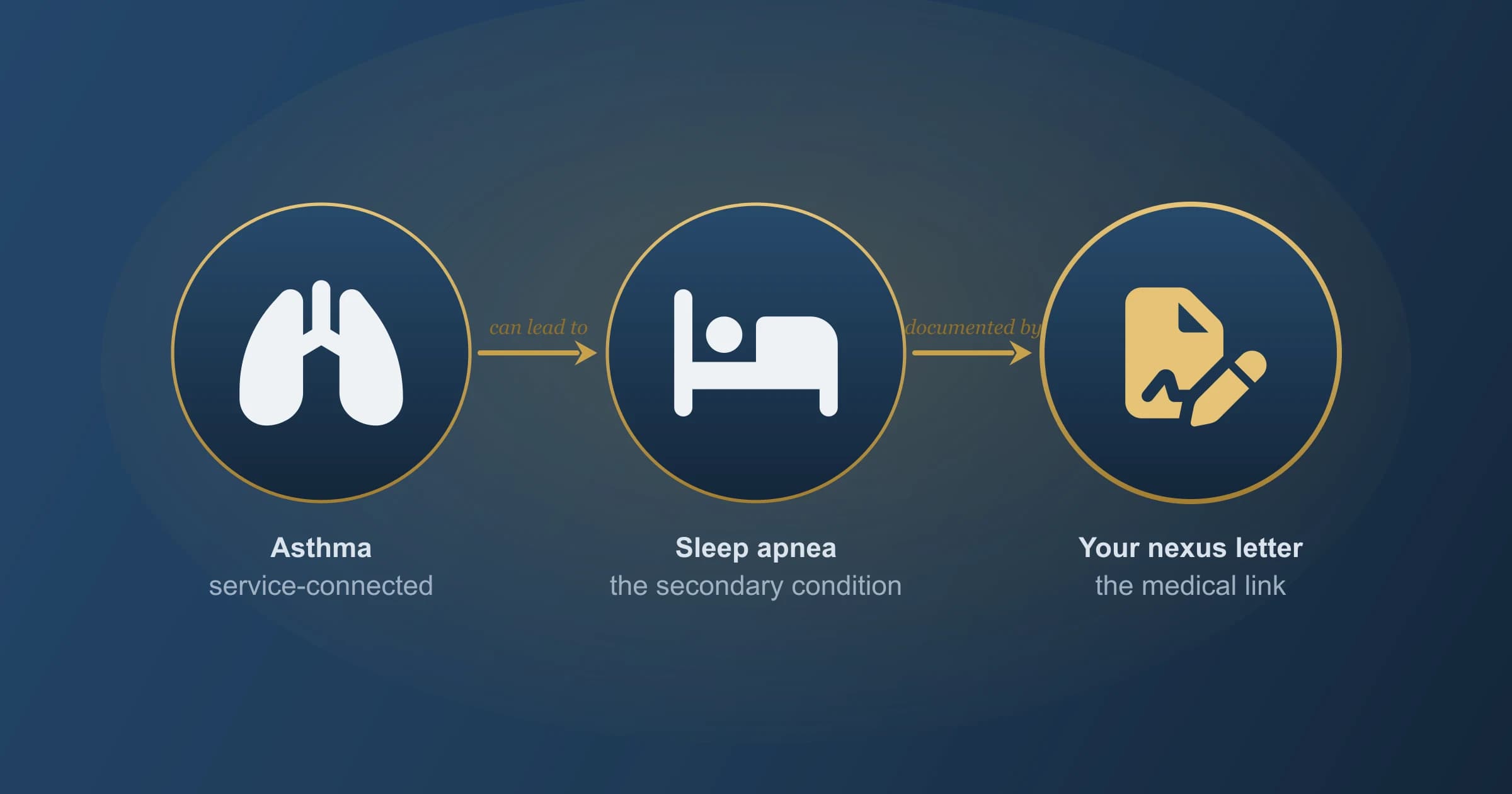
Key Takeaways
- Sleep apnea can be service-connected as secondary to asthma when a nexus letter links the two conditions.
- The letter must use the phrase “at least as likely as not” and come from a licensed medical provider.
- A sleep study that confirms sleep apnea is essential supporting evidence for the claim.
- Asthma can drive sleep apnea through airway inflammation, worse breathing at night, and weight gain from corticosteroids.
- The VA rates sleep apnea under Diagnostic Code 6847 at 0, 30, 50, or 100 percent, separate from your asthma rating.
What Is a Nexus Letter?
A nexus letter is a statement from a licensed medical professional explaining how one health condition is related to another, or to a veteran's service. For individuals managing multiple chronic conditions, particularly those related to the respiratory system, a nexus letter can demonstrate the medical connection between a new diagnosis, such as sleep apnea, and an existing condition, like asthma.
A nexus letter for sleep apnea secondary to asthma specifically addresses whether your asthma may have caused or aggravated your sleep apnea. The letter should be based on clinical experience, medical evidence, and a review of your history.
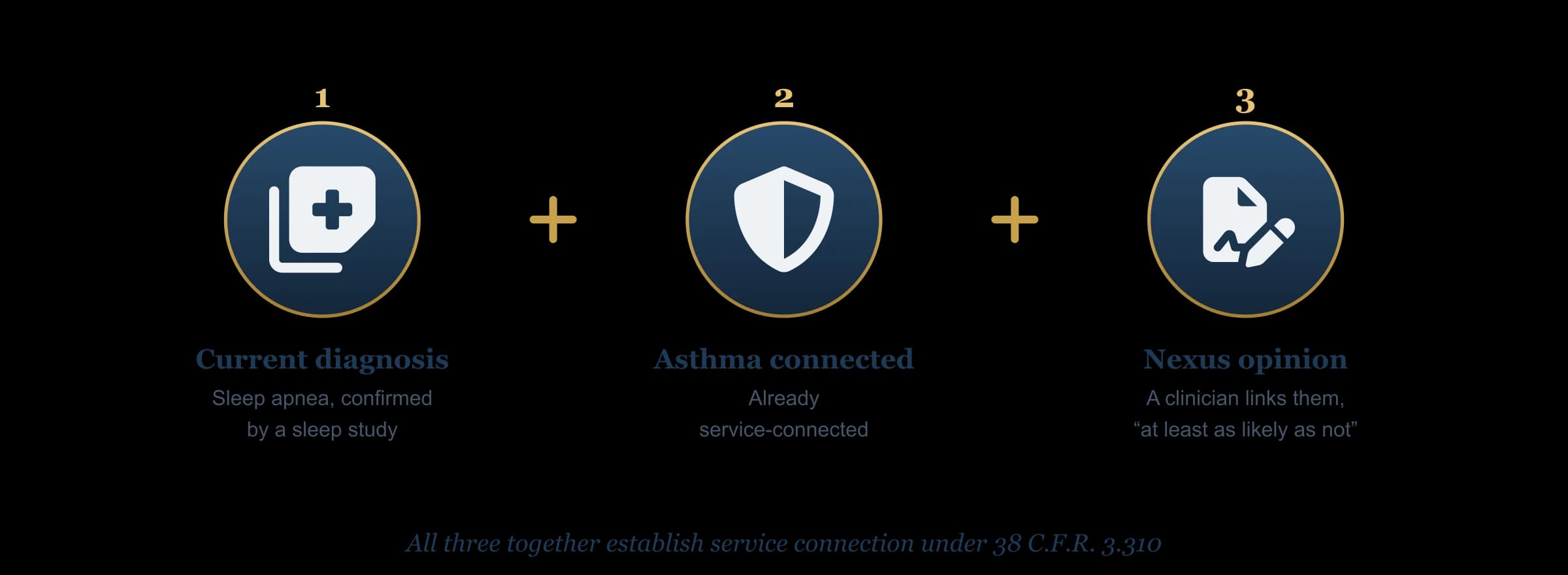
What a Secondary Sleep Apnea Claim Needs
A secondary claim rests on three things. When all three are in place, the nexus letter ties them together and asks the VA to connect your sleep apnea to your service-connected asthma.
Why Is a Nexus Letter for Sleep Apnea Secondary to Asthma So Important?
When applying for benefits for a secondary condition, it is not enough to simply have both conditions diagnosed. There must be medical documentation showing how the two are connected.
The purpose of a nexus letter for sleep apnea secondary to asthma is to establish that link with a clear medical explanation. The letter can help answer:
- Did the asthma contribute to the development of sleep apnea?
- Did asthma medications worsen sleep apnea symptoms?
- Is the relationship between the two supported by medical literature?
Having a medical expert provide a clear, evidence-based answer to those questions can significantly strengthen your case.
Secondary service connection, one condition caused or aggravated by an already service-connected disability, is governed by 38 CFR 3.310, the regulation a secondary claim is judged against.
What's the Connection Between Asthma and Sleep Apnea?
Both asthma and sleep apnea affect your breathing, but in different ways. Asthma narrows your airways due to inflammation. Sleep apnea causes breathing to stop and start during sleep due to airway obstruction or signaling issues from the brain.
There are several ways asthma may contribute to or aggravate sleep apnea:
- Inflammation and airway narrowing: Asthma causes inflammation in the airways. At night, this inflammation can restrict airflow and contribute to apnea events.
- Medication side effects: Common asthma medications, particularly corticosteroids, can lead to weight gain, a known risk factor for obstructive sleep apnea.
- Poor sleep quality: Asthma symptoms often worsen at night, disturbing sleep patterns and worsening breathing issues.
Medical studies, including those published in journals, have observed a notable overlap between asthma and obstructive sleep apnea, especially in patients who are obese or have persistent asthma symptoms.
How Asthma Leads to Sleep Apnea, Step by Step
A strong nexus letter for sleep apnea secondary to asthma does more than name both conditions. It walks the reader through how one leads to the other. Here is that chain, the same one the diagram above shows.
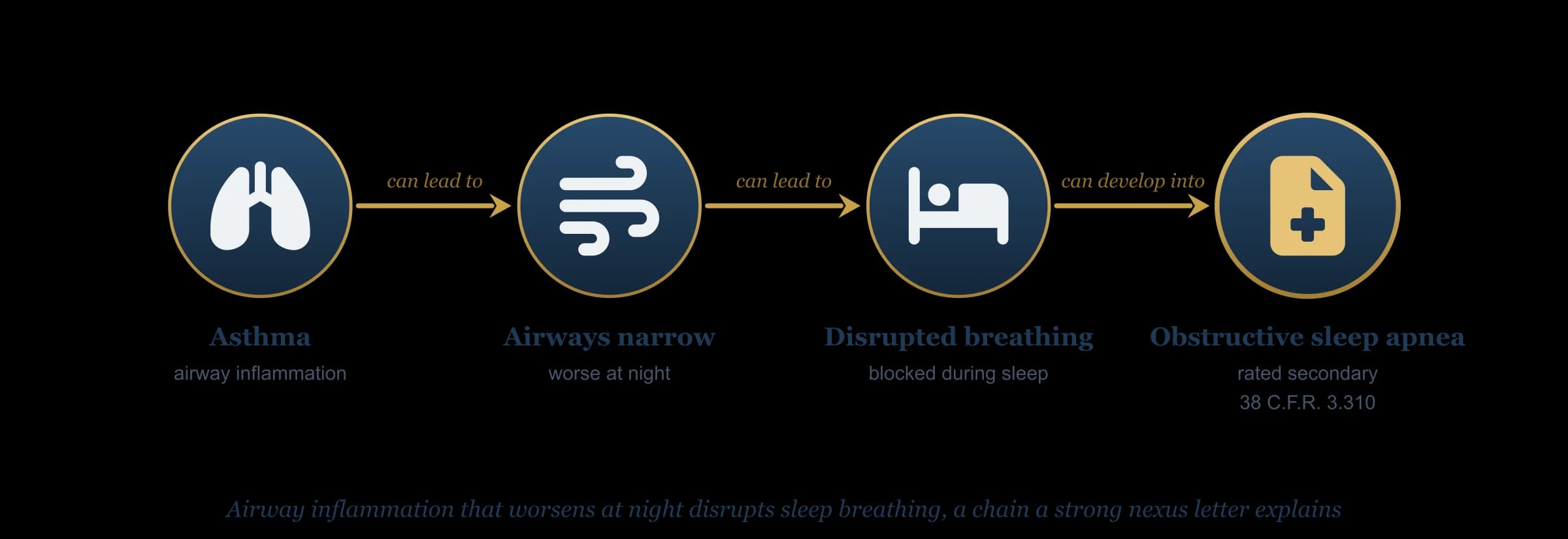
- 1Airway inflammationAsthma keeps your airways swollen and irritated. Even between attacks, that inflammation leaves less room for air to move.
- 2Worse breathing at nightAsthma symptoms often flare after you lie down to sleep. The airways narrow further, and airflow drops right when your body needs steady breathing the most.
- 3Disrupted breathing in sleepRestricted airflow makes it easier for the airway to collapse or block during sleep, so breathing keeps stopping and starting through the night.
- 4Obstructive sleep apneaOver time, those repeated pauses can develop into obstructive sleep apnea, which the VA can rate as a condition secondary to your asthma.
There is also a second route worth naming in the letter:
Common asthma medications, especially corticosteroids, can lead to weight gain. Extra weight is a well-known risk factor for obstructive sleep apnea. So even the treatment for your asthma can push you toward sleep apnea, and a good nexus letter can address that pathway too.
Who Should Write Your Nexus Letter?
The nexus letter should be issued by a qualified and licensed medical provider. Ideally, the provider should have experience dealing with either respiratory or sleep-related conditions.
Preferred specialties:
- Pulmonologists: Specialists in lung and airway disorders.
- Sleep medicine specialists: Experts in diagnosing and treating sleep-related conditions like sleep apnea.
- Internal medicine or primary care providers: Especially those familiar with your medical history.
It is important that the physician is comfortable writing medical opinions and understands the format required for such documentation.
What Should Be Included in a Nexus Letter?
A complete and effective nexus letter for sleep apnea secondary to asthma should contain the following:
- 1
Physician's qualifications
The letter should begin with the provider's full name, medical license number, specialty, and a brief description of their experience.
- 2
Review of medical records
The provider should note that they reviewed your medical records, including diagnosis of asthma and sleep apnea, treatment history, and other relevant data.
- 3
Medical opinion statement
The core of the letter should include a statement such as: “It is at least as likely as not that the patient's sleep apnea is related to or has been aggravated by their service-connected asthma.”
- 4
Rationale and evidence
The opinion should be supported by a detailed explanation and, when possible, references to clinical studies or literature.
- 5
Signature and contact info
The letter should be signed and dated, with the provider's full contact details in case follow-up is needed.
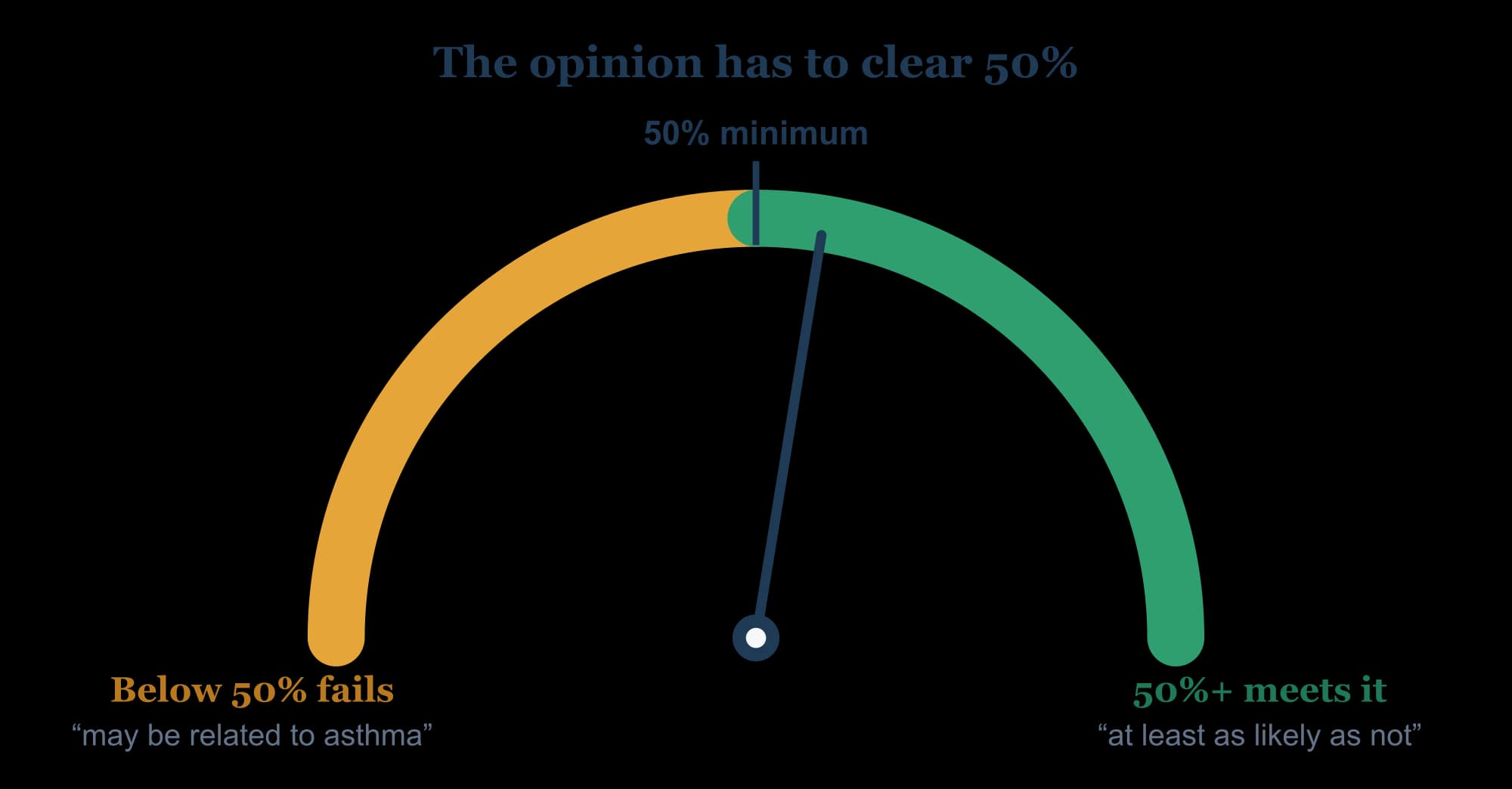
The "at least as likely as not" threshold comes from the benefit-of-the-doubt rule in 38 U.S.C. 5107(b), which resolves an even balance of evidence in the veteran's favor.
What Documents Should You Provide to the Doctor?
To help your doctor write an accurate and complete nexus letter, provide the following:
- Diagnosis of asthma: Service treatment records or previous VA decision letters.
- Diagnosis of sleep apnea: Sleep study results or specialist evaluation reports.
- Medical history: Any overlap of symptoms, treatment timelines, and medications prescribed.
- Current medication list: Include corticosteroids or any medications that could impact weight or sleep patterns.
All this information provides the provider with context, allowing them to form a strong medical rationale for the connection.
The Evidence a Secondary Sleep Apnea Claim Needs
The nexus letter is the centerpiece, but it is only as strong as the records behind it. Gather these before your provider writes, so the opinion rests on evidence and not assumption.
- A sleep study: A sleep study (polysomnography) is the test that confirms sleep apnea. It is the single most important piece of supporting evidence, and the provider will reference it in the letter.
- Pulmonary function tests: Breathing tests and other asthma records show how active your asthma is and help the provider explain the link to your sleep apnea.
- Service treatment records: Records tied to your asthma service connection, such as the VA decision letter, show that the asthma is already service-connected.
- Treatment and medication history: A list of your medications, including any corticosteroids, and notes on how your symptoms have changed over time.
The VA's guidance on the evidence a claim needs explains that a clear medical opinion connecting the two conditions, backed by these records, is what a secondary claim turns on.
How to Prepare for the Evaluation
When meeting with the physician, be ready to:
- Talk about the history of your asthma and how it has progressed
- Explain your sleep issues, including how they affect your quality of life
- Discuss any medications and side effects
- Provide examples of how your asthma symptoms worsen at night or interfere with sleep
The more specific and honest you are during your evaluation, the more tailored and credible your nexus letter for sleep apnea secondary to asthma will be.
How to Request the Nexus Letter
You do not need to use complicated legal or medical language when requesting the letter. You can simply say:
“Doctor, I have been diagnosed with asthma, which is service-connected, and I also have sleep apnea. I need a medical opinion letter explaining whether the two conditions are related. Could you provide a written statement that includes your credentials, a clear opinion, and a brief explanation of the connection based on my medical records?”
If your provider does not offer this type of documentation, there are professional services that offer independent medical opinions and can work with you to draft a letter based on your records. The VA's guidance on the evidence needed to support a claim explains what a secondary claim turns on, including the sleep study that confirms a sleep-apnea diagnosis.
How the VA Rates Sleep Apnea
If your secondary claim is granted, the next step is your disability rating. For sleep apnea, the rating can range from:
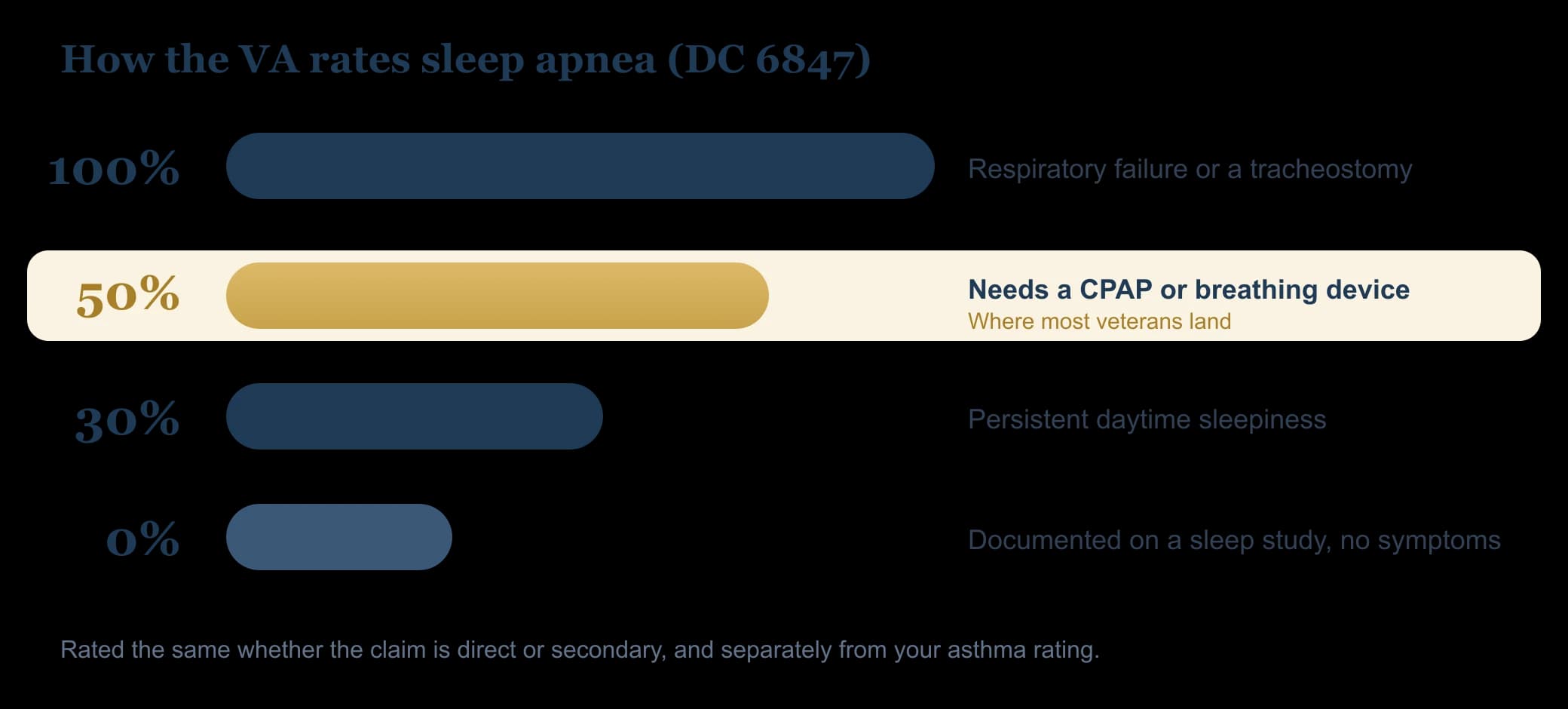
- 0%Sleep-disordered breathing is documented on a sleep study, but you have no symptoms.
- 30%You have persistent daytime sleepiness.
- 50%You need a CPAP or a similar breathing device. This is where most veterans land.
- 100%There is chronic respiratory failure, a tracheostomy, or another serious complication.
The sleep-apnea rating levels are set by 38 CFR 4.97, Diagnostic Code 6847, the VA's schedule of ratings for the respiratory system. Sleep apnea is rated separately from your asthma.
What Should You Avoid in a Nexus Letter?
Here are some common issues that weaken the impact of a nexus letter:
- Vague language: The letter should clearly state the opinion using “at least as likely as not” rather than saying “might be related” or “could be possible.”
- Lack of supporting evidence: Without a rationale, even a well-written letter may not be taken seriously.
- Written by an unqualified provider: The author must be a licensed healthcare professional.
- No review of records: The letter should confirm that the provider reviewed your medical documents, not just listened to your description.
Each of these issues can reduce the effectiveness of the nexus letter for sleep apnea secondary to asthma.
Is Your Secondary Claim Ready?
Score your claim
0 of 3 in hand
Check each item you already have in hand. Your score updates as you go.
A few core pieces are missing. Start by confirming your asthma service connection and getting a sleep study.
Have a clinician build the missing pieces →Conclusion
If you have been diagnosed with asthma and sleep apnea, there may be a medical connection between the two conditions. A nexus letter for sleep apnea secondary to asthma can help document that relationship in a format that meets common evidentiary standards for disability-related evaluations.
Taking the time to organize your medical records and work with a qualified medical professional can strengthen your documentation. If you are looking for support in obtaining a clear and medically sound nexus letter, contact Patriot Path to learn how we can assist with nexus letter services for veterans.
Related guides
Ready to Strengthen Your Secondary Sleep Apnea Claim?
Patriot Path's licensed MDs write independent nexus letters built to meet the VA's evidentiary standards, connecting sleep apnea to a service-connected condition like asthma with a records review and clear medical rationale. Up to five conditions per engagement.
Frequently Asked Questions
What is a nexus letter for sleep apnea secondary to asthma?
A nexus letter is a written medical opinion that explains how your sleep apnea may be caused or worsened by your service-connected asthma. It helps establish the medical link needed to support a secondary condition in a disability claim.
Who can write a nexus letter for sleep apnea secondary to asthma?
Any licensed healthcare provider can write a nexus letter, but pulmonologists or sleep specialists are ideal due to their expertise in respiratory and sleep conditions. The provider should also be familiar with how to document medical opinions clearly and professionally.
What should a strong nexus letter include?
A good nexus letter includes the doctor's credentials, a clear medical opinion using “at least as likely as not,” and a detailed explanation supported by your records or relevant research. Without these elements, the letter may not meet the required standard of evidence.
Do I need a sleep study to support the nexus letter?
Yes, a sleep study is typically required to confirm a diagnosis of sleep apnea and is essential supporting evidence for the nexus letter. The physician writing the letter will likely reference these results to explain the connection to asthma.
Can I still get a nexus letter if my claim was denied?
Yes, you can request a new nexus letter and submit it as additional evidence in a supplemental claim or appeal. A more detailed or professionally written letter can often address issues that led to the original denial.
Citations & References
- 38 CFR 3.310, Disabilities that are proximately due to, or aggravated by, service-connected disease or injury (eCFR). https://www.ecfr.gov/current/title-38/chapter-I/part-3/subpart-A/section-3.310
- 38 U.S.C. 5107, Claimant responsibility; benefit of the doubt (U.S. Code). https://uscode.house.gov/view.xhtml?req=granuleid:USC-prelim-title38-section5107&num=0&edition=prelim
- 38 CFR 4.97, Schedule of ratings, respiratory system (Diagnostic Code 6847, sleep apnea) (eCFR). https://www.ecfr.gov/current/title-38/chapter-I/part-4/subpart-B/section-4.97
- VA.gov, Evidence needed to support your claim. https://www.va.gov/disability/how-to-file-claim/evidence-needed/
- VA.gov, Eligibility for VA disability benefits. https://www.va.gov/disability/eligibility/