
Sleep Apnea, Secondary Conditions
Nexus Letter for Sleep Apnea Secondary to Rhinitis
Medically reviewed by the Patriot Path Medical Team
Licensed MD reviewers • Last updated:
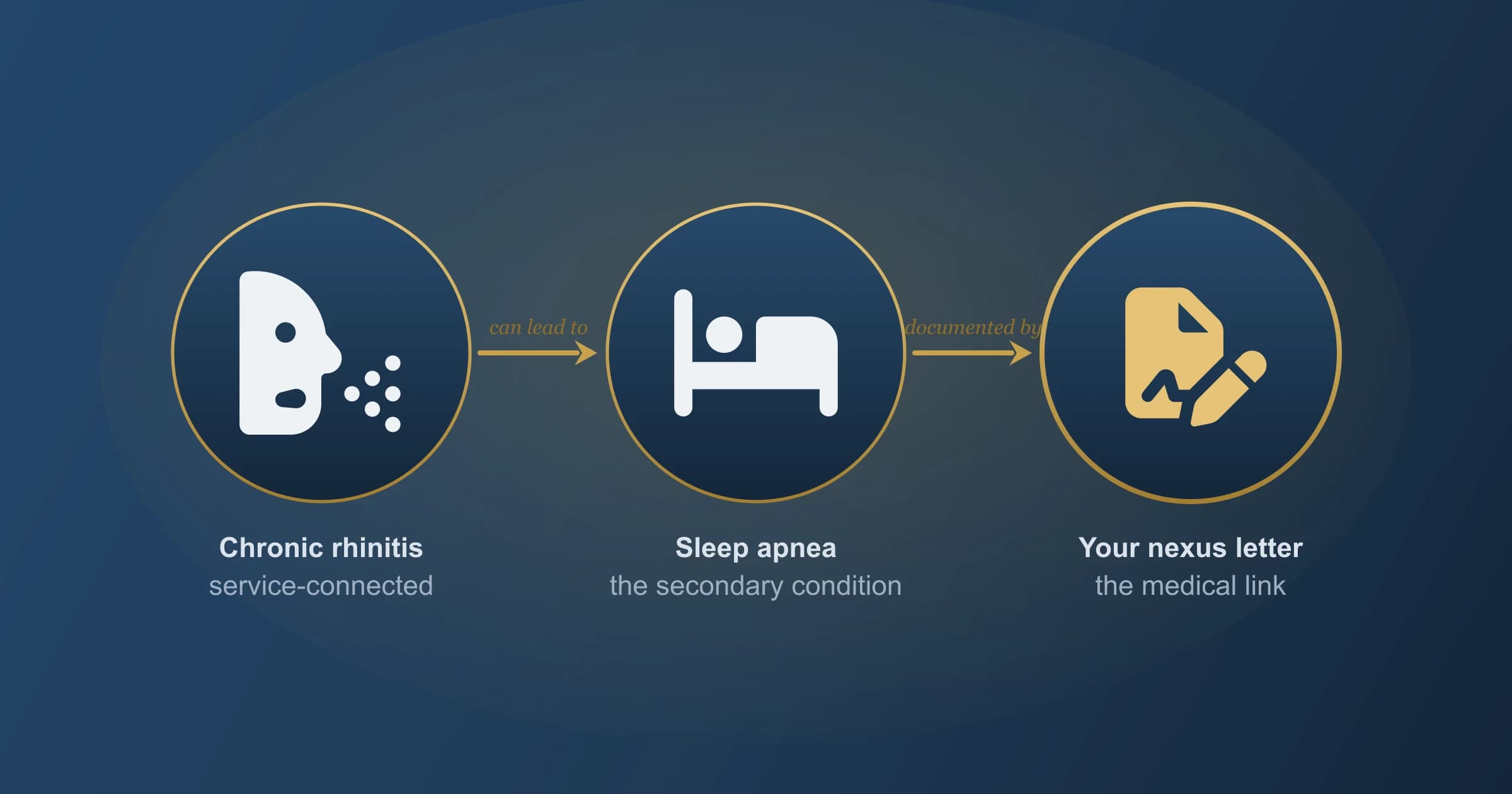
A nexus letter for sleep apnea secondary to rhinitis is a medical opinion that links your service-connected rhinitis to your obstructive sleep apnea. It states the connection is at least as likely as not and explains the medicine behind it, giving your VA secondary claim the evidence it needs.
If you are dealing with sleep apnea that may be related to rhinitis, and you have already been diagnosed with rhinitis as a service-connected condition, then securing a nexus letter for sleep apnea secondary to rhinitis is a critical step. This document can support your case by clearly linking your current condition to another health issue already connected to your service history.
This comprehensive guide explains what a nexus letter is, how rhinitis and sleep apnea are medically connected, what goes into a proper letter, and how to obtain one through the appropriate channels.
Key Takeaways
- A nexus letter for sleep apnea secondary to rhinitis is the medical opinion that links your service-connected rhinitis to your obstructive sleep apnea.
- The VA does not assume the link, so a clear opinion, at least as likely as not, is what a secondary claim under 38 C.F.R. 3.310 turns on.
- Your claim needs three things: a sleep study confirming sleep apnea, rhinitis already service-connected, and a clinician's nexus opinion tying them together.
- Sleep apnea is rated under 38 C.F.R. 4.97, Diagnostic Code 6847, from 0 to 100 percent based on your symptoms and treatment.
What Is a Nexus Letter?
A nexus letter is a written medical opinion that connects a current health condition, such as sleep apnea, to an existing, service-related condition like rhinitis. It is typically written by a licensed medical provider who can explain the medical relationship between the two conditions and why the connection is likely based on the individual's history.
In cases where sleep apnea is not directly related to active duty but may have developed or worsened due to rhinitis, this letter helps present a clear argument for that medical connection.
A nexus letter for sleep apnea secondary to rhinitis is specifically used to show that your breathing-related sleep disorder is more likely than not caused by, or aggravated by, chronic rhinitis.
What Your Secondary Claim Needs
A nexus letter for sleep apnea secondary to rhinitis does one job: it supplies the missing link. Three things have to line up, and the letter ties them together.
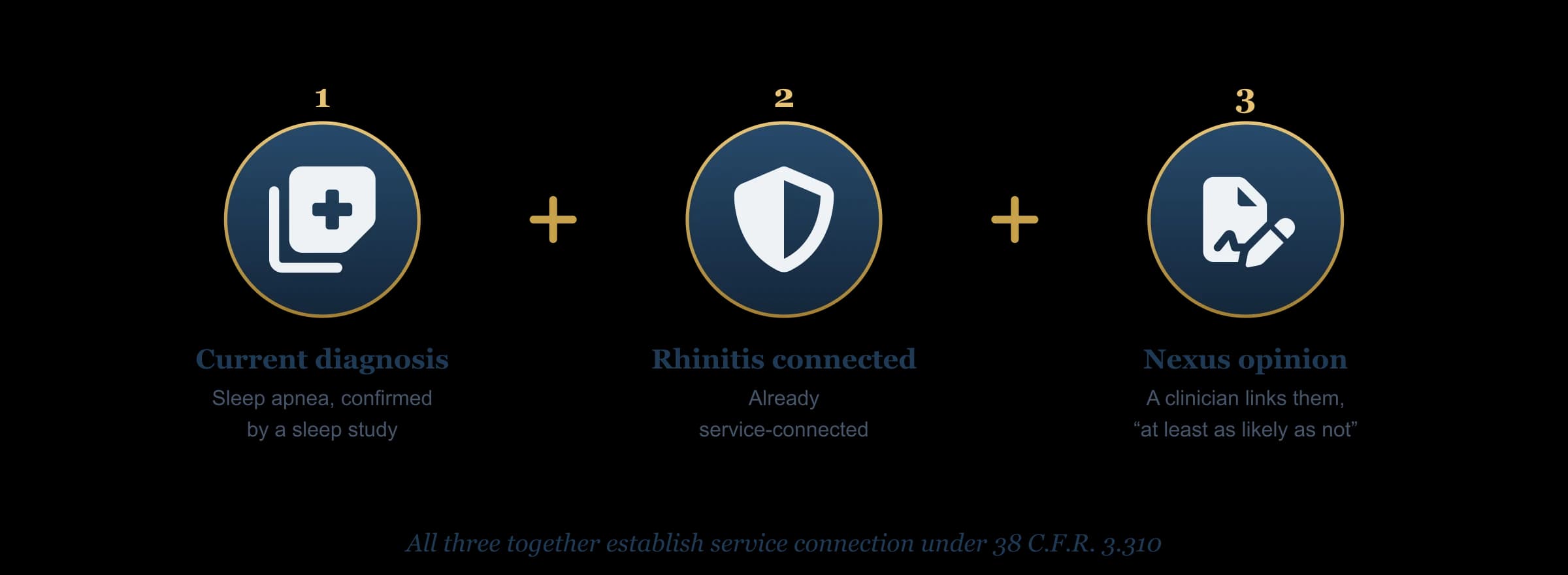
- 1
A current sleep apnea diagnosis
Obstructive sleep apnea confirmed by a sleep study, such as a polysomnography or an approved home test. This is the condition you are claiming.
- 2
Rhinitis already service-connected
Your rhinitis needs an existing VA service connection. The secondary claim builds on it, so this has to be settled first.
- 3
A medical nexus opinion
A qualified opinion that your sleep apnea is at least as likely as not caused or aggravated by your rhinitis. This is the nexus letter.
Why Is a Nexus Letter Important?
A nexus letter helps clarify the relationship between two conditions when the secondary condition is not automatically presumed to be linked to military service. Without strong medical reasoning and documentation, these types of claims are often denied.
A well-structured nexus letter for sleep apnea secondary to rhinitis provides:
- A professional medical explanation showing how the two conditions are related
- A specific opinion using phrases like “more likely than not” to reflect medical certainty
- A logical link between medical records, symptoms, and environmental exposures
Secondary service connection, one condition caused or aggravated by an already service-connected disability, is governed by 38 CFR 3.310, which is the standard a secondary claim is judged against.
How Does Rhinitis Affect Sleep Apnea?
Rhinitis causes inflammation in the nasal passages, leading to blockage or restricted airflow. This nasal congestion can disrupt breathing during sleep, especially when it is chronic or untreated.
Over time, this disruption may cause or worsen obstructive sleep apnea (OSA), a condition in which breathing repeatedly stops and starts during sleep.
Research has shown that nasal obstruction is a contributing factor in OSA. This is especially relevant when the inflammation is due to environmental exposure, chronic allergies, or chemical irritants, common scenarios in various work or deployment environments.
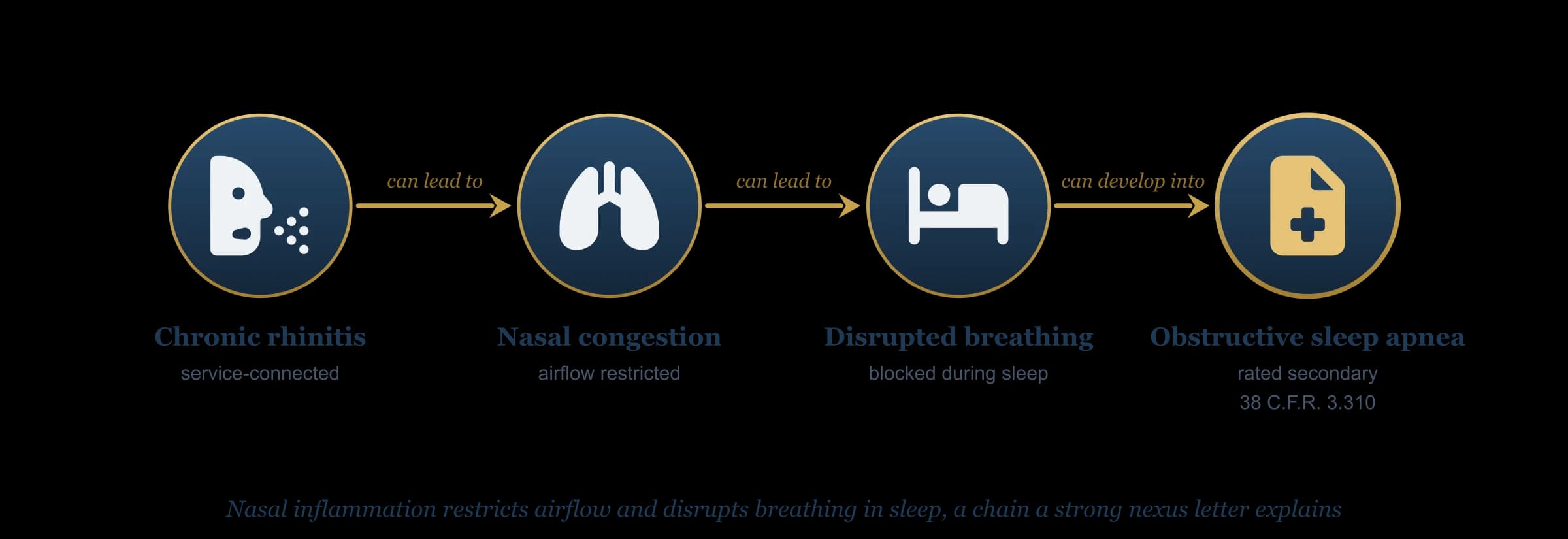
Step by step, here is the chain a strong nexus letter for sleep apnea secondary to rhinitis walks through:
- 1Chronic rhinitisService-connected rhinitis keeps the nasal passages inflamed and swollen.
- 2Nasal congestionThat inflammation narrows the airway and restricts the airflow moving through the nose.
- 3Disrupted breathingDuring sleep, the restricted airflow makes breathing harder and the airway more likely to collapse.
- 4Obstructive sleep apneaOver time, this repeated disruption can cause or worsen obstructive sleep apnea, which the VA can rate as a secondary condition.
The direction matters. A careful letter anchors the timeline, showing the rhinitis came first and the sleep apnea followed, so the connection reads clearly.
Common Rhinitis Triggers That May Affect Veterans
- Exposure to sand, smoke, or environmental dust
- Deployment to regions with high allergen or pollution levels
- Reactions to burn pit exposure or harsh chemicals
The consistent nasal inflammation caused by rhinitis can result in reduced airflow and increased nighttime breathing difficulty, making the link to sleep apnea a logical medical outcome.
What Should Be Included in a Nexus Letter for Sleep Apnea Secondary to Rhinitis?
A strong nexus letter for sleep apnea secondary to rhinitis must go beyond simply stating an opinion. It should meet specific standards and provide clear medical justification. Here is what it should include:
- 1
Diagnosis Confirmation
The provider must document that the individual has:
- A diagnosis of rhinitis, confirmed by a qualified medical professional
- A diagnosis of sleep apnea, typically confirmed by a sleep study (such as a polysomnography test)
- 2
Detailed Medical Rationale
The provider must explain how rhinitis contributes to the development of sleep apnea. Common examples include:
- Chronic nasal blockage interfering with airflow during sleep
- Postnasal drip or inflammation causing airway irritation
- Disrupted breathing leading to frequent apneas
- 3
Medical Opinion Language
A clear and VA-compliant opinion statement should be included. For example:
“It is at least as likely as not that the individual's service-connected rhinitis contributed to or worsened their diagnosed sleep apnea.”
- 4
Provider Credentials
The letter should be signed by a licensed medical professional, such as a physician, an ENT specialist, or a pulmonologist. Including their full name, license number, and contact details gives the letter professional weight.
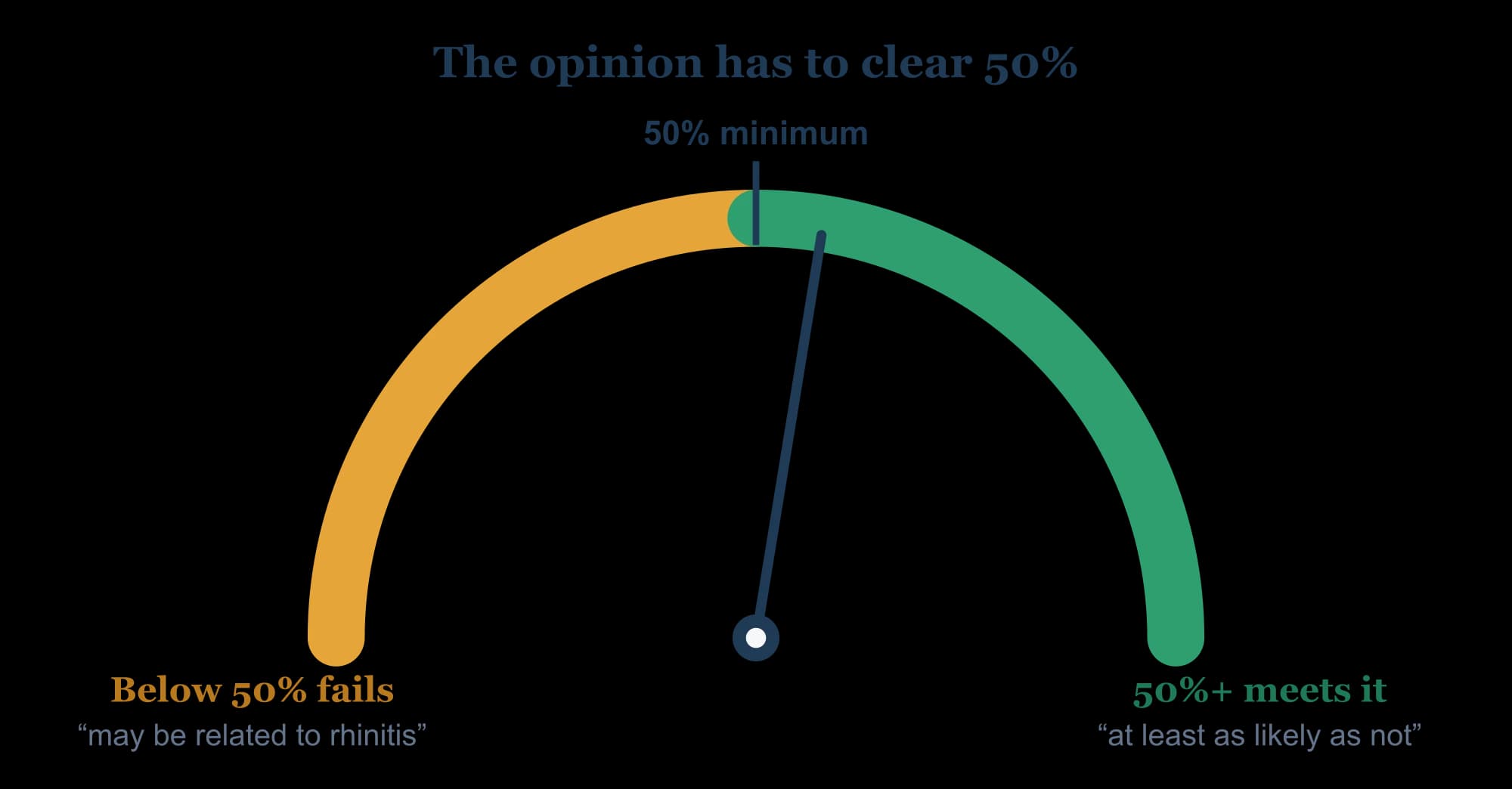
The “at least as likely as not” threshold comes from the benefit-of-the-doubt rule in 38 U.S.C. 5107(b), which resolves an even balance of evidence in the veteran's favor.
Step-by-Step Guide: How to Obtain a Nexus Letter for Sleep Apnea Secondary to Rhinitis
- 1
Organize Your Medical Records
Gather documents showing:
- Diagnosis and treatment of rhinitis
- Sleep apnea diagnosis from a sleep study
- Medical history showing when symptoms began
- Any documentation of environmental exposures (e.g., deployment records, occupational notes)
These records form the basis of your case and support the reasoning in the nexus letter.
- 2
Select a Qualified Medical Provider
Look for a provider who:
- Is licensed and experienced in writing medical opinions
- Understands how rhinitis and sleep apnea interact
- Is familiar with the language commonly used in nexus letters
This could be a private doctor, a sleep specialist, an ENT specialist, or a medical professional referred by support services that assist with claim-related documentation.
- 3
Provide Context to the Medical Professional
Help the provider understand your specific situation. Be ready to share:
- A timeline of when your symptoms started
- Environmental or workplace exposures you encountered
- How your sleep has been affected over time
The more context your provider has, the more effective the nexus letter will be.
- 4
Review and Finalize the Nexus Letter
Before the letter is submitted:
- Confirm that the wording includes a strong, clear statement of causation
- Double-check that both diagnoses are mentioned
- Make sure the letter is signed and dated with proper credentials listed
The VA's own guidance on the evidence needed to support a claim explains that a medical opinion connecting your condition to service is exactly the kind of evidence a secondary claim turns on.
Evidence That Strengthens the Claim
A nexus letter for sleep apnea secondary to rhinitis is only as strong as the records behind it. These are the pieces that let a clinician write from evidence, not guesswork.
- A sleep studyThe polysomnography or approved home test that confirms your obstructive sleep apnea and shows how severe it is.
- Records showing your rhinitisService treatment records and later notes that document the rhinitis, when it began, and how it was treated.
- A symptom timelineRoughly when the rhinitis started and when the sleep problems followed, so the clinician can anchor the direction of the link.
- A personal statementIn your own words: the congestion, the poor sleep, the daytime fatigue, and how the two conditions run together.
The clearer this record, the easier it is for a provider to explain the connection and for the VA to accept it.
Who Can Help You Find a Provider?
There are various organizations and services that offer referrals to medical providers who are familiar with writing nexus letters. These services often work with licensed professionals who can deliver detailed, objective medical opinions based on your records.
While it is important to make sure the provider is familiar with your case, remember that the provider must remain independent and neutral when offering medical judgment.
How the VA Rates Sleep Apnea
If your nexus letter is accepted and the sleep apnea is service-connected, the VA rates it under 38 C.F.R. 4.97, Diagnostic Code 6847. There are four levels, and the one you receive depends on your symptoms and your treatment.
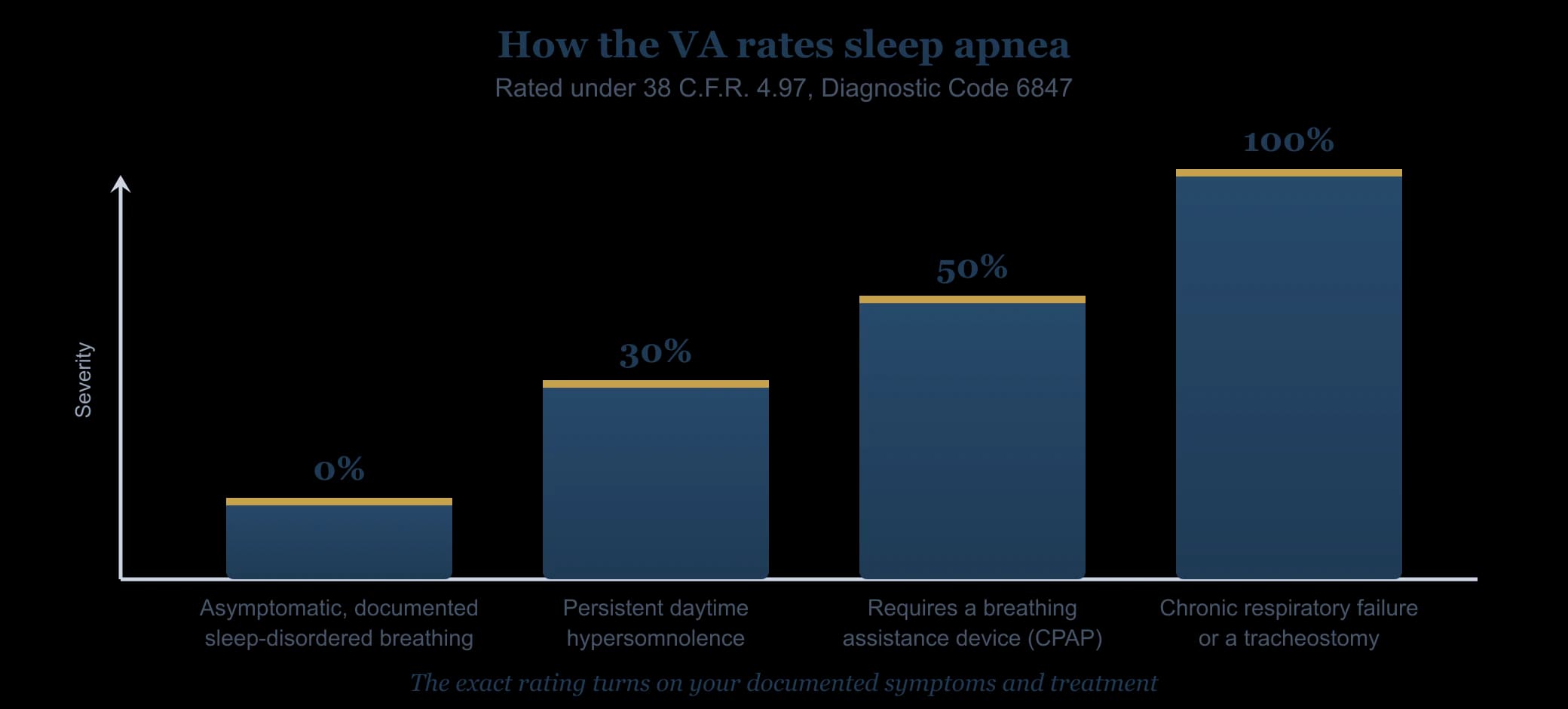
Many veterans reach the 50 percent level, because it applies when a doctor prescribes a CPAP machine or similar breathing device. The nexus letter does not set the rating; it establishes the connection, and the rating then follows from your medical evidence.
These levels are set by 38 C.F.R. 4.97, Diagnostic Code 6847, the VA's schedule of ratings for the respiratory system.
What Happens After You Submit the Nexus Letter?
Once submitted with your claim, the nexus letter for sleep apnea secondary to rhinitis will be reviewed as part of your medical evidence. Claims evaluators will assess:
- Whether the medical opinion is clearly stated
- If the explanation makes logical medical sense
- Whether the nexus is strong enough to support a secondary service connection
If the letter is accepted, the next step is determining your disability rating. For sleep apnea, this could range from:
- 0% (if asymptomatic)
- 30% (if symptoms are present without the need for treatment)
- 50% (if CPAP or similar therapy is prescribed)
- 100% (for severe cases causing chronic respiratory failure or other serious complications)
The sleep-apnea rating levels are set by 38 CFR 4.97, Diagnostic Code 6847, the VA's schedule of ratings for the respiratory system.
Common Reasons Nexus Letters Are Rejected
Some common mistakes that weaken a nexus letter for sleep apnea secondary to rhinitis include:
- Vague language or lack of detail
- No clear “at least as likely as not” statement
- Missing provider credentials
- Unsupported or speculative claims
To avoid delays or denials, ensure your letter is professionally written and includes specific references to your medical history.
Is Your Secondary Claim Ready?
Score your claim
0 of 3 in hand
Check each item you already have in hand. Your score updates as you go.
A few core pieces are missing. Start by confirming your rhinitis service connection and getting the sleep apnea diagnosed by a sleep study.
Have a clinician build the missing pieces →Conclusion
If you are managing sleep apnea and already have a diagnosis of rhinitis, a nexus letter for sleep apnea secondary to rhinitis can play a vital role in your documentation process. This letter provides a clear medical explanation linking both conditions and supports your case with a credible, evidence-based opinion.
Taking the time to gather your records and work with a qualified medical provider can make a significant difference in how your documentation is reviewed. Contact Patriot Path today to see how we can help you succeed with our trusted nexus letter services for veterans and take the next step toward strengthening your claim.
Ready to Strengthen Your Secondary Sleep Apnea Claim?
Patriot Path's licensed MDs write independent nexus letters built to meet the VA's evidentiary standards, connecting sleep apnea to a service-connected condition like rhinitis with clear medical rationale. Up to five conditions per engagement.
Frequently Asked Questions
What is a nexus letter for sleep apnea secondary to rhinitis?
A nexus letter for sleep apnea secondary to rhinitis is a medical document that explains how your service-connected rhinitis may have caused or contributed to the development or worsening of your sleep apnea. It is typically written by a licensed doctor to support the connection between the two conditions.
Who can write a nexus letter for sleep apnea secondary to rhinitis?
Any licensed medical provider, such as a physician, an ENT specialist, or a sleep specialist, can write a nexus letter. It is important that the provider understands the medical link between rhinitis and sleep apnea.
Why is a nexus letter important for secondary sleep apnea claims?
A nexus letter helps demonstrate that your sleep apnea is not a standalone condition, but is instead tied to another service-connected issue, such as rhinitis. Without it, the claim may lack the medical evidence needed for proper evaluation.
What should be included in a nexus letter for sleep apnea secondary to rhinitis?
The letter should confirm both diagnoses, explain how rhinitis contributes to or aggravates sleep apnea, and include a statement that the connection is “at least as likely as not.” It should also be signed by a qualified medical professional.
Can I submit a nexus letter at any point in my claim?
Yes, a nexus letter can be submitted with your initial claim or later as additional evidence during an appeal. Adding it early may help reduce delays and strengthen the case.
Citations & References
- 38 CFR 3.310, Disabilities that are proximately due to, or aggravated by, service-connected disease or injury (eCFR). https://www.ecfr.gov/current/title-38/chapter-I/part-3/subpart-A/section-3.310
- 38 CFR 4.97, Schedule of ratings, respiratory system (Diagnostic Code 6847, sleep apnea) (eCFR). https://www.ecfr.gov/current/title-38/chapter-I/part-4/subpart-B/section-4.97
- 38 U.S.C. 5107, Claimant responsibility; benefit of the doubt (U.S. Code). https://uscode.house.gov/view.xhtml?req=granuleid:USC-prelim-title38-section5107&num=0&edition=prelim
- VA.gov, How to file a VA disability claim. https://www.va.gov/disability/how-to-file-claim/
- VA.gov, Evidence needed to support your claim. https://www.va.gov/disability/how-to-file-claim/evidence-needed/