
PACT Act Claims
PACT Act Presumptive Conditions: The Full List and What to Do When Yours Is Not on It
Medically reviewed by the Patriot Path Medical Team
Licensed MD reviewers • Last updated: July 2026
PACT Act presumptive conditions are illnesses the VA automatically connects to military service for veterans with qualifying toxic exposure: more than twenty burn pit conditions, the expanded Agent Orange list including hypertension, and Camp Lejeune's eight. If your condition is on a list and your service matches the window, the VA concedes the connection. If it is not, your claim is decided on the medical evidence you bring. This guide covers the whole list, the law behind it, which jobs carried which exposures, and exactly what to do when your condition falls off the list's edge.
A veteran's story
Dana ran convoy security out of Balad for two tours, breathing the burn pit plume that drifted over the motor pool most mornings. Years later, two diagnoses: chronic sinusitis and GERD. Same exposure, same records, filed together.
The sinusitis was granted in months. It is on the PACT Act burn pit list, her service window qualified, and the VA conceded the connection without an argument. The GERD came back denied: not on any presumptive list, and nothing in the file connected it to service.
One claim, two paths. The sinusitis needed little more than her DD-214 and the diagnosis. The GERD needed what the list could not give her: a physician reviewing her records and stating, in the language the VA requires, that the condition was at least as likely as not connected to her documented exposure. That opinion is the difference between the two halves of her decision letter, and it is what this page is about.

What the PACT Act Is and What It Changed
The PACT Act is the Sergeant First Class (SFC) Heath Robinson Honoring our Promise to Address Comprehensive Toxics (PACT) Act of 2022, the largest expansion of veteran toxic exposure benefits in decades. It is named for a combat medic who died of lung cancer after burn pit exposure in Iraq, and it exists because of a pattern: veterans getting sick from exposures the VA recognized slowly, one condition and one lawsuit at a time.
The law's core move is the presumption. For conditions on its lists, filed by veterans whose service matches a qualifying window and location, the VA concedes the connection to service instead of demanding proof. That single change removes the hardest element of a disability claim for hundreds of thousands of veterans: no independent medical opinion, no fight over causation, just the diagnosis and the service record.
The PACT Act added more than twenty burn pit and airborne hazard conditions to the presumptive lists, expanded Agent Orange presumptive locations beyond Vietnam, added hypertension and monoclonal gammopathy of undetermined significance (MGUS) to the Agent Orange list, and expanded VA health care eligibility for toxic-exposed veterans. There is no deadline: the VA states plainly that veterans and survivors can file for PACT Act benefits at any time.
What the PACT Act did not do
It did not cover everything. The PACT Act is a list, and lists have edges. Conditions off the list, exposures with no presumption at all (jet fuel, most industrial solvents, PFAS as of this writing), and service outside a qualifying window are still decided the old way: on the medical evidence you bring. Roughly half of this page is about the list; the other half is about its edges, because that is where claims are actually lost.
How a Presumptive Condition Works Under the Law
Presumptive is a precise legal term, and understanding the machinery matters because it tells you exactly what the VA has conceded and what it has not. Two different presumptions are working in sequence, and veterans lose claims by assuming the first one covers the second.
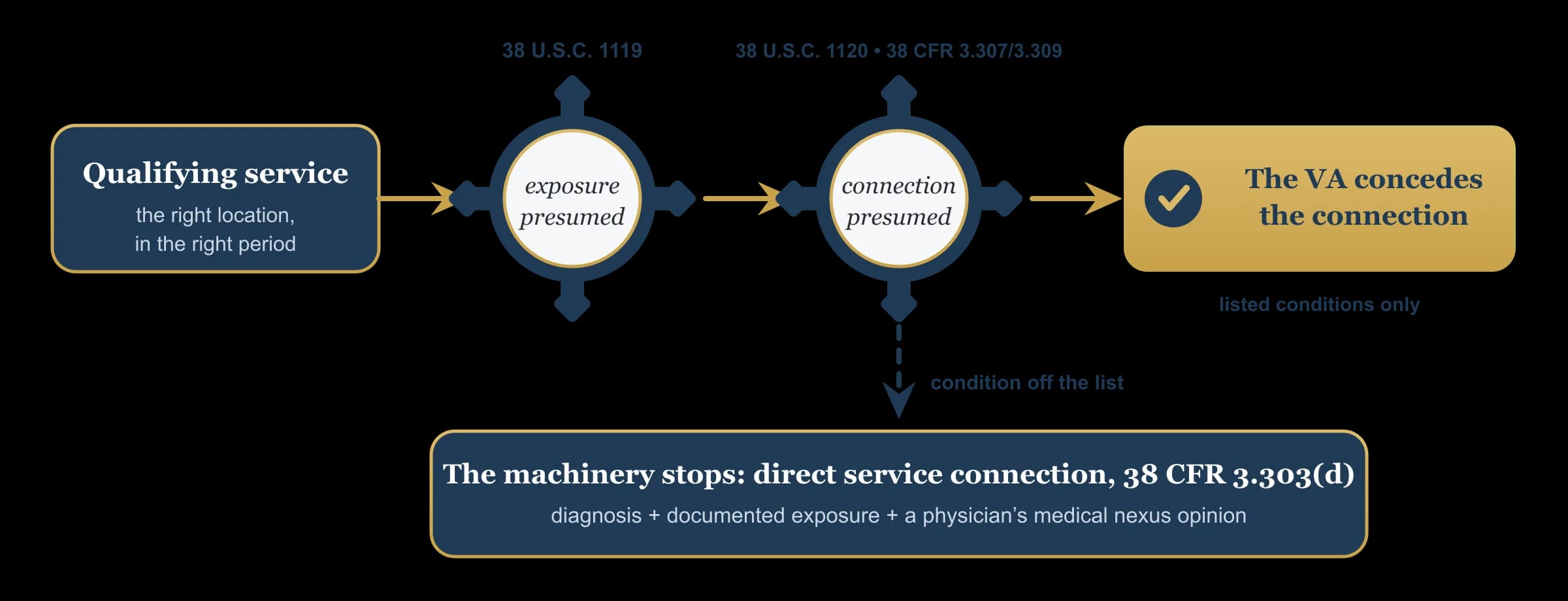
Gear one: the exposure is presumed
Under 38 U.S.C. 1119, the VA presumes you were exposed to specific substances if you served in designated locations during designated periods. You do not have to produce a photo of the burn pit or an air-quality log. Service in the right place and window establishes the exposure itself.
Gear two: the connection is presumed, for listed conditions only
If your diagnosed condition is on the presumptive list for that exposure, the VA concedes that service caused it: under 38 U.S.C. 1120 for the burn pit and airborne hazard list, and under 38 CFR 3.307 and 3.309 for the Agent Orange and Camp Lejeune lists. This is the gear that actually grants claims, and it only turns for conditions on the list.
Off the list: the machinery stops
A conceded exposure with an off-list condition gets no presumption of connection. The claim runs as direct service connection under 38 CFR 3.303(d): diagnosis, exposure, and a medical opinion linking them. The VA will not supply that opinion for you.
The exam the VA owes you: TERA and 38 U.S.C. 1168
The PACT Act also changed what happens when your file is thin. If your claim involves what the law calls a toxic exposure risk activity (TERA) and the record lacks enough evidence to decide, 38 U.S.C. 1168 generally obligates the VA to provide an exam and obtain a medical opinion on the connection, unless it finds no indication of an association between the condition and the exposure.
That exam is free, and you should attend it. But it is the VA's examiner working from the VA's framing of the question. An independent physician's opinion in your file before that exam anchors the causation question the way your evidence supports, instead of leaving the framing entirely to the government's contractor.
The PACT Act Presumptive Conditions List
The tables below are the working list: the presumptive conditions for the three big exposure groups, current as of this writing. The VA continues to review and add conditions, so treat this as the map and confirm the current list on VA.gov before you file. Each table links to the full guide for that exposure, where the qualifying windows and details live.
One reading note: the burn pit list works in two halves, a set of named respiratory illnesses and a set of cancers defined by body system. A cancer of any type in a listed system counts, which makes the cancer half of the list broader than it looks.
Burn pits and airborne hazards (PACT Act, 2022)
The largest PACT Act expansion. Two halves: named respiratory illnesses, then cancers by body system.
| Respiratory illnesses | Cancers |
|---|---|
| Asthma (diagnosed after service) | Brain cancer |
| Chronic bronchitis | Gastrointestinal cancer of any type |
| Chronic obstructive pulmonary disease (COPD) | Genitourinary cancer |
| Chronic rhinitis | Glioblastoma |
| Chronic sinusitis | Head cancer of any type |
| Constrictive or obliterative bronchiolitis | Hematologic and lymphatic cancers |
| Emphysema | Lymphoma of any type |
| Granulomatous disease | Melanoma |
| Interstitial lung disease | Neck cancer of any type |
| Pleuritis | Pancreatic cancer |
| Pulmonary fibrosis | Reproductive cancer of any type |
| Sarcoidosis | Respiratory cancer of any type |
Agent Orange (long-standing list plus PACT additions)
Hypertension and MGUS are the PACT Act's additions to this list.
| AL amyloidosis | Bladder cancer |
| Chloracne and similar acneiform disease | Chronic B-cell leukemias |
| High blood pressure (hypertension) | Hodgkin's disease |
| Hypothyroidism | Ischemic heart disease |
| Monoclonal gammopathy of undetermined significance (MGUS) | Multiple myeloma |
| Non-Hodgkin's lymphoma | Parkinson's disease |
| Parkinsonism | Peripheral neuropathy (early onset) |
| Porphyria cutanea tarda | Prostate cancer |
| Respiratory cancers (including lung cancer) | Some soft tissue sarcomas |
| Type 2 diabetes |
Camp Lejeune contaminated water
Eight conditions under a long-standing presumption that predates the PACT Act, tied to 30 days of qualifying service at Camp Lejeune or MCAS New River between August 1, 1953 and December 31, 1987.
| Adult leukemia | Aplastic anemia and other myelodysplastic syndromes |
| Bladder cancer | Kidney cancer |
| Liver cancer | Multiple myeloma |
| Non-Hodgkin's lymphoma | Parkinson's disease |
- Gulf War illness works differently: it presumes patterns of symptoms (undiagnosed illnesses and certain chronic multisymptom illnesses) rather than a fixed condition list. Gulf War guide →
- Radiation has its own defined list tied to radiation-risk activities. Radiation guide →
- AFFF and PFAS, jet fuel, and most solvents carry no presumptive list at all: every claim from those exposures runs on the direct path. AFFF and PFAS guide →
The list keeps moving
The PACT Act built a standing review process, and the lists have kept evolving since 2022: the burn pit cancer list on VA.gov's eligibility page now names broader categories than the law's original rollout, including genitourinary cancers and hematologic and lymphatic cancers as named groups. Claims sites publish breathless yearly updates of varying accuracy, so verify any condition you read about against the VA.gov eligibility pages themselves, which are the lists the raters actually apply. If your condition was added or recategorized after an old denial, the supplemental claim section below is for you.
The Qualifying Service Windows and Locations
A presumptive condition only presumes with qualifying service behind it: the right place, in the right period, for that exposure's list. These are the burn pit and airborne hazard windows, which drive most PACT Act claims. The other exposures' windows live on their guides.
On or after September 11, 2001
Afghanistan, Djibouti, Egypt, Jordan, Lebanon, Syria, Uzbekistan, Yemen, or the airspace above them.
On or after August 2, 1990
Bahrain, Iraq, Kuwait, Oman, Qatar, Saudi Arabia, Somalia, the United Arab Emirates, or the airspace above them, plus the neutral zone between Iraq and Saudi Arabia and the Arabian Sea, Gulf of Aden, Gulf of Oman, Persian Gulf, and Red Sea.
For the other exposures' windows:
- Agent Orange locations and periods
- Camp Lejeune's 1953 to 1987 window
- Radiation-risk activities
- Gulf War theater service
If your condition is on a list but your service misses the window, the presumption fails on the calendar, not the medicine. Those claims move to the direct path below, where the connection can still be proven the ordinary way.
Military Toxicology: Which Jobs Carried Which Exposures
Toxicology is the study of what a substance does to a body at a dose over time, and military service concentrated doses in ways civilian life rarely does: the same flight line, the same fuel, the same smoke, every day for years. Peer-reviewed reviews of military occupational exposures catalog a long list, from combustion products and fuels to solvents, firefighting foam, and ionizing radiation.
This matters for claims because your military occupational specialty is evidence. The VA does not need a photograph of you next to the burn pit; your MOS, duty stations, and performance reports document what you did and what doing it exposed you to. When a physician writes a nexus opinion for an off-list condition, the occupational record is usually where the exposure half of the argument comes from.
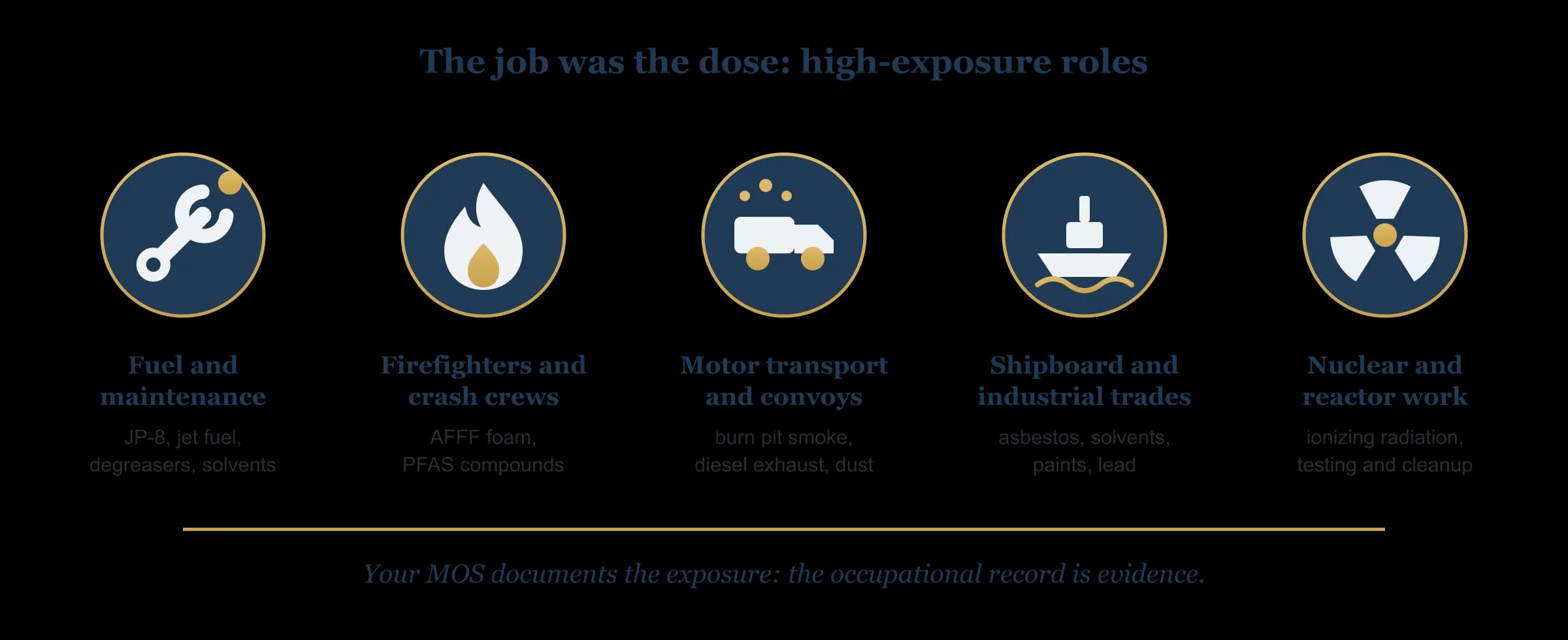
Fuel handlers, flight line, and maintainers
Jet fuel and JP-8, degreasers and industrial solvents, exhaust. Daily skin and inhalation exposure that adds up over a career.
Firefighters and crash crews
AFFF firefighting foam and the PFAS compounds in it, plus combustion products from every fire fought.
Motor transport, convoy, and base operations in theater
Burn pit plumes, diesel exhaust, and the fine particulate dust of Southwest Asia, breathed on every route and perimeter.
Shipboard ratings and industrial trades
Asbestos in ships and buildings, solvents and paints in enclosed spaces, lead. The classic exposures of the maintenance Navy and the motor pool.
Nuclear, reactor, and cleanup personnel
Ionizing radiation from weapons testing, reactor spaces, and cleanup operations at sites like Enewetak Atoll.
None of these occupational exposures needs to appear on a presumptive list to support a claim. The list decides which path the claim takes, not whether a path exists.
Put your exposure history on the record now
Every veteran enrolled in VA health care is entitled to a free toxic exposure screening, with a follow-up at least every five years. It takes minutes, and it timestamps your exposure history in your VA medical record years before any claim needs it. Ask for it at any VA appointment.
Filing a PACT Act Claim
Filing is the same VA Form 21-526EZ disability claim as any other condition, online at VA.gov, through a Veterans Service Organization, or by mail. What changes on a presumptive claim is how little you have to prove:
- 1Confirm the diagnosis is on recordThe VA connects documented conditions, not symptoms. Get the condition named in your medical records with the testing behind it.
- 2Match your service to the windowPull your DD-214 and duty history and check them against the qualifying locations and periods above. On a presumptive claim, this plus the diagnosis is essentially the whole case.
- 3File, and attend the C&P exam if one is scheduledFile VA Form 21-526EZ. Describe your worst days honestly at the exam. For a listed condition with qualifying service, the connection itself should not be in dispute.
The full step-by-step, including evidence for the harder cases, lives in the toxic exposure claims guide.
File when ready, not when rushed: there is no deadline for PACT Act benefits, though an earlier filing date generally sets an earlier effective date.
When Your Condition Is Not on the List
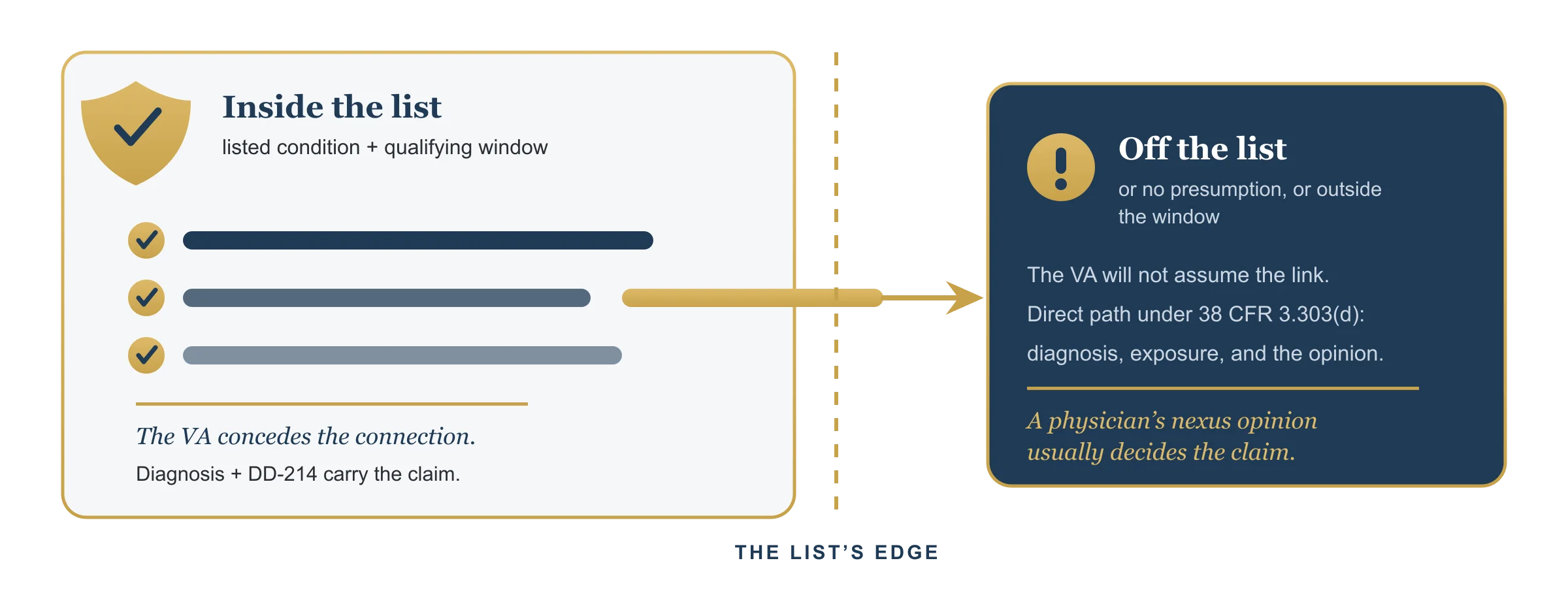
Here is the half of the PACT Act conversation the list articles skip. The law expanded the lists; it did not repeal medicine. Conditions the research ties to exposures but the regulations do not yet, GERD after years of burn pit smoke, peripheral neuropathy after a career in solvents, a cancer outside the listed body systems, all still happen, and they are all still claimable.
Off-list claims run as direct service connection under 38 CFR 3.303(d). Three elements: a current diagnosis, a documented exposure, and a medical opinion connecting the two to at least a 50 percent probability, the at-least-as-likely-as-not standard. The first two usually already exist in your records. The third is the one the VA will not supply, and it is where these claims are won or lost.
That third element is a nexus letter: a physician's written opinion, built from your records and the literature, naming your exposure and the mechanism, and stating the connection in the language the VA requires. On a direct toxic exposure claim it is usually the single most important document in the file.
If that is your claim, start here:
Denied Before the PACT Act? File a Supplemental Claim
If the VA denied your claim in the past and your condition has since become presumptive, you do not need to start over or wait for the VA to find you. File a supplemental claim: the VA states directly that it will review the case again under the new presumption. This is the single highest-yield move the PACT Act created for older denials.
If your condition is still not presumptive, a supplemental claim works the other way: it needs new and relevant evidence, and a physician's nexus opinion is the textbook example, because it supplies exactly the element the original denial said was missing.
For what makes denials stick and how appeals actually work, see can the VA reject a nexus letter.
Which PACT Act Path Is Your Claim On?
Three questions against the lists above. This tells you whether your claim looks presumptive or belongs on the direct path, and what each path needs.
Answer the question above to see your path.
This tool is general education about how the two claim paths work. It does not prepare or file anything, and the VA decides every claim on its own complete file.
How Patriot Path Helps
Patriot Path physicians write nexus letters and independent medical opinions for the claims the PACT Act's lists leave behind: the off-list conditions, the no-presumption exposures, the service that missed a window, and the denials that came back for lack of a medical link. Every letter is built from your records, names the exposure and the mechanism, cites the literature, and states the opinion in the language the VA requires.
The first consultation is free, and it is an honest read: if your claim is presumptive and a letter would add nothing, we say so. If a letter can carry the claim, it is a flat $1,500, written by a licensed physician who reviews your complete file.
See our flat-rate pricing and the full scope of our nexus letter services.
Key Takeaways
- PACT Act presumptive conditions are conceded by the VA: diagnosis plus qualifying service, and the connection is presumed by law, 38 U.S.C. 1120 for the burn pit list and 38 CFR 3.307 and 3.309 for Agent Orange and Camp Lejeune.
- The presumption machinery has two gears: 38 U.S.C. 1119 presumes the exposure, but only listed conditions get the presumed connection. Exposure conceded is not connection conceded.
- The burn pit list is broader than it looks: cancers count by body system, of any type.
- Your MOS is evidence. The occupational record documents the exposure half of every off-list claim.
- Off-list conditions are still claimable under 38 CFR 3.303(d); a physician's at-least-as-likely-as-not opinion usually decides them.
- Denied before the PACT Act? A supplemental claim gets the case reviewed again, either under a new presumption or with new medical evidence.
- There is no deadline for PACT Act benefits, and the free toxic exposure screening documents your history before any claim needs it.
On the List or Off It, Know Where Your Claim Stands
If your condition is presumptive, you may not need us at all, and we will tell you that for free. If it fell off the list's edge, our physicians write the opinion that carries it: built from your records, cited to the literature, in the language the VA requires.
Frequently Asked Questions
What are the PACT Act presumptive conditions?
Conditions the VA automatically connects to service for veterans with qualifying toxic exposure. The burn pit list covers more than twenty conditions in two halves: named respiratory illnesses such as asthma diagnosed after service, COPD, and chronic sinusitis, plus cancers by body system. The Agent Orange list adds nineteen more including hypertension and MGUS, and the long-standing Camp Lejeune water presumption adds eight. Each list requires service in its own qualifying window.
Is hypertension a PACT Act presumptive condition?
Yes, for Agent Orange exposure. The PACT Act added high blood pressure (hypertension) and monoclonal gammopathy of undetermined significance (MGUS) to the Agent Orange presumptive list, so veterans with qualifying herbicide exposure and a hypertension diagnosis can claim it presumptively. Hypertension from other exposures, such as burn pits, is not presumptive and runs on the direct path.
What if my condition is not on the PACT Act list?
It is still claimable. Off-list conditions run as direct service connection under 38 CFR 3.303(d): you need the diagnosis, documented exposure, and a physician's opinion that the condition is at least as likely as not connected to it. The PACT Act even helps here: under 38 U.S.C. 1119 the exposure itself is often presumed, and under 38 U.S.C. 1168 the VA generally must provide an exam and medical opinion when a toxic exposure claim lacks sufficient evidence, unless it finds no indication of an association.
Do I need a nexus letter for a PACT Act claim?
Not for a presumptive claim: if your condition is on the list and your service qualifies, the VA concedes the connection and a letter adds little. You likely do need one if your condition is off the list, your exposure carries no presumption, your service misses the window, or you were denied for lack of a medical link. On those direct claims the nexus opinion is usually the deciding document.
What is a toxic exposure risk activity (TERA)?
TERA is the PACT Act's term for service activity the VA recognizes as carrying toxic exposure risk, recorded in your military record or established by evidence. It matters for one big reason: when a claim involves a TERA and the file lacks enough evidence to decide, 38 U.S.C. 1168 generally requires the VA to provide an exam and obtain a medical nexus opinion before deciding, rather than simply denying the claim as unsupported. The exception is a file showing no indication of an association between the condition and the exposure.
Is there a deadline to file a PACT Act claim?
No. The VA states that veterans and survivors can file for PACT Act benefits at any time. That said, the effective date of a granted claim is generally tied to when you file, so waiting usually costs back pay rather than eligibility. Filing an intent to file can preserve an earlier effective date while you gather evidence.
I was denied before the PACT Act. Can the VA look at my claim again?
Yes. If your condition has since become presumptive, file a supplemental claim: the VA says directly that it will review the case again, and you do not need to wait for the VA to contact you. If your condition is still not presumptive, a supplemental claim with new and relevant evidence, most often a physician's nexus opinion, gets the claim decided again by supplying the element the denial said was missing.
Related guides
- Military toxic exposure VA claims guideThe umbrella guide: every exposure, both claim paths, start to finish.
- Toxic exposures hubEvery exposure the VA recognizes, each with its own deep dive.
- Burn pits and airborne hazardsThe exposure the PACT Act was largely written for.
- Agent OrangeThe long-standing list, now including hypertension and MGUS.
- Camp Lejeune waterEight presumptive conditions tied to the base's drinking water.
- Military chemical exposureWarfare agents, Project SHAD, and the claim path for each.
- What is a nexus letter?The document that carries off-list toxic exposure claims.
- Who can write a nexus letterWhich providers the VA takes seriously.
- Can the VA reject a nexus letter?Why letters fail and how to appeal a denial.
Citations & References
- 38 U.S.C. 1119, Presumptions of toxic exposure (Cornell LII) https://www.law.cornell.edu/uscode/text/38/1119
- 38 U.S.C. 1168, Medical nexus examinations for toxic exposure risk activities (Cornell LII) https://www.law.cornell.edu/uscode/text/38/1168
- 38 U.S.C. 1120, Presumption of service connection for diseases associated with exposure to burn pits and other toxins (Cornell LII) https://www.law.cornell.edu/uscode/text/38/1120
- 38 CFR 3.303, Principles relating to service connection, including direct connection under 3.303(d) (eCFR) https://www.ecfr.gov/current/title-38/chapter-I/part-3/subpart-A/subject-group-ECFR39056aee4e9ff13/section-3.303
- 38 CFR 3.307, Presumptive service connection for chronic, tropical, and exposure-related disease (eCFR) https://www.ecfr.gov/current/title-38/chapter-I/part-3/subpart-A/subject-group-ECFR39056aee4e9ff13/section-3.307
- 38 CFR 3.309, Disease subject to presumptive service connection (eCFR) https://www.ecfr.gov/current/title-38/chapter-I/part-3/subpart-A/subject-group-ECFR39056aee4e9ff13/section-3.309
- The PACT Act and your VA benefits (VA.gov) https://www.va.gov/resources/the-pact-act-and-your-va-benefits/
- VA PACT Act performance dashboard and resources (VA.gov) https://www.va.gov/pact/
- Eligibility for VA disability: exposure to hazardous chemicals and materials (VA.gov) https://www.va.gov/disability/eligibility/hazardous-materials-exposure/
- Exposure to burn pits and other specific environmental hazards, including qualifying locations and periods (VA.gov) https://www.va.gov/disability/eligibility/hazardous-materials-exposure/specific-environmental-hazards/
- Agent Orange exposure and VA disability compensation, including the presumptive condition list (VA.gov) https://www.va.gov/disability/eligibility/hazardous-materials-exposure/agent-orange/
- About VA Form 21-526EZ, Application for Disability Compensation (VA.gov) https://www.va.gov/find-forms/about-form-21-526ez/
- Supplemental claims and decision reviews (VA.gov) https://www.va.gov/decision-reviews/supplemental-claim/
- Military exposures overview (VA Public Health) https://www.publichealth.va.gov/exposures/
- Occupational Exposures and Environmental Health Hazards of Military Personnel, peer-reviewed review (NIH PMC) https://pmc.ncbi.nlm.nih.gov/articles/PMC8158372/