
Chemical Exposure Claims
Military Chemical Exposure: The Agents, Their Health Effects, and Your VA Claim Path
Medically reviewed by the Patriot Path Medical Team
Licensed MD reviewers • Last updated: July 2026
Military chemical exposure covers four groups of agents: chemical warfare agents like mustard gas and lewisite, the Cold War testing programs known as Project 112 and SHAD, herbicides like Agent Orange, and the industrial chemicals of daily military work. Each group has its own VA claim path. Some carry presumptive conditions; others are decided entirely on the medical evidence you bring. This guide covers what each agent does to the body, which path your claim is on, and what to do when no presumption exists, which for chemical exposures is most of the time.
A veteran's story
Ray was a boatswain's mate in the 1960s. Years after his discharge, a letter told him what his ship had actually been doing on one deployment: participating in shipboard vulnerability tests the government later acknowledged as Project SHAD. Decades on, he carries a COPD diagnosis and a question nobody had answered: does the testing connect to the lungs?
The VA does not presume any condition for SHAD participation. His claim would be decided case by case, on the evidence in his file. The Defense Health Agency verified his participation; his pulmonologist documented the COPD. What the file lacked was the third element: a medical opinion connecting the two.
That is the shape of most chemical exposure claims. The exposure is real, the diagnosis is real, and no list connects them for you. A physician's reasoned opinion, written to the VA's standard, is often the piece that decides it, and knowing that before you file beats learning it from a denial letter.
The Four Groups of Military Chemical Exposure
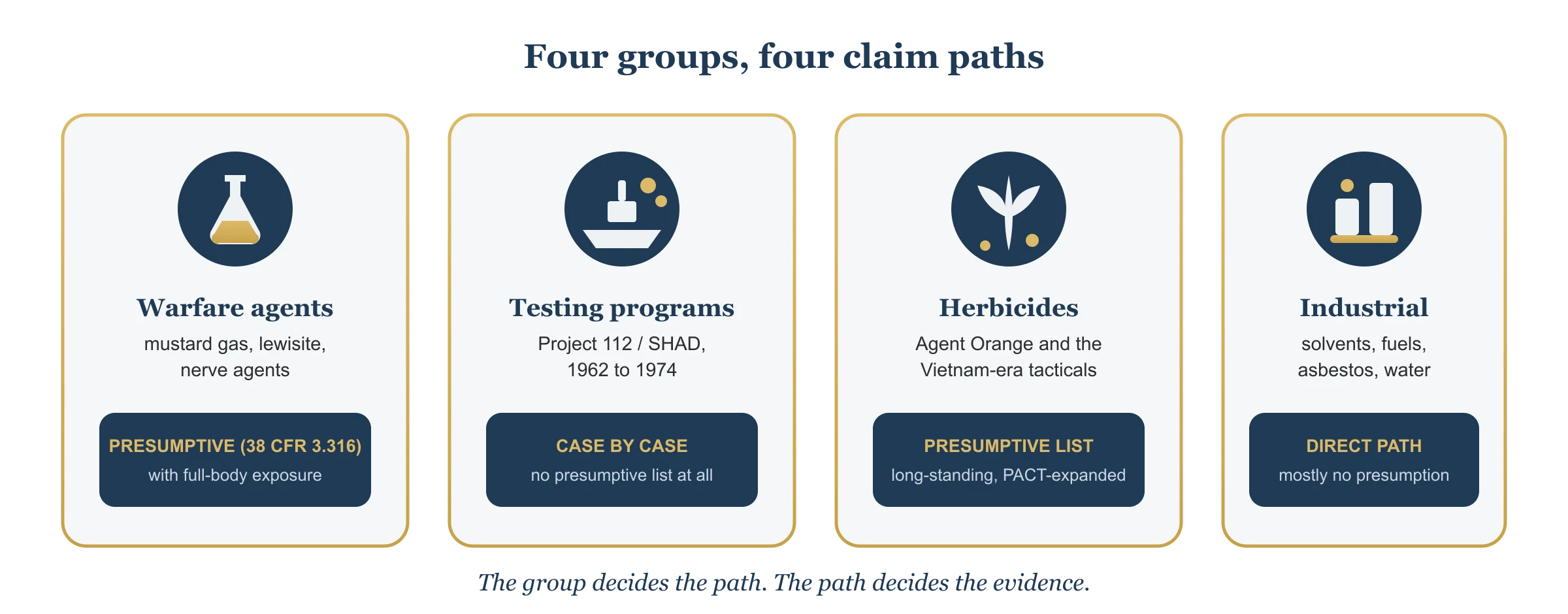
Chemical exposure in military service is not one thing. It spans agents designed to injure, agents tested on ships and ranges, agents sprayed as herbicides, and agents that simply came with the job. The VA treats these groups differently, and knowing which group your exposure belongs to tells you most of what your claim will need.
The four groups below cover nearly every chemical exposure the VA sees. Two of them, warfare agents and the testing programs, are this page's deep dives, because almost nothing else written for veterans covers them properly. The other two have dedicated guides of their own, summarized and linked here.
Chemical warfare agents
Mustard gas (sulfur and nitrogen mustard), lewisite, and nerve agents. Encountered in WWII-era testing programs, demilitarization work, and battlefield incidents.
Testing programs (Project 112/SHAD)
Cold War chemical and biological warfare vulnerability tests, 1962 to 1974, on ships and land ranges. Many participants learned of their exposure only decades later.
Herbicides
Agent Orange and the other tactical herbicides of the Vietnam era, with a long-standing presumptive list that the PACT Act expanded.
Industrial chemicals
Solvents, degreasers, fuels, asbestos, and contaminated water. The daily, low-grade exposures of the motor pool, the flight line, and the ship.
Chemical Warfare Agents: Mustard Gas, Lewisite, and Nerve Agents
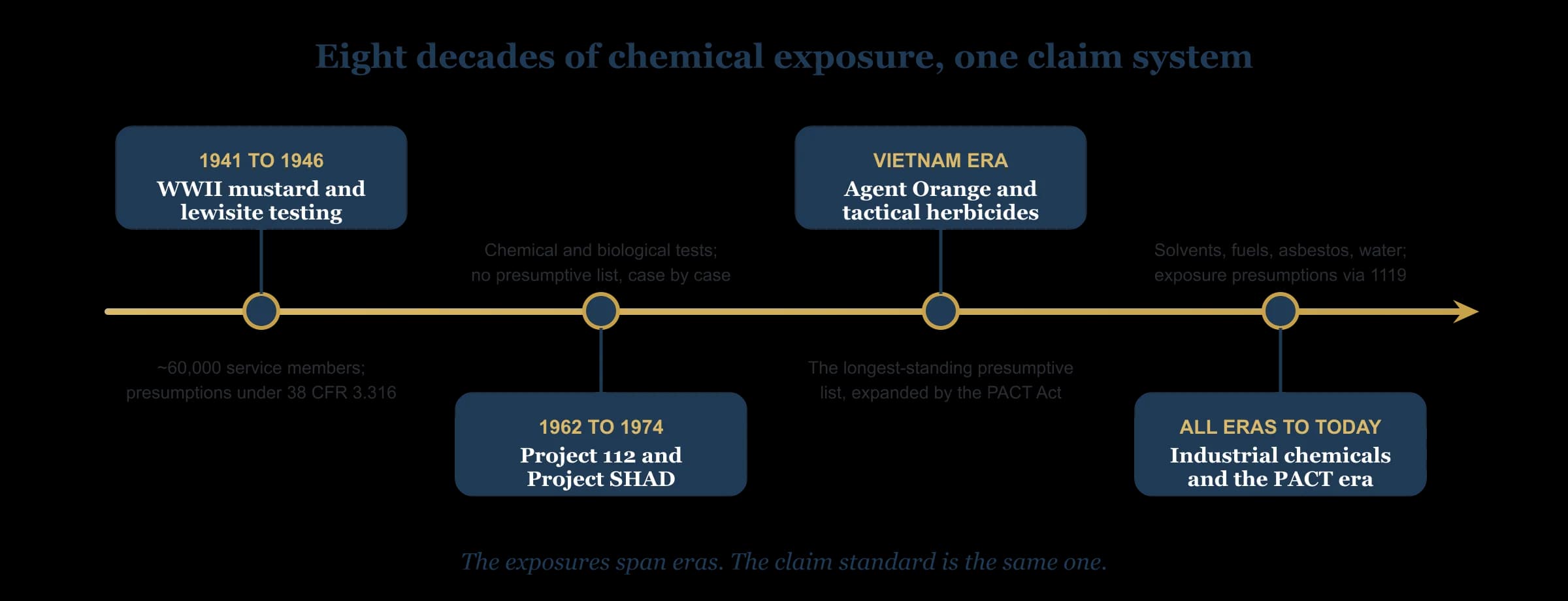
Between 1941 and the end of 1946, roughly 60,000 U.S. service members took part in military testing of mustard agents and lewisite, from drops of agent on the skin to full-body chamber and field exposures. Many were sworn to secrecy, and the records were thin for decades. The National Academies documented the program and its health effects in the landmark report Veterans at Risk.
The VA's rules for these agents are unusual and worth understanding precisely, because they run on a different regulation than the rest of the toxic exposure system.
How 38 CFR 3.316 works
For veterans with full-body exposure to nitrogen or sulfur mustard or to lewisite during service, 38 CFR 3.316 presumes service connection for specific chronic conditions, with no nexus opinion required. The regulation runs in three groups. Full-body mustard exposure covers chronic conjunctivitis, keratitis, corneal opacities, scar formation, and cancers of the nasopharynx, larynx, lung (except mesothelioma), and squamous cell skin cancer. Mustard or lewisite exposure covers chronic laryngitis, bronchitis, emphysema, asthma, and COPD. Nitrogen mustard exposure alone also covers acute nonlymphocytic leukemia.
Two catches. First, the presumption fails if the condition traces to your own willful misconduct or if affirmative evidence shows a nonservice cause superseded the exposure. Second, and more practically: per VA.gov, you claim the resulting disease, never the exposure itself. An application that says only that you were exposed goes nowhere; the claim is built on the diagnosed condition the exposure is believed to have caused.
Proving the exposure depends on when and where you served. For the WWII-era testing window, service at a designated testing location plus a description of the full-body exposure activity lets the VA presume the exposure. Outside those locations and periods, your military records need to show the contact, and thinner records mean the exposure half of the claim needs real documentation work.
Nerve agents and other warfare chemicals
VA Public Health also recognizes exposure risks from other warfare agents, including nerve agents encountered in demilitarization work, chemical weapons disposal, and incidents such as munitions handling. No broad presumptive list exists for these exposures, so claims from them run on the direct path: diagnosis, documented exposure, and a medical opinion connecting the two.
If your record shows chemical weapons work of any kind, treat the occupational history itself as evidence. Duty stations, unit assignments, and job codes documenting that work are what a physician builds the exposure half of a nexus opinion on.
Project 112 and Project SHAD: The Testing Programs
From 1962 to 1974, the Department of Defense ran chemical and biological warfare vulnerability tests known as Project 112 and, for the shipboard tests, Project SHAD (Shipboard Hazard and Defense). Thousands of service members were present for tests involving live agents, simulants, and decontamination compounds, and many were never told at the time. The government began acknowledging the tests and notifying veterans decades later.
Here is the fact that shapes every SHAD claim: the VA presumes no conditions for Project 112/SHAD participation. None. Every claim is decided case by case on its own medical evidence. Participation gets you attention, health care eligibility considerations, and a verified exposure history, but it does not get you a presumed connection to any diagnosis.
That makes the claim path unusually clear. First, verify participation: the Defense Health Agency holds the participation records and runs a hotline (800-497-6261) that confirms whether your unit or ship took part and provides supporting documentation. Second, document your diagnosis. Third, connect the two, and because no presumption will do it for you, a physician's nexus opinion in the at least as likely as not language is usually the document the decision turns on.
Why SHAD claims are the textbook nexus case
A SHAD claim has a government-verified exposure and a documented diagnosis, and the VA will still deny it if nothing in the file medically connects them. The connection is the entire contest. That is precisely the job a well-reasoned independent medical opinion exists to do, and it is why a denied SHAD claim is often a fixable one.
Herbicides and Industrial Chemicals: Where They Are Covered
The other two chemical groups have dedicated guides, because each carries its own locations, windows, and lists. Here is the short version and where to go deep.
Herbicides (Agent Orange)
The Vietnam-era tactical herbicides carry the VA's longest-standing presumptive list, now including hypertension and MGUS via the PACT Act, across Vietnam, the Korean DMZ, Thailand, and other recognized locations.
Industrial solvents and asbestos
TCE, PCE, degreasers, fuels, and asbestos: the working chemicals of ships, motor pools, and flight lines. Mostly no presumptive list, so these claims run on the direct path with occupational evidence.
Contaminated water (Camp Lejeune)
Industrial solvents in base drinking water, with eight presumptive conditions tied to 30 days of qualifying service between August 1, 1953 and December 31, 1987.
Not sure which group your exposure belongs to? The path check further down this page sorts it in three questions.
What Chemical Exposure Does to the Body
Chemical agents injure by route and by dose: what you breathed, touched, or swallowed, at what concentration, for how long. Peer-reviewed reviews of military occupational exposures catalog the pattern across every service era. The effects cluster by body system, and the clusters are worth knowing because they are what connect a decades-old exposure to a present-day diagnosis.
Respiratory
The most consistent cluster: chronic laryngitis, bronchitis, emphysema, asthma, and COPD appear by name in the mustard and lewisite regulation, and airway disease follows solvent and fume exposure across occupations.
Eyes and skin
Blistering agents scar what they touch. Chronic conjunctivitis, keratitis, corneal opacities, and scar formation are presumptive for full-body mustard exposure; chronic skin disease follows solvent contact.
Cancers
Nasopharyngeal, laryngeal, lung, and squamous cell skin cancers for mustard exposure; acute nonlymphocytic leukemia for nitrogen mustard; solvent-linked cancers such as those recognized at Camp Lejeune.
Neurological
Nerve agents act on the nervous system by design, and chronic solvent exposure is associated with peripheral neuropathy and cognitive effects in the occupational literature.
None of these conditions needs to appear on a presumptive list to be claimable. The list decides which path the claim takes, not whether a path exists.
The Two Claim Paths for Chemical Exposure
Every chemical exposure claim runs one of two ways. If your condition is on a presumptive list for your exposure and your service matches the qualifying window, the VA concedes the connection: the mustard and lewisite conditions under 38 CFR 3.316, the herbicide list, Camp Lejeune's eight. If not, the claim runs as direct service connection under 38 CFR 3.303(d): diagnosis, exposure, and a medical opinion connecting them.
The modern machinery helps more than most veterans expect. Under 38 U.S.C. 1119 the VA presumes the exposure itself for designated locations and periods, which removes the old fight over proving contact. And when a claim involves a toxic exposure risk activity and the file lacks enough evidence to decide, 38 U.S.C. 1168 generally obligates the VA to provide an exam and obtain a medical opinion before deciding, unless it finds no indication of an association between the condition and the exposure.
But notice what the chemical groups on this page have in common: outside the mustard, herbicide, and Camp Lejeune lists, almost nothing chemical is presumptive. SHAD carries no list at all. Nerve agents carry none. Solvents and fuels carry none. For the chemical route more than any other, the direct path is the normal path, and the medical opinion is the deciding evidence.
For every presumptive list in one place, with the qualifying windows and the law behind them, see the PACT Act presumptive conditions guide.
The Evidence That Carries a Chemical Exposure Claim
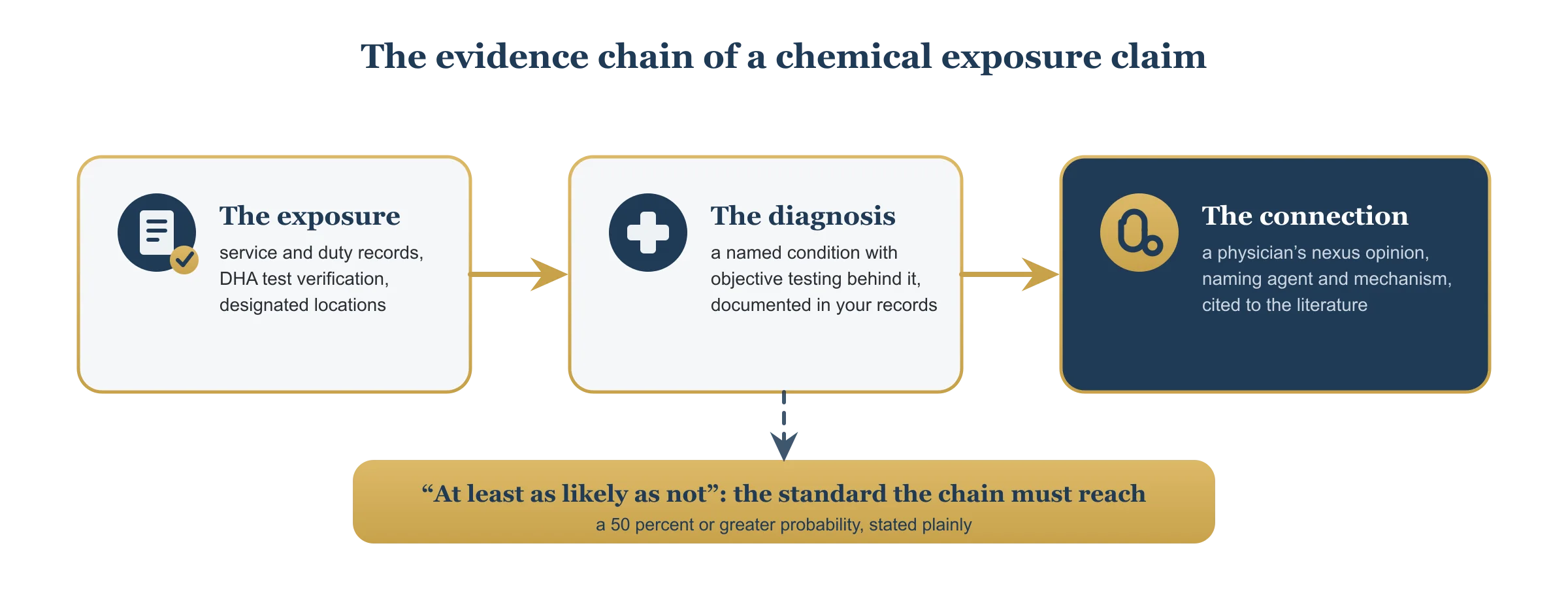
Chemical claims are won on three kinds of paper, and the exposure half deserves more attention than veterans usually give it, because chemical contact rarely made it into a service record on its own.
Exposure documentation
Test-participation confirmation from the Defense Health Agency for Project 112/SHAD; designated-location service for WWII mustard testing; duty stations, job codes, and unit records for occupational chemical work. Your occupation is evidence.
The diagnosis, with objective support
The named condition and the testing behind it: pulmonary function tests for airway disease, pathology for cancers, nerve studies for neuropathy. The VA connects documented conditions, not symptoms.
The medical connection
For everything off a list, a physician's written opinion connecting the diagnosis to the documented exposure, stating the connection is at least as likely as not, naming the agent and the mechanism, and citing the literature.
Put the history on record now
The free VA toxic exposure screening puts your chemical exposure history in your VA medical record, timestamped years before any claim needs it. Every veteran enrolled in VA health care is entitled to it, with a follow-up at least every five years. Ask at any VA appointment.
When a Chemical Exposure Claim Needs a Nexus Letter
If your condition sits on the mustard and lewisite list with qualifying full-body exposure, or on the herbicide or Camp Lejeune lists with qualifying service, you likely do not need a nexus letter, and buying one adds little. File with the diagnosis and the service proof.
Everything else on this page is the other case. SHAD participation with any diagnosis. Nerve agent or chemical weapons work. Solvent and fuel exposure. Mustard contact outside the designated windows. A listed condition with service the window does not cover. In each of these, the VA will not assume the connection, and the physician's opinion connecting your documented exposure to your diagnosed condition is usually the single document the claim turns on.
That opinion has to be phrased to the standard: at least as likely as not, a 50 percent or greater probability, naming the exposure and the mechanism. Opinions that say may be related or could be connected do not meet the bar.
If that is your claim, start here:
Which Path Is Your Chemical Exposure Claim On?
Pick your exposure group and answer two questions. This tells you whether your claim looks presumptive or belongs on the direct path, and what each path needs.
Pick your exposure group above to start.
This tool is general education about how the two claim paths work. It does not prepare or file anything, and the VA decides every claim on its own complete file.
How Patriot Path Helps
Patriot Path physicians write nexus letters and independent medical opinions for exactly the claims this page describes: the case-by-case SHAD file, the off-window mustard exposure, the solvent career with a respiratory diagnosis, the chemical claim that came back denied for lack of a medical link. Every letter is built from your records, names the agent and the mechanism, cites the literature, and states the opinion in the language the VA requires.
The first consultation is free, and it is an honest read: if your claim is presumptive and a letter would add nothing, we say so. If a letter can carry the claim, it is a flat $1,500, written by a licensed physician who reviews your complete file.
See our flat-rate pricing and the full scope of our nexus letter services.
Key Takeaways
- Military chemical exposure spans four groups: warfare agents, the 1962 to 1974 testing programs, herbicides, and industrial chemicals, each with its own claim path.
- Full-body mustard gas or lewisite exposure carries presumptive conditions under 38 CFR 3.316, and you claim the disease, never the exposure itself.
- Project 112/SHAD has no presumptive conditions at all: every claim is case by case, which makes the medical nexus opinion the deciding evidence.
- The Defense Health Agency (800-497-6261) verifies SHAD participation and provides supporting documentation.
- Outside the mustard, herbicide, and Camp Lejeune lists, almost no chemical exposure is presumptive: the direct path under 38 CFR 3.303(d) is the normal path.
- 38 U.S.C. 1119 often presumes the exposure itself, and 38 U.S.C. 1168 generally obligates the VA to obtain an exam and opinion when a toxic exposure file is thin.
- Get the free VA toxic exposure screening: it documents your chemical exposure history before any claim needs it.
The Exposure Was Real. Make the File Prove It.
Chemical exposure claims fail on the connection, not the chemistry. If your claim is presumptive, we will tell you that for free. If it is not, our physicians write the opinion that connects your documented exposure to your diagnosis, cited to the literature, in the language the VA requires.
Frequently Asked Questions
What counts as military chemical exposure?
Four groups: chemical warfare agents such as mustard gas, lewisite, and nerve agents; the Cold War testing programs known as Project 112 and Project SHAD; tactical herbicides such as Agent Orange; and industrial chemicals such as solvents, fuels, asbestos, and contaminated water. Each group has its own VA claim path, and most carry no presumptive conditions, so most chemical claims are decided on the medical evidence.
Is mustard gas exposure a presumptive condition?
For veterans with full-body exposure to nitrogen or sulfur mustard or lewisite, 38 CFR 3.316 presumes specific chronic conditions: eye conditions and several cancers for mustard, the chronic respiratory diseases including asthma and COPD for mustard or lewisite, and acute nonlymphocytic leukemia for nitrogen mustard. You must claim the diagnosed disease itself, and outside the WWII-era designated testing locations you also need records showing the contact.
What is Project SHAD and can I get VA disability for it?
Project SHAD was the shipboard portion of Project 112, chemical and biological warfare vulnerability tests run from 1962 to 1974. You can absolutely file a claim, but the VA presumes no conditions for participation: every SHAD claim is decided case by case. The Defense Health Agency (800-497-6261) verifies participation, and because no list connects your diagnosis for you, a physician's nexus opinion usually decides the claim.
Do I need a nexus letter for a chemical exposure claim?
Usually, yes, because most chemical exposures carry no presumption. The exceptions are the 38 CFR 3.316 mustard and lewisite conditions with qualifying full-body exposure, the Agent Orange list, and Camp Lejeune's eight conditions, where the VA concedes the connection. For SHAD, nerve agents, solvents, fuels, and off-list conditions, the claim runs on the direct path and the medical opinion is usually the deciding evidence.
How do I prove I was exposed to chemicals in the military?
It depends on the group. SHAD participation is verified by the Defense Health Agency from official test rosters. WWII mustard testing is presumed from service at designated locations plus a description of the full-body exposure. Occupational exposures are documented through duty stations, job codes, unit records, and performance reports, and under 38 U.S.C. 1119 the VA presumes some exposures outright for designated locations and periods. Your occupational record is evidence; use it.
What health problems does military chemical exposure cause?
The effects cluster by body system. Respiratory disease is the most consistent: chronic laryngitis, bronchitis, emphysema, asthma, and COPD appear by name in the mustard and lewisite regulation. Blistering agents cause chronic eye and skin conditions. Recognized cancers include nasopharyngeal, laryngeal, lung, and squamous cell skin cancers for mustard exposure. Nerve agents and chronic solvent exposure are associated with neurological effects in the occupational literature.
My chemical exposure claim was denied. Is it worth appealing?
Usually, yes. Most chemical exposure denials say the same thing: no evidence of a link between the condition and service. That specific gap is fixable with a supplemental claim carrying new and relevant evidence, and a physician's nexus opinion is the textbook example because it supplies exactly the element the denial named. If your condition has since become presumptive, a supplemental claim can also pick up the new basis.
Related guides
- Military toxic exposure VA claims guideThe umbrella guide: every exposure route, both claim paths.
- PACT Act presumptive conditionsThe full lists, the qualifying windows, and the law behind them.
- Toxic exposures hubEvery exposure the VA recognizes, each with its own deep dive.
- Agent OrangeThe herbicide list, locations, and windows.
- Solvents and asbestosThe industrial chemicals of the maintenance trades.
- Camp Lejeune waterIndustrial solvents in base drinking water.
- What is a nexus letter?The document that carries case-by-case chemical claims.
- Who can write a nexus letterWhich providers the VA takes seriously.
Citations & References
- 38 CFR 3.316, Claims based on chronic effects of exposure to mustard gas and Lewisite (Cornell LII) https://www.law.cornell.edu/cfr/text/38/3.316
- 38 CFR 3.303, Principles relating to service connection, including direct connection under 3.303(d) (eCFR) https://www.ecfr.gov/current/title-38/chapter-I/part-3/subpart-A/subject-group-ECFR39056aee4e9ff13/section-3.303
- 38 U.S.C. 1119, Presumptions of toxic exposure (Cornell LII) https://www.law.cornell.edu/uscode/text/38/1119
- 38 U.S.C. 1168, Medical nexus examinations for toxic exposure risk activities (Cornell LII) https://www.law.cornell.edu/uscode/text/38/1168
- Mustard gas or lewisite exposure eligibility (VA.gov) https://www.va.gov/disability/eligibility/hazardous-materials-exposure/mustard-gas-lewisite/
- Exposure to mustard gas or lewisite, compensation claims (VA Benefits) https://www.benefits.va.gov/compensation/claims-postservice-exposures-mustard.asp
- Exposure through Project 112 or Project SHAD eligibility (VA.gov) https://www.va.gov/disability/eligibility/hazardous-materials-exposure/project-112-shad/
- Project 112/SHAD compensation claims (VA Benefits) https://www.benefits.va.gov/COMPENSATION/claims-postservice-exposures-project_112_shad.asp
- Project 112/SHAD overview (VA Public Health) https://www.publichealth.va.gov/exposures/shad/index.asp
- Warfare agents exposure category (VA Public Health) https://www.publichealth.va.gov/exposures/categories/warfare-agents.asp
- Chemicals exposure category (VA Public Health) https://www.publichealth.va.gov/exposures/categories/chemicals.asp
- Exposure to hazardous chemicals and materials (VA.gov) https://www.va.gov/disability/eligibility/hazardous-materials-exposure/
- Asbestos exposure eligibility (VA.gov) https://www.va.gov/disability/eligibility/hazardous-materials-exposure/asbestos/
- Veterans at Risk: The Health Effects of Mustard Gas and Lewisite (National Academies, NCBI Bookshelf) https://www.ncbi.nlm.nih.gov/books/NBK236059/
- Occupational Exposures and Environmental Health Hazards of Military Personnel, peer-reviewed review (NIH PMC) https://pmc.ncbi.nlm.nih.gov/articles/PMC8158372/