
VA Nexus Letters
How to Write a VA Nexus Letter: The 7 Requirements
Medically reviewed by the Patriot Path Medical Team
Licensed MD reviewers • Last updated: August 2026
A VA nexus letter must satisfy seven requirements to carry weight. It states which records the provider reviewed, names a current diagnosis, identifies the in-service event, shows the connection exists in medical research, explains the mechanism behind it, gives an "at least as likely as not" opinion, and carries the provider's credentials and signature. Miss one and the VA can discount the letter.
A veteran's story
Derek served eight years in the Army infantry. When he filed for VA disability benefits for chronic knee pain, he hired a local orthopedist to write a nexus letter, paid out of pocket, waited two weeks, and submitted it with his claim. The VA denied him anyway.
The problem wasn't his diagnosis. It wasn't his service record. It was two things working against him at once.
His doctor had written that the knee condition "may be related" to his military service, a phrase that falls below the VA's minimum evidentiary threshold. But the deeper problem was what the letter didn't include: any explanation of how the injury caused the condition, or why the medical evidence supported that conclusion.
After working with Patriot Path, a board-certified physician drafted a new letter, one that included both the correlative research linking military load-bearing to post-traumatic osteoarthritis and the causative reasoning explaining exactly how Derek's documented in-service injury altered his joint mechanics over time. His claim was approved three months later.

What Is a VA Nexus Letter?
A nexus letter is a written medical opinion that links a veteran's current, diagnosed condition to something that happened during military service. It does not prove the diagnosis; the VA already has that. It proves the connection, which is the element most claims turn on.
For a plain-language primer, see our guide to what a nexus letter is.
For the full picture, start with our overview of nexus letters for VA disability claims.
The VA's 3-Part Nexus Test
Every service-connection decision rests on three elements. A nexus letter exists to satisfy the third, and it only works when the first two are already documented.
- 1
A current diagnosis
A formal, ICD-coded diagnosis from a licensed provider. The VA rates diagnoses, not symptoms.
- 2
An in-service event
Documentation of an injury, stressor, exposure, or sustained occupational pattern during service.
- 3
A medical nexus
A physician's reasoned medical opinion, with correlative research and causative reasoning, connecting the diagnosis to service.
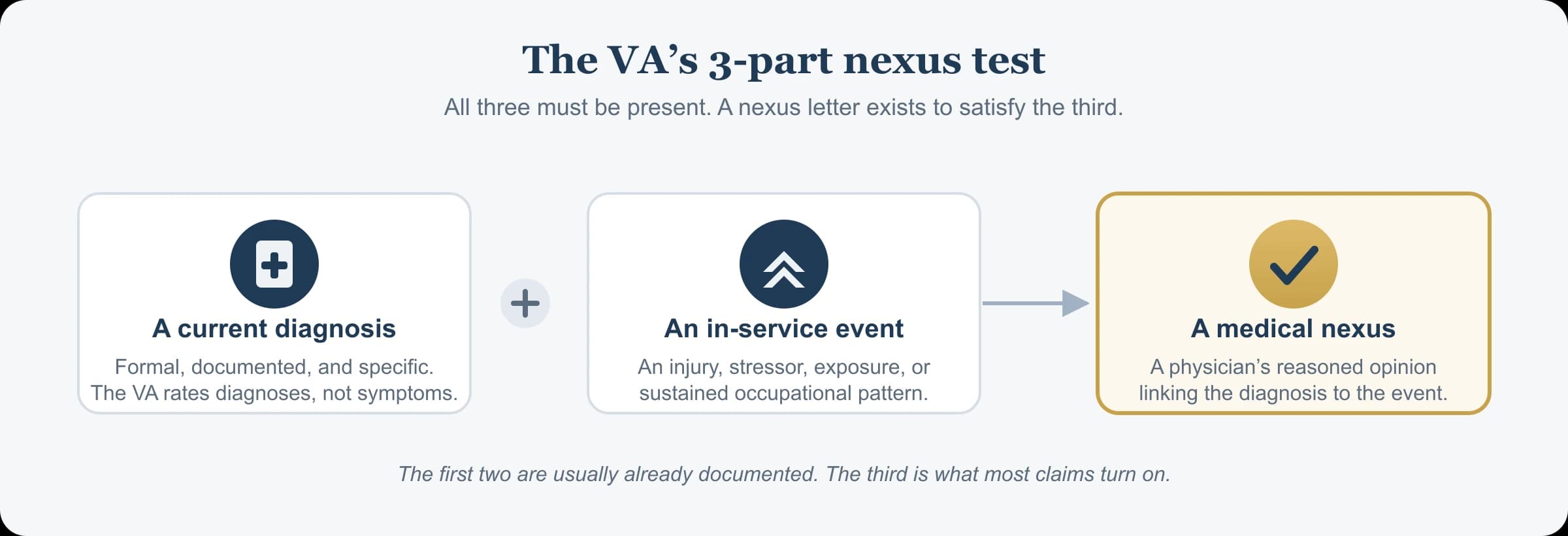
The nexus letter doesn't prove your condition; the VA already has your diagnosis. It proves the connection. The strongest letters don't just assert that connection; they demonstrate it, with correlative research and causative reasoning.
The "At Least as Likely as Not" Standard
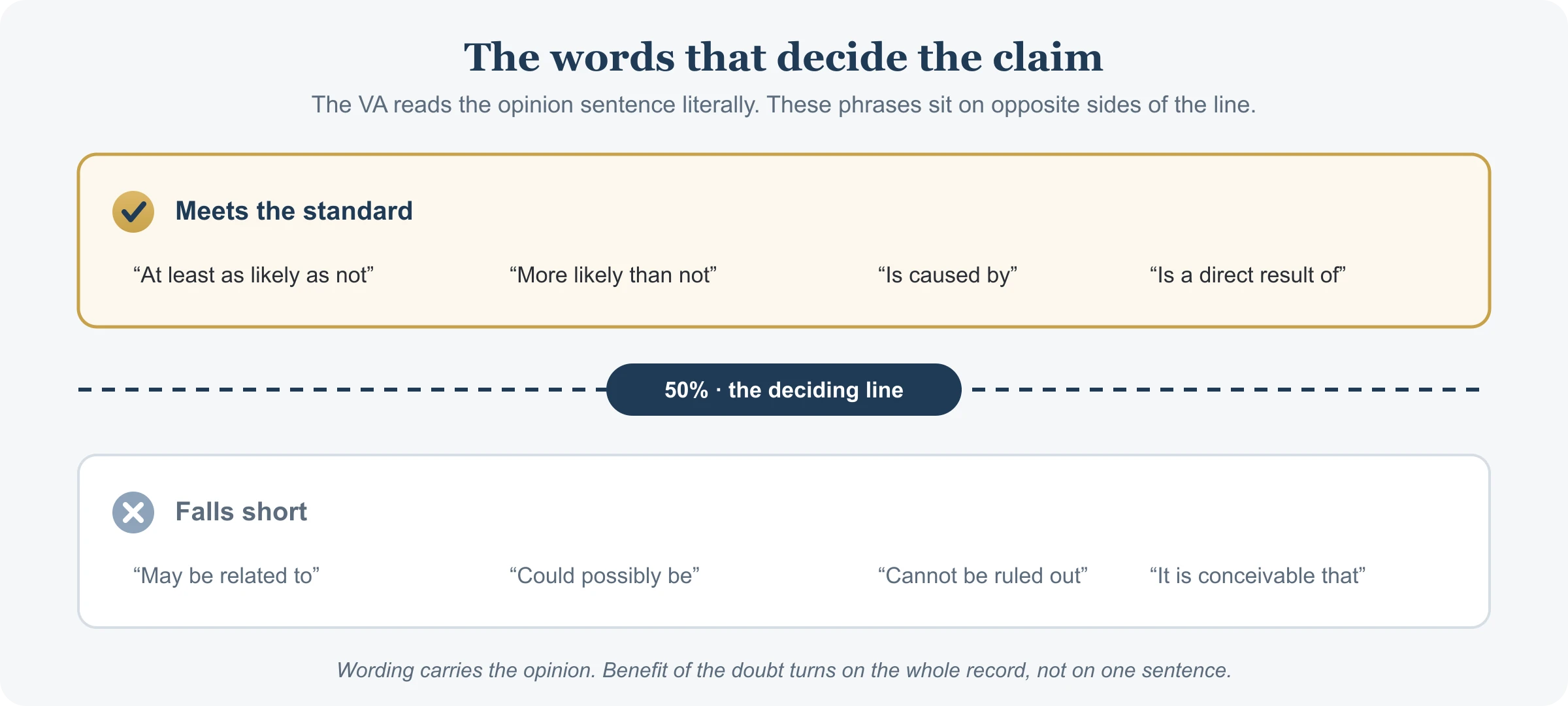
The nexus opinion has to clear a specific probability bar: at least a 50% likelihood that the condition connects to service. The exact wording matters, because the VA reads it literally.
Phrases that meet the bar
- “At least as likely as not related to military service” Meets the 50% threshold, the gold standard phrase.
- “More likely than not caused by the veteran's service” Exceeds 50%, stronger than the minimum requirement.
- “The preponderance of evidence supports service connection” Legal language that also meets the threshold.
Phrases that fail
- “May be related to service” Possibility, not probability. Derek's exact problem.
- “Could have been caused by service” "Could" does not meet the 50% standard.
- “Consistent with the veteran's history” Consistency is not causation in VA adjudication.
- “Possibly related to military duties” One of the most commonly cited denial reasons.
The 7 Elements of a Complete Nexus Letter
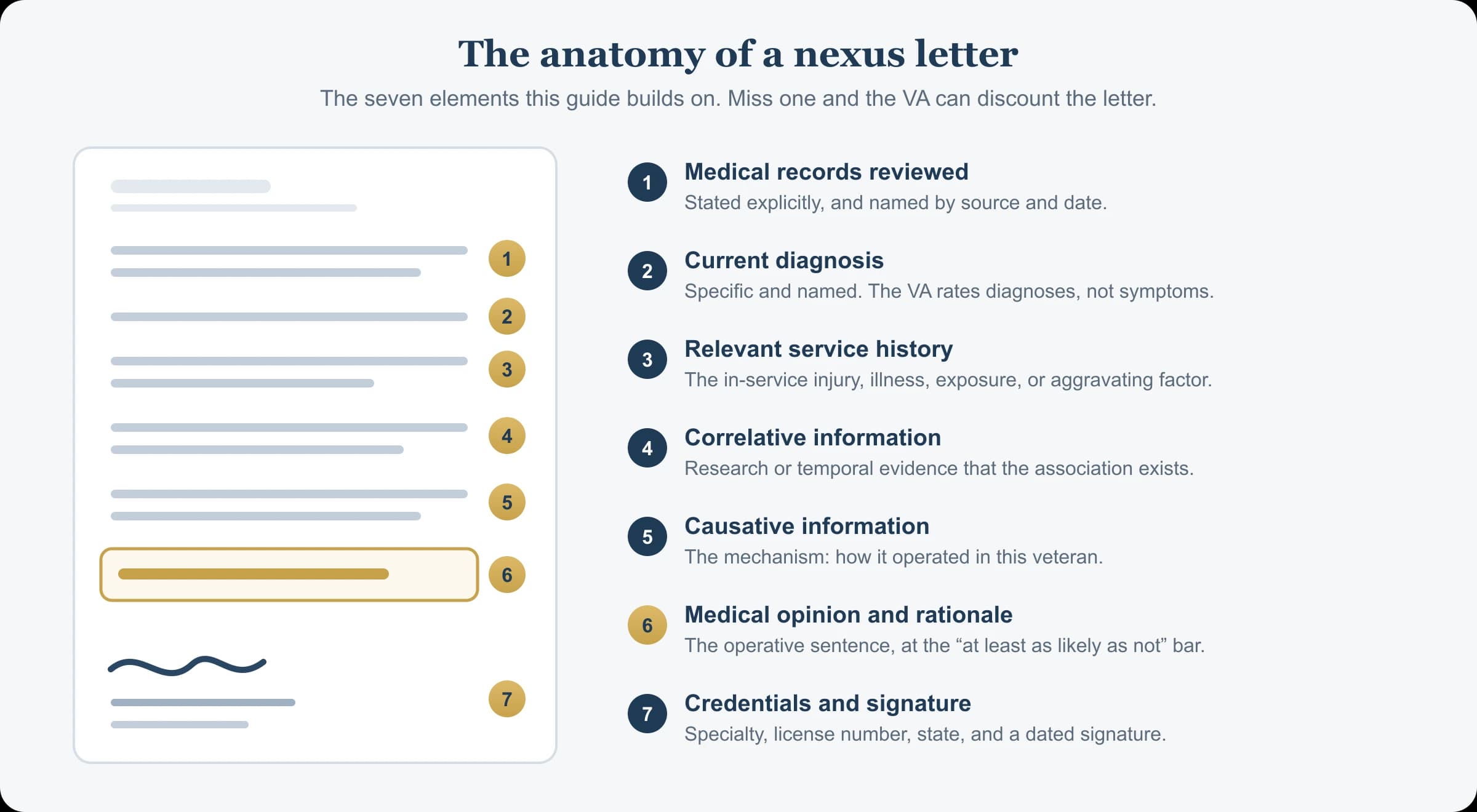
Most nexus letter templates stop at 5 elements. The framework below reflects how rigorous, clinically defensible letters are actually built, and why Patriot Path letters are structured differently from what a general practitioner typically produces.
- 1
Records Reviewed
RequiredThe physician must state explicitly which records were reviewed: VA medical records, private records, service documents, lay statements, prior VA decisions. A letter that doesn't reference records reviewed signals an uninformed opinion.
Service Treatment Records (STRs) are ideal when available, but not always obtainable. What matters is that the physician identifies and reviews whatever documented evidence exists.
- 2
Current Diagnosis
RequiredNamed precisely using the same diagnostic language as the veteran's medical records. "Chronic knee pain" is not a diagnosis. "Right knee osteoarthritis, post-traumatic (ICD-10: M17.31)" is. Vague language creates adjudication gaps.
- 3
Relevant Service History / Event
RequiredThe specific in-service injury, illness, exposure, or aggravating factor. Must be specific, not a vague reference to "military duties."
- 4
Correlative Information
RequiredDemonstrates an association between the veteran's condition and the claimed cause, drawing on external evidence to show the connection is medically plausible and documented in the literature.
- TBI and migraine features (Ishii et al., 2021) doi.org/10.1186/s10194-021-01291-x
- Burn pit exposure and chronic airway disease (Wang et al., 2023) doi.org/10.1016/j.anai.2023.06.012
- Military noise exposure and tinnitus incidence (Geronimo-Hara et al., 2025) doi.org/10.1044/2025_AJA-24-00198
- Temporal relationship: symptom onset documented shortly after the in-service event, established from the veteran's records with no external citation required.
Answers: Is this type of connection known to occur in the medical literature?
- 5
Causative Information
RequiredExplains the actual biological or biomechanical mechanism by which the service event caused or aggravated this specific veteran's condition. The most clinically demanding component, requiring genuine specialty expertise.
- Knee injury to gait alteration to lumbar disc compression (Kotaki et al., 2025) doi.org/10.3390/s25216605
- PTSD hyperarousal to elevated norepinephrine to hypertension (Wingenfeld et al., 2015) doi.org/10.1016/j.psyneuen.2014.10.023
- Head trauma to diffuse axonal injury to cognitive and mood sequelae (Sardinha et al., 2019) doi.org/10.1097/JTN.0000000000000471
Answers: How did A cause B in this specific veteran?
- 6
Medical Opinion and Rationale
RequiredThe explicit "at least as likely as not" conclusion, carrying full legal weight only when it rests on the correlative research and causative reasoning above. A standalone opinion without that foundation is an assertion. With it, it is a medical argument.
- 7
Provider Credentials and Signature
RequiredFull name, specialty, medical license number, state of licensure, and a dated signature. A condition-matched specialist carries more evidentiary authority; VA adjudicators weigh the author's expertise relative to the claimed condition.
How to Structure the Letter, Section by Section
The VA publishes no required form or template for a nexus letter. What it evaluates is whether the required content is present and easy to find. A predictable order helps, because an adjudicator working through a large file should not have to hunt for the opinion sentence.
- 1
Letterhead
Practice letterhead with the provider's name, credentials, address, and phone number. A letter on plain paper invites questions about provenance that are easy to avoid.
- 2
Date and addressee
Dated, and addressed to the VA. Evidence is normally submitted to the Evidence Intake Center, which scans and routes it; the adjudication itself happens at the Regional Office handling the claim.
- 3
Veteran identifiers
Full legal name, plus the VA file number or claim number. Without these the letter can be separated from the file it belongs to.
- 4
The provider's qualifications
Specialty, board certification, years in practice, and the treating relationship if there is one. This is what tells the adjudicator how much weight the opinion deserves.
- 5
Records reviewed
The specific records examined, named by source and date range. A generic line saying records were reviewed carries far less weight than a list.
- 6
Diagnosis and in-service event
The current diagnosis, then the specific service event, exposure, or occupational pattern the opinion connects it to.
- 7
Rationale
The reasoning: the medical literature establishing that the association exists, then the mechanism explaining how it operated in this veteran.
- 8
The opinion
The operative sentence, stated in the VA's own probability language. This belongs in its own short paragraph rather than buried mid-page.
- 9
Signature block
Handwritten or verified electronic signature, printed name, license number, state of licensure, and the date. An unsigned letter is trivially easy to set aside.
Attachments belong at the end, referenced by name in the body. If the letter cites three studies, those three studies should be identifiable from the letter itself.
How the Letter Gets Built, Step by Step
The order matters. Every step below supplies something the next step needs, which is why the opinion sentence is written last. A letter that opens with its conclusion and reasons backward tends to read as advocacy rather than analysis.
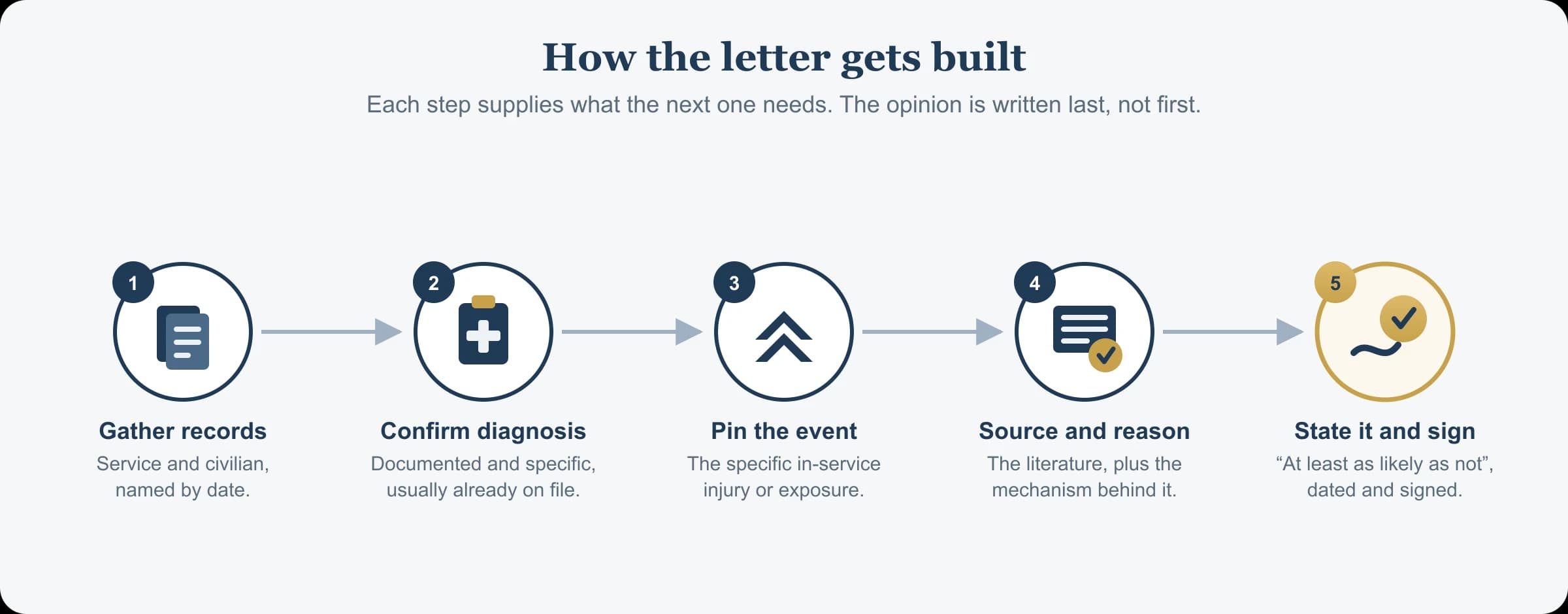
- 1
Gather the records
Service treatment records, the personnel file, and civilian treatment notes. The goal is a documented thread from service to the present, including the gaps, because an unexplained gap is the first thing a reviewer will probe.
- 2
Confirm the diagnosis
A nexus letter connects a diagnosed condition to service, so the diagnosis needs to be documented and specific. It is usually already in the file. Where it is not, an examining physician can document the diagnosis and give the nexus opinion in the same report, which is worth raising with the provider up front.
- 3
Pin the in-service event
Name the specific injury, stressor, exposure, or sustained occupational pattern, with the documentation that supports it. Vagueness here propagates into every later step.
- 4
Source the literature and reason the mechanism
Establish that the association is recognized in the medical literature, then explain how it operated in this particular veteran. Both halves are required, and the second is the one most letters omit.
- 5
State the opinion and sign
Only now is the probability statement written, because it has to follow from what precedes it. Then credentials, date, and signature.
How a Physician Sources the Medical Literature
What gives a medical opinion weight is the reasoned explanation behind it, not the presence of citations. Literature is not strictly required. It does strengthen the correlative half considerably, and it is the part most commonly done badly, either omitted entirely or attached in the form of studies that do not say what the letter claims they say.
Peer-reviewed and indexed
Studies from journals indexed in PubMed or similar databases. A citation an adjudicator can locate is worth more than one they cannot, and consumer health articles are not a substitute.
Matched to the actual claim
The literature has to address the same condition, the same exposure or mechanism, and ideally a comparable population. A study of a different cohort weakens the letter when the mismatch is noticed.
Cited specifically
Author, title, journal, and year, so the citation can be checked. "Studies show" is not a citation and reads as filler.
Honest about strength
A single small study supports a weaker claim than a body of consistent evidence, and saying so openly is more persuasive than overstating it. Overstatement is easy to catch and damages the rest of the letter.
Literature alone only establishes that the association exists in general. It cannot establish that it happened to this veteran. That is the work of the mechanism, and a letter that stops at the research has done half the job.
Does Your Nexus Letter Cover All 7 Requirements?
Score your current letter
0 of 7 covered
Check each item your current letter already includes. Your score updates as you go.
Several core elements are missing. A letter in this state is at high risk of being given little weight.
Have a physician build the missing pieces →Why Correlative and Causative Information Matter
Most veterans, and many physicians, treat a nexus letter as a simple opinion document: "I believe this veteran's condition is related to service." But the VA's adjudication process is adversarial. C&P examiners can counter an unsupported opinion with their own. When a nexus letter includes published research and a clear mechanistic explanation, it becomes much harder for an examiner to dismiss.
Consider two veterans with the same condition, post-traumatic hypertension:
Correlative information
Shows the claimed connection exists in the population, documented in peer-reviewed literature, epidemiological studies, or clinical research.
Causative information
Explains the specific biological or biomechanical mechanism by which the service event caused or aggravated this veteran's condition.
Opinion without support
“It is at least as likely as not that the veteran's hypertension is related to his military service.”
The same opinion, made defensible
“It is at least as likely as not that the veteran's hypertension is related to his military service. This opinion is supported by: (1) peer-reviewed literature documenting elevated rates of hypertension among veterans with PTSD, consistent with the chronic sympathetic nervous system dysregulation associated with this condition; and (2) the documented timeline of the veteran's symptom onset, which corresponds directly with the period of active combat exposure. The mechanism, chronic cortisol and catecholamine elevation in PTSD patients driving vascular resistance, is well-established in the cardiovascular literature.”
Complete vs Incomplete: What the VA Sees
| Element | Incomplete letter | Complete letter |
|---|---|---|
| Records reviewed | No mention | States which records were reviewed: VA records, private records, service documents |
| Diagnosis | "Knee pain and discomfort" | "Right knee osteoarthritis, post-traumatic (ICD-10: M17.31)" |
| Service history | Vague: "military duties" | Specific documented event with dates and record citations |
| Correlative info | None, no literature cited | Peer-reviewed studies linking the condition type to service exposure |
| Causative info | None, mechanism not explained | Specific mechanism connecting service event to the veteran's diagnosis |
| Nexus opinion | "May be related to service" | "At least as likely as not related to the veteran's documented military service" |
| Credentials | "Dr. Smith" | Name, specialty, license number, state of licensure, signed and dated |
The bottom line for veterans
- Most letters fail not because the claim is weak, but because they skip the correlative research and causative reasoning that make the opinion defensible.
- "At least as likely as not" is the legal conclusion, but without evidence supporting it, it is an assertion, not an argument.
- Correlative information shows the connection is documented in the literature; causative information explains how it happened to you.
- Specialist credentials matched to your condition carry more weight, and specialists are better positioned to write the clinical sections that matter.
- Patriot Path's 7-element letters include published research citations and mechanism-level causative reasoning in every engagement.
Common Reasons the VA Rejects a Nexus Letter
The VA can assign a letter "little to no probative value" when it is missing a required element, uses language below the 50% threshold, comes from a provider without relevant credentials, or omits the correlative and causative reasoning that makes the opinion defensible. A letter is not accepted or rejected outright; it is weighed against everything else in the file.
If a letter has already been discounted, a revised letter through a supplemental claim can correct the gap.
Who Can Write a VA Nexus Letter?
Any licensed medical professional can technically write a nexus letter, but the correlative and causative components require genuine specialty expertise. A general practitioner can state an opinion. A condition-matched specialist can explain the mechanism and cite the literature that supports it.
- General practitioners: can produce a basic nexus letter, but typically lack the depth of specialty knowledge needed for rigorous correlative and causative sections.
- Specialists: a psychiatrist for PTSD, a pulmonologist for sleep apnea, a neurologist for TBI, an orthopedic specialist for joint conditions carry both the clinical knowledge and the professional authority to write letters VA adjudicators take seriously.
- VA doctors: not barred from helping. VHA Directive 1134(3) requires providers, when requested, to assist with medical forms and provide medical statements, except where specifically prohibited. In practice many VA providers do not have your service records and are not positioned to assess causation, which is why an independent medical opinion (IMO) from an outside provider is the usual route.
- Patriot Path: our board-certified physicians and licensed PhDs are matched to each veteran's specific condition. Every letter includes correlative literature, causative reasoning, and the full 7-element framework, not a template.
Provider scope of practice is its own question. For one common case, see whether a chiropractor can write a nexus letter.
For the full provider-by-provider breakdown, see who can write a nexus letter.
When You May Not Need a Nexus Letter
Not every claim needs a nexus letter. Some conditions are presumptively service-connected, which means the VA already accepts the link between the condition and qualifying service and does not require you to prove causation. Many conditions tied to Agent Orange, Gulf War service, radiation, and burn-pit and other toxic exposures recognized under the PACT Act fall into this category.
If your condition is on a presumptive list and you meet the service requirements, a nexus letter is usually unnecessary for the service-connection element, though you still need a current diagnosis and evidence of qualifying service. When a condition is not presumptive, when you claim it as secondary to another condition, or when the VA disputes that a presumption applies, a nexus letter becomes essential again.
See which conditions are covered under our toxic exposure guides.
How Patriot Path Builds Letters
- 1
We request and review all available medical records, VA records, private history, service documents, C&P reports, and lay statements, before writing a word.
- 2
We assign a physician whose specialty matches your claimed condition, the person best positioned to write the correlative and causative sections with clinical authority.
- 3
Our physician identifies peer-reviewed research relevant to your condition and service history, then documents the specific mechanism connecting your service event to your diagnosis.
- 4
Every letter is checked against all 7 required elements, records, diagnosis, service history, correlative citations, causative mechanism, nexus opinion, and credentials, before delivery.
- 5
Your letter arrives formatted for immediate submission, with credentials, records reviewed, and all 7 elements in order.
Read about how our nexus letter process works and what a nexus letter costs.
Want to see the framework on a finished letter? Read a full nexus letter example.
Get a Letter That Clears the Bar
Your nexus letter has one job: clear the VA's evidentiary bar. If yours is missing the correlative research or causative reasoning that makes it defensible, our board-certified physicians can write one that isn't.
Frequently Asked Questions
Do I need to include research studies in my nexus letter?
Not strictly required, but they significantly strengthen the correlative component. Peer-reviewed citations from journals, the DSM-5, VA/NIH databases, or epidemiological studies give the physician's opinion an evidentiary foundation that is much harder for a C&P examiner to counter with a bare assertion. Patriot Path physicians include relevant citations as a standard practice, not an add-on.
Can any doctor write a VA nexus letter?
Any licensed medical professional can write one, but the correlative and causative sections require genuine specialty expertise. A general practitioner can issue an opinion; a condition-matched specialist can document the mechanism and cite the literature. Specialist letters carry more evidentiary weight in VA adjudication. VA physicians are not prohibited from writing them: VHA Directive 1134(3) requires providers, when requested, to assist with medical forms and provide medical statements, except where specifically prohibited. In practice many VA providers do not have your service records and are not positioned to assess causation, which is why an outside independent medical opinion is the usual route.
What is the "at least as likely as not" standard?
This is the minimum probability threshold for VA service connection, a 50% or greater likelihood that the condition connects to military service. Under 38 U.S.C. 5107(b), when the evidence for and against a claim is in approximate balance, the VA resolves that doubt in the veteran's favor. That balance is judged on the whole record rather than on any one sentence, but an opinion stated below the threshold gives the VA little to weigh. "May be related" does not meet it.
What is the difference between a nexus letter and a DBQ?
A Disability Benefits Questionnaire (DBQ) documents disability severity for rating purposes; it determines what percentage the veteran receives. A nexus letter establishes service connection; it argues why the VA should connect the condition to service in the first place. The DBQ answers "how bad is it"; the nexus letter answers "is it connected to service."
Can the VA reject a nexus letter?
Yes. The VA can give a nexus letter "little to no probative value" if it lacks required elements, uses language below the probability threshold, is written by a physician without relevant credentials, or omits the correlative and causative reasoning that makes the opinion clinically defensible. A nexus letter is evidence the VA weighs alongside all other evidence in the file.
What records should a nexus letter reference?
Whatever documented evidence exists: VA medical records, private records, service documents, C&P exam reports, buddy statements, and any prior VA decisions. Service Treatment Records (STRs) are ideal when available, but not always obtainable. What matters is that the physician explicitly states which records were reviewed; this signals an evidence-based opinion rather than a cursory one.
What happens if my nexus letter is missing an element?
The VA assigns it reduced weight and often cites the missing element as the primary denial reason. This can be corrected through a supplemental claim with a revised or replacement letter. Patriot Path's 7-element compliance review catches gaps before the letter reaches an adjudicator.
How is Patriot Path's approach different from other nexus letter services?
Most services produce letters that include the nexus opinion and basic rationale. Patriot Path's letters are built to a 7-element framework that includes both correlative literature citations and causative mechanism reasoning, the components that make a letter clinically defensible and difficult for a VA examiner to counter. Every letter is written by a condition-matched specialist, not a general practitioner or a template.
Citations & References
- M21-1, Part IV, Subpart i, Chapter 3, Section C, Insufficient Examinations, VA Adjudication Procedures Manual (KnowVA) https://knowva.ebenefits.va.gov/system/templates/selfservice/va_ssnew/help/customer/locale/en-US/portal/554400000001018/content/554400000180517/M21-1-Part-IV-Subpart-i-Chapter-3-Section-C-Insufficient-Examinations#1a
- 38 CFR 3.303, Direct Service Connection (eCFR) https://www.ecfr.gov/current/title-38/chapter-I/part-3/subpart-A/subject-group-ECFR39056aee4e9ff13/section-3.303
- 38 U.S.C. 5107, Benefit of the Doubt (U.S. Code, House.gov) https://uscode.house.gov/view.xhtml?req=granuleid:USC-1999-title38-section5107&num=0&edition=2024
- Ishii R, Schwedt TJ, Trivedi M, et al. Mild traumatic brain injury affects the features of migraine. J Headache Pain. 2021;22(1):80. doi:10.1186/s10194-021-01291-x https://doi.org/10.1186/s10194-021-01291-x
- Wang X, Doherty TA, James C. Military burn pit exposure and airway disease: Implications for our Veteran population. Ann Allergy Asthma Immunol. 2023;131(6):720-725. doi:10.1016/j.anai.2023.06.012 https://doi.org/10.1016/j.anai.2023.06.012
- Geronimo-Hara TRT, Belding JN, Warner SG, Trone DW, Rull RP. Incidence and Risk Factors for Tinnitus Among Military Service Members in the Millennium Cohort Study. Am J Audiol. 2025;34(2):330-343. doi:10.1044/2025_AJA-24-00198 https://doi.org/10.1044/2025_AJA-24-00198
- Kotaki Y, Kudo D, Kimura R, et al. The Effect of Knee Extension Limitation on Lumbar Intervertebral Disc Compression Force During Walking: A 3D Musculoskeletal Analysis. Sensors (Basel). 2025;25(21):6605. doi:10.3390/s25216605 https://doi.org/10.3390/s25216605
- Wingenfeld K, Whooley MA, Neylan TC, Otte C, Cohen BE. Effect of current and lifetime posttraumatic stress disorder on 24-h urinary catecholamines and cortisol: results from the Mind Your Heart Study. Psychoneuroendocrinology. 2015;52:83-91. doi:10.1016/j.psyneuen.2014.10.023 https://doi.org/10.1016/j.psyneuen.2014.10.023
- Sardinha DS, Vieira RCA, Paiva WS, de Oliveira DV, de Sousa RMC. Behavioral Changes and Associated Factors After Diffuse Axonal Injury. J Trauma Nurs. 2019;26(6):328-339. doi:10.1097/JTN.0000000000000471 https://doi.org/10.1097/JTN.0000000000000471