
Welcome to Patriot Path
Nexus Letters for Hearing Loss
Licensed Physician, MD | Patriot Path Medical Team
Specializing in VA auditory evaluations and independent medical opinions • Last updated: June 2026
Board-certified physicians specializing in VA disability documentation. Meet our clinicians → • Our review process →
Hearing loss is the second most claimed VA disability, right behind tinnitus, and for the same reason: years around weapons, aircraft, and heavy machinery take a toll. It usually comes on slowly, so a lot of veterans do not connect it to service until the conversations at the dinner table start slipping by.
A nexus letter can fix that. Our physicians connect your hearing loss to your service in the language the VA expects, and pair it with your tinnitus claim. One flat fee of $1,500, and the first consultation is free.
How VA Rates Hearing Loss
VA rates hearing loss under 38 C.F.R. § 4.85, Diagnostic Code 6100. Unlike most conditions, it is not judged by how bad it feels. It is calculated from your audiogram, using two hearing tests and two tables. Ratings run from 0% to 100%, but 0% is the most common result, even for real, documented loss. The bands below are a plain-language guide; the exact number comes from the math explained underneath.
| Rating | What it generally takes | Monthly pay (approx) |
|---|---|---|
| 0% | Mild to moderate loss, especially when your word recognition is still good. This is the most common outcome, even with real loss that you notice every day.Most Common | $0 |
| 10% | Moderate loss in both ears, or moderate loss in one ear with worse loss in the other. | ~$180/mo |
| 20% | Moderate-to-severe loss in both ears, with reduced word recognition. | ~$357/mo |
| 30% to 40% | Severe loss in both ears. | ~$552 to $796/mo |
| 50% and up | Profound loss or near-total deafness in both ears. | ~$1,133/mo+ |
Pay figures are approximate 2026 rates (effective December 1, 2025) for a single veteran with no dependents. Check VA.gov for current amounts.
How the VA actually calculates a hearing loss rating
The rating is not a judgment call. It is a calculation from your audiogram. Here is the path your numbers take.
- 1
Two tests, no hearing aids
A state-licensed audiologist runs a puretone audiometry test and a Maryland CNC word-recognition test. Both are done with your hearing aids out, so the result reflects your unaided hearing.
- 2
Average your hearing thresholds
For each ear, the VA averages your puretone thresholds at 1000, 2000, 3000, and 4000 Hertz. That single number is your puretone threshold average.
- 3
Turn each ear into a Roman numeral (Table VI)
That average and your word-recognition score meet on a grid called Table VI, which gives each ear a Roman numeral from I (near normal) to XI (profound loss).
- 4
Combine both ears (Table VII)
Your better ear and your poorer ear meet on a second grid, Table VII. Where they cross is your rating, from 0% to 100%.
Two things to know. First, unusual patterns of loss get special handling under 38 C.F.R. § 4.86, which can bump your numeral up. Second, hearing loss only counts as a disability for VA purposes once it crosses the thresholds in 38 C.F.R. § 3.385. Because the formula leans heavily on word recognition, many veterans with real, documented loss still rate 0%. A 0% rating is not a loss: it makes your hearing loss service-connected, so any future worsening is already on record, and it sits alongside a 10% tinnitus rating.
Want your own number? Run your audiogram through the tables.
Open the hearing loss rating calculator →Making a VA Disability Claim for Hearing Loss
When you file a VA disability claim for hearing loss, three things need to line up:
A current diagnosis
An audiogram from a state-licensed audiologist, using the Maryland CNC word test and puretone audiometry, that shows loss meeting 38 C.F.R. § 3.385.
A service connection
Noise exposure in service, such as flight lines, engine rooms, armor, firing ranges, or blasts, usually without consistent hearing protection.
A medical nexus
A qualified opinion that your hearing loss is 'at least as likely as not' connected to that noise exposure.
Hearing loss is not presumptive in the Agent Orange or PACT Act sense, and outside the narrow sensorineural route covered below it often comes on slowly, so the VA frequently denies it as 'age-related' when the service link is not spelled out. The nexus is where these claims are won. A nexus letter supplies it: a written medical opinion tying your hearing loss to your service. The 'at least as likely as not' standard (a 50% or better chance) comes from the benefit-of-the-doubt rule in 38 U.S.C. § 5107(b), carried out in 38 C.F.R. § 3.102.
How to Connect Your Hearing Loss to Service
There are a few ways to tie hearing loss to your service. The direct noise-exposure path is the common one, even when the loss did not show up until years later.
Direct connection
Loud noise in service damaged your hearing.
- Sustained high noise. Flight lines, engine and boiler rooms, generators, armor, and firing ranges wear hearing down over months and years.
- Your job. The VA keeps a noise-exposure list by military job. Aviation, armor, motor pool, artillery, and infantry roles carry a high probability of hazardous noise.
- Delayed onset. Noise damage often shows up as measurable loss years after service. That gap does not disqualify you, but it makes a nexus letter more important.
Secondary connection
Another service-connected condition, or its treatment, caused the hearing loss (38 C.F.R. § 3.310).
- Head injury or TBI. A blast or head injury in service can damage hearing.
- Ear disease. Meniere's disease and chronic ear infections can cause lasting loss.
- Ototoxic medication. Some drugs taken for a service-connected condition can damage the inner ear.
Aggravation
You had some hearing loss before service, and service made it permanently worse.
- Worsened by service. Mild loss at entry that loud duty pushed measurably worse, beyond normal aging.
Secondary Conditions
Hearing loss connects to other conditions in both directions. It can follow another service-connected condition, and it can be the starting point for one. Whether documenting a link raises your combined rating depends on the condition: it has to be separately diagnosed, service-connected as secondary, and rated at a compensable level on symptoms that are not already counted in another rating. There is one narrow exception. Under 38 C.F.R. 3.324, where a veteran has two or more permanent service-connected disabilities, none of them compensable, and they clearly interfere with normal employability, VA is authorized to apply a single 10 percent rating. It is not available if you already hold any compensable rating, including a 10 percent tinnitus rating, and it is not combined with any other rating. If you already carry other ratings, 38 C.F.R. 4.25 has VA combine everything and round to the nearest ten only once, at the end, so a compensable secondary can raise your combined figure by its own percentage, by less, or not at all.
Hearing loss may be secondary to
- Head injury or TBI. A blast or head injury can damage hearing.
- Meniere's disease or ear conditions. Chronic ear disease can cause lasting loss.
- Ototoxic medication. Drugs taken for a service-connected condition can harm the inner ear.
Conditions that may go with hearing loss
- Tinnitus. Ringing commonly occurs alongside hearing loss, and the two normally carry separate evaluations that combine. Which theory to plead is not the obvious one. See our guide to claiming tinnitus alongside service-connected hearing loss →
- Depression and anxiety. Studies link hearing loss with depression, and a diagnosed mental health condition can be claimed as secondary under 38 C.F.R. 3.310 when the evidence connects the two. The hearing loss is rated from your audiogram under 38 C.F.R. 4.85, Table VII, and the depression on occupational and social impairment under 38 C.F.R. 4.130. Those are different measurements. 38 C.F.R. 4.14 then bars counting the same manifestation under two diagnoses, so the symptoms counted toward the mental rating need to be distinct from the hearing difficulty the audiogram already scores. See our guide to a nexus letter for depression secondary to hearing loss →
- Balance problems. Some inner-ear conditions that cause hearing loss also cause dizziness, which is rated on its own.
What to Gather - Evidence Checklist
Gather these before you file or ask for a letter. Tick each off as you go.
Frequently Asked Questions
How does the VA rate hearing loss?
From your audiogram, not from how bad it feels. A state-licensed audiologist runs a Maryland CNC word test and a puretone test. The VA averages your thresholds at 1000, 2000, 3000, and 4000 Hertz, turns each ear into a Roman numeral on Table VI, then combines both ears on Table VII for a rating from 0% to 100%.
Why did I get 0% when my hearing is clearly bad?
The formula leans heavily on word recognition, so it is common to rate 0% even with real loss, especially if you still score well on the word test. A 0% rating still makes your hearing loss service-connected, which protects you if it worsens and lets it pair with a 10% tinnitus rating.
What is the Maryland CNC test?
It is a standardized word-recognition test the VA requires for hearing claims. You repeat back a list of words, and your score, along with your puretone average, sets your Roman numeral on Table VI. It must be done by a state-licensed audiologist, without hearing aids.
Is hearing loss presumptive?
For one type of hearing loss, in a narrow way, yes. Sensorineural hearing loss is treated as an organic disease of the nervous system, which makes it a chronic disease under 38 C.F.R. § 3.309(a) per VA's manual at M21-1 V.iii.12.A.1.d. The word sensorineural is doing real work there: conductive and mixed losses are not in that category. What it gives you is the continuity-of-symptomatology route under 38 C.F.R. § 3.303(b), and a one-year presumption under 38 C.F.R. § 3.307 only if you served 90 days or more during a war period or after December 31, 1946 and the loss was already at 10 percent or more within a year of separation. A 0% rating does not meet that 10 percent bar. None of this resembles the Agent Orange or PACT Act presumptives. Outside those conditions you show the connection is 'at least as likely as not', usually to noise exposure, and because loss often shows up years later a clear record of your military job matters a great deal.
Can I claim hearing loss and tinnitus together?
Yes, and there is a filing-order reason to. VA's manual says a claim phrased as hearing loss can bring tinnitus within its scope, and that the hearing-related claim date then governs the effective date; a claim phrased as tinnitus generally does not work the other way. Our guide to a nexus letter for tinnitus secondary to hearing loss covers that asymmetry and what the two ratings actually combine to.
What does it cost, and how do we start?
Patriot Path charges $1,500 flat for a nexus letter, and the first consultation is free. Book a consultation and a clinician will tell you straight whether a letter can help.
Guides for this condition
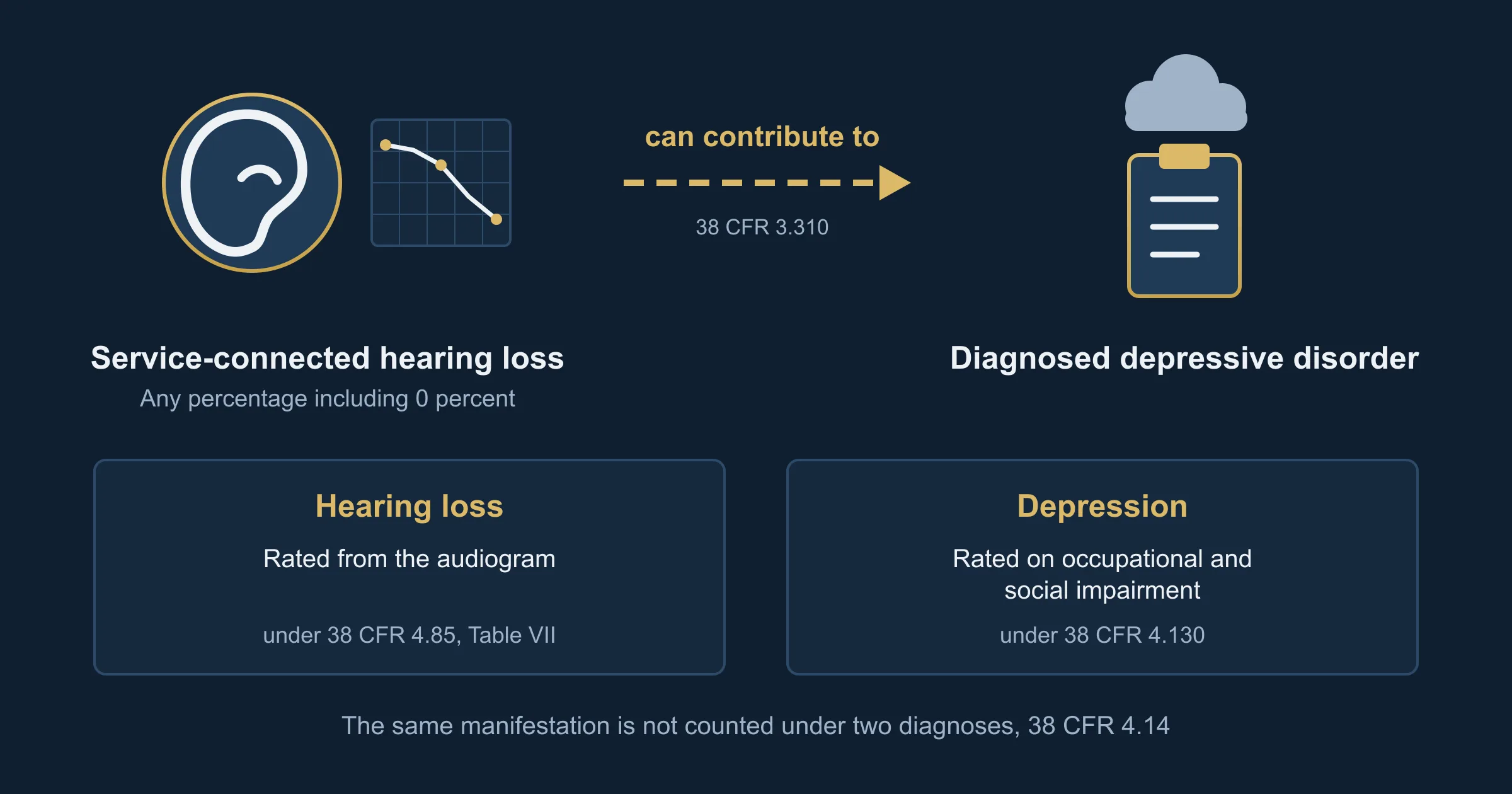 Nexus Letter for Depression Secondary to Hearing LossDepression secondary to service-connected hearing loss, even at 0 percent: what the opinion must show, why the ratings use separate tests, and the research.Read the guide
 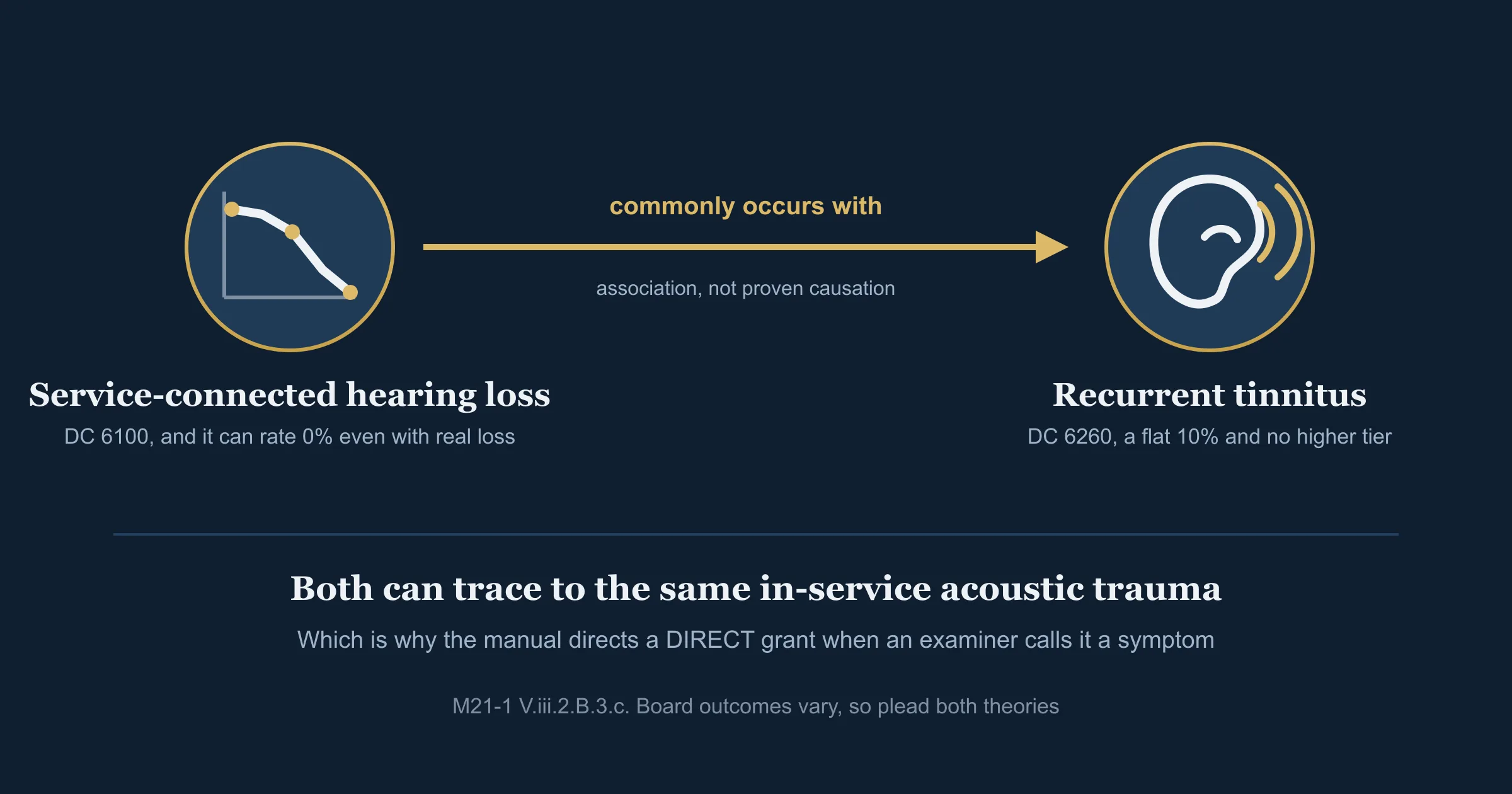 Nexus Letter for Tinnitus Secondary to Hearing LossVA's manual tells the rater to grant tinnitus directly, not as a 3.310 secondary claim. Why Board practice varies, what DC 6260 adds, and when you need no letter.Read the guide
The noise took your hearing. Let your claim show it.
Let our physicians prepare a hearing loss nexus letter that meets the VA's evidence standards, and pair it with your tinnitus claim.
Sources & Regulatory References
- VA disability compensation (VA.gov) https://www.va.gov/disability/
- 38 CFR 4.85, Evaluation of hearing impairment, Tables VI, VIa, VII (eCFR) https://www.ecfr.gov/current/title-38/section-4.85
- 38 CFR 4.86, Exceptional patterns of hearing impairment (eCFR) https://www.ecfr.gov/current/title-38/section-4.86
- 38 CFR 3.385, Disability due to impaired hearing (eCFR) https://www.ecfr.gov/current/title-38/section-3.385
- 38 C.F.R. 3.324, Multiple noncompensable service-connected disabilities (eCFR) https://www.ecfr.gov/current/title-38/section-3.324
- 38 CFR 3.303, Principles relating to service connection (eCFR) https://www.ecfr.gov/current/title-38/section-3.303
- 38 U.S.C. 5107, Benefit of the doubt (Cornell LII) https://www.law.cornell.edu/uscode/text/38/5107