
VA Secondary Claims
Nexus Letter for Tinnitus Secondary to Hearing Loss
Medically reviewed by the Patriot Path Medical Team
Licensed MD reviewers • Last updated:
If the VA already rates your hearing loss and the ringing came with it, the primary is already established and the claim is live. The surprise is the theory. VA's own adjudication manual tells the rater that when an examiner calls your tinnitus a symptom of your hearing loss, the right answer is to concede that both came from the same cause and grant tinnitus on a direct basis, not as a secondary condition. That matters because an opinion written purely as a 38 CFR 3.310 secondary argument is arguing a theory the manual tells the rater not to use. It does not mean a secondary claim fails. Board decisions from 2017, 2023 and 2025 granted tinnitus under 3.310 on exactly these facts. It means the strongest filing raises both theories and lets the adjudicator take whichever one fits, and this page shows you how to do that.
An illustrative example
A veteran was a turret mechanic and carries a 0 percent rating for bilateral hearing loss granted in 2014. The ringing started in service and never stopped, but nobody ever told him it was a separate claim, and he assumed a 0 percent rating meant there was nothing there.
Two things are true at once here, and they pull in opposite directions. A 0 percent hearing loss rating is still service connection, so the primary exists and the tinnitus claim is live. And his service records already mention ringing, which under VA's own manual may mean he needs no medical opinion at all to win it. The first useful thing anyone can do for him is read his file and tell him which of those he is.
A composite drawn from common fact patterns, not a real client. It illustrates the sequence, not a predicted outcome.
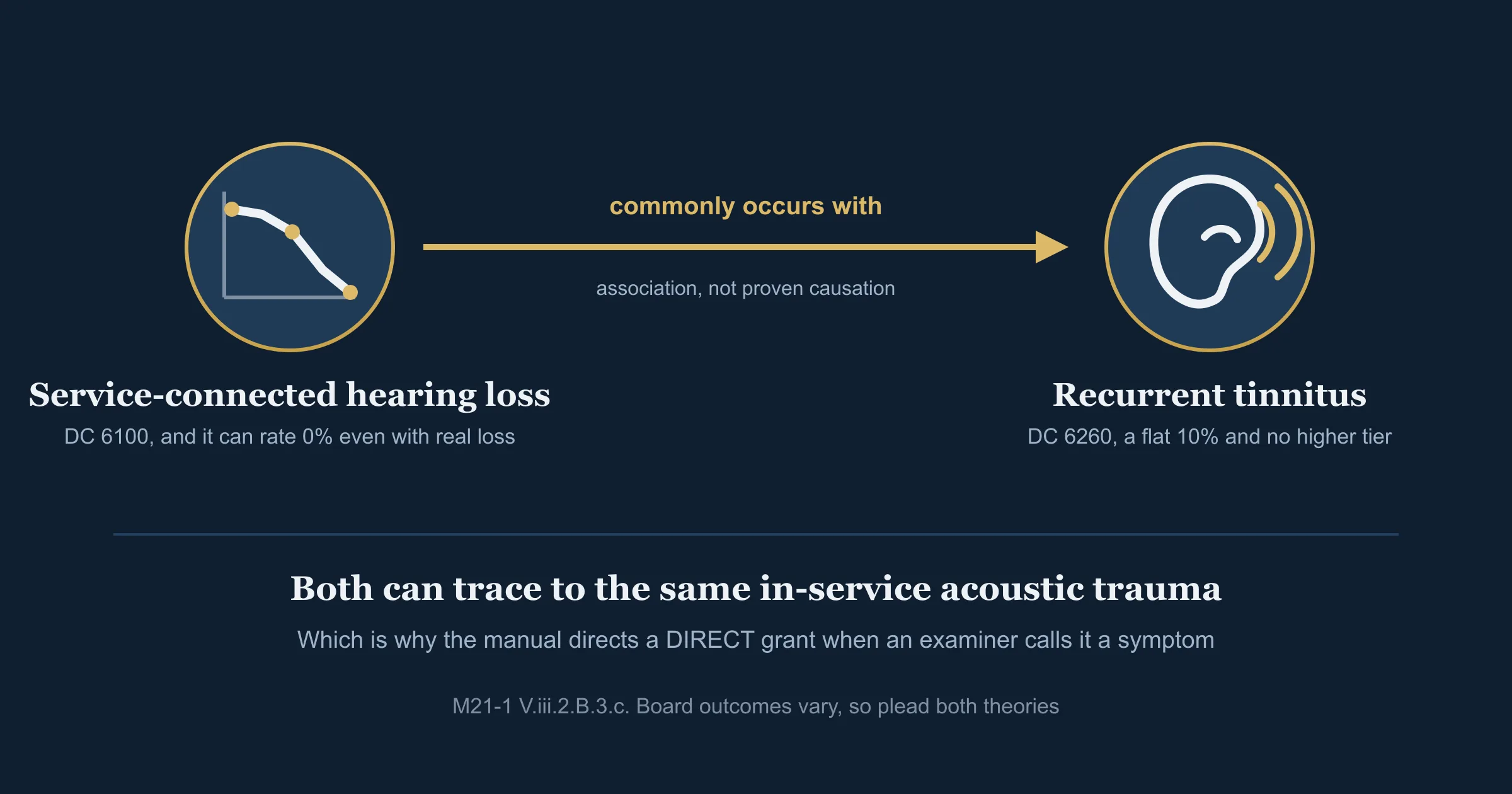
The theory you plead is not the obvious one
Almost everyone arrives at this claim the same way. The hearing loss is already service connected, the ringing plainly travels with it, and 38 CFR 3.310(a) says a disability which is proximately due to or the result of a service-connected disease or injury shall be service connected. So the natural filing is tinnitus secondary to hearing loss.
VA's adjudication manual sends the rater somewhere else. M21-1, Part V, Subpart iii, 2.B.3.c gives raters a table for reading examiner opinions about tinnitus. Where the examiner states tinnitus is a symptom of hearing loss, the instruction is to evaluate tinnitus separately under 38 CFR 4.87, DC 6260 if the hearing loss is determined to be service connected, and to establish service connection for tinnitus on a direct, not secondary, basis.
The reasoning is spelled out in the note attached to that row. If the hearing loss is service connected, and the tinnitus is a symptom of the hearing loss, VA concedes that the hearing loss and tinnitus result from the same etiology, and service connection is therefore warranted for tinnitus on a direct basis in these cases.
Read that carefully, because it is better news than it sounds. The manual is not refusing the claim. It is saying the connection is so well accepted that it will not make you prove a causal chain at all. The in-service noise that damaged your hearing is taken to have produced the ringing too, and the tinnitus is granted in its own right.
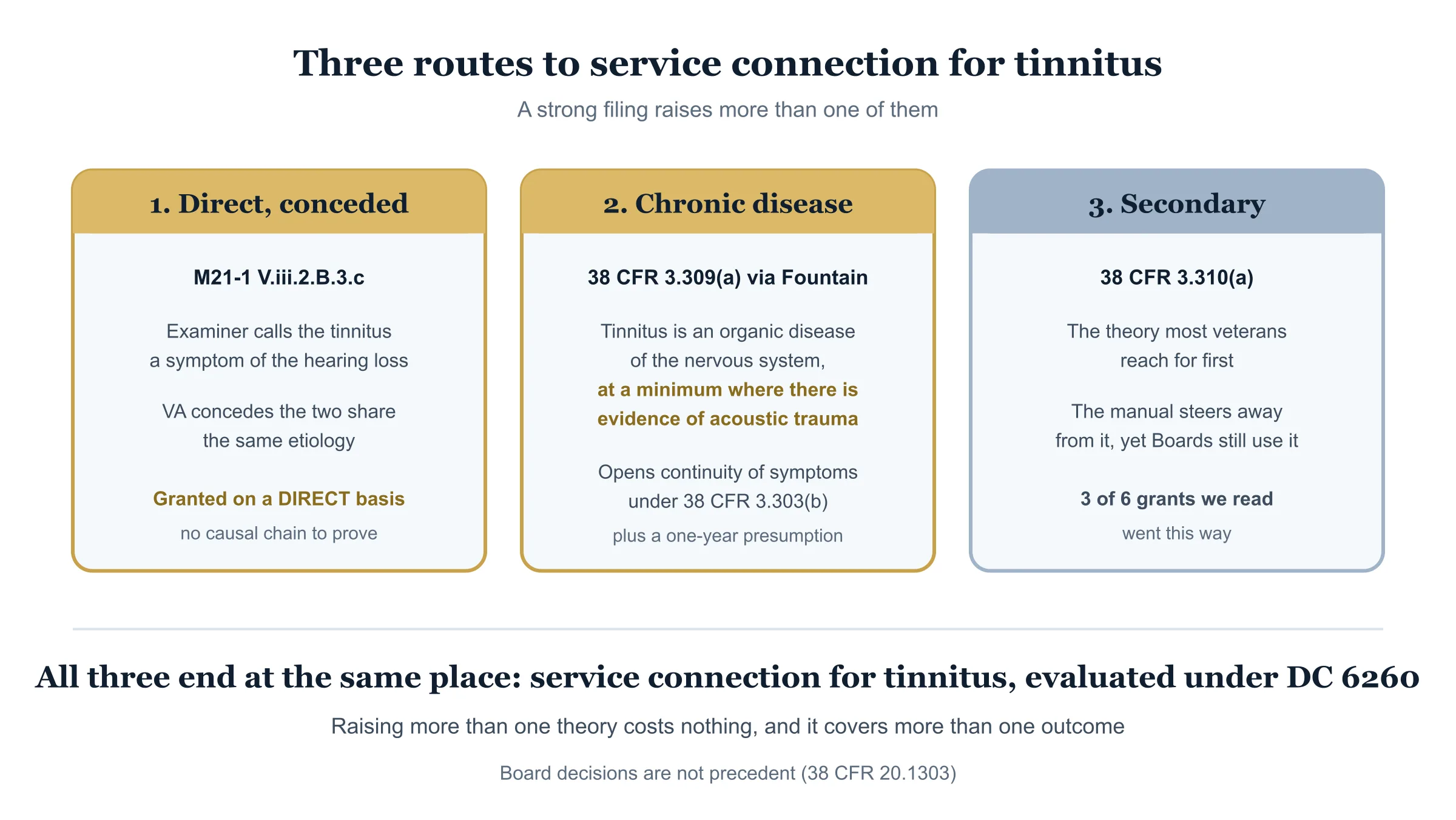
What this changes about the letter
An opinion that only argues the 3.310 chain, hearing loss causing tinnitus, gives the rater one theory and it is the theory the manual steers away from. An opinion that establishes common etiology from the in-service noise exposure supports the route the manual actually prescribes, and it also supports the secondary theory as a fallback. Ask for both.
But Board practice is not uniform, and pretending otherwise would be wrong
We read six Board grants of service connection for tinnitus. Five of them had a hearing loss claim decided in the same decision. Three of those granted the tinnitus expressly under 38 CFR 3.310 as secondary to service-connected hearing loss, and two turned on the very same examiner sentence about tinnitus being a symptom of the hearing loss. One granted it purely on a direct basis under 38 CFR 3.303. One granted it on a direct and a secondary theory at once, with the secondary link running to a different service-connected condition rather than to the hearing loss. The sixth had no hearing loss claim in it at all and was granted on the chronic-disease continuity route described below. So the manual states one thing and adjudicators do not follow it uniformly. Plead both theories. Raising both is free, and it keeps the outcome from turning on which label you happened to pick.
There is a second direct route, and it has a name
Beyond the manual's common-etiology concession, tinnitus has an independent path to service connection that most pages on this topic never mention. It runs through the chronic-disease provisions, and the case that opened it is Fountain v. McDonald, 27 Vet.App. 258 (2015).
Start with what the regulation does and does not say, because this is where competing pages get sloppy. 38 CFR 3.309(a) is the list of chronic diseases. The word tinnitus does not appear in it. Neither does the word hearing. What the list contains is a category, other organic diseases of the nervous system, and the question in Fountain was whether tinnitus belongs inside it. VA argued it did not, and conceded in briefing that its own regulation was ambiguous on the point.
The Court disagreed with VA. It adopted the interpretation urged by the veteran, that section 3.309(a) includes tinnitus, at a minimum where there is evidence of acoustic trauma, as an organic disease of the nervous system. That qualifier about acoustic trauma is part of the holding and travels with it. For a veteran whose hearing loss was granted on military noise exposure, the qualifier is satisfied on the face of the file.
VA's manual now says the same thing in its own voice. M21-1, Part V, Subpart iii, 12.A.1.d lists the conditions inside that category, and both tinnitus and sensorineural hearing loss are on it. The separate topic on auditory conditions puts it plainly: sensorineural hearing loss and tinnitus are considered organic diseases of the nervous system and are subject to presumptive service connection under 38 CFR 3.309(a).
What being a chronic disease actually buys you
A continuity route that other conditions do not get
Under Walker v. Shinseki, 708 F.3d 1331 (Fed. Cir. 2013), the continuity-of-symptomatology provision in 38 CFR 3.303(b) is available only for the chronic diseases listed in 3.309(a). That is why the question in Fountain mattered so much. It means you may be able to establish the claim by showing the ringing began in service and has continued since, without a medical opinion bridging the gap.
A one-year presumption, with real conditions attached
38 CFR 3.307 supplies the presumption itself, and its conditions are specific. The veteran must have served 90 days or more during a war period or after December 31, 1946, and the disease must have become manifest to a degree of 10 percent or more within one year from the date of separation from service. Since 10 percent is the only compensable level for tinnitus, recurrent ringing inside that first year is what the criterion is asking about.
What it is not
This is not the kind of presumptive most veterans have in mind. It is nothing like Agent Orange or the PACT Act, where exposure to a named hazard is what triggers it. It is a chronic-disease presumption with a service-length requirement and a one-year window, and outside that window the ordinary rules apply.
One caution on how Fountain is cited. Its disposition was to vacate the Board's decision and remand the tinnitus claim for readjudication. It did not grant anyone benefits. Pages that describe it as a win for the veteran are describing something that did not happen in that opinion.
Does tinnitus actually add anything to a hearing loss rating
This is the question veterans actually want answered, and across ten competitor pages we measured on this topic, not one of them works it. Two of them get it actively wrong, and in two different ways. One publishes 20 percent and 30 percent tinnitus tiers that do not exist. The other attaches monthly rate figures at 30, 50 and 70 percent to a claim whose tinnitus component is capped at 10. Here is what the schedule says.
Tinnitus is rated under 38 CFR 4.87, Diagnostic Code 6260. Its rating row is a single line, tinnitus, recurrent, 10, with three Notes printed under it. There is one evaluation and it is 10 percent. There is no higher tier, and no lower one is printed in the code, which is what 38 CFR 4.31 is for: where a diagnostic code provides no zero percent evaluation, a zero percent evaluation is assigned when the requirements for the compensable evaluation are not met. Under this code that requirement is that the tinnitus be recurrent.
Note (2) to that code closes the door people most often try: assign only a single evaluation for recurrent tinnitus, whether the sound is perceived in one ear, both ears, or in the head. Bilateral ringing is still one 10 percent evaluation, not two.
Note (3) decides which tinnitus the code covers at all. It says not to evaluate objective tinnitus, meaning tinnitus in which the sound is audible to other people and has a definable cause that may or may not be pathologic, under this diagnostic code, and to evaluate it as part of any underlying condition causing it instead. So DC 6260 is the code for the ringing only you can hear. Objective tinnitus is not shut out of compensation; it is routed to whatever condition is producing the sound.
The combination rule, and the exception nobody quotes
Note (1) to DC 6260 is the provision that governs whether tinnitus rides alongside a hearing loss rating, and it is worth reading with its ending intact: a separate evaluation for tinnitus may be combined with an evaluation under diagnostic codes 6100, 6200, 6204, or other diagnostic code, except when tinnitus supports an evaluation under one of those diagnostic codes.
The first half is the good news and it is why hearing loss and tinnitus normally sit side by side on a rating decision. The exception is the part that gets dropped, including in several places on this site until this page was written. If your tinnitus is the very finding that produced an evaluation under another code, it cannot also be paid separately. The clearest example is Meniere's syndrome: DC 6205 tells raters to evaluate it either under its own criteria or by separately rating vertigo, hearing impairment and tinnitus, whichever gives the higher overall result, but not to combine an evaluation for tinnitus with an evaluation under DC 6205.
Now the arithmetic, with the numbers a veteran actually sees
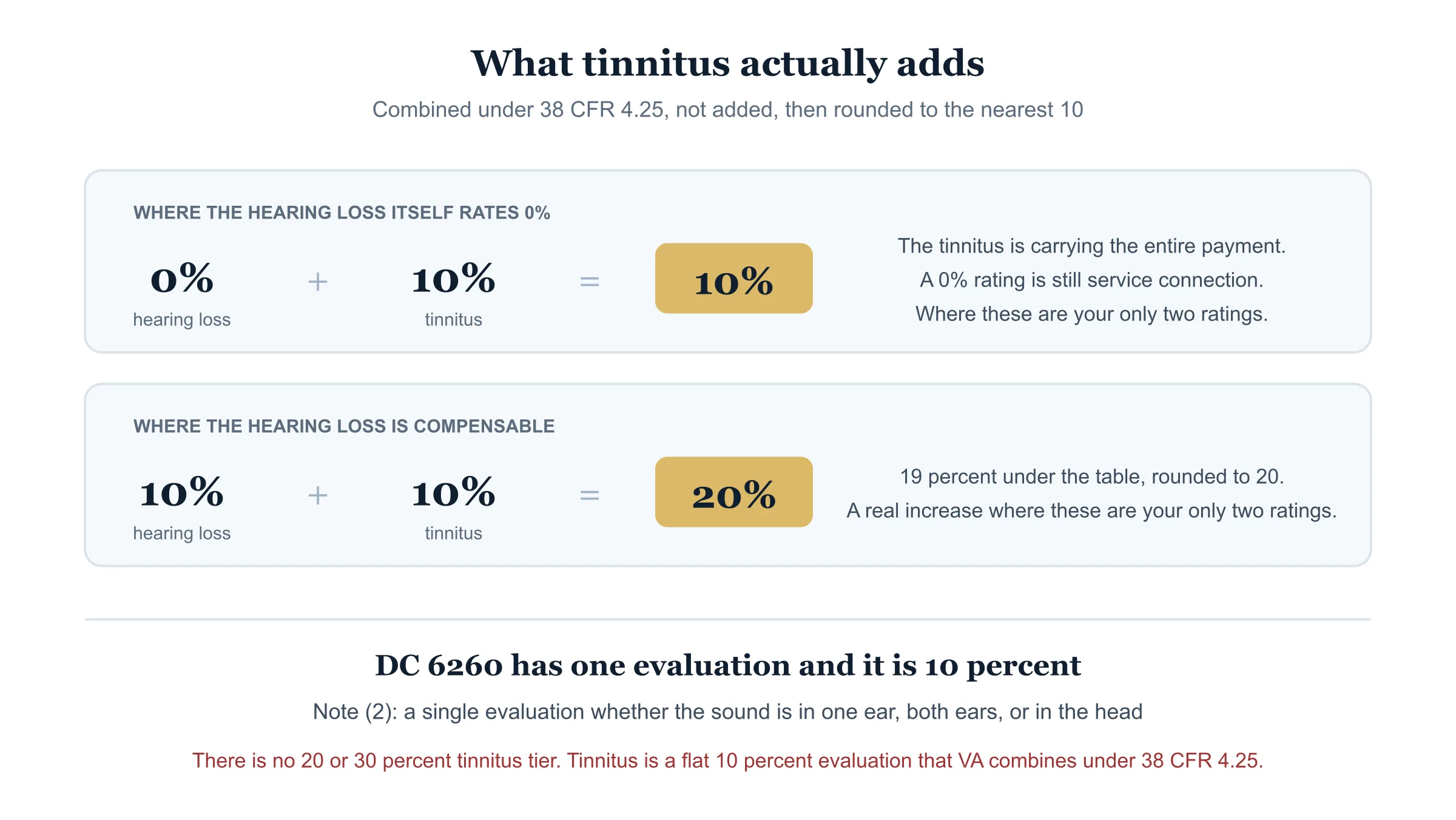
Combined ratings are not added. Under 38 CFR 4.25 each additional disability applies to the efficiency remaining after the previous one. The rounding matters as much as the combining: 38 CFR 4.25(b) says the conversion to the nearest degree divisible by 10 is done only once per rating decision, after every disability has been combined, and is the last step. The two examples below assume hearing loss and tinnitus are your only service-connected disabilities. If you already carry other ratings, VA re-combines all of them and rounds once at the end, so the same 10 percent tinnitus evaluation can move your combined figure by 10, by less, or by nothing at all.
The situation people are least prepared for is the one where the hearing loss itself rates 0 percent. That can happen even with genuine, service-connected loss, because 38 CFR 3.385 lets hearing become a disability for VA purposes at a level the rating formula does not pay for. A 0 percent hearing loss combined with a 10 percent tinnitus evaluation is 10 percent. In that situation the tinnitus is carrying the entire payment.
Where the hearing loss is compensable at 10 percent, adding tinnitus at 10 percent gives 19 percent under the combined ratings table, which rounds to 20 percent. On those facts that is a real increase and it is worth having. Where you already have other service-connected disabilities the arithmetic runs differently, as above, and near the top of the scale a 10 percent evaluation can leave the paid percentage where it was. It is still worth claiming: the unrounded value carries into every future rating decision, and service connection for tinnitus is what makes the conditions it goes on to cause claimable as secondaries. It is not the 20 or 30 percent tinnitus tier that one competing page invents, because no such tier exists, and it is not the 30, 50 and 70 percent monthly rates another attaches to a claim whose tinnitus component is capped at 10.
A 0 percent rating is still service connection. It protects you if the hearing worsens later, and it is a valid service-connected primary for this claim, which is the point most veterans in that position have never been told.
The threshold that decides whether you have a claim at all
A secondary claim needs a service-connected primary. For hearing, whether you have one turns on a specific regulation that not one of the ten competitor pages we measured cites, including a 4,378-word page that explains the testing seven times over.
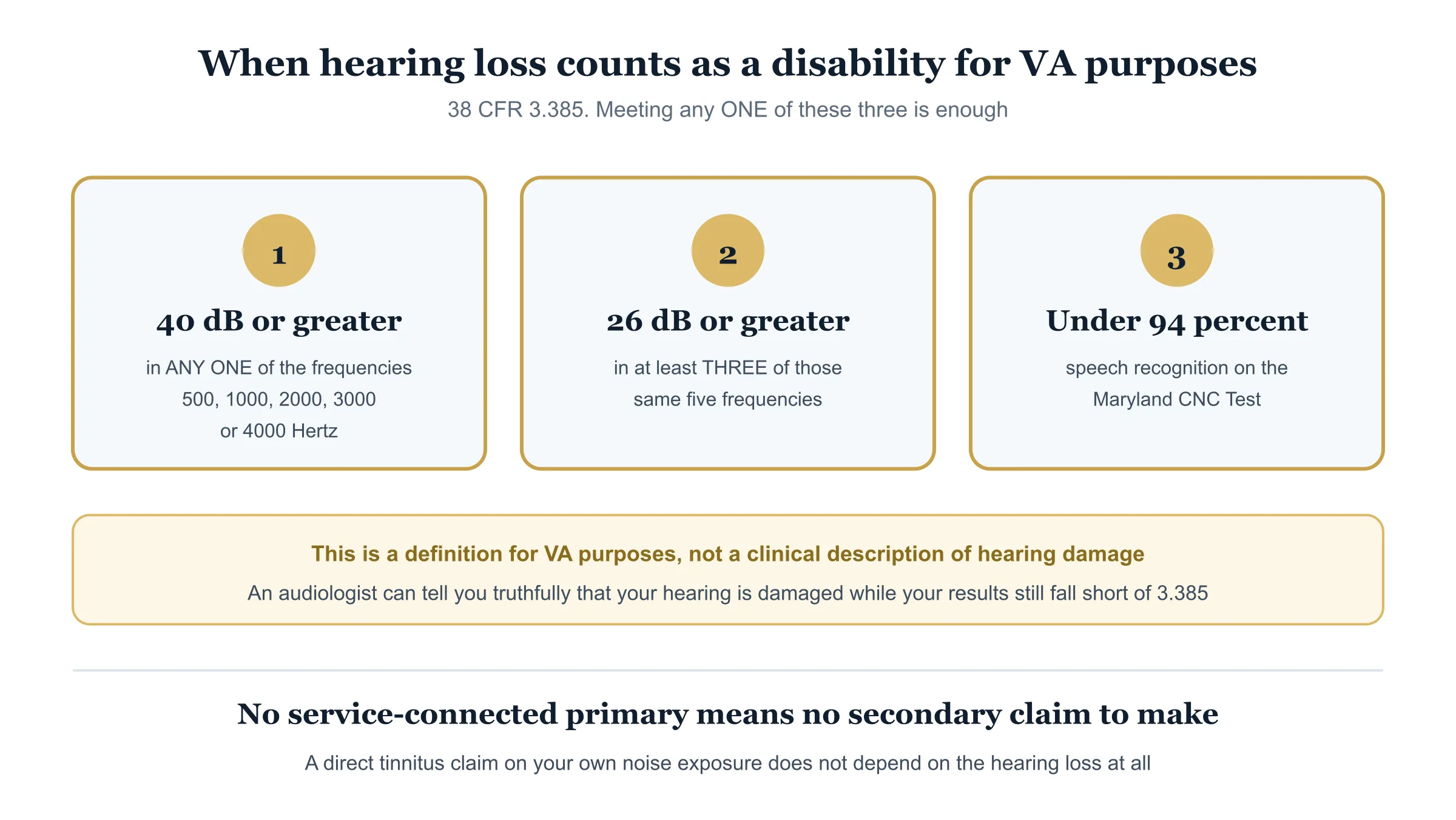
38 CFR 3.385 sets the threshold. For the purposes of applying the laws administered by VA, impaired hearing is considered a disability when the auditory threshold in any of the frequencies 500, 1000, 2000, 3000 or 4000 Hertz is 40 decibels or greater, or when the auditory thresholds for at least three of those frequencies are 26 decibels or greater, or when speech recognition scores using the Maryland CNC Test are less than 94 percent.
Those three routes are alternatives, so meeting any one of them is enough. Note the opening clause, because it does real work: this is a definition for VA purposes, not a clinical description of what counts as hearing loss. An audiologist can tell you truthfully that your hearing is damaged while your results still fall short of 3.385.
If your hearing loss has not been service connected, the honest position is that there is no secondary claim here yet. That is not a letter problem and no opinion can fix it. What may still be open is a direct tinnitus claim on your own noise exposure, which does not depend on the hearing loss at all, and the routes above are how it runs.
A normal hearing test at separation does not end the argument
One objection recurs across this cluster: that the separation audiogram was normal. Hensley v. Brown, 5 Vet.App. 155 (1993), is the answer to it, and VA's own manual cites Hensley for the proposition that decreased hearing thresholds on audiometry in service are evidence of an in-service event, injury or disease. In one 2025 Board decision we read, three separate VA opinions were found inadequate for resting on the normal in-service audiograms while ignoring what the veteran said about his own symptoms. Zero of the ten competitor pages we measured mention Hensley at all.
Filing order changes your effective date, and the two directions are not symmetric
This is a small, sourced, and genuinely useful piece of sequencing that we could not find published anywhere else. It comes from two adjacent topics in the same manual section, which say deliberately different things.
A hearing loss claim can pull tinnitus in with it
M21-1 V.iii.2.B.2.a instructs raters that where a claim is phrased as service connection or an increased evaluation for hearing loss, and other lay or medical evidence raises the issue of tinnitus and establishes entitlement, the tinnitus is to be considered within the scope of the hearing loss claim. And then the part that is worth money: where service connection is established for tinnitus, use the date of the hearing-related claim for effective date purposes. The manual's reasoning is that a claimant without medical training might describe extraneous sounds in the ears as hearing loss, so the wording is genuinely ambiguous.
A tinnitus claim generally does not pull hearing loss in
M21-1 V.iii.2.B.3.a says the opposite for the reverse direction. A claim phrased as being for tinnitus generally should not be interpreted as raising a claim for service connection or an increased evaluation for hearing loss, because tinnitus has a specific definition and a claim asserting that condition is generally unambiguous. The manual does add that raters should solicit a hearing loss claim where the evidence shows one, but if you have to be solicited, the effective date runs from the date you file after solicitation, not from your tinnitus claim.
The practical consequence is that describing your hearing problems broadly, in your own words, is not sloppiness. If both conditions are in play and only one is on the form, the hearing-loss framing is the one that carries the other along.
You may not need us, and here is how to tell
We sell nexus letters. This section costs us business and it stays because it is true, and because the alternative is taking money from someone whose claim was already winnable without us.
VA's manual states outright when an opinion is unnecessary. M21-1 V.iii.2.B.3.b says a medical opinion is not required to establish direct service connection for claimed tinnitus if the service treatment records document the original complaints or diagnosis of tinnitus, there is current medical evidence of a diagnosis or the veteran competently and credibly reports current tinnitus, and the veteran claims continuity of tinnitus since service or there are records or other competent and credible evidence of continuity. The manual prints one exception directly beneath that test: an opinion may still be necessary on those same facts if the evidence suggests a superseding post-service cause of your current tinnitus.
If all three of those describe your file, an opinion from us is very unlikely to change the outcome. On those facts the manual says an opinion is not required.
The case law bears that out. In one Board decision we read in full, a Coast Guard air crewman won service connection for tinnitus over a VA examiner who had opined against him, with no private medical opinion anywhere in the record. The Board wrote that because tinnitus is a chronic disease under 38 CFR 3.309(a), an award of service connection was appropriate even in the absence of a favorable nexus opinion.
When a private opinion does earn its keep
The picture changes when the record is contested or thin. In a 2025 Board decision, three separate VA opinions were rejected as inadequate for ignoring what the veteran had reported about his own symptoms, and the claim was granted on a private otolaryngologist's opinion. He had done his own audiometric testing and tied the loss to the veteran's jet engine mechanic duty and unprotected noise exposure. The Board then set that opinion alongside the in-service complaints the VA examiners had passed over, and granted on the two together. That is the shape of a case where an independent opinion is the difference: a negative or inadequate VA examination, a gap in the records, an onset you cannot date from the file alone, or an aggravation theory that needs a baseline established.
One thing worth saying about that same decision, because it cuts against the easy sales pitch. The private opinion won the hearing loss half of that appeal. The tinnitus half was granted on the VA examiner's own language. Even in the cases where a letter matters, it does not always matter to the part you assume.
What the medical evidence actually shows, and what it does not
This section is hedged on purpose. The association between hearing loss and tinnitus is strong and consistently reported across populations. The causal claim that competing pages make from it is not established, and an opinion that overstates it can be picked apart by an adjudicator who reads the underlying papers.
The association is strong and it has been measured in veterans
In the Million Veteran Program, a cohort of 267,395 US veterans with audiometric records, 86 percent had hearing loss and 47 percent reported tinnitus. In a population-based aging cohort, people with audiometric hearing impairment were about twice as likely to have tinnitus as those without, with an odds ratio of 2.27 and a 95 percent confidence interval of 1.92 to 2.69.
Both figures describe populations, not individuals, and the veteran cohort is drawn from people receiving VA audiometric care, so it is not the rate among all veterans.
The studies behind those two figures are cross-sectional, which limits what can be claimed
None of the verified sources on this relationship is longitudinal or experimental in humans. They measure both conditions at one point in time. That design cannot establish which came first, and it cannot rule out the explanation that fits military service best of all: that the same acoustic trauma independently damaged the hearing and produced the ringing.
That shared-cause explanation is not a weakness in your claim. It is precisely the common etiology the manual says VA should concede.
The mechanism is a live hypothesis, not settled science
The leading accounts are that cochlear damage reduces the signal reaching the brain and central auditory structures compensate by turning up their own gain, described in the literature as central gain enhancement, maladaptive plasticity, or thalamocortical dysrhythmia. The 2026 Nature Reviews Disease Primers on tinnitus presents all three at once as candidate accounts rather than choosing between them, and the authors of the central gain review call it hypothesized to be a potential mechanism.
Much of the supporting work is in animal models, which cannot report a subjective sound. Treat any page that states one mechanism as established with suspicion.
Plenty of people have tinnitus with a normal audiogram
This is the counter-fact, and a page that hides it is setting its readers up. Tinnitus occurs in people whose hearing tests come back clinically normal. Physiological work has found reduced auditory-nerve output in such people despite normal thresholds, which is where the term hidden hearing loss comes from, and the same Million Veteran Program analysis notes tinnitus in individuals with preserved audiometric thresholds. In the aging cohort above, tinnitus prevalence did not rise with age even though hearing impairment plainly did.
What that work shows is that a normal audiogram does not rule out peripheral damage. It does not show that any particular person's normal audiogram is concealing it, and no honest opinion will claim otherwise about you.
The language an opinion should use
The defensible formulation is that the veteran's hearing loss and tinnitus are at least as likely as not attributable to the same in-service acoustic trauma, with the tinnitus commonly occurring alongside cochlear injury of the kind documented on his audiogram. That is supportable. Hearing loss caused the tinnitus, stated flatly as fact, is not supportable from this literature, and it is also the weaker argument, because it invites a rater to ask which condition came first instead of accepting that one event produced both.
If the ringing came first, aggravation is the theory that fits
Not every veteran's chronology runs hearing loss first. Where tinnitus predates the service-connected hearing loss or has another cause, the theory that fits the facts is aggravation rather than causation, and it lives in 38 CFR 3.310(b).
The regulation on its face still recites a deduction for the natural progress of the disease, and this is a place where the regulation and the manual have come apart. M21-1 V.ii.2.D.1.a records that following Spicer v. McDonough, 61 F.4th 1360 (Fed. Cir. 2023), VA will no longer consider natural progress, and that permanent worsening is not required. Cite each source for what it says rather than quoting the older clause as if it were current practice.
What has not changed is the evidentiary burden, and it is the part veterans are least prepared for. An aggravation theory needs a baseline, and there is more than one way to establish one. 38 CFR 3.310(b) accepts medical evidence created before the onset of aggravation, or the earliest medical evidence created at any time between that onset and the evidence establishing the current level of severity. M21-1 V.ii.2.D.1.c goes further than the regulation and allows any other credible evidence, including lay evidence, though it cautions that lay evidence on its own may not be sufficient. That last route matters more on tinnitus than on most conditions, because tinnitus severity has no objective test. The rating reflects only the increase. If no baseline can be established at all, the theory has nothing to measure.
There is a hard limit worth naming here. Tinnitus is a single 10 percent evaluation with no higher tier, so an aggravation theory on tinnitus itself has very little room to move the number. Where aggravation is genuinely worth pleading is on the conditions the ringing goes on to affect, and our pages on depression, anxiety and migraines secondary to tinnitus cover those.
What the Board has actually done with these claims
We fetched and read six Board grants in full, including the ORDER block, rather than working from summaries. The four set out below show the range of outcomes honestly, including the ones that cut against this page's framing. The other two are listed in the citations at the foot of this page so the count above is checkable.
One point applies to all of them. Every decision below granted SERVICE CONNECTION. None of them assigned a percentage. Entitlement and payment are different things, and a page that blurs them is telling you something it does not know.
Citation Nr A22022713 (2022)
- What was granted
- Service connection granted for both tinnitus and bilateral sensorineural hearing loss. The tinnitus was granted on a direct basis under 38 CFR 3.303 alone, resting on the veteran's lay statements, which the Board found competent and credible. It then ran the relationship backwards to reach the hearing loss, reasoning that where a condition began in service, continued since, and has been medically attributed as secondary to an underlying primary condition, service connection is warranted for that primary condition as well.
- What it shows
- The examiner's characterization of tinnitus as a symptom of the hearing loss was used to establish the primary, not the secondary. Note also that the tinnitus grant rested on no medical opinion of any kind. Two brief private treating-provider opinions carried the hearing loss half, and the Board remarked that they offered no detailed rationales.
Citation Nr 1613022 (2016)
- What was granted
- Service connection for tinnitus granted over a VA examiner's negative opinion. The Board applied Fountain and Walker as operative law, noting that organic diseases of the nervous system including tinnitus are chronic diseases under 38 CFR 3.309(a), and concluded that even in the absence of a favorable nexus opinion an award of service connection was appropriate.
- What it shows
- The cleanest illustration of the chronic-disease route, and the clearest case on this page for not buying anything. There was no private opinion in the record at all, and no hearing loss claim either. This veteran won tinnitus on continuity of symptoms alone.
Citation Nr A25032474 (2025)
- What was granted
- Service connection granted for bilateral hearing loss and for tinnitus, the tinnitus expressly as secondary to the service-connected hearing loss on a causation basis. Three VA opinions were found inadequate for noting only the in-service audiograms without considering the veteran's own reports of diminished hearing, and the hearing loss was granted on a private otolaryngologist's positive nexus opinion.
- What it shows
- The most recent decision we read, and it cuts against the direct-basis framing: the veteran pleaded tinnitus as direct and the Board granted it as secondary. It is also the strongest case here for an independent opinion, though the private opinion won the hearing loss claim rather than the tinnitus one.
Citation Nr A23002765 (2023)
- What was granted
- Service connection granted for bilateral hearing loss and for tinnitus. The May 2022 VA examination stated the veteran has a diagnosis of clinical hearing loss and that the tinnitus is at least as likely as not a symptom associated with the hearing loss, and the Board found on that basis that the criteria for service connection on a secondary basis were met.
- What it shows
- The sharpest example of the tension on this page. That examiner sentence is precisely the one M21-1 V.iii.2.B.3.c addresses, and the manual's answer is a direct grant. The Board granted under 3.310 instead. Both routes reached the same result for this veteran, which is the practical reason to plead both.
Board decisions are not precedent. Under 38 CFR 20.1303 a Board decision is binding only with respect to the specific case decided, and the Board states in its own decisions that they are not precedential and do not establish VA policies or interpretations of general applicability. None of these decisions predicts what will happen in your claim.
What the opinion needs to contain
Not one of the ten competitor pages we measured carries a sample or an annotated letter. Every one of them repeats the phrase at least as likely as not and stops there. Here is what actually has to be in the document, and why each part is there.
- A statement that the records were reviewed, and which onesName the service treatment records, the DD-214 and military occupational specialty, the audiograms including entrance and separation where they exist, and the rating decision that granted the hearing loss. An opinion that does not show what it read is the first thing an adjudicator discounts, and inadequate-rationale findings sank three VA opinions in one of the decisions above.
- The common-etiology finding, stated as the primary conclusionThis is the part that supports the route the manual actually prescribes. The opinion should conclude that the hearing loss and the tinnitus are at least as likely as not attributable to the same in-service acoustic trauma, and explain the noise exposure that produced both.
- The secondary theory, as an express alternativeBecause Board practice varies, the opinion should also address whether the tinnitus is at least as likely as not caused or aggravated by the service-connected hearing loss under 38 CFR 3.310. Raising it costs nothing and three of the six grants we read went that way.
- A rationale, not a conclusion wearing a rationale's clothesThe reasoning has to connect the specific audiometric pattern in your file to the specific symptom you report. A high-frequency notch consistent with noise exposure, the ear or ears involved, and the character and onset of the ringing. In one decision above the Board credited private opinions while noting they offered no detailed rationales, which is a warning, not a model.
- An answer to the normal-separation-audiogram objectionIf your exit hearing test was normal, the opinion should say why that does not defeat the claim, citing Hensley v. Brown. It is a recurring objection and it is answerable. Watch where it runs: in one decision we read, the examiner denied the hearing loss nexus almost solely because no hearing loss showed at separation, then denied the tinnitus too, on the ground that the tinnitus was a symptom of that hearing loss.
- Baseline evidence if aggravation is being pleadedWhere the ringing predates the hearing loss, the opinion needs to establish a baseline severity and a current severity. The baseline can come from evidence created before the worsening began or from the earliest evidence available after it. Without a baseline there is nothing for the rating to measure.
- Credentials and independenceThe writer's qualifications to speak to auditory etiology, and a statement that the opinion is independent. A conclusion is worth what the person signing it is qualified to say.
What to leave out
No promise about a percentage. No claim that the letter itself establishes the diagnosis, which it cannot. And no statement that hearing loss caused the tinnitus as established fact, because the literature does not support it and a rater who checks will find that out.
Is this claim ready to file
The first three of these are absolute requirements rather than points, and none of them is something a nexus letter can supply. The rest is the evidence that decides how strong the claim is.
0 of 8 in hand, but a requirement is not met yet
There is no secondary claim to make yet, because a secondary claim under 38 CFR 3.310 attaches to a disability the VA has already service-connected. Whether your hearing qualifies at all turns on 38 CFR 3.385, which is a question your audiogram answers and no letter can change. Worth knowing before you go further: tinnitus also has a direct route that does not depend on the hearing loss at all, and this page covers it above.
Nothing to buy at this stage. When that piece is in place, our page on tinnitus and VA disability covers the rating and the other routes to a claim.
Start with a free consultation
We will read your rating decision, your service records and your audiograms, and tell you which of the three routes fits your file before anyone writes anything. If the answer is that your records already satisfy what the manual asks for and you do not need an opinion from us, that is what we will say.
Frequently Asked Questions
Should I file tinnitus as secondary to my hearing loss, or as a direct claim?
Raise both. VA's adjudication manual at M21-1 V.iii.2.B.3.c tells the rater that when an examiner calls tinnitus a symptom of your service-connected hearing loss, VA concedes both came from the same cause and grants tinnitus on a direct rather than a secondary basis. But of six Board grants we read in full, three went the other way and granted under 38 CFR 3.310 anyway. Pleading both costs you nothing and covers both outcomes.
My hearing loss is rated 0 percent. Can I still claim tinnitus?
Yes. A 0 percent rating is still service connection, so the primary disability exists and the claim is live. This matters more than most veterans realize, because 38 CFR 3.385 lets hearing become a disability for VA purposes at a level the rating formula does not pay for: the formula leans heavily on word recognition, so real damage can score too well to be compensated. Where hearing loss and tinnitus are your only service-connected disabilities, a 10 percent tinnitus evaluation combined with a 0 percent hearing loss rating comes to 10 percent, and the tinnitus is carrying the whole payment.
How much does tinnitus add to my combined rating?
Tinnitus is a flat 10 percent under Diagnostic Code 6260 and there is no higher tier. What that adds depends on what you already have, because combined ratings are not added but combined under 38 CFR 4.25 and then rounded to the nearest 10. With hearing loss at 0 percent, the result is 10 percent. With hearing loss at 10 percent, 10 and 10 combine to 19 and round to 20 percent. Both of those assume hearing loss and tinnitus are your only service-connected disabilities. If you already have others, 38 CFR 4.25(b) has VA combine everything and round once at the end, so a 10 percent tinnitus evaluation may raise your combined figure by 10, by less, or leave it unchanged. Any page showing 20 or 30 percent tinnitus tiers is describing something that does not exist in the schedule.
I have ringing in both ears. Is that two ratings?
No. Note (2) to DC 6260 says to assign only a single evaluation for recurrent tinnitus, whether the sound is perceived in one ear, both ears, or in the head. One 10 percent evaluation covers it either way. This is settled and it is not worth appealing.
Is tinnitus a presumptive condition?
In one specific and limited way, yes, and it is not the way most veterans mean. Tinnitus is treated as an organic disease of the nervous system, which makes it a chronic disease under 38 CFR 3.309(a). The regulation itself never names tinnitus; it names the category, and tinnitus was placed inside it by the Court in Fountain v. McDonald, 27 Vet.App. 258 (2015), at a minimum where there is evidence of acoustic trauma, and by VA's own manual at M21-1 V.iii.12.A.1.d. That gives you two things: the continuity-of-symptomatology route under 38 CFR 3.303(b), and a one-year presumption under 38 CFR 3.307 if the ringing reached a compensable level within a year of separation and you served 90 days or more during a war period or after December 31, 1946. It is nothing like the Agent Orange or PACT Act presumptives, where exposure to a named hazard is the trigger.
Do I even need a nexus letter for this?
Quite possibly not, and we would rather say so than take your money. M21-1 V.iii.2.B.3.b states that a medical opinion is not required to establish direct service connection for tinnitus where your service treatment records document the original complaint or diagnosis, there is current evidence of tinnitus or you competently and credibly report it, and you claim continuity of symptoms since service. If your file looks like that, on those facts the manual says an opinion is not required. The manual prints one exception right beneath that test: an opinion may still be needed on those same facts if the evidence suggests a superseding post-service cause of your current tinnitus, so a long civilian noise history is the thing to check first. One Board decision we read granted tinnitus with no medical nexus opinion anywhere in the record. Where a letter does earn its keep is a negative or inadequate VA examination, a thin or missing record, an onset you cannot date, or an aggravation theory that needs a baseline.
My separation hearing test was normal. Does that sink the claim?
It does not, and it is a recurring objection rather than a fatal one. Hensley v. Brown, 5 Vet.App. 155 (1993), is the authority, and VA's own manual cites it for the point that decreased hearing thresholds on in-service audiometry are evidence of an in-service event or injury. In a 2025 Board decision we read, three separate VA opinions were found inadequate for resting on the normal in-service audiograms while ignoring what the veteran reported about his own symptoms. If your file has this problem, the opinion should address it head on rather than working around it.
Does hearing loss actually cause tinnitus?
The association is strong and repeatedly replicated, and the causal claim is not established. In a cohort of 267,395 US veterans with audiometric records, 86 percent had hearing loss and 47 percent reported tinnitus, and in a population-based aging cohort people with hearing impairment were about twice as likely to have tinnitus, at an odds ratio of 2.27. But every one of those studies measures both conditions at one point in time, so none of them shows which came first or rules out the explanation that fits military service best: the same acoustic trauma produced both. Plenty of people also have tinnitus with clinically normal hearing tests. For a claim, the shared-cause framing is both more honest and more useful, because it is exactly the common etiology the manual says VA should concede.
Should I file for hearing loss and tinnitus at the same time?
If both are in play, yes, and the order matters in a way almost nobody publishes. M21-1 V.iii.2.B.2.a says a claim phrased as hearing loss can bring tinnitus within its scope where the evidence raises it, and that where service connection for tinnitus is then established, the effective date runs from the hearing-related claim. The reverse is not true: V.iii.2.B.3.a says a claim phrased as tinnitus generally should not be read as raising a hearing loss claim, because tinnitus has a specific meaning. So describing your hearing problems broadly in your own words is not sloppiness, it is the framing that carries the other condition along.
Can my tinnitus rating ever go above 10 percent?
Not under DC 6260, which provides one evaluation at 10 percent and nothing above it. Two other routes exist and both are demanding. Extraschedular consideration under 38 CFR 3.321(b)(1) is decided by the Director of Compensation Service rather than the rating board, and only where the schedular evaluation is inadequate to rate a single service-connected disability that is so exceptional or unusual, through related factors such as marked interference with employment or frequent periods of hospitalization, that applying the regular standards is impractical. Where the ringing produces the effects the schedule already accounts for, that threshold is not reached. A total disability rating based on individual unemployability is the other, and it turns on your overall inability to maintain substantially gainful employment rather than on tinnitus alone. The ordinary way this claim grows is through the conditions the ringing goes on to affect, which is what our pages on depression, anxiety and migraines secondary to tinnitus cover.
What does a nexus letter from Patriot Path cost?
One flat fee of $1,500, and the first consultation is free. On this particular claim that free consultation matters more than usual, because VA's own manual sets out conditions under which no opinion is required at all. If your file meets them, we will tell you.
Related guides
- Tinnitus and VA disabilityThe flagship: how VA rates tinnitus, why it caps at 10 percent, and the secondary claims that flow out of it.
- Hearing loss and VA disabilityHow the Maryland CNC and puretone results become a percentage, and why real loss can still rate 0 percent.
- Nexus letter for depression secondary to hearing lossAnother claim a service-connected hearing loss can anchor: a mental health condition under 38 CFR 3.310, rated on its own psychiatric symptoms.
- Why you need a nexus letter for a secondary conditionThe umbrella page on how secondary claims work under 38 CFR 3.310.
- What is a nexus letterStart here if you have not commissioned one of these before.
Citations & References
- 38 CFR 4.87, Schedule of ratings, Ear (eCFR) https://www.ecfr.gov/current/title-38/section-4.87
- 38 CFR 4.85, Evaluation of hearing impairment (eCFR) https://www.ecfr.gov/current/title-38/section-4.85
- 38 CFR 4.86, Exceptional patterns of hearing impairment (eCFR) https://www.ecfr.gov/current/title-38/section-4.86
- 38 CFR 3.385, Disability due to impaired hearing (eCFR) https://www.ecfr.gov/current/title-38/section-3.385
- 38 CFR 3.303, Principles relating to service connection (eCFR) https://www.ecfr.gov/current/title-38/section-3.303
- 38 CFR 3.307, Presumptive service connection for chronic, tropical, or prisoner-of-war related disease (eCFR) https://www.ecfr.gov/current/title-38/section-3.307
- 38 CFR 3.309, Disease subject to presumptive service connection (eCFR) https://www.ecfr.gov/current/title-38/section-3.309
- 38 CFR 3.310, Disabilities that are proximately due to, or aggravated by, service-connected disease or injury (eCFR) https://www.ecfr.gov/current/title-38/section-3.310
- 38 CFR 4.14, Avoidance of pyramiding (eCFR) https://www.ecfr.gov/current/title-38/section-4.14
- 38 CFR 4.25, Combined ratings table (eCFR) https://www.ecfr.gov/current/title-38/section-4.25
- 38 CFR 4.31, Zero percent evaluations (eCFR) https://www.ecfr.gov/current/title-38/section-4.31
- 38 CFR 3.321, General rating considerations, including extraschedular (eCFR) https://www.ecfr.gov/current/title-38/section-3.321
- 38 CFR 3.102, Reasonable doubt (eCFR) https://www.ecfr.gov/current/title-38/section-3.102
- 38 CFR 20.1303, Board decisions are non-precedential (eCFR) https://www.ecfr.gov/current/title-38/section-20.1303
- 38 USC 1110, Basic entitlement for wartime disability compensation https://uscode.house.gov/view.xhtml?req=granuleid:USC-prelim-title38-section1110&num=0&edition=prelim
- 38 USC 5107, Claimant responsibility; benefit of the doubt https://uscode.house.gov/view.xhtml?req=granuleid:USC-prelim-title38-section5107&num=0&edition=prelim
- M21-1, Part V, Subpart iii, Chapter 2, Section B, Conditions of the Auditory System https://www.knowva.ebenefits.va.gov/system/templates/selfservice/va_ssnew/help/customer/locale/en-US/portal/554400000001018/content/554400000014464/M21-1-Part-V-Subpart-iii-Chapter-2-Section-B-Conditions-of-the-Auditory-System
- M21-1, Part V, Subpart iii, Chapter 12, Section A, Neurological Conditions and Convulsive Disorders https://www.knowva.ebenefits.va.gov/system/templates/selfservice/va_ssnew/help/customer/locale/en-US/portal/554400000001018/content/554400000180519/M21-1-Part-V-Subpart-iii-Chapter-12-Section-A-Neurological-Conditions-and-Convulsive-Disorders
- Fountain v. McDonald, 27 Vet.App. 258 (2015) https://www.uscourts.cavc.gov/documents/Fountain13-0540.pdf
- BVA Citation Nr A22022713 (2022) https://www.va.gov/vetapp22/Files11/A22022713.txt
- BVA Citation Nr 1613022 (2016) https://www.va.gov/vetapp16/Files2/1613022.txt
- BVA Citation Nr A25032474 (2025) https://www.va.gov/vetapp25/Files4/A25032474.txt
- BVA Citation Nr A23002765 (2023) https://www.va.gov/vetapp23/Files2/A23002765.txt
- BVA Citation Nr 1748440 (2017), read in full and counted in the six, not set out above https://www.va.gov/vetapp17/Files8/1748440.txt
- BVA Citation Nr 23006705 (2023), read in full and counted in the six, not set out above https://www.va.gov/vetapp23/Files2/23006705.txt
- A National Cohort Study of Tinnitus and Hearing Loss in the Million Veteran Program. Ear Hear. 2026 (PMID 42507681) https://pubmed.ncbi.nlm.nih.gov/42507681/
- Oosterloo BC et al. Prevalence of Tinnitus in an Aging Population and Its Relation to Age and Hearing Loss. Otolaryngol Head Neck Surg. 2021 (PMID 32988263) https://pubmed.ncbi.nlm.nih.gov/32988263/
- Tinnitus. Nat Rev Dis Primers. 2026 (PMID 42168216) https://pubmed.ncbi.nlm.nih.gov/42168216/
- Schaette R, McAlpine D. Tinnitus with a normal audiogram: physiological evidence for hidden hearing loss and computational model. J Neurosci. 2011 (PMID 21940438) https://pubmed.ncbi.nlm.nih.gov/21940438/
- Auerbach BD et al. Central gain control in tinnitus and hyperacusis. Front Neurol. 2014 (PMID 25386157) https://pubmed.ncbi.nlm.nih.gov/25386157/