
Secondary claim guide
Nexus Letter for Depression Secondary to Hearing Loss
Medically reviewed by the Patriot Path Medical Team
Licensed MD reviewers • Last updated:
Depression can be service connected as secondary to service-connected hearing loss, including hearing loss rated 0 percent, under 38 CFR 3.310. No presumption or manual shortcut applies, so the link rests on medical evidence. The rating is a separate step: the hearing loss is scored from an audiogram, and the depression from its own psychiatric symptoms.
Keeping those two questions apart is the whole skill of this claim. This page covers what VA needs to decide service connection, what the research can and cannot support, what fifteen Board decisions show, and why the psychiatric record should describe the depression itself rather than the hearing loss a second time.
An illustrative example
A former artillery crewman has carried a 0 percent rating for bilateral hearing loss since 2015. Over several years he stops going to his church group and to family dinners, and his primary care doctor eventually diagnoses a depressive disorder and starts medication. He assumes a 0 percent rating means VA does not consider his hearing a real disability, and when he finally drafts a statement, it is three paragraphs about not being able to follow conversations.
Two things in that plan need correcting before anyone writes a word. A 0 percent rating is still service connection, so the primary for a secondary claim exists. And his statement describes the hearing loss, which his audiogram already measures, while saying almost nothing about the depression, which is the condition actually being claimed. What his file lacks is a clinician's account of the depression and a reasoned opinion on how it relates to his hearing loss.
A composite written to illustrate the two questions on this page. It is not a client, not a case result, and not a prediction about any claim.
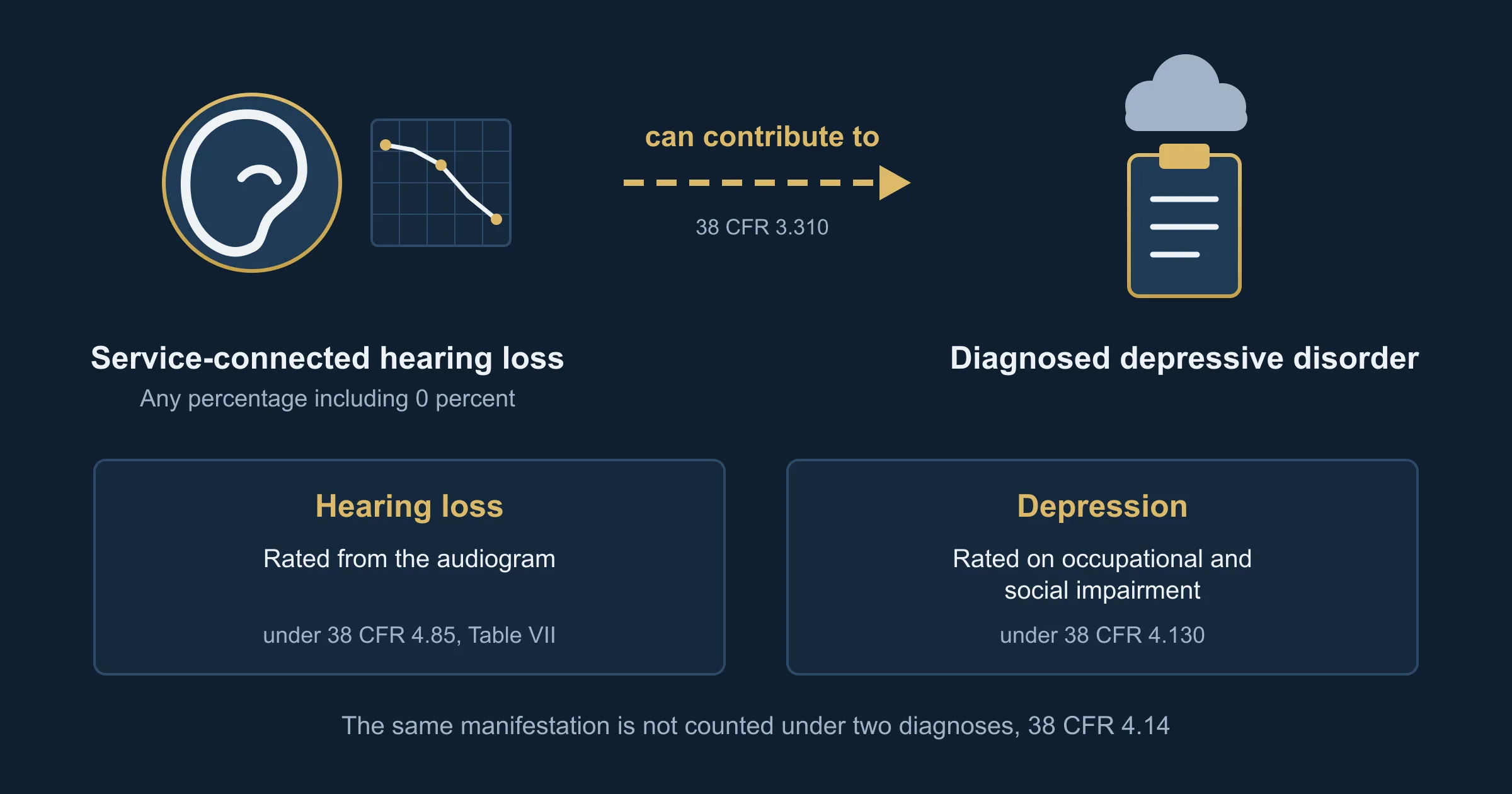
Two Questions a Veteran Must Not Confuse
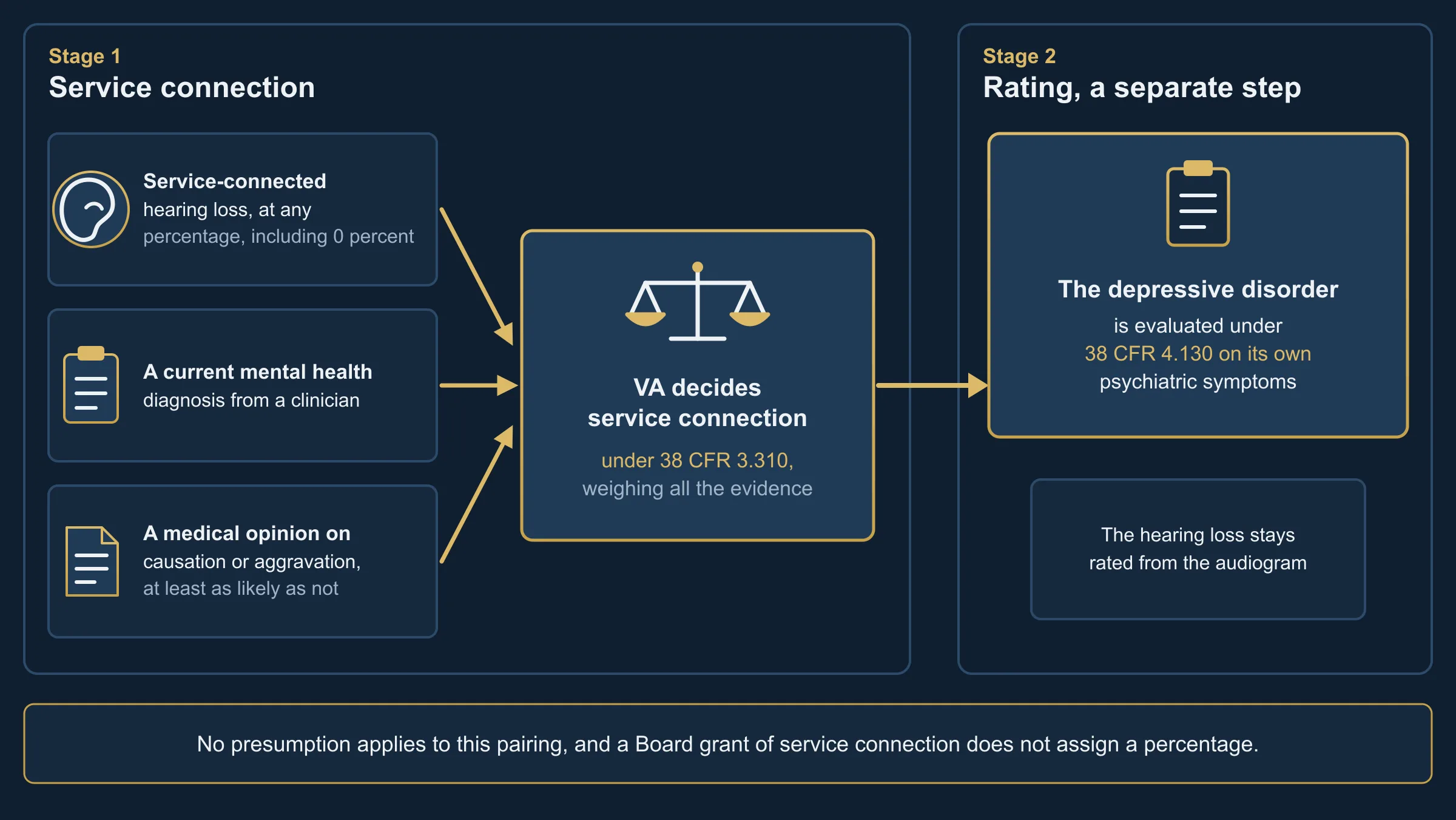
A claim for depression secondary to hearing loss asks VA two separate questions, in order. They use different evidence, they are answered by different people in the process, and the mistakes this page is written to prevent come from treating the answer to one as if it settled the other.
Question one: is the depression service connected?
38 CFR 3.310(a) and (b)
This is a medical-opinion question. Under 38 CFR 3.310(a), disability which is proximately due to or the result of a service-connected disease or injury shall be service connected, and 3.310(b) adds a route for a condition that service-connected disability has made worse. The evidence that decides it is the diagnosis, the timeline, and a reasoned opinion on how the two conditions relate in this veteran.
Question two: what is each condition rated?
38 CFR 4.85, Table VII and 38 CFR 4.130
This is a rating question, answered only after service connection is granted. The hearing loss is scored from audiometry, and the depressive disorder from occupational and social impairment. The two are measured with different instruments. 38 CFR 4.14 bars evaluating the same manifestation under two diagnoses, and our reading is that this means the symptoms counted toward the mental rating should be distinct from the manifestation the audiogram already scores. The rating section below works through that reading and its limits, including the fact that VA's hearing chapter never mentions 4.14 and that no Board decision we read applied it to this pairing.
There is no presumption to lean on for the first question. 38 CFR 3.310 codifies only two situations in which a condition is held to be the proximate result of a service-connected one: cardiovascular disease after qualifying amputations, and a list of conditions after a traumatic brain injury, including "Depression if manifest within 3 years of moderate or severe TBI, or within 12 months of mild TBI". Hearing loss appears in neither. For hearing loss, the link has to be shown.
The regulation adds a sentence that is easy to over-read: when service connection is thus established for a secondary condition, the secondary condition shall be considered a part of the original condition. 3.310 does not say what that means for the rating, so we do not turn it into a rating rule. The rating mechanics on this page come from Part 4 and from VA's adjudication manual, cited where used.
VA's Manual Has No Shortcut for This Pairing
VA raters work from the M21-1 Adjudication Procedures Manual as well as the regulations. For hearing, the governing article is Part V, Subpart iii, Chapter 2, Section B, Conditions of the Auditory System, which we read in full on September 13, 2026. Across its 43,754 characters of text, the strings depress, anxiet, mental, psychiatr, 3.310, 4.130, 4.14 and pyramid each appear zero times. The hearing chapter says nothing at all about a psychiatric condition that follows hearing loss.
The manual's mental disorders chapter is silent from the other side. Part V, Subpart iii, Chapter 13 contains no block on service connecting a mental disorder secondary to a physical condition, and the string 3.310 does not appear in it. So the secondary-claim rules that apply are the general ones in Part V, Subpart ii, Chapter 2, Section D, which the aggravation section below quotes.
That silence is a real difference from the claim one link away. The same auditory chapter has a block on interpreting medical opinions involving tinnitus. Where an examiner states that the tinnitus is a symptom of the hearing loss, and the hearing loss is determined to be service connected, it directs the rater to evaluate tinnitus separately under 38 CFR 4.87, DC 6260 and to establish service connection for tinnitus on a direct, not secondary, basis. Depression gets no equivalent instruction anywhere in the chapter. This is a genuine 38 CFR 3.310 claim, and the relationship between the two conditions has to be carried by evidence.
What gets VA to look, and what gets VA to grant
Those are two different bars, and the manual keeps them apart. Part IV, Subpart i, Chapter 1, Section B, Block 1.e says that medical expertise is ultimately required to establish entitlement to SC on a secondary basis, but the threshold for ordering an examination is low. The kinds of evidence it lists as giving a claim credibility for that purpose include the veteran's own lay statement describing the symptoms and how they relate to the primary disability, and a medical treatise establishing a known relationship between the two.
The same block sets a floor under that low threshold: a generalized statement merely asserting a conclusion that a condition is secondary to an SC disability is not sufficient to satisfy the Element 3 standard for requesting an examination. A research citation can help get an examination ordered, but the manual does not treat it as the nexus itself.
A private letter is not always required, and the Board record shows it
We sell nexus letters, and this is still true. In Citation Nr A21016395 (2021), the Board granted service connection for a depressive disorder secondary to service-connected bilateral hearing loss on the favorable opinion of a VA examiner, with no private opinion described in the decision. In Citation Nr A25083470 (2025), the Board granted service connection for persistent depressive disorder with no medical nexus opinion of any kind, relying on the veteran's lay statements and literature he submitted, after giving a VA medical opinion minimal probative value.
A25083470 needs one caution attached. Its theory was mixed: the finding of fact tied the disorder to active service to include the service-connected hearing loss and tinnitus, and its conclusion of law does not cite 38 CFR 3.310. It shows that the record, not the presence of a purchased letter, decides these claims. It is not a template for a pure secondary claim.
A 0 Percent Hearing Loss Rating Still Counts as the Primary
A secondary claim needs a service-connected primary, and here that is the hearing loss grant, at whatever percentage it carries. The text of 38 CFR 3.310(a) turns on a service-connected disease or injury and does not require that the primary be compensable.
Service-connected hearing loss can sit at 0 percent because two different tests are involved. 38 CFR 3.385 decides when impaired hearing counts as a disability for VA purposes, and Table VII of 38 CFR 4.85 decides what percentage that disability is assigned. Hearing can pass the first test and score 0 percent on the second. For this claim, the point is only that a 0 percent grant is still a grant.
The Board record includes that fact pattern. In Citation Nr 0929092 (2009), the veteran's hearing loss was rated 0 percent, and the Board granted service connection for a depressive disorder claimed as secondary to service-connected tinnitus and bilateral hearing loss. Treat it as an illustration and nothing more: it is a legacy decision, tinnitus was co-claimed, and the Board expressly applied the version of 38 CFR 3.310 in force before the 2006 amendment.
The depression does not have to start after the grant
Depression that began before VA granted the hearing loss can still be secondary to it. Part V, Subpart ii, Chapter 2, Section D, Block 1.b, citing Frost v. Shulkin, 29 Vet.App. 131 (2017), states: "To establish causation, the primary disability need not be SC, or even diagnosed, at the time the secondary disability is incurred." What matters for causation is the medical relationship, not the order of the paperwork.
Frost is about causation. It is not a rule about when payments start. Effective dates are governed by 38 CFR 3.400, whose general rule for an initial claim or supplemental claim is the date of receipt of the claim or the date entitlement arose, whichever is later. 3.400 has no paragraph written specifically for secondary service connection. VA's manual does. Part V, Subpart ii, Chapter 4, Section A, Block 3.g states that the effective date assigned for a secondary service-connected disability cannot be earlier than the effective date assigned for the causal or primary disability, and that where an unclaimed causal condition falls within the scope of a claim, the causal disability's effective date is guided by the date the secondary claim was received. Neither rule is a reason to delay filing, and this page does not try to apply either one to anyone's filing history.
If the depression began before the hearing loss itself, that is a different situation, and aggravation is the theory that fits. The aggravation section below covers it.
If you also have service-connected tinnitus
Seven of the ten Board grants we read named hearing loss and tinnitus together as the primary, and the only veteran research on depression we found concerns tinnitus rather than hearing loss (the evidence section below gives the figures). If both are service connected, the opinion should address which condition, or which combination, the depression relates to, based on the veteran's own history rather than on which claim looks easier. Our guide to depression secondary to tinnitus covers that primary.
Two Rating Instruments, and the Rule Against Counting the Same Thing Twice
Once service connection is granted, each condition is rated on its own schedule. The schedules measure different things, which is also where the one real drafting risk on this claim sits.
The hearing ledger: an audiogram and two tables
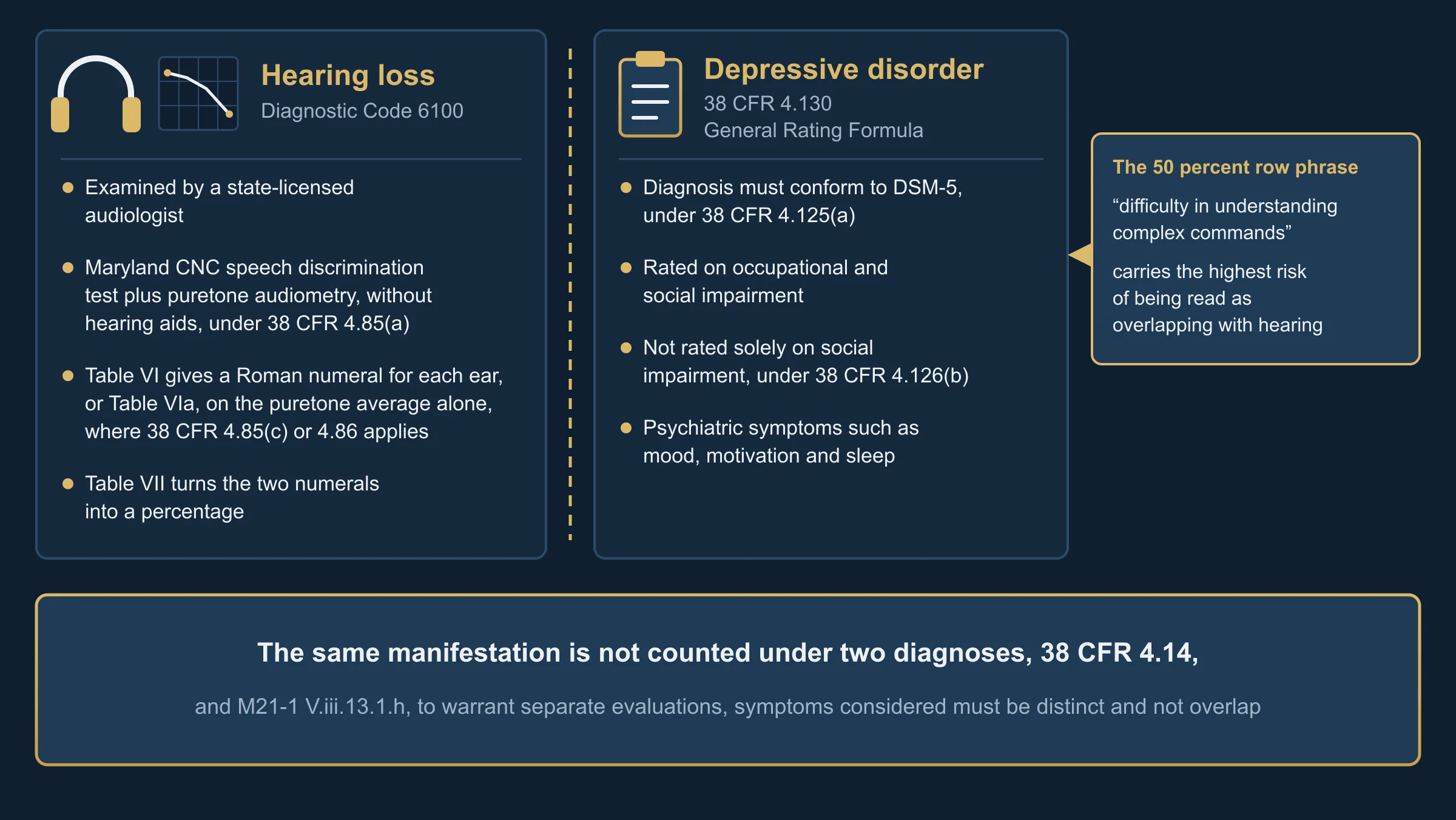
38 CFR 4.85(a) sets the examination: "An examination for hearing impairment for VA purposes must be conducted by a state-licensed audiologist and must include a controlled speech discrimination test (Maryland CNC) and a puretone audiometry test. Examinations will be conducted without the use of hearing aids."
Table VI then assigns each ear a Roman numeral from a combination of the percent of speech discrimination and the puretone threshold average, and Table VII combines the two ears' numerals into a percentage. The diagnostic code for hearing loss, 6100, has no written criteria of its own. It appears in the heading of Table VII, and it is not a row in the ear schedule at 38 CFR 4.87. Nothing in 4.85 or 4.87 rates mood, relationships, or occupational and social functioning; the strings depress, mental and social appear in neither section's text. A speech discrimination score is one of the two measurements the hearing rating is built from in most cases, but not all. Under 38 CFR 4.85(c), Table VIa, which uses the puretone threshold average alone, supplies the numeral where the examiner certifies that a speech discrimination test is not appropriate or cannot be obtained, and where that happens no speech discrimination score enters the hearing rating. Separately, 38 CFR 4.86 directs the rating specialist to take whichever of Table VI or Table VIa gives the higher numeral when the puretone threshold is 55 decibels or more at all four frequencies, or 30 decibels or less at 1000 Hertz with 70 decibels or more at 2000 Hertz; that rule does not remove the speech score, it adds Table VIa as an alternative and takes whichever helps the veteran more, so speech discrimination may or may not end up carrying the result. The audiologist still administers both tests either way, because 38 CFR 4.85(a) requires it. If your numeral came from Table VIa, speech discrimination is not in your hearing percentage, and the overlap caution below has less to bite on.
The mental ledger: occupational and social impairment
Depressive disorders are listed in 38 CFR 4.130, including major depressive disorder under Diagnostic Code 9434, persistent depressive disorder under 9433, unspecified depressive disorder under 9435, and chronic adjustment disorder under 9440. Each is rated under the General Rating Formula for Mental Disorders, whose organizing measure at every level is occupational and social impairment. Two parts of it matter for this claim.
First, 38 CFR 4.126(a) directs the rating agency to assign an evaluation based on all the evidence of record that bears on occupational and social impairment rather than solely on the examiner's assessment of the level of disability at the moment of the examination. Second, 38 CFR 4.126(b) says the rating agency will consider the extent of social impairment, but shall not assign an evaluation solely on the basis of social impairment. The words isolation and withdrawal appear zero times in 4.130. Isolation can be part of a medical explanation of how depression developed; it is not a rating criterion.
The rule against counting twice
38 CFR 4.14 opens: "The evaluation of the same disability under various diagnoses is to be avoided." It closes: "Both the use of manifestations not resulting from service-connected disease or injury in establishing the service-connected evaluation, and the evaluation of the same manifestation under different diagnoses are to be avoided." The test is sameness of the manifestation, not the fact that two diagnostic codes sit on one rating sheet.
VA's manual states the practical version in its mental disorders chapter, at Part V, Subpart iii, Chapter 13, Block 1.h: "Avoid assigning separate evaluations for SC disabilities based on the same manifestations as this constitutes pyramiding. To warrant separate evaluations, symptoms considered must be distinct and not overlap." Its worked example is a veteran service connected for PTSD, with anxiety considered in that evaluation, who is later granted fibromyalgia on a record where anxiety is also a manifestation. The result the manual gives: "Fibromyalgia will be SC and rated separately from PTSD. However, anxiety may only be considered in determining the rating to be assigned for PTSD or fibromyalgia."
Part V, Subpart ii, Chapter 3, Section D, Block 2.b of the manual records the court standard: "Separate evaluations are warranted where none of the symptomatology for any one condition duplicates or overlaps another", citing Esteban v. Brown, 6 Vet.App. 259 (1994).
Where the two vocabularies meet
None of the manual's examples involves hearing, so applying the rule to this pairing is our reading, not an instruction the manual gives. This matters wherever Table VI governs, which is the usual case, because that is where the hearing rating is built partly from how well a veteran understands speech, and the mental formula uses words that can sound like the same thing.
The phrase with the highest risk of being read as overlapping sits in the 50 percent row: "difficulty in understanding complex commands". A veteran with poor speech discrimination may miss spoken instructions for purely auditory reasons, and the speech discrimination score already measures exactly that, where the rating ran through Table VI. The only use of the word communication in the formula is in the 100 percent row, "gross impairment in thought processes or communication", which in context describes a disorder of thought. Where the formula says speech, as in "circumstantial, circumlocutory, or stereotyped speech", it means the veteran's own speech, not what he can hear. And the 30 percent row describes a person "with routine behavior, self-care, and conversation normal", where a hearing-impaired veteran's conversation can be affected for reasons unrelated to mood.
What the Board decisions do and do not show about this
Be clear about the limits. Across the fifteen Board decisions we read, the strings 4.14, pyramid and 4.130 appear in none, and none of them assigned a psychiatric percentage, because the Board decided service connection and left the rating to the agency. At least four of the grants rested partly on accounts of communication difficulty, with no pyramiding discussion at all. Nothing in that record shows that a claim framed around communication gets denied.
The practical point is narrower, and it is about accuracy rather than strategy. The rating stage is where 38 CFR 4.14 operates, so the psychiatric record and the medical opinion should describe the psychiatric condition itself: mood, withdrawal from people and activities, loss of interest, sleep, motivation, and how those affect work and relationships. Difficulty hearing belongs in the audiology record, where it is already measured. A mental health record that only re-describes the hearing loss leaves the rater with little that is distinct to rate.
One caution applies to anyone reading that paragraph. Describe what is actually happening, fully and honestly, to every clinician and at any VA examination. The goal is a complete record of the depression, not a choice of words.
Sleep follows the same logic. Part V, Subpart iii, Chapter 13, Block 1.k of the manual says that where insomnia is a symptom of another service-connected disability, a separate SC evaluation on a secondary basis is not warranted for insomnia, and the insomnia symptoms should be included in the evaluation assigned under the DC for the primary SC disability. Sleep problems that are part of a service-connected depression belong in the depression evaluation, not in a separate claim.
The full General Rating Formula, row by row, is on our depression condition page.
What the Research Shows, and What It Cannot Show
Research can support a clinician's reasoning. It cannot answer the question VA actually asks, which is about one veteran. Every finding below comes from the published abstract of the study cited, stated in the units the authors used.
The association is consistent across several meta-analyses
A 2024 meta-analysis in Frontiers in Neurology pooled 24 cohort studies and reported that hearing loss was associated with an increased risk of depression, at an odds ratio of 1.35 (95 percent confidence interval 1.27 to 1.44), and 1.39 (1.26 to 1.54) in studies with five or more years of follow-up. A 2020 meta-analysis in The Gerontologist, covering 35 studies and 147,148 older adults, reported an odds ratio of 1.47 (1.31 to 1.65) overall and 1.39 (1.16 to 1.67) in cohort studies alone, and classified certainty in the overall estimate as low. The 2024 authors call hearing loss an independent risk factor for depression; that is their reading of observational data, not a demonstrated causal effect.
The link runs in both directions
A meta-analysis of 20 studies and 675,291 people, published in Frontiers in Public Health (volume 11, 2023, online January 2024), examined sensorineural hearing loss and depression each way. People with sensorineural hearing loss had a higher risk of depression, at an odds ratio of 1.43 (1.32 to 1.55), and people with depression had a higher risk of sensorineural hearing loss, at 1.30 (1.11 to 1.48). That second figure is why a careful opinion looks at which condition came first in this veteran's records, rather than assuming the direction.
The strength of the finding depends on study design
A 2025 PLOS One meta-analysis of nine studies measured depressive symptom scores as a standardized mean difference. Older adults with age-related hearing loss scored higher overall (Hedges' g of 0.52), but the effect came from the cross-sectional studies (g of 0.68), and the cohort-study subgroup was not statistically different (g of 0.06). A German population study of 5,948 adults found higher odds of depressive symptoms with measured hearing loss (odds ratio 1.3, p equal to 0.025), and its authors wrote that longitudinal studies are required to clarify the causal relationships.
One long cohort fits the order a secondary claim relies on
A 24-year analysis of 11,099 participants in the US Health and Retirement Study, 3,024 of whom developed hearing loss, compared depressive symptoms before and after onset. Before onset, the yearly rise in symptoms did not differ between people who went on to develop hearing loss and people who did not. After onset, symptoms showed a significant acute increase (beta 0.234, 95 percent confidence interval 0.184 to 0.283, on an eight-item depression scale). That is the temporal pattern a secondary opinion describes: hearing loss first, then a change in mood. It is still observational, and the abstract does not say how hearing loss was identified.
Genetic studies do not support a causal effect
Two Mendelian randomization analyses, which use genetic variants to test causal direction, found no causal relationship. A 2024 bidirectional study found no causal association of major depressive disorder on sensorineural hearing loss (odds ratio 1.088, P equal to 0.246) and no reverse effect of sensorineural hearing loss on major depressive disorder. A 2025 study found low-frequency and speech-frequency age-related hearing loss associated with depression in US survey data (odds ratios 1.5, 95 percent confidence interval 1.1 to 2.1, and 1.4, 95 percent confidence interval 1.0 to 1.9, as the authors printed them), no association for high-frequency loss, and concluded that its Mendelian randomization analyses do not support a causal relationship. One limit is worth stating, and it is our reading rather than something either paper says. These methods test genetically predicted hearing loss, which stands for lifelong inherited liability rather than for hearing damaged by noise at one point in a service career, so a null result here weakens the case for a causal effect without settling the question for acquired loss. What both results do mean is that no one can say science has proven that hearing loss causes depression.
Loneliness and isolation are a plausible pathway, with limits
A 2020 systematic review of 14 studies, 12 of them cross-sectional, reported that "most multivariable-adjusted studies found that hearing loss was associated with higher risk of loneliness and social isolation" in older adults. In a secondary analysis of the ACHIEVE randomized trial (977 adults aged 70 to 84), the hearing intervention group retained one additional person in their social network over three years relative to a health education control; the authors wrote that clinical meaningfulness is unknown and that the loneliness changes were not clinically meaningful. It is a reasonable hypothesis for an opinion to discuss, not a proven mechanism.
The signal follows how people experience their hearing, not only the audiogram
In the ACHIEVE baseline data on 948 older adults with untreated hearing loss, a worse score on a self-reported hearing handicap questionnaire was associated with depression (1.24, 1.16 to 1.33), while for the audiometric average the abstract reports only an association with physical quality of life. A 2026 meta-analysis in Otolaryngology-Head and Neck Surgery, which pooled 14 studies of suicidality in people with hearing loss and assessed depression alongside it, reported in a subgroup analysis that the risk of depression was elevated only in people with subjective hearing loss, while the raised risk of suicidal ideation held for people with either subjective or audiometrically measured loss. That supports grounding an opinion in the veteran's documented experience rather than a threshold number. It does not change the rating rule: the mental evaluation still rests on psychiatric symptoms.
Whether treating hearing loss helps depression is unresolved
The evidence conflicts. A 2025 umbrella review found insufficient evidence of hearing aid benefit on depression, and a twelve-week double-blind pilot trial in 25 older adults who had both major depressive disorder and moderate to profound hearing loss found no significant effect on depression of active versus sham hearing aids (Hamilton scale, p equal to 0.46). A Portuguese trial reported improved depressive symptoms at four weeks, and a Korean nationwide cohort found a 1.3-fold higher depression risk in adults with severe hearing loss and no rehabilitation than in those with cochlear implants (95 percent confidence interval 1.051 to 1.615), an observational result. The 2026 Cochrane update on hearing aids reported no depression result in its abstract.
No veteran-specific rate was found
We found no study reporting the rate of depression among veterans with hearing loss. In the Million Veteran Program, 86 percent of 267,395 veterans in VA care with audiometric records had hearing loss, which is a prevalence figure, not a depression figure. In a VA study of 769,934 recent veterans, 21 percent of those diagnosed with tinnitus also had depression and another 17 percent had both depression and anxiety; those are tinnitus figures. Two older papers whose titles promise veteran data have no abstract in PubMed, so they are not used here.
What this means for the opinion
The research shows an association that runs both ways, genetic studies that do not support a settled causal effect, and no veteran-specific rate. That is not a weakness to hide. It is the reason the opinion has to be about this veteran.
The question VA asks is individual: whether this veteran's depression is at least as likely as not caused, or made worse, by his service-connected hearing loss. Population research informs that judgment; it does not make it. An opinion that says the literature proves the link overstates it. One that walks through the veteran's own timeline, treatment record, other possible causes, and the published association with its limits stated is the kind that holds up.
If the Depression Came First: The Aggravation Route
Where depression predates the hearing loss, the theory that fits is aggravation: that the service-connected hearing loss made an existing condition worse.
What the regulation says
38 CFR 3.310(b) provides: "Any increase in severity of a nonservice-connected disease or injury that is proximately due to or the result of a service-connected disease or injury, and not due to the natural progress of the nonservice-connected disease, will be service connected." VA will not concede aggravation unless the baseline level of severity is established by medical evidence created before the onset of aggravation, or by the earliest medical evidence created between that onset and the medical evidence establishing the current level. The text then has the rating activity deduct both the baseline and any increase due to natural progress from the current level.
What VA's manual now applies, after Spicer
The manual has moved since, and the two should be cited separately. Part V, Subpart ii, Chapter 2, Section D was updated on May 1, 2026 to incorporate Spicer v. McDonough, 61 F.4th 1360 (Fed. Cir. 2023). It records that VA "will apply the broader but-for standard and will no longer consider natural progress of the NSC disability when deciding a claim based on aggravation of an NSC disability by an SC disability." It also states that permanent worsening of an NSC disability by an SC disability is not required to establish SC on the basis of aggravation under 38 CFR 3.310(b).
Under the manual there is one deduction, not two. Block 1.g directs the rater to deduct the baseline level of severity of the NSC disability from the current level to calculate the appropriate evaluation to assign. And Block 1.h covers the case where the worsening is real but the baseline and current levels fall at the same rating level: VA is to grant service connection and assign a noncompensable evaluation.
The baseline is the part that decides these claims
Block 1.c of the manual allows the baseline to rest on medical evidence created before the onset of aggravation, and on any other credible evidence, including lay evidence, that supports establishment of the baseline, with a note that lay evidence on its own may not be sufficient. The regulation's text is narrower and names only the two medical-evidence windows above.
Block 1.f is the hard edge. It states that if no baseline can be established, no aggravation can be demonstrated, and that such a claim must be denied, though only after VA's duty to assist has been fulfilled. It then adds: "Do not assume a baseline of 0 percent when a baseline cannot be established by the available evidence." That sentence cuts against a veteran who hopes VA will treat an undocumented earlier period as symptom-free. The practical answer is to find the earlier mental health records, if they exist, before the claim is filed.
Why the opinion must answer aggravation even when causation is the theory
Two of the Board decisions set out below pull in opposite directions on this. In A26001432 a VA examination was found inadequate for skipping the aggravation question, and the veteran won on private evidence. In A24085323 the Board acknowledged the rule that an opinion saying a condition is not caused by a service-connected disability does not address aggravation, but held that no separate aggravation opinion was needed where nothing in the record suggested the hearing loss had contributed. The difference was the record. An opinion that answers causation and aggravation separately, in terms, leaves nothing for that argument to turn on.
What a Strong Nexus Letter for This Claim Includes
The Board weighs a medical opinion by whether it explains itself. In most of the decisions we read, the private opinions that carried a claim showed what they reviewed and gave reasons. The exception is A26001432, where the Board granted on a private examination whose reasoning the decision never describes, against a VA opinion it had found inadequate. The one private letter that failed used a hedge where a conclusion belonged. These are the elements, in the order a reader of the letter needs them.
- The records reviewed, namedAudiology records, the hearing loss rating decision, mental health and primary care records, and any prior VA examination. In Citation Nr 1330948 (2013) the Board found a private psychiatrist's opinion "persuasive and probative as the examiner reviewed the Veteran's pertinent treatment records and provided a clear explanation for his opinion".
- A DSM-5 diagnosis38 CFR 4.125(a) provides: "If the diagnosis of a mental disorder does not conform to DSM-5 or is not supported by the findings on the examination report, the rating agency shall return the report to the examiner to substantiate the diagnosis." The opinion should name the diagnosis and the findings that support it. A letter cannot create a diagnosis the records do not contain.
- The timelineWhen the hearing loss was first documented, when the psychiatric symptoms or treatment began, and how each changed. The order of those dates decides whether the opinion is about causation, aggravation, or both, and it answers the two-way association in the research directly.
- The individual explanation, in psychiatric termsHow this veteran's depression developed in relation to his hearing loss, described as psychiatric history: withdrawal from people and activities, loss of interest, changes in mood, sleep and motivation, and their effect on work and family life. The private psychologist's opinion that carried A25043990, set out in the Board section below, was built on exactly that kind of behavioral account. The rating section above explains why the psychiatric account should stand on its own.
- Other possible causes, addressed by nameThree of the four denials we read had another cause in the record: in A24085323 the examiner recorded that the veteran attributed almost all of it to sadness that wars are continuing, in A24061977 the examiner attributed it to a nonservice-connected back condition, and in Citation Nr A25005152 (2025) the treatment records tied it to nonservice-connected multiple myeloma and financial strain. An opinion that ignores the other candidates reads as advocacy. One that weighs them and explains why the hearing loss is at least as likely as not a cause or an aggravating factor is the one that holds up.
- Aggravation, answered separatelyWhether or not the depression came first, a sentence that addresses aggravation in terms, for the reason set out in the aggravation section.
- A rationale that uses the literature honestlyThe association, the two-way finding and the null genetic studies, stated accurately and then applied to this veteran. A citation list is not a rationale.
- The standard, stated as a conclusionAt least as likely as not, not a hedge; the one private letter that lost in the decisions we read, in 1509967 below, said may be. That phrase does not appear in 38 USC 5107(b), whose rule is that when there is an approximate balance of positive and negative evidence regarding any issue material to the determination of a matter, the Secretary shall give the benefit of the doubt to the claimant. 38 CFR 3.102 adds that reasonable doubt is not a means of reconciling actual conflict or a contradiction in the evidence. The balance is weighed across all the evidence, not triggered by one document.
- A medical opinion, not a legal conclusionVA's manual tells its own staff: "Do not request that a medical authority make conclusions of law, as this is a responsibility inherent to the rating activity." A private opinion that leaves service connection and the percentage to VA respects the same line.
What we cannot do
We cannot supply a diagnosis your records do not contain, and we will not write an opinion your records do not support. We cannot guarantee an outcome or predict a percentage. We write physician medical opinions; we do not represent veterans or file claims.
Who can write this kind of opinion, and which providers VA takes seriously, is covered in our guide to who can write a nexus letter.
What the Board of Veterans' Appeals Has Decided
We read fifteen distinct Board decisions on a psychiatric disorder claimed as secondary to service-connected hearing loss. Fourteen are merits decisions and we read each ORDER block; the fifteenth is a remand that decided nothing. The nine below show the range, denials included. The search was not exhaustive, so nothing here is a grant rate or a trend.
Board decisions are not precedent. Under 38 CFR 20.1303, previously issued Board decisions will be considered binding only with regard to the specific case decided, and each recent decision states that it is not precedential and does not establish VA policies or interpretations of general applicability.
Citation Nr A26001432 (2026)
Granted: service connection for depressive disorder. Hearing loss was the only primary.
The favorable evidence was a private physician examination, which noted that the depressive disorder results from the service-connected bilateral hearing loss, and a disability benefits questionnaire to the same effect. The Board wrote that the July 2025 VA examiner "failed to address if the Veteran's bilateral hearing loss aggravated his mental health condition", found that examination inadequate, and granted without remanding for a new one. The decision describes no rationale in the private opinion.
Why it matters. An incomplete VA opinion can lose to private evidence. It is not a model letter, because the decision describes none.
Citation Nr A25043990 (2025)
Granted: service connection for depressive disorder to include as secondary to bilateral hearing loss.
A private psychologist's January 2019 opinion recorded that the veteran withdrew from any activities that involved other people because of his hearing loss. A VA examination and addendum were negative. The Board called that opinion "the most probative evidence of record as to the etiology of the Veteran's depressive disorder", found "no adequate opinion to the contrary", and granted on a secondary basis. The veteran's own account of onset, in the VA addendum, involved hearing problems interfering with communication.
Why it matters. A hearing-loss-only grant on a private opinion that described a behavioral pathway. The decision does not explain why the VA opinions were not treated as adequate.
Citation Nr A21016395 (2021)
Granted: service connection for depressive disorder with major depressive-like episode, claimed as secondary to service-connected bilateral hearing loss.
A September 2020 VA examiner found the depression at least as likely as not proximately due to or the result of the service-connected condition. The decision describes no private opinion. The veteran had written that being unable to follow conversations around him made him feel lonely. The claim had first been denied when he was service connected for hearing loss in the right ear only; the Board had since granted the left ear.
Why it matters. A VA examiner's favorable opinion carried the claim. Read your own examination reports before paying for anything.
Citation Nr A25031880 (2025)
Granted: service connection for major depressive disorder with generalized anxiety disorder, as secondary to service-connected bilateral hearing loss and tinnitus.
A private board-certified psychiatrist interviewed the veteran, reviewed the records, cited medical treatises, and opined that the conditions were more likely than not a direct result of his tinnitus and hearing loss. The Board found the opinion well-reasoned and highly probative, corroborated by VA examination notes of anger and ridicule due to hearing loss and of avoidance of social connections. The negative VA opinions addressed only a direct theory.
Why it matters. A reasoned private opinion corroborated by VA's own examiners. Tinnitus was co-claimed.
Citation Nr 1139373 (2011)
Granted: service connection for depression secondary to service-connected hearing loss and tinnitus, on the basis of aggravation.
A VA examiner found the depression longstanding and driven by psychosocial factors, not directly caused by the hearing conditions, but as likely as not made worse by them. The examiner noted the hearing loss affected conversational understanding and contributed to frustration and lower self-worth.
Why it matters. Aggravation alone was enough on that record. It is a legacy decision, so use it for the shape of the theory, not for current standards.
Citation Nr A25083470 (2025)
Granted: service connection for an acquired psychiatric disorder, diagnosed as persistent depressive disorder, including as secondary to service-connected bilateral hearing loss and tinnitus.
No medical nexus opinion supported the claim. The veteran submitted lay statements and literature, and the Board gave a January 2023 VA medical opinion minimal probative value for failing to rule out a relationship to, or aggravation by, the in-service stressors and the service-connected hearing conditions.
Why it matters. A letter is not always required, though the theory was mixed, as explained above.
Citation Nr A24085323 (2024)
Denied: service connection for unspecified depressive disorder as secondary to service-connected bilateral hearing loss.
A VA examining psychologist found the depression less likely than not related, explaining that the veteran attributed almost all of it to sadness that wars are continuing around the world. The veteran submitted no statements and identified no supporting evidence. The Board wrote: "The case might have been different, for example, if there was some information or evidence indicating that the hearing loss may have been a factor contributing to the depression."
Why it matters. Nothing on the veteran's side, and an examiner who identified a different cause.
Citation Nr A24061977 (2024)
Denied: service connection for depression.
The veteran's hearing loss was rated 90 percent. A March 2022 VA examiner attributed the depression to his nonservice-connected back condition, and no favorable medical opinion was in the record. The Board gave more probative weight to the VA examination.
Why it matters. A high hearing loss rating is not evidence of a link. Without an opinion addressing the competing cause, the claim failed.
Citation Nr 1509967 (2015)
Denied: service connection for an acquired psychiatric disorder, to include as secondary to service-connected bilateral hearing loss and tinnitus.
The private letter said the veteran had several criteria for mild depression and that this 'may be' secondary to his chronic tinnitus. The Board found it of little probative value, writing that the letter 'lacks a concrete diagnosis of depression' and that the legal standard is 'at least as likely as not,' which it defined as a probability of 50 percent or greater, a statement the letter never made. VA examiners had found the veteran did not meet the criteria for a mood or other mental health disorder, and the dominant diagnosis was a neurocognitive disorder.
Why it matters. A hedge is not an opinion. This letter was measured against at least as likely as not and did not reach it, and it named no diagnosis. Note what was not the problem: the claim was pled as secondary to hearing loss and tinnitus together, so naming tinnitus was inside the claim. Name the primary your own records support, and say how likely the link is in the words VA uses.
Three cautions. Every grant above granted service connection only, and none assigned a psychiatric percentage. The legacy decisions cited on this page (2009 to 2015) predate Lynch v. McDonough and Spicer v. McDonough, so their framing is dated. And A25043990 was also published as A25043819; it is one decision, not two.
Is There a Claim Here to Evaluate?
Check your file
Tick what is true of your file today. The first two items are requirements that decide whether there is a claim secondary to hearing loss to bring. The rest are not a score; each is something a medical opinion draws on.
Tick the items that are true of your file today. The first two decide whether there is a claim secondary to hearing loss to bring.
Start With What Is Already in Your File
A free consultation begins with your hearing loss rating decision, your mental health records, and any VA examination already on file. A clinician will tell you whether an independent opinion would add anything, and if your record already carries a favorable VA opinion, that is what we will say.
Frequently Asked Questions
Can hearing loss cause depression for VA purposes?
VA can service connect depression as secondary to service-connected hearing loss under 38 CFR 3.310 when the evidence as a whole supports that the hearing loss caused or worsened it in the individual veteran. No presumption applies to this pairing. The research shows a two-way association rather than settled causation, so the claim rests on an individual medical judgment.
My hearing loss is rated 0 percent. Can it still be the primary condition?
Yes. A 0 percent rating is still service connection, and 38 CFR 3.310(a) turns on a service-connected disease or injury without requiring that it be compensable. Hearing can meet VA's definition of a hearing disability and still score 0 percent on the rating table.
Will VA call it pyramiding if I am rated for both hearing loss and depression?
Not because the two conditions coexist. Hearing loss is rated from an audiogram and depression on occupational and social impairment, which are different measurements. 38 CFR 4.14 bars counting the same manifestation under two diagnoses, so the symptoms counted toward the mental rating need to be distinct from the hearing difficulty the audiogram already scores. None of the fifteen Board decisions we read discussed this, and none of them reached the rating stage for the psychiatric disorder.
Do I need a private nexus letter, or can VA's own exam be enough?
VA's own examination can be enough. In one Board decision we read, service connection was granted on a VA examiner's favorable opinion, and in another it was granted with no medical nexus opinion at all, on a mixed theory. A private opinion earns its place when the VA opinion is negative or incomplete, another cause appears in the record, or the timeline needs explaining.
My depression started before my hearing got worse. Is there still a claim?
Possibly, through aggravation under 38 CFR 3.310(b). The claim needs a baseline: evidence of how severe the depression was before the hearing loss made it worse. VA's manual says a claim with no establishable baseline must be denied once VA has done its duty to assist, and that VA should not assume the baseline was 0 percent. Earlier mental health records are the thing to look for first.
I also have service-connected tinnitus. Which condition should the claim name?
The one your records and the medical opinion actually support, which may be one condition or both. Seven of the ten Board grants we read named hearing loss and tinnitus together. Our guide to depression secondary to tinnitus covers that primary.
Will wearing hearing aids, or not wearing them, hurt my claim?
No Board decision we read held that wearing hearing aids, or not wearing them, defeated a claim. In one, a VA examiner who could not give an opinion without a hearing aid trial had that statement given no probative value. It can still enter the weighing. In A24085323 the Board twice quoted the veteran's statement that he has hearing aids but does not wear them because he gets along without them, and used it, with the fact that he did not raise his hearing until the examiner asked, to find no indication that his depression may have been aggravated by his hearing loss. The point is not to wear or not wear them, it is to describe what your hearing does to your daily life when an examiner asks. The research on whether hearing aids reduce depression is mixed.
Do I have to name the exact psychiatric diagnosis on my claim?
No. VA's manual instructs raters not to limit consideration only to a particular mental disorder diagnosis or theory of service connection identified by the claimant. VA still needs a diagnosis in the evidence to grant.
What does a nexus letter from Patriot Path cost?
Patriot Path charges $1,500 flat for a nexus letter, and the first consultation is free. On this claim the consultation starts by reading what is already in your file, including any VA examination, because a favorable VA opinion may mean you do not need us.
Related guides
- Hearing loss and VA disabilityThe primary claim: how hearing loss is service connected and how the audiogram becomes a percentage.
- Depression and VA disabilityThe full mental disorders rating table and the direct route to service connection for depression.
- Tinnitus alongside service-connected hearing lossAnother claim that starts from the same service-connected hearing loss, where VA's manual does supply a shortcut.
- Nexus letter for depression secondary to tinnitusSame diagnosis, different primary. Read it if the ringing, rather than the hearing loss, is what your records tie to your mood.
- Nexus letter for depression secondary to TBISame diagnosis, a primary that carries a regulatory presumption under 38 CFR 3.310(d) that hearing loss does not.
- Nexus letter for depression secondary to chronic painSame diagnosis, a musculoskeletal primary, and the same separation of physical and mental ratings.
Citations & References
- 38 CFR 3.310, Disabilities that are proximately due to, or aggravated by, service-connected disease or injury (eCFR) https://www.ecfr.gov/current/title-38/section-3.310
- 38 CFR 3.385, Disability due to impaired hearing (eCFR) https://www.ecfr.gov/current/title-38/section-3.385
- 38 CFR 3.400, Effective dates (eCFR) https://www.ecfr.gov/current/title-38/section-3.400
- 38 CFR 3.102, Reasonable doubt (eCFR) https://www.ecfr.gov/current/title-38/section-3.102
- 38 CFR 4.14, Avoidance of pyramiding (eCFR) https://www.ecfr.gov/current/title-38/section-4.14
- 38 CFR 4.85, Evaluation of hearing impairment, including Table VII (eCFR) https://www.ecfr.gov/current/title-38/section-4.85
- 38 CFR 4.86, Exceptional patterns of hearing impairment (eCFR) https://www.ecfr.gov/current/title-38/section-4.86
- 38 CFR 4.87, Schedule of ratings, ear (eCFR) https://www.ecfr.gov/current/title-38/section-4.87
- 38 CFR 4.125, Diagnosis of mental disorders (eCFR) https://www.ecfr.gov/current/title-38/section-4.125
- 38 CFR 4.126, Evaluation of disability from mental disorders (eCFR) https://www.ecfr.gov/current/title-38/section-4.126
- 38 CFR 4.130, Schedule of ratings, mental disorders (eCFR) https://www.ecfr.gov/current/title-38/section-4.130
- 38 CFR 20.1303, Nonprecedential nature of Board decisions (eCFR) https://www.ecfr.gov/current/title-38/section-20.1303
- 38 USC 5107, Claimant responsibility; benefit of the doubt (Cornell LII) https://www.law.cornell.edu/uscode/text/38/5107
- M21-1, Part V, Subpart iii, Chapter 2, Section B, Conditions of the Auditory System (VA KnowVA, article 554400000014464)
- M21-1, Part V, Subpart iii, Chapter 13, Mental Disorders, Blocks 1.b, 1.h and 1.k (VA KnowVA, article 554400000180520)
- M21-1, Part V, Subpart ii, Chapter 2, Section D, Secondary Service Connection and Aggravation (VA KnowVA, article 554400000180484)
- M21-1, Part V, Subpart ii, Chapter 3, Section D, Evaluating Disabilities, Block 2.b (VA KnowVA, article 554400000180489)
- M21-1, Part V, Subpart ii, Chapter 4, Section A, Block 3.g, Correlation Between Effective Date for Primary and Secondary SC Disabilities (VA KnowVA, article 554400000180492)
- M21-1, Part IV, Subpart i, Chapter 1, Section B, Block 1.e, Secondary SC and Aggravation Claims (VA KnowVA, article 554400000180495)
- M21-1, Part IV, Subpart i, Chapter 2, Section A, Block 7.j, Examination Requests Overview (VA KnowVA, article 554400000180498)
- Association of hearing loss and risk of depression: a systematic review and meta-analysis. Front Neurol. 2024 (PMID 39497727)
- Hearing Loss and Depression in Older Adults: A Systematic Review and Meta-analysis. Gerontologist. 2020 (PMID 30835787)
- Bidirectional associations between sensorineural hearing loss and depression and anxiety: a meta-analysis. Front Public Health. 2023;11, published online January 2024 (PMID 38259802)
- Association between age-related hearing loss and depression: A systematic review and meta-analysis. PLoS One. 2025 (PMID 39752630)
- Hearing Loss and Its Relation to Loneliness and Depression, A Population-Based Cohort Study. Laryngoscope. 2025 (PMID 39950361)
- Trajectory of depressive symptom before and after incident hearing loss: A 24-year population-based longitudinal cohort study. Arch Gerontol Geriatr. 2026 (PMID 41308281)
- Causal relationship between psychiatric disorders and sensorineural hearing loss: A bidirectional two-sample mendelian randomization analysis. J Psychosom Res. 2024 (PMID 38461621)
- Association between different frequencies of age-related hearing loss and depression: A Mendelian randomization and observational study. J Psychosom Res. 2025 (PMID 40554133)
- Hearing Loss, Loneliness, and Social Isolation: A Systematic Review. Otolaryngol Head Neck Surg. 2020 (PMID 32151193)
- Hearing Intervention, Social Isolation, and Loneliness: A Secondary Analysis of the ACHIEVE Randomized Clinical Trial. JAMA Intern Med. 2025 (PMID 40354063)
- Depression and Health-Related Quality of Life Among Older Adults With Hearing Loss in the ACHIEVE Study. J Appl Gerontol. 2024 (PMID 38016096)
- Suicidality in Individuals With Hearing Loss: A Systematic Review and Meta-Analysis. Otolaryngol Head Neck Surg. 2026 (PMID 41521828)
- The Benefits of Hearing Aids for Adults: A Systematic Umbrella Review. Ear Hear. 2025 (PMID 39849317)
- Hearing Rehabilitative Treatment for Older Adults With Comorbid Hearing Loss and Depression: Effects on Depressive Symptoms and Executive Function. Am J Geriatr Psychiatry. 2022 (PMID 34489159)
- Age-related hearing loss, depression and auditory amplification: a randomized clinical trial. Eur Arch Otorhinolaryngol. 2022 (PMID 33860839)
- Depression risk after cochlear implantation compared with other rehabilitation strategies in severe hearing loss: a nationwide cohort study. Sci Rep. 2026 (PMID 41723246)
- Hearing aids for mild to moderate hearing loss in adults. Cochrane Database Syst Rev. 2026 (PMID 42644645)
- A National Cohort Study of Tinnitus and Hearing Loss in the Million Veteran Program. Ear Hear. 2026, online ahead of print (PMID 42507681)
- Tinnitus, Depression, Anxiety, and Suicide in Recent Veterans: A Retrospective Analysis. Ear Hear. 2018 (PMID 29624539)
- Board of Veterans' Appeals, Citation Nr A26001432 (2026) https://www.va.gov/vetapp26/Files1/A26001432.txt
- Board of Veterans' Appeals, Citation Nr A25043990 (2025) https://www.va.gov/vetapp25/Files5/A25043990.txt
- Board of Veterans' Appeals, Citation Nr A21016395 (2021) https://www.va.gov/vetapp21/Files10/A21016395.txt
- Board of Veterans' Appeals, Citation Nr A25031880 (2025) https://www.va.gov/vetapp25/Files4/A25031880.txt
- Board of Veterans' Appeals, Citation Nr 1139373 (2011) https://www.va.gov/vetapp11/files4/1139373.txt
- Board of Veterans' Appeals, Citation Nr A25083470 (2025) https://www.va.gov/vetapp25/Files9/A25083470.txt
- Board of Veterans' Appeals, Citation Nr A24085323 (2024) https://www.va.gov/vetapp24/Files12/A24085323.txt
- Board of Veterans' Appeals, Citation Nr A24061977 (2024) https://www.va.gov/vetapp24/Files9/A24061977.txt
- Board of Veterans' Appeals, Citation Nr 1509967 (2015) https://www.va.gov/vetapp15/Files2/1509967.txt
- Board of Veterans' Appeals, Citation Nr 0929092 (2009) https://www.va.gov/vetapp09/files4/0929092.txt
- Board of Veterans' Appeals, Citation Nr 1330948 (2013) https://www.va.gov/vetapp13/Files3/1330948.txt
- Board of Veterans' Appeals, Citation Nr A25005152 (2025) https://www.va.gov/vetapp25/Files1/A25005152.txt
M21-1 citations name the part, subpart, chapter, section and block; the manual is published on VA's KnowVA portal, and the text quoted here was read on September 13, 2026. Studies are cited by PubMed identifier (PMID), and the findings reported on this page come from each study's published abstract.